
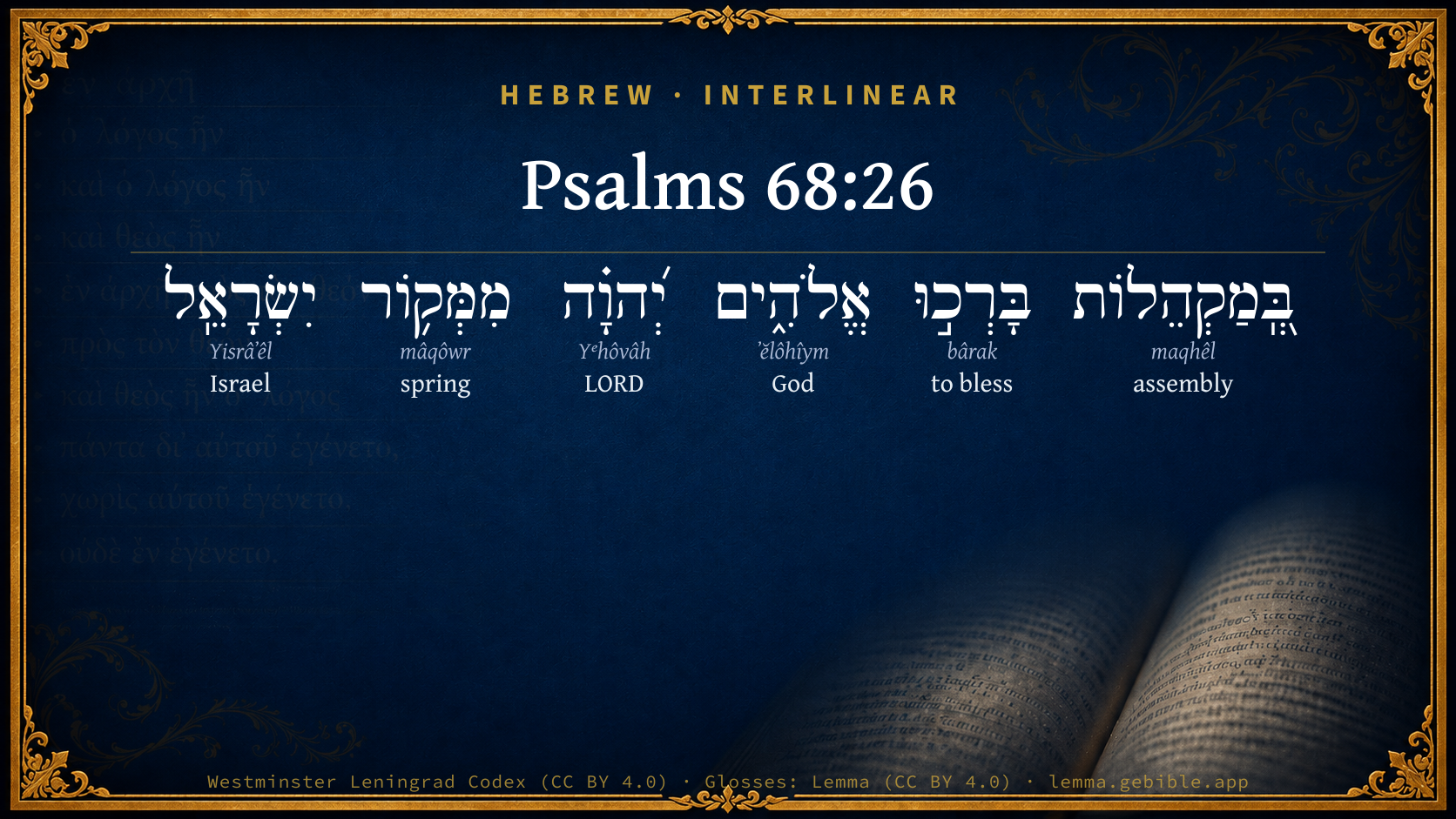
Psalms 68:26

Hebrew (Westminster Leningrad Codex) Psalms 68:26 appears in the Hebrew Old Testament. The text above is from the Westminster Leningrad Codex. Each word links to its Strong’s number, a concise gloss, and parsing drawn from the Open Scriptures Hebrew Bible morphology. Click any word for its full Brown-Driver-Briggs (BDB) entry.
Download image
Cite this verse

Psalms 68:26 (World English Bible). Public Domain. Lemma interlinear Bible study tool, https://lemma.gebible.app/v/psalms/68/26.

Show BibTeX & RIS
BibTeX
RIS
English Translation
"Bless God in the congregations, Even the Lord in the assembly of Israel!"
World English Bible · Public Domain
Download a study sheet

One document with this verse’s original text, its word-by-word gloss line, the meaning frame, cross-references with their text, attributed commentary, and full source and license credits — printable, and it pastes into notes with its structure intact.

This verse Autodidact and up

Study sheet (.html) Plain text (.txt)

A passage Seminary Student

Up to 50 verses in one chapter. A passage sheet keeps up to 6 commentary sources and 12 cross-references per verse, in the order this page ranks them, and says so on the sheet whenever that leaves anything out. Ask for a single verse and you get the Autodidact verse sheet above.

Everything on this page stays free to read, with no account — the sheet is a download of what is already on screen, not access to it.

Want to remove ads? Support Godless Engineer
Compare translations 3

The same verse in 3 English versions, stacked beneath the original-language interlinear above. Click any original word for its lexicon entry.

Each is an independent rendering of the whole verse — the interlinear is not word-aligned to these translations.

Highlighted words mark where these versions differ — a whole-verse word diff, not a word-by-word alignment.

  • World English Bible Public Domain
    "Bless God in the congregations, Even the Lord in the assembly of Israel!"
  • King James Version Public Domain
    Bless ye God in the congregations, even the Lord, from the fountain of Israel.
  • unfoldingWord Literal Text CC BY-SA 4.0
    Bless God in the assemblies, Yahweh, from the fountain of Israel.

unfoldingWord Literal Text — © unfoldingWord, licensed CC BY-SA 4.0. Word-aligned USFM3 via Door43 (git.door43.org/unfoldingWord/en_ult).

Versions to compare (up to 4)

3 of 4 selected

Show all 18 translations

Every available English version of this verse, each an independent rendering of the whole verse.

  • World English Bible Public Domain
    "Bless God in the congregations, Even the Lord in the assembly of Israel!"
  • Berean Standard Bible Public Domain
    Bless God in the great congregation; bless the LORD from the fountain of Israel.
  • Majority Standard Bible Public Domain
    Bless God in the great congregation; bless the LORD from the fountain of Israel.
  • King James Version Public Domain
    Bless ye God in the congregations, even the Lord, from the fountain of Israel.
  • American Standard Version (1901) Public Domain
    Bless ye God in the congregations, Even the Lord, `ye that are' of the fountain of Israel.
  • Revised Version (1885) Public Domain
    Bless ye God in the congregations, even the Lord, ye that are of the fountain of Israel.
  • Geneva Bible (1599) Public Domain
    Praise yee God in the assemblies, and the Lord, ye that are of the fountaine of Israel.
  • Douay-Rheims (1899) Public Domain
    Princes went before joined with singers, in the midst of young damsels playing on timbrels.
  • Young's Literal Translation Public Domain
    In assemblies bless ye God, The Lord -- from the fountain of Israel.
  • Literal Standard Version CC BY-SA 4.0
    In assemblies bless God, || The Lord—from the fountain of Israel.
  • Unlocked Literal Bible CC BY-SA 4.0
    Bless God in the assemblies; praise Yahweh, you who are from the fountain of Israel.
  • unfoldingWord Literal Text CC BY-SA 4.0
    Bless God in the assemblies, Yahweh, from the fountain of Israel.
  • Darby Bible Public Domain
    In the congregations bless ye God, the Lord, -- [ye] from the fountain of Israel.
  • World Messianic Bible Public Domain
    “Bless God in the congregations, even the Lord in the assembly of Israel!”
  • Webster's Bible Public Domain
    \\68:25\\The singers went before, the players on instruments followed after; among them were the damsels playing with timbrels.
  • Free Bible Version CC BY-SA 4.0
    Praise God, everyone who has come to worship; praise the Lord, everyone who belongs to Israel.
  • Bible in Basic English Public Domain
    Give praise to God in the great meeting; even the Lord, you who come from the fountain of Israel.
  • JPS Tanakh (1917) Public Domain
    (68-27) 'Bless ye God in full assemblies, even the Lord, ye that are from the fountain of Israel.'

Literal Standard Version (2020), Covenant Press — licensed CC BY-SA 4.0. Text via the HelloAO Bible API (eBible.org). Unlocked Literal Bible (unfoldingWord) — licensed CC BY-SA 4.0. Text via the HelloAO Bible API (eBible.org). unfoldingWord Literal Text — © unfoldingWord, licensed CC BY-SA 4.0. Word-aligned USFM3 via Door43 (git.door43.org/unfoldingWord/en_ult). Free Bible Version, Dr. Jonathan Gallagher — licensed CC BY-SA 4.0. Text via the HelloAO Bible API (eBible.org).

Word by word

More ways to search: Search by grammar → Find every occurrence → Compare this word →

Practice this passage: Drill this verse → Learn its vocabulary →

About this verse

These counts appear in no published source. They are computed here, from the morphology-tagged text and Lemma’s own curated glosses. What Lemma adds →

6
words
6
distinct lemmas
Wisdom
section

Notable vocabulary

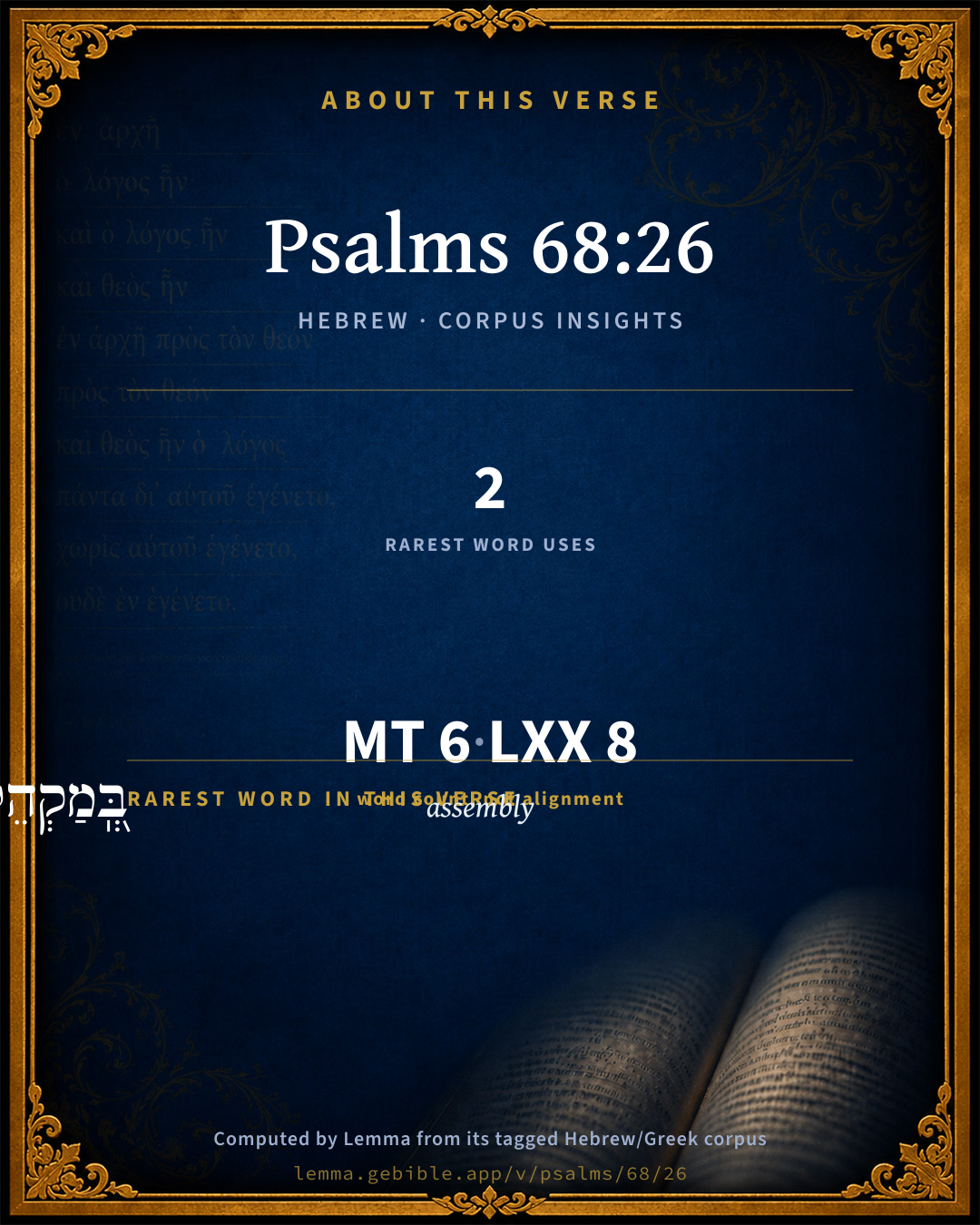
The rarest word here is בְּֽ֭מַקְהֵלוֹת assembly H4721 — appearing just 2 times in the whole Hebrew Bible.

Shared distinctive vocabulary

בְּֽ֭מַקְהֵלוֹת assembly H4721 occurs in 2 verses of the Hebrew Bible. Also found in:

Grammatical profile

  • 1 verb
  • 5 nouns

Verb forms

  • בָּרְכ֣וּ Piel · Imperative

Hebrew & Septuagint length

In English translation the verse runs 13 words from the Hebrew and 12 from the Septuagint (LXX English) — closely comparable.

A rough comparison of the two English renderings, which tokenize alike — not a word-level alignment.

Word counts can differ between the Hebrew and the Greek without any difference in meaning — e.g. the Hebrew direct-object marker אֵת has no separate Greek word, and Greek often adds the article ὁ.

In the original languages it is 6 Hebrew tokens and 8 Greek tokens — but the two are counted differently (Hebrew bundles its prefixes and suffixes into one token; the Greek is in lemma form), so that isn’t a like-for-like length.

Cross-references

8

Topical passages linked to Psalms 68:26 in the Treasury of Scripture Knowledge — connected by theme and wording, ordered by reader-vote popularity; previews shown in the World English Bible.

  • Isaiah 48:1 Hear you this, house of Jacob, who are called by the name of Israel, and are come forth out of the waters of Judah; who swear by the name of Yahweh, and make mention of the God of Israel, but not in truth, nor in righteousness
  • Deuteronomy 33:28 Israel dwells in safety, The fountain of Jacob alone, In a land of grain and new wine; Yes, his heavens drop down dew.
  • Psalms 26:12 My foot stands in an even place. In the congregations I will bless Yahweh.
  • Psalms 111:1 Praise Yah! I will give thanks to Yahweh with my whole heart, In the council of the upright, and in the congregation.
  • Proverbs 5:16 Should your springs overflow in the streets, Streams of water in the public squares?
  • 1 Chronicles 16:7–36 Then on that day David first ordained to give thanks to Yahweh, by the hand of Asaph and his brothers.
  • Psalms 135:19–21 House of Israel, praise Yahweh! House of Aaron, praise Yahweh!
  • Psalms 107:32 Let them exalt him also in the assembly of the people, And praise him in the seat of the elders.

Cross-references courtesy of OpenBible.info (CC BY 4.0).

Hebrew and Greek witnesses Masoretic Hebrew ↔ Greek Septuagint

The same verse in the two great witnesses to the Old Testament, shown verse-for-verse.

You’re reading Greek Psalm 67 (Hebrew Psalm 68). The Septuagint counts the superscription, so verse numbers can differ from the Hebrew — chapter-level alignment, not verse-by-verse. Numbering follows Rahlfs.

These are two independent witnesses, not word-aligned to each other, and the Septuagint is shown in lemma (dictionary) form.

Hebrew Psalms 68:26 Masoretic · Westminster Leningrad Codex

בְּֽ֭מַקְהֵלוֹת בָּרְכ֣וּ אֱלֹהִ֑ים יְ֝הוָ֗ה מִמְּק֥וֹר יִשְׂרָאֵֽל

"Bless God in the congregations, Even the Lord in the assembly of Israel!"

World English Bible · Public Domain

Greek LXX Greek Psalm 67:26 Septuagint · lemma form

προφθάνω ἄρχων ἔχω ψάλλω ἐν μέσος νεᾶνις τυμπανίστρια

Praise God in the congregations, the Lord from the fountains of Israel.

LXX2012 (modern English Septuagint) · Public Domain

Hebrew: Westminster Leningrad Codex (CC BY 4.0). Greek: Septuagint (public domain); English from LXX2012 (modern English Septuagint) (Public Domain). How the Septuagint differs from the Hebrew →

Commentary

Notes on Psalms 68:26 from classic Christian and Jewish commentators (each source and its license shown beneath its notes). The classic Christian expositions comment on the surrounding passage and are grouped to its opening verse, so a note may address several verses; the Jewish commentaries on the Tanakh (Rashi and others) are per-verse, so they appear only where the commentator wrote on this verse.

Lemma curates 59 commentaries, every one of them public domain or Creative Commons licensed, each selected and text-cleaned for this edition rather than reprinted as found. About our sources →

Trapp's Complete Commentary

John Trapp

Psa 68:26 Bless ye God in the congregations, [even] the Lord, from the fountain of Israel.

Ver. 26. Bless ye God in the congregations] i.e. Catervatim ac turmatim, by troops and companies.

Even the Lord from the fountain of Israel] That is, from the heart, say some, which is the true fountain of praising God. Others understand it as Christ, who is of the fountain of Israel, Rom 9:5; there are those who think that the study of the Hebrew tongue is here recommended to us. Reuchlin was wont to say, that the Latins drank out of cisterns, the Greeks out of ponds, but the Hebrews out of the fountain itself. Calvin and the most interpreters read the words, Ye that are of the fountain of Israel, springing out of his loins. See Deu 33:28 Isa 48:1; Isa 51:1.

John Trapp, A Commentary or Exposition upon All the Books of the Old and New Testament (1647–1656) — public domain. Text from a community e-Sword module.

The Biblical Illustrator

Joseph S. Exell

Psa_68:26-28

Bless ye God in the congregations, oven the Lord, from the fountain of Israel, etc.

Public worship

I. Expound the passage.

1. Israel had ordinary congregations every Sabbath and national ones three times a year, and their business was to bless God.

2. All Israel was to unite in this.

3. All the tribes are supposed to be present.

4. Those tribes which are named had each some speciality belonging to it.

5. Princes and people were together, etc.

II. Apply the subject. Two things are here exemplified--diligence and brotherly union. Three things are recommended--united praise, acknowledgment of mercies, and prayer. (Andrew Fuller.)

The Biblical Illustrator, edited by Joseph S. Exell (c. 1880s–1900s) — public domain. Text from a community e-Sword module.

The Treasury of David

Charles H. Spurgeon

Ver. 26. Bless ye God in the congregations. Let the assembled company magnify the God whose ark they followed. United praise is like the mingled perfume which Aaron made, it should all be presented unto God. He blesses us; let him be blessed.

Even the Lord, from the fountain of Israel. A parallel passage to that in Deborah's song: "They that are delivered from the noise of archers in the places of drawing water, there shall they rehearse the righteous acts of the Lord." The seat of the ark would be the fountain of refreshing for all the tribes, and there they were to celebrate his praises. "Drink, "says the old inscription, "drink, weary traveller; drink and pray." We may alter one word, and read it, drink and praise. If the Lord overflows with grace, we should overflow with gratitude. Ezekiel saw an ever growing stream flow from under the altar, and issue out from under the threshold of the sanctuary, and wherever it flowed it gave life: let as many as have quaffed this life giving stream glorify "the fountain of Israel."

Ver. 26-28. This Psalm was sung, it is probable, on the removal of the ark into the City of David. Numbers 10. It was now that the ark had rest, and the tribes assembled three times a year at Jerusalem, the place that God had chosen. The text is a lively description of their worship.

I. Offer a few remarks by way of expounding the passage.

1. Israel had their lesser congregations in ordinary every Sabbath day, and their national ones three times a year. Their business in all was to bless God.

2. This business was to be carried on by all Israel, beginning at the fountain head, and proceeding through all its streams. God had blessed Israel; let Israel bless God.

3. All the tribes are supposed to be present; four are mentioned in the name of the whole, as inhabiting the confines of the land. Their union was a source of joy; they had been divided by civil wars, but now they are met together.

4. Those tribes which are named had each something particular attending it. Little Benjamin (see Judges 21) had nearly been a tribe lacking in Israel, but now appears with its ruler. Judah had been at war with Benjamin: Saul was a Benjamite; David was of Judah: yet they happily lost their antipathy in the worship of God. Zebulun and Naphtali were distant tribes; yet they were there! dark, too, yet there.

5. The princes and the people were all together.

6. They were supposed to be strong, but were reminded that what they had of strength was of God's commanding. Their union and success, as well as that degree of righteousness among them which exalted the nation, was of God They are not so strong, but that they need strengthening, and are directed to pray as well as praise: Strengthen, O God, that which thou hast wrought for us.

II. Apply the subject. Two things are here exemplified,

namely--diligence and brotherly union; and three

things recommended, namely--united praise; united

acknowledgment that, for what they are, they are

indebted to God; and united prayer for future mercies.

Each of these affords a rule for us.

1. The worship of God must be attended with diligence. There are the princes of Zebulun and Naphtali. They had to travel about two hundred miles three times a year, thither and back again; that is, twelve hundred in a year, twenty-four miles a week. Those who neglect the worship of God for little difficulties show that their heart is not in it, and when they do attend cannot expect to profit: "they have snuffed at it." Those whose hearts are in it often reap great advantage. God blessed the Israelites in their journeys, as well as when there (Ps 84:6): "The rain filleth the pools; "and so the Christians. There is a peculiar promise to those that seek him early.

2. The worship of God must be attended to with brotherly love. All the tribes must go up together. It is a kind law that enjoins social worship; we need each other to stimulate. "O magnify the Lord with me, and let us exalt his name together." God has made us so that we shall be greatly influenced by each other, both to good and evil. It greatly concerns us to cultivate such a spirit. To this end we must cherish an affectionate behaviour in our common intercourse --bear, forbear, and forgive; and, whatever differences we may have, not suffer them to hinder our worship. The tribes, as we have seen, had their differences; yet they were there. When all Israel met at Hebron to anoint David king, what should we have said if some had kept away because others went?

3. Our business, when assembled, must be to bless God in our congregations; and a pleasant work this is. Israel had reasons, and good reasons, and Christians more. Thank him for his unspeakable gift; bless him for the means of grace, and the hopes of glory. Bless him; he "healeth all thy diseases, "etc. Psalm 103. This is an employment that fits for heaven. The tears of a mourner in God's house were supposed to defile his altar. We may mourn for sin; but a fretful spirit, discontented and unthankful, defiles God's altar still.

4. Another part of our business is to unite in acknowledging that whatever we are, we owe it to God alone; "Thy God hath commanded thy strength." We possess a degree of strength both individually and socially. Art thou strong in faith, in hope, in zeal? It is in him thou art strong. Are we strong as a society? It is God that increaseth us with men like a flock; it is he that keeps us in union, gives us success, etc.

5. Another part of our business must be to unite in prayer for future mercies. We are not so strong, either as individuals or societies, but that there is room for increase; and this is the proper object of prayer. God has wrought a great work for us in regeneration. God has wrought much for us as a church in giving us increase, respect, and room in the earth. Pray that each may be increased; or, in the words of the text: Strengthen, O God, that which thou hast wrought for us. Are there none who are strangers to all this? Andrew Fuller.

None.

Psalms 68:27*

Ver. 26-28. This Psalm was sung, it is probable, on the removal of the ark into the City of David. Numbers 10. It was now that the ark had rest, and the tribes assembled three times a year at Jerusalem, the place that God had chosen. The text is a lively description of their worship.

I. Offer a few remarks by way of expounding the passage.

1. Israel had their lesser congregations in ordinary every Sabbath day, and their national ones three times a year. Their business in all was to bless God.

2. This business was to be carried on by all Israel, beginning at the fountain head, and proceeding through all its streams. God had blessed Israel; let Israel bless God.

3. All the tribes are supposed to be present; four are mentioned in the name of the whole, as inhabiting the confines of the land. Their union was a source of joy; they had been divided by civil wars, but now they are met together.

4. Those tribes which are named had each something particular attending it. Little Benjamin (see Judges 21) had nearly been a tribe lacking in Israel, but now appears with its ruler. Judah had been at war with Benjamin: Saul was a Benjamite; David was of Judah: yet they happily lost their antipathy in the worship of God. Zebulun and Naphtali were distant tribes; yet they were there! dark, too, yet there.

5. The princes and the people were all together.

6. They were supposed to be strong, but were reminded that what they had of strength was of God's commanding. Their union and success, as well as that degree of righteousness among them which exalted the nation, was of God They are not so strong, but that they need strengthening, and are directed to pray as well as praise: Strengthen, O God, that which thou hast wrought for us.

II. Apply the subject. Two things are here exemplified,

namely--diligence and brotherly union; and three

things recommended, namely--united praise; united

acknowledgment that, for what they are, they are

indebted to God; and united prayer for future mercies.

Each of these affords a rule for us.

1. The worship of God must be attended with diligence. There are the princes of Zebulun and Naphtali. They had to travel about two hundred miles three times a year, thither and back again; that is, twelve hundred in a year, twenty-four miles a week. Those who neglect the worship of God for little difficulties show that their heart is not in it, and when they do attend cannot expect to profit: "they have snuffed at it." Those whose hearts are in it often reap great advantage. God blessed the Israelites in their journeys, as well as when there (Ps 84:6): "The rain filleth the pools; "and so the Christians. There is a peculiar promise to those that seek him early.

2. The worship of God must be attended to with brotherly love. All the tribes must go up together. It is a kind law that enjoins social worship; we need each other to stimulate. "O magnify the Lord with me, and let us exalt his name together." God has made us so that we shall be greatly influenced by each other, both to good and evil. It greatly concerns us to cultivate such a spirit. To this end we must cherish an affectionate behaviour in our common intercourse--bear, forbear, and forgive; and, whatever differences we may have, not suffer them to hinder our worship. The tribes, as we have seen, had their differences; yet they were there. When all Israel met at Hebron to anoint David king, what should we have said if some had kept away because others went?

3. Our business, when assembled, must be to bless God in our congregations; and a pleasant work this is. Israel had reasons, and good reasons, and Christians more. Thank him for his unspeakable gift; bless him for the means of grace, and the hopes of glory. Bless him; he "healeth all thy diseases, "etc. Psalm 103. This is an employment that fits for heaven. The tears of a mourner in God's house were supposed to defile his altar. We may mourn for sin; but a fretful spirit, discontented and unthankful, defiles God's altar still.

4. Another part of our business is to unite in acknowledging that whatever we are, we owe it to God alone; "Thy God hath commanded thy strength." We possess a degree of strength both individually and socially. Art thou strong in faith, in hope, in zeal? It is in him thou art strong. Are we strong as a society? It is God that increaseth us with men like a flock; it is he that keeps us in union, gives us success, etc.

5. Another part of our business must be to unite in prayer for future mercies. We are not so strong, either as individuals or societies, but that there is room for increase; and this is the proper object of prayer. God has wrought a great work for us in regeneration. God has wrought much for us as a church in giving us increase, respect, and room in the earth. Pray that each may be increased; or, in the words of the text: Strengthen, O God, that which thou hast wrought for us. Are there none who are strangers to all this? Andrew Fuller.

Ver. 26-28. See Psalms on "Ps 68:26" for further information.

I. Offer a few remarks by way of expounding the passage.

1. Israel had their lesser congregations in ordinary every Sabbath day, and their national ones three times a year. Their business in all was to bless God.

2. This business was to be carried on by all Israel, beginning at the fountain head, and proceeding through all its streams. God had blessed Israel; let Israel bless God.

3. All the tribes are supposed to be present; four are mentioned in the name of the whole, as inhabiting the confines of the land. Their union was a source of joy; they had been divided by civil wars, but now they are met together.

4. Those tribes which are named had each something particular attending it. Little Benjamin (see Judges 21) had nearly been a tribe lacking in Israel, but now appears with its ruler. Judah had been at war with Benjamin: Saul was a Benjamite; David was of Judah: yet they happily lost their antipathy in the worship of God. Zebulun and Naphtali were distant tribes; yet they were there! dark, too, yet there.

5. The princes and the people were all together.

6. They were supposed to be strong, but were reminded that what they had of strength was of God's commanding. Their union and success, as well as that degree of righteousness among them which exalted the nation, was of God. They are not so strong, but that they need strengthening, and are directed to pray as well as praise: Strengthen, O God, that which thou hast wrought for us.

II. Apply the subject. Two things are here exemplified,

namely--diligence and brotherly union; and three

things recommended, namely--united praise; united

acknowledgment that, for what they are, they are

indebted to God; and united prayer for future mercies.

Each of these affords a rule for us.

1. The worship of God must be attended with diligence. There are the princes of Zebulun and Naphtali. They had to travel about two hundred miles three times a year, thither and back again; that is, twelve hundred in a year, twenty-four miles a week. Those who neglect the worship of God for little difficulties show that their heart is not in it, and when they do attend cannot expect to profit: "they have snuffed at it." Those whose hearts are in it often reap great advantage. God blessed the Israelites in their journeys, as well as when there (Ps 84:6): "The rain filleth the pools; "and so the Christians. There is a peculiar promise to those that seek him early.

2. The worship of God must be attended to with brotherly love. All the tribes must go up together. It is a kind law that enjoins social worship; we need each other to stimulate. "O magnify the Lord with me, and let us exalt his name together." God has made us so that we shall be greatly influenced by each other, both to good and evil. It greatly concerns us to cultivate such a spirit. To this end we must cherish an affectionate behaviour in our common intercourse--bear, forbear, and forgive; and, whatever differences we may have, not suffer them to hinder our worship. The tribes, as we have seen, had their differences; yet they were there. When all Israel met at Hebron to anoint David king, what should we have said if some had kept away because others went?

3. Our business, when assembled, must be to bless God in our congregations; and a pleasant work this is. Israel had reasons, and good reasons, and Christians more. Thank him for his unspeakable gift; bless him for the means of grace, and the hopes of glory. Bless him; he "healeth all thy diseases, "etc. Psalm 103. This is an employment that fits for heaven. The tears of a mourner in God's house were supposed to defile his altar. We may mourn for sin; but a fretful spirit, discontented and unthankful, defiles God's altar still.

4. Another part of our business is to unite in acknowledging that whatever we are, we owe it to God alone; "Thy God hath commanded thy strength." We possess a degree of strength both individually and socially. Art thou strong in faith, in hope, in zeal? It is in him thou art strong. Are we strong as a society? It is God that increaseth us with men like a flock; it is he that keeps us in union, gives us success, etc.

5. Another part of our business must be to unite in prayer for future mercies. We are not so strong, either as individuals or societies, but that there is room for increase; and this is the proper object of prayer. God has wrought a great work for us in regeneration. God has wrought much for us as a church in giving us increase, respect, and room in the earth. Pray that each may be increased; or, in the words of the text: Strengthen, O God, that which thou hast wrought for us. Are there none who are strangers to all this? Andrew Fuller.

Charles H. Spurgeon's The Treasury of David (1869–1885) — public domain. Psalms only. Text from a community e-Sword/MySword module.

J. A. Alexander on Psalms

Joseph Addison Alexander

27. (Psa 68:26). In assemblies bless ye God, the Lord, from the fountain of Israel. Not only individually, or in triumphal marches, but in the stated convocations of the people at the sanctuary. See above, on Psa 26:12, the only other place where the Hebrew word occurs, except as a proper name (Num 33:25), and where it evidently has the same sense. The only satisfactory explanation of the last words, from the fountain of Israel, is that afforded by supplying ye who are before it, and applying the whole clause as a description of the chosen people, under the figure of a stream derived or flowing from a fountain. Compare the similar ideas and expression in Isa 48:1; Isa 51:1.

Joseph Addison Alexander, The Psalms Translated and Explained (1850) — public domain. Text from a community e-Sword module.

Geneva Bible (1599)

Geneva Bible translators

Which come of the Patriarch Jacob.

Geneva Bible (1599) marginal notes — public domain. Text via Bolls.life.

Jamieson, Fausset & Brown

Robert Jamieson, A. R. Fausset & David Brown

from--or literally, "of"

the fountain of Israel--that is, lineal descendants of Jacob, are invited to unite in the doxology. Then by one of the nearest tribes, one of the most eminent, and two of the most remote, are represented the whole nation of Israel, passing forward (Num. 7:1-89).

Jamieson, Fausset & Brown — Commentary Critical and Explanatory on the Whole Bible (1871) — public domain (CC PDM 1.0). Text via the HelloAO Bible API.

Adam Clarke's Commentary

Verse 26. Bless ye God] This is what they sung.

Adam Clarke's Commentary on the Bible (1810–1826) — public domain. Text from a community e-Sword/MySword module.

Ellicott's Commentary for English Readers

(26) Bless ye.—Apparently these words are part of the processional hymn. But in Jdg_5:9 a similar outburst of praise appears to come from the poet.

From the fountain of Israel.—A comparison with Isa_48:1; Isa_51:1, certainly allows us to understand this in the congregations sprung from the head waters (as we say) of the races, i.e., the patriarchal ancestors. At the same time if there were any mode of taking the words literally instead of figuratively it would be preferable.

A Bible Commentary for English Readers, edited by Charles John Ellicott (1878–1897) — public domain. Text from a community e-Sword module.

The Cambridge Bible for Schools and Colleges

gen. ed. J. J. S. Perowne

26. This verse is best regarded as a part of the processional hymn. Cp. Jdg_5:2; Jdg_5:9.

from the fountain of Israel] Kay and Cheyne compare Psa_118:26, Psa_135:21, and suppose that ‘the fountain of Israel’ is the Temple. But it is better to render with R.V., and A.V. marg., (ye that are) of the fountain of Israel; the patriarch being regarded as the fountain-head from which the nation is derived. Cp. Isa_48:1, “O house of Jacob, which are called by the name of Israel, and are come forth out of the waters of Judah”; Psa_51:1-2; and Deu_33:28. The address reminds them of the privileges of their ancestry. It is however possible that the preposition from is an accidental repetition of the initial letter of the word for ‘fountain,’ and should be omitted. ‘The fountain of Israel’ will then be the Lord Himself, the source of His people’s life. Cp. Jer_2:13; Jer_17:13; Psa_36:9. The P.B.V. (Great Bible, not Coverdale) Give thanks, O Israel, unto God the Lord in the congregations, from the ground of the heart appears to be due to a misunderstanding of Münster’s In congregalionibus benedicite deo atque domino ex origine (cordis) Israel, Israel being wrongly taken as a vocative.

The Cambridge Bible for Schools and Colleges (gen. ed. J. J. S. Perowne; Cambridge University Press, 1878–1918) — public domain. Text from a community e-Sword module.

John Gill's Exposition

Bless ye God in the congregations,.... This was what they said as they sung and played; they called upon the churches, and the members of them, and upon one another, to bless the Lord Jesus Christ, God manifest in the flesh; not by invoking or bestowing a blessing on him, which cannot be, and of which he has no need; but by proclaiming him to be God over all, blessed for evermore, as he is in himself; and the perfections of his nature, by attributing all the blessings of nature, grace, and glory to him, in whom they are, and from whom they come; and by exercising faith upon him for them particularly, and for pardon, righteousness, supplies of grace, and everlasting salvation; and by giving him the glory of all, and ascribing blessing and honour to him on account of them; which should be done openly and publicly, in the several particular congregated churches of Christ; and this shows the psalm still refers to Gospel times, in which only such churches are;

even the Lord, from the fountain of Israel; or, "the Lord, who is of the fountain of Israel" (w); that is, whose natural descent is from Israel, or Jacob, as Christ's was, according to the flesh, Rom 9:5; though some take this to be a description of the posterity of Jacob, those that go out from the fountain of Israel, as Aben Ezra and Kimchi; see Isa 48:1; so the Tigurine version, and others; who are called upon to bless the Lord: but then it must be understood not of the carnal Israelites, they rejected the Messiah, Jesus, and called him accursed; but the spiritual seed of Jacob, whether Jews or Gentiles; Israelites indeed, in whom is no guile. The Targum, and so Jarchi, interpret it of the seed of Israel; compare with this Luk 1:41; the words may be read, "for", or "because of the fountain of Israel" (x): God, who is the fountain of living wafers; Christ, whose blood is the fountain opened for sin and uncleanness; the Spirit, who, in the operations of his grace, is a well or fountain of living water, springing up unto eternal life; and all spiritual blessings, and the abundance of them, which the spiritual Israel of God enjoy, may be designed by this phrase; and so be considered as the reason why God the Lord is to be blessed. Some understand it of the Scriptures, from whence all divine knowledge, blessing, and praise are derived; and others of the heart, and the abundance of it, from whence, and not with the lips only, men should bless and praise the Lord.

(w) "qui est ex fonte Israelis", i.e. "natus ex semine Israelis", Tillius & Vitringa apud Michael (x) "Ob vel propter fontem lsrael", Gejerus.

John Gill's Exposition of the Whole Bible (1746–1763) — public domain (CC PDM 1.0). Text via the HelloAO Bible API.

Albert Barnes' Notes on the Bible

Bless ye God in the congregations - In the assemblages of the people; not only as individuals, but in solemn precessions; in triumphal marches; when the people are assembled together. In this public manner acknowledge God as the true God, and render him praise.

Even the Lord, from the fountain of Israel - Margin, “Ye that are of;” that is, “of the fountain of Israel.” The margin has undoubtedly expressed the correct idea. The appeal is to the Hebrew people represented as descending from a common stock or ancestor - Jacob or Israel - as a stream or river flows from a fountain. Compare the notes at Isa 48:1; see also Isa 51:1; Deu 33:28. All the descendants of Jacob or Israel are thus called on to unite in solemnly praising the Lord their God.

Albert Barnes' Notes on the Bible (1834–1885) — public domain. Text from a community e-Sword/MySword module.

Matthew Poole's English Annotations

Or, as it is rendered in our margin, and by many others, ye that are of or from the fountain of Israel, or Jacob, i.e. all ye people of Israel, who are called the

fountain of Jacob, Deu 33:28, and said to come forth out of the waters of Judah, Isa 48:1, and consequently of Jacob or Israel. See also Pro 5:18; Isa 51:1. And this sense seems to be confirmed by the following verse, wherein this fountain is distributed into its several streams, the tribes of Israel. But these words may be and are by some joined with the former, either thus, Bless—the Lord for the fountain of Israel, i.e. for that fountain which God hath opened to Israel for the purging away of sin and uncleanness, as it is expressed Zec 13:1, even the blood and Spirit of Christ. and all those spiritual blessings which God confers upon his people in his sanctuary, and by his ordinances; which are oft compared to waters, as Isa 12:3; Eze 47:1; and to a fountain or well, as Joe 3:18; Joh 4:14. See also Pro 14:27; Jer 2:13. Or thus, Bless—the Lord who is of the fountain of Israel, i.e. who though he be the most high God, yet according to the flesh is descended from Israel, as is noted, Rom 9:5. But the first sense seems most natural and easy.

Matthew Poole's English Annotations on the Holy Bible (1683–1685) — public domain. Text from a community e-Sword/MySword module.

Whedon's Commentary on the Bible

Daniel D. Whedon

26. From the fountain of Israel—That is, Ye who are of the fountain of Israel; of the pure Hebrew stock or ancestry.

Daniel D. Whedon (gen. ed.), Commentary on the Old and New Testaments (1874–1909) — public domain. Text from a community e-Sword module.

The Pulpit Commentary

Bless ye God in the congregations, even the Lord, from the fountain of Israel. This is probably the refrain of the hymn sung. (comp. Exo_15:21 2Ch_5:13 Ezr_3:11) By "the fountain of Israel" is no doubt meant the sanctuary on Mount Zion ever-living fountain of praise" (Kay).

The Pulpit Commentary (1880–1919), ed. H.D.M. Spence-Jones & Joseph S. Exell — public domain. Text from a community e-Sword module.

John Wesley's Explanatory Notes

Fountain - All ye people of Israel.

John Wesley, Explanatory Notes Upon the Whole Bible (1754–1765) — public domain. Text via the GEBible commentary corpus.

unfoldingWord translationNotes

Door43 World Missions Community

Bless God in the assemblies; praise Yahweh, you who are from the fountain of Israel

It may be helpful to change the order of these phrases. AT: "You who are from the fountain of Israel, praise Yahweh and bless God in the assembly"

from the fountain of Israel

The word "fountain" is a metaphor for the ability of the man Israel to be the ancestor of many people: as much water comes from a fountain, so Israel is the ancestor of many people. This also implies that the call is to those who serve God as the man Israel did. AT: "true descendants of Israel" or "all of you descendants from Israel"(See: Metaphor and Assumed Knowledge and Implicit Information)

their multitudes

"their group." The word "their" refers to the leaders of Judah.

translationWords

bless

assembly

praise

descend

Israel

Benjamin

tribe

Judah

Zebulun

Naphtali

unfoldingWord translationNotes — © Distant Shores Media and the Door43 World Missions Community, licensed CC BY-SA 4.0. Source: git.door43.org/Door43/en_tn.

Rashi

Rabbi Shlomo Yitzchaki (Rashi)

in the midst of maidens playing timbrels With Miriam and her maidens, who took the timbrel in her hand, and they said with their praise...

Rashi on the Tanakh — English translations: “The Judaica Press complete Tanach with Rashi, translated by A. J. Rosenberg” (CC BY 4.0); “Pentateuch with Rashi's commentary by M. Rosenbaum and A.M. Silbermann, 1929-1934” (public domain); “The Metsudah Tanach series, Lakewood, N.J” (CC BY 4.0); and “The Book of Joshua, Metsudah Publications, 1997” (CC BY 4.0). Text via Sefaria.

Lesson kit

Teaching starters — assembled from the data on this page, not authored interpretation. Every prompt links to the verse data it draws on. Edit before teaching.

Psalms, in the Wisdom, opens this verse with 6 words (6 distinct Hebrew lemmas). Its most distinctive word is maqhêl (“assembly”). A historical commentator’s framing appears above. Read the whole chapter for the surrounding context.

Discussion questions

  1. The word maqhêl carries the sense “assembly.” How does it shape the verse?
  2. Psalms 26:12 shares the word «assembly» with this verse. How do the two illuminate each other?
  3. These translations render this verse differently; the difference is in the English rendering, not the original. What questions does that raise?
  4. The verb «בָּרְכ֣וּ» is Piel Imperative. How does its form color the action?
  5. Reading how Trapp's Complete Commentary and The Biblical Illustrator read this verse, where do the two commentators agree and where do they part?

Things to notice

Reading settings

Reading text

Shown beneath each verse's original-language words.

Old Testament
Old Testament edition

Read the OT as the Masoretic Hebrew (MT) or the Greek Septuagint (LXX).

English shown for the Greek Septuagint (in the Hebrew ↔ Greek comparison).

Comparing translations? Open the Compare panel on any verse page to stack up to four side by side.