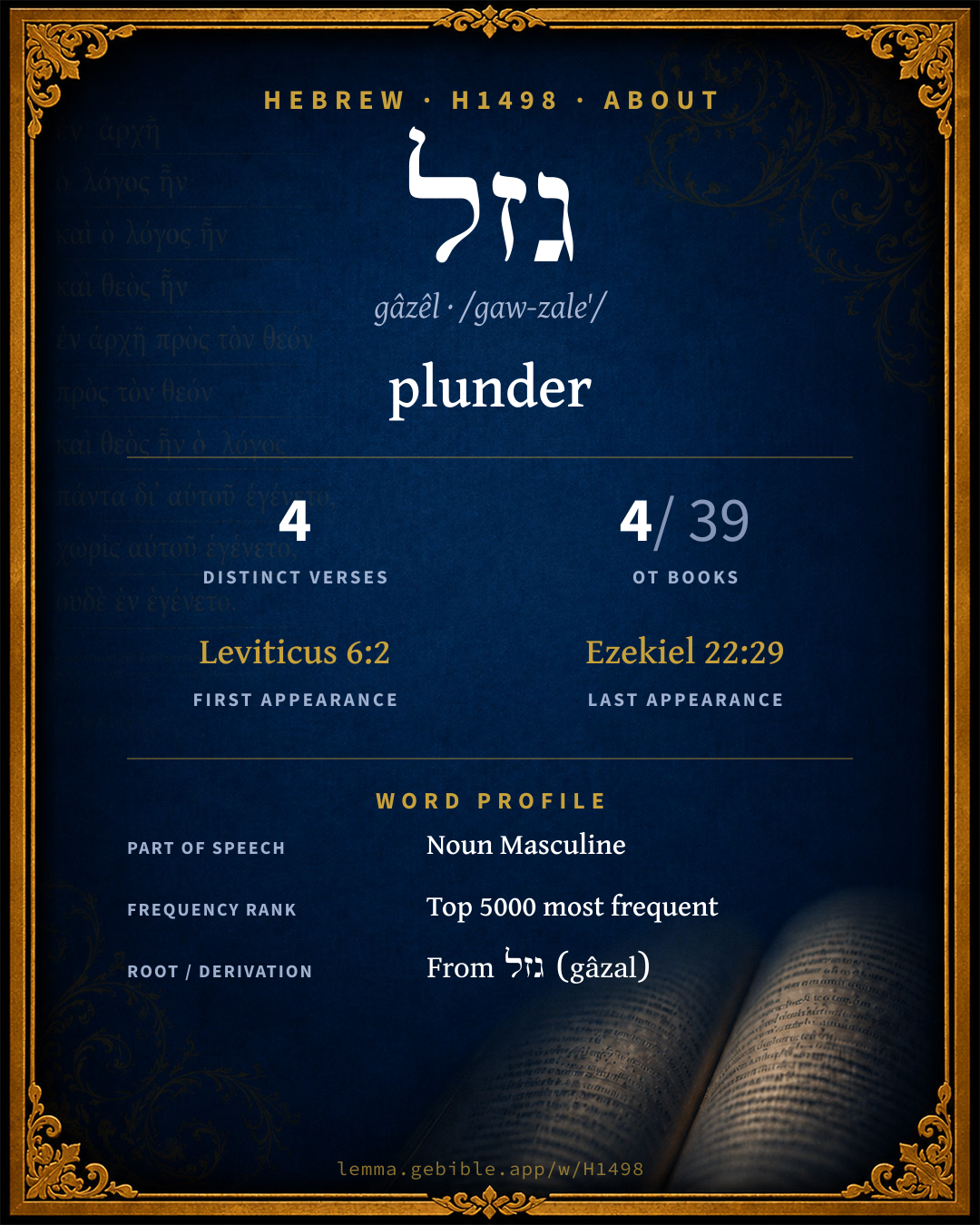
גָּזֵל
plunder
Full lexicon entry — Brown-Driver-Briggs (BDB)
From Brown-Driver-Briggs (BDB)
Where this word appears
Grammar key — what these labels mean
Part of speech
- Noun
- A naming word — a person, place, thing, or idea.
Noun type
- Common
- A common noun — a general class of person, place, or thing (“king,” “city,” “water”), not a specific name.
State
- Absolute
- The independent form of a noun, not bound to a following word.
Gender
- Masculine
- Grammatically masculine.
Number
- Singular
- One.
Every verse where H1498 appears — 4 distinct verses across 4 books. Click any verse to open its interlinear word-by-word view. Verse text shown in the World English Bible for context — . Each verse’s Hebrew form is shown with its reference; the English is not keyword-highlighted, since the data carries no word-level English alignment. Use “Compare translations” on any verse to read it across multiple English versions. This concordance covers the Hebrew Bible; Septuagint (Greek Old Testament) occurrences are not indexed here.
Leviticus 1 verse
Psalms 1 verse
Isaiah 1 verse
Ezekiel 1 verse
About this entry
At a glance — auto-summarized from this page’s data, not written by a person. Every figure links to its source below. This summary describes the numbers; it doesn’t interpret them.
גזל (gâzêl) is a Hebrew noun most often rendered “plunder.” With only 4 verses it sits in the long tail of Hebrew Bible vocabulary. It concentrates in Leviticus, which alone accounts for 25% of its uses. It first appears in Leviticus 6:2. It clusters with גזל, גוזל and גזל under a shared root. The sections below give every sense, occurrence, and version rendering.
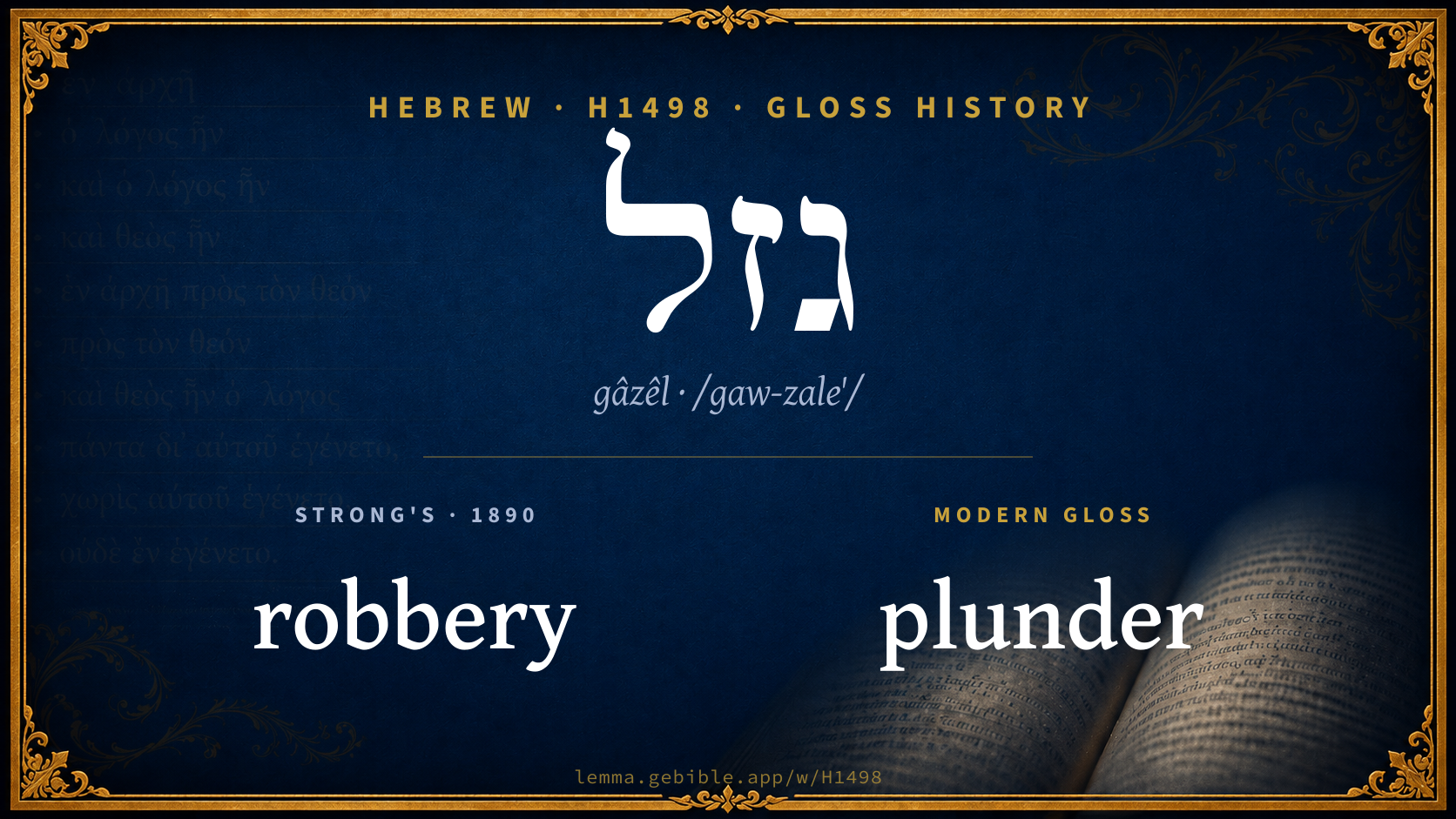
Gloss history
Strong's 1890 vs modern scholarship
About this word
Strong's H1498 catalogs a Hebrew word from the Hebrew Old Testament.
These counts are not copied from any lexicon or concordance. They are computed here, from the morphology-tagged Hebrew Old Testament. What Lemma adds →
- 4
- distinct verses
- The word appears in 4 distinct verses.
- 4 / 39
- OT books
- The word appears in 4 of 39 Old Testament books.
- #3,696
- by frequency
- Top 5000 most frequent Hebrew words (rank 3,696 of 8,640 Hebrew words by occurrence).
View all 4 occurrences in the concordance →
By section of the Old Testament
By traditional corpus
Conventional, traditional groupings — biblical authorship is debated, so this is a traditional corpus grouping, not an authorship claim. Each share is this word’s portion of its verses in that division of the Hebrew canon. Each figure is a share of the word’s 4 distinct verses.
- Prophets (Nevi'im) 2 verses · 50%
- Torah (Pentateuch) 1 verse · 25%
- Writings (Ketuvim) 1 verse · 25%
How translations render this word
Counts come from each version’s own published word-to-Strong’s tagging or interlinear alignment — an approximate guide to how each version renders this word, not a word-level alignment the data otherwise carries. Because each total is that version’s own tagged count, the per-version totals vary from one another and need not match the appearance or distinct-verse counts above. These counts may also differ from a printed concordance because Lemma counts each distinctly tagged rendering and does not collapse phrase taggings into a single head-word total. This is a fixed set of word-tagged versions (KJV, ASV, BSB, ULT) and does not change with the reading translation you choose elsewhere. Each version’s license is shown beside its name below (and on Sources).
- King James Version: Robbery 3×
- American Standard Version: Robbery 3×
- Berean Standard Bible: Denial 1×, Robbery 1×, Stolen 1×
- unfoldingWord Literal Text: Robbery 3×
King James Version Public Domain
Renders H1498 across 4 tagged occurrences — most commonly:
Plus 1 rendering that appears only once — usually multi-word phrases or single function words the recovered tagging swept in, not distinct renderings.
American Standard Version Public Domain
Renders H1498 across 4 tagged occurrences — most commonly:
Plus 1 rendering that appears only once — usually multi-word phrases or single function words the recovered tagging swept in, not distinct renderings.
Berean Standard Bible Public Domain
Renders H1498 across 4 tagged occurrences — most commonly:
Not rendered by a distinct English word in 2 further occurrences.
unfoldingWord Literal Text CC BY-SA 4.0
Renders H1498 across 5 tagged occurrences — most commonly:
Plus 2 renderings that appear only once — usually multi-word phrases or single function words the recovered tagging swept in, not distinct renderings.
Senses in BDB
The 1 sense BDB distinguishes for this word, in lexicon order (not ranked by frequency or importance). The full entry — with sub-senses — is in the Lexicon Entry tab.
- robbery, something plundered
Word origin
n.[m.] robbery—abs. גָּזֵל Lv 5:21 + 3 times + Ez 18:18 cf. infr.; cstr. גֵּ֫זֶל Ec 5:7 Ez 18:18 (but cf. infr.);—robbery Lv 5:21 (P) ψ 62:11 (‖ עֹשֶׁק) Is 61:8; = thing plundered, taken as plunder, as acc. cogn. Ez 22:29 (גָּזַל גָּזֵל); fig. גֵּזֶל משפט = wresting of justice (cf. Is 10:2) Ec 5:7—Ez 18:18 has גֵּזֶל אָח, but 𝔊 Co del. אח; read then גָּזֵל.—Cf. LagBN 172.
— Brown-Driver-Briggs (Oxford 1906, public domain), digitized via Sefaria, supplemented by the OpenScriptures HebrewLexicon (CC BY 4.0). See Sources.
Derived from גזל (gâzal) (H1497) — to plunder.
Jastrow Dictionary
A second Hebrew/Aramaic lexicon for comparison, covering Aramaic and post-biblical (Talmudic, Targumic, Midrashic) usage that the biblical-Hebrew BDB does not. Matched by lemma rather than by Strong’s number, so a lemma may carry more than one Jastrow headword (shown separately below), and the entries cover usage well beyond the Bible.
גָּזַל
- (b. h.) to tear away, rob (with accus. of person or of object); to take illegitimately. B. Kam. X, 5 הגּוֹזֵל שדה מ־ he who robs a field from his neighbor (takes forcible possession). Ib. 6 הגוזל את וכ׳ he who robs his neighbor (takes illegitimately what belongs to his neighbor). Ib. 7 גְּזַלְתִּיךָ I have wronged thee (and owe thee retribution). Ber. 35ᵇ כאילו גוֹזֵל להקב"ה as though he robbed the Lord. Taan. 16ᵃ ג׳ מריש ובנאו בבירה if one robbed a beam and placed it in a large building; a. v. fr.—Part. גּוֹזֵל robber, pl. גּוֹזְלִין. Y. B. Bath. III, 14ᵃ bot. האומנין והג׳ וכ׳ mechanics (who take working material to their homes) and robbers cannot claim the right of possession, v. חֲזָקָה.—Part. pass. גָּזוּל robbed, illegitimately acquired. Succ. III, 1; a. fr.
- to be robbed (of object taken, or of person deprived). B. Kam. 95ᵃ, a. e. קרקע אינה נִגְזֶלֶת landed property cannot be robbed, i.e. can never become legitimate property by the law of limitation, v. יִאוּשׁ.—Part. נִגְזָל the person robbed of his property, claimant. Shebu. VII, 1; a. fr.
גְּזַל I
- Targ. Lev. V, 23; a. e.—B. Kam. 103ᵃ מִיגְזַל גַזְלוּהָ they acquired it illegitimately. Ib. 96ᵃ; a. fr.—[גזל to spin, Targ. Y. Ex. XXXV, 26, quoted in Ar. s. v. כש 3, read עזל.]
גָּזֵל
- robbery, wrong, oppression. Sabb. 32ᵇ בעוון ג׳ וכ׳ as a punishment for the crime of oppression, the locust rises &c. (ref. to Am. IV, 1 a. 9). Gen. R. s. 31, beg. שׁטופים בזימה ובג׳ steeped in lust and violence. Pes. 113ᵇ Canaan bequeathed to his sons … אהבו את הג׳ love ye violence. B. Kam. 80ᵇ אין בו משום ג׳ the law of robbery does not apply to it (it is not private property). Erub. 100ᵇ we should have learned ג׳ מנמלה the regard of property from the ant. B. Kam. 109ᵃ עד שיוציא גְּזֵילוֹ וכ׳ until he dispossesses himself of his robbery. Ib. שיוציא גזילה (corr. acc.). Ib.ᵇ גזילו יוצא וכ׳ his robbery must go out of his possession. Y. B. Mets. II, 8ᶜ גזילו של גוי וכ׳ what has been illegitimately taken from a gentile, is forbidden (must be restored). Y. Gitt. IV, 45ᶜ מפני ג׳ השבט in order to protect the (priestly) tribe from loss; Y. Orl. II, 61ᵈ bot. מפני גיל השבט (corr. acc.); a. fr. e.g. Amos 4:1
A Dictionary of the Targumim, the Talmud Babli and Yerushalmi, and the Midrashic Literature (Marcus Jastrow; London, Luzac, 1903) — Public Domain. Digitized via Sefaria. Digitized via Sefaria. Full attribution on Sources.
Forms in the corpus
The 4 distinct written forms H1498 takes in the Hebrew Bible, most frequent first — each parse links to that state’s occurrences in the concordance. Hebrew forms include their vowel points and cantillation, so a single lemma takes many written forms.
| Form | Parsing | Example | Uses |
|---|---|---|---|
| בְ/גָזֵ֔ל | Noun, Common, Masculine, Singular, Absolute | Leviticus 6:2 | 1 |
| גָזֵ֖ל | Noun, Common, Masculine, Singular, Absolute | Isaiah 61:8 | 1 |
| גָּזֵ֑ל | Noun, Common, Masculine, Singular, Absolute | Ezekiel 22:29 | 1 |
| וּ/בְ/גָזֵ֪ל | Noun, Common, Masculine, Singular, Absolute | Psalms 62:10 | 1 |
Same root — word family
Other BDB entries built from the same root as H1498, grouped by Strong’s listed origin. These share a root / origin per the lexicon — not necessarily a shared meaning. Each links to that word’s own entry.
Derives from
Shares the same root
Derived from this word
Compare all same-root words → Showing 4 of 5 — not the complete family. They share a root, not necessarily a meaning.
Septuagint verse parallels
This word appears in 4 verses that also exist in the Greek Old Testament (Septuagint), out of the 4 Hebrew verses it occurs in. You can read those verses in Greek by switching the Old Testament edition to the Septuagint.
Read these verses in the Septuagint
This is a verse-level parallel only — the same verses exist in both the Hebrew and Greek Old Testaments. No word-level Hebrew↔Greek correspondence is claimed: the data carries no such alignment, so no Greek word is shown as this Hebrew word’s translation. Coverage is not total — the Septuagint omits the deuterocanon and renumbers the Psalms, so some Hebrew verses have no direct Greek parallel.