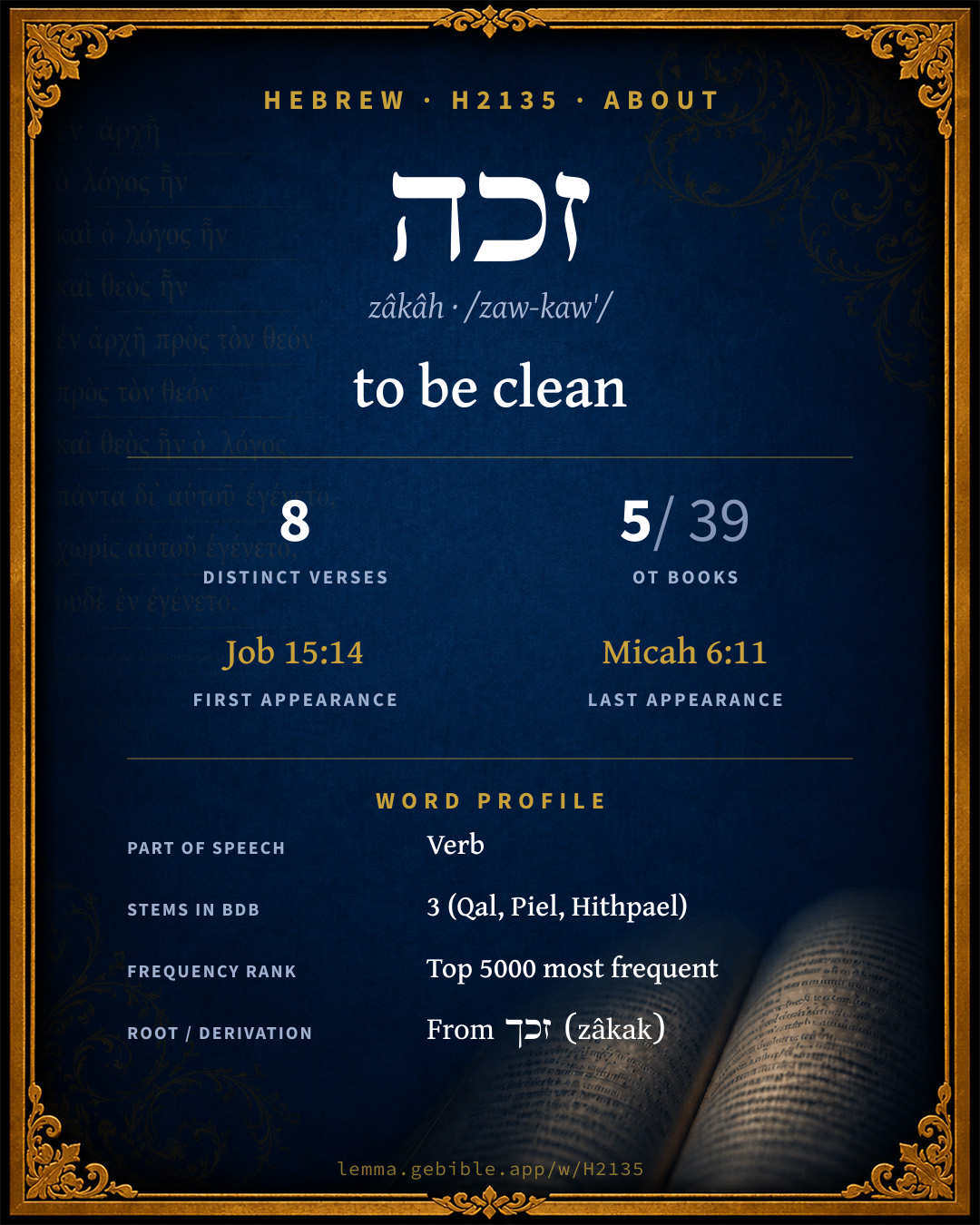
זָכָה
to be clean
also: be pure, be clear fuller range ↓
Full lexicon entry — Brown-Driver-Briggs (BDB)
From Brown-Driver-Briggs (BDB)
Where this word appears
See every Qal verb in the Hebrew Bible →
Grammar key — what these labels mean
Part of speech
- Verb
- An action or state-of-being word.
Stem
- Piel
- An intensive or resultative active stem.
- Qal
- The basic, simple active stem — the plain form of the verb (“he wrote”). Here: ‘be clean’
- Hithpael
- The reflexive or reciprocal stem (the subject acts on itself).
Form
- Perfect
- A completed action or state — Hebrew marks aspect (completeness) more than strict tense (“he wrote”).
- Imperfect
- An incomplete, ongoing, or future action (“he will / would write”).
- Imperative
- A direct command (“write!”).
Person
- 1st Person
- The speaker (“I / we”).
- 3rd Person
- The one spoken about (“he / she / it / they”).
- 2nd Person
- The one addressed (“you”).
Gender
- Common
- Either gender — not distinguished for this form.
- Masculine
- Grammatically masculine.
Number
- Singular
- One.
- Plural
- More than one (in Hebrew, generally three or more).
Grammatical forms
- Verb, Piel, Perfect, 1st Person, Common, Singular 2 times (25%)
- Verb, Qal, Imperfect, 3rd Person, Masculine, Singular 2 times (25%)
- Verb, Qal, Imperfect, 1st Person, Common, Singular 1 time (13%)
- Verb, Piel, Imperfect, 3rd Person, Masculine, Singular 1 time (13%)
- Verb, Qal, Imperfect, 2nd Person, Masculine, Singular 1 time (13%)
- Verb, Hithpael, Imperative, 2nd Person, Masculine, Plural 1 time (13%)
Parsed forms decoded from the imported morphology (morphhb / Westminster Leningrad Codex — WLC text public domain, morphhb tagging CC BY 4.0), counted across 8 parsed occurrences — not distinct verses.
Every verse where H2135 appears — 8 distinct verses across 5 books. Click any verse to open its interlinear word-by-word view. Verse text shown in the World English Bible for context — . Each verse’s Hebrew form is shown with its reference; the English is not keyword-highlighted, since the data carries no word-level English alignment. Use “Compare translations” on any verse to read it across multiple English versions. This concordance covers the Hebrew Bible; Septuagint (Greek Old Testament) occurrences are not indexed here.
Job 2 verses
Psalms 3 verses
- Psalms 51:4 תִּזְכֶּ֥ה Qal impf 2ms Against you, and you only, have I sinned, And done that which is evil in your sight; That you may be proved right when you speak, And justified when you judge.
- Psalms 73:13 זִכִּ֣יתִי Piel pf 1cs Surely in vain I have cleansed my heart, And washed my hands in innocence,
- Psalms 119:9 יְזַכֶּה Piel impf 3ms How can a young man keep his way pure? By living according to your word.
Proverbs 1 verse
Isaiah 1 verse
Micah 1 verse
About this entry
At a glance — auto-summarized from this page’s data, not written by a person. Every figure links to its source below. This summary describes the numbers; it doesn’t interpret them.
“to be clean” is the headline sense of the Hebrew verb זכה (zâkâh). Its earliest occurrence is Job 15:14. It turns up in 8 verses across 5 books, an uncommon footprint. It concentrates in Psalms, which alone accounts for 38% of its uses. Across 3 stems, its meaning turns on the binyan (Qal, Piel). See the sense tree, 8-verse concordance, and the renderings breakdown below.
Gloss history
Strong's 1890 vs modern scholarship
About this word
Strong's H2135 catalogs a Hebrew word from the Hebrew Old Testament.
These counts are not copied from any lexicon or concordance. They are computed here, from the morphology-tagged Hebrew Old Testament. What Lemma adds →
- 8
- distinct verses
- The word appears in 8 distinct verses.
- 5 / 39
- OT books
- The word appears in 5 of 39 Old Testament books.
- #2,625
- by frequency
- Top 5000 most frequent Hebrew words (rank 2,625 of 8,640 Hebrew words by occurrence).
View all 8 occurrences in the concordance →
By section of the Old Testament
By traditional corpus
Conventional, traditional groupings — biblical authorship is debated, so this is a traditional corpus grouping, not an authorship claim. Each share is this word’s portion of its verses in that division of the Hebrew canon. Each figure is a share of the word’s 8 distinct verses.
- Writings (Ketuvim) 6 verses · 75%
- Prophets (Nevi'im) 2 verses · 25%
How translations render this word
Counts come from each version’s own published word-to-Strong’s tagging or interlinear alignment — an approximate guide to how each version renders this word, not a word-level alignment the data otherwise carries. Because each total is that version’s own tagged count, the per-version totals vary from one another and need not match the appearance or distinct-verse counts above. These counts may also differ from a printed concordance because Lemma counts each distinctly tagged rendering and does not collapse phrase taggings into a single head-word total. This is a fixed set of word-tagged versions (KJV, ASV, BSB, ULT) and does not change with the reading translation you choose elsewhere. Each version’s license is shown beside its name below (and on Sources).
- King James Version: Be clear 1×, Clean 1×, Cleanse 1×
- American Standard Version: Be clear 1×, Clean 1×, Have i cleansed 1×
- Berean Standard Bible: Pure 2×
- unfoldingWord Literal Text: Pure 2×
King James Version Public Domain
Renders H2135 across 8 tagged occurrences — most commonly:
American Standard Version Public Domain
Renders H2135 across 8 tagged occurrences — most commonly:
Berean Standard Bible Public Domain
Renders H2135 across 8 tagged occurrences — most commonly:
Plus 6 renderings that appear only once — usually multi-word phrases or single function words the recovered tagging swept in, not distinct renderings.
unfoldingWord Literal Text CC BY-SA 4.0
Renders H2135 across 13 tagged occurrences — most commonly:
Plus 11 renderings that appear only once — usually multi-word phrases or single function words the recovered tagging swept in, not distinct renderings.
Senses in the full BDB
Hebrew verbs can shift meaning by stem (binyan): Qal is the basic action, Niphal is often passive or reflexive, Piel often intensifies or makes it factitive, and Hiphil is typically causative. The senses below are grouped under the stem BDB assigns to each. This entry also uses Hithpael (reflexive or reciprocal).
What do BDB’s symbols mean?
BDB uses these scholarly abbreviations:
| Symbol | Meaning |
|---|---|
| 𝔊 | the Septuagint (the ancient Greek translation, LXX) |
| 𝔙 | the Vulgate (the Latin translation) |
| 𝔖 | the Syriac version (the Peshitta) |
| 𝔗 | the Targum (the Aramaic translation) |
| ψ | the Psalms |
| √ | root (the underlying root or stem) |
| ‖ | parallel passage (a synonymous or contrasted parallel) |
| † | the dagger: every passage where the word occurs is cited |
The 4 senses and sub-senses the full Brown-Driver-Briggs lexicon distinguishes for this word, in lexicon order (not ranked by frequency), with BDB’s own verbatim wording and sub-sense lettering. Shown in Hebrew script with BDB’s own scholarly abbreviations. The condensed entry is in the Lexicon Entry tab. See also the Forms in the corpus table below.
Qal
- 1. be clean, pure
- 2. be clear, be justified = be regarded as just, righteous, of God
Piel
- . make or keep clean, pure
Hithpael
- . make yourselves clean
Senses from the full Brown-Driver-Briggs lexicon (Brown, Driver, Briggs; Oxford 1906 — public domain), digitized via Sefaria, supplemented by the OpenScriptures HebrewLexicon (CC BY 4.0). Full attribution on Sources.
Word origin
[ זָכָה ] vb. be clear, clean, pure, alw. in a moral sense
— Brown-Driver-Briggs (Oxford 1906, public domain), digitized via Sefaria, supplemented by the OpenScriptures HebrewLexicon (CC BY 4.0). See Sources.
Derived from זכך (zâkak) (H2141) — to be bright.
Jastrow Dictionary
A second Hebrew/Aramaic lexicon for comparison, covering Aramaic and post-biblical (Talmudic, Targumic, Midrashic) usage that the biblical-Hebrew BDB does not. Matched by lemma rather than by Strong’s number, so a lemma may carry more than one Jastrow headword (shown separately below), and the entries cover usage well beyond the Bible.
זָכָה
- , v. זכי
זכי
- [to be pure, clear,]
- 1. to be acquitted, be right. B. Mets. 107ᵇ זוֹכֶה בדין he will be successful in his plea before court. Ber. 7ᵇ זוכה בדין (v. Rabb. D. S. a. l. note) he will be found righteous in Divine judgment; a. fr.
- 2. to be found worthy of, to be privileged, to succeed. Ib. I, 5 ולא זָכִיתִי וכ׳ I did not succeed (in proving) that &c. Ib. 5ᵇ לא … זוכה לשתי וכ׳ not every one is privileged to enjoy two tables (this world and the hereafter). Ḥag. 5ᵇ תִּזְכּוּ להקביל וכ׳ you will be privileged to receive &c. Pes. 19ᵃ זָכִינוּ שאין וכ׳ it was a good thing for us that &c. Erub. 54ᵃ ז׳ תאוות וכ׳ if one is favored, ‘thou givest him the desire of his heart’ (without prayer), if less favored &c. Yeb. 63ᵃ, v. נֶגֶד; a. fr.
- 3. to take possession, have authority; to own (cmp. קָנָה); to gain, obtain a privilege. B. Mets. I, 3 אני זָכִיתִי בה I took possession of it for myself; ז׳ בה it is his. Ib. 4 זה שהחזיק בה ז׳ בה the one that took a hold of it, is the legitimate owner. Ib. זָכְתָה לי שדי my field (in which the object lies) has taken possession for me. Y. Kidd. I, 60ᵃ top הראוי לִזְכּוֹת ע"י עצמו וכ׳ he who is legally qualified to acquire ownership through his own act, can obtain ownership through another person.—Erub. VII, 11 (81ᵇ), a. fr. זָכִין לאדם שלא בפניו you may obtain a privilege in behalf of a person in his absence, but you cannot act in his behalf to his disadvantage; a. fr.
- 4. (v. Pi.) to benefit another person by one’s own merit, to transfer blessing &c. Eduy. II, 9 האב זוֹכֶה לבן וכ׳ a (good) father transmits to his son the benefits of beauty &c. Tosef. ib. I, 14 עד הפרק זוכה לו up to the age of majority the father’s merit stands by him, מכאן ואילך זוכה לעצמו after that he lives on his own merits.
- 5. to deserve well of, be of service to. Lev. R. s. 34 (ref. to Ps. XLI, 2) הוי … היאך לִזְכּוֹת עמו reflect well how to be of real service to him. Ib. לזכות בו to deserve divine reward through him. Ib. שיהו זָכִין אלו לאלו that they may deserve well of each other (the poor being the instrumentality of bliss to the giver); a. fr. e.g. Psalms 41:2
- 1. to acquit, to argue or vote for acquittal. Erub. 19ᵃ יפה זִכִּיתָ וכ׳ thou wast right in acquitting, in condemning. Snh. III, 5 שנים מְזַכִּין if two vote for acquittal; a. fr.
- 2. to obtain a privilege for, take possession in behalf of; to transfer, make an assignment to. Y. Kidd. l. c. זה זי׳ לבן דעת the one obtained a privilege for a rational being. B. Bath. VIII, 6 זי׳ בה לאחר if in his will (found on his body) he made an assignment to somebody else (as executor); a. fr.
- 3. to transfer divine favor, to exercise a protecting influence on. Snh. 111ᵃ מְזַכֶּה את כל וכ׳ protects the entire town. Yoma 87ᵃ לא דיין שזוכין לעצמן אלא שמְזַכִּין וכ׳ Ms. M. not only do they obtain divine grace for themselves, but they also transfer the same on their children &c.; a. fr.
- 4. to lead to righteousness, to convert, make better, purer. Ib.; Ab. V, 18, a. e. כל המזכה את וכ׳ whoever causes a community to do good. Macc. III, 16 רצה הקב"ה לזַכּוֹת וכ׳, the Lord desired to make Israel pure; a. fr.
- , Nithpa. נִזְדַּכֶּה
- 1. to be acquitted, to be found not guilty. Snh. 30ᵃ מדבריהם נז׳ פלוני the defendant has been acquitted by their (the court’s) verdict. Y. ib. V, 22ᵈ top ובאיזו מִזְדַּכֶּה פוטרין אותו and on which-soever (of the two counts) he is found not guilty, he is acquitted; a. fr.
- 2. to have favorable evidence or argument offered. Ib. 23ᵃ נ׳ מפי עצמו if the defendant himself offers &c. Ib. הרי שנ׳ מפי עצמו (read מפי עדו).
A Dictionary of the Targumim, the Talmud Babli and Yerushalmi, and the Midrashic Literature (Marcus Jastrow; London, Luzac, 1903) — Public Domain. Digitized via Sefaria. Digitized via Sefaria. Full attribution on Sources.
Forms in the corpus
The 7 distinct written forms H2135 takes in the Hebrew Bible, most frequent first — each parse links to that stem’s occurrences in the concordance. Hebrew forms include their vowel points and cantillation, so a single lemma takes many written forms.
| Form | Parsing | Example | Uses |
|---|---|---|---|
| זִכִּ֣יתִי | Verb, Piel, Perfect, 1st Person, Common, Singular | Proverbs 20:9 | 2 |
| הִזַּכּ֔וּ | Verb, Hithpael, Imperative, 2nd Person, Masculine, Plural | Isaiah 1:16 | 1 |
| הַ/אֶזְכֶּ֖ה | Verb, Qal, Imperfect, 1st Person, Common, Singular | Micah 6:11 | 1 |
| יְזַכֶּה | Verb, Piel, Imperfect, 3rd Person, Masculine, Singular | Psalms 119:9 | 1 |
| יִזְכֶּ֑ה | Verb, Qal, Imperfect, 3rd Person, Masculine, Singular | Job 15:14 | 1 |
| יִּ֝זְכֶּ֗ה | Verb, Qal, Imperfect, 3rd Person, Masculine, Singular | Job 25:4 | 1 |
| תִּזְכֶּ֥ה | Verb, Qal, Imperfect, 2nd Person, Masculine, Singular | Psalms 51:4 | 1 |
Same root — word family
Other BDB entries built from the same root as H2135, grouped by Strong’s listed origin. These share a root / origin per the lexicon — not necessarily a shared meaning. Each links to that word’s own entry.
Derives from
Shares the same root
Derived from this word
Proper names from this root
People and places named from this root — a name, not an additional meaning of the word.
Compare all same-root words → Showing 4 of 6 — not the complete family. 1 of the same-root words is a proper name (a person or place). They share a root, not necessarily a meaning.
Septuagint verse parallels
This word appears in 7 verses that also exist in the Greek Old Testament (Septuagint), out of the 8 Hebrew verses it occurs in. You can read those verses in Greek by switching the Old Testament edition to the Septuagint.
Read these verses in the Septuagint
This is a verse-level parallel only — the same verses exist in both the Hebrew and Greek Old Testaments. No word-level Hebrew↔Greek correspondence is claimed: the data carries no such alignment, so no Greek word is shown as this Hebrew word’s translation. Coverage is not total — the Septuagint omits the deuterocanon and renumbers the Psalms, so some Hebrew verses have no direct Greek parallel.