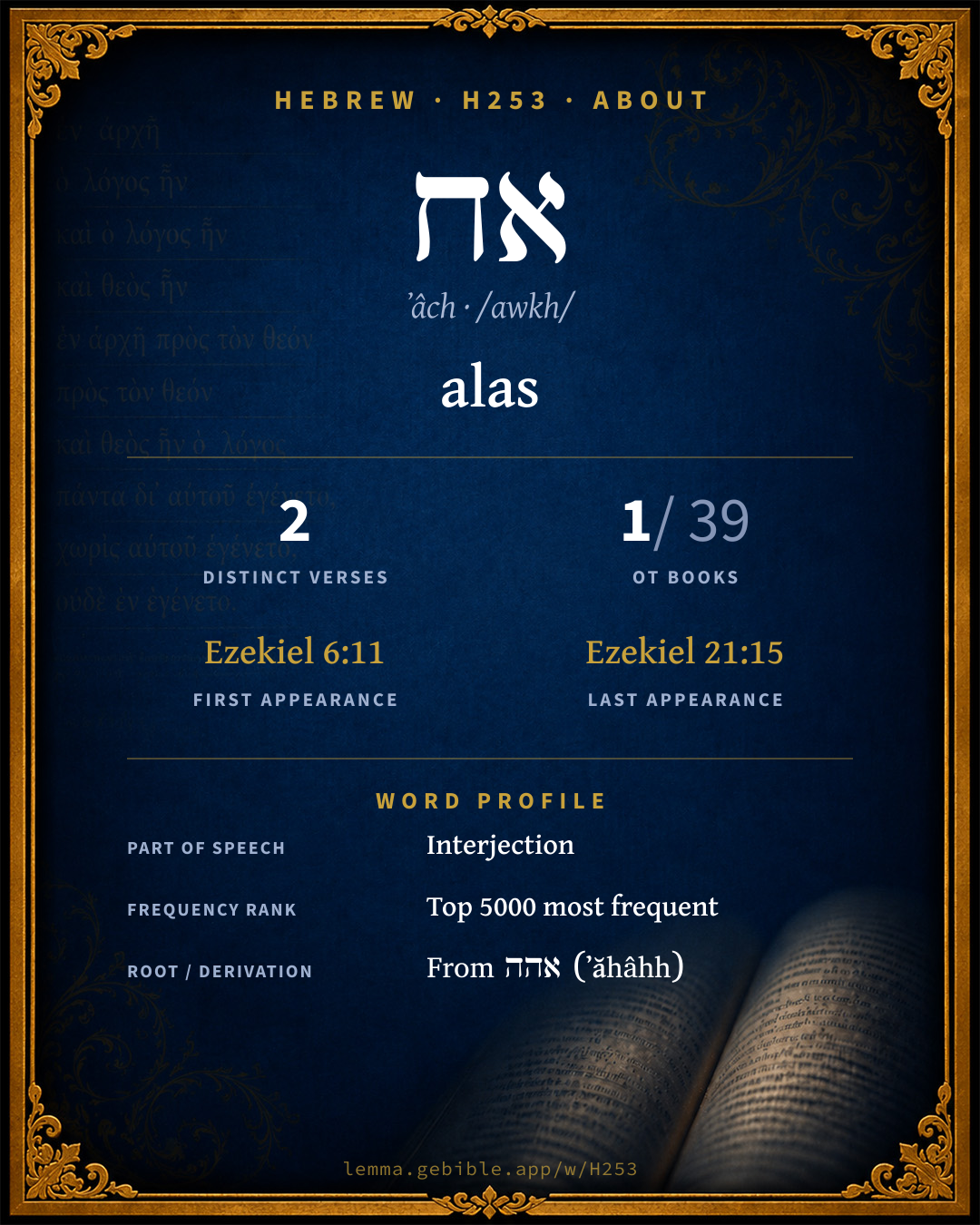
אָח
alas
Full lexicon entry — Brown-Driver-Briggs (BDB)
From Brown-Driver-Briggs (BDB)
Where this word appears
Grammar key — what these labels mean
Part of speech
- Particle
- A short function word — article, negation, interrogative, the sign of the direct object, and the like.
Every verse where H253 appears — 2 distinct verses across 1 book. Click any verse to open its interlinear word-by-word view. Verse text shown in the World English Bible for context — . Each verse’s Hebrew form is shown with its reference; the English is not keyword-highlighted, since the data carries no word-level English alignment. Use “Compare translations” on any verse to read it across multiple English versions. This concordance covers the Hebrew Bible; Septuagint (Greek Old Testament) occurrences are not indexed here.
Ezekiel 2 verses
- Ezekiel 6:11 אָ֔ח ptcl intj Thus says the Lord Yahweh: Smite with your hand, and stamp with your foot, and say, Alas! because of all the evil abominations of the house of Israel; for they shall fall by the sword, by the famine, and by the pestilence.
- Ezekiel 21:15 אָ֛ח ptcl intj I have set the threatening sword against all their gates, that their heart may melt, and their stumblings be multiplied: ah! it is made as lightning, it is pointed for slaughter.
About this entry
At a glance — auto-summarized from this page’s data, not written by a person. Every figure links to its source below. This summary describes the numbers; it doesn’t interpret them.
אח — transliterated ʼâch — is a Hebrew word carrying the sense “alas.” It is rare — just 2 verses in the entire Hebrew Bible. Its uses cluster heavily in Ezekiel (100% of all occurrences). Its earliest occurrence is Ezekiel 6:11. Sharing its root, it stands alongside אהה, הה and אח. Each statement above links to its evidence; the full detail follows below.
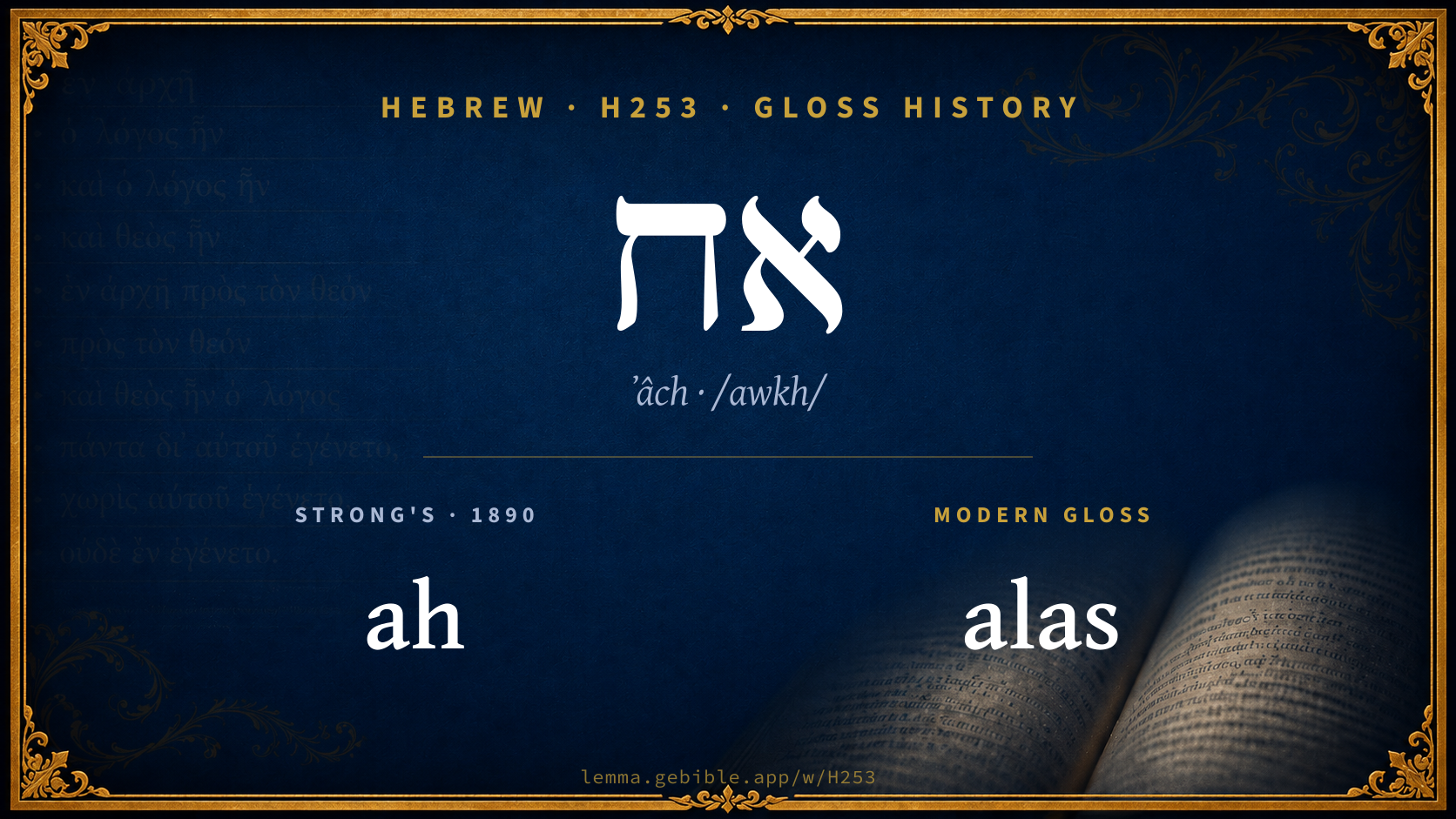
Gloss history
Strong's 1890 vs modern scholarship
About this word
Strong's H253 catalogs a Hebrew word from the Hebrew Old Testament.
These counts are not copied from any lexicon or concordance. They are computed here, from the morphology-tagged Hebrew Old Testament. What Lemma adds →
- 2
- distinct verses
- The word appears in 2 distinct verses.
- 1 / 39
- OT books
- The word appears in 1 of 39 Old Testament books.
- #4,807
- by frequency
- Top 5000 most frequent Hebrew words (rank 4,807 of 8,640 Hebrew words by occurrence).
View all 2 occurrences in the concordance →
Most concentrated in
- Ezekiel 2 verses 100%
By section of the Old Testament
By traditional corpus
Conventional, traditional groupings — biblical authorship is debated, so this is a traditional corpus grouping, not an authorship claim. Each share is this word’s portion of its verses in that division of the Hebrew canon. Each figure is a share of the word’s 2 distinct verses.
- Prophets (Nevi'im) 2 verses · 100%
How translations render this word
Counts come from each version’s own published word-to-Strong’s tagging or interlinear alignment — an approximate guide to how each version renders this word, not a word-level alignment the data otherwise carries. Because each total is that version’s own tagged count, the per-version totals vary from one another and need not match the appearance or distinct-verse counts above. These counts may also differ from a printed concordance because Lemma counts each distinctly tagged rendering and does not collapse phrase taggings into a single head-word total. This is a fixed set of word-tagged versions (KJV, ASV, BSB, ULT) and does not change with the reading translation you choose elsewhere. Each version’s license is shown beside its name below (and on Sources).
BDB lists this Strong’s number as 5 distinct words (homographs). Each count above pools all of them and is not split by sense — see the Senses section below. A low-frequency rendering may belong to a different one of those words, not the primary meaning.
- King James Version†: Ah 1×, Alas 1×
- American Standard Version†: Ah 1×, Alas 1×
- Berean Standard Bible†: Alas 1×, Yes 1×
- unfoldingWord Literal Text†: Ah 1×, Alas 1×
King James Version Public Domain
Renders H253 across 2† tagged occurrences — most commonly:
American Standard Version Public Domain
Renders H253 across 2† tagged occurrences — most commonly:
Berean Standard Bible Public Domain
Renders H253 across 2† tagged occurrences — most commonly:
Not rendered by a distinct English word in 1 further occurrence.
unfoldingWord Literal Text CC BY-SA 4.0
Renders H253 across 2† tagged occurrences — most commonly:
Senses in the full BDB
What do BDB’s symbols mean?
BDB uses these scholarly abbreviations:
| Symbol | Meaning |
|---|---|
| 𝔊 | the Septuagint (the ancient Greek translation, LXX) |
| 𝔙 | the Vulgate (the Latin translation) |
| 𝔖 | the Syriac version (the Peshitta) |
| 𝔗 | the Targum (the Aramaic translation) |
| ψ | the Psalms |
| √ | root (the underlying root or stem) |
| ‖ | parallel passage (a synonymous or contrasted parallel) |
| † | the dagger: every passage where the word occurs is cited |
The 4 senses and sub-senses the full Brown-Driver-Briggs lexicon distinguishes for this word, in lexicon order (not ranked by frequency), with BDB’s own verbatim wording and sub-sense lettering. Shown in Hebrew script with BDB’s own scholarly abbreviations. The condensed entry is in the Lexicon Entry tab. See also the Forms in the corpus table below.
אח I interj. (onomatop.) ah! alas! Ez 6
אח II
- 1. brother, born of same mother (& father) Gn 4:2, 8, 9, 10, 11; 27:6, 11; 44:20; 49:5; cf. 28:2; 29:10(×2) + Ex 4:14 + often; also of half-brother Gn 20:5, 13, 16 (on parentage cf. v 12) 37:2, 4, 5 +, 2 S 13:4, 7, 8 +. e.g. Genesis 4:2
- 2. indef. = relative; Lot, of Abr. Gn 13:8; 14:14, 16; Jacob, of Laban 29:12, 15 (nephew); hence of kinship in wider sense; member of same tribe Nu 16:10; 18:2, 6 2 S 19:13; of same people Ex 2:11(×2); 4:18 Dt 15:12 Ju 14:3 Is 66:20 Ne 5:1, 5, 8 vid. especially Lv 19:17 cf. v 18 (extended to incl. sojourner גֵּר v 34); of Israel & Judah 2 S 19:42; Isr. & Edom Nu 20:14; cf. of Ishmael Gn 16:12; 25:18; of friend 2 S 1:26 1 K 9:13; 20:32, 33; of allies בְּרִית א׳ Am 1:9. e.g. Genesis 13:8
- 3. fig. of resemblance Jb 30:29 אָח הָיִיתִי לְתַנִּים (‖ רֵעַ לִבְנוֹת יַעֲנָה) i.e. by reason of his crying, cf. Di; Pr 18:9 מִתְרַפֶּה בִּמְלַאכְתּוֹ אָח הוּא לְבַעַל מַשְׁחִית. e.g. Job 30:29
- 4. in phr. one … another אִישׁ אָחִיו Gn 9:5 Jo 2:8 Zc 7:10; אָחִיו … אִישׁ Gn 13:11 + 25 times + Ex 32:27 (where also same phr. c. רֵעֵהוּ & קְרֹבוֹ—v. these words—& also אִישׁ, אֶחָד); for development of idiom cf. Dt 15:2 Is 19:2 Je 34:14 (cf. 15) 17 Ez 38:21 Hg 2:22; usually of men; of faces of golden cherubim Ex 25:20; 37:9; of scales of crocodile Jb 41:9. (אָח fire-pot v. sub ii. אחח.) On pr. names compounded with אָח, v. reff. given under אָב supr. e.g. Genesis 9:5
Senses from the full Brown-Driver-Briggs lexicon (Brown, Driver, Briggs; Oxford 1906 — public domain), digitized via Sefaria, supplemented by the OpenScriptures HebrewLexicon (CC BY 4.0). Full attribution on Sources.
Word origin
III. interj. (onomatop.) ah! alas! Ez 6:11; 21:20. iii. אָח Ez 18:10 (textual error). Ez 18:10 אָח is a vox nihili (dittogr. from foll. אחד: v. Comm.): in 21:10 also dub. (𝔊 εὖ), read אַךְ Ew Hi Sm Toy, חַדָּה Co Berthol, אַתְּ Oort Krae.
IV. n.m. brother (Ph. אח, Arabic أَخٌ (cstr. أَخُو etc.), Sab. אחֿ (sf. אחֿיהו) CISiv, 1, 17 and 24 al., Ethiopic እኅው Assyrian aḫu cf. DlW, Aramaic אַח, ܐܰܚܳܐ; Palm., Nab. sf. אחוהי, אחיה);—abs. אָח Gn 24:29 + (Ez 18:10 del. Co cf. 𝔊 𝔖 𝔙; Ew Sm אַךְ; Dl Ba Ez x defends as = one cf. Assyrian aḫu) never c. art.; cstr. אֲחִי Gn 10:21 +; sf. אָחִי Gn 4:9 +; אָחִיךָ Gn 4:9 +; אָחִיו Gn 4:2 +; אָחִיהוּ Je 34:9 + 3 times etc.; pl. אַחִים Gn 13:8 +; so read Ho 13:15 v. DeCompl. Var. 23 cf. sub אָחוּ; cstr. אֲחֵי Nu 27:10 +; sf. אַחַי Gn 19:7 +; אֶחָ֑י 1 S 20:29 + (but 1 S 30:23 𝔊 We אַחֲרֵי for אֶחָ֑י את); אַחֶיךָ Gn 37:13 +; אֶחָיו Gn 44:14 + etc.
V. n.f. fire-pot, brasier (Arabic وَلَدًا, in Thes, is an error fire-pot is loan-word from Egyptian ʿḫ according to WMMOLZ 3, 51) always c. art. Je 36:22 הַא׳ לְפָנָיו מְבֹעָ֑רֶת the brasier before him was burning; v 23 הָאֵשׁ אֲשֶׁר אֶל־הָא׳; v 23 הָאֵשׁ אֲשֶׁר עַל־הָא׳ (i. אָח, brother v. sub אחה; iii. אָח interj., p. 25).
— Brown-Driver-Briggs (Oxford 1906, public domain), digitized via Sefaria, supplemented by the OpenScriptures HebrewLexicon (CC BY 4.0). See Sources.
Derived from אהה (ʼăhâhh) (H162) — alas.
Jastrow Dictionary
A second Hebrew/Aramaic lexicon for comparison, covering Aramaic and post-biblical (Talmudic, Targumic, Midrashic) usage that the biblical-Hebrew BDB does not. Matched by lemma rather than by Strong’s number, so a lemma may carry more than one Jastrow headword (shown separately below), and the entries cover usage well beyond the Bible.
אָח I
- brother, kinsman; fellow, equal, fellow-believer &c. Meg. 11ᵃ (play on ăhashverosh, Ahasverus) אָׄחִׄיו ש̇ל ר̇אש̇ וכ׳ a brother (in cruelty) to the chief tyrant (Nebucadn.); a. fr.—Pl. אַחִים, אַחִין. Gen. R. s. 89, beg. (play on āḥu, Gen. XLI, 2) in years of plenty הבריות נעשו א׳ וכ׳ people are brotherly to each other. Gen. R. s. 99 אחים דפחתא וכ׳ brothers to the degraded woman (Dinah), … but not to Joseph; a. fr.—Cant. R. to VIII, 1 שני אחים brother and sister e.g. Genesis 41:2
אַח
- Targ. fr.—Pl. אָחִין. Targ. Gen. XIII, 8; a. e.—אַחֵי Yeb. 65ᵇ.—Y. Yoma VI, 43ᵈ אֲחֵינָן our brothers
אָח II
- interj. interj.
- 1. (b. h.) exclamation of sorrow, Oh! Meg. 11ᵃ (play on ăhashverosh; v. אָח I) א׳ לראשו woe upon his head. Snh. 102ᵇ (play on Ahab אח־אב) א׳ לשמי׳ a subject of grief to the Lord, and father (friend) of idolatry.—2 (= Syr.) exclamation of joy, Ah! Targ. Is. XLIV, 16 (h. הֶאָח).
A Dictionary of the Targumim, the Talmud Babli and Yerushalmi, and the Midrashic Literature (Marcus Jastrow; London, Luzac, 1903) — Public Domain. Digitized via Sefaria. Digitized via Sefaria. Full attribution on Sources.
Forms in the corpus
The 2 distinct written forms H253 takes in the Hebrew Bible, most frequent first — each parse links to that state’s occurrences in the concordance. Hebrew forms include their vowel points and cantillation, so a single lemma takes many written forms.
| Form | Parsing | Example | Uses |
|---|---|---|---|
| אָ֔ח | Particle, Interjection | Ezekiel 6:11 | 1 |
| אָ֛ח | Particle, Interjection | Ezekiel 21:15 | 1 |
Same root — word family
Other BDB entries built from the same root as H253, grouped by Strong’s listed origin. These share a root / origin per the lexicon — not necessarily a shared meaning. Each links to that word’s own entry.
Derives from
Shares the same root
Derived from this word
Compare all same-root words → Showing 4 of 5 — not the complete family. They share a root, not necessarily a meaning.
Septuagint verse parallels
This word appears in 2 verses that also exist in the Greek Old Testament (Septuagint), out of the 2 Hebrew verses it occurs in. You can read those verses in Greek by switching the Old Testament edition to the Septuagint.
Read these verses in the Septuagint
This is a verse-level parallel only — the same verses exist in both the Hebrew and Greek Old Testaments. No word-level Hebrew↔Greek correspondence is claimed: the data carries no such alignment, so no Greek word is shown as this Hebrew word’s translation. Coverage is not total — the Septuagint omits the deuterocanon and renumbers the Psalms, so some Hebrew verses have no direct Greek parallel.