
Proverbs 25:22

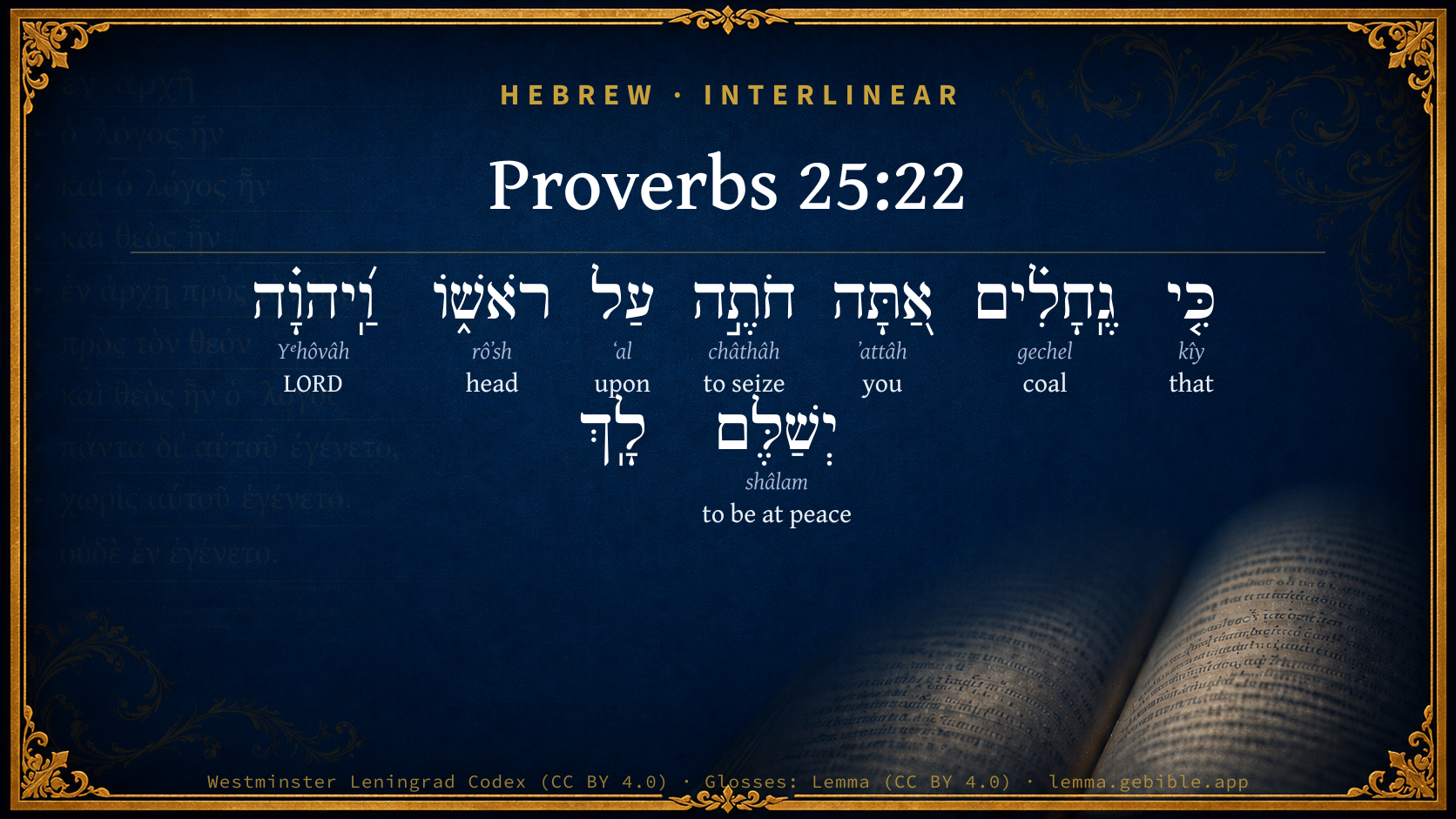
Hebrew (Westminster Leningrad Codex) Proverbs 25:22 appears in the Hebrew Old Testament. The text above is from the Westminster Leningrad Codex. Each word links to its Strong’s number, a concise gloss, and parsing drawn from the Open Scriptures Hebrew Bible morphology. Click any word for its full Brown-Driver-Briggs (BDB) entry.
Download image
Cite this verse

Proverbs 25:22 (World English Bible). Public Domain. Lemma interlinear Bible study tool, https://lemma.gebible.app/v/proverbs/25/22.

Show BibTeX & RIS
BibTeX
RIS
English Translation
For you will heap coals of fire on his head, And Yahweh will reward you.
World English Bible · Public Domain
Download a study sheet

One document with this verse’s original text, its word-by-word gloss line, the meaning frame, cross-references with their text, attributed commentary, and full source and license credits — printable, and it pastes into notes with its structure intact.

This verse Autodidact and up

Study sheet (.html) Plain text (.txt)

A passage Seminary Student

Up to 50 verses in one chapter. A passage sheet keeps up to 6 commentary sources and 12 cross-references per verse, in the order this page ranks them, and says so on the sheet whenever that leaves anything out. Ask for a single verse and you get the Autodidact verse sheet above.

Everything on this page stays free to read, with no account — the sheet is a download of what is already on screen, not access to it.

Want to remove ads? Support Godless Engineer
Compare translations 3

The same verse in 3 English versions, stacked beneath the original-language interlinear above. Click any original word for its lexicon entry.

Each is an independent rendering of the whole verse — the interlinear is not word-aligned to these translations.

Highlighted words mark where these versions differ — a whole-verse word diff, not a word-by-word alignment.

  • World English Bible Public Domain
    For you will heap coals of fire on his head, And Yahweh will reward you.
  • King James Version Public Domain
    For thou shalt heap coals of fire upon his head, and the LORD shall reward thee.
  • unfoldingWord Literal Text CC BY-SA 4.0
    for you are heaping embers on his head, and Yahweh will repay to you.

unfoldingWord Literal Text — © unfoldingWord, licensed CC BY-SA 4.0. Word-aligned USFM3 via Door43 (git.door43.org/unfoldingWord/en_ult).

Versions to compare (up to 4)

3 of 4 selected

Show all 18 translations

Every available English version of this verse, each an independent rendering of the whole verse.

  • World English Bible Public Domain
    For you will heap coals of fire on his head, And Yahweh will reward you.
  • Berean Standard Bible Public Domain
    For in so doing, you will heap burning coals on his head, and the LORD will reward you.
  • Majority Standard Bible Public Domain
    For in so doing, you will heap burning coals on his head, and the LORD will reward you.
  • King James Version Public Domain
    For thou shalt heap coals of fire upon his head, and the LORD shall reward thee.
  • American Standard Version (1901) Public Domain
    For thou wilt heap coals of fire upon his head, And Jehovah will reward thee.
  • Revised Version (1885) Public Domain
    For thou shalt heap coals of fire upon his head, and the LORD shall reward thee.
  • Geneva Bible (1599) Public Domain
    For thou shalt lay coles vpon his head, and the Lord shall recompense thee.
  • Douay-Rheims (1899) Public Domain
    For thou shalt heap hot coals upon his head, and the Lord will reward thee.
  • Young's Literal Translation Public Domain
    For coals thou art putting on his head, And Jehovah giveth recompense to thee.
  • Literal Standard Version CC BY-SA 4.0
    For you are putting coals on his head, || And YHWH gives repayment to you.
  • Unlocked Literal Bible CC BY-SA 4.0
    for you will shovel coals of fire on his head and Yahweh will reward you.
  • unfoldingWord Literal Text CC BY-SA 4.0
    for you are heaping embers on his head, and Yahweh will repay to you.
  • Darby Bible Public Domain
    for thou shalt heap coals of fire upon his head, and Jehovah shall reward thee.
  • World Messianic Bible Public Domain
    for you will heap coals of fire on his head, and the LORD will reward you.
  • Webster's Bible Public Domain
    For thou shalt heap coals of fire upon his head, and the LORD will reward thee.
  • Free Bible Version CC BY-SA 4.0
    This will make him ashamed as if he had burning coals piled on his head, and the Lord will reward you.
  • Bible in Basic English Public Domain
    For so you will put coals of fire on his head, and the Lord will give you your reward.
  • JPS Tanakh (1917) Public Domain
    For thou wilt heap coals of fire upon his head, and the LORD will reward thee.

Literal Standard Version (2020), Covenant Press — licensed CC BY-SA 4.0. Text via the HelloAO Bible API (eBible.org). Unlocked Literal Bible (unfoldingWord) — licensed CC BY-SA 4.0. Text via the HelloAO Bible API (eBible.org). unfoldingWord Literal Text — © unfoldingWord, licensed CC BY-SA 4.0. Word-aligned USFM3 via Door43 (git.door43.org/unfoldingWord/en_ult). Free Bible Version, Dr. Jonathan Gallagher — licensed CC BY-SA 4.0. Text via the HelloAO Bible API (eBible.org).

Word by word

More ways to search: Search by grammar → Find every occurrence → Compare this word →

Practice this passage: Drill this verse → Learn its vocabulary →

About this verse

These counts appear in no published source. They are computed here, from the morphology-tagged text and Lemma’s own curated glosses. What Lemma adds →

9
words
8
distinct lemmas
Wisdom
section

Notable vocabulary

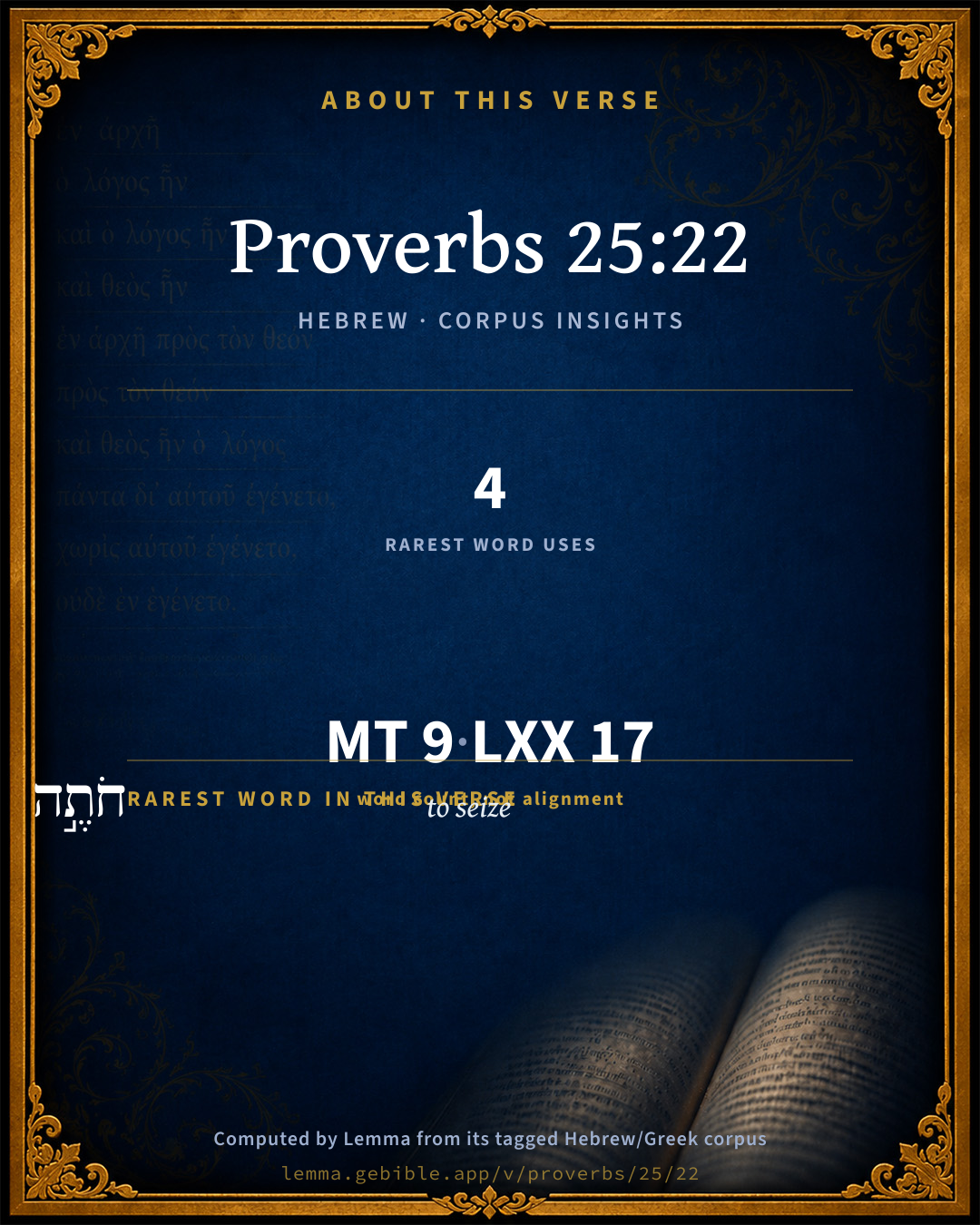
The rarest word here is חֹתֶ֣ה to seize H2846 — appearing just 4 times in the whole Hebrew Bible.

Shared distinctive vocabulary

חֹתֶ֣ה to seize H2846 occurs in 4 verses of the Hebrew Bible. Also found in:

Grammatical profile

  • 2 verbs
  • 3 nouns
  • 1 pronoun
  • 2 prepositions
  • 1 conjunction

Verb forms

  • חֹתֶ֣ה Qal · Participle Active
  • יְשַׁלֶּם Piel · Imperfect

Hebrew & Septuagint length

In English translation the verse runs 15 words from the Hebrew and 20 from the Septuagint (LXX English) — closely comparable.

A rough comparison of the two English renderings, which tokenize alike — not a word-level alignment.

Word counts can differ between the Hebrew and the Greek without any difference in meaning — e.g. the Hebrew direct-object marker אֵת has no separate Greek word, and Greek often adds the article ὁ.

In the original languages it is 9 Hebrew tokens and 17 Greek tokens — but the two are counted differently (Hebrew bundles its prefixes and suffixes into one token; the Greek is in lemma form), so that isn’t a like-for-like length.

Cross-references

2

Topical passages linked to Proverbs 25:22 in the Treasury of Scripture Knowledge — connected by theme and wording, ordered by reader-vote popularity; previews shown in the World English Bible.

  • 2 Samuel 16:12 It may be that Yahweh will look on the wrong done to me, and that Yahweh will requite me good for [his] cursing of me this day.
  • Matthew 10:13 If the household is worthy, let your peace come on it, but if it isn't worthy, let your peace return to you.

Cross-references courtesy of OpenBible.info (CC BY 4.0).

Hebrew and Greek witnesses Masoretic Hebrew ↔ Greek Septuagint

The same verse in the two great witnesses to the Old Testament, shown verse-for-verse.

These are two independent witnesses, not word-aligned to each other, and the Septuagint is shown in lemma (dictionary) form.

Hebrew Proverbs 25:22 Masoretic · Westminster Leningrad Codex

כִּ֤י גֶֽחָלִ֗ים אַ֭תָּה חֹתֶ֣ה עַל רֹאשׁ֑וֹ וַֽ֝יהוָ֗ה יְשַׁלֶּם לָֽךְ

For you will heap coals of fire on his head, And Yahweh will reward you.

World English Bible · Public Domain

Greek LXX Proverbs 25:22 Septuagint · lemma form

οὗτος γάρ ποιέω ἄνθραξ πῦρ σωρεύω ἐπί ὁ κεφαλή αὐτός ὁ δέ κύριος ἀντι ἀποδίδωμι σύ ἀγαθός

for so doing you shall heap coals of fire upon his head, and the Lord shall reward you with good.

LXX2012 (modern English Septuagint) · Public Domain

Hebrew: Westminster Leningrad Codex (CC BY 4.0). Greek: Septuagint (public domain); English from LXX2012 (modern English Septuagint) (Public Domain). How the Septuagint differs from the Hebrew →

Commentary

Notes on Proverbs 25:22 from classic Christian and Jewish commentators (each source and its license shown beneath its notes). The classic Christian expositions comment on the surrounding passage and are grouped to its opening verse, so a note may address several verses; the Jewish commentaries on the Tanakh (Rashi and others) are per-verse, so they appear only where the commentator wrote on this verse.

Lemma curates 59 commentaries, every one of them public domain or Creative Commons licensed, each selected and text-cleaned for this edition rather than reprinted as found. About our sources →

Trapp's Complete Commentary

John Trapp

Pro 25:22 For thou shalt heap coals of fire upon his head, and the LORD shall reward thee.

Ver. 22. For thou shalt heap coals of fire.] By heaping courtesies upon him, thou shalt win him over to thyself, as the king of Israel did those Syrians he feasted. They came no more after that by way of ambush or incursion into the bounds of Israel. In doing some good to our enemies, we do most to ourselves.

And the Lord shall reward thee.] However men deal with thee. It may be they may prove dross that will not be melted, dirt that will not be mollified, but moulder to nothing, crumble to crattle as stones, &c., as having no metal of ingenuity or good nature in them. But desist not, despond not; "God will reward thee," and his retributions are more than bountiful. Or, as the words may be read, "God will pacify for thee," as he did Saul for David. Never did a charitable act go away without a blessing. God cannot but love in us this imitation of his mercy, who bids his sun to shine upon the evil and unthankful, and that love is never fruitless.

John Trapp, A Commentary or Exposition upon All the Books of the Old and New Testament (1647–1656) — public domain. Text from a community e-Sword module.

Geneva Bible (1599)

Geneva Bible translators

Thou shalt, as it were by force, overcome him, insomuch that his own conscience shall move him to acknowledge the benefits, and his heart shall be inflamed.

Geneva Bible (1599) marginal notes — public domain. Text via Bolls.life.

Adam Clarke's Commentary

Verse 22. Thou shalt heap coals of fire upon his head] Not to consume, but to melt him into kindness; a metaphor taken from smelting metallic ores: -

So artists melt the sullen ore of lead,

By heaping coals of fire upon its head:

In the kind warmth the metal learns to glow,

And pure from dross the silver runs below.

S. WESLEY.

Adam Clarke's Commentary on the Bible (1810–1826) — public domain. Text from a community e-Sword/MySword module.

Ellicott's Commentary for English Readers

(22) Thou shalt heap coals of fire on his head.—Thou shalt make him burn with shame at the thought of the wrong he has done thee. Thus, to bring a sinner to repentance is well-pleasing to the Lord, who shall reward thee for it. This is better far than to indulge resentment, which must bring sorrow to oneself, punishment from God—whose prerogative of vengeance (Rom_12:19) has been usurped—and only serve to harden the offender in his hostility.

A Bible Commentary for English Readers, edited by Charles John Ellicott (1878–1897) — public domain. Text from a community e-Sword module.

The Cambridge Bible for Schools and Colleges

gen. ed. J. J. S. Perowne

22. heap coals of fire upon his head] i.e. take the most effectual vengeance upon him. It is best to take the expression both here, and in the Epistle to the Romans, where it is quoted, in the simplest sense of taking vengeance, expressed by a familiar figure (Psa_120:4; Psa_140:10), without carrying out the figure into any idea of the effect upon your enemy, whether for good or for evil, of your conduct: q.d. your natural desire is to be avenged, let this ‘feeding him’ and ‘giving him drink’ be the effective form of vengeance which you adopt. And as an incentive remember that in doing him good you will bring a blessing upon yourself: “the Lord shall reward thee.” The proverb thus belongs by anticipation to the highest sphere of moral teaching, Mat_5:44; Rom_12:20.

The Cambridge Bible for Schools and Colleges (gen. ed. J. J. S. Perowne; Cambridge University Press, 1878–1918) — public domain. Text from a community e-Sword module.

John Gill's Exposition

For thou shall heap coals of fire upon his head,.... Not to increase his punishment and damnation, the more aggravated by kindness shown him; but to bring him by such means to a sense of former injuries, and to shame for them, repentance of them, and love of the person injured, and carefulness for the future of doing him any further wrong;

and the Lord shall reward thee: with good things, for all the good done to thine enemy, whether it has the desired effect on him or not; or whether he rewards thee or not; see Rom 12:20.

John Gill's Exposition of the Whole Bible (1746–1763) — public domain (CC PDM 1.0). Text via the HelloAO Bible API.

Haydock's Catholic Bible Commentary

Coals of charity; (St. Chrysostom in Romans xii. 20.) or, if he prove obstinate, his punishment will be the greater. (Geier.) --- The former sense is more received. (Calmet)

George Leo Haydock (1774–1849), Haydock's Catholic Family Bible and Commentary, 1859 edition — public domain. Excludes Psalms (Douay-Rheims chapter numbering differs from Protestant) and Deuterocanonical books (Catholic canon only).

Matthew Poole's English Annotations

For, understand, in so doing, which words are expressed Rom 12:20, where this text is quoted,

thou shalt heap coals of fire upon his head; either,

1. In a bad sense, thou shalt hereby aggravate his sin, and occasion a more speedy and grievous vengeance from God, which, like fire from heaven, shall fall upon his head and consume him. Not that he persuades him to do a kindness with an evil intent, with an expectation, or desire, or design of bringing God’s wrath upon him; but only he foretells what would happen, and dissuades him from taking vengeance, and provokes him to kindness instead of it, because vengeance is God’s peculiar work, which he will certainly inflict upon such persons; which argument is used to that very purpose by St. Paul, Rom 12:19. Or,

2. In a good sense, thou shalt melt him into repentance, and inflame him with love and kindness to thee for so unexpected and undeserved a favour; he shall be as heartily grieved and tormented with the thoughts of his vile and wicked carriage to thee, as a man would be that had burning coals of fire heaped upon his head. But if these coals of fire do not melt him, but still he hardens his heart against thee, they will consume him. Thus either by the one or by the other way thou shalt be secured and delivered from him. The metaphor may seem to be taken from founders, who melt the hardest metals by heaping coals of fire upon them. And the head may be here mentioned rather than any other part, because in Scripture phrase both blessings and curses are said to fall upon men’s heads, i.e. upon them, heads being frequently put for persons.

The Lord shall reward thee; thy charity to him shall be fully recompensed to thee, if not by him, yet by God, which is far better.

Matthew Poole's English Annotations on the Holy Bible (1683–1685) — public domain. Text from a community e-Sword/MySword module.

The Pulpit Commentary

For thou shalt heap coals of fire upon his head. This expression has been taken in various senses. It has been thought to mean that the forgiveness of the injured person brings to the cheek of the offender the burning blush of shame. But heaping coals on the head cannot naturally be taken to express such an idea. St. Chrysostom and other Fathers consider that Divine vengeance is implied, as in Psa_11:6, "Upon the wicked he shall rain snares; fire and brimstone and burning wind shall be their portion;" and Psa_140:10, "Let burning coals fall upon them." Of course, in one view, kindness to an evil man only gives him occasion for fresh ingratitude and hatred, and therefore increases God"s wrath against him. But it would be a wicked motive to act this beneficent part only to have the satisfaction of seeing your injurer humbled or punished. And the gnome implies that the sinner is benefited by the clemency shown to him, that the requital of evil by good brings the offender to a better mind, and aids his spiritual life. "Coals of fire" are a metaphor for the penetrating pain of remorse and repentance. The unmerited kindness which he receives forces upon him the consciousness of his ill doing, which is accompanied by the sharp rain of regret. St. Augustine, "Ne dubitaveris figurate dictum...ut intelligas carbones ignis esse urentes poenitentiae gemitus, quibus superbia sanatur ejus, qui dolit se inimicum fuisse hominis, a quo ejus miseriae subvenitur" ("De Doctr. Christ.," 3:16). Lesetre quotes St. Francis de Sales, who gives again a different view, "You are not obliged to seek reconciliation with one who has offended you; it may be rather his part to seek you; yet nevertheless go and follow the Saviour"s counsel, prevent him with good, render him good for evil: heap coals of fire on his head and on his heart, which may burn up all ill will and constrain him to love you" ("De l"Am. de Dieu," 8:9). And the Lord shall reward thee. This consideration can scarcely be regarded as the chief motive for the liberality enjoined, though it would be present to the kind person"s mind, and be a support and comfort to him in a course of conduct repugnant to the natural man. He would remember the glorious reward promised to godliness by the prophet, (Isa_58:8, etc.) and how Saul had expressed his consciousness of David"s magnanimity in sparing his life. "Thou art more righteous than I; for thou hast rewarded me good, whereas I have rewarded thee evil... wherefore the Lord reward thee good for that thou hast done unto me this day". (1Sa_24:17, 19 and 1Sa_26:21)

The Pulpit Commentary (1880–1919), ed. H.D.M. Spence-Jones & Joseph S. Exell — public domain. Text from a community e-Sword module.

John Wesley's Explanatory Notes

For - In so doing, which words are expressed Rom. xii, 20, where this text is quoted. Thou shalt melt him into repentance, and love.

John Wesley, Explanatory Notes Upon the Whole Bible (1754–1765) — public domain. Text via the GEBible commentary corpus.

Rashi

Rabbi Shlomo Yitzchaki (Rashi)

for...coals they are to him, that you are scooping from the fire to heap upon his head.

scooping Heb. חותה. Any scooping of coals from a fire is called חותה, as it is stated (Isa. 30:14): “to scoop (לחתות) fire from a hearth.”

will reward you Heb. ישלם לך, will cause him to make peace with you, that he should not overpower you.

Rashi on the Tanakh — English translations: “The Judaica Press complete Tanach with Rashi, translated by A. J. Rosenberg” (CC BY 4.0); “Pentateuch with Rashi's commentary by M. Rosenbaum and A.M. Silbermann, 1929-1934” (public domain); “The Metsudah Tanach series, Lakewood, N.J” (CC BY 4.0); and “The Book of Joshua, Metsudah Publications, 1997” (CC BY 4.0). Text via Sefaria.

Lesson kit

Teaching starters — assembled from the data on this page, not authored interpretation. Every prompt links to the verse data it draws on. Edit before teaching.

Proverbs, in the Wisdom, opens this verse with 9 words (8 distinct Hebrew lemmas). Its most distinctive word is châthâh (“to seize”). A historical commentator’s framing appears above. Read the whole chapter for the surrounding context.

Discussion questions

  1. How does “to seize” (châthâh) shape what this verse is saying?
  2. Psalms 52:5 shares the word «to seize» with this verse. How do the two illuminate each other?
  3. These translations render this verse differently; the difference is in the English rendering, not the original. What questions does that raise?
  4. The verb «חֹתֶ֣ה» is Qal Participle Active. How does its form color the action?
  5. Reading how Trapp's Complete Commentary and Geneva Bible (1599) read this verse, where do the two commentators agree and where do they part?

Things to notice

Reading settings

Reading text

Shown beneath each verse's original-language words.

Old Testament
Old Testament edition

Read the OT as the Masoretic Hebrew (MT) or the Greek Septuagint (LXX).

English shown for the Greek Septuagint (in the Hebrew ↔ Greek comparison).

Comparing translations? Open the Compare panel on any verse page to stack up to four side by side.