
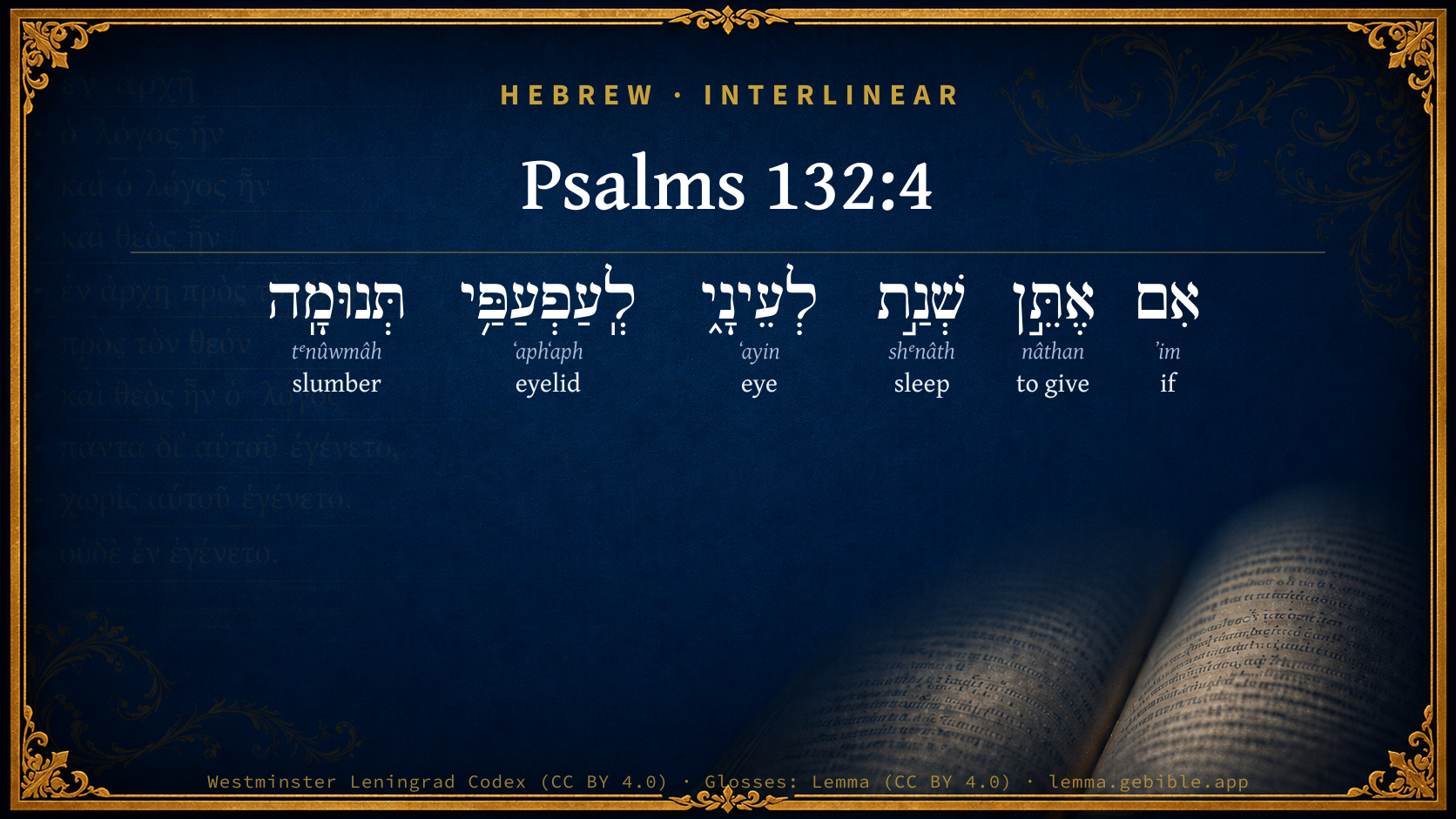
Psalms 132:4

Hebrew (Westminster Leningrad Codex) Psalms 132:4 appears in the Hebrew Old Testament. The text above is from the Westminster Leningrad Codex. Each word links to its Strong’s number, a concise gloss, and parsing drawn from the Open Scriptures Hebrew Bible morphology. Click any word for its full Brown-Driver-Briggs (BDB) entry.
Download image
Cite this verse

Psalms 132:4 (World English Bible). Public Domain. Lemma interlinear Bible study tool, https://lemma.gebible.app/v/psalms/132/4.

Show BibTeX & RIS
BibTeX
RIS
English Translation
I will not give sleep to my eyes, Or slumber to my eyelids;
World English Bible · Public Domain
Highlights
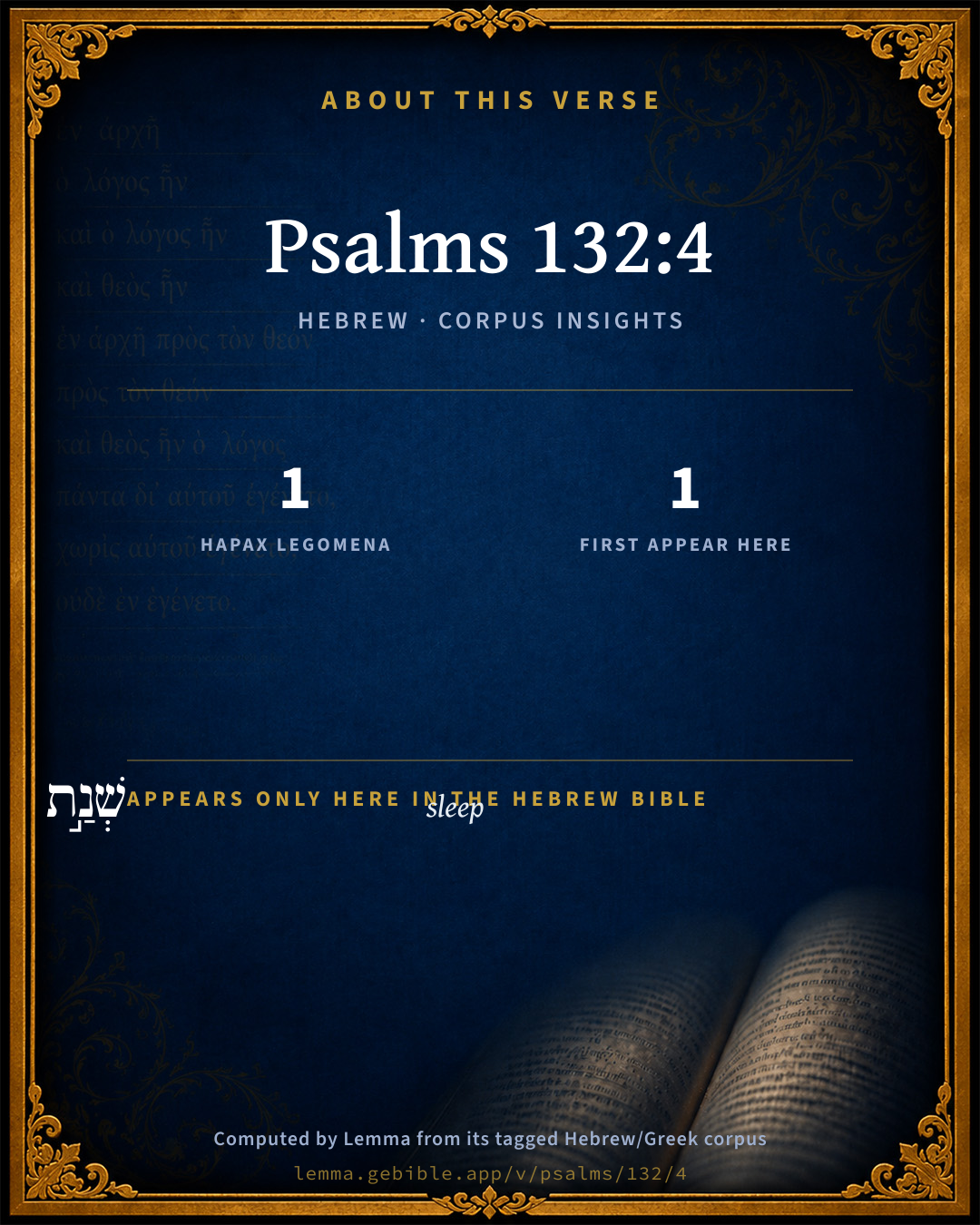
  • 1 hapax legomenon — only here in the Hebrew Bible
  • 1 first appearance in the Hebrew Bible
Full analysis ↓
Download a study sheet

One document with this verse’s original text, its word-by-word gloss line, the meaning frame, cross-references with their text, attributed commentary, and full source and license credits — printable, and it pastes into notes with its structure intact.

This verse Autodidact and up

Study sheet (.html) Plain text (.txt)

A passage Seminary Student

Up to 50 verses in one chapter. A passage sheet keeps up to 6 commentary sources and 12 cross-references per verse, in the order this page ranks them, and says so on the sheet whenever that leaves anything out. Ask for a single verse and you get the Autodidact verse sheet above.

Everything on this page stays free to read, with no account — the sheet is a download of what is already on screen, not access to it.

Want to remove ads? Support Godless Engineer
Compare translations 3

The same verse in 3 English versions, stacked beneath the original-language interlinear above. Click any original word for its lexicon entry.

Each is an independent rendering of the whole verse — the interlinear is not word-aligned to these translations.

Highlighted words mark where these versions differ — a whole-verse word diff, not a word-by-word alignment.

  • World English Bible Public Domain
    I will not give sleep to my eyes, Or slumber to my eyelids;
  • King James Version Public Domain
    I will not give sleep to mine eyes, or slumber to mine eyelids,
  • unfoldingWord Literal Text CC BY-SA 4.0
    if I give sleep to my eyes, slumber to my eyelids,

unfoldingWord Literal Text — © unfoldingWord, licensed CC BY-SA 4.0. Word-aligned USFM3 via Door43 (git.door43.org/unfoldingWord/en_ult).

Versions to compare (up to 4)

3 of 4 selected

Show all 17 translations

Every available English version of this verse, each an independent rendering of the whole verse.

  • World English Bible Public Domain
    I will not give sleep to my eyes, Or slumber to my eyelids;
  • Berean Standard Bible Public Domain
    I will not give sleep to my eyes or slumber to my eyelids,
  • Majority Standard Bible Public Domain
    I will not give sleep to my eyes or slumber to my eyelids,
  • King James Version Public Domain
    I will not give sleep to mine eyes, or slumber to mine eyelids,
  • American Standard Version (1901) Public Domain
    I will not give sleep to mine eyes, Or slumber to mine eyelids;
  • Revised Version (1885) Public Domain
    I will not give sleep to mine eyes, or slumber to mine eyelids;
  • Geneva Bible (1599) Public Domain
    Nor suffer mine eyes to sleepe, nor mine eye lids to slumber,
  • Young's Literal Translation Public Domain
    If I give sleep to mine eyes, To mine eyelids -- slumber,
  • Literal Standard Version CC BY-SA 4.0
    If I give sleep to my eyes, || To my eyelids—slumber,
  • Unlocked Literal Bible CC BY-SA 4.0
    I will not give sleep to my eyes or rest to my eyelids
  • unfoldingWord Literal Text CC BY-SA 4.0
    if I give sleep to my eyes, slumber to my eyelids,
  • Darby Bible Public Domain
    I will not give sleep to mine eyes, slumber to mine eyelids,
  • World Messianic Bible Public Domain
    I will not give sleep to my eyes, or slumber to my eyelids,
  • Webster's Bible Public Domain
    I will not give sleep to my eyes, or slumber to my eyelids,
  • Free Bible Version CC BY-SA 4.0
    I will not go to sleep, I will not take a nap,
  • Bible in Basic English Public Domain
    I will not give sleep to my eyes, or rest to my eyeballs,
  • JPS Tanakh (1917) Public Domain
    I will not give sleep to mine eyes, nor slumber to mine eyelids;

Literal Standard Version (2020), Covenant Press — licensed CC BY-SA 4.0. Text via the HelloAO Bible API (eBible.org). Unlocked Literal Bible (unfoldingWord) — licensed CC BY-SA 4.0. Text via the HelloAO Bible API (eBible.org). unfoldingWord Literal Text — © unfoldingWord, licensed CC BY-SA 4.0. Word-aligned USFM3 via Door43 (git.door43.org/unfoldingWord/en_ult). Free Bible Version, Dr. Jonathan Gallagher — licensed CC BY-SA 4.0. Text via the HelloAO Bible API (eBible.org).

Word by word

More ways to search: Search by grammar → Find every occurrence → Compare this word →

Practice this passage: Drill this verse → Learn its vocabulary →

About this verse

These counts appear in no published source. They are computed here, from the morphology-tagged text and Lemma’s own curated glosses. What Lemma adds →

6
words
6
distinct lemmas
Wisdom
section

Notable vocabulary

1 hapax legomenon — a word that appears only here in the entire Hebrew Bible:

  • שְׁנַ֣ת sleep H8153

First appearance in Scripture

This word makes its first canonical appearance in the Hebrew Bible here:

  • שְׁנַ֣ת sleep H8153

Shared distinctive vocabulary

תְּנוּמָֽה slumber H8572 occurs in 5 verses of the Hebrew Bible. Also found in:

Grammatical profile

  • 1 verb
  • 4 nouns
  • 1 conjunction

Verb forms

  • אֶתֵּ֣ן Qal · Imperfect

Hebrew & Septuagint length

In English translation the verse runs 13 words from the Hebrew and 18 from the Septuagint (LXX English) — closely comparable.

A rough comparison of the two English renderings, which tokenize alike — not a word-level alignment.

Word counts can differ between the Hebrew and the Greek without any difference in meaning — e.g. the Hebrew direct-object marker אֵת has no separate Greek word, and Greek often adds the article ὁ.

Cross-references

3

Topical passages linked to Psalms 132:4 in the Treasury of Scripture Knowledge — connected by theme and wording, ordered by reader-vote popularity; previews shown in the World English Bible.

  • Proverbs 6:4 Give no sleep to your eyes, Nor slumber to your eyelids.
  • Ruth 3:18 Then said she, "Sit still, my daughter, until you know how the matter will fall; for the man will not rest, until he has finished the thing this day."
  • Genesis 24:33 Food was set before him to eat. But he said, "I will not eat until I have told my message." He said, "Speak on."

Cross-references courtesy of OpenBible.info (CC BY 4.0).

Hebrew and Greek witnesses Masoretic Hebrew ↔ Greek Septuagint

The same verse in the two great witnesses to the Old Testament, shown verse-for-verse.

You’re reading Greek Psalm 131 (Hebrew Psalm 132). The Septuagint counts the superscription, so verse numbers can differ from the Hebrew — chapter-level alignment, not verse-by-verse. Numbering follows Rahlfs.

These are two independent witnesses, not word-aligned to each other, and the Septuagint is shown in lemma (dictionary) form.

Hebrew Psalms 132:4 Masoretic · Westminster Leningrad Codex

אִם אֶתֵּ֣ן שְׁנַ֣ת לְעֵינָ֑י לְֽעַפְעַפַּ֥י תְּנוּמָֽה

I will not give sleep to my eyes, Or slumber to my eyelids;

World English Bible · Public Domain

Greek LXX Greek Psalm 131:4 Septuagint · lemma form

εἰ δίδωμι ὕπνος ὁ ὀφθαλμός ἐγώ καί ὁ βλέφαρον ἐγώ νυσταγμός καί ἀνάπαυσις ὁ κρόταφος ἐγώ

I will not give sleep to my eyes, nor slumber to my eyelids, nor rest to my temples,

LXX2012 (modern English Septuagint) · Public Domain

On this verse, The Cambridge Bible for Schools and Colleges discusses the Septuagint’s reading. Read the note in Commentary ↓

Hebrew: Westminster Leningrad Codex (CC BY 4.0). Greek: Septuagint (public domain); English from LXX2012 (modern English Septuagint) (Public Domain). How the Septuagint differs from the Hebrew →

Commentary

Notes on Psalms 132:4 from classic Christian and Jewish commentators (each source and its license shown beneath its notes). The classic Christian expositions comment on the surrounding passage and are grouped to its opening verse, so a note may address several verses; the Jewish commentaries on the Tanakh (Rashi and others) are per-verse, so they appear only where the commentator wrote on this verse.

Lemma curates 59 commentaries, every one of them public domain or Creative Commons licensed, each selected and text-cleaned for this edition rather than reprinted as found. About our sources →

Trapp's Complete Commentary

John Trapp

Psa 132:4 I will not give sleep to mine eyes, [or] slumber to mine eyelids,

Ver. 4. I will not give sleep to mine eyes] viz. With any good content; or, more than needs must.

John Trapp, A Commentary or Exposition upon All the Books of the Old and New Testament (1647–1656) — public domain. Text from a community e-Sword module.

J. A. Alexander on Psalms

Joseph Addison Alexander

4. (Psa 132:4) If I give sleep to my eyes, to my eylids slumber. This is a part of the sentence begun in Psa 132:3 and completed in Psa 132:5. The promise is, of course, not to be absolutely understood, but as meaning, that he would not sleep at ease, or abandon himself to undisturbed repose, till the condition was complied with.

Joseph Addison Alexander, The Psalms Translated and Explained (1850) — public domain. Text from a community e-Sword module.

Ellicott's Commentary for English Readers

(4) I will not.—For this proverbial expression see Pro_6:4.

A Bible Commentary for English Readers, edited by Charles John Ellicott (1878–1897) — public domain. Text from a community e-Sword module.

The Cambridge Bible for Schools and Colleges

gen. ed. J. J. S. Perowne

4. A proverbial expression. Cp. Pro_6:4. The addition in P.B.V. “I will not suffer mine eyes to sleep, nor mine eyelids to slumber, neither the temples of my head to take any rest” comes through the Vulg. from the LXX, where it is a second rendering of the preceding words, added from the version of Theodotion.

The Cambridge Bible for Schools and Colleges (gen. ed. J. J. S. Perowne; Cambridge University Press, 1878–1918) — public domain. Text from a community e-Sword module.

John Gill's Exposition

Lo, we heard of it at Ephratah,.... Either of the ark which David and others had heard of, that it formerly was at Shiloh, Jos 18:1; here called Ephratah, as some think; so the Ephraimites are called Ephrathites, Jdg 12:5; and Elkanah of Ramathaimzophim, of Mount Ephraim, is said to be an Ephrathite, Sa1 1:1; but this tribe the Lord chose not, but the tribe of Judah, for his habitation; and rejected the tabernacle of Shiloh, and removed it from thence, Psa 78:60;

we found it in the fields of the wood; at Kirjathjearim, which signifies the city of woods; being built among woods, and surrounded with them: here the ark was twenty years, and here David found it; and from hence he brought it to the house of Obededom, and from thence to Zion, Sa1 7:1. Or else the place where the temple was to be built; which was not known till the times of David, who was of Ephratah or Bethlehem: here he was born and brought up; and here he was, as Arama supposes, when it was revealed to him where the temple should be built. According to R. Moses, the sense is, We have heard of it by the hand of David, who was of Ephratah: but Aben Ezra thinks the meaning is, that in former times men used to say, We have heard from the mouths of the prophets that the chosen place was near to Bethlehem Ephratah; only the precise place was not known, whether to the east or west, or north or south, of Bethlehem. Some think that not any particular city is intended, but a country, even all the neighbourhood of Bethlehem Ephratah; and took in Jerusalem, where the temple was built, it being but a few miles from the place; so Adrichomius (u) says, the country round about Ephratah had its name from thence; see Kg1 11:26. Now the place found for the building of the temple was "the fields of the wood", or the threshingfloor of Araunah the Jebusite, and was on Mount Moriah; David found by the order he had to build an altar here, and by the acceptance of his sacrifices, that this was the place for the house of God, Ch1 22:1; and here Solomon built the temple, Ch2 3:1; and which was formerly a woody place, as mountains generally are; and this seems to have been when Abraham offered his son on it, who then spied a ram caught in the thickets, Gen 22:2. The Targum is,

"we found it in the field of the forest of Lebanon, the place where the ancient fathers prayed;''

the temple being built of the wood of Lebanon. But all this is to be understood of the Lord, the mighty God of Jacob, who was heard of at Ephratah; the Shechinah, of divine Majesty; so Kimchi, Arama, and Ben Melech. And indeed the Messiah is meant, the antitype of the ark and temple; of whom the saints or believers in him, a chorus of which is here introduced, had heard that he should be born at Ephratah, which is Bethlehem; see Gen 35:19. And if this psalm was written by the captives in Babylon, they might have heard of this from the prophecy of Micah, Psa 5:2; the shepherds heard from the mouths of the angels that Christ was born there; and we Christians have heard the same, and know and believe it, Luk 2:4. And he has been "found in the fields of the wood"; in a low, mean, abject state, as this phrase signifies; Eze 16:5. The shepherds found him rejected from being in the inn, there being no room for him, and lying in a manger, Luk 2:7; the angels found him in the wilderness, among the wild beasts of the field, Mar 1:13; nor had he the convenience even of foxes, and birds of the air; had no habitation or place where to lay his head, Mat 8:20; And he is to be found in the field of the Scriptures, where this rich treasure and pearl of great price lies hid, Mat 13:44; and being preached among the Gentiles, after his incarnation, sufferings, death, resurrection, and ascension, who are compared to wildernesses, and desert places, was found by many of them, Isa 35:1; and which serves to set off with a foil his glory; being like the apple tree among the trees of the wood, Sol 2:3.

(u) Theatrum Terrae Sanct. p. 41.

John Gill's Exposition of the Whole Bible (1746–1763) — public domain (CC PDM 1.0). Text via the HelloAO Bible API.

Albert Barnes' Notes on the Bible

I will not give sleep to mine eyes ... - There is no difference here between the words sleep and slumber. The meaning is, that the house of the Lord should be his first care.

Albert Barnes' Notes on the Bible (1834–1885) — public domain. Text from a community e-Sword/MySword module.

The Treasury of David

Charles H. Spurgeon

Ver. 4. I will not give sleep to mine eyes, or slumber to wine eyelids. He could not enjoy sleep till he had done his best to provide a place for the ark. It is a strong expression, and it is not to be coolly discussed by us. Remember that the man was all on fire, and he was writing poetry also, and therefore his language is not that which we should employ in cold blood. Everybody can see what he means, and how intensely he means it. Oh, that many more were seized with sleeplessness because the house of the Lord lies waste? They can slumber fast enough, and not even disturb themselves with a dream, though the cause of God should be brought to the lowest ebb by their covetousness. What is to become of those who have no care about divine things, and never give a thought to the claims of their God?

Psalms 132:5*

Charles H. Spurgeon's The Treasury of David (1869–1885) — public domain. Psalms only. Text from a community e-Sword/MySword module.

The Pulpit Commentary

I will not give sleep to mine eyes, or slumber to my eyelids. Exegetical of the last clause of ver. 3.

The Pulpit Commentary (1880–1919), ed. H.D.M. Spence-Jones & Joseph S. Exell — public domain. Text from a community e-Sword module.

Lesson kit

Teaching starters — assembled from the data on this page, not authored interpretation. Every prompt links to the verse data it draws on. Edit before teaching.

Psalms, in the Wisdom, opens this verse with 6 words (6 distinct Hebrew lemmas). Its most distinctive word is shᵉnâth (“sleep”). A historical commentator’s framing appears above. Read the whole chapter for the surrounding context.

Discussion questions

  1. How does “sleep” (shᵉnâth) shape what this verse is saying?
  2. This verse holds 1 word here found nowhere else in the Hebrew Bible. What might the rare word draw attention to?
  3. The word “sleep” first appears here in Scripture. What is being introduced at this debut?
  4. Job 33:15 shares the word «slumber» with this verse. How do the two illuminate each other?
  5. These translations render this verse differently. What is at stake in choosing one wording over another?
  6. The verb «אֶתֵּ֣ן» is Qal Imperfect. How does its form color the action?
  7. Reading how Trapp's Complete Commentary and J. A. Alexander on Psalms read this verse, where do the two commentators agree and where do they part?

Things to notice

  • 1 word in this verse appears nowhere else in the Hebrew Bible.
  • 1 word makes its first canonical appearance in Scripture here.
  • These translations choose different wording for 2 words in this verse.
  • 6 distinct Hebrew lemmas span 6 words in this verse.

Reading settings

Reading text

Shown beneath each verse's original-language words.

Old Testament
Old Testament edition

Read the OT as the Masoretic Hebrew (MT) or the Greek Septuagint (LXX).

English shown for the Greek Septuagint (in the Hebrew ↔ Greek comparison).

Comparing translations? Open the Compare panel on any verse page to stack up to four side by side.