
Proverbs 2:15

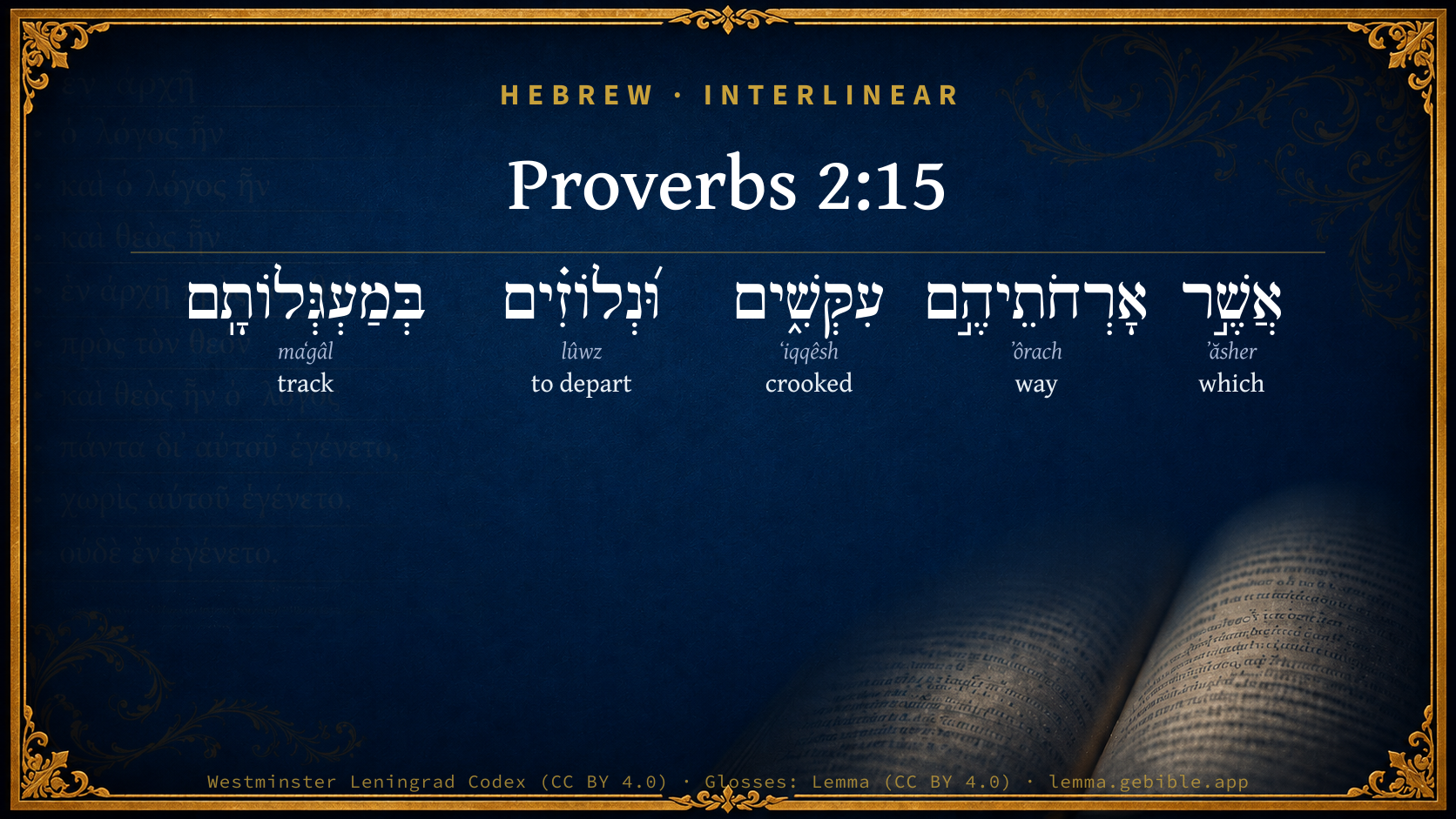
Hebrew (Westminster Leningrad Codex) Proverbs 2:15 appears in the Hebrew Old Testament. The text above is from the Westminster Leningrad Codex. Each word links to its Strong’s number, a concise gloss, and parsing drawn from the Open Scriptures Hebrew Bible morphology. Click any word for its full Brown-Driver-Briggs (BDB) entry.
Download image
Cite this verse

Proverbs 2:15 (World English Bible). Public Domain. Lemma interlinear Bible study tool, https://lemma.gebible.app/v/proverbs/2/15.

Show BibTeX & RIS
BibTeX
RIS
English Translation
Who are crooked in their ways, And wayward in their paths:
World English Bible · Public Domain
Highlights
  • 1 first appearance in the Hebrew Bible
Full analysis ↓
Download a study sheet

One document with this verse’s original text, its word-by-word gloss line, the meaning frame, cross-references with their text, attributed commentary, and full source and license credits — printable, and it pastes into notes with its structure intact.

This verse Autodidact and up

Study sheet (.html) Plain text (.txt)

A passage Seminary Student

Up to 50 verses in one chapter. A passage sheet keeps up to 6 commentary sources and 12 cross-references per verse, in the order this page ranks them, and says so on the sheet whenever that leaves anything out. Ask for a single verse and you get the Autodidact verse sheet above.

Everything on this page stays free to read, with no account — the sheet is a download of what is already on screen, not access to it.

Want to remove ads? Support Godless Engineer
Compare translations 3

The same verse in 3 English versions, stacked beneath the original-language interlinear above. Click any original word for its lexicon entry.

Each is an independent rendering of the whole verse — the interlinear is not word-aligned to these translations.

Highlighted words mark where these versions differ — a whole-verse word diff, not a word-by-word alignment.

  • World English Bible Public Domain
    Who are crooked in their ways, And wayward in their paths:
  • King James Version Public Domain
    Whose ways are crooked, and they froward in their paths:
  • unfoldingWord Literal Text CC BY-SA 4.0
    whose paths crooked and going astray in their tracks;

unfoldingWord Literal Text — © unfoldingWord, licensed CC BY-SA 4.0. Word-aligned USFM3 via Door43 (git.door43.org/unfoldingWord/en_ult).

Versions to compare (up to 4)

3 of 4 selected

Show all 18 translations

Every available English version of this verse, each an independent rendering of the whole verse.

  • World English Bible Public Domain
    Who are crooked in their ways, And wayward in their paths:
  • Berean Standard Bible Public Domain
    whose paths are crooked and whose ways are devious.
  • Majority Standard Bible Public Domain
    whose paths are crooked and whose ways are devious.
  • King James Version Public Domain
    Whose ways are crooked, and they froward in their paths:
  • American Standard Version (1901) Public Domain
    Who are crooked in their ways, And wayward in their paths:
  • Revised Version (1885) Public Domain
    Who are crooked in their ways, and perverse in their paths:
  • Geneva Bible (1599) Public Domain
    Whose wayes are crooked and they are lewde in their paths.
  • Douay-Rheims (1899) Public Domain
    Whose ways are perverse, and their steps infamous.
  • Young's Literal Translation Public Domain
    Whose paths `are' crooked, Yea, they are perverted in their ways.
  • Literal Standard Version CC BY-SA 4.0
    Whose paths [are] crooked, || Indeed, they are perverted in their ways.
  • Unlocked Literal Bible CC BY-SA 4.0
    They follow crooked paths, and using deception they hide their tracks.
  • unfoldingWord Literal Text CC BY-SA 4.0
    whose paths crooked and going astray in their tracks;
  • Darby Bible Public Domain
    whose paths are crooked, and who are perverted in their course:
  • World Messianic Bible Public Domain
    who are crooked in their ways, and wayward in their paths,
  • Webster's Bible Public Domain
    Whose ways are crooked, and they froward in their paths:
  • Free Bible Version CC BY-SA 4.0
    They live crooked lives doing deceitful things.
  • Bible in Basic English Public Domain
    Whose ways are not straight, and whose footsteps are turned to evil:
  • JPS Tanakh (1917) Public Domain
    Who are crooked in their ways, and perverse in their paths;

Literal Standard Version (2020), Covenant Press — licensed CC BY-SA 4.0. Text via the HelloAO Bible API (eBible.org). Unlocked Literal Bible (unfoldingWord) — licensed CC BY-SA 4.0. Text via the HelloAO Bible API (eBible.org). unfoldingWord Literal Text — © unfoldingWord, licensed CC BY-SA 4.0. Word-aligned USFM3 via Door43 (git.door43.org/unfoldingWord/en_ult). Free Bible Version, Dr. Jonathan Gallagher — licensed CC BY-SA 4.0. Text via the HelloAO Bible API (eBible.org).

Word by word

More ways to search: Search by grammar → Find every occurrence → Compare this word →

Practice this passage: Drill this verse → Learn its vocabulary →

About this verse

These counts appear in no published source. They are computed here, from the morphology-tagged text and Lemma’s own curated glosses. What Lemma adds →

5
words
5
distinct lemmas
Wisdom
section

Notable vocabulary

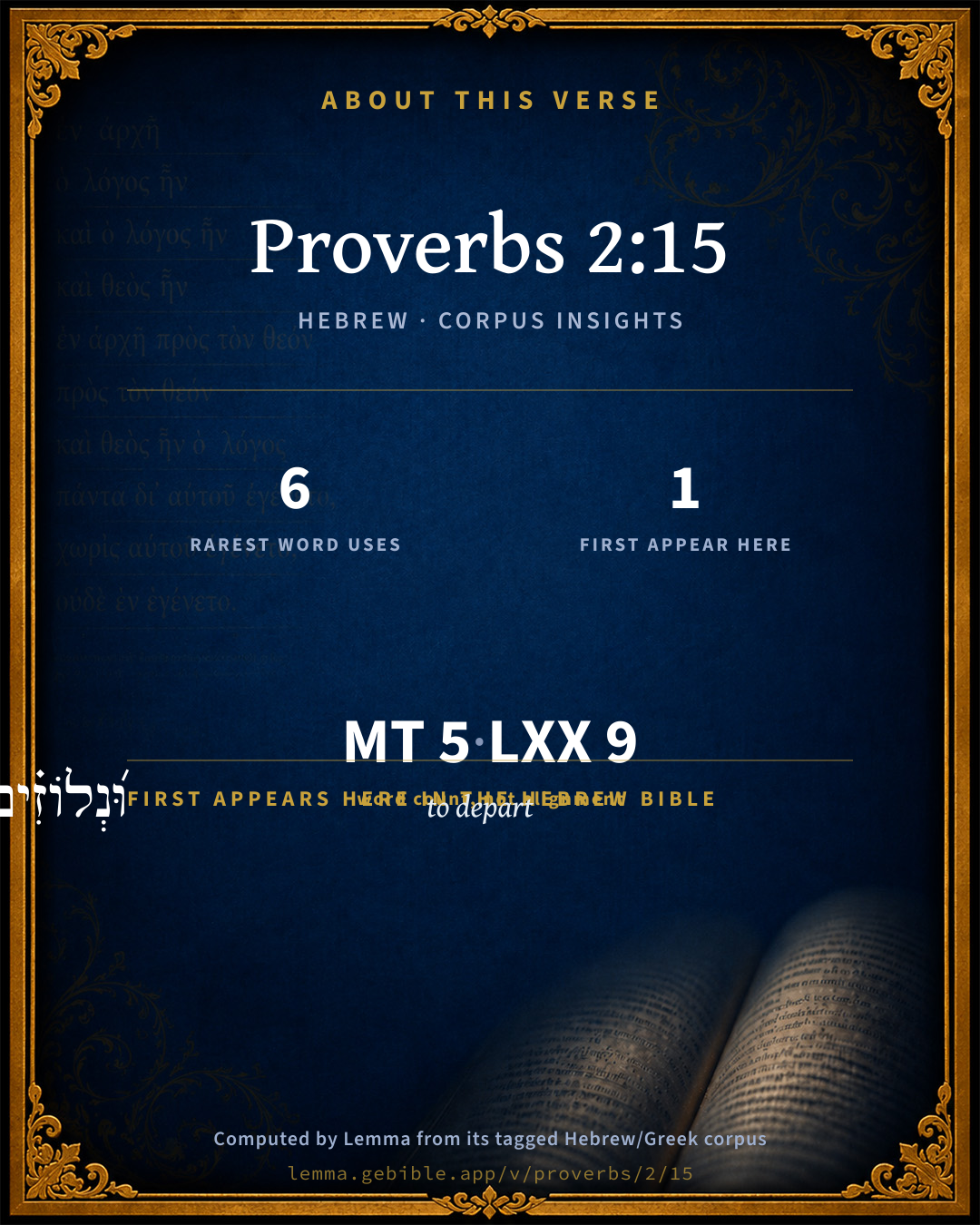
The rarest word here is וּ֝נְלוֹזִ֗ים to depart H3868 — appearing just 6 times in the whole Hebrew Bible.

First appearance in Scripture

This word makes its first canonical appearance in the Hebrew Bible here:

  • וּ֝נְלוֹזִ֗ים to depart H3868

Shared distinctive vocabulary

וּ֝נְלוֹזִ֗ים to depart H3868 occurs in 6 verses of the Hebrew Bible. Also found in:

Grammatical profile

  • 1 verb
  • 2 nouns
  • 1 adjective
  • 1 particle

Verb forms

  • וּ֝נְלוֹזִ֗ים Niphal · Participle Active

Hebrew & Septuagint length

In English translation the verse runs 11 words from the Hebrew and 8 from the Septuagint (LXX English) — closely comparable.

A rough comparison of the two English renderings, which tokenize alike — not a word-level alignment.

Word counts can differ between the Hebrew and the Greek without any difference in meaning — e.g. the Hebrew direct-object marker אֵת has no separate Greek word, and Greek often adds the article ὁ.

In the original languages it is 5 Hebrew tokens and 9 Greek tokens — but the two are counted differently (Hebrew bundles its prefixes and suffixes into one token; the Greek is in lemma form), so that isn’t a like-for-like length.

Cross-references

6

Topical passages linked to Proverbs 2:15 in the Treasury of Scripture Knowledge — connected by theme and wording, ordered by reader-vote popularity; previews shown in the World English Bible.

  • Psalms 125:5 But as for those who turn aside to their crooked ways, Yahweh will lead them away with the workers of iniquity. Peace be on Israel.
  • Proverbs 21:8 The way of the guilty is devious, But the conduct of the innocent is upright.
  • Deuteronomy 32:5 They have dealt corruptly with him, [they are] not his children, [it is] their blemish; [They are] a perverse and crooked generation.
  • Philippians 2:15 that you may become blameless and harmless, children of God without blemish in the midst of a crooked and perverse generation, among whom you are seen as lights in the world,
  • Isaiah 59:8 The way of peace they don't know; and there is no justice in their goings: they have made them crooked paths; whoever goes therein does not know peace.
  • Isaiah 30:8–13 Now go, write it before them on a tablet, and inscribe it in a book, that it may be for the time to come forever and ever.

Cross-references courtesy of OpenBible.info (CC BY 4.0).

Hebrew and Greek witnesses Masoretic Hebrew ↔ Greek Septuagint

The same verse in the two great witnesses to the Old Testament, shown verse-for-verse.

These are two independent witnesses, not word-aligned to each other, and the Septuagint is shown in lemma (dictionary) form.

Hebrew Proverbs 2:15 Masoretic · Westminster Leningrad Codex

אֲשֶׁ֣ר אָרְחֹתֵיהֶ֣ם עִקְּשִׁ֑ים וּ֝נְלוֹזִ֗ים בְּמַעְגְּלוֹתָֽם

Who are crooked in their ways, And wayward in their paths:

World English Bible · Public Domain

Greek LXX Proverbs 2:15 Septuagint · lemma form

ὅς ὁ τρίβος σκολιός καί καμπύλος ὁ τροχιά αὐτός

whose paths are crooked, and their courses winding;

LXX2012 (modern English Septuagint) · Public Domain

On this verse, The Pulpit Commentary discusses the Septuagint’s reading. Read the note in Commentary ↓

Hebrew: Westminster Leningrad Codex (CC BY 4.0). Greek: Septuagint (public domain); English from LXX2012 (modern English Septuagint) (Public Domain). How the Septuagint differs from the Hebrew →

Commentary

Notes on Proverbs 2:15 from classic Christian and Jewish commentators (each source and its license shown beneath its notes). The classic Christian expositions comment on the surrounding passage and are grouped to its opening verse, so a note may address several verses; the Jewish commentaries on the Tanakh (Rashi and others) are per-verse, so they appear only where the commentator wrote on this verse.

Lemma curates 59 commentaries, every one of them public domain or Creative Commons licensed, each selected and text-cleaned for this edition rather than reprinted as found. About our sources →

Trapp's Complete Commentary

John Trapp

Pro 2:15 Whose ways [are] crooked, and [they] froward in their paths:

Ver. 15. Whose ways are crooked.] How justly may God say to such, as the crab in the fable did to the serpent, when he had given him his death’s wound for his crooked conditions, and then saw him stretch himself out straight, At oportuit sic vixisse: It is too late now, you should have lived so.

And who are froward.] Absurd, ’Aτοποι. {2Th 3:2} Men made up of mere incongruities, solacising in opinion, speeches, actions, all.

John Trapp, A Commentary or Exposition upon All the Books of the Old and New Testament (1647–1656) — public domain. Text from a community e-Sword module.

Jamieson, Fausset & Brown

Robert Jamieson, A. R. Fausset & David Brown

crooked--tortuous, unprincipled.

froward--literally, (they) are going back, not only aside from right, but opposite to it.

Jamieson, Fausset & Brown — Commentary Critical and Explanatory on the Whole Bible (1871) — public domain (CC PDM 1.0). Text via the HelloAO Bible API.

The Cambridge Bible for Schools and Colleges

gen. ed. J. J. S. Perowne

15. whose ways, &c.] Rather, with R.V.:

Who are crooked in their ways,

And perverse in their paths.

The Cambridge Bible for Schools and Colleges (gen. ed. J. J. S. Perowne; Cambridge University Press, 1878–1918) — public domain. Text from a community e-Sword module.

John Gill's Exposition

Whose ways are crooked,.... Which swerve from and are not agreeably to the rule of the divine word, either the law of God or the Gospel of Christ; sin is an aberration, a straying from the rule of God's word, a transgression of his law; and a walk in it is unbecoming the Gospel of Christ; it has many serpentine windings and turnings in it; full of distortions and excursions, and many retrograde actions; see Psa 125:5;

and they froward in their paths; declining here and there, sometimes going one way and sometimes another, but always following that which is evil, and resolute to continue therein.

John Gill's Exposition of the Whole Bible (1746–1763) — public domain (CC PDM 1.0). Text via the HelloAO Bible API.

Matthew Poole's English Annotations

Whose ways are crooked, or, who make their ways crooked, i.e. whose course of life swerves from the right and straight way of God’s law.

Matthew Poole's English Annotations on the Holy Bible (1683–1685) — public domain. Text from a community e-Sword/MySword module.

The Pulpit Commentary

Whose ways are crooked; better, perhaps, who as to their ways are crooked. This is the construction adopted by Fleischer, Berthean, Zockler, and others, though it may be remarked that the substantive jrao (orakh ), "way," is common gender, and may thin; agree with the adjective vqee (ikesh), "perverse," which is masculine. The Targum, LXX, Vulgate, Syriac, and Arabic, all make "crooked" agree with "ways," do that, grammatically, the Authorized Version may be regarded as not incorrect. Crooked (, ik"shim); i.e. tortuous, perverse, not straightforward, (skoliai , LXX). Symmachus translates the original by skambai , i.e. "bent." Theodotion, by striblai , "twisted, crookt? Sinners, in their perverseness, are ever winding about, turning in every direction, and changing from purpose to purpose, as wayward caprice or shifting inclination, the alternations of evil propensity, happen to dictate (Wardlaw). (For the expressions "crooked ways," see Psa_125:5) And they froward in their paths; i.e. perverse in their paths. The root idea of the Hebrew niph. participle (vun"lozim), translated "and they froward," is "to bend aside," "to turn away." They are turned aside to the right hand and to the left in their walk. The niph. participle zwOln (naloz) only occurs four times in the Scriptures here; Pro_3:32 Pro_14:2; and Isa_30:12. This is the last feature in their wickedness.

Crooked ways.

I CROOKED WAYS ARE DEVIATIONS FROM THE STRAIGHT PATHS OF MORAL SIMPLICITY. The man of high character is simple in conduct. Great complexity of motive is generally a sign of moral laxity. The way of right is straight because it makes for its goal without any considerations of expediency, danger, or]pleasure. To be turned aside from the steep Hill of Difficulty, or into By-path Meadows is to forsake the right for selfish ease. When men allow considerations of momentary advantage to guide their actions, they will be perpetually swayed from side to side till their track is marked by an irregular "zigzag." "The expression of truth," rays Seneca, "is simplicity.

II CROOKED WAYS ARE SIGNS OF LACK OF PRINCIPLE. Principles are like the rails on which the train runs, keeping it in a direct course and facilitating its speed. The unprincipled man is off the rails, and the result is confusion. Like a ship without compass, rudder, or chart, the unprincipled man drifts with wind and tide, and so leaves behind him a crooked track. The security for straightforward conduct is the guidance of a deep-seated principle of righteousness.

III CROOKED WAYS RESULT FROM SHORT-SIGHTED AIMS. The lane which is made, bit by bit, from farm to farm, is likely to wind about; but the old Roman high road that connects two distant cities runs as directly as possible. The ploughman who looks no further than his horses" heads will make a crooked furrow; to go straight he must fix his eyes on the end of the field. He who regards only present circumstances will wander aimlessly. To go right we must look out of self to Christ; beyond present expediency to the full purpose and end of life; above all earthly pursuits to the goal of the life eternal.

IV CROOKED WAYS ARE DECEITFUL WAYS. Bad men often fear to go straight towards their evil aims lest they shall be discovered. They beat about the bush. The assassin avoids the high road and slinks along under a hedge, that he may come upon his victim unawares. The thief breaks into the house by the back door. Honesty is direct; dishonesty is circuitous. Crooked ways tend to become deceitful, if they are not so of set purpose. A man may wander in them till he has lost account of the points of the compass, and knows not whither he is going. The most elementary notions of right and wrong are then confused. This is the common issue of casuistic and disingenuous conduct; it results in self-deception.

V CROOKED WAYS LEAD TO A FATAL END. The way to heaven is to "turn to the right, and keep straight on." The road that leads to destruction is broad, admitting of much irregularity of motion from one side to the other. It is the straight and narrow way that leads to life.

The Pulpit Commentary (1880–1919), ed. H.D.M. Spence-Jones & Joseph S. Exell — public domain. Text from a community e-Sword module.

John Wesley's Explanatory Notes

Crooked - Who swerve from the straight way of God's law, and have windings and turnings, to escape conviction.

John Wesley, Explanatory Notes Upon the Whole Bible (1754–1765) — public domain. Text via the GEBible commentary corpus.

Rashi

Rabbi Shlomo Yitzchaki (Rashi)

and perverse in their paths Heb. ונלוזים. Every expression of נלוז is an expression of crookedness, as it is always next to עקש, and עקש is an expression of crookedness, as it is stated (Isa. 42:16): “and crooked paths (ומעקשים) into straight ones.”

and perverse in their paths They are crooked in their corrupt ways.

Rashi on the Tanakh — English translations: “The Judaica Press complete Tanach with Rashi, translated by A. J. Rosenberg” (CC BY 4.0); “Pentateuch with Rashi's commentary by M. Rosenbaum and A.M. Silbermann, 1929-1934” (public domain); “The Metsudah Tanach series, Lakewood, N.J” (CC BY 4.0); and “The Book of Joshua, Metsudah Publications, 1997” (CC BY 4.0). Text via Sefaria.

Lesson kit

Teaching starters — assembled from the data on this page, not authored interpretation. Every prompt links to the verse data it draws on. Edit before teaching.

Proverbs, in the Wisdom, opens this verse with 5 words (5 distinct Hebrew lemmas). Its most distinctive word is lûwz (“to depart”). A historical commentator’s framing appears above. Read the whole chapter for the surrounding context.

Discussion questions

  1. What does “to depart” (lûwz) contribute to the verse as a whole?
  2. This is the first place “to depart” appears in Scripture (first appears here). What does its debut here establish?
  3. How does Proverbs 3:21, which shares the word «to depart», read alongside this verse?
  4. These translations render this verse differently. What is at stake in choosing one wording over another?
  5. «וּ֝נְלוֹזִ֗ים» is a Niphal Participle Active verb. How does that grammatical form shape the action described?
  6. Compare how Trapp's Complete Commentary and Jamieson, Fausset & Brown read this verse. Where do they agree or differ?

Things to notice

Reading settings

Reading text

Shown beneath each verse's original-language words.

Old Testament
Old Testament edition

Read the OT as the Masoretic Hebrew (MT) or the Greek Septuagint (LXX).

English shown for the Greek Septuagint (in the Hebrew ↔ Greek comparison).

Comparing translations? Open the Compare panel on any verse page to stack up to four side by side.