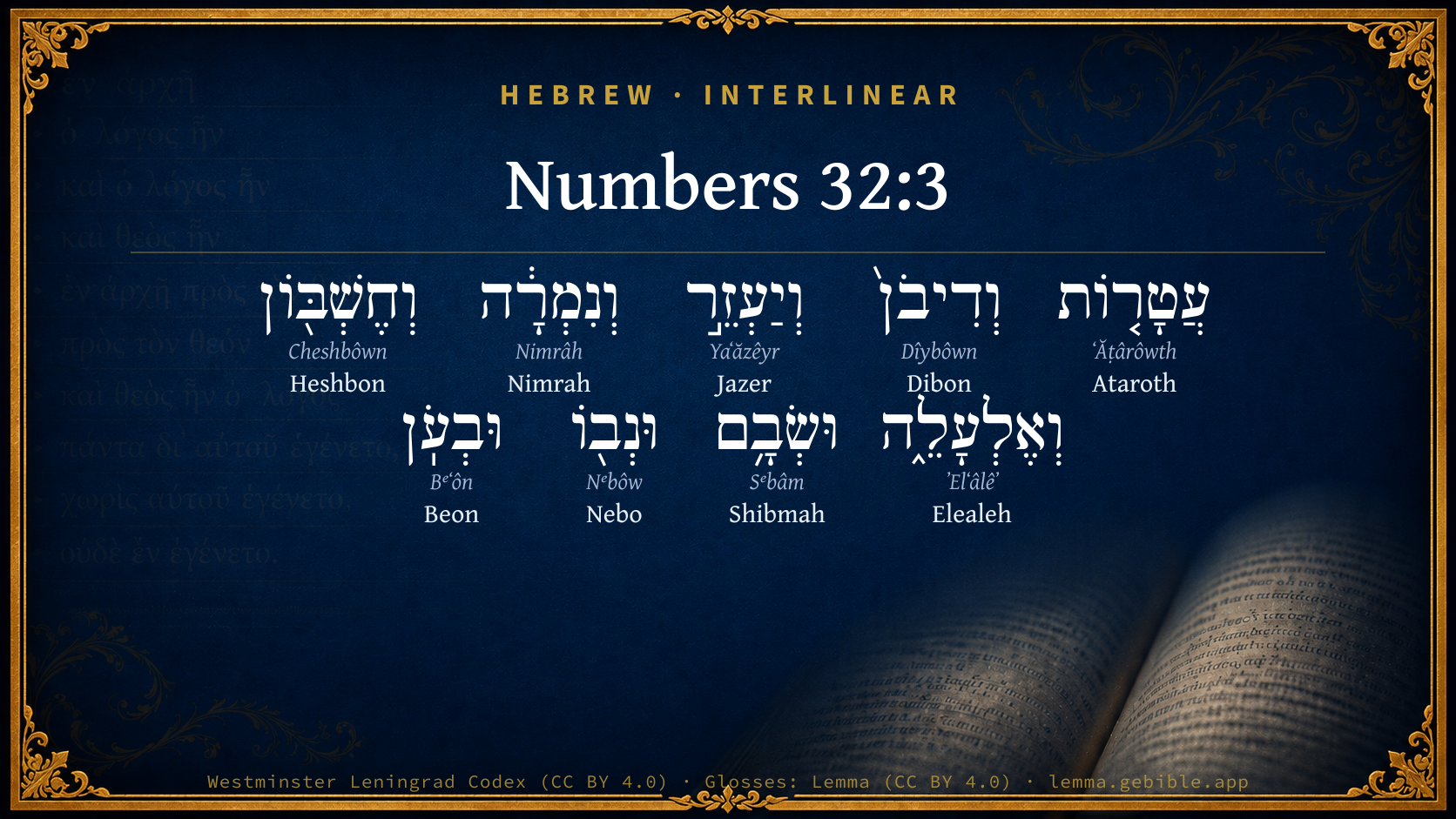
Numbers 32:3

Hebrew (Westminster Leningrad Codex) Numbers 32:3 appears in the Hebrew Old Testament. The text above is from the Westminster Leningrad Codex. Each word links to its Strong’s number, a concise gloss, and parsing drawn from the Open Scriptures Hebrew Bible morphology. Click any word for its full Brown-Driver-Briggs (BDB) entry.
Download image
Cite this verse

Numbers 32:3 (World English Bible). Public Domain. Lemma interlinear Bible study tool, https://lemma.gebible.app/v/numbers/32/3.

Show BibTeX & RIS
BibTeX
RIS
English Translation
Ataroth, and Dibon, and Jazer, and Nimrah, and Heshbon, and Elealeh, and Sebam, and Nebo, and Beon,
World English Bible · Public Domain
Highlights
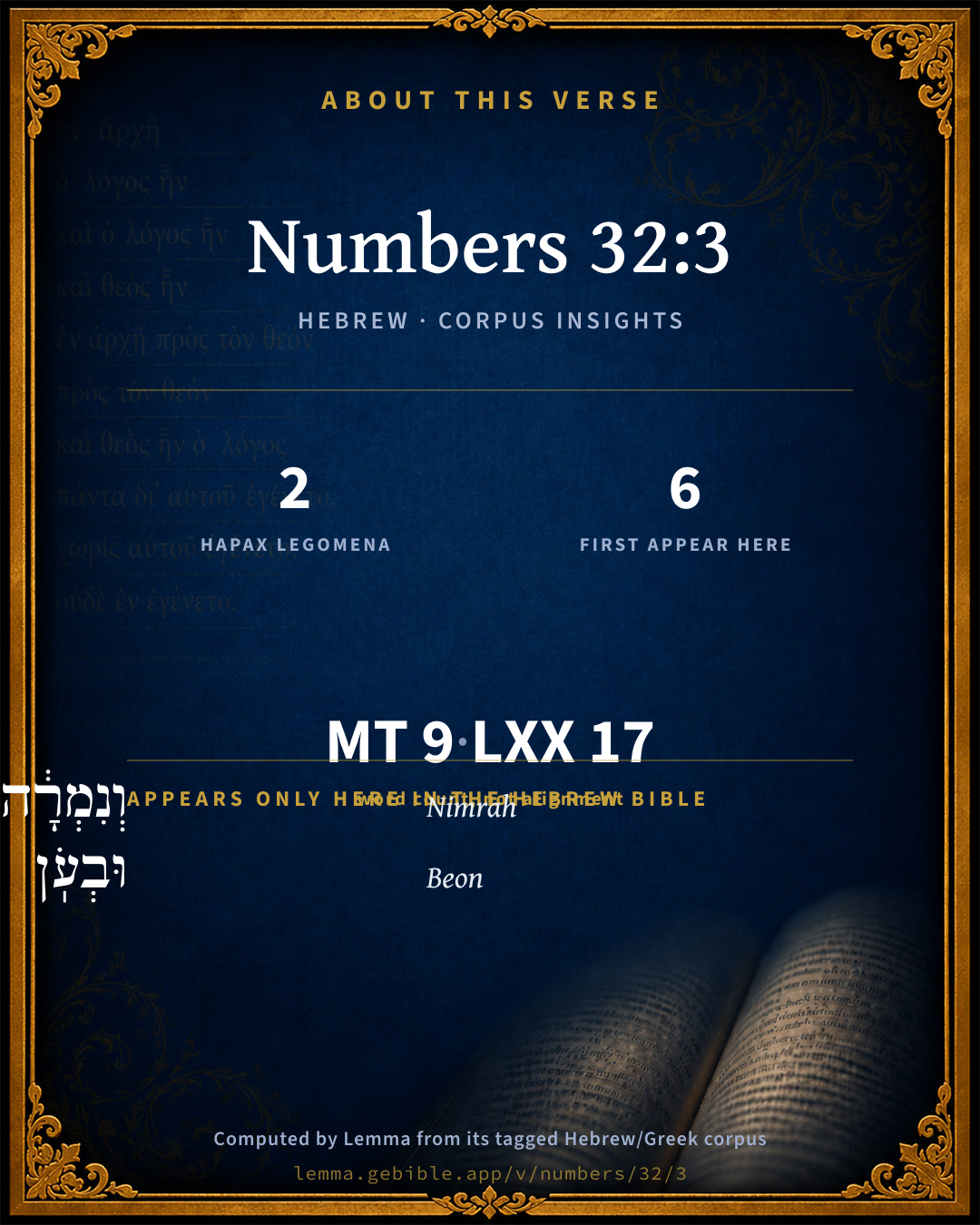
  • 2 hapax legomena — only here in the Hebrew Bible
  • 6 first appearances in the Hebrew Bible
Full analysis ↓
Download a study sheet

One document with this verse’s original text, its word-by-word gloss line, the meaning frame, cross-references with their text, attributed commentary, and full source and license credits — printable, and it pastes into notes with its structure intact.

This verse Autodidact and up

Study sheet (.html) Plain text (.txt)

A passage Seminary Student

Up to 50 verses in one chapter. A passage sheet keeps up to 6 commentary sources and 12 cross-references per verse, in the order this page ranks them, and says so on the sheet whenever that leaves anything out. Ask for a single verse and you get the Autodidact verse sheet above.

Everything on this page stays free to read, with no account — the sheet is a download of what is already on screen, not access to it.

Want to remove ads? Support Godless Engineer
Compare translations 3

The same verse in 3 English versions, stacked beneath the original-language interlinear above. Click any original word for its lexicon entry.

Each is an independent rendering of the whole verse — the interlinear is not word-aligned to these translations.

Highlighted words mark where these versions differ — a whole-verse word diff, not a word-by-word alignment.

  • World English Bible Public Domain
    Ataroth, and Dibon, and Jazer, and Nimrah, and Heshbon, and Elealeh, and Sebam, and Nebo, and Beon,
  • King James Version Public Domain
    Ataroth, and Dibon, and Jazer, and Nimrah, and Heshbon, and Elealeh, and Shebam, and Nebo, and Beon,
  • unfoldingWord Literal Text CC BY-SA 4.0
    “Ataroth, and Dibon, and Jazer, and Nimrah, and Heshbon, and Elealeh, and Sebam, and Nebo, and Beon

unfoldingWord Literal Text — © unfoldingWord, licensed CC BY-SA 4.0. Word-aligned USFM3 via Door43 (git.door43.org/unfoldingWord/en_ult).

Versions to compare (up to 4)

3 of 4 selected

Show all 18 translations

Every available English version of this verse, each an independent rendering of the whole verse.

  • World English Bible Public Domain
    Ataroth, and Dibon, and Jazer, and Nimrah, and Heshbon, and Elealeh, and Sebam, and Nebo, and Beon,
  • Berean Standard Bible Public Domain
    “Ataroth, Dibon, Jazer, Nimrah, Heshbon, Elealeh, Sebam, Nebo, and Beon,
  • Majority Standard Bible Public Domain
    “Ataroth, Dibon, Jazer, Nimrah, Heshbon, Elealeh, Sebam, Nebo, and Beon,
  • King James Version Public Domain
    Ataroth, and Dibon, and Jazer, and Nimrah, and Heshbon, and Elealeh, and Shebam, and Nebo, and Beon,
  • American Standard Version (1901) Public Domain
    Ataroth, and Dibon, and Jazer, and Nimrah, and Heshbon, and Elealeh, and Sebam, and Nebo, and Beon,
  • Revised Version (1885) Public Domain
    Ataroth, and Dibon, and Jazer, and Nimrah, and Heshbon, and Elealeh, and Sebam, and Nebo, and Beon,
  • Geneva Bible (1599) Public Domain
    The land of Ataroth, and Dibon, and Iazer, and Nimrah, and Heshbon, and Elealeh, and Shebam, and Nebo, and Beon,
  • Douay-Rheims (1899) Public Domain
    Ataroth, and Dibon, and Jazer, and Nemra, Hesebon, and Eleale, and Saban, and Nebo, and Beon,
  • Young's Literal Translation Public Domain
    `Ataroth, and Dibon, and Jazer, and Nimrah, and Heshbon, and Elealeh, and Shebam, and Nebo, and Beon --
  • Literal Standard Version CC BY-SA 4.0
    “Ataroth, and Dibon, and Jazer, and Nimrah, and Heshbon, and Elealeh, and Shebam, and Nebo, and Beon,
  • Unlocked Literal Bible CC BY-SA 4.0
    “This is a list of places we have surveyed: Ataroth, Dibon, Jazer, Nimrah, Heshbon, Elealeh, Sebam, Nebo, and Beon.
  • unfoldingWord Literal Text CC BY-SA 4.0
    “Ataroth, and Dibon, and Jazer, and Nimrah, and Heshbon, and Elealeh, and Sebam, and Nebo, and Beon
  • Darby Bible Public Domain
    Ataroth, and Dibon, and Jaazer, and Nimrah, and Heshbon, and Elaleh, and Sebam, and Nebo, and Beon,
  • World Messianic Bible Public Domain
    “Ataroth, Dibon, Jazer, Nimrah, Heshbon, Elealeh, Sebam, Nebo, and Beon,
  • Webster's Bible Public Domain
    Ataroth, and Dibon, and Jazer, and Nimrah, and Heshbon, and Elealeh, and Shebam, and Nebo, and Beon,
  • Free Bible Version CC BY-SA 4.0
    “The towns of Ataroth, Dibon, Jazer, Nimrah, Heshbon, Elealeh, Sebam, Nebo, and Beon,
  • Bible in Basic English Public Domain
    Ataroth, and Dibon, and Jazer, and Nimrah, and Heshbon, and Elealeh, and Sebam, and Nebo, and Beon,
  • JPS Tanakh (1917) Public Domain
    'Ataroth, and Dibon, and Jazer, and Nimrah, and Heshbon, and Elealeh, and Sebam, and Nebo, and Beon,

Literal Standard Version (2020), Covenant Press — licensed CC BY-SA 4.0. Text via the HelloAO Bible API (eBible.org). Unlocked Literal Bible (unfoldingWord) — licensed CC BY-SA 4.0. Text via the HelloAO Bible API (eBible.org). unfoldingWord Literal Text — © unfoldingWord, licensed CC BY-SA 4.0. Word-aligned USFM3 via Door43 (git.door43.org/unfoldingWord/en_ult). Free Bible Version, Dr. Jonathan Gallagher — licensed CC BY-SA 4.0. Text via the HelloAO Bible API (eBible.org).

Word by word

More ways to search: Search by grammar → Find every occurrence → Compare this word →

Practice this passage: Drill this verse → Learn its vocabulary →

About this verse

These counts appear in no published source. They are computed here, from the morphology-tagged text and Lemma’s own curated glosses. What Lemma adds →

9
words
9
distinct lemmas
Pentateuch
section

Notable vocabulary

2 hapax legomena — words that appear only here in the entire Hebrew Bible:

  • וְנִמְרָ֔ה Nimrah H5247
  • וּבְעֹֽן Beon H1194

First appearance in Scripture

These words make their first canonical appearance in the Hebrew Bible here:

  • עֲטָר֤וֹת Ataroth H5852
  • וְנִמְרָ֔ה Nimrah H5247
  • וְאֶלְעָלֵ֑ה Elealeh H500
  • וּשְׂבָ֥ם Shibmah H7643
  • וּנְב֖וֹ Nebo H5015
  • וּבְעֹֽן Beon H1194

Shared distinctive vocabulary

עֲטָר֤וֹת Ataroth H5852 occurs in 4 verses of the Hebrew Bible. Also found in:

Grammatical profile

  • 9 nouns

Hebrew & Septuagint length

In English translation the verse runs 17 words from the Hebrew and 17 from the Septuagint (LXX English) — the same length.

A rough comparison of the two English renderings, which tokenize alike — not a word-level alignment.

Word counts can differ between the Hebrew and the Greek without any difference in meaning — e.g. the Hebrew direct-object marker אֵת has no separate Greek word, and Greek often adds the article ὁ.

In the original languages it is 9 Hebrew tokens and 17 Greek tokens — but the two are counted differently (Hebrew bundles its prefixes and suffixes into one token; the Greek is in lemma form), so that isn’t a like-for-like length.

Cross-references

16

Topical passages linked to Numbers 32:3 in the Treasury of Scripture Knowledge — connected by theme and wording, ordered by reader-vote popularity; previews shown in the World English Bible.

  • Numbers 32:34–38 The children of Gad built Dibon, and Ataroth, and Aroer,
  • Joshua 13:17 Heshbon, and all its cities that are in the plain; Dibon, and Bamoth Baal, and Beth Baal Meon,
  • Isaiah 16:8–9 For the fields of Heshbon languish, [and] the vine of Sibmah; the lords of the nations have broken down the choice branches of it, which reached even to Jazer, which wandered into the wilderness; its shoots were spread abroad, they passed over the sea.
  • Jeremiah 48:34 From the cry of Heshbon even to Elealeh, even to Jahaz have they uttered their voice, from Zoar even to Horonaim, to Eglath Shelishiyah: for the waters of Nimrim also shall become desolate.
  • Numbers 21:25–26 Israel took all these cities: and Israel lived in all the cities of the Amorites, in Heshbon, and in all the towns of it.
  • Numbers 21:28 For a fire is gone out of Heshbon, A flame from the city of Sihon: It has devoured Ar of Moab, The lords of the high places of the Arnon.
  • Numbers 32:1 Now the children of Reuben and the children of Gad had a very great multitude of cattle: and when they saw the land of Jazer, and the land of Gilead, that behold, the place was a place for cattle;
  • Joshua 13:19 and Kiriathaim, and Sibmah, and Zereth-shahar in the mount of the valley,
  • Judges 11:26 While Israel lived in Heshbon and its towns, and in Aroer and its towns, and in all the cities that are along by the side of the Arnon, three hundred years; why didn't you recover them within that time?
  • Nehemiah 9:22 Moreover you gave them kingdoms and peoples, which you did allot after their portions: so they possessed the land of Sihon, even the land of the king of Heshbon, and the land of Og king of Bashan.
  • Isaiah 15:2–4 They are gone up to Bayith, and to Dibon, to the high places, to weep: Moab wails over Nebo, and over Medeba; on all their heads is baldness, every beard is cut off.
  • Isaiah 15:6 For the waters of Nimrim shall be desolate; for the grass is withered away, the tender grass fails, there is no green thing.
  • Jeremiah 48:2 The praise of Moab is no more; in Heshbon they have devised evil against her: Come, and let us cut her off from being a nation. You also, Madmen, shall be brought to silence: the sword shall pursue you.
  • Jeremiah 48:22–23 and on Dibon, and on Nebo, and on Beth Diblathaim,
  • Jeremiah 48:32 With more than the weeping of Jazer will I weep for you, vine of Sibmah: your branches passed over the sea, they reached even to the sea of Jazer: on your summer fruits and on your vintage the destroyer is fallen.
  • Jeremiah 48:45 Those who fled stand without strength under the shadow of Heshbon; for a fire is gone forth out of Heshbon, and a flame from the midst of Sihon, and has devoured the corner of Moab, and the crown of the head of the tumultuous ones.

Cross-references courtesy of OpenBible.info (CC BY 4.0).

Hebrew and Greek witnesses Masoretic Hebrew ↔ Greek Septuagint

The same verse in the two great witnesses to the Old Testament, shown verse-for-verse.

These are two independent witnesses, not word-aligned to each other, and the Septuagint is shown in lemma (dictionary) form.

Hebrew Numbers 32:3 Masoretic · Westminster Leningrad Codex

עֲטָר֤וֹת וְדִיבֹן֙ וְיַעְזֵ֣ר וְנִמְרָ֔ה וְחֶשְׁבּ֖וֹן וְאֶלְעָלֵ֑ה וּשְׂבָ֥ם וּנְב֖וֹ וּבְעֹֽן

Ataroth, and Dibon, and Jazer, and Nimrah, and Heshbon, and Elealeh, and Sebam, and Nebo, and Beon,

World English Bible · Public Domain

Greek LXX Numbers 32:3 Septuagint · lemma form

αταρωθ καί δαιβων καί ιαζηρ καί ναμβρα καί εσεβων καί ελεαλη καί σεβαμα καί ναβαυ καί βαιαν

Ataroth, and Daebon, and Jazer, and Namra, and Esebon, and Eleale, and Sebama, and Nabau, and Baean,

LXX2012 (modern English Septuagint) · Public Domain

Hebrew: Westminster Leningrad Codex (CC BY 4.0). Greek: Septuagint (public domain); English from LXX2012 (modern English Septuagint) (Public Domain). How the Septuagint differs from the Hebrew →

Targum (Aramaic paraphrase)

2

The Targum is the ancient Jewish Aramaic paraphrase of the Hebrew Scriptures — an interpretive translation, not the Hebrew text itself. Onkelos (literal) and Pseudo-Jonathan (expansive) render the Torah, and Jonathan the Prophets. Coverage is partial: where no permissively-licensed English translation exists for a verse, only the Aramaic is shown. This is verse-level text, not a word-by-word alignment to the Hebrew.

  1. Targum Onkelos Torah (Genesis–Deuteronomy)
    מַכְלֶלְתָּא וּמַלְבֶּשְׁתָּא וְכוּמְרִין וּבֵית נִמְרִין וּבֵית חוּשְׁבָּנָא וּבַעֲלֵי דְבָבָא וְסִימָא וּבֵית קְבוּרְתָּא דְמשֶׁה וּבְעוֹן

    (no public-domain English translation for this verse)

    Targum Onkelos — Aramaic: “Onkelos Genesis” (public domain); “Onkelos Exodus” (public domain); “Onkelos Leviticus” (public domain); “Onkelos Numbers” (public domain); “Onkelos Deuteronomy” (public domain). English: “Sefaria Community Translation” (CC0 1.0 (public-domain dedication)); “J.W. Etheridge. The Targums of Onkelos and Jonathan Ben Uzziel on the Pentateuch. London: Longmans, Green, 1862” (public domain). Text via Sefaria.

  2. Targum Pseudo-Jonathan Torah (Genesis–Deuteronomy)
    מַכְלֶלְתָּא וּמַדְבֶּשְׁתָּא מַכְוַור וּבֵית נִמְרֵי וּבֵית חוּשְׁבָּנֵי מַעֲלַת מְרָא שִׁירַן וּבֵית קְבוּרְתֵּיהּ דְמשֶׁה וּבְעוֹן

    Makelta, Madbeshta, Mikvar, Beth Nimre, Beth Hoshbane, Maalath Meda, Shiran, Beth Kebureth, de Moshe, and Behon,

    Targum Pseudo-Jonathan — Aramaic: “Targum Jonathan on Genesis” (public domain); “Targum Jonathan on Exodus” (public domain); “Targum Jonathan on Leviticus” (public domain); “Targum Jonathan on Numbers” (public domain); “Targum Jonathan on Deuteronomy” (public domain). English: “The Targum of Jonathan ben Uzziel, trans. J. W. Etheridge, London, 1862” (public domain). Text via Sefaria.

Commentary

Notes on Numbers 32:3 from classic Christian and Jewish commentators (each source and its license shown beneath its notes). The classic Christian expositions comment on the surrounding passage and are grouped to its opening verse, so a note may address several verses; the Jewish commentaries on the Tanakh (Rashi and others) are per-verse, so they appear only where the commentator wrote on this verse.

Lemma curates 59 commentaries, every one of them public domain or Creative Commons licensed, each selected and text-cleaned for this edition rather than reprinted as found. About our sources →

Keil & Delitzsch

C. F. Keil & F. Delitzsch

In Num 32:3 the country is more distinctly defined by the introduction of the names of a number of important towns, whilst the clause "the country which the Lord smote before the congregation of Israel," in which the defeat of Sihon is referred to, describes it as one that was without a ruler, and therefore could easily be taken possession of. For more minute remarks as to the towns themselves, see at Num 32:34. On the construction את יתּן, see at Gen 4:18. - The words, "let us not go over the Jordan," may be understood as expressing nothing more than the desire of the speakers not to receive their inheritance on the western side of the Jordan, without their having any intention of withdrawing their help from the other tribes in connection with the conquest of Canaan, according to their subsequent declaration (Num 32:16.); but they may also be understood as expressing a wish to settle at once in the land to the east of the Jordan, and leave the other tribes to conquer Canaan alone. Moses understood them in the latter sense (Num 32:6.), and it is probable that this was their meaning, as, when Moses reproved them, the speakers did not reply that they had not cherished the intention attributed to them, but simply restricted themselves to the promise of co-operation in the conquest of Canaan. But even in this sense their request did not manifest "a shamelessness that would hardly be historically true" (Knobel). It may very well be explained from the opinion which they cherished, and which is perfectly intelligible after the rapid and easy defeat of the two mighty kings of the Amorites, Sihon and Og, that the remaining tribes were quite strong enough to conquer the land of Canaan on the west of the Jordan. But for all that, the request of the Reubenites and Gadites did indicate an utter want of brotherly feeling, and complete indifference to the common interests of the whole nation, so that they thoroughly deserved the reproof which they received from Moses.

Keil & Delitzsch — Biblical Commentary on the Old Testament (1861–1891) — public domain (CC PDM 1.0). Text via the HelloAO Bible API. (Old Testament only.)

Tyndale Open Study Notes

Tyndale Open Resources

32:3 Reuben, Gad, and half of Manasseh settled in the land that Israel had recently captured from Sihon the Amorite and Og of Bashan (cp. 21:21-35). • Ataroth, Dibon, Jazer, Nimrah, Heshbon, and Elealeh have been linked with archaeological sites. • The location of Sibmah is unknown. • Though the location of a town called Nebo is unknown, it was certainly near a mountain or ridge of that same name, which was located along the escarpment that rises above the northern end of the Dead Sea. • The site named Beon is almost certainly the place called “Baal-meon” in 32:38, which probably corresponds to the ruins at Ma’in.

Tyndale Open Study Notes — © Tyndale Open Resources, licensed CC BY-SA 4.0. Text via the HelloAO Bible API.

Adam Clarke's Commentary

Verse 3. Ataroth, and Dibon, &c.] The places mentioned here belonged to Sihon, king of the Amorites, and Og, king of Bashan, which being conquered by the Israelites, constituted ever after a part of their territories, Nu 32:33.

Adam Clarke's Commentary on the Bible (1810–1826) — public domain. Text from a community e-Sword/MySword module.

The Cambridge Bible for Schools and Colleges

gen. ed. J. J. S. Perowne

3. All these names recur in Num_32:34-38, three of them in a slightly different form (see R.V. marg.). Beon is probably a mere scribal slip for Meon.

The Cambridge Bible for Schools and Colleges (gen. ed. J. J. S. Perowne; Cambridge University Press, 1878–1918) — public domain. Text from a community e-Sword module.

John Gill's Exposition

Even the county which the Lord smote before the congregation of Israel,.... In which the above cities were, and perhaps some others not named: this was now in the hands of the people of Israel, being subdued by them, the conquest of which is ascribed unto the Lord, for the victory was of him; it was he that smote their enemies; and delivered their country into their hands; and now Moses, Eleazar, and the princes of the congregation, being the representatives of the people, had a right to dispose of it, and, which these two tribes request might be given to them, because, say they:

it is a land for cattle, and thy servants have cattle; to stock it, with and great numbers of them; see

John Gill's Exposition of the Whole Bible (1746–1763) — public domain (CC PDM 1.0). Text via the HelloAO Bible API.

Albert Barnes' Notes on the Bible

See Num 32:34-38 notes.

Albert Barnes' Notes on the Bible (1834–1885) — public domain. Text from a community e-Sword/MySword module.

Haydock's Catholic Bible Commentary

Saban, and Nebo. These towns were afterwards retaken by the Moabites, Isaias xv. 2, 8. --- Beon. Perhaps the same with Mehon, or Beth Baal Mehon, Josue xiii. 17. (Calmet)

George Leo Haydock (1774–1849), Haydock's Catholic Family Bible and Commentary, 1859 edition — public domain. Excludes Psalms (Douay-Rheims chapter numbering differs from Protestant) and Deuterocanonical books (Catholic canon only).

Matthew Poole's English Annotations

Ataroth; different from that Ataroth, Jos 16:2,7, which was on the other side of Jordan.

Nimrah, called Beth-nimrah, Num 22:36; Jos 13:27; and the waters of Nimrim, Isa 15:6. Shebam, called Shibmah, Num 32:38.

Beon which is thought to be the same place called Baal-meon, Num 32:38, and Beth-meon, Jer 48:23.

Matthew Poole's English Annotations on the Holy Bible (1683–1685) — public domain. Text from a community e-Sword/MySword module.

Whedon's Commentary on the Bible

Daniel D. Whedon

3. Ataroth — Hebrew, crowns. There were several cities of this name.

This was probably in the land of Jazer. It has not been identified.

Dibon — Jos_13:17, note. Nimrah occurs only here. Modern research has not yet identified it. There are several places east of the Jordan whose names resemble this.

Heshbon — Jos_13:17, note.

Elealeh — The extensive ruins of this place are still to be seen, bearing very nearly their ancient name, El-A’al, signifying the high, about a mile north of Heshbon on the summit of a rounded hill. Shebam is probably the same as Shibmah, Num_32:38, and Sibmah, Jos_13:19, note.

Nebo — This town was rebuilt by Reuben. It does not occur in the list of his towns (Jos_13:15-23) unless it be under another name, as is intimated in Num_32:38. Nebo being the name of a heathen god would naturally be changed after its conquest by Israel.

Beon — Baal-meon, Num_32:38, changed, probably to eliminate the pagan association, to Beth-meon, Jer_48:23. It was Moabite in Ezekiel’s day, and named as one of the cities which are “the glory of the country.” The site is still known. “Taking a sweep on the fine turf to the south-east,” (from Heshbon,) says Tristram, “we passed by the ruins of Ma’in, (Baal-meon,) shapeless and featureless, at which a cursory glance was sufficient.”

Daniel D. Whedon (gen. ed.), Commentary on the Old and New Testaments (1874–1909) — public domain. Text from a community e-Sword module.

The Pulpit Commentary

Ataroth. As to the nine places here mentioned, see on verses 34-38. They all lie to the south of Gilead, properly so called, within a comparatively short distance of the route by which the main body of the Israelites had advanced. Probably the cattle which followed the host were still grazing under guard around these places, and it was very natural that tribes which had hitherto lived closely crowded together should not at first contemplate spreading themselves very far a field.

The Pulpit Commentary (1880–1919), ed. H.D.M. Spence-Jones & Joseph S. Exell — public domain. Text from a community e-Sword module.

Rashi

Rabbi Shlomo Yitzchaki (Rashi)

עטרות ודיבון וגו׳ ATOROTH AND DIBON etc. — These belonged to the land of Sihon and Og.

Rashi on the Tanakh — English translations: “The Judaica Press complete Tanach with Rashi, translated by A. J. Rosenberg” (CC BY 4.0); “Pentateuch with Rashi's commentary by M. Rosenbaum and A.M. Silbermann, 1929-1934” (public domain); “The Metsudah Tanach series, Lakewood, N.J” (CC BY 4.0); and “The Book of Joshua, Metsudah Publications, 1997” (CC BY 4.0). Text via Sefaria.

Sforno

Rabbi Ovadia Sforno

Ataros, Divon. Each one of them alone was an area for livestock.

Sforno on the Tanakh — English translation: “Yalkut, Sifsei Chachomim Chumash, Metsudah Publications, 2009” (CC BY 4.0). Text via Sefaria.

Lesson kit

Teaching starters — assembled from the data on this page, not authored interpretation. Every prompt links to the verse data it draws on. Edit before teaching.

Numbers, in the Pentateuch, opens this verse with 9 words (9 distinct Hebrew lemmas). Its most distinctive word is Nimrâh (“Nimrah”). A historical commentator’s framing appears above. Read the whole chapter for the surrounding context.

Discussion questions

  1. How does “Nimrah” (Nimrâh) shape what this verse is saying?
  2. This verse holds 2 words here found nowhere else in the Hebrew Bible. What might the rare words draw attention to?
  3. 6 words here appear for the first time in Scripture. What is being introduced at this debut?
  4. Numbers 32:34 shares the word «Ataroth» with this verse. How do the two illuminate each other?
  5. These translations render this verse differently; the difference is in the English rendering, not the original. What questions does that raise?
  6. Reading how Keil & Delitzsch and Tyndale Open Study Notes read this verse, where do the two commentators agree and where do they part?

Things to notice

Reading settings

Reading text

Shown beneath each verse's original-language words.

Old Testament
Old Testament edition

Read the OT as the Masoretic Hebrew (MT) or the Greek Septuagint (LXX).

English shown for the Greek Septuagint (in the Hebrew ↔ Greek comparison).

Comparing translations? Open the Compare panel on any verse page to stack up to four side by side.