
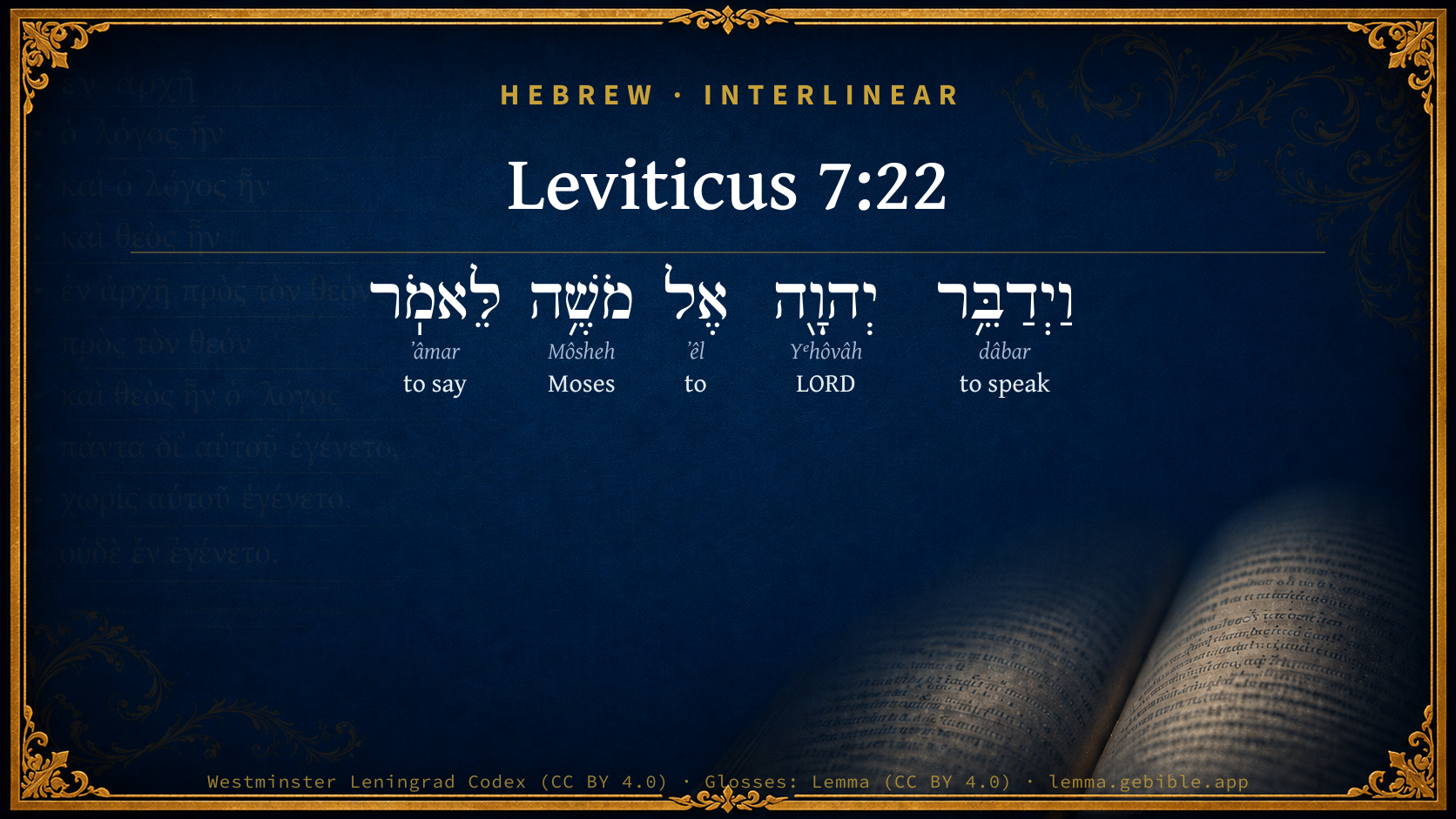
Leviticus 7:22

Hebrew (Westminster Leningrad Codex) Leviticus 7:22 appears in the Hebrew Old Testament. The text above is from the Westminster Leningrad Codex. Each word links to its Strong’s number, a concise gloss, and parsing drawn from the Open Scriptures Hebrew Bible morphology. Click any word for its full Brown-Driver-Briggs (BDB) entry.
Download image
Cite this verse

Leviticus 7:22 (World English Bible). Public Domain. Lemma interlinear Bible study tool, https://lemma.gebible.app/v/leviticus/7/22.

Show BibTeX & RIS
BibTeX
RIS
English Translation
Yahweh spoke to Moses, saying,
World English Bible · Public Domain
Download a study sheet

One document with this verse’s original text, its word-by-word gloss line, the meaning frame, cross-references with their text, attributed commentary, and full source and license credits — printable, and it pastes into notes with its structure intact.

This verse Autodidact and up

Study sheet (.html) Plain text (.txt)

A passage Seminary Student

Up to 50 verses in one chapter. A passage sheet keeps up to 6 commentary sources and 12 cross-references per verse, in the order this page ranks them, and says so on the sheet whenever that leaves anything out. Ask for a single verse and you get the Autodidact verse sheet above.

Everything on this page stays free to read, with no account — the sheet is a download of what is already on screen, not access to it.

Want to remove ads? Support Godless Engineer
Compare translations 3

The same verse in 3 English versions, stacked beneath the original-language interlinear above. Click any original word for its lexicon entry.

Each is an independent rendering of the whole verse — the interlinear is not word-aligned to these translations.

Highlighted words mark where these versions differ — a whole-verse word diff, not a word-by-word alignment.

  • World English Bible Public Domain
    Yahweh spoke to Moses, saying,
  • King James Version Public Domain
    And the LORD spake unto Moses, saying,
  • unfoldingWord Literal Text CC BY-SA 4.0
    And Yahweh spoke to Moses, saying,

unfoldingWord Literal Text — © unfoldingWord, licensed CC BY-SA 4.0. Word-aligned USFM3 via Door43 (git.door43.org/unfoldingWord/en_ult).

Versions to compare (up to 4)

3 of 4 selected

Show all 18 translations

Every available English version of this verse, each an independent rendering of the whole verse.

  • World English Bible Public Domain
    Yahweh spoke to Moses, saying,
  • Berean Standard Bible Public Domain
    Then the LORD said to Moses,
  • Majority Standard Bible Public Domain
    Then the LORD said to Moses,
  • King James Version Public Domain
    And the LORD spake unto Moses, saying,
  • American Standard Version (1901) Public Domain
    And Jehovah spake unto Moses, saying,
  • Revised Version (1885) Public Domain
    And the LORD spake unto Moses, saying,
  • Geneva Bible (1599) Public Domain
    Againe ye Lord spake vnto Moses, saying,
  • Douay-Rheims (1899) Public Domain
    And the Lord spoke to Moses, saying:
  • Young's Literal Translation Public Domain
    And Jehovah speaketh unto Moses, saying,
  • Literal Standard Version CC BY-SA 4.0
    And YHWH speaks to Moses, saying,
  • Unlocked Literal Bible CC BY-SA 4.0
    Then Yahweh spoke to Moses, saying,
  • unfoldingWord Literal Text CC BY-SA 4.0
    And Yahweh spoke to Moses, saying,
  • Darby Bible Public Domain
    And Jehovah spoke to Moses, saying,
  • World Messianic Bible Public Domain
    The LORD spoke to Moses, saying,
  • Webster's Bible Public Domain
    And the LORD spoke to Moses, saying,
  • Free Bible Version CC BY-SA 4.0
    The Lord told Moses,
  • Bible in Basic English Public Domain
    And the Lord said to Moses,
  • JPS Tanakh (1917) Public Domain
    And the LORD spoke unto Moses, saying:

Literal Standard Version (2020), Covenant Press — licensed CC BY-SA 4.0. Text via the HelloAO Bible API (eBible.org). Unlocked Literal Bible (unfoldingWord) — licensed CC BY-SA 4.0. Text via the HelloAO Bible API (eBible.org). unfoldingWord Literal Text — © unfoldingWord, licensed CC BY-SA 4.0. Word-aligned USFM3 via Door43 (git.door43.org/unfoldingWord/en_ult). Free Bible Version, Dr. Jonathan Gallagher — licensed CC BY-SA 4.0. Text via the HelloAO Bible API (eBible.org).

Word by word

More ways to search: Search by grammar → Find every occurrence → Compare this word →

Practice this passage: Drill this verse → Learn its vocabulary →

About this verse

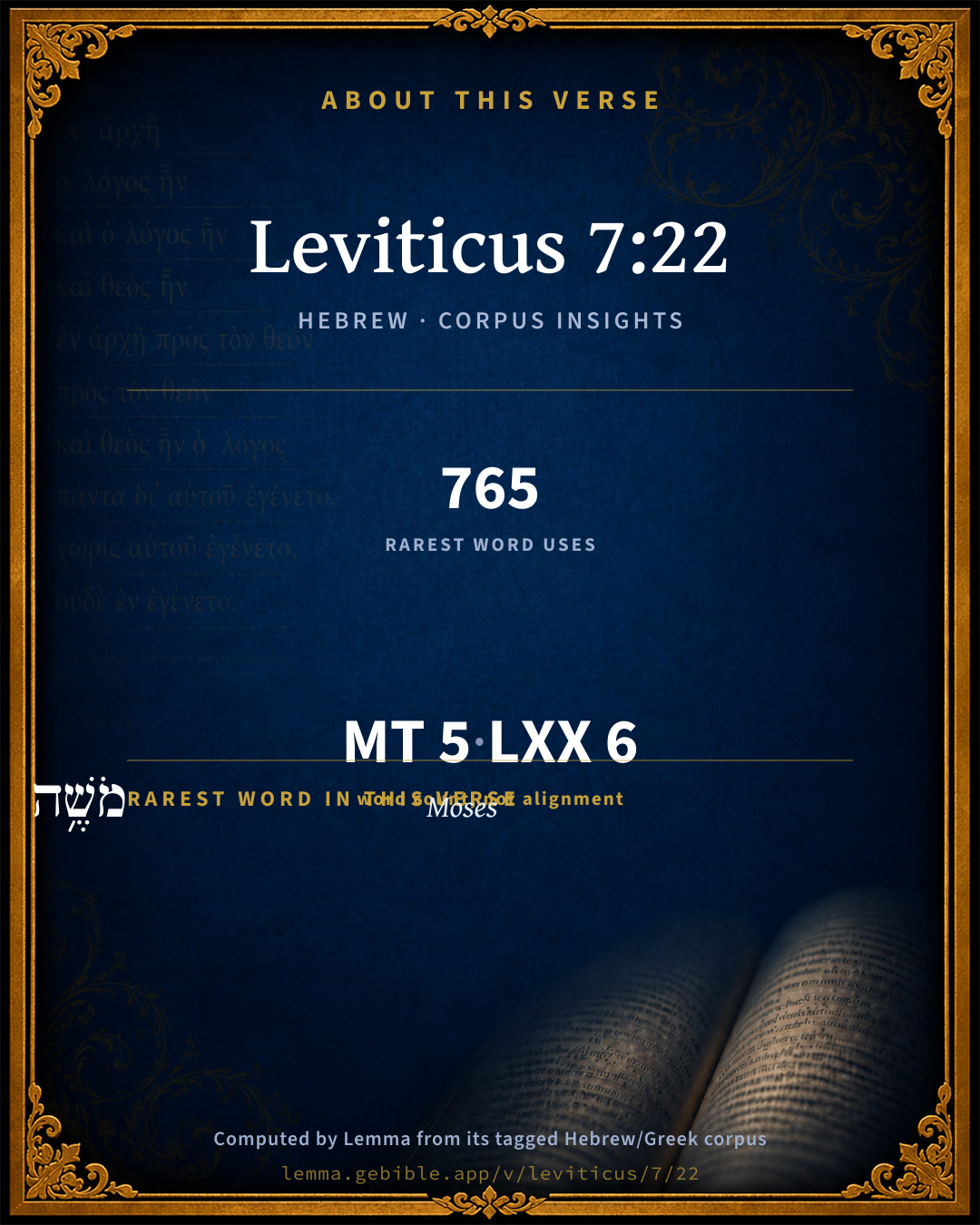
These counts appear in no published source. They are computed here, from the morphology-tagged text and Lemma’s own curated glosses. What Lemma adds →

5
words
5
distinct lemmas
Pentateuch
section

Grammatical profile

  • 2 verbs
  • 2 nouns
  • 1 preposition

Verb forms

  • וַיְדַבֵּ֥ר Piel · Sequential Imperfect
  • לֵּאמֹֽר Qal · Infinitive Construct

Hebrew & Septuagint length

In English translation the verse runs 5 words from the Hebrew and 19 from the Septuagint (LXX English) — the Septuagint runs noticeably longer here. See the side-by-side →

A rough comparison of the two English renderings, which tokenize alike — not a word-level alignment.

Word counts can differ between the Hebrew and the Greek without any difference in meaning — e.g. the Hebrew direct-object marker אֵת has no separate Greek word, and Greek often adds the article ὁ.

In the original languages it is 5 Hebrew tokens and 6 Greek tokens — but the two are counted differently (Hebrew bundles its prefixes and suffixes into one token; the Greek is in lemma form), so that isn’t a like-for-like length.

Hebrew and Greek witnesses Masoretic Hebrew ↔ Greek Septuagint

The same verse in the two great witnesses to the Old Testament, shown verse-for-verse.

Here the Septuagint runs noticeably longer than the Hebrew — LXX2012 (modern English Septuagint) 19 words vs World English Bible 5. A rough length comparison of the two English translations, not a word-level alignment — read both below.

These are two independent witnesses, not word-aligned to each other, and the Septuagint is shown in lemma (dictionary) form.

Hebrew Leviticus 7:22 Masoretic · Westminster Leningrad Codex

וַיְדַבֵּ֥ר יְהוָ֖ה אֶל מֹשֶׁ֥ה לֵּאמֹֽר

Yahweh spoke to Moses, saying,

World English Bible · Public Domain

Greek LXX Leviticus 7:22 Septuagint · lemma form

καί λαλέω κύριος πρός μωυσῆς λέγω

and you⌃ shall give the right shoulder for a choice piece to the priest of your sacrifices of peace-offering.

LXX2012 (modern English Septuagint) · Public Domain

Hebrew: Westminster Leningrad Codex (CC BY 4.0). Greek: Septuagint (public domain); English from LXX2012 (modern English Septuagint) (Public Domain). How the Septuagint differs from the Hebrew →

Targum (Aramaic paraphrase)

2

The Targum is the ancient Jewish Aramaic paraphrase of the Hebrew Scriptures — an interpretive translation, not the Hebrew text itself. Onkelos (literal) and Pseudo-Jonathan (expansive) render the Torah, and Jonathan the Prophets. Coverage is partial: where no permissively-licensed English translation exists for a verse, only the Aramaic is shown. This is verse-level text, not a word-by-word alignment to the Hebrew.

  1. Targum Onkelos Torah (Genesis–Deuteronomy)
    וּמַלֵיל יְיָ עִם מֹשֶׁה לְמֵימָר

    (no public-domain English translation for this verse)

    Targum Onkelos — Aramaic: “Onkelos Genesis” (public domain); “Onkelos Exodus” (public domain); “Onkelos Leviticus” (public domain); “Onkelos Numbers” (public domain); “Onkelos Deuteronomy” (public domain). English: “Sefaria Community Translation” (CC0 1.0 (public-domain dedication)); “J.W. Etheridge. The Targums of Onkelos and Jonathan Ben Uzziel on the Pentateuch. London: Longmans, Green, 1862” (public domain). Text via Sefaria.

  2. Targum Pseudo-Jonathan Torah (Genesis–Deuteronomy)
    וּמַלֵיל יְיָ עִם משֶׁה לְמֵימָר

    And the Lord spake with Mosheh, saying:

    Targum Pseudo-Jonathan — Aramaic: “Targum Jonathan on Genesis” (public domain); “Targum Jonathan on Exodus” (public domain); “Targum Jonathan on Leviticus” (public domain); “Targum Jonathan on Numbers” (public domain); “Targum Jonathan on Deuteronomy” (public domain). English: “The Targum of Jonathan ben Uzziel, trans. J. W. Etheridge, London, 1862” (public domain). Text via Sefaria.

Commentary

Notes on Leviticus 7:22 from classic Christian and Jewish commentators (each source and its license shown beneath its notes). The classic Christian expositions comment on the surrounding passage and are grouped to its opening verse, so a note may address several verses; the Jewish commentaries on the Tanakh (Rashi and others) are per-verse, so they appear only where the commentator wrote on this verse.

Lemma curates 59 commentaries, every one of them public domain or Creative Commons licensed, each selected and text-cleaned for this edition rather than reprinted as found. About our sources →

Ellicott's Commentary for English Readers

(22) And the Lord spake unto Moses.—This formula introduces a fresh communication made to the lawgiver (Lev_7:22-27), containing explanations and restrictions of the precept laid down in Lev_3:17, about the fat and blood of animals. The section before us, therefore, supplements and expands the previous law upon the same subject, just as the foregoing section supplemented and expanded the regulations about the different sacrifices.

A Bible Commentary for English Readers, edited by Charles John Ellicott (1878–1897) — public domain. Text from a community e-Sword module.

Trapp's Complete Commentary

John Trapp

Lev 7:22 And the LORD spake unto Moses, saying,

Ver. 22. And the Lord spake unto Moses.] This is oft repeated to draw attention and get authority. See 1Th 2:13.

John Trapp, A Commentary or Exposition upon All the Books of the Old and New Testament (1647–1656) — public domain. Text from a community e-Sword module.

Keil & Delitzsch

C. F. Keil & F. Delitzsch

On the other hand, "the soul which eats flesh of the peace-offering, and his uncleanness is upon him (for "whilst uncleanness is upon him;" the suffix is to be understood as referring to נפשׁ construed as a masculine, see Lev 2:1), "shall be cut off" (see Gen 17:14). This was to be done, whether the uncleanness arose from contact with an unclean object (any unclean thing), or from the uncleanness of man (cf. ch. 12-15), or from an unclean beast (see at Lev 11:4-8), or from any other unclean abomination. שׁקץ, abomination, includes the unclean fishes, birds, and smaller animals, to which this expression is applied in Lev 11:10-42 (cf. Eze 8:10 and Isa 66:17). Moreover contact with animals that were pronounced unclean so far as eating was concerned, did not produce uncleanness so long as they were alive, or if they had been put to death by man; but contact with animals that had died a natural death, whether they belonged to the edible animals or not, that is to say, with carrion (see at Lev 11:8).

There is appended to these regulations, as being substantially connected with them, the prohibition of fat and blood as articles of food (Lev 7:22-27). By "the fat of ox, or of sheep, or of goat," i.e., the three kinds of animals used in sacrifice, or "the fat of the beast of which men offer a firing to Jehovah" (Lev 7:25), we are to understand only those portions of fat which are mentioned in Lev 3:3-4, Lev 3:9; not fat which grows in with the flesh, nor the fat portions of other animals, which were clean but not allowed as sacrifices, such as the stag, the antelope, and other kinds of game.

Keil & Delitzsch — Biblical Commentary on the Old Testament (1861–1891) — public domain (CC PDM 1.0). Text via the HelloAO Bible API. (Old Testament only.)

Tyndale Open Study Notes

Tyndale Open Resources

7:22-27 In the sacrificial system, the fat and blood of all altar offerings belonged to God. They were offered before any of the sacrifice could be eaten. Consuming blood was specifically forbidden because it represented the very life of the animal (17:10-16). The injunction against eating fat might have been because fat, considered to be the best part of the offering, belonged to God.

Tyndale Open Study Notes — © Tyndale Open Resources, licensed CC BY-SA 4.0. Text via the HelloAO Bible API.

Jamieson, Fausset & Brown

Robert Jamieson, A. R. Fausset & David Brown

Ye shall eat no manner of fat--(See on Lev 3:17).

Jamieson, Fausset & Brown — Commentary Critical and Explanatory on the Whole Bible (1871) — public domain (CC PDM 1.0). Text via the HelloAO Bible API.

The Cambridge Bible for Schools and Colleges

gen. ed. J. J. S. Perowne

Fat and Blood prohibited (22–27)

The Peace-Offering being the only sacrifice which was partly consumed by the offerer, any rule as to portions of the animal that were not to be eaten would appropriately be added to the regulations concerning this sacrifice. Accordingly, in ch. 3, which treats of the Peace-Offering, the prohibition of fat and blood occurs in a short form (Lev_7:17). It is repeated here in connexion with the preceding regulations about Peace-Offerings. The fat which is prohibited is that contained in the portions reserved as an offering made by fire unto the Lord, described at length in chs. 3, 4 and Lev_7:3-5. They were the same in the Peace-, Guilt-, and Sin-Offerings. The ordinary fat found with the flesh was not forbidden. Lev_7:25 explains that the portions which in a sacrifice are set apart for the Lord must not be consumed as food by man, even when the animals were not suitable to be offered on the altar, as in the case of that which dieth of itself, or is torn of beasts. If the animal were fit to be offered, according to Lev_17:4-5, it must when killed be brought before the Lord, and these portions would be burnt on the altar by the priest. The prohibition extends only to the ox, sheep, or goat, i.e. to the animals which were brought for sacrifice, but the prohibition of blood (Lev_7:26) is more general. No manner of blood may be eaten, whether of fowl or beast. It is of permanent obligation (Lev_3:17).

The command is given to Noah, Gen_9:4 (P), and is repeated in this book, Lev_17:10-14. Cp. 1Sa_14:32-34. The prohibition of blood was enforced among the Arabs by Mohammed. See J. M. Rodwell’s Koran2, Sur. 2. [xci. The Cow] 168.

The Cambridge Bible for Schools and Colleges (gen. ed. J. J. S. Perowne; Cambridge University Press, 1878–1918) — public domain. Text from a community e-Sword module.

John Gill's Exposition

Speak unto the children of Israel, saying,.... Putting them in mind, by repeating to them the laws concerning fat and blood, Lev 3:17.

ye shall eat no manner of fat; of any creature fit for food, whose flesh otherwise may be eaten, and particularly

of ox, or of sheep, or of goats: creatures used in sacrifice; though this is not to be restrained to such of them, and the fat of them that were sacrificed, whose fat was claimed by the Lord as his, and was burnt on his altar; but this is to be understood of the fat of these creatures when killed for their common use, for the food of them and their families; the fat even of these was not to be eaten; that which was not separated from the flesh, but mixed with it, might be eaten, but not that which was separated (l).

(l) Bechai in Lev. 3. 17.

John Gill's Exposition of the Whole Bible (1746–1763) — public domain (CC PDM 1.0). Text via the HelloAO Bible API.

The Pulpit Commentary

Vers. 22-27. Repetition of the prohibition of eating the fat and the blood, addressed to the people in the midst of the instructions to the priests. Ye shall eat no manner of fat must be taken to mean none of the fat already specified, that is, the internal fat, and, in the case of the sheep, the tail; It is uncertain whether the law as to fat was regarded as binding upon the Israelites after they had settled in Palestine. Probably it was silently abrogated; but the prohibition of Mood was undoubtedly perpetual, (Deu_12:16) and it is based on a principle which does not apply to the fat. (Lev_17:11)

Vers. 22-27. Instructions for the people on the fat and on the blood.

The prohibition of fat was to secure the rights of Jehovah from invasion. The fat was a gift sanctified to God. The prohibition of the blood was to keep up the idea of atonement, the blood being regarded as the soul of the animal which God had appointed as the medium of atonement for the soul of man. Here is

I THE SUPREMACY OF THE DIVINE CLAIMS.

1. The recognition by the conscience in doctrine, in the place religion holds in the life.

2. The social state should be regulated on this principle. Man must not invade God"s rights if he would retain God"s blessing. Observance of the sabbath. The law of nations rests on the Law of God.

3. The individual believer will take care that he robs God of nothing. His service demands the fat, the choicest faculties, the deepest feelings, the largest gifts.

II THE RIGHTEOUSNESS OF GOD MADE THE RIGHTEOUSNESS OF MAN. Life for life. The blood sanctified, the blood saved. On the foundation of a perfect reconciliation alone can a true humanity be preserved and developed. Mistake of the ancient Greeks in worshipping humanity unredeemed, leading to animalism, and eventually to the substitution of mere art for morality, therefore the degradation of humanity. The elevation of the soul is the elevation of the whole man; "Im ganzen, guten, schoenen resolut zu leben," is a motto only to be adopted in the Christian sense. "He that sayeth his life shall lose it;" he that offers it up to God shall redeem it. R.

The Pulpit Commentary (1880–1919), ed. H.D.M. Spence-Jones & Joseph S. Exell — public domain. Text from a community e-Sword module.

Kretzmann's Popular Commentary

Paul E. Kretzmann

The Eating of Fat And Blood Forbidden

v. 22. And the Lord spake unto Moses, saying,

v. 23. Speak unto the children of Israel, saying, Ye shall eat no manner of fat, of ox, or of sheep, or of goat. This seems to apply to the fat of the abdominal cavity in sacrificial animals only, Lev 3:17.

v. 24. And the fat of the beast that dieth of itself, its blood therefore not having a chance to drain out, and the fat of that which is torn with beasts, may be used in any other use, for purposes of every-day life; but ye shall in no wise eat of it, for animals that found their death in this manner were unclean and defiled those that ate of their flesh or of their fat.

v. 25. For whosoever eateth the fat of the beast, of which men offer an offering made by fire unto the Lord, the loose fat of the abdominal cavity, even the soul that eateth it shall be cut off from his people.

v. 26. Moreover, ye shall eat no manner of blood, a prohibition which had been given as early as the time of Noah, Gen 9:4; Cf Lev 3:17; Lev 17:10-14, whether it be of fowl or of beast, in any of your dwellings.

v. 27. Whatsoever soul it be that eateth any manner of blood, even that soul shall be cut off from his people. The blood was regarded as the bearer of the soul of the animal, and the latter had been set apart for the atonement of men; hence its great value and the strictness of the prohibition. As a holy people, the children of Israel were to avoid every form of defilement.

Paul E. Kretzmann, Popular Commentary of the Bible (1921–1924) — public domain. Text from a community e-Sword module.

unfoldingWord translationNotes

Door43 World Missions Community

Then Yahweh spoke to Moses, saying, "Speak to the people of Israel and say, 'You must eat no fat

This has a quotation within a quotation. A direct quotation can be stated as an indirect quotation. AT: "Then Yahweh spoke to Moses and told him to tell the people of Israel this: 'You must eat no fat" (See: Quotes Within Quotes and Direct and Indirect Quotations)

died without being a sacrifice

"died but was not a sacrifice"

the fat of an animal torn by wild animals

This can be translated in active form. AT: "the fat of an animal that wild animals killed" (See: Active or Passive)

may be used

This can be translated in active form. AT: "you may use" (See: Active or Passive)

translationWords

Yahweh

Moses

Israel

cow

ewe

goat

die

sacrifice

unfoldingWord translationNotes — © Distant Shores Media and the Door43 World Missions Community, licensed CC BY-SA 4.0. Source: git.door43.org/Door43/en_tn.

Lesson kit

Teaching starters — assembled from the data on this page, not authored interpretation. Every prompt links to the verse data it draws on. Edit before teaching.

Leviticus, in the Pentateuch, opens this verse with 5 words (5 distinct Hebrew lemmas). Its most distinctive word is Môsheh (“Moses”). The Greek Septuagint runs longer here. A historical commentator’s framing appears above. Read the whole chapter for the surrounding context.

Discussion questions

  1. What does “Moses” (Môsheh) contribute to the verse as a whole?
  2. The Septuagint runs longer here than the Hebrew. What might account for the difference?
  3. These translations render this verse differently. What is at stake in choosing one wording over another?
  4. «וַיְדַבֵּ֥ר» is a Piel Sequential Imperfect verb. How does that grammatical form shape the action described?
  5. Compare how Ellicott's Commentary for English Readers and Trapp's Complete Commentary read this verse. Where do they agree or differ?

Things to notice

Reading settings

Reading text

Shown beneath each verse's original-language words.

Old Testament
Old Testament edition

Read the OT as the Masoretic Hebrew (MT) or the Greek Septuagint (LXX).

English shown for the Greek Septuagint (in the Hebrew ↔ Greek comparison).

Comparing translations? Open the Compare panel on any verse page to stack up to four side by side.