
Lamentations 3:51

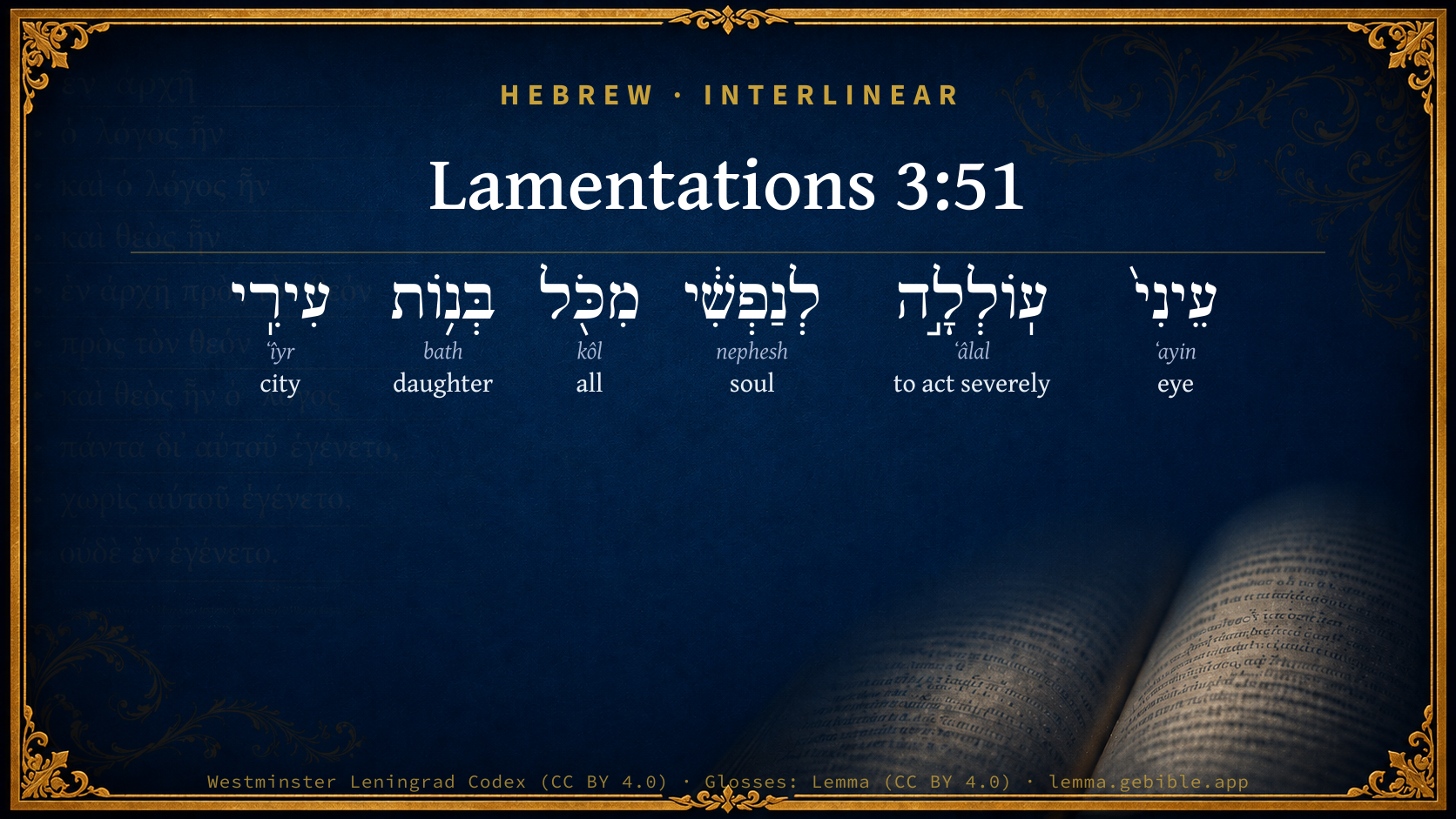
Hebrew (Westminster Leningrad Codex) Lamentations 3:51 appears in the Hebrew Old Testament. The text above is from the Westminster Leningrad Codex. Each word links to its Strong’s number, a concise gloss, and parsing drawn from the Open Scriptures Hebrew Bible morphology. Click any word for its full Brown-Driver-Briggs (BDB) entry.
Download image
Cite this verse

Lamentations 3:51 (World English Bible). Public Domain. Lemma interlinear Bible study tool, https://lemma.gebible.app/v/lamentations/3/51.

Show BibTeX & RIS
BibTeX
RIS
English Translation
My eye affects my soul, because of all the daughters of my city.
World English Bible · Public Domain
Download a study sheet

One document with this verse’s original text, its word-by-word gloss line, the meaning frame, cross-references with their text, attributed commentary, and full source and license credits — printable, and it pastes into notes with its structure intact.

This verse Autodidact and up

Study sheet (.html) Plain text (.txt)

A passage Seminary Student

Up to 50 verses in one chapter. A passage sheet keeps up to 6 commentary sources and 12 cross-references per verse, in the order this page ranks them, and says so on the sheet whenever that leaves anything out. Ask for a single verse and you get the Autodidact verse sheet above.

Everything on this page stays free to read, with no account — the sheet is a download of what is already on screen, not access to it.

Want to remove ads? Support Godless Engineer
Compare translations 3

The same verse in 3 English versions, stacked beneath the original-language interlinear above. Click any original word for its lexicon entry.

Each is an independent rendering of the whole verse — the interlinear is not word-aligned to these translations.

Highlighted words mark where these versions differ — a whole-verse word diff, not a word-by-word alignment.

  • World English Bible Public Domain
    My eye affects my soul, because of all the daughters of my city.
  • King James Version Public Domain
    Mine eye affecteth mine heart because of all the daughters of my city.
  • unfoldingWord Literal Text CC BY-SA 4.0
    My eye brings grief to my soul because of all the daughters of my city. TSADHE

unfoldingWord Literal Text — © unfoldingWord, licensed CC BY-SA 4.0. Word-aligned USFM3 via Door43 (git.door43.org/unfoldingWord/en_ult).

Versions to compare (up to 4)

3 of 4 selected

Show all 18 translations

Every available English version of this verse, each an independent rendering of the whole verse.

  • World English Bible Public Domain
    My eye affects my soul, because of all the daughters of my city.
  • Berean Standard Bible Public Domain
    My eyes bring grief to my soul because of all the daughters of my city.
  • Majority Standard Bible Public Domain
    My eyes bring grief to my soul because of all the daughters of my city.
  • King James Version Public Domain
    Mine eye affecteth mine heart because of all the daughters of my city.
  • American Standard Version (1901) Public Domain
    Mine eye affecteth my soul, because of all the daughters of my city.
  • Revised Version (1885) Public Domain
    Mine eye affecteth my soul, because of all the daughters of my city.
  • Geneva Bible (1599) Public Domain
    Mine eye breaketh mine heart because of all the daughters of my citie.
  • Douay-Rheims (1899) Public Domain
    Ain. My eye hath wasted my soul because of all the daughters of my city.
  • Young's Literal Translation Public Domain
    My eye affecteth my soul, Because of all the daughters of my city.
  • Literal Standard Version CC BY-SA 4.0
    My eye affects my soul, || Because of all the daughters of my city.
  • Unlocked Literal Bible CC BY-SA 4.0
    My eyes cause me grief because of all the daughters of my city.
  • unfoldingWord Literal Text CC BY-SA 4.0
    My eye brings grief to my soul because of all the daughters of my city. TSADHE
  • Darby Bible Public Domain
    Mine eye affecteth my soul, because of all the daughters of my city.
  • World Messianic Bible Public Domain
    My eye affects my soul, because of all the daughters of my city.
  • Webster's Bible Public Domain
    My eye affecteth my heart because of all the daughters of my city.
  • Free Bible Version CC BY-SA 4.0
    What I've seen torments me because of what's happened to all the women in my city.
  • Bible in Basic English Public Domain
    The Lord is unkind to my soul, more than all the daughters of my town.
  • JPS Tanakh (1917) Public Domain
    Mine eye affected my soul, because of all the daughters of my city.

Literal Standard Version (2020), Covenant Press — licensed CC BY-SA 4.0. Text via the HelloAO Bible API (eBible.org). Unlocked Literal Bible (unfoldingWord) — licensed CC BY-SA 4.0. Text via the HelloAO Bible API (eBible.org). unfoldingWord Literal Text — © unfoldingWord, licensed CC BY-SA 4.0. Word-aligned USFM3 via Door43 (git.door43.org/unfoldingWord/en_ult). Free Bible Version, Dr. Jonathan Gallagher — licensed CC BY-SA 4.0. Text via the HelloAO Bible API (eBible.org).

Word by word

More ways to search: Search by grammar → Find every occurrence → Compare this word →

Practice this passage: Drill this verse → Learn its vocabulary →

עֽוֹלְלָ֣ה
ʻâlal
H5953
“to act severely”
Verb, Poel, Perfect, 3rd Person, Feminine, Singular
Part of Speech
Verb
Stem
Poel
Form
Perfect
Person
3rd Person
Gender
Feminine
Number
Singular
Full BDB Definition

Origin: a primitive root

TWOT: 1627 , 1627b , 1628

to act severely, deal with severely, make a fool of someone - (Poel) to act severely - (Poal) to be severely dealt with - (Hithpael) to busy oneself, divert oneself, deal wantonly, deal - (Hithpoel) to practise practices, thrust forth (in wickedness) - (Poel) to glean - (Poel) to act or play the child - (Poel) to insert, thrust, thrust in, thrust upon ruthlessly, abuse (by thrusting through)
  1. עֵינִי֙ ʻayin H5869 “eye · my” Noun, Common, Both, Singular, Construct + Suffix, Personal, 1st Person, Common, Singular
  2. לְנַפְשִׁ֔י nephesh H5315 “to/for · soul · my” Preposition + Noun, Common, Both, Singular, Construct + Suffix, Personal, 1st Person, Common, Singular
  3. מִכֹּ֖ל kôl H3605 “from · all of” Preposition + Noun, Common, Masculine, Singular, Construct
  4. בְּנ֥וֹת bath H1323 “daughters of” Noun, Common, Feminine, Plural, Construct
  5. עִירִֽי ʻîyr H5892 “city · my” Noun, Common, Feminine, Singular, Construct + Suffix, Personal, 1st Person, Common, Singular

About this verse

These counts appear in no published source. They are computed here, from the morphology-tagged text and Lemma’s own curated glosses. What Lemma adds →

6
words
6
distinct lemmas
Prophets
section

Notable vocabulary

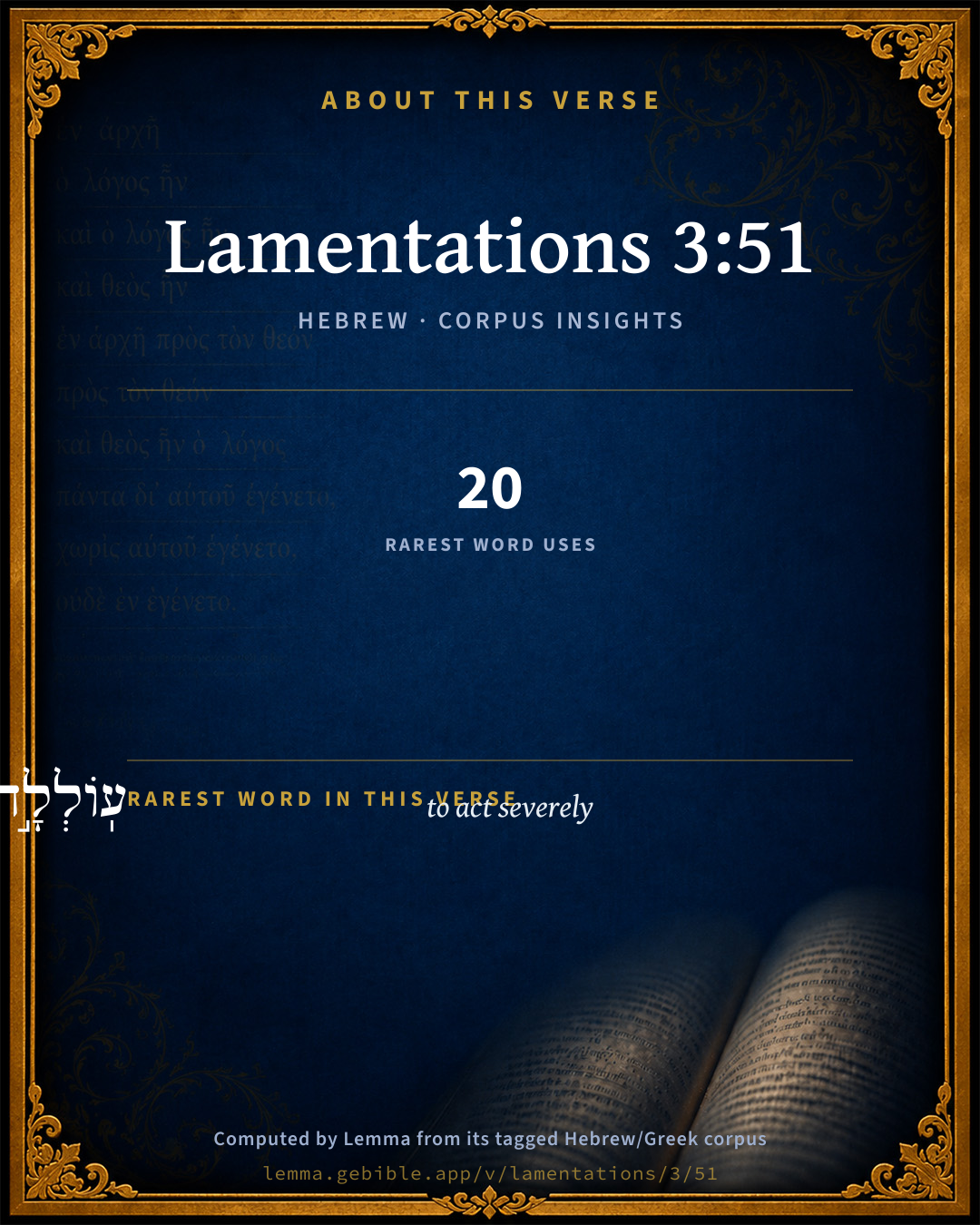
The rarest word here is עֽוֹלְלָ֣ה to act severely H5953 — appearing just 20 times in the whole Hebrew Bible.

Shared distinctive vocabulary

עֽוֹלְלָ֣ה to act severely H5953 occurs in 18 verses of the Hebrew Bible. Also found in:

Grammatical profile

  • 1 verb
  • 5 nouns

Verb forms

  • עֽוֹלְלָ֣ה Poel · Perfect

Hebrew & Septuagint length

In English translation the verse runs 13 words from the Hebrew and 15 from the Septuagint (LXX English) — closely comparable.

A rough comparison of the two English renderings, which tokenize alike — not a word-level alignment.

Word counts can differ between the Hebrew and the Greek without any difference in meaning — e.g. the Hebrew direct-object marker אֵת has no separate Greek word, and Greek often adds the article ὁ.

Cross-references

11

Topical passages linked to Lamentations 3:51 in the Treasury of Scripture Knowledge — connected by theme and wording, ordered by reader-vote popularity; previews shown in the World English Bible.

  • Jeremiah 19:9 I will cause them to eat the flesh of their sons and the flesh of their daughters; and they shall eat everyone the flesh of his friend, in the siege and in the distress, with which their enemies, and those who seek their life, shall distress them.
  • Luke 19:41–44 When he drew near, he saw the city and wept over it,
  • 1 Samuel 30:3–4 When David and his men came to the city, behold, it was burned with fire; and their wives, and their sons, and their daughters, were taken captive.
  • Jeremiah 4:19–21 My anguish, my anguish! I am pained at my very heart; my heart is disquieted in me; I can't hold my peace; because you have heard, O my soul, the sound of the trumpet, the alarm of war.
  • Jeremiah 11:22 therefore thus says Yahweh of hosts, Behold, I will punish them: the young men shall die by the sword; their sons and their daughters shall die by famine;
  • Jeremiah 14:16 The people to whom they prophesy shall be cast out in the streets of Jerusalem because of the famine and the sword; and they shall have none to bury them-them, their wives, nor their sons, nor their daughters: for I will pour their wickedness on them.
  • Jeremiah 14:18 If I go forth into the field, then, behold, the slain with the sword! and if I enter into the city, then, behold, those who are sick with famine! for both the prophet and the priest go about in the land, and have no knowledge.
  • Lamentations 1:18 Yahweh is righteous; for I have rebelled against his commandment: Please hear all you peoples, and see my sorrow: My virgins and my young men are gone into captivity.
  • Lamentations 2:21 The youth and the old man lie on the ground in the streets; My virgins and my young men are fallen by the sword: You have killed them in the day of your anger; you have slaughtered, [and] not pitied.
  • Lamentations 5:11 They ravished the women in Zion, The virgins in the cities of Judah.
  • Genesis 44:34 For how will I go up to my father, if the boy isn't with me? Lest I see the evil that will come on my father."

Cross-references courtesy of OpenBible.info (CC BY 4.0).

Hebrew and Greek witnesses Masoretic Hebrew ↔ Greek Septuagint

The same verse in the two great witnesses to the Old Testament, shown verse-for-verse.

These are two independent witnesses, not word-aligned to each other, and the Septuagint is shown in lemma (dictionary) form.

Hebrew Lamentations 3:51 Masoretic · Westminster Leningrad Codex

עֵינִי֙ עֽוֹלְלָ֣ה לְנַפְשִׁ֔י מִכֹּ֖ל בְּנ֥וֹת עִירִֽי

My eye affects my soul, because of all the daughters of my city.

World English Bible · Public Domain

Greek LXX Lamentations 3:51 Septuagint · lemma form

ὁ ὀφθαλμός ἐγώ ἐπιφυλλίζω ἐπί ὁ ψυχή ἐγώ παρά πᾶς θυγατήρ πόλις

My eye shall prey upon my soul, because of all the daughters of the city.

LXX2012 (modern English Septuagint) · Public Domain

Hebrew: Westminster Leningrad Codex (CC BY 4.0). Greek: Septuagint (public domain); English from LXX2012 (modern English Septuagint) (Public Domain). How the Septuagint differs from the Hebrew →

Commentary

Notes on Lamentations 3:51 from classic Christian and Jewish commentators (each source and its license shown beneath its notes). The classic Christian expositions comment on the surrounding passage and are grouped to its opening verse, so a note may address several verses; the Jewish commentaries on the Tanakh (Rashi and others) are per-verse, so they appear only where the commentator wrote on this verse.

Lemma curates 59 commentaries, every one of them public domain or Creative Commons licensed, each selected and text-cleaned for this edition rather than reprinted as found. About our sources →

Trapp's Complete Commentary

John Trapp

Lam 3:51 Mine eye affecteth mine heart because of all the daughters of my city.

Ver. 51. Mine eye affecteth my heart.] Iisdem quibus videmus oculis flemus, We see and weep with the same eyes. But Pliny {a} wondereth where that humour is at other times that floweth out of the eyes so readily and plentifully in case of grief.

Because of all the daughters of my city.] Or, Prae omnibus filiabus, ‘More than all the daughters,’ &c.; more than the most passionate women use to weep when they are most grieved.

{a} Lib. ii. cap. 32.

John Trapp, A Commentary or Exposition upon All the Books of the Old and New Testament (1647–1656) — public domain. Text from a community e-Sword module.

Keil & Delitzsch

C. F. Keil & F. Delitzsch

Lam 3:51, taken literally, runs thus: "Mine eye does evil to my soul" (עולל with ל signifies to inflict an injury on one, cause suffering, as in Lam 1:2, Lam 1:22; Lam 2:20), i.e., it causes pain to the soul, as the Chaldee has already paraphrased it. The expression does not merely signify "causes me grief" (Thenius, Gerlach); but the eye, weakened through incessant weeping, causes pain to the soul, inasmuch as the pain in the eye increases the pain in the soul, i.e., heightens the pain of the soul through the superaddition of physical pain (Ngelsbach). Ewald has quite missed the meaning of the verse in his translation, "Tears assail my soul," and in his explanatory remark that עוללה is used in a bad sense, like the Latin afficit; for, if עולל had this meaning, עיני could not stand for tears, because it is not the tears, but only the eyes weakened by weeping, that affect the soul with pain. Ewald is also wrong in seeking, with Grotius, to understand "the daughters of my city" as signifying the country towns, and to explain the phrase by referring to Lam 2:22. For, apart from the consideration that the appeal to Lam 2:22 rests on a false conception of that passage, the meaning attributed to the present verse is shown to be untenable by the very fact that the expression "daughters of my city" is never used for the daughter-towns of Jerusalem; and such a designation, however possible it might be in itself, would yet be quite incomprehensible in this present connection, where there is no other subject of lamentation, either before or after, than Jerusalem in its ruined condition, and the remnant of its inhabitants (Gerlach). "The daughters of my city" are the daughters of Jerusalem, the female portion of the inhabitants of the city before and after its destruction. Nor will what is added, "because of the daughters of my city," seem strange, if we consider that, even in Lam 1:4, Lam 1:18 and Lam 2:20-21, the fate and the wretched condition of the virgins of the city are mentioned as peculiarly deplorable, and that, in fact, the defenceless virgins were most to be pitied when the city fell; cf. Lam 5:11. But the objection of Bttcher and Thenius, that מכּל בּנות forms a harsh construction, whether we view it grammatically or in the light of the circumstances, inasmuch as מן, after "mine eye pains me," is unsuitable, whether taken in a causal or a comparative meaning: - this objection, certainly, has some truth in its favour, and tells against any attempt to take the words as indicating a comparison. but there is nothing against the causal meaning, if "mine eyes causes pain to my soul" merely signifies "my eye pains me," because the pain of the eye is the result of the profuse weeping. If those words, however, possess the meaning we have given above (the pain in the eyes increases the smart in the soul), then there is nothing strange at all in the thought, "The evil condition of the daughters of my city is so deplorable, that mine eyes fail through weeping, and the sorrow of my soul is thereby intensified." Gerlach has already refuted, though more fully than was necessary, the conjecture of Bttcher, that בּנות should be changed into בּכּות (from all the weeping of my city).

Keil & Delitzsch — Biblical Commentary on the Old Testament (1861–1891) — public domain (CC PDM 1.0). Text via the HelloAO Bible API. (Old Testament only.)

Geneva Bible (1599)

Geneva Bible translators

I am overcome with sore weeping for all my people.

Geneva Bible (1599) marginal notes — public domain. Text via Bolls.life.

Jamieson, Fausset & Brown

Robert Jamieson, A. R. Fausset & David Brown

eye affecteth mine heart--that is, causeth me grief with continual tears; or, "affecteth my life" (literally, "soul," Margin), that is, my health [GROTIUS].

daughters of . . . city--the towns around, dependencies of Jerusalem, taken by the foe.

Jamieson, Fausset & Brown — Commentary Critical and Explanatory on the Whole Bible (1871) — public domain (CC PDM 1.0). Text via the HelloAO Bible API.

Adam Clarke's Commentary

Verse 51. Mine eye affecteth mine heart] What I see I feel. I see nothing but misery; and I feel, in consequence, nothing but pain. There have been various translations of the original: but they all amount to this.

The daughters of my city.] The villages about Jerusalem.

Adam Clarke's Commentary on the Bible (1810–1826) — public domain. Text from a community e-Sword/MySword module.

John Calvin's Commentaries

He had said, that his eye flowed down, and then, that it was like a fountain, from which many streams or rivers flowed: he now adopts another mode of speaking, that his eyes grieved his soul; and it is a sign of the greatest sorrow when he who weeps seeks some relief, and is at the same time overpowered by that external feeling. For many indulge in grief and inflame themselves; then the soul of man is like a fan to rouse the burning. But when we weep and our eyes shed tears, and when the mind in a manner exhausts itself, it is a proof of the greatest grief. And this great. grief Jeremiah wished to express by saying, that his eye troubled or grieved his soul

The latter part is explained in two ways: sonic render thus, “Because of all the daughters of my city.” But though this meaning is generally taken, I yet prefer the opinion of those who render the words thus, “More than all the daughters of my city,” for מן, men, denotes a comparison, as it is also a causative. He says, then, that he was given to grief more than all the young women. As the female sex, as it is well known, are more tender and softer than men, the Prophet amplifies his lamentation by this comparison, that in weeping he exceeded all the young women of the city, so that he had almost forgotten his manhood. Had he said, the daughters of the people, it might be explained as before, as referring either to the cities, or to the whole people, that is, the whole community. But when he mentions all the daughters of his city, I cannot otherwise take the passage but as setting forth a comparison, that is, that he could not moderate his grief, but was so seized with it as women are, and also young girls, whose hearts, as it has been already said, are still more tender. The rest to-morrow.

John Calvin's Commentaries (1540-1563) — public domain. Text from the Calvin Translation Society English edition (1840s-50s) via the Christian Classics Ethereal Library (ccel.org). Calvin's coverage is partial (roughly two-thirds of the Bible); uncommented books and verses are honest gaps, never fabricated. The 19th-century editor's footnotes and remarks are omitted so the notes are faithfully Calvin's own voice.

Ellicott's Commentary for English Readers

(51) Affecteth.—Better, harmeth, or causeth grief to.

The daughters of my city.—The words have been understood (1) of the maidens of Jerusalem (comp. Lam_1:4; Lam_1:18; Lam_2:20-21); and (2) of the daughter-towns which looked to it as their metropolis. Of these (1) is preferable.

A Bible Commentary for English Readers, edited by Charles John Ellicott (1878–1897) — public domain. Text from a community e-Sword module.

The Cambridge Bible for Schools and Colleges

gen. ed. J. J. S. Perowne

51. affecteth my soul] The inflammation of eyes caused by continual weeping, or, better, the sights of misery on which he looks, add to his mental suffering.

the daughters of my city] either those whose untoward fate has been already lamented (Lam_1:4; Lam_1:18, Lam_2:10; Lam_2:21), or the villages, daughter towns of Jerusalem. For this sense cp. (with mg.) Num_21:25; Jos_17:11. In Psa_48:11 “daughters” has the same sense.

The Cambridge Bible for Schools and Colleges (gen. ed. J. J. S. Perowne; Cambridge University Press, 1878–1918) — public domain. Text from a community e-Sword module.

John Gill's Exposition

Thou hast heard my voice,.... Either in times past, when he cried unto him, and was delivered; and this was an encouragement to call upon him again in such extremity, who had shown himself to be a God hearing and answering prayer; hence it follows:

hide not thine ear at my breathing, at my cry; turn not a deaf ear to me, who hast been wont to hear me heretofore; stop not thine ear at my cry now, at my prayer, which he calls his "breathing"; prayer is the breath of a soul regenerated by the Spirit, and is a sign and evidence of life, when it is spiritual; in it a soul pants after God, and communion with him, and salvation by him. Some render it, "at my gasping" (s); or "panting", for breath; just ready to expire, unless immediate help is given: or else the whole of this refers to the present time, when the Lord heard and answered, not only the first clause, but this also; which may be rendered, not by way of petition, but affirmation, "thou didst not hide thine ear at my breathing, at my cry" (t); and this agrees both with what goes before, and with what is expressed in Lam 3:57.

(s) "ad anhelitum meum", Cocceius; "ad respirationem meam", Pagnius, Montanus, Junius & Tremellius, Piscator. (t) "non avertisti", Grotius.

John Gill's Exposition of the Whole Bible (1746–1763) — public domain (CC PDM 1.0). Text via the HelloAO Bible API.

Haydock's Catholic Bible Commentary

Wasted. Literally, "robbed." (Haydock) --- I have felt more for my people than they have themselves. Moral writers often product this text, to shew the dangers of an unguarded glance (Calmet) at women.

George Leo Haydock (1774–1849), Haydock's Catholic Family Bible and Commentary, 1859 edition — public domain. Excludes Psalms (Douay-Rheims chapter numbering differs from Protestant) and Deuterocanonical books (Catholic canon only).

Matthew Poole's English Annotations

The eye and the ear are those organs of the body, by which the soul exerciseth its senses to bring in all objects, whether pleasant or sad, to the understanding to judge of them, according to the judgment of which upon them it is affected with joy or sorrow, desire or aversation, &c.; and the eye is the chiefest of these, because its evidence is more certain, and less subject to deceit. The prophet and most of the Jews were eye-witnesses to the evils which had befallen the Jews, and which at present were upon them; so as their hearts were the more affected. The word translated

affect is by some noted to signify to waste and consume, which are the effects of a deep affecting the heart with sad and miserable objects. Because of all the daughters of my city: our margin tells us that it may be also read more than all the daughters of my city; according to which the sense is, that he was more affected with the state of Jerusalem than the tenderest woman that had lived in it: but it is as well, if not better, in this place rendered causally, showing the reason of his deep affliction, viz. all those miseries he had seen fall upon all the Jewish nation, or upon all the inhabitants of Jerusalem.

Matthew Poole's English Annotations on the Holy Bible (1683–1685) — public domain. Text from a community e-Sword/MySword module.

Whedon's Commentary on the Bible

Daniel D. Whedon

51. Mine eye affecteth, etc. — Literally, Mine eye does evil to my soul; that is, causeth pain to.

Because of all the daughters of my city — Ewald and others understand by this the country towns round about Jerusalem, but it is a sufficient reply to this to say, that this interpretation is wholly without warrant of usage. The margin has for “because,” more than; but this, though admissible as a translation, is not to be preferred. The obvious meaning is the true one. The condition of the virgin daughters of an oriental city which had fallen into the power of the enemy was in these brutal times peculiarly deplorable.

Daniel D. Whedon (gen. ed.), Commentary on the Old and New Testaments (1874–1909) — public domain. Text from a community e-Sword module.

The Pulpit Commentary

Affecteth mine heart; rather, paineth me; literally, paineth my soul, the soul being mentioned as the centre of the feelings and emotions. The daughters of my city. The sad fate of the virgins of Jerusalem oppressed the spirit of the writer. (comp. Lam_1:4, 18 2:10, 21)

The eye and the life.

"Mine eye affecteth mine heart." More correctly, "Mine eye paineth my soul, or my life;" that is, what I see, so melancholy is it, that it preys on my mind and undermines my health. Note

I THE EFFECT OF THE SENSES ON THE LIFE. The eye is more than an optical instrument. The effect produced by the image on the retina depends upon who it is that sees and what it is that he sees. Age, education, peculiarities of experience, will make all the difference. The very exercising of the senses was evidently intended to give pleasure. There is correspondence between the eye and the beautiful and sublime in nature; between the ear and melodious and harmonious sounds; and yet some peculiar experience may interpose, so that there shall no longer be beauty in the beautiful, melody in the melodious. What we get from the exercise of our senses will depend upon what we bring. The prophet saw desolation all around him where once there had been crowded and prosperous life. What could he do hut feel as if a broken heart would be the end of his thoughts? But the spoilers would look at the scene differently, for to them it was the place of enrichment and triumph.

II COMPENSATIONS FOR THE LOSS OF SENSE. Loss of vision is a serious matter to one whose intellect is full of life and activity, So Milton seems to have felt, judging from his touching references to his blindness in his poetry. But this makes it all the more needful to recollect the other side. The blind have exemptions from some pains. They do not see the painful sights of the streets: the drunkard, the ragged beggars, the weary faces weary with incessant struggling for a position or a livelihood. They can guess much of the trouble of the world, but many of the manifestations of that trouble they only know when they are told. We do well to keep in mind and rightly estimate the compensations for natural losses.

III RESPONSIBILITY FOR THE RIGHT USE OF OUR NATURAL POWERS. The expression of the prophet here indicates that he was in the right way. To have looked on such a scene with indifference or only mild regret would have argued a very wrong state of mind indeed. Surely in the judgment the question to many will be," What use did you make of your eyesight? Did you gather up impressions which made you feel how deep is the spiritual sickness of the world, how certain it is that only Christ can make the world better? And further, did you lend practical help to bring men within reach of the saving power of Christ?" To this extent it will be better in the day of judgment for many blind than for those who have gone through the smitten world with both eyes open and yet as if they did not see. Y.

The Pulpit Commentary (1880–1919), ed. H.D.M. Spence-Jones & Joseph S. Exell — public domain. Text from a community e-Sword module.

unfoldingWord translationNotes

Door43 World Missions Community

My eyes cause me grief

The phrase "My eyes" represents what he sees. AT: "What I see causes me to grieve" (See: Metonymy)

because of all the daughters of my city

It can be stated clearly that the "daughters of my city" are suffering. AT: "because the daughters of my city are suffering" or "because I see the daughters of my city suffering" (See: Assumed Knowledge and Implicit Information)

all the daughters of my city

Possible meanings are 1) the women of Jerusalem or 2) all the inhabitants of Jerusalem. (See: Idiom)

I have been hunted like a bird by those who were my enemies

The author speaks of people looking for him in order to kill him as if he were an animal that they were hunting. This can be stated in active form. AT: "My enemies have looked for me in order to kill me like people who hunt for a bird" (See: Metaphor)

They cast me into a pit

"They threw me into a pit" or "They dropped me into a well"

threw a stone on me

Possible meanings are 1) "threw stones down on me" or 2) "covered the pit with a stone"

they caused waters to overflow, covering my head

"the level of the water in the pit rose up over my head"

I have been cut off

Being "cut off" often represents being killed. Here it represents dying very soon. AT: "I am about to die" (See: Metaphor)

translationWords

adversary

cistern

cut off

unfoldingWord translationNotes — © Distant Shores Media and the Door43 World Missions Community, licensed CC BY-SA 4.0. Source: git.door43.org/Door43/en_tn.

Rashi

Rabbi Shlomo Yitzchaki (Rashi)

My eye sullies my soul more than all the daughters of my city Jeremiah was from a priestly family, and he said, “My eye, with its tears, sullies my face over myself more than all the daughters of my city.”

sullies Heb. עוֹלְלָה, an expression of sullying, like (Job 16:15): “and sullied (וְעוֹלַלְתִּי) my radiance.”

more than all the daughters of my city My family has more to cry for than all the daughters of the city, for it was chosen for sanctity and for the service of the Holy One, blessed be He, over all Israel.

Rashi on the Tanakh — English translations: “The Judaica Press complete Tanach with Rashi, translated by A. J. Rosenberg” (CC BY 4.0); “Pentateuch with Rashi's commentary by M. Rosenbaum and A.M. Silbermann, 1929-1934” (public domain); “The Metsudah Tanach series, Lakewood, N.J” (CC BY 4.0); and “The Book of Joshua, Metsudah Publications, 1997” (CC BY 4.0). Text via Sefaria.

Lesson kit

Teaching starters — assembled from the data on this page, not authored interpretation. Every prompt links to the verse data it draws on. Edit before teaching.

Lamentations, in the Prophets, opens this verse with 6 words (6 distinct Hebrew lemmas). Its most distinctive word is ʻâlal (“to act severely”). A historical commentator’s framing appears above. Read the whole chapter for the surrounding context.

Discussion questions

  1. How does “to act severely” (ʻâlal) shape what this verse is saying?
  2. Exodus 10:2 shares the word «to act severely» with this verse. How do the two illuminate each other?
  3. These translations render this verse differently; the difference is in the English rendering, not the original. What questions does that raise?
  4. The verb «עֽוֹלְלָ֣ה» is Poel Perfect. How does its form color the action?
  5. Reading how Trapp's Complete Commentary and Keil & Delitzsch read this verse, where do the two commentators agree and where do they part?

Things to notice

Reading settings

Reading text

Shown beneath each verse's original-language words.

Old Testament
Old Testament edition

Read the OT as the Masoretic Hebrew (MT) or the Greek Septuagint (LXX).

English shown for the Greek Septuagint (in the Hebrew ↔ Greek comparison).

Comparing translations? Open the Compare panel on any verse page to stack up to four side by side.