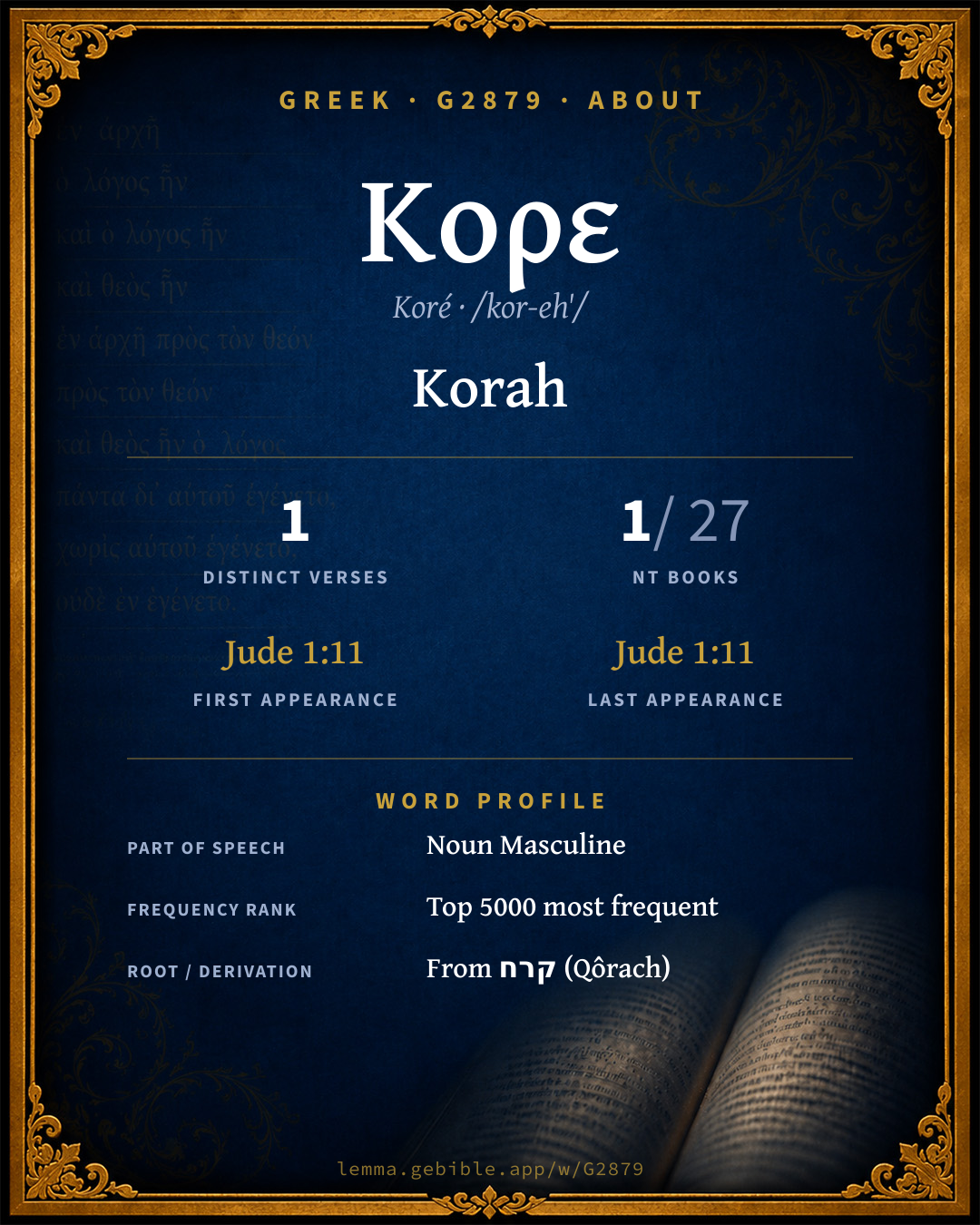
Κορέ
Korah
Thayer's lists 2 entries for ‘Korah’ fuller range ↓
Full lexicon entry — Thayer's Greek Lexicon
From Thayer's Greek Lexicon
Where this word appears
Every verse where G2879 appears — 1 distinct verse across 1 book. Click any verse to open its interlinear word-by-word view. Verse text shown in the World English Bible for context — . Each verse’s Greek form is shown with its reference; the English is not keyword-highlighted, since the data carries no word-level English alignment. Use “Compare translations” on any verse to read it across multiple English versions. This concordance covers the Greek New Testament; Septuagint (Greek Old Testament) occurrences of this word are not indexed here.
Jude 1 verse
About this entry
At a glance — auto-summarized from this page’s data, not written by a person. Every figure links to its source below. This summary describes the numbers; it doesn’t interpret them.
“Korah” is the headline sense of the Greek name Κορε (Koré). It is rare — just 1 verse in the entire Greek New Testament. More than three-quarters of its appearances fall in Jude. Found nowhere else but Jude 1:11. See 1-verse concordance and the renderings breakdown below.
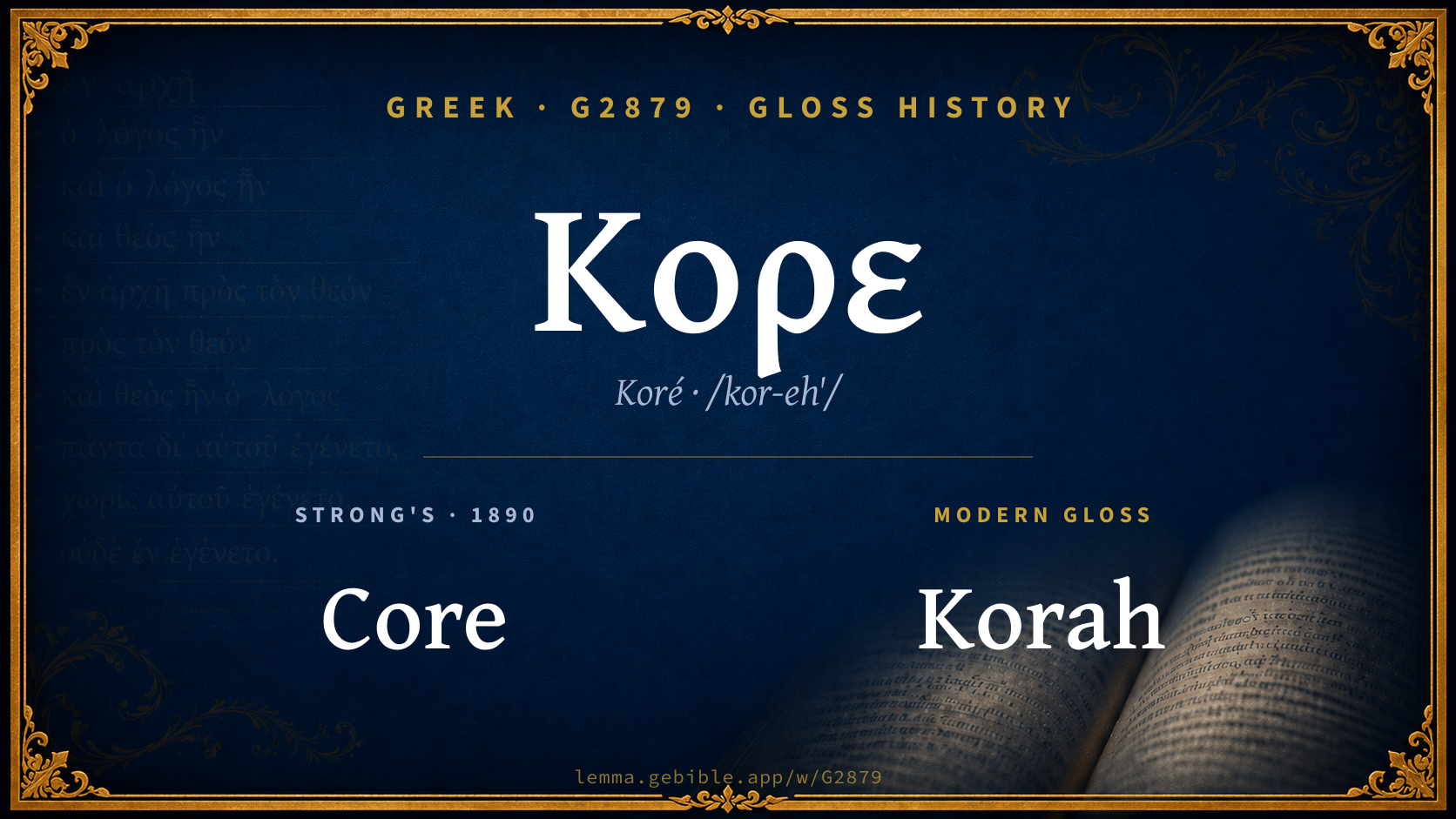
Gloss history
Strong's 1890 vs modern scholarship
About this word
Strong's G2879 catalogs a Greek word from the Greek New Testament.
These counts are not copied from any lexicon or concordance. They are computed here, from the morphology-tagged Greek New Testament. What Lemma adds →
- 1
- distinct verses
- The word appears in 1 distinct verse.
- 1 / 27
- NT books
- The word appears in 1 of 27 New Testament books.
- #3,503
- by frequency
- Top 5000 most frequent Greek words (rank 3,503 of 5,347 Greek words by occurrence).
View all 1 occurrence in the concordance →
Most concentrated in
- Jude 1 verse 100%
By section of the New Testament
By traditional corpus
Conventional, traditional groupings — biblical authorship is debated, so this is a traditional corpus grouping, not an authorship claim. Some books belong to more than one corpus (Luke is in both the Gospels and the Lukan corpus, and so on), so these shares overlap and need not total 100%. Each figure is a share of the word’s 1 distinct verse.
- General (Catholic) Epistles 1 verse · 100%
How translations render this word
Counts come from each version’s own published word-to-Strong’s tagging or interlinear alignment — an approximate guide to how each version renders this word, not a word-level alignment the data otherwise carries. Because each total is that version’s own tagged count, the per-version totals vary from one another and need not match the appearance or distinct-verse counts above. These counts may also differ from a printed concordance because Lemma counts each distinctly tagged rendering and does not collapse phrase taggings into a single head-word total. This is a fixed set of word-tagged versions (KJV, ASV, BSB, ULT) and does not change with the reading translation you choose elsewhere. Each version’s license is shown beside its name below (and on Sources).
- King James Version: Core 1×
- American Standard Version: Korah 1×
- Berean Standard Bible: Korah’s 1×
- unfoldingWord Literal Text: Korah 1×
King James Version Public Domain
Renders G2879 across 1 tagged occurrence — most commonly:
American Standard Version Public Domain
Renders G2879 across 1 tagged occurrence — most commonly:
Berean Standard Bible Public Domain
Renders G2879 across 1 tagged occurrence — most commonly:
unfoldingWord Literal Text CC BY-SA 4.0
Renders G2879 across 1 tagged occurrence — most commonly:
Senses in Thayer's
The 2 senses Thayer's distinguishes for this word, in lexicon order (not ranked by frequency or importance). The full entry — with sub-senses — is in the Lexicon Entry tab.
- Korah = "baldness"
- a man who, with others, rebelled against Moses
Word origin
Derived from קרח (Qôrach) (H7141) — Korah.
Of hebrew origin [ H7141 ]; Core (that is Korach ) an Israelite : - Core.
— Strong’s Exhaustive Concordance (1890), public domain.
Same root — word family
Other Thayer's entries built from the same root as G2879, grouped by Strong’s listed origin. These share a root / origin per the lexicon — not necessarily a shared meaning. Each links to that word’s own entry.
Derives from
Proper names from this root
People and places named from this root — a name, not an additional meaning of the word.
Compare all same-root words → 2 of the same-root words are proper names (people or places). They share a root, not necessarily a meaning.
Bible dictionary
Public-domain dictionary articles matched to this entry by name (Korah). A biblical name can be shared by more than one person or place, so an article may treat several.
Easton's Bible Dictionary · M. G. Easton, 1897
Ice, hail. (1.) The third son of Esau, by Aholibamah (Gen. 36:14; 1 Chr. 1:35).
(2.) A Levite, the son of Izhar, the brother of Amram, the father of Moses and Aaron (Ex. 6:21). The institution of the Aaronic priesthood and the Levitical service at Sinai was a great religious revolution. The old priesthood of the heads of families passed away. This gave rise to murmurings and discontent, while the Israelites were encamped at Kadesh for the first time, which came to a head in a rebellion against Moses and Aaron, headed by Korah, Dathan, and Abiram. Two hundred and fifty princes, "men of renown" i.e., well-known men from among the other tribes, joined this conspiracy. The whole company demanded of Moses and Aaron that the old state of things should be restored, alleging that "they took too much upon them" (Num. 16:1-3). On the morning after the outbreak, Korah and his associates presented themselves at the door of the tabernacle, and "took every man his censer, and put fire in them, and laid incense thereon." But immediately "fire from the Lord" burst forth and destroyed them all (Num. 16:35). Dathan and Abiram "came out and stood in the door of their tents, and their wives, and their sons, and their little children," and it came to pass "that the ground clave asunder that was under them; and the earth opened her mouth and swallowed them up." A plague thereafter began among the people who sympathized in the rebellion, and was only stayed by Aaron's appearing between the living and the dead, and making "an atonement for the people" (16:47).
The descendants of the sons of Korah who did not participate in the rebellion afterwards rose to eminence in the Levitical service.
Smith's Bible Dictionary · William Smith, 1863
(baldness).
+ Third son of Esau by Aholibamah. (Genesis 36:5,14,18; 1 Chronicles 1:35) He was born in Canaan before Esau migrated to Mount Seir, (Genesis 36:5-9) and was one of the "dukes" of Edom. (B.C. 1790.) + Another Edomitish "duke" of this name, sprung from Eliphaz, Esau's son of Adah. (Genesis 36:16) + One of the "sons of Hebron," in (1 Chronicles 2:43) + Son of Izhar the son of Kohath the son of Levi. He was leader of the famous rebellion against his cousins Moses and Aaron in the wilderness, for which he paid the penalty of perishing with his followers by an earthquake and flames of fire. (Numbers 16; 26:9-11) The particular grievance which rankled in the mind of Korah and his company was their exclusion from the office of the priesthood, and their being confined--those among them who were Levites-- to the inferior service of the tabernacle. Korah's position as leader in this rebellion was evidently the result of his personal character, which was that of a bold, haughty and ambitious man. (B.C. 1490.) In the New Testament (Jude 1:11) Korah is coupled with Cain and Balaam.
Hitchcock's Bible Names Dictionary · Roswell D. Hitchcock, 1869
baldness; ice; frost
Classic public-domain reference works; full attribution on Sources.
Septuagint usage
The same Greek word Κορε appears 42 times in the Greek Old Testament (Septuagint), across 41 verses in 6 books.
- 42
- LXX occurrences
- Tagged occurrences of this Greek word in the Septuagint.
- 41
- verses
- Distinct Septuagint verses containing this word.
- 6 / 39
- OT books
- The word appears in 6 of the 39 Old Testament books.
Sample Septuagint occurrences
- Genesis 36:5 κορε
- Exodus 6:21 κορε
- Numbers 16:1 κορε
- 1 Chronicles 1:23 κορε
- 2 Chronicles 20:19 κορε
- Psalms 41:1 κορε
Septuagint occurrences (same lexeme)
Every verse where the same Strong’s number (G2879) appears in the Greek Septuagint. Verse text shown in the World English Bible for context; the Greek form is the matched word — the English is not keyword-highlighted.
- Genesis 36:5 κορε Oholibamah bore Jeush, Jalam, and Korah. These are the sons of Esau, who were born to him in the land of Canaan.
- Genesis 36:14 κορε These were the sons of Oholibamah, the daughter of Anah, the daughter of Zibeon, Esau's wife: she bore to Esau Jeush, Jalam, and Korah.
- Genesis 36:16 κορε chief Korah, chief Gatam, chief Amalek: these are the chiefs who came of Eliphaz in the land of Edom; these are the sons of Adah.
- Genesis 36:18 κορε These are the sons of Oholibamah, Esau's wife: chief Jeush, chief Jalam, chief Korah: these are the chiefs who came of Oholibamah the daughter of Anah, Esau's wife.
- Exodus 6:21 κορε The sons of Izhar: Korah, and Nepheg, and Zichri.
- Exodus 6:24 κορε The sons of Korah: Assir, and Elkanah, and Abiasaph; these are the families of the Korahites.
- Exodus 38:22 κορε Bezalel the son of Uri, the son of Hur, of the tribe of Judah, made all that Yahweh commanded Moses.
- Numbers 16:1 κορε Now Korah, the son of Izhar, the son of Kohath, the son of Levi, with Dathan and Abiram, the sons of Eliab, and On, the son of Peleth, sons of Reuben, took [men]:
- Numbers 16:5 κορε and he spoke to Korah and to all his company, saying, In the morning Yahweh will show who are his, and who is holy, and will cause him to come near to him: even him whom he shall choose will he cause to come near to him.
- Numbers 16:6 κορε This do: take you censers, Korah, and all his company;
- Numbers 16:8 κορε Moses said to Korah, Hear now, you sons of Levi:
- Numbers 16:16 κορε Moses said to Korah, You and all your company go before Yahweh, you, and they, and Aaron, tomorrow:
- Numbers 16:19 κορε Korah assembled all the congregation against them to the door of the tent of meeting: and the glory of Yahweh appeared to all the congregation.
- Numbers 16:24 κορε Speak to the congregation, saying, Get away from around the tent of Korah, Dathan, and Abiram.
- Numbers 16:27 κορε So they got them up from the tent of Korah, Dathan, and Abiram, on every side: and Dathan and Abiram came out, and stood at the door of their tents, and their wives, and their sons, and their little ones.
- Numbers 16:32 κορε and the earth opened its mouth, and swallowed them up, and their households, and all the men who appertained to Korah, and all their goods.
- Numbers 17:5 κορε It shall happen, that the rod of the man whom I shall choose shall bud: and I will make to cease from me the murmurings of the children of Israel, which they murmur against you.
- Numbers 17:14 κορε
- Numbers 26:9 κορε The sons of Eliab: Nemuel, and Dathan, and Abiram. These are that Dathan and Abiram, who were called of the congregation, who strove against Moses and against Aaron in the company of Korah, when they strove against Yahweh,
- Numbers 26:10 κορε and the earth opened its mouth, and swallowed them up together with Korah, when that company died; what time the fire devoured two hundred fifty men, and they became a sign.
- Numbers 26:11 κορε Notwithstanding, the sons of Korah didn't die.
- Numbers 26:58 κορε These are the families of Levi: the family of the Libnites, the family of the Hebronites, the family of the Mahlites, the family of the Mushites, the family of the Korahites. Kohath became the father of Amram.
- Numbers 27:3 κορε Our father died in the wilderness, and he was not among the company of those who gathered themselves together against Yahweh in the company of Korah: but he died in his own sin; and he had no sons.
- 1 Chronicles 1:23 κορε and Ophir, and Havilah, and Jobab. All these were the sons of Joktan.
- 1 Chronicles 2:43 κορε The sons of Hebron: Korah, and Tappuah, and Rekem, and Shema.
- 1 Chronicles 6:7 κορε Meraioth became the father of Amariah, and Amariah became the father of Ahitub,
- 1 Chronicles 6:22 κορε The sons of Kohath: Amminadab his son, Korah his son, Assir his son,
- 1 Chronicles 9:19 κορε Shallum the son of Kore, the son of Ebiasaph, the son of Korah, and his brothers, of his father's house, the Korahites, were over the work of the service, keepers of the thresholds of the tent: and their fathers had been over the camp of Yahweh, keepers of the entry.
- 1 Chronicles 26:19 κορε These were the divisions of the doorkeepers; of the sons of the Korahites, and of the sons of Merari.
- 2 Chronicles 20:19 κορε The Levites, of the children of the Kohathites and of the children of the Korahites, stood up to praise Yahweh, the God of Israel, with an exceeding loud voice.
- Psalms 41:1 κορε Blessed is he who considers the poor: Yahweh will deliver him in the day of evil.
- Psalms 43:1 κορε Vindicate me, God, and plead my cause against an ungodly nation. Oh, deliver me from deceitful and wicked men.
- Psalms 44:1 κορε We have heard with our ears, God; Our fathers have told us, What work you did in their days, In the days of old.
- Psalms 45:1 κορε My heart overflows with a noble theme. I recite my verses for the king. My tongue is like the pen of a skillful writer.
- Psalms 46:1 κορε God is our refuge and strength, A very present help in trouble.
- Psalms 47:1 κορε Oh clap your hands, all you nations. Shout to God with the voice of triumph!
- Psalms 48:1 κορε Great is Yahweh, and greatly to be praised, In the city of our God, in his holy mountain.
- Psalms 83:1 κορε God, don't keep silent. Don't keep silent, And don't be still, God.
- Psalms 84:1 κορε How lovely are your dwellings, Yahweh of Hosts!
- Psalms 86:1 κορε Hear, Yahweh, and answer me, For I am poor and needy.
- Psalms 87:1 κορε His foundation is in the holy mountains.
These are occurrences of the same Greek lexeme (G2879) in the Septuagint — not a translation of any one Hebrew word. The store carries no word-level Hebrew↔Greek alignment, so no Hebrew original is asserted here. Counts come from the recovered LXX Strong's tagging — high-frequency vocabulary is well covered, while rare or late forms may be untagged — so they reflect tagged occurrences and may slightly undercount.