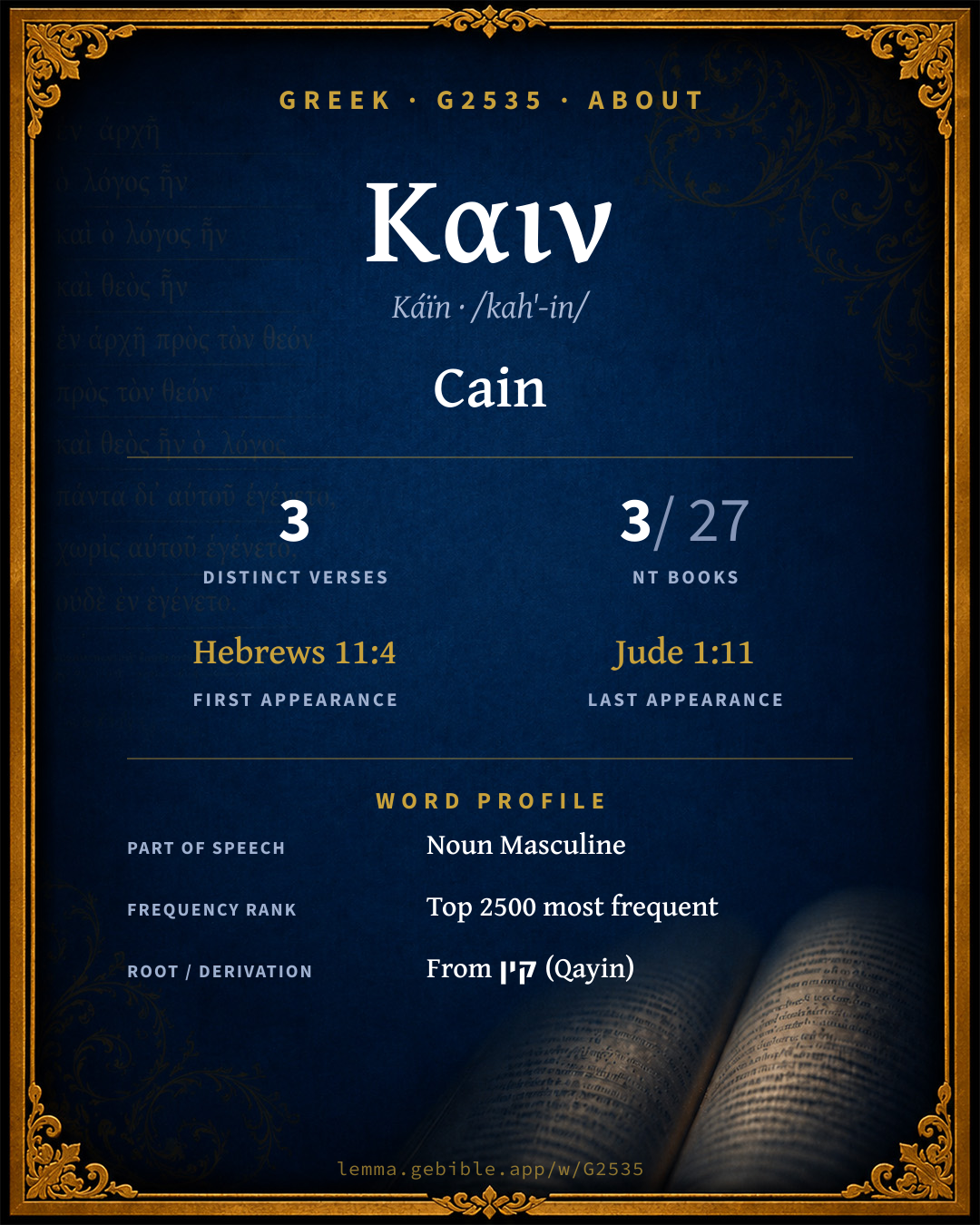
Κάΐν
Cain
Thayer's lists 2 entries for ‘Cain’ fuller range ↓
Full lexicon entry — Thayer's Greek Lexicon
From Thayer's Greek Lexicon
Where this word appears
Every verse where G2535 appears — 3 distinct verses across 3 books. Click any verse to open its interlinear word-by-word view. Verse text shown in the World English Bible for context — . Each verse’s Greek form is shown with its reference; the English is not keyword-highlighted, since the data carries no word-level English alignment. Use “Compare translations” on any verse to read it across multiple English versions. This concordance covers the Greek New Testament; Septuagint (Greek Old Testament) occurrences of this word are not indexed here.
Hebrews 1 verse
1 John 1 verse
Jude 1 verse
About this entry
At a glance — auto-summarized from this page’s data, not written by a person. Every figure links to its source below. This summary describes the numbers; it doesn’t interpret them.
Καιν (Káïn) is a Greek name most often rendered “Cain.” It occurs a mere 3 verses across Scripture. It concentrates in Hebrews, which alone accounts for 33% of its uses. Debuting at Hebrews 11:4, it then recurs through the corpus. The sections below give every occurrence and version rendering.
Gloss history
Strong's 1890 vs modern scholarship
About this word
Strong's G2535 catalogs a Greek word from the Greek New Testament.
These counts are not copied from any lexicon or concordance. They are computed here, from the morphology-tagged Greek New Testament. What Lemma adds →
- 3
- distinct verses
- The word appears in 3 distinct verses.
- 3 / 27
- NT books
- The word appears in 3 of 27 New Testament books.
- #2,203
- by frequency
- Top 2500 most frequent Greek words (rank 2,203 of 5,347 Greek words by occurrence).
View all 3 occurrences in the concordance →
By section of the New Testament
By traditional corpus
Conventional, traditional groupings — biblical authorship is debated, so this is a traditional corpus grouping, not an authorship claim. Some books belong to more than one corpus (Luke is in both the Gospels and the Lukan corpus, and so on), so these shares overlap and need not total 100%. Each figure is a share of the word’s 3 distinct verses.
- General (Catholic) Epistles 2 verses · 67%
- Johannine 1 verse · 33%
- Hebrews 1 verse · 33%
How translations render this word
Counts come from each version’s own published word-to-Strong’s tagging or interlinear alignment — an approximate guide to how each version renders this word, not a word-level alignment the data otherwise carries. Because each total is that version’s own tagged count, the per-version totals vary from one another and need not match the appearance or distinct-verse counts above. These counts may also differ from a printed concordance because Lemma counts each distinctly tagged rendering and does not collapse phrase taggings into a single head-word total. This is a fixed set of word-tagged versions (KJV, ASV, BSB, ULT) and does not change with the reading translation you choose elsewhere. Each version’s license is shown beside its name below (and on Sources).
- King James Version: Cain 3×
- American Standard Version: Cain 3×
- Berean Standard Bible: Cain 3×
- unfoldingWord Literal Text: Cain 3×
King James Version Public Domain
Renders G2535 across 3 tagged occurrences — most commonly:
American Standard Version Public Domain
Renders G2535 across 3 tagged occurrences — most commonly:
Berean Standard Bible Public Domain
Renders G2535 across 3 tagged occurrences — most commonly:
unfoldingWord Literal Text CC BY-SA 4.0
Renders G2535 across 3 tagged occurrences — most commonly:
Senses in Thayer's
The 2 senses Thayer's distinguishes for this word, in lexicon order (not ranked by frequency or importance). The full entry — with sub-senses — is in the Lexicon Entry tab.
- Cain = "maker: fabricator (literally smith)"
- the first born of Adam, and slew his brother, Abel
Word origin
Derived from קין (Qayin) (H7014) — Cain.
Of hebrew origin [ H7014 ]; Cain (that is Cajin ) the son of Adam : - Cain.
— Strong’s Exhaustive Concordance (1890), public domain.
Same root — word family
Other Thayer's entries built from the same root as G2535, grouped by Strong’s listed origin. These share a root / origin per the lexicon — not necessarily a shared meaning. Each links to that word’s own entry.
Derives from
Proper names from this root
People and places named from this root — a name, not an additional meaning of the word.
Compare all same-root words → 2 of the same-root words are proper names (people or places). They share a root, not necessarily a meaning.
Bible dictionary
Public-domain dictionary articles matched to this entry by name (Cain). A biblical name can be shared by more than one person or place, so an article may treat several.
Easton's Bible Dictionary · M. G. Easton, 1897
A possession; a spear. (1.) The first-born son of Adam and Eve (Gen. 4). He became a tiller of the ground, as his brother Abel followed the pursuits of pastoral life. He was "a sullen, self-willed, haughty, vindictive man; wanting the religious element in his character, and defiant even in his attitude towards God." It came to pass "in process of time" (marg. "at the end of days"), i.e., probably on the Sabbath, that the two brothers presented their offerings to the Lord. Abel's offering was of the "firstlings of his flock and of the fat," while Cain's was "of the fruit of the ground." Abel's sacrifice was "more excellent" (Heb. 11:4) than Cain's, and was accepted by God. On this account Cain was "very wroth," and cherished feelings of murderous hatred against his brother, and was at length guilty of the desperate outrage of putting him to death (1 John 3:12). For this crime he was expelled from Eden, and henceforth led the life of an exile, bearing upon him some mark which God had set upon him in answer to his own cry for mercy, so that thereby he might be protected from the wrath of his fellow-men; or it may be that God only gave him some sign to assure him that he would not be slain (Gen. 4:15). Doomed to be a wanderer and a fugitive in the earth, he went forth into the "land of Nod", i.e., the land of "exile", which is said to have been in the "east of Eden," and there he built a city, the first we read of, and called it after his son's name, Enoch. His descendants are enumerated to the sixth generation. They gradually degenerated in their moral and spiritual condition till they became wholly corrupt before God. This corruption prevailed, and at length the Deluge was sent by God to prevent the final triumph of evil. (See ABEL.)
(2.) A town of the Kenites, a branch of the Midianites (Josh. 15:57), on the east edge of the mountain above Engedi; probably the "nest in a rock" mentioned by Balaam (Num. 24:21). It is identified with the modern Yekin, 3 miles south-east of Hebron.
Smith's Bible Dictionary · William Smith, 1863
one of the cities in the low country of Judah, named with Zanoah and Gibeah. (Joshua 15:57)
(possession). Gen. 4. He was the eldest son of Adam and Eve; he followed the business of agriculture. In a fit of jealousy, roused by the rejection of his own sacrifice and the acceptance of Abel's, he committed the crime of murder, for which he was expelled from Eden, and led the life of an exile. He settled in the land of Nod, and built a city, which he named after his son Enoch. His descendants are enumerated together with the inventions for which they were remarkable. (B.C. 4000.)
Hitchcock's Bible Names Dictionary · Roswell D. Hitchcock, 1869
possession, or possessed
Classic public-domain reference works; full attribution on Sources.
Septuagint usage
The same Greek word Καιν appears 16 times in the Greek Old Testament (Septuagint), across 13 verses in 1 book.
- 16
- LXX occurrences
- Tagged occurrences of this Greek word in the Septuagint.
- 13
- verses
- Distinct Septuagint verses containing this word.
- 1 / 39
- OT books
- The word appears in 1 of the 39 Old Testament books.
Sample Septuagint occurrences
- Genesis 4:1 καιν
Septuagint occurrences (same lexeme)
Every verse where the same Strong’s number (G2535) appears in the Greek Septuagint. Verse text shown in the World English Bible for context; the Greek form is the matched word — the English is not keyword-highlighted.
- Genesis 4:1 καιν The man knew Eve his wife. She conceived, and gave birth to Cain, and said, "I have gotten a man with Yahweh's help."
- Genesis 4:2 καιν Again she gave birth, to Cain's brother Abel. Abel was a keeper of sheep, but Cain was a tiller of the ground.
- Genesis 4:3 καιν As time passed, it happened that Cain brought an offering to Yahweh from the fruit of the ground.
- Genesis 4:5 καιν but he didn't respect Cain and his offering. Cain was very angry, and the expression on his face fell.
- Genesis 4:6 καιν Yahweh said to Cain, "Why are you angry? Why has the expression of your face fallen?
- Genesis 4:8 καιν Cain said to Abel, his brother, "Let's go into the field." It happened, when they were in the field, that Cain rose up against Abel, his brother, and killed him.
- Genesis 4:9 καιν Yahweh said to Cain, "Where is Abel, your brother?" He said, "I don't know. Am I my brother's keeper?"
- Genesis 4:13 καιν Cain said to Yahweh, "My punishment is greater than I can bear.
- Genesis 4:15 καιν Yahweh said to him, "Therefore whoever slays Cain, vengeance will be taken on him sevenfold." Yahweh appointed a sign for Cain, lest any finding him should strike him.
- Genesis 4:16 καιν Cain went out from Yahweh's presence, and dwelt in the land of Nod, on the east of Eden.
- Genesis 4:17 καιν Cain knew his wife. She conceived, and gave birth to Enoch. He built a city, and called the name of the city, after the name of his son, Enoch.
- Genesis 4:24 καιν If Cain will be avenged seven times, Truly Lamech seventy-seven times."
- Genesis 4:25 καιν Adam knew his wife again. She gave birth to a son, and named him Seth. For, she said, "God has appointed me another child instead of Abel, for Cain killed him."
These are occurrences of the same Greek lexeme (G2535) in the Septuagint — not a translation of any one Hebrew word. The store carries no word-level Hebrew↔Greek alignment, so no Hebrew original is asserted here. Counts come from the recovered LXX Strong's tagging — high-frequency vocabulary is well covered, while rare or late forms may be untagged — so they reflect tagged occurrences and may slightly undercount.