

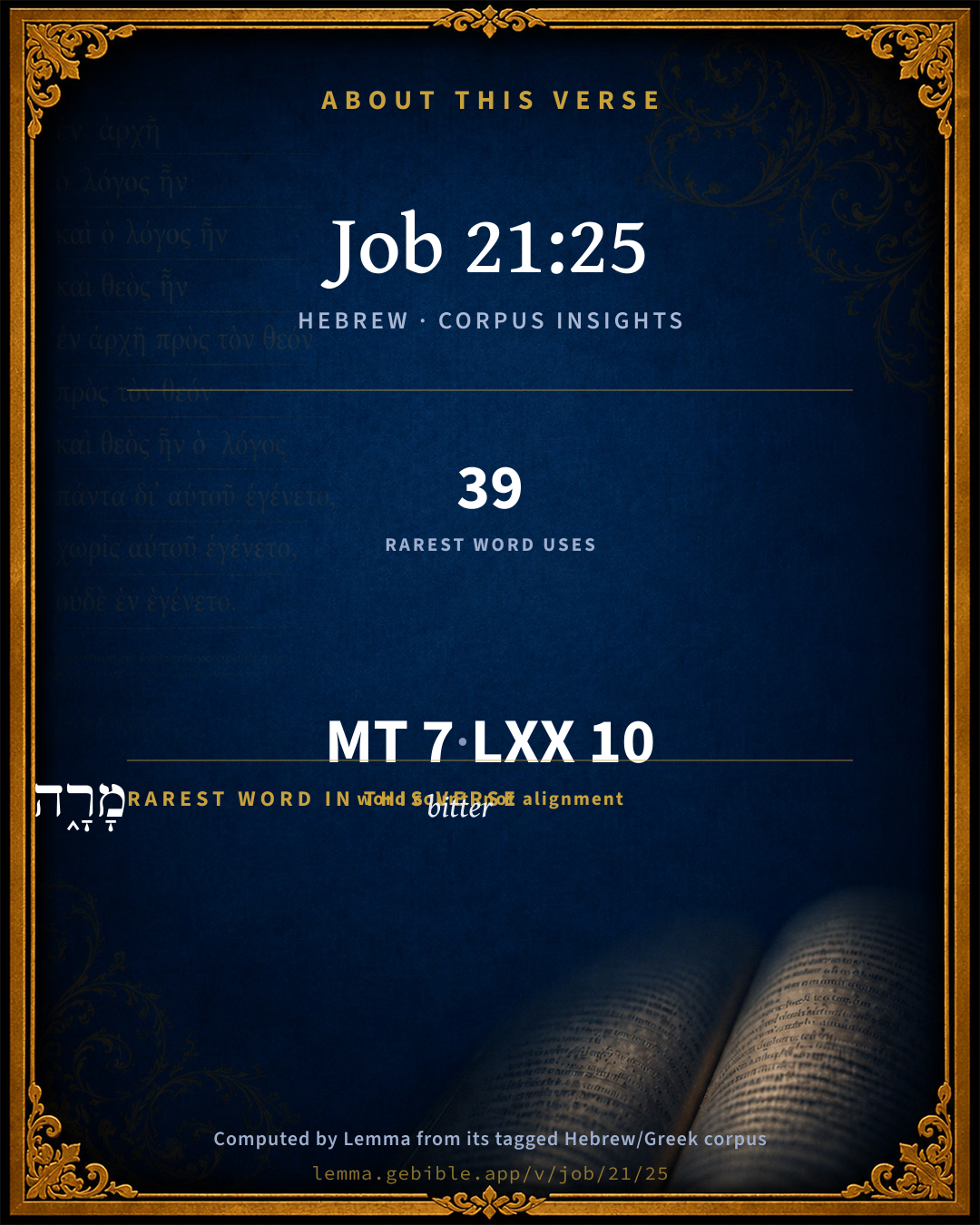
Job 21:25

Hebrew (Westminster Leningrad Codex) Job 21:25 appears in the Hebrew Old Testament. The text above is from the Westminster Leningrad Codex. Each word links to its Strong’s number, a concise gloss, and parsing drawn from the Open Scriptures Hebrew Bible morphology. Click any word for its full Brown-Driver-Briggs (BDB) entry.
Download image
Cite this verse

Job 21:25 (World English Bible). Public Domain. Lemma interlinear Bible study tool, https://lemma.gebible.app/v/job/21/25.

Show BibTeX & RIS
BibTeX
RIS
English Translation
Another dies in bitterness of soul, And never tastes of good.
World English Bible · Public Domain
Download a study sheet

One document with this verse’s original text, its word-by-word gloss line, the meaning frame, cross-references with their text, attributed commentary, and full source and license credits — printable, and it pastes into notes with its structure intact.

This verse Autodidact and up

Study sheet (.html) Plain text (.txt)

A passage Seminary Student

Up to 50 verses in one chapter. A passage sheet keeps up to 6 commentary sources and 12 cross-references per verse, in the order this page ranks them, and says so on the sheet whenever that leaves anything out. Ask for a single verse and you get the Autodidact verse sheet above.

Everything on this page stays free to read, with no account — the sheet is a download of what is already on screen, not access to it.

Want to remove ads? Support Godless Engineer
Compare translations 3

The same verse in 3 English versions, stacked beneath the original-language interlinear above. Click any original word for its lexicon entry.

Each is an independent rendering of the whole verse — the interlinear is not word-aligned to these translations.

Highlighted words mark where these versions differ — a whole-verse word diff, not a word-by-word alignment.

  • World English Bible Public Domain
    Another dies in bitterness of soul, And never tastes of good.
  • King James Version Public Domain
    And another dieth in the bitterness of his soul, and never eateth with pleasure.
  • unfoldingWord Literal Text CC BY-SA 4.0
    But that one dies in the soul of bitterness, and he has not eaten the good.

unfoldingWord Literal Text — © unfoldingWord, licensed CC BY-SA 4.0. Word-aligned USFM3 via Door43 (git.door43.org/unfoldingWord/en_ult).

Versions to compare (up to 4)

3 of 4 selected

Show all 18 translations

Every available English version of this verse, each an independent rendering of the whole verse.

  • World English Bible Public Domain
    Another dies in bitterness of soul, And never tastes of good.
  • Berean Standard Bible Public Domain
    Yet another man dies in the bitterness of his soul, having never tasted prosperity.
  • Majority Standard Bible Public Domain
    Yet another man dies in the bitterness of his soul, having never tasted prosperity.
  • King James Version Public Domain
    And another dieth in the bitterness of his soul, and never eateth with pleasure.
  • American Standard Version (1901) Public Domain
    And another dieth in bitterness of soul, And never tasteth of good.
  • Revised Version (1885) Public Domain
    And another dieth in bitterness of soul, and never tasteth of good.
  • Geneva Bible (1599) Public Domain
    And another dieth in the bitternes of his soule, and neuer eateth with pleasure.
  • Douay-Rheims (1899) Public Domain
    But another dieth in bitterness of soul without any riches:
  • Young's Literal Translation Public Domain
    And this `one' dieth with a bitter soul, And have not eaten with gladness.
  • Literal Standard Version CC BY-SA 4.0
    And this [one] dies with a bitter soul, || And has not eaten with gladness.
  • Unlocked Literal Bible CC BY-SA 4.0
    Another man dies in bitterness of soul, one who has never experienced anything good.
  • unfoldingWord Literal Text CC BY-SA 4.0
    But that one dies in the soul of bitterness, and he has not eaten the good.
  • Darby Bible Public Domain
    And another dieth in bitterness of soul, and hath not tasted good:
  • World Messianic Bible Public Domain
    Another dies in bitterness of soul, and never tastes of good.
  • Webster's Bible Public Domain
    And another dieth in the bitterness of his soul, and never eateth with pleasure.
  • Free Bible Version CC BY-SA 4.0
    Another dies after a miserable life without ever experiencing happiness.
  • Bible in Basic English Public Domain
    And another comes to his end with a bitter soul, without ever tasting good.
  • JPS Tanakh (1917) Public Domain
    And another dieth in bitterness of soul, and hath never tasted of good.

Literal Standard Version (2020), Covenant Press — licensed CC BY-SA 4.0. Text via the HelloAO Bible API (eBible.org). Unlocked Literal Bible (unfoldingWord) — licensed CC BY-SA 4.0. Text via the HelloAO Bible API (eBible.org). unfoldingWord Literal Text — © unfoldingWord, licensed CC BY-SA 4.0. Word-aligned USFM3 via Door43 (git.door43.org/unfoldingWord/en_ult). Free Bible Version, Dr. Jonathan Gallagher — licensed CC BY-SA 4.0. Text via the HelloAO Bible API (eBible.org).

Word by word

More ways to search: Search by grammar → Find every occurrence → Compare this word →

Practice this passage: Drill this verse → Learn its vocabulary →

About this verse

These counts appear in no published source. They are computed here, from the morphology-tagged text and Lemma’s own curated glosses. What Lemma adds →

7
words
7
distinct lemmas
Wisdom
section

Shared distinctive vocabulary

מָרָ֑ה bitter H4751 occurs in 36 verses of the Hebrew Bible. Also found in:

Grammatical profile

  • 2 verbs
  • 1 noun
  • 2 adjectives
  • 1 pronoun
  • 1 particle

Verb forms

  • יָ֭מוּת Qal · Imperfect
  • אָ֝כַ֗ל Qal · Perfect

Hebrew & Septuagint length

In English translation the verse runs 11 words from the Hebrew and 12 from the Septuagint (LXX English) — closely comparable.

A rough comparison of the two English renderings, which tokenize alike — not a word-level alignment.

Word counts can differ between the Hebrew and the Greek without any difference in meaning — e.g. the Hebrew direct-object marker אֵת has no separate Greek word, and Greek often adds the article ὁ.

In the original languages it is 7 Hebrew tokens and 10 Greek tokens — but the two are counted differently (Hebrew bundles its prefixes and suffixes into one token; the Greek is in lemma form), so that isn’t a like-for-like length.

Cross-references

12

Topical passages linked to Job 21:25 in the Treasury of Scripture Knowledge — connected by theme and wording, ordered by reader-vote popularity; previews shown in the World English Bible.

  • Ezekiel 4:16–17 Moreover he said to me, Son of man, behold, I will break the staff of bread in Jerusalem: and they shall eat bread by weight, and with fearfulness; and they shall drink water by measure, and in dismay:
  • Job 7:11 "Therefore I will not keep silent. I will speak in the anguish of my spirit. I will complain in the bitterness of my soul.
  • 2 Samuel 17:8 Hushai said moreover, You know your father and his men, that they are mighty men, and they are fierce in their minds, as a bear robbed of her cubs in the field; and your father is a man of war, and will not lodge with the people.
  • 1 Kings 17:12 She said, As Yahweh your God lives, I don't have a cake, but a handful of meal in the jar, and a little oil in the jar: and, behold, I am gathering two sticks, that I may go in and bake it for me and my son, that we may eat it, and die.
  • Job 3:20 "Why is light given to him who is in misery, Life to the bitter in soul,
  • Job 9:18 He will not allow me to take my breath, But fills me with bitterness.
  • Job 10:1 "My soul is weary of my life; I will give free course to my complaint. I will speak in the bitterness of my soul.
  • Job 20:23 When he is about to fill his belly, God will cast the fierceness of his wrath on him. It will rain on him while he is eating.
  • Proverbs 14:10 The heart knows its own bitterness and joy; He will not share these with a stranger.
  • Ecclesiastes 6:2 a man to whom God gives riches, wealth, and honor, so that he lacks nothing for his soul of all that he desires, yet God gives him no power to eat of it, but an alien eats it. This is vanity, and it is an evil disease.
  • Isaiah 38:15–17 What shall I say? he has both spoken to me, and himself has done it: I shall go softly all my years because of the bitterness of my soul.
  • Ezekiel 12:18 Son of man, eat your bread with quaking, and drink your water with trembling and with fearfulness;

Cross-references courtesy of OpenBible.info (CC BY 4.0).

Hebrew and Greek witnesses Masoretic Hebrew ↔ Greek Septuagint

The same verse in the two great witnesses to the Old Testament, shown verse-for-verse.

These are two independent witnesses, not word-aligned to each other, and the Septuagint is shown in lemma (dictionary) form.

Hebrew Job 21:25 Masoretic · Westminster Leningrad Codex

וְזֶ֗ה יָ֭מוּת בְּנֶ֣פֶשׁ מָרָ֑ה וְלֹֽא אָ֝כַ֗ל בַּטּוֹבָֽה

Another dies in bitterness of soul, And never tastes of good.

World English Bible · Public Domain

Greek LXX Job 21:25 Septuagint · lemma form

ὁ δέ τελευτάω ὑπό πικρία ψυχή οὐ ἐσθίω οὐδείς ἀγαθός

And another dies in bitterness of soul, not eating any good thing.

LXX2012 (modern English Septuagint) · Public Domain

Hebrew: Westminster Leningrad Codex (CC BY 4.0). Greek: Septuagint (public domain); English from LXX2012 (modern English Septuagint) (Public Domain). How the Septuagint differs from the Hebrew →

Commentary

Notes on Job 21:25 from classic Christian and Jewish commentators (each source and its license shown beneath its notes). The classic Christian expositions comment on the surrounding passage and are grouped to its opening verse, so a note may address several verses; the Jewish commentaries on the Tanakh (Rashi and others) are per-verse, so they appear only where the commentator wrote on this verse.

Lemma curates 59 commentaries, every one of them public domain or Creative Commons licensed, each selected and text-cleaned for this edition rather than reprinted as found. About our sources →

Trapp's Complete Commentary

John Trapp

Job 21:25 And another dieth in the bitterness of his soul, and never eateth with pleasure.

Ver. 25. And another dieth in the bitterness of his soul] Heb. And this dieth with a bitter soul; in a sad and sorrowful condition; having suffered many a little death all his life long (as godly men especially use to do, being destitute, afflicted, tormented, Heb 11:37, seldom without a cross on their backs), and then dieth not only in the sorrows of death, but in the sorrows of life which to him hath been a lifeless life, because a joyless life.

And never eateth with pleasure] Either because he hath but prisoners’ pittance, which will neither keep him alive nor suffer him to die; or, if he sit at a full table, yet his body is so ill affected by sickness, or his mind with sorrow, that he finds no good relish in what he eateth. That it is better with any of us, see a mercy and be thankful.

John Trapp, A Commentary or Exposition upon All the Books of the Old and New Testament (1647–1656) — public domain. Text from a community e-Sword module.

The Biblical Illustrator

Joseph S. Exell

Job_21:23; Job_21:25-26

One dieth in his full strength . . . Another dieth in the bitterness of his soul.

Providence vindicated against the superficial observer

That which hampers men most in understanding providence is its tremendous extent. It is like a great poem, and all that one life or one observer can read is a few words, or at most, a few lines. God does not always show His hand. Sometimes He does, and when it suits Him better, He hides it. It is expedient that some mystery hang over the dispensations of this life. Whatever is unsatisfactory, therefore, at present plainly suggests that the scheme is yet unfinished. The unsatisfactory nature of the present suggests a future. Revelation steps in to tell us that this life is but the vestibule of existence. One or two considerations will modify our hasty conclusions in regard to the real fortunes of those who live and die around us, whether their circumstances be apparently prosperous or depressed.

1. Happiness and misery are by no means always according to appearance. They depend more upon the inner state of the soul than its outward surroundings, and are therefore put, to some extent, within the power of everyone.

2. Men make their judgments too much from the outside. It is the outside look of providence that puzzles us, and makes understanding difficult.

We arrive at the following conclusions--

1. God is no indifferent spectator of human fortunes, but manages them on a perfectly righteous plan.

2. The deceptive character of appearances makes it necessary to subtract a good deal from the apparent happiness and misery of the world at the outset of our investigations.

3. Physical disadvantages, and deprivation of the members and senses are capable of compensation in the other world.

4. The difficulty in understanding aright the providence of God, arises from the complex nature of many of His acts, which may have various distinct branches or departments, as penal, disciplinary, merciful, and even remunerative, all in a single stroke.

5. We can understand enough of the Divine doings to enable us to trust for the remainder.

6. The root of all happiness is a good conscience, and this is put within the reach of all.

7. A good conscience can only be had and maintained by seeking the kingdom of God and His righteousness with all the means in our power.

8. And for all the purposes of practical piety, it is rather necessary we should remember the superintending arm of the great Worker, than that we should understand what He is doing. (William Isaac Keay.)

The Biblical Illustrator, edited by Joseph S. Exell (c. 1880s–1900s) — public domain. Text from a community e-Sword module.

Joseph Benson's Commentary

Job 21:25-26. Another dieth — Another wicked man, or any other man promiscuously considered, either good or bad. In the bitterness of his soul — With heart-breaking pains and sorrows; and never eateth with pleasure — Hath no pleasure in his life, no, not so much as at meal-time, when men usually are most free and pleasant. So he shows there is a great variety in God’s dispensations; he distributes great prosperity to one, and great afflictions to another, according to his wise but secret counsel. They shall lie down alike in the dust — All these worldly differences are ended by death, and they lie in the grave without any distinction till the time of the general resurrection. So that no man can tell who is good and who is bad, by events which befall them in this life. And if one wicked man die in a palace, and another in a dungeon, they will meet in the congregation of the dead and damned; and the worm that dieth not, and the fire that is not quenched, will be the same to both: which makes those differences inconsiderable, and not worth perplexing ourselves about.

Joseph Benson's Commentary on the Old and New Testaments (1811–1818) — public domain. Text from a community e-Sword module.

Tyndale Open Study Notes

Tyndale Open Resources

21:25 in bitter poverty: Job repeatedly complained about the apparent futility of existence (3:20; 7:11; 9:18; 10:1).

Tyndale Open Study Notes — © Tyndale Open Resources, licensed CC BY-SA 4.0. Text via the HelloAO Bible API.

Geneva Bible (1599)

Geneva Bible translators

To wit, the godly.

Geneva Bible (1599) marginal notes — public domain. Text via Bolls.life.

The Cambridge Bible for Schools and Colleges

gen. ed. J. J. S. Perowne

25. A different history; cf. Job’s words of himself, ch. Job_3:20, Job_7:11.

never eateth with pleasure] Rather, and hath not tasted (lit. eaten) of good.

The Cambridge Bible for Schools and Colleges (gen. ed. J. J. S. Perowne; Cambridge University Press, 1878–1918) — public domain. Text from a community e-Sword module.

John Gill's Exposition

They shall lie down alike in the dust,.... Such as have lived and died in great outward prosperity, or in more unhappy circumstances; these are levelled by death, and brought into the same state and condition; are laid on dusty beds, where there is no difference between them, their rest together is in the dust; here they dwell, and here they lie and sleep until they are awaked in the morning of the resurrection:

and the worms shall cover them; these are the companions alike unto them, and sweetly feed on the one as on the other; the earth is their bed, and worms are their covering; even such who used to lie on beds of down, and were covered with coverings of silk, have now the same bed and covering as those who used to lie on beds of straw, and scarce any thing to cover them; worms are spread under them, and are spread upon them; they are both their bed and their covering, Isa 14:11.

John Gill's Exposition of the Whole Bible (1746–1763) — public domain (CC PDM 1.0). Text via the HelloAO Bible API.

Haydock's Catholic Bible Commentary

Any. Hebrew, "ever having eaten with pleasure." (Haydock)

George Leo Haydock (1774–1849), Haydock's Catholic Family Bible and Commentary, 1859 edition — public domain. Excludes Psalms (Douay-Rheims chapter numbering differs from Protestant) and Deuterocanonical books (Catholic canon only).

Matthew Poole's English Annotations

Another; either,

1. Another wicked man. Or,

2. Any other man promiscuously considered, either good or bad. So hereby he shows how indifferently and alike God deals the concerns of this life to one and another, to good and bad. So he shows that there is a great variety in God’s dispensations; that he distributes great prosperity to one, and great afflictions to another no worse than he, according to his wise but secret counsel.

In the bitterness of his soul, i.e. with heart-breaking pains and sorrows.

Never eateth with pleasure, i.e. hath no pleasure in his life, no, not so much as at meal-time, when men usually are most free and pleasant.

Matthew Poole's English Annotations on the Holy Bible (1683–1685) — public domain. Text from a community e-Sword/MySword module.

Whedon's Commentary on the Bible

Daniel D. Whedon

25. Another — The good man. Never eateth, etc. — Rather, Has not enjoyed the good: the oft recurring שׂובה, that is, the so-called greatest good of life.

Daniel D. Whedon (gen. ed.), Commentary on the Old and New Testaments (1874–1909) — public domain. Text from a community e-Sword module.

The Pulpit Commentary

And another dieth in the bitterness of his soul. Others have to suffer terribly before death comes to them. Their whole life is wretched, and their spirit is embittered by their misfortunes. And never eateth with pleasure ; rather, and never tasteth of good (see the Revised Version).

The Pulpit Commentary (1880–1919), ed. H.D.M. Spence-Jones & Joseph S. Exell — public domain. Text from a community e-Sword module.

John Wesley's Explanatory Notes

Another - Another wicked man. So there is a great variety of God's dispensations; he distributes great prosperity to one, and great afflictions to another, according to his wise but secret counsel.

John Wesley, Explanatory Notes Upon the Whole Bible (1754–1765) — public domain. Text via the GEBible commentary corpus.

unfoldingWord translationNotes

Door43 World Missions Community

Connecting Statement:

Job continues speaking to his friends.

Another man dies

Job contrasts this man to the man who dies in peace in Job 21:23.

in bitterness of soul

Here sorrow is spoken of as if it tasted bitter, and "soul" refers to the whole man. AT: "with anger and resentment" or "after living a sad life" (See: Metaphor and Synecdoche)

has never experienced anything good

This can be stated in positive form. AT: "has experienced only bad things"

They lie down alike in the dust

This is a polite way to say that they died. AT: "They both die and people bury them" (See: Euphemism)

the worms cover them both

Worms are associated with decay of dead bodies. AT: "the worms in the dirt eat their dead bodies" (See: Assumed Knowledge and Implicit Information)

translationWords

soul

unfoldingWord translationNotes — © Distant Shores Media and the Door43 World Missions Community, licensed CC BY-SA 4.0. Source: git.door43.org/Door43/en_tn.

Rashi

Rabbi Shlomo Yitzchaki (Rashi)

And this one dies with a bitter spirit Those that are exalted and holy to Him—them He requites immediately.

Rashi on the Tanakh — English translations: “The Judaica Press complete Tanach with Rashi, translated by A. J. Rosenberg” (CC BY 4.0); “Pentateuch with Rashi's commentary by M. Rosenbaum and A.M. Silbermann, 1929-1934” (public domain); “The Metsudah Tanach series, Lakewood, N.J” (CC BY 4.0); and “The Book of Joshua, Metsudah Publications, 1997” (CC BY 4.0). Text via Sefaria.

Lesson kit

Teaching starters — assembled from the data on this page, not authored interpretation. Every prompt links to the verse data it draws on. Edit before teaching.

Job, in the Wisdom, opens this verse with 7 words (7 distinct Hebrew lemmas). Its most distinctive word is mar (“bitter”). A historical commentator’s framing appears above. Read the whole chapter for the surrounding context.

Discussion questions

  1. The word mar carries the sense “bitter.” How does it shape the verse?
  2. How does Genesis 27:34, which shares the word «bitter», read alongside this verse?
  3. These translations render this verse differently. What is at stake in choosing one wording over another?
  4. «יָ֭מוּת» is a Qal Imperfect verb. How does that grammatical form shape the action described?
  5. Compare how Trapp's Complete Commentary and The Biblical Illustrator read this verse. Where do they agree or differ?

Things to notice

Reading settings

Reading text

Shown beneath each verse's original-language words.

Old Testament
Old Testament edition

Read the OT as the Masoretic Hebrew (MT) or the Greek Septuagint (LXX).

English shown for the Greek Septuagint (in the Hebrew ↔ Greek comparison).

Comparing translations? Open the Compare panel on any verse page to stack up to four side by side.