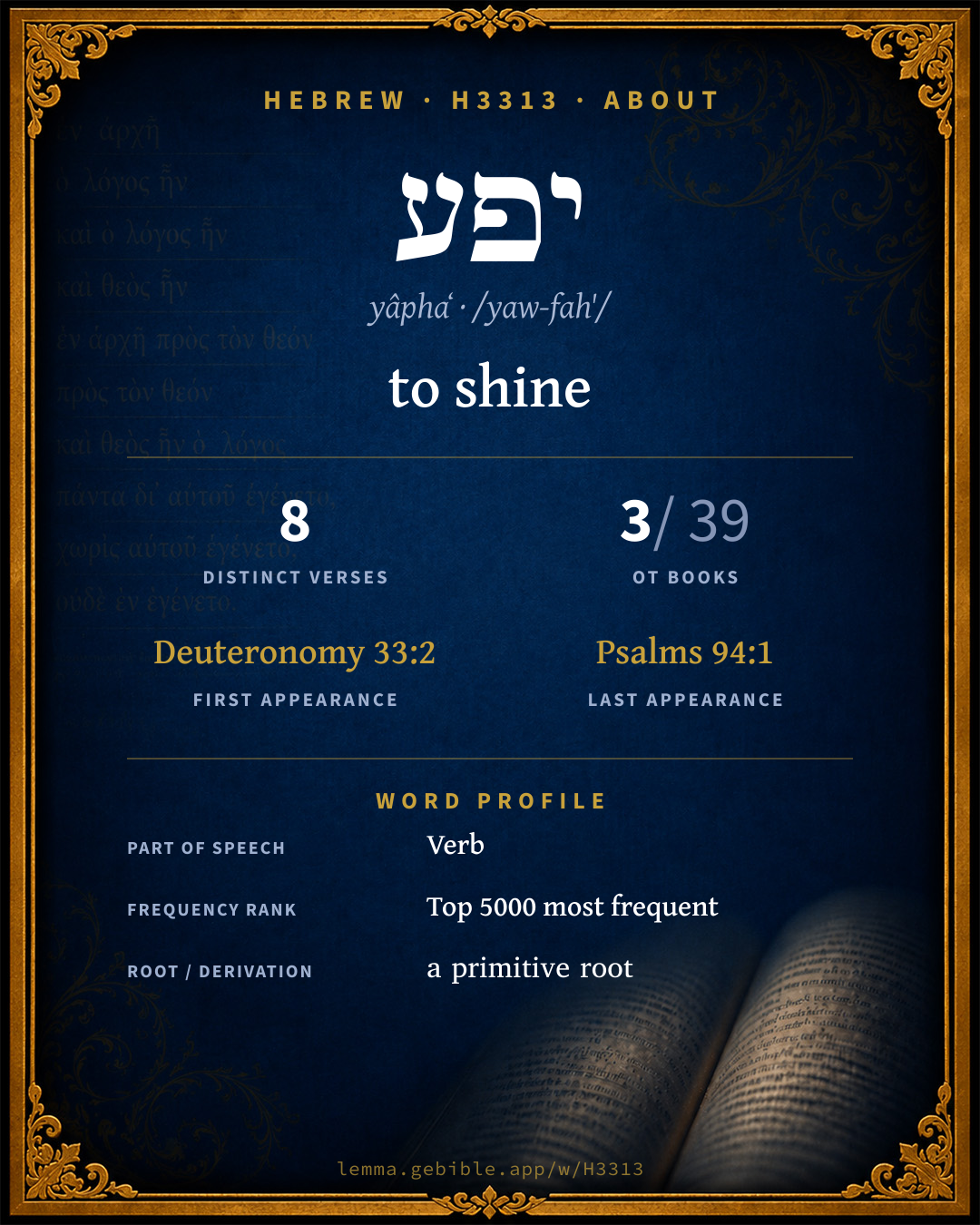
יָפַע
to shine
also: cause to shine, send out beams fuller range ↓
Full lexicon entry — Brown-Driver-Briggs (BDB)
From Brown-Driver-Briggs (BDB)
Where this word appears
Grammar key — what these labels mean
Part of speech
- Verb
- An action or state-of-being word.
Stem
- Hiphil
- The causative active stem (“he caused / brought about”).
Form
- Perfect
- A completed action or state — Hebrew marks aspect (completeness) more than strict tense (“he wrote”).
- Sequential Imperfect
- An imperfect with prefixed waw — the standard past-narrative form (waw-consecutive imperfect).
- Jussive
- A third- or second-person volitional form expressing wish or command (“let him write”).
- Imperative
- A direct command (“write!”).
Person
- 3rd Person
- The one spoken about (“he / she / it / they”).
- 2nd Person
- The one addressed (“you”).
Gender
- Masculine
- Grammatically masculine.
- Feminine
- Grammatically feminine.
Number
- Singular
- One.
Grammatical forms
- Verb, Hiphil, Perfect, 3rd Person, Masculine, Singular 3 times (38%)
- Verb, Hiphil, Imperative, 2nd Person, Masculine, Singular 2 times (25%)
- Verb, Hiphil, Sequential Imperfect, 3rd Person, Feminine, Singular 1 time (13%)
- Verb, Hiphil, Jussive, 3rd Person, Feminine, Singular 1 time (13%)
- Verb, Hiphil, Perfect, 2nd Person, Masculine, Singular 1 time (13%)
Parsed forms decoded from the imported morphology (morphhb / Westminster Leningrad Codex — WLC text public domain, morphhb tagging CC BY 4.0), counted across 8 parsed occurrences — not distinct verses.
Every verse where H3313 appears — 8 distinct verses across 3 books. Click any verse to open its interlinear word-by-word view. Verse text shown in the World English Bible for context — . Each verse’s Hebrew form is shown with its reference; the English is not keyword-highlighted, since the data carries no word-level English alignment. Use “Compare translations” on any verse to read it across multiple English versions. This concordance covers the Hebrew Bible; Septuagint (Greek Old Testament) occurrences are not indexed here.
Deuteronomy 1 verse
Job 4 verses
- Job 3:4 תּוֹפַ֖ע Hiphil juss 3fs Let that day be darkness; Don't let God from above seek for it, Neither let the light shine on it.
- Job 10:3 הוֹפָֽעְתָּ Hiphil pf 2ms Is it good to you that you should oppress, That you should despise the work of your hands, And smile on the counsel of the wicked?
- Job 10:22 וַ/תֹּ֥פַע conj + Hiphil wimpf 3fs The land dark as midnight, Of the shadow of death, without any order, Where the light is as midnight.'"
- Job 37:15 וְ֝/הוֹפִ֗יעַ conj + Hiphil pf 3ms Do you know how God controls them, And causes the lightning of his cloud to shine?
Psalms 3 verses
- Psalms 50:2 הוֹפִֽיעַ Hiphil pf 3ms Out of Zion, the perfection of beauty, God shines forth.
- Psalms 80:1 הוֹפִֽיעָ/ה Hiphil impv 2ms + sfx h Hear us, Shepherd of Israel, You who lead Joseph like a flock, You who sit above the cherubim, shine forth.
- Psalms 94:1 הוֹפִֽיַע Hiphil impv 2ms Yahweh, you God to whom vengeance belongs, You God to whom vengeance belongs, shine forth.
About this entry
At a glance — auto-summarized from this page’s data, not written by a person. Every figure links to its source below. This summary describes the numbers; it doesn’t interpret them.
יפע (yâphaʻ) is a Hebrew verb most often rendered “to shine.” Job dominates its distribution — 4 of 8 verses. The Hebrew Bible uses it across 8 verses — uncommon. Debuting at Deuteronomy 33:2, it then recurs through the corpus. The lexical range runs to 3 senses — “to shine” plus “cause to shine” and “send out beams”. For the data behind this summary, explore the sense tree and the renderings breakdown below.
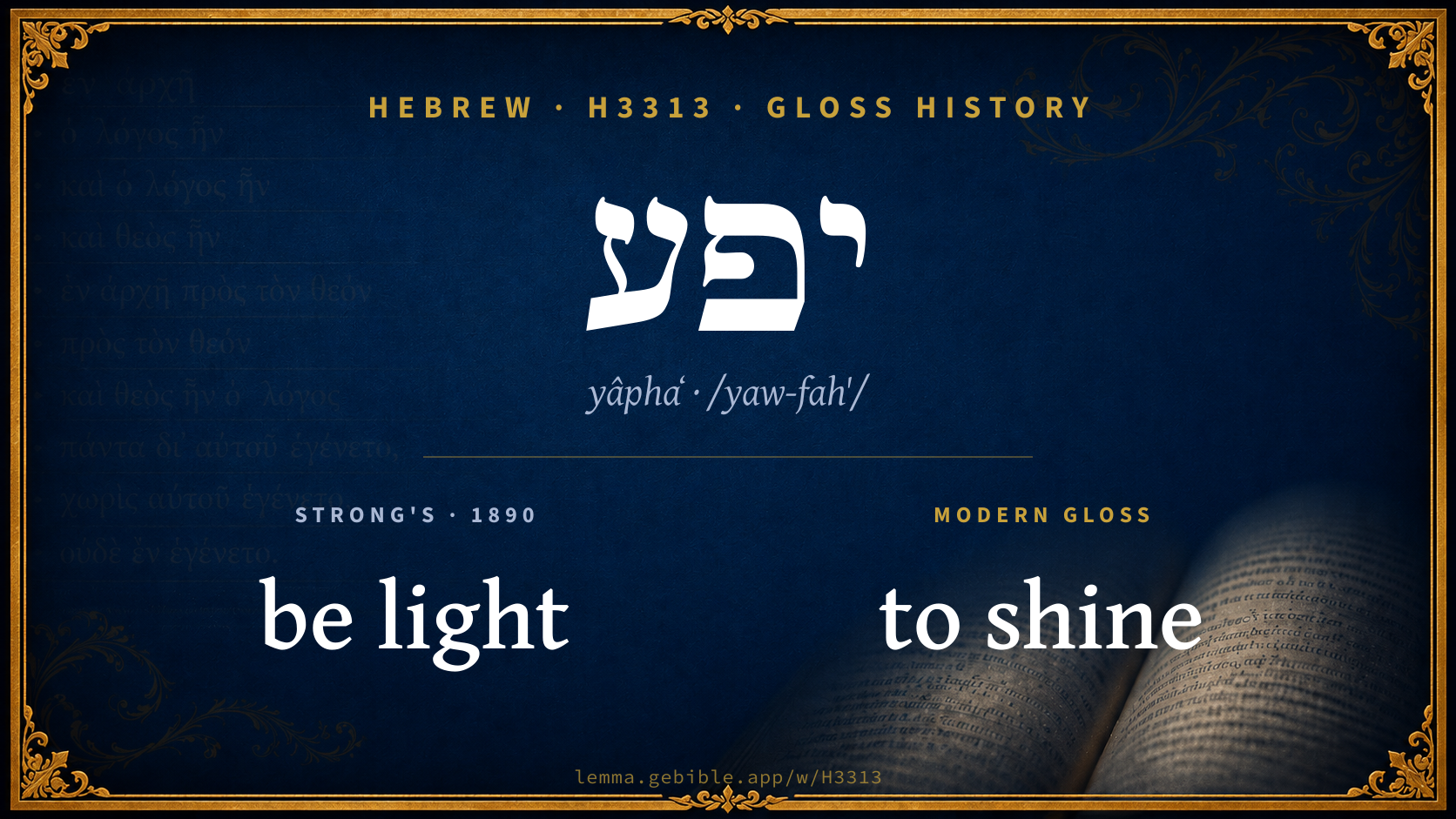
Gloss history
Strong's 1890 vs modern scholarship
About this word
Strong's H3313 catalogs a Hebrew word from the Hebrew Old Testament.
These counts are not copied from any lexicon or concordance. They are computed here, from the morphology-tagged Hebrew Old Testament. What Lemma adds →
- 8
- distinct verses
- The word appears in 8 distinct verses.
- 3 / 39
- OT books
- The word appears in 3 of 39 Old Testament books.
- #2,625
- by frequency
- Top 5000 most frequent Hebrew words (rank 2,625 of 8,640 Hebrew words by occurrence).
View all 8 occurrences in the concordance →
Most concentrated in
- Job 4 verses 50%
- Psalms 3 verses 38%
- Deuteronomy 1 verse 13%
By section of the Old Testament
By traditional corpus
Conventional, traditional groupings — biblical authorship is debated, so this is a traditional corpus grouping, not an authorship claim. Each share is this word’s portion of its verses in that division of the Hebrew canon. Each figure is a share of the word’s 8 distinct verses.
- Writings (Ketuvim) 7 verses · 88%
- Torah (Pentateuch) 1 verse · 13%
How translations render this word
Counts come from each version’s own published word-to-Strong’s tagging or interlinear alignment — an approximate guide to how each version renders this word, not a word-level alignment the data otherwise carries. Because each total is that version’s own tagged count, the per-version totals vary from one another and need not match the appearance or distinct-verse counts above. These counts may also differ from a printed concordance because Lemma counts each distinctly tagged rendering and does not collapse phrase taggings into a single head-word total. This is a fixed set of word-tagged versions (KJV, ASV, BSB, ULT) and does not change with the reading translation you choose elsewhere. Each version’s license is shown beside its name below (and on Sources).
- King James Version: Shine 3×
- American Standard Version: Shine 2×
- Berean Standard Bible: Shine forth 2×
- unfoldingWord Literal Text: Shine forth 2×
King James Version Public Domain
Renders H3313 across 8 tagged occurrences — most commonly:
Plus 5 renderings that appear only once — usually multi-word phrases or single function words the recovered tagging swept in, not distinct renderings.
American Standard Version Public Domain
Renders H3313 across 8 tagged occurrences — most commonly:
Plus 6 renderings that appear only once — usually multi-word phrases or single function words the recovered tagging swept in, not distinct renderings.
Berean Standard Bible Public Domain
Renders H3313 across 8 tagged occurrences — most commonly:
Plus 6 renderings that appear only once — usually multi-word phrases or single function words the recovered tagging swept in, not distinct renderings.
unfoldingWord Literal Text CC BY-SA 4.0
Renders H3313 across 11 tagged occurrences — most commonly:
Plus 9 renderings that appear only once — usually multi-word phrases or single function words the recovered tagging swept in, not distinct renderings.
Senses in BDB
The 3 senses BDB distinguishes for this word, in lexicon order (not ranked by frequency or importance). The full entry — with sub-senses — is in the Lexicon Entry tab.
- to shine, shine forth or out, cause to shine, send out beams
(Hiphil)
- to shine out, shine forth, send out beams
- to cause to shine
Word origin
[ יָפַע ] vb. only Hiph. shine out or forth, send out beams, cause to shine
— Brown-Driver-Briggs (Oxford 1906, public domain), digitized via Sefaria, supplemented by the OpenScriptures HebrewLexicon (CC BY 4.0). See Sources.
Origin: a primitive root
Jastrow Dictionary
A second Hebrew/Aramaic lexicon for comparison, covering Aramaic and post-biblical (Talmudic, Targumic, Midrashic) usage that the biblical-Hebrew BDB does not. Matched by lemma rather than by Strong’s number, so a lemma may carry more than one Jastrow headword (shown separately below), and the entries cover usage well beyond the Bible.
יָפַע
- , Hif. הוֹפִיעַ
- 1. to join, arrive (cmp. אָתָא), to come forth, appear. Gen. R. s. 12 כל א׳ וא׳ ה׳ בזמנו each (part of creation) came forth in its due time (though all were created at once).
- 2. to bring, transfer. B. Kam. 38ᵃ (ref. to Deut. XXXIII, 2) מפארן ה׳ ממונם וכ׳ from (what occurred at) Paran (the gentiles refusing to receive the Law) he (the Lord) transferred their wealth to Israel. e.g. Deuteronomy 33:2
- 3. to bring about, bring to light, reveal. Gen. R. s. 90; Yalk. ib. 148 (play on צ̇פ̇נ̇ת̇ פ̇ע̇נ̇ח̇) צפ̇ונ̇ות̇ הופ̇יע̇ ונ̇ח̇ות וכ׳ he reveals secrets, and it is easy to him to tell them; צ̇פ̇ונ̇ות̇ הופיע̇ בדעת מנ̇יח̇ וכ׳ he brings secret things to light through his intelligence; with them he sets mankind at ease. Macc. 23ᵇ; Gen. R. s. 85 בג׳ מקומות ה׳ רוה"ק on three occasions did the holy spirit reveal (the true state of affairs); (oth. opin. v. פּוּעַ). Koh. R. to VII, 1 (play on פועה, Ex. I, 15) שהוֹפִיעָה את מעשה אחיה she (Miriam) brought about what happened to her brother (she was the cause of Moses’ peculiar career). e.g. Exodus 1:15
- 4. to lift up, raise. Ex. R. s. 1 (play on פועה, v. supra) שהופיעה את ישראל וכ׳ she (Miriam) lifted Israel up to God.—ה׳ פנים כנגד to lift one’s face up against, to have the courage to rebuke. Ib. שהופיעה פ׳ … וזקפה וכ׳ she lifted her face up against Pharaoh and turned her nose up against him (in angry rebuke). Ib. שה׳ פ׳ כנגד אביה she dared to reprove her father. Y. B. Kam. IV, 4ᵇ top.
יְפַע
- , to appear, rise. Targ. Job III, 4 תֵּפַע (תֵּיפַע; h. text תּוֹפַע).
- 1. same. Ib. X, 3 אוֹפַעְתָּ thou appearest (approving, h. text הופעת). Targ. Ps. LXXX, 2. Ib. XCIV, 1.
- 2. to send forth. Targ. Job XXXVII, 15.
A Dictionary of the Targumim, the Talmud Babli and Yerushalmi, and the Midrashic Literature (Marcus Jastrow; London, Luzac, 1903) — Public Domain. Digitized via Sefaria. Digitized via Sefaria. Full attribution on Sources.
Forms in the corpus
The 8 distinct written forms H3313 takes in the Hebrew Bible, most frequent first — each parse links to that stem’s occurrences in the concordance. Hebrew forms include their vowel points and cantillation, so a single lemma takes many written forms.
| Form | Parsing | Example | Uses |
|---|---|---|---|
| הוֹפִ֨יעַ֙ | Verb, Hiphil, Perfect, 3rd Person, Masculine, Singular | Deuteronomy 33:2 | 1 |
| הוֹפִֽיַע | Verb, Hiphil, Imperative, 2nd Person, Masculine, Singular | Psalms 94:1 | 1 |
| הוֹפִֽיעַ | Verb, Hiphil, Perfect, 3rd Person, Masculine, Singular | Psalms 50:2 | 1 |
| הוֹפִֽיעָ/ה | Verb, Hiphil, Imperative, 2nd Person, Masculine, Singular | Psalms 80:1 | 1 |
| הוֹפָֽעְתָּ | Verb, Hiphil, Perfect, 2nd Person, Masculine, Singular | Job 10:3 | 1 |
| וְ֝/הוֹפִ֗יעַ | Verb, Hiphil, Perfect, 3rd Person, Masculine, Singular | Job 37:15 | 1 |
| וַ/תֹּ֥פַע | Verb, Hiphil, Sequential Imperfect, 3rd Person, Feminine, Singular | Job 10:22 | 1 |
| תּוֹפַ֖ע | Verb, Hiphil, Jussive, 3rd Person, Feminine, Singular | Job 3:4 | 1 |
Same root — word family
Other BDB entries built from the same root as H3313, grouped by Strong’s listed origin. These share a root / origin per the lexicon — not necessarily a shared meaning. Each links to that word’s own entry.
Derived from this word
Proper names from this root
People and places named from this root — a name, not an additional meaning of the word.
Compare all same-root words → 2 of the same-root words are proper names (people or places). They share a root, not necessarily a meaning.
Septuagint verse parallels
This word appears in 8 verses that also exist in the Greek Old Testament (Septuagint), out of the 8 Hebrew verses it occurs in. You can read those verses in Greek by switching the Old Testament edition to the Septuagint.
Read these verses in the Septuagint
This is a verse-level parallel only — the same verses exist in both the Hebrew and Greek Old Testaments. No word-level Hebrew↔Greek correspondence is claimed: the data carries no such alignment, so no Greek word is shown as this Hebrew word’s translation. Coverage is not total — the Septuagint omits the deuterocanon and renumbers the Psalms, so some Hebrew verses have no direct Greek parallel.