Jeremiah 34:4

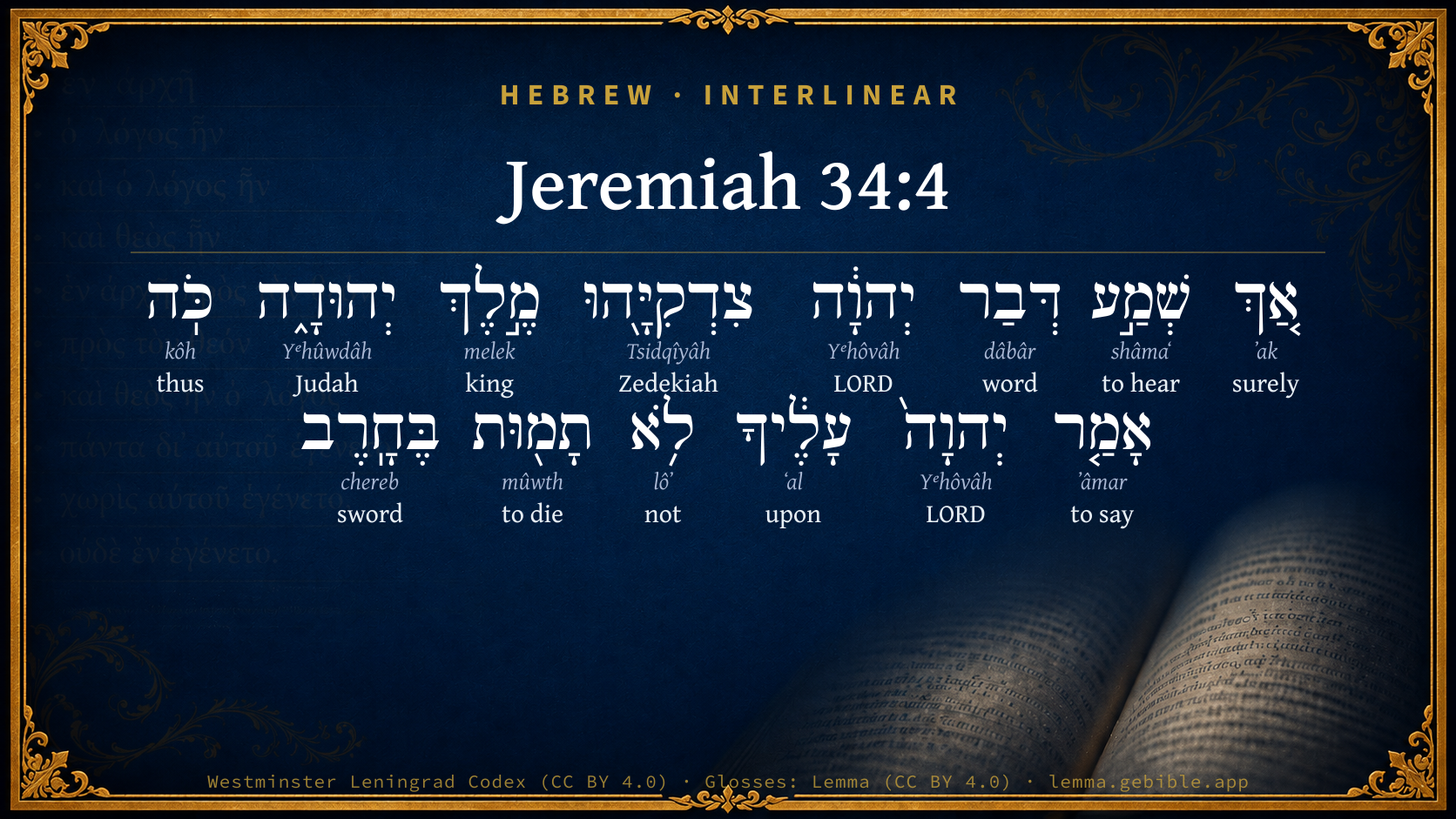
Hebrew (Westminster Leningrad Codex) Jeremiah 34:4 appears in the Hebrew Old Testament. The text above is from the Westminster Leningrad Codex. Each word links to its Strong’s number, a concise gloss, and parsing drawn from the Open Scriptures Hebrew Bible morphology. Click any word for its full Brown-Driver-Briggs (BDB) entry.
Download image
Cite this verse

Jeremiah 34:4 (World English Bible). Public Domain. Lemma interlinear Bible study tool, https://lemma.gebible.app/v/jeremiah/34/4.

Show BibTeX & RIS
BibTeX
RIS
English Translation
Yet hear the word of Yahweh, O Zedekiah king of Judah: thus says Yahweh concerning you, You shall not die by the sword;
World English Bible · Public Domain
Download a study sheet

One document with this verse’s original text, its word-by-word gloss line, the meaning frame, cross-references with their text, attributed commentary, and full source and license credits — printable, and it pastes into notes with its structure intact.

This verse Autodidact and up

Study sheet (.html) Plain text (.txt)

A passage Seminary Student

Up to 50 verses in one chapter. A passage sheet keeps up to 6 commentary sources and 12 cross-references per verse, in the order this page ranks them, and says so on the sheet whenever that leaves anything out. Ask for a single verse and you get the Autodidact verse sheet above.

Everything on this page stays free to read, with no account — the sheet is a download of what is already on screen, not access to it.

Want to remove ads? Support Godless Engineer
Compare translations 3

The same verse in 3 English versions, stacked beneath the original-language interlinear above. Click any original word for its lexicon entry.

Each is an independent rendering of the whole verse — the interlinear is not word-aligned to these translations.

Highlighted words mark where these versions differ — a whole-verse word diff, not a word-by-word alignment.

  • World English Bible Public Domain
    Yet hear the word of Yahweh, O Zedekiah king of Judah: thus says Yahweh concerning you, You shall not die by the sword;
  • King James Version Public Domain
    Yet hear the word of the LORD, O Zedekiah king of Judah; Thus saith the LORD of thee, Thou shalt not die by the sword:
  • unfoldingWord Literal Text CC BY-SA 4.0
    Listen to the word of Yahweh, Zedekiah king of Judah! Yahweh says this concerning you, ‘You will not die by the sword.

unfoldingWord Literal Text — © unfoldingWord, licensed CC BY-SA 4.0. Word-aligned USFM3 via Door43 (git.door43.org/unfoldingWord/en_ult).

Versions to compare (up to 4)

3 of 4 selected

Show all 18 translations

Every available English version of this verse, each an independent rendering of the whole verse.

  • World English Bible Public Domain
    Yet hear the word of Yahweh, O Zedekiah king of Judah: thus says Yahweh concerning you, You shall not die by the sword;
  • Berean Standard Bible Public Domain
    Yet hear the word of the LORD, O Zedekiah king of Judah. This is what the LORD says concerning you: You will not die by the sword;
  • Majority Standard Bible Public Domain
    Yet hear the word of the LORD, O Zedekiah king of Judah. This is what the LORD says concerning you: You will not die by the sword;
  • King James Version Public Domain
    Yet hear the word of the LORD, O Zedekiah king of Judah; Thus saith the LORD of thee, Thou shalt not die by the sword:
  • American Standard Version (1901) Public Domain
    Yet hear the word of Jehovah, O Zedekiah king of Judah: thus saith Jehovah concerning thee, Thou shalt not die by the sword;
  • Revised Version (1885) Public Domain
    Yet hear the word of the LORD, O Zedekiah king of Judah: thus saith the LORD concerning thee, Thou shalt not die by the sword;
  • Geneva Bible (1599) Public Domain
    Yet heare the worde of the Lord, O Zedekiah, King of Iudah: thus sayth the Lord of thee, Thou shalt not dye by the sword,
  • Douay-Rheims (1899) Public Domain
    Yet hear the word of the Lord, O Sedecias king of Juda: Thus saith the Lord to thee: Thou shalt not die by the sword.
  • Young's Literal Translation Public Domain
    `Only, hear a word of Jehovah, O Zedekiah king of Judah, Thus said Jehovah unto thee: Thou dost not die by sword,
  • Literal Standard Version CC BY-SA 4.0
    Only, hear a word of YHWH, O Zedekiah king of Judah—thus said YHWH to you: You do not die by sword,
  • Unlocked Literal Bible CC BY-SA 4.0
    Listen to the word of Yahweh, Zedekiah king of Judah! Yahweh says this concerning you, 'You will not die by the sword.
  • unfoldingWord Literal Text CC BY-SA 4.0
    Listen to the word of Yahweh, Zedekiah king of Judah! Yahweh says this concerning you, ‘You will not die by the sword.
  • Darby Bible Public Domain
    Only, hear the word of Jehovah, O Zedekiah king of Judah. Thus saith Jehovah as to thee: Thou shalt not die by the sword;
  • World Messianic Bible Public Domain
    “Yet hear the LORD’s word, O Zedekiah king of Judah. The LORD says concerning you, ‘You won’t die by the sword.
  • Webster's Bible Public Domain
    Yet hear the word of the LORD, O Zedekiah king of Judah; Thus saith the LORD concerning thee, Thou shalt not die by the sword:
  • Free Bible Version CC BY-SA 4.0
    Listen to what the Lord is telling you, Zedekiah king of Judah. This is what the Lord says about you: You won't be killed;
  • Bible in Basic English Public Domain
    But give ear to the word of the Lord, O Zedekiah, king of Judah; this is what the Lord has said about you: Death will not come to you by the sword:
  • JPS Tanakh (1917) Public Domain
    Yet hear the word of the LORD, O Zedekiah king of Judah: Thus saith the LORD concerning thee: Thou shalt not die by the sword;

Literal Standard Version (2020), Covenant Press — licensed CC BY-SA 4.0. Text via the HelloAO Bible API (eBible.org). Unlocked Literal Bible (unfoldingWord) — licensed CC BY-SA 4.0. Text via the HelloAO Bible API (eBible.org). unfoldingWord Literal Text — © unfoldingWord, licensed CC BY-SA 4.0. Word-aligned USFM3 via Door43 (git.door43.org/unfoldingWord/en_ult). Free Bible Version, Dr. Jonathan Gallagher — licensed CC BY-SA 4.0. Text via the HelloAO Bible API (eBible.org).

Word by word

More ways to search: Search by grammar → Find every occurrence → Compare this word →

Practice this passage: Drill this verse → Learn its vocabulary →

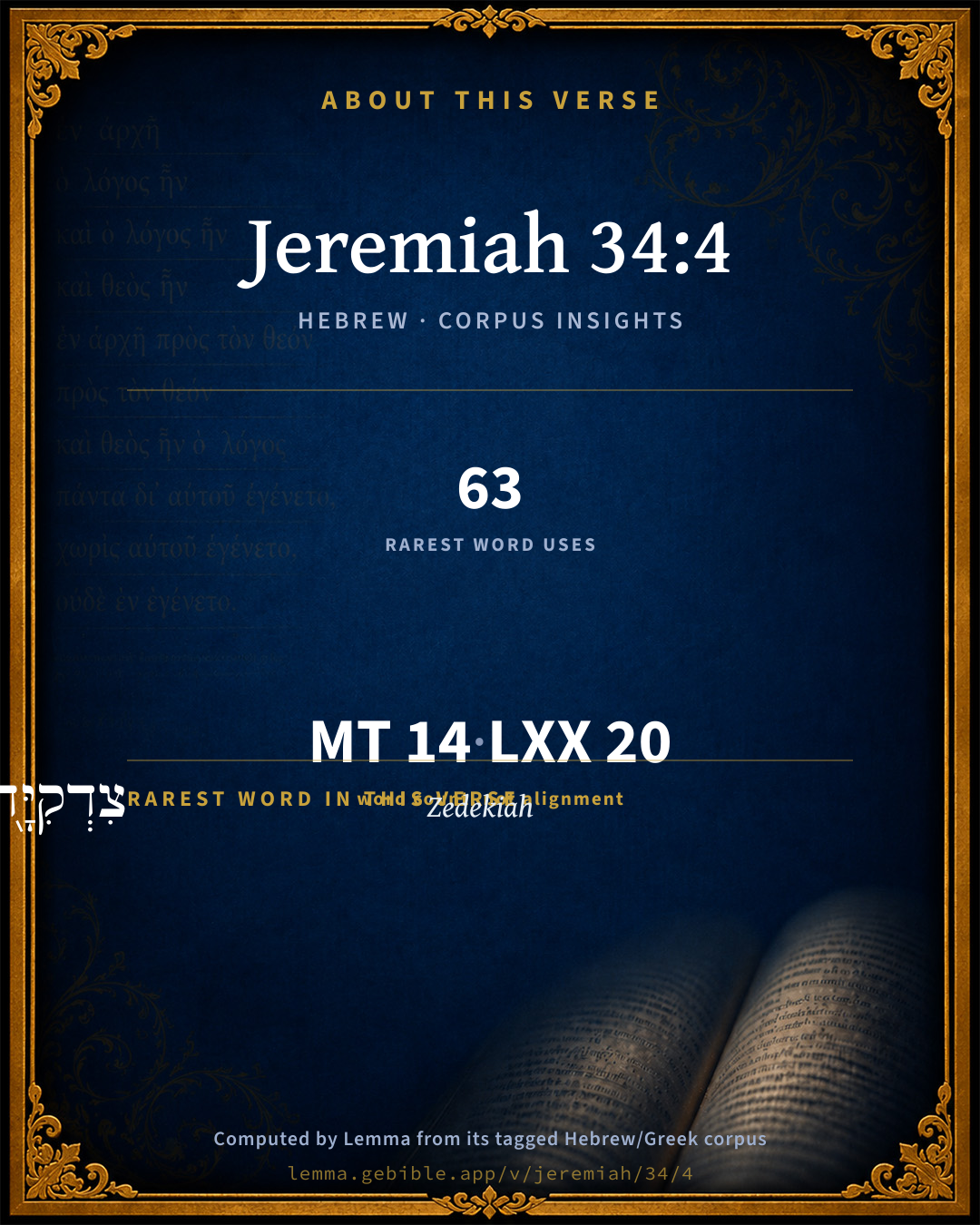
צִדְקִיָּ֖הוּ
Tsidqîyâh
H6667
“Zedekiah”
Noun, Proper
Part of Speech
Noun
Type
Proper
Full BDB Definition

Origin: from H6664 and H3050

TWOT: None

Zedekiah = "Jehovah is righteous" - the last king of Judah renamed from 'Mattaniah' by Nebuchadnezzar; son of Josiah by wife Hamutal; placed on the throne by Nebuchadnezzar when he carried his nephew Jehoiakim in captivity - false prophet at the court of king Ahab of the northern kingdom of Israel - son of Maaseiah, a false prophet in Babylon - son of Hananiah, one of the princes of Judah in the time of Jeremiah - a priest who sealed the covenant with Nehemiah - son of king Jehoiakim of Judah
  1. אַ֚ךְ ʼak H389 “surely” Particle, Accusative
  2. שְׁמַ֣ע shâmaʻ H8085 “hear” Verb, Qal, Imperative, 2nd Person, Masculine, Singular
  3. דְּבַר dâbâr H1697 “word of” Noun, Common, Masculine, Singular, Construct
  4. יְהוָ֔ה Yᵉhôvâh H3068 “LORD” Noun, Proper
  5. מֶ֣לֶךְ melek H4428 “king of” Noun, Common, Masculine, Singular, Construct
  6. יְהוּדָ֑ה Yᵉhûwdâh H3063 “Judah” Noun, Proper
  7. כֹּֽה kôh H3541 “thus” Adverb
  8. אָמַ֤ר ʼâmar H559 “to say” Verb, Qal, Perfect, 3rd Person, Masculine, Singular
  9. יְהוָה֙ Yᵉhôvâh H3068 “LORD” Noun, Proper
  10. עָלֶ֔יךָ ʻal H5921 “upon · you” Preposition + Suffix, Personal, 2nd Person, Masculine, Singular
  11. לֹ֥א lôʼ H3808 “not” Particle, Negative
  12. תָמ֖וּת mûwth H4191 “to die” Verb, Qal, Imperfect, 2nd Person, Masculine, Singular
  13. בֶּחָֽרֶב chereb H2719 “in/at the · sword” Preposition, Determined + Noun, Common, Feminine, Singular, Absolute

About this verse

These counts appear in no published source. They are computed here, from the morphology-tagged text and Lemma’s own curated glosses. What Lemma adds →

14
words
13
distinct lemmas
Prophets
section

Grammatical profile

  • 3 verbs
  • 7 nouns
  • 1 preposition
  • 1 adverb
  • 2 particles

Verb forms

  • שְׁמַ֣ע Qal · Imperative
  • אָמַ֤ר Qal · Perfect
  • תָמ֖וּת Qal · Imperfect

Repetition

A word recurs within this verse — often emphatic in Hebrew:

  • יְהוָ֔ה LORD H3068 ×2

Hebrew & Septuagint length

In the original languages it is 14 Hebrew tokens and 20 Greek tokens — but the two are counted differently (Hebrew bundles its prefixes and suffixes into one token; the Greek is in lemma form), so that isn’t a like-for-like length.

Hebrew and Greek witnesses Masoretic Hebrew ↔ Greek Septuagint

The same verse in the two great witnesses to the Old Testament, shown verse-for-verse.

These are two independent witnesses, not word-aligned to each other, and the Septuagint is shown in lemma (dictionary) form.

Hebrew Jeremiah 34:4 Masoretic · Westminster Leningrad Codex

אַ֚ךְ שְׁמַ֣ע דְּבַר יְהוָ֔ה צִדְקִיָּ֖הוּ מֶ֣לֶךְ יְהוּדָ֑ה כֹּֽה אָמַ֤ר יְהוָה֙ עָלֶ֔יךָ לֹ֥א תָמ֖וּת בֶּחָֽרֶב

Yet hear the word of Yahweh, O Zedekiah king of Judah: thus says Yahweh concerning you, You shall not die by the sword;

World English Bible · Public Domain

Greek LXX Structure differs

In the Septuagint, Jeremiah is about an eighth shorter than the Hebrew and arranges its material differently — the Oracles Against the Nations (Hebrew chapters 46–51) appear in the middle of the Greek book, after 25:13. Because the chapter and verse boundaries do not line up, a verse-for-verse comparison with the Hebrew is not shown.

A verse-for-verse comparison isn’t shown here because the chapters and verses don’t line up. Switch to the LXX edition with the MT / LXX toggle above to read the Greek directly.

Hebrew: Westminster Leningrad Codex (CC BY 4.0). Greek: Septuagint (public domain); English from a public-domain English Septuagint. How the Septuagint differs from the Hebrew →

Targum (Aramaic paraphrase)

1

The Targum is the ancient Jewish Aramaic paraphrase of the Hebrew Scriptures — an interpretive translation, not the Hebrew text itself. Onkelos (literal) and Pseudo-Jonathan (expansive) render the Torah, and Jonathan the Prophets. Coverage is partial: where no permissively-licensed English translation exists for a verse, only the Aramaic is shown. This is verse-level text, not a word-by-word alignment to the Hebrew.

  1. Targum Jonathan Prophets (Joshua–Malachi)
    בְּרַם קַבֵּיל פִּתְגָמָא דַייָ צִדְקִיָה מְלַךְ שִׁבְטָא דְבֵית יְהוּדָה כִּדְנַן אֲמַר יְיָ עֲלָךְ לָא תִתְקְטֵיל בְּחַרְבָּא:

    (no public-domain English translation for this verse)

    Targum Jonathan — Aramaic: “Mikraot Gedolot” (public domain). English: “Sefaria Community Translation” (CC0 1.0 (public-domain dedication)); “London "Chaldee Paraphrase," 1871” (public domain). Text via Sefaria.

Commentary

Notes on Jeremiah 34:4 from classic Christian and Jewish commentators (each source and its license shown beneath its notes). The classic Christian expositions comment on the surrounding passage and are grouped to its opening verse, so a note may address several verses; the Jewish commentaries on the Tanakh (Rashi and others) are per-verse, so they appear only where the commentator wrote on this verse.

Lemma curates 59 commentaries, every one of them public domain or Creative Commons licensed, each selected and text-cleaned for this edition rather than reprinted as found. About our sources →

Trapp's Complete Commentary

John Trapp

Jer 34:4 Yet hear the word of the LORD, O Zedekiah king of Judah; Thus saith the LORD of thee, Thou shalt not die by the sword:

Ver. 4. Yet hear the word of the Lord.] A word of comfort. The Lord is good to all, and his tender mercies are over all his works. {Psa 145:9} Out of his philanthropy he giveth this wicked prince a mitigation of his just punishment, and a further time to repent. {as Rev 2:21} And possibly this goodness of God might in time lead him to repentance. {as Rom 2:4}

Thou shalt not die by the sword.] And yet Josiah, his father, a far better man, did; so unsearchable are God’s judgments, and his ways past finding out.

John Trapp, A Commentary or Exposition upon All the Books of the Old and New Testament (1647–1656) — public domain. Text from a community e-Sword module.

Tyndale Open Study Notes

Tyndale Open Resources

34:4-5 Even though the Babylonians would defeat Judah, the Lord promised to protect Zedekiah during the war; the king would die peacefully and be honored by the survivors of the siege. But see 39:5-7 for a description of Zedekiah’s being captured and tortured and then taken away to Babylon.

Tyndale Open Study Notes — © Tyndale Open Resources, licensed CC BY-SA 4.0. Text via the HelloAO Bible API.

Jamieson, Fausset & Brown

Robert Jamieson, A. R. Fausset & David Brown

Mitigation of Zedekiah's punishment.

Jamieson, Fausset & Brown — Commentary Critical and Explanatory on the Whole Bible (1871) — public domain (CC PDM 1.0). Text via the HelloAO Bible API.

John Calvin's Commentaries

Here Jeremiah adds some comfort, even that Zedekiah himself would not be slain by the sword, but that he would die in his bed, and, as they commonly say, yield to his fate. It was indeed some mitigation of punishment, that God extended his life and suffered him not to be immediately smitten with the sword. And yet if we consider all circumstances, it would have been a lighter evil at once to be put to death, than to prolong life on the condition of being doomed to pine away in constant misery. When the eyes are pulled out, we know that the principal part of life is lost. When, therefore, this punishment was inflicted on Zedekiah, was not death desirable? And then he was not only deprived of his royal dignity, but was bereaved also of all his offspring, and was afterwards bound with chains. We hence see that what remained to him was not so much an object of desire, he might have preferred ten times or a hundred times to die. God, however, designed it as a favor, that he was not smitten with the sword.

A question may be here raised, Ought violent death to be so much dreaded? We indeed know that some heathens have wished it. They tell us of Julius Caesar, that the day before he was killed, he disputed at supper what death was the best, and that he deemed it the easiest death (εὐθανασίαν) when one is suddenly deprived of life, — the very thing which happened to him the day after. Thus he seemed to have gained his wish, for he had said, that it was a happy kind of death to be suddenly extinguished. There is, however, no doubt but that natural death is always more easy to be borne, when other things, as they say, are equal; for the feeling of nature is this, that men always dread a bloody death, and it is regarded a monstrous thing when human blood is shed; but when any one dies quietly through disease, as it is a common thing, we do not feel so much horror. Then time is granted to the sick, to think of God’s hand, to reflect on the hope of a better life, and also to flee to God’s mercy, which cannot be done in a violent death. When, therefore, all these are duly weighed, it ought not to be deemed strange, that God, willing to mitigate the punishment of Zedekiah, should say, Thou shaft not die by the sword, but thou shall die in peace To die in peace is to die a natural death, when no violence is used, but when God hhnself calls men, as though he stretched forth his hand to them. It is indeed certain, that it is much better for some to be slain by the sword, than to pine away through disease: for we see that many are either seized with frenzy on their bed, or rage against God, or remain obstinate: there are, in short, dreadful examples, which daily occur, where the Spirit of God does not work nor rule. For there is then no tenderness in man, especially when he has the fear of death; he then kindles up as it were into rage against God. But, on the other hand, many who are brought into affliction, acknowledge themselves to be justly condemned, and at the same time acknowledge the punishment inflicted to be medicine, in order that they may obtain mercy before God. To many, then, it is better to die a violent death than to die in peace; but this happens through the fault of men: at the same time, natural death, as I have said, justly deserves to be much preferred to a violent and bloody death, and I have briefly stated the reasons. The subject might indeed be more fully handled, but it is enough to touch shortly on the chief point as the passage requires.

John Calvin's Commentaries (1540-1563) — public domain. Text from the Calvin Translation Society English edition (1840s-50s) via the Christian Classics Ethereal Library (ccel.org). Calvin's coverage is partial (roughly two-thirds of the Bible); uncommented books and verses are honest gaps, never fabricated. The 19th-century editor's footnotes and remarks are omitted so the notes are faithfully Calvin's own voice.

Ellicott's Commentary for English Readers

(4) Thou shalt not die by the sword.—The tone is one of comparative mildness, the motive apparently being the wish to persuade the king to abandon his useless resistance, and to court the favour of the conqueror. His going to Babylon would not necessarily shut him out from a life of comparative ease and an honourable burial. Jeconiah, it is true, had been thrown into prison (Jer_51:31), and remained there during the whole reign of Nebuchadnezzar, but that was the result of his obstinate resistance, and Zedekiah might avert that doom by a timely submission.

A Bible Commentary for English Readers, edited by Charles John Ellicott (1878–1897) — public domain. Text from a community e-Sword module.

The Cambridge Bible for Schools and Colleges

gen. ed. J. J. S. Perowne

4, 5. Du. challenges the statement in these vv. as not in consonance with the troublous ending of Zedekiah’s life in exile. If the text be sound, “in peace” can only mean a natural death, as opposed to one by violence or by the executioner’s sword. But there is likelihood in Co.’s view that some words may have fallen out, and that the utterance (“Yet hear, etc.”) was conditional on the king’s timely submission to Babylon.

The Cambridge Bible for Schools and Colleges (gen. ed. J. J. S. Perowne; Cambridge University Press, 1878–1918) — public domain. Text from a community e-Sword module.

John Gill's Exposition

Yet hear the word of the Lord, O Zedekiah king of Judah,.... Which, though a king, he ought to hearken to; and, besides, what follows was for comfort, being a mitigation of his sentence, and containing in it mercy, as well as judgment:

thus saith the Lord of thee, thou shalt not die by the sword: of the king of Babylon; or a violent death; and therefore fear not to deliver up thyself and city into his hands; which he might be twelfth to do, fearing he would put him to death immediately.

John Gill's Exposition of the Whole Bible (1746–1763) — public domain (CC PDM 1.0). Text via the HelloAO Bible API.

Whedon's Commentary on the Bible

Daniel D. Whedon

4. Not die by the sword — Though a captive, yet a king of God’s covenant people, and hence distinguished by the care of God for him even in misfortune and defeat. In this he was in contrast with Jehoiakim.

Daniel D. Whedon (gen. ed.), Commentary on the Old and New Testaments (1874–1909) — public domain. Text from a community e-Sword module.

The Pulpit Commentary

Yet hear the word of the Lord, etc. Clearly this introduces a limitation of the foregoing threat. Zedekiah will, it is true, be carried to Babylon, but he will not suffer a violent death; he will "die in peace," and be buried with all customary royal honours. A difficulty, however, has been felt in admitting this view. How could Zedekiah be said to die in peace, when he was "in prison till the day of his death"? (Jer_52:11) and how could the deposed king of a captive people be honoured with a public mourning? The reply is

(1) that, as compared with a cruel death by flaying or impalement, it was "peace" to live in the obscure quiet of a prison; and

(2) that, as the Jews appear to have been left very much to themselves (see Ezekiel, passim), it is credible enough that they were allowed to show the customary honours to a deceased representative of David. At any rate, the alternative view seems not in accordance with sound exegesis, viz. that the verse means this, "If thou obey the word of the Lord, and surrender thyself to Nebuchadnezzar, thou shalt live and die in peaceable possession of the throne." What parallel can be produced for this violent interpretation?

The Pulpit Commentary (1880–1919), ed. H.D.M. Spence-Jones & Joseph S. Exell — public domain. Text from a community e-Sword module.

unfoldingWord translationNotes

Door43 World Missions Community

You will not die by the sword.

The word "sword" is a metonym for dying in war. AT: "You will not die in battle" (See: Metonymy)

the funeral burning of your ancestors

The people would burn spices in honor of people who had recently died. They did not burn the dead people's bodies.

this is Yahweh's declaration

Yahweh speaks of himself by name to express the certainty of what he is declaring. See how you translated this in Jeremiah 1:8. AT: "this is what Yahweh has declared" or "this is what I, Yahweh, have declared" (See: First, Second, or Third Person)

translationWords

die

sword

peace

body

woe

lord

lament

declare

unfoldingWord translationNotes — © Distant Shores Media and the Door43 World Missions Community, licensed CC BY-SA 4.0. Source: git.door43.org/Door43/en_tn.

Lesson kit

Teaching starters — assembled from the data on this page, not authored interpretation. Every prompt links to the verse data it draws on. Edit before teaching.

Jeremiah, in the Prophets, opens this verse with 14 words (13 distinct Hebrew lemmas). Its most distinctive word is Tsidqîyâh (“Zedekiah”). A historical commentator’s framing appears above. Read the whole chapter for the surrounding context.

Discussion questions

  1. What does “Zedekiah” (Tsidqîyâh) contribute to the verse as a whole?
  2. “LORD” occurs 2× in this one verse. What is the effect of the repetition?
  3. These translations render this verse differently. What is at stake in choosing one wording over another?
  4. The verb «שְׁמַ֣ע» is Qal Imperative. How does its form color the action?
  5. Reading how Trapp's Complete Commentary and Tyndale Open Study Notes read this verse, where do the two commentators agree and where do they part?

Things to notice

Reading settings

Reading text

Shown beneath each verse's original-language words.

Old Testament
Old Testament edition

Read the OT as the Masoretic Hebrew (MT) or the Greek Septuagint (LXX).

English shown for the Greek Septuagint (in the Hebrew ↔ Greek comparison).

Comparing translations? Open the Compare panel on any verse page to stack up to four side by side.