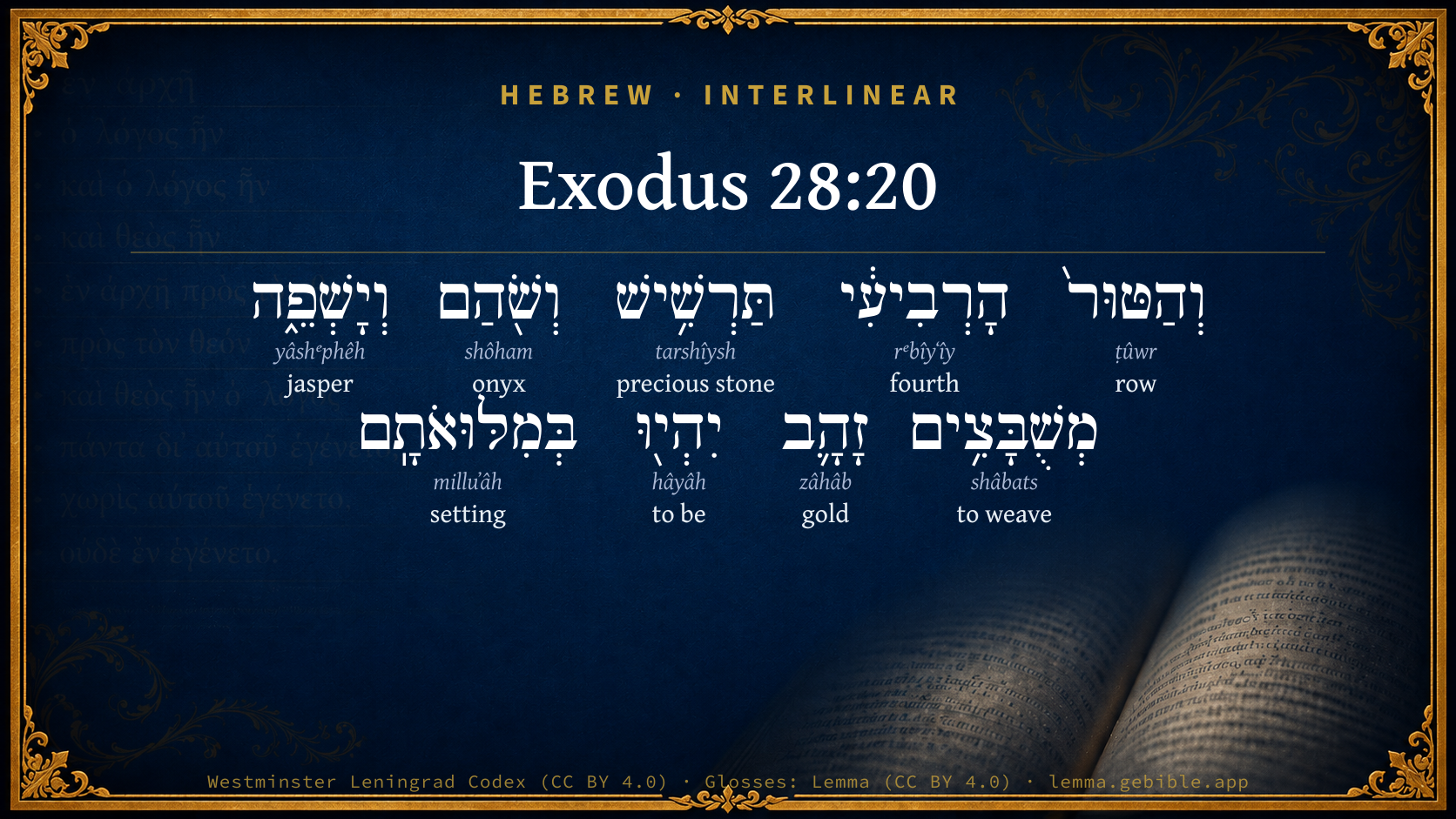
Exodus 28:20

Hebrew (Westminster Leningrad Codex) Exodus 28:20 appears in the Hebrew Old Testament. The text above is from the Westminster Leningrad Codex. Each word links to its Strong’s number, a concise gloss, and parsing drawn from the Open Scriptures Hebrew Bible morphology. Click any word for its full Brown-Driver-Briggs (BDB) entry.
Download image
Cite this verse

Exodus 28:20 (World English Bible). Public Domain. Lemma interlinear Bible study tool, https://lemma.gebible.app/v/exodus/28/20.

Show BibTeX & RIS
BibTeX
RIS
English Translation
and the fourth row a chrysolite, an onyx, and a jasper: they shall be enclosed in gold in their settings.
World English Bible · Public Domain
Highlights Full analysis ↓
Download a study sheet

One document with this verse’s original text, its word-by-word gloss line, the meaning frame, cross-references with their text, attributed commentary, and full source and license credits — printable, and it pastes into notes with its structure intact.

This verse Autodidact and up

Study sheet (.html) Plain text (.txt)

A passage Seminary Student

Up to 50 verses in one chapter. A passage sheet keeps up to 6 commentary sources and 12 cross-references per verse, in the order this page ranks them, and says so on the sheet whenever that leaves anything out. Ask for a single verse and you get the Autodidact verse sheet above.

Everything on this page stays free to read, with no account — the sheet is a download of what is already on screen, not access to it.

Want to remove ads? Support Godless Engineer
Compare translations 3

The same verse in 3 English versions, stacked beneath the original-language interlinear above. Click any original word for its lexicon entry.

Each is an independent rendering of the whole verse — the interlinear is not word-aligned to these translations.

Highlighted words mark where these versions differ — a whole-verse word diff, not a word-by-word alignment.

  • World English Bible Public Domain
    and the fourth row a chrysolite, an onyx, and a jasper: they shall be enclosed in gold in their settings.
  • King James Version Public Domain
    And the fourth row a beryl, and an onyx, and a jasper: they shall be set in gold in their inclosings.
  • unfoldingWord Literal Text CC BY-SA 4.0
    And the fourth row: a beryl, and an onyx, and a jasper. They shall be set in gold—in their ornamental settings.

unfoldingWord Literal Text — © unfoldingWord, licensed CC BY-SA 4.0. Word-aligned USFM3 via Door43 (git.door43.org/unfoldingWord/en_ult).

Versions to compare (up to 4)

3 of 4 selected

Show all 18 translations

Every available English version of this verse, each an independent rendering of the whole verse.

  • World English Bible Public Domain
    and the fourth row a chrysolite, an onyx, and a jasper: they shall be enclosed in gold in their settings.
  • Berean Standard Bible Public Domain
    and in the fourth row a beryl, an onyx, and a jasper. Mount these stones in gold filigree settings.
  • Majority Standard Bible Public Domain
    and in the fourth row a beryl, an onyx, and a jasper. Mount these stones in gold filigree settings.
  • King James Version Public Domain
    And the fourth row a beryl, and an onyx, and a jasper: they shall be set in gold in their inclosings.
  • American Standard Version (1901) Public Domain
    and the fourth row a beryl, and an onyx, and a jasper: they shall be inclosed in gold in their settings.
  • Revised Version (1885) Public Domain
    and the fourth row a beryl, and an onyx, and a jasper: they shall be enclosed in gold in their settings.
  • Geneva Bible (1599) Public Domain
    And in the fourth rowe a chrysolite, an onix, and a iasper: and they shall be set in golde in their embossements.
  • Douay-Rheims (1899) Public Domain
    In the fourth a chrysolite, an onyx, and a beryl. They shall be set in gold by their rows.
  • Young's Literal Translation Public Domain
    and the fourth row `is' beryl, and onyx, and jasper; embroidered with gold are they in their settings,
  • Literal Standard Version CC BY-SA 4.0
    and the fourth row [is] beryl, and onyx, and jasper; they are embroidered with gold in their settings,
  • Unlocked Literal Bible CC BY-SA 4.0
    The fourth row must have a beryl, and an onyx, and a jasper. They must be mounted in gold settings.
  • unfoldingWord Literal Text CC BY-SA 4.0
    And the fourth row: a beryl, and an onyx, and a jasper. They shall be set in gold—in their ornamental settings.
  • Darby Bible Public Domain
    and the fourth row, a chrysolite, and an onyx, and a jasper; enclosed in gold shall they be in their settings.
  • World Messianic Bible Public Domain
    and the fourth row a chrysolite, an onyx, and a jasper. They shall be enclosed in gold in their settings.
  • Webster's Bible Public Domain
    And the fourth row a beryl, and an onyx, and a jasper: they shall be set in gold in their inclosings.
  • Free Bible Version CC BY-SA 4.0
    In the fourth row topaz, beryl, and jasper. Place these stones in ornamental gold settings.
  • Bible in Basic English Public Domain
    The fourth, a topaz, a beryl, and a jasper; they are to be fixed in twisted frames of gold.
  • JPS Tanakh (1917) Public Domain
    and the fourth row a beryl, and an onyx, and a jasper; they shall be inclosed in gold in their settings.

Literal Standard Version (2020), Covenant Press — licensed CC BY-SA 4.0. Text via the HelloAO Bible API (eBible.org). Unlocked Literal Bible (unfoldingWord) — licensed CC BY-SA 4.0. Text via the HelloAO Bible API (eBible.org). unfoldingWord Literal Text — © unfoldingWord, licensed CC BY-SA 4.0. Word-aligned USFM3 via Door43 (git.door43.org/unfoldingWord/en_ult). Free Bible Version, Dr. Jonathan Gallagher — licensed CC BY-SA 4.0. Text via the HelloAO Bible API (eBible.org).

Word by word

More ways to search: Search by grammar → Find every occurrence → Compare this word →

Practice this passage: Drill this verse → Learn its vocabulary →

מְשֻׁבָּצִ֥ים
shâbats
H7660
“woven”
Verb, Pual, Participle Passive, Masculine, Plural, Absolute
Part of Speech
Verb
Stem
Pual
Form
Participle Passive
Gender
Masculine
Number
Plural
State
Absolute
Full BDB Definition

Origin: a primitive root

TWOT: 2320

to weave in checkered or plaited work or pattern (meaning probable) - (Piel) to weave, plait - (Pual) inwoven, set (participle)
  1. וְהַטּוּר֙ ṭûwr H2905 “and · the · row” Conjunction + Particle, Definite Article + Noun, Common, Masculine, Singular, Absolute
  2. הָרְבִיעִ֔י rᵉbîyʻîy H7243 “the · fourth” Particle, Definite Article + Adjective, Ordinal number, Masculine, Singular, Absolute
  3. תַּרְשִׁ֥ישׁ tarshîysh H8658 “precious stone” Noun, Common, Masculine, Singular, Absolute
  4. וְשֹׁ֖הַם shôham H7718 “and · onyx” Conjunction + Noun, Common, Masculine, Singular, Absolute
  5. וְיָשְׁפֵ֑ה yâshᵉphêh H3471 “and · jasper” Conjunction + Noun, Common, Masculine, Singular, Absolute
  6. זָהָ֛ב zâhâb H2091 “gold” Noun, Common, Masculine, Singular, Absolute
  7. יִהְי֖וּ hâyâh H1961 “to be” Verb, Qal, Imperfect, 3rd Person, Masculine, Plural
  8. בְּמִלּוּאֹתָֽם milluʼâh H4396 “in/at · settings · their” Preposition + Noun, Common, Feminine, Plural, Construct + Suffix, Personal, 3rd Person, Masculine, Plural

About this verse

These counts appear in no published source. They are computed here, from the morphology-tagged text and Lemma’s own curated glosses. What Lemma adds →

9
words
9
distinct lemmas
Pentateuch
section

Notable vocabulary

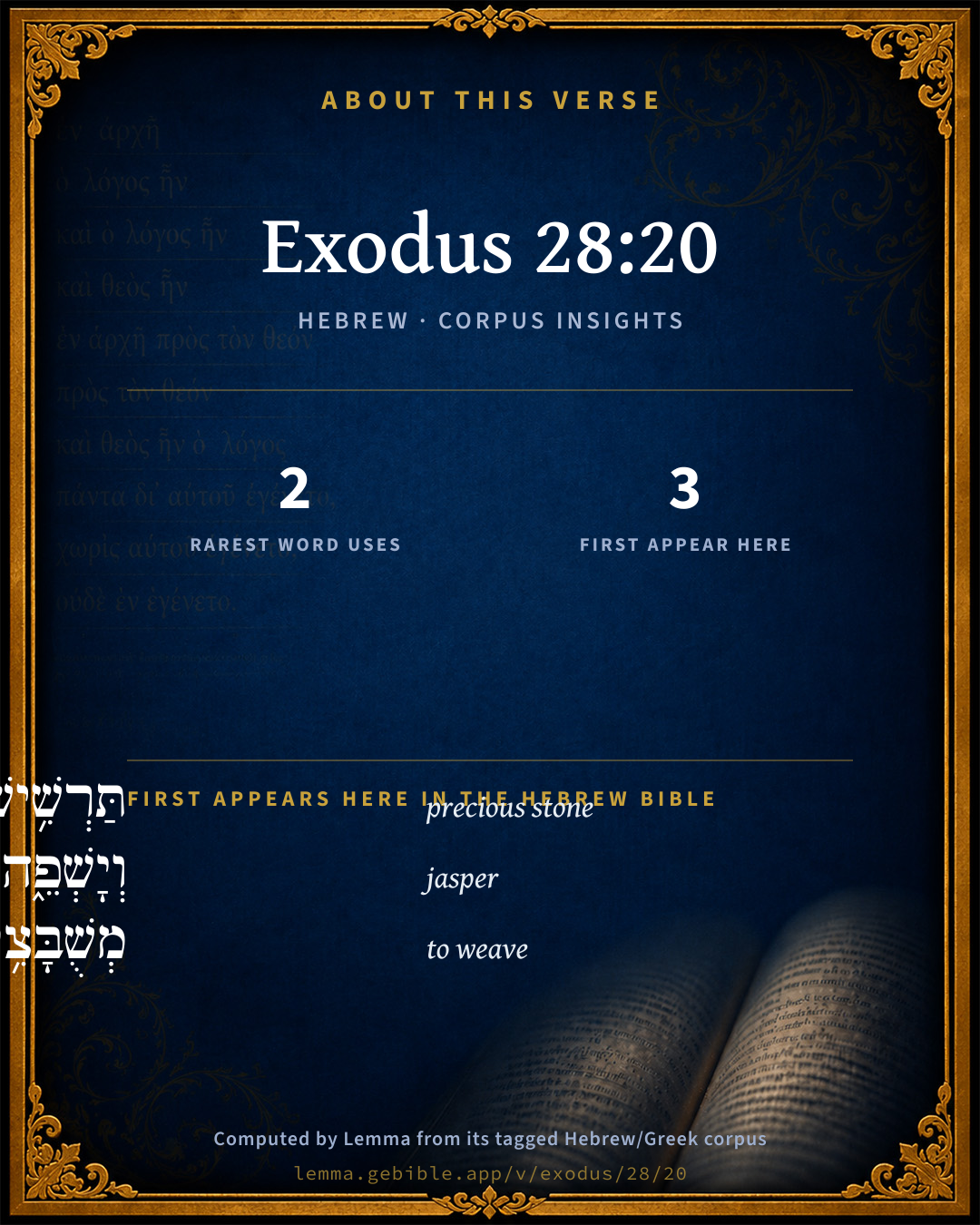
The rarest word here is מְשֻׁבָּצִ֥ים to weave H7660 — appearing just 2 times in the whole Hebrew Bible.

First appearance in Scripture

These words make their first canonical appearance in the Hebrew Bible here:

  • תַּרְשִׁ֥ישׁ precious stone H8658
  • וְיָשְׁפֵ֑ה jasper H3471
  • מְשֻׁבָּצִ֥ים to weave H7660

Shared distinctive vocabulary

מְשֻׁבָּצִ֥ים to weave H7660 occurs in 2 verses of the Hebrew Bible. Also found in:

Grammatical profile

  • 2 verbs
  • 6 nouns
  • 1 adjective

Verb forms

  • מְשֻׁבָּצִ֥ים Pual · Participle Passive
  • יִהְי֖וּ Qal · Imperfect

Hebrew & Septuagint length

In English translation the verse runs 20 words from the Hebrew and 28 from the Septuagint (LXX English) — the Septuagint runs noticeably longer here. See the side-by-side →

A rough comparison of the two English renderings, which tokenize alike — not a word-level alignment.

Word counts can differ between the Hebrew and the Greek without any difference in meaning — e.g. the Hebrew direct-object marker אֵת has no separate Greek word, and Greek often adds the article ὁ.

Cross-references

6

Topical passages linked to Exodus 28:20 in the Treasury of Scripture Knowledge — connected by theme and wording, ordered by reader-vote popularity; previews shown in the World English Bible.

  • Ezekiel 1:16 The appearance of the wheels and their work was like a beryl: and they four had one likeness; and their appearance and their work was as it were a wheel within a wheel.
  • Ezekiel 10:9 I looked, and behold, four wheels beside the cherubim, one wheel beside one cherub, and another wheel beside another cherub; and the appearance of the wheels was like a beryl stone.
  • Daniel 10:6 his body also was like the beryl, and his face as the appearance of lightning, and his eyes as flaming torches, and his arms and his feet like burnished brass, and the voice of his words like the voice of a multitude.
  • Revelation 4:3 that looked like a jasper stone and a sardius. There was a rainbow around the throne, like an emerald to look at.
  • Revelation 21:11 having the glory of God. Her light was like a most precious stone, as if it was a jasper stone, clear as crystal;
  • Revelation 21:18–20 The construction of its wall was jasper. The city was pure gold, like pure glass.

Cross-references courtesy of OpenBible.info (CC BY 4.0).

Hebrew and Greek witnesses Masoretic Hebrew ↔ Greek Septuagint

The same verse in the two great witnesses to the Old Testament, shown verse-for-verse.

Here the Septuagint runs noticeably longer than the Hebrew — LXX2012 (modern English Septuagint) 28 words vs World English Bible 20. A rough length comparison of the two English translations, not a word-level alignment — read both below.

These are two independent witnesses, not word-aligned to each other, and the Septuagint is shown in lemma (dictionary) form.

Hebrew Exodus 28:20 Masoretic · Westminster Leningrad Codex

וְהַטּוּר֙ הָרְבִיעִ֔י תַּרְשִׁ֥ישׁ וְשֹׁ֖הַם וְיָשְׁפֵ֑ה מְשֻׁבָּצִ֥ים זָהָ֛ב יִהְי֖וּ בְּמִלּוּאֹתָֽם

and the fourth row a chrysolite, an onyx, and a jasper: they shall be enclosed in gold in their settings.

World English Bible · Public Domain

Greek LXX Exodus 28:20 Septuagint · lemma form

καί ὁ στίχος ὁ τέταρτος χρυσόλιθος καί βηρύλλιον καί ὀνύχιον περικαλύπτω χρυσίον συνδέω ἐν χρυσίον εἰμί κατά στίχος αὐτός

and the fourth row, a chrysolite, and a beryl, and an onyx stone, set round with gold, bound together with gold: let them be according to their row.

LXX2012 (modern English Septuagint) · Public Domain

On this verse, The Cambridge Bible for Schools and Colleges discusses the Septuagint’s reading. Read the note in Commentary ↓

Hebrew: Westminster Leningrad Codex (CC BY 4.0). Greek: Septuagint (public domain); English from LXX2012 (modern English Septuagint) (Public Domain). How the Septuagint differs from the Hebrew →

Targum (Aramaic paraphrase)

2

The Targum is the ancient Jewish Aramaic paraphrase of the Hebrew Scriptures — an interpretive translation, not the Hebrew text itself. Onkelos (literal) and Pseudo-Jonathan (expansive) render the Torah, and Jonathan the Prophets. Coverage is partial: where no permissively-licensed English translation exists for a verse, only the Aramaic is shown. This is verse-level text, not a word-by-word alignment to the Hebrew.

  1. Targum Onkelos Torah (Genesis–Deuteronomy)
    וְסִדְרֵא רְבִיעָאָה כְּרוּם יַמָא וּבוּרְלָא וּפַנְטֵרֵי מְרַמְצָן דִדְהַב יְהוֹן בְּאַשְׁלָמוּתְהוֹן:

    (no public-domain English translation for this verse)

    Targum Onkelos — Aramaic: “Onkelos Genesis” (public domain); “Onkelos Exodus” (public domain); “Onkelos Leviticus” (public domain); “Onkelos Numbers” (public domain); “Onkelos Deuteronomy” (public domain). English: “Sefaria Community Translation” (CC0 1.0 (public-domain dedication)); “J.W. Etheridge. The Targums of Onkelos and Jonathan Ben Uzziel on the Pentateuch. London: Longmans, Green, 1862” (public domain). Text via Sefaria.

  2. Targum Pseudo-Jonathan Torah (Genesis–Deuteronomy)
    וְשׁוּם סִדְרָא רְבִיעָאָה כְּרוּם יַמָא רַבָּא וּבִירְלֵיוַות חַלָא וּמַרְגְּנִיַית אַפַּנְטוּרִין וַעֲלֵיהוֹן חָקִיק וּמְפָרַשׁ שְׁמָהַת תְּלָתָא שִׁבְטַיָא זְבוּלוּן יוֹסֵף וּבִנְיָמִין מְשַׁקְעִין בִּדְהַב יְהוֹן בְּאַשְׁלָמוּתְהוֹן

    And the name of the fourth row, chrysolite, onyx, and jasper; and upon them shall be written and expressed the names of three tribes, Zebulon, Joseph, and Benjamin. Set in gold shall they be, in their completeness.

    Targum Pseudo-Jonathan — Aramaic: “Targum Jonathan on Genesis” (public domain); “Targum Jonathan on Exodus” (public domain); “Targum Jonathan on Leviticus” (public domain); “Targum Jonathan on Numbers” (public domain); “Targum Jonathan on Deuteronomy” (public domain). English: “The Targum of Jonathan ben Uzziel, trans. J. W. Etheridge, London, 1862” (public domain). Text via Sefaria.

Commentary

Notes on Exodus 28:20 from classic Christian and Jewish commentators (each source and its license shown beneath its notes). The classic Christian expositions comment on the surrounding passage and are grouped to its opening verse, so a note may address several verses; the Jewish commentaries on the Tanakh (Rashi and others) are per-verse, so they appear only where the commentator wrote on this verse.

Lemma curates 59 commentaries, every one of them public domain or Creative Commons licensed, each selected and text-cleaned for this edition rather than reprinted as found. About our sources →

Geneva Bible (1599)

Geneva Bible translators

Hebrew, Tarshish.

Geneva Bible (1599) marginal notes — public domain. Text via Bolls.life.

Ellicott's Commentary for English Readers

(20) They shall be set in gold in their inclosings.—Or, in their settings. Every gem was to be enclosed in its own setting of gold.

A Bible Commentary for English Readers, edited by Charles John Ellicott (1878–1897) — public domain. Text from a community e-Sword module.

The Cambridge Bible for Schools and Colleges

gen. ed. J. J. S. Perowne

20. a beryl] Heb. tarshish, χρυσόλιθος (Rev_21:10), chrysolithus: Eze_1:16; Eze_10:9; Eze_28:13, Son_5:14, Dan_10:6. The name tarshish apparently points to its being obtained from Tarshish (Tartessus) in Spain. The chrysolite (‘gold-stone’) of the later Greeks (which was also obtained from Spain, Pliny, H. N. xxxvii. 127) is probably our topaz1[208], but as this was unknown in earlier times, some other gold-coloured stone must be intended,—perhaps (Petrie) the yellow jasper. It is not however stated whether this stone is (or was) found in Spain. The rend. beryl is as old as Abarbanel (1437–1508): the chalcedony (RVm.; Rev_21:19) of the ancients,—so called from its being found at Chalcedon (opposite to Byzantium),—was the green transparent carbonate of copper, our copper emerald (Smith, DB. s.v.).

[208] By a curious interchange of terms, it seems that ‘the ancient chrysolite is the modern topaz, and the ancient topaz the modern chrysolite’ (Smith, DB. s.v. Beryl).

an onyx] Heb. shôham, βηρύλλιον (so LXX. here, but not consistently), onychinus: v. 9, Exo_25:7, Gen_2:12, Eze_28:13, Job_28:16, 1Ch_29:2. This is usually supposed to be either the onyx (LXX. in Job; Vulg. mostly) or the beryl (LXX. here; Pesh. Targ. always): the onyx being a stratified stone, consisting of layers of white (resembling in colour the nail, whence the name), grey, and other colours (see DB. s.v.), and the beryl a clear blue, green, or pale yellow stone (see EB. s.v.). Myres, however (EB. iv. 4808), argues in favour of malachite (green carbonate of copper), ‘common in Egypt in all periods, obtained from the Sinaitic mine district,’ and also other sources of copper, as Cyprus, and known likewise in Babylonia and Assyria.

a jasper] Heb. yâshepheh, ὀνύχιον, beryllus (but see on ‘diamond’ in v. 18): Eze_28:13, Rev_21:19. In all probability the green jasper is intended.

The Cambridge Bible for Schools and Colleges (gen. ed. J. J. S. Perowne; Cambridge University Press, 1878–1918) — public domain. Text from a community e-Sword module.

John Gill's Exposition

And the stones shall be with the names of the children of Israel, twelve, according to their names,.... And just so many are reckoned up in the preceding verses, each of which had one or other of the names of the children of Israel engraved on them, according to the order of their names in their birth. Some have thought that Levi's name was omitted, but their reason for it seems not sufficient; for why might not he bear the name of his own tribe, and represent that as well as the rest, since the whole Israel of God is represented by his antitype?

like the engravings of a net, everyone with his name shall they be according to the twelve tribes; not like the impression of a seal on wax, then the letters indeed would have been protuberant, as some have thought; but these were like the engravings of a seal, in which the letters or figures are cut within it: these twelve stones, with the names on them, represent the twelve tribes of Israel, and they the whole spiritual Israel of God; and being precious stones, show the excellency of the people of God, of what value, and in what esteem they are with God and Christ, being their jewels and peculiar treasure; and their names being in them, denote the special and particular knowledge God has of them, their names being written in heaven in the book of life; and they are called by name by the Lord; and being engraved as a signet, is an emblem of their being set as a seal on the arm and heart of Christ, and of their being as dear and precious to him as a signet on a man's right hand; and being set in ouches and enclosures of gold, express both the dignity and excellency, and the careful preservation of them: these were set in rows, as members of churches are, everyone in his order, rank, and station, Co1 12:18.

John Gill's Exposition of the Whole Bible (1746–1763) — public domain (CC PDM 1.0). Text via the HelloAO Bible API.

Haydock's Catholic Bible Commentary

Chrysolite, (beryl and opale,) onyx, (Septuagint, beryl; Chaldean, or emerald; Calmet) beryl, (Hebrew, jasper; Septuagint &c., onyx) were inscribed with the names of Zabulon, Joseph, and Benjamin. In Ezechiel xxviii. 13, the jasper stone comes in the sixth place, as it does in the Vulgate here. (Calmet) --- The mystical interpretation of these stones, may be seen in Cornelius a Lapide. St. Epiphanius has written a learned work on the 12 precious stones. (Haydock)

George Leo Haydock (1774–1849), Haydock's Catholic Family Bible and Commentary, 1859 edition — public domain. Excludes Psalms (Douay-Rheims chapter numbering differs from Protestant) and Deuterocanonical books (Catholic canon only).

The Pulpit Commentary

The fourth row a beryl, and an onyx, and a jasper. If the identifications above suggested are allowed, two at least of these translations must be rejected. We have supposed the third stone in the first row to have been the "beryl," and the third in the second the "onyx." Perhaps we should translate, "a turquoise, a sardonyx, and a jasper." (See the comment on ver. 9.) Their inclosings. Rather, "their settings," as in ver. 17.

The Pulpit Commentary (1880–1919), ed. H.D.M. Spence-Jones & Joseph S. Exell — public domain. Text from a community e-Sword module.

Keil & Delitzsch

C. F. Keil & F. Delitzsch

"Gold borders shall be on their settings" (see at Exo 28:11 and Exo 28:13). The golden capsules, in which the stones were "filled," i.e., set, were to be surrounded by golden ornaments, which not only surrounded and ornamented the stones, but in all probability helped to fix them more firmly and yet more easily upon the woven fabric.

Keil & Delitzsch — Biblical Commentary on the Old Testament (1861–1891) — public domain (CC PDM 1.0). Text via the HelloAO Bible API. (Old Testament only.)

Rashi

Rabbi Shlomo Yitzchaki (Rashi)

משבצים זהב יהיו SET IN GOLD SHALL THEY — the rows — BE במלאותם IN THEIR SETTINGS — surrounded by gold settings in depth of such a size that each shall be filled by the thickness of the stone. This is the meaning of במלאותם, “in their fillings”: of such a size as will be filled by the thickness of the stones shall be the depth of the settings, neither more nor less.

Rashi on the Tanakh — English translations: “The Judaica Press complete Tanach with Rashi, translated by A. J. Rosenberg” (CC BY 4.0); “Pentateuch with Rashi's commentary by M. Rosenbaum and A.M. Silbermann, 1929-1934” (public domain); “The Metsudah Tanach series, Lakewood, N.J” (CC BY 4.0); and “The Book of Joshua, Metsudah Publications, 1997” (CC BY 4.0). Text via Sefaria.

Lesson kit

Teaching starters — assembled from the data on this page, not authored interpretation. Every prompt links to the verse data it draws on. Edit before teaching.

Exodus, in the Pentateuch, opens this verse with 9 words (9 distinct Hebrew lemmas). Its most distinctive word is shâbats (“to weave”). The Greek Septuagint runs longer here. A historical commentator’s framing appears above. Read the whole chapter for the surrounding context.

Discussion questions

  1. What does “to weave” (shâbats) contribute to the verse as a whole?
  2. 3 words here appear for the first time in Scripture. What is being introduced at this debut?
  3. Exodus 28:39 shares the word «to weave» with this verse. How do the two illuminate each other?
  4. Compared with the Hebrew, the Septuagint runs longer here. What questions does that raise?
  5. The translations on this page render this verse differently — a whole-verse word diff, not a word-by-word alignment. What might account for the different wordings?
  6. The verb «מְשֻׁבָּצִ֥ים» is Pual Participle Passive. How does its form color the action?
  7. Reading how Geneva Bible (1599) and Ellicott's Commentary for English Readers read this verse, where do the two commentators agree and where do they part?

Things to notice

  • 3 words make their first canonical appearance in Scripture here.
  • These translations choose different wording for 9 words in this verse.
  • 9 distinct Hebrew lemmas span 9 words in this verse.

Reading settings

Reading text

Shown beneath each verse's original-language words.

Old Testament
Old Testament edition

Read the OT as the Masoretic Hebrew (MT) or the Greek Septuagint (LXX).

English shown for the Greek Septuagint (in the Hebrew ↔ Greek comparison).

Comparing translations? Open the Compare panel on any verse page to stack up to four side by side.