Luke 8:23

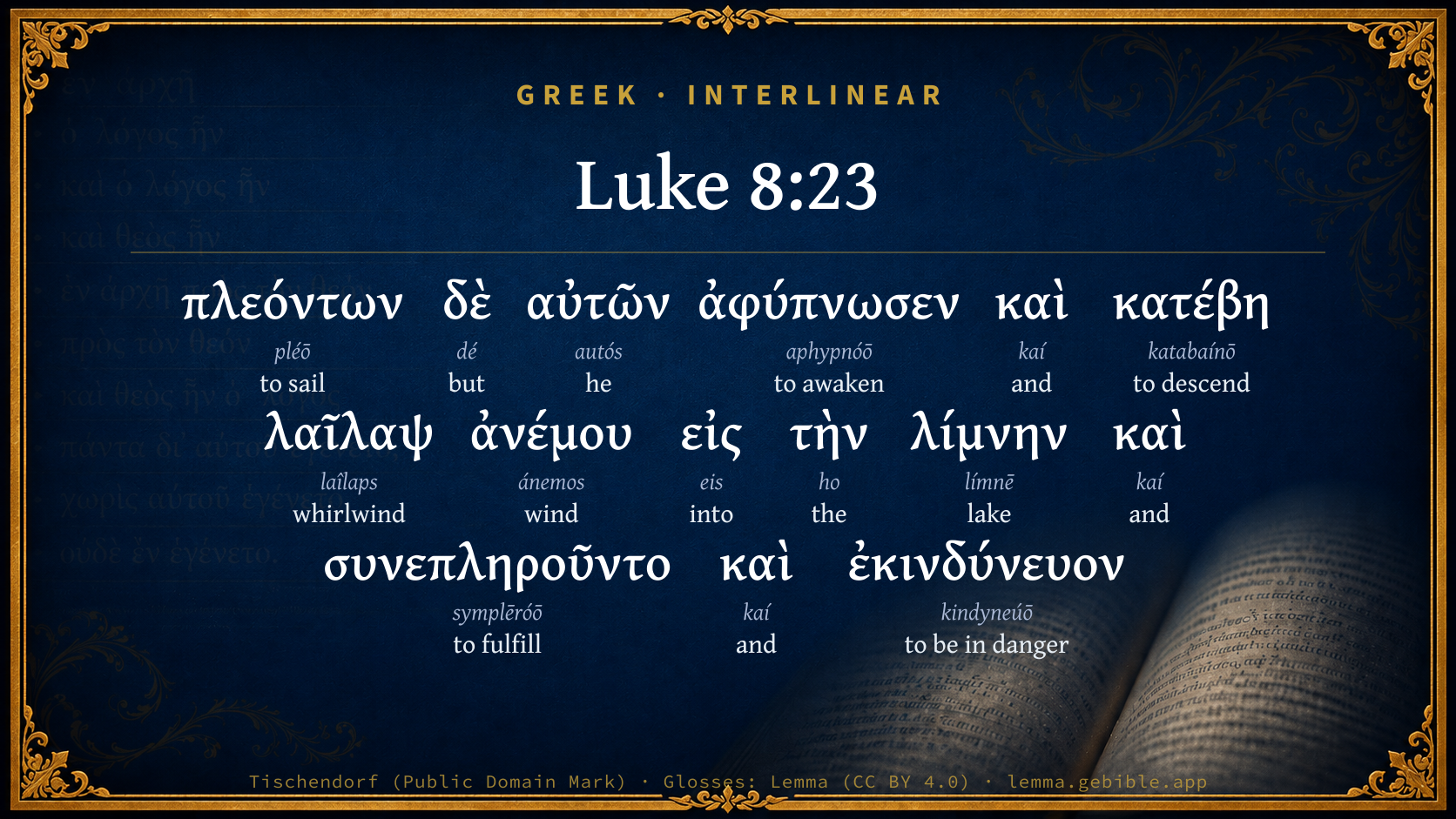
Greek (Tischendorf 8th ed.) Luke 8:23 appears in the Greek New Testament. The text above is from the Tischendorf 8th edition. Each word links to its Strong’s number and a concise gloss. Click any word for its full Thayer’s Greek Lexicon entry.
Download image
Cite this verse

Luke 8:23 (World English Bible). Public Domain. Lemma interlinear Bible study tool, https://lemma.gebible.app/v/luke/8/23.

Show BibTeX & RIS
BibTeX
RIS
English Translation
But as they sailed, he fell asleep. A wind storm came down on the lake, and they were taking on dangerous amounts of water.
World English Bible · Public Domain
Highlights
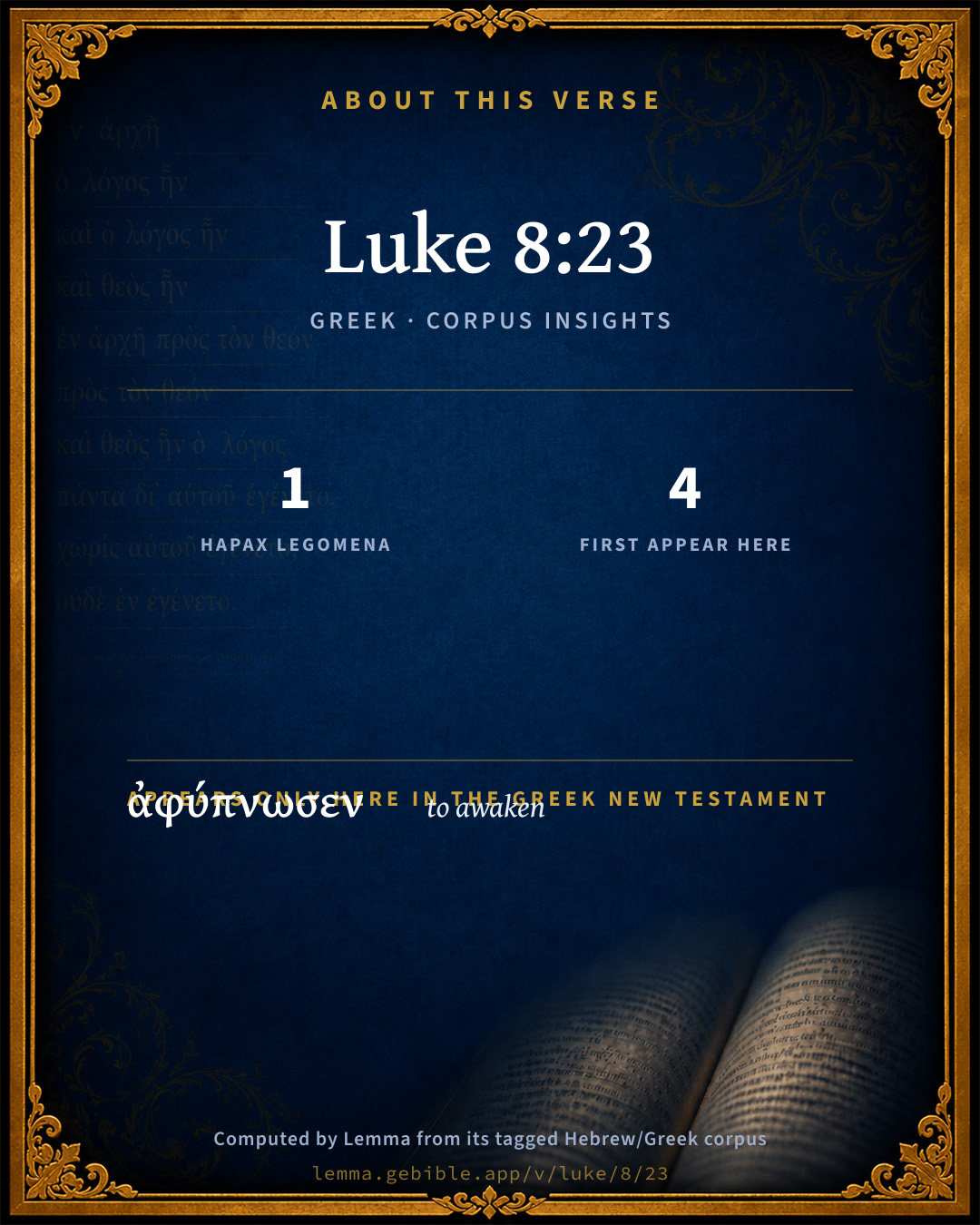
  • 1 hapax legomenon — only here in the Greek New Testament
  • 4 first appearances in the Greek New Testament
Full analysis ↓
Download a study sheet

One document with this verse’s original text, its word-by-word gloss line, the meaning frame, cross-references with their text, attributed commentary, and full source and license credits — printable, and it pastes into notes with its structure intact.

This verse Autodidact and up

Study sheet (.html) Plain text (.txt)

A passage Seminary Student

Up to 50 verses in one chapter. A passage sheet keeps up to 6 commentary sources and 12 cross-references per verse, in the order this page ranks them, and says so on the sheet whenever that leaves anything out. Ask for a single verse and you get the Autodidact verse sheet above.

Everything on this page stays free to read, with no account — the sheet is a download of what is already on screen, not access to it.

Want to remove ads? Support Godless Engineer
Compare translations 3

The same verse in 3 English versions, stacked beneath the original-language interlinear above. Click any original word for its lexicon entry.

Each is an independent rendering of the whole verse — the interlinear is not word-aligned to these translations.

Highlighted words mark where these versions differ — a whole-verse word diff, not a word-by-word alignment.

  • World English Bible Public Domain
    But as they sailed, he fell asleep. A wind storm came down on the lake, and they were taking on dangerous amounts of water.
  • King James Version Public Domain
    But as they sailed he fell asleep: and there came down a storm of wind on the lake; and they were filled with water, and were in jeopardy.
  • unfoldingWord Literal Text CC BY-SA 4.0
    But as they voyaged, he fell asleep. Then a windstorm came down on the lake, and they were being filled and were in danger.

unfoldingWord Literal Text — © unfoldingWord, licensed CC BY-SA 4.0. Word-aligned USFM3 via Door43 (git.door43.org/unfoldingWord/en_ult).

Versions to compare (up to 4)

3 of 4 selected

Show all 19 translations

Every available English version of this verse, each an independent rendering of the whole verse.

  • World English Bible Public Domain
    But as they sailed, he fell asleep. A wind storm came down on the lake, and they were taking on dangerous amounts of water.
  • Berean Standard Bible Public Domain
    As they sailed, He fell asleep, and a windstorm came down on the lake, so that the boat was being swamped, and they were in great danger.
  • Majority Standard Bible Public Domain
    As they sailed, He fell asleep, and a windstorm came down on the lake, so that the boat was being swamped, and they were in great danger.
  • King James Version Public Domain
    But as they sailed he fell asleep: and there came down a storm of wind on the lake; and they were filled with water, and were in jeopardy.
  • American Standard Version (1901) Public Domain
    But as they sailed he fell asleep: and there came down a storm of wind on the lake; and they were filling `with water', and were in jeopardy.
  • Revised Version (1885) Public Domain
    But as they sailed he fell asleep: and there came down a storm of wind on the lake; and they were filling with water, and were in jeopardy.
  • Geneva Bible (1599) Public Domain
    And as they sayled, he fell a sleepe, and there came downe a storme of winde on the lake, and they were filled with water, and were in ieopardie.
  • Douay-Rheims (1899) Public Domain
    And when they were sailing, he slept; and there came down a storm of wind upon the lake, and they were filled, and were in danger.
  • Young's Literal Translation Public Domain
    and as they are sailing he fell deeply asleep, and there came down a storm of wind to the lake, and they were filling, and were in peril.
  • Literal Standard Version CC BY-SA 4.0
    and as they are sailing He fell deeply asleep, and there came down a storm of wind to the lake, and they were filling, and were in peril.
  • Unlocked Literal Bible CC BY-SA 4.0
    But as they sailed he fell asleep. A terrible windstorm came down on the lake, and their boat was filling with water, and they were in danger.
  • unfoldingWord Literal Text CC BY-SA 4.0
    But as they voyaged, he fell asleep. Then a windstorm came down on the lake, and they were being filled and were in danger.
  • Darby Bible Public Domain
    And as they sailed, he fell asleep; and a sudden squall of wind came down on the lake, and they were filled [with water], and were in danger;
  • World Messianic Bible Public Domain
    But as they sailed, he fell asleep. A wind storm came down on the lake, and they were taking on dangerous amounts of water.
  • Webster's Bible Public Domain
    But as they sailed, he fell asleep: and there came down a storm of wind on the lake; and they were filled with water, and were in jeopardy.
  • Free Bible Version CC BY-SA 4.0
    As they were sailing, Jesus fell asleep, and a storm came down on the lake. The boat began filling with water and they were in danger of sinking.
  • Bible in Basic English Public Domain
    But while they were sailing he went to sleep: and a storm of wind came down on the sea, and the boat became full of water and they were in danger.
  • Text-Critical English NT CC BY 4.0
    and as they were sailing along, he fell asleep. Then a windstorm came down on the lake, and they were in danger as the boat was being swamped by the waves.
  • Tyndale New Testament (1534) Public Domain
    And as they sayled he fell a slepe and there arose a storme of wynde in the lake and they were fylled with water and were in ieopardy.

Literal Standard Version (2020), Covenant Press — licensed CC BY-SA 4.0. Text via the HelloAO Bible API (eBible.org). Unlocked Literal Bible (unfoldingWord) — licensed CC BY-SA 4.0. Text via the HelloAO Bible API (eBible.org). unfoldingWord Literal Text — © unfoldingWord, licensed CC BY-SA 4.0. Word-aligned USFM3 via Door43 (git.door43.org/unfoldingWord/en_ult). Free Bible Version, Dr. Jonathan Gallagher — licensed CC BY-SA 4.0. Text via the HelloAO Bible API (eBible.org).

Word by word

More ways to search: Search by grammar → Find every occurrence → Compare this word →

Practice this passage: Drill this verse → Learn its vocabulary →

ἀφύπνωσεν
aphypnóō
G879
“to awaken”
Verb, Aorist, Active, Indicative, 3rd person, Singular
Part of Speech
Verb
Tense
Aorist
Voice
Active
Mood
Indicative
Person
3rd person
Number
Singular
Full Thayer's Definition

Origin: from a compound of G575 and G5258

TDNT: 17:05,1

1. to awaken from sleep 2. to fall asleep, to fall off to sleep
  1. πλεόντων pléō G4126 “to sail” Verb, Present, Active, Participle, Genitive, Plural, Masculine
  2. δὲ dé G1161 “but” Conjunction
  3. αὐτῶν autós G846 “he” Personal pronoun, Genitive, Plural, Masculine
  4. καὶ kaí G2532 “and” Conjunction
  5. κατέβη katabaínō G2597 “to descend” Verb, Aorist, Active, Indicative, 3rd person, Singular
  6. λαῖλαψ laîlaps G2978 “whirlwind” Noun, Nominative, Singular, Feminine
  7. ἀνέμου ánemos G417 “wind” Noun, Genitive, Singular, Masculine
  8. εἰς eis G1519 “into” Preposition
  9. τὴν ho G3588 “the” Article, Accusative, Singular, Feminine
  10. λίμνην límnē G3041 “lake” Noun, Accusative, Singular, Feminine
  11. καὶ kaí G2532 “and” Conjunction
  12. συνεπληροῦντο symplēróō G4845 “to fulfill” Verb, Imperfect, Passive, Indicative, 3rd person, Plural
  13. καὶ kaí G2532 “and” Conjunction
  14. ἐκινδύνευον kindyneúō G2793 “to be in danger” Verb, Imperfect, Active, Indicative, 3rd person, Plural

About this verse

These counts appear in no published source. They are computed here, from the morphology-tagged text and Lemma’s own curated glosses. What Lemma adds →

15
words
13
distinct lemmas
Gospels
section

Notable vocabulary

1 hapax legomenon — a word that appears only here in the entire Greek New Testament:

  • ἀφύπνωσεν to awaken G879

First appearance in Scripture

These words make their first canonical appearance in the Greek New Testament here:

  • πλεόντων to sail G4126
  • ἀφύπνωσεν to awaken G879
  • συνεπληροῦντο to fulfill G4845
  • ἐκινδύνευον to be in danger G2793

Shared distinctive vocabulary

λαῖλαψ whirlwind G2978 occurs in 3 verses of the Greek New Testament. Also found in:

Repetition

A word recurs within this verse:

Cross-references

10

Topical passages linked to Luke 8:23 in the Treasury of Scripture Knowledge — connected by theme and wording, ordered by reader-vote popularity; previews shown in the World English Bible.

  • Psalms 93:3–4 The floods have lifted up, Yahweh, The floods have lifted up their voice. The floods lift up their waves.
  • Isaiah 54:11 you afflicted, tossed with tempest, and not comforted, behold, I will set your stones in beautiful colors, and lay your foundations with sapphires.
  • Psalms 44:23 Wake up! Why do you sleep, Lord? Arise! Don't reject us forever.
  • Psalms 107:23–30 Those who go down to the sea in ships, Who do business in great waters;
  • Psalms 124:2–4 If it had not been Yahweh who was on our side, When men rose up against us;
  • Psalms 148:8 Lightning and hail, snow and clouds; Stormy wind, fulfilling his word;
  • Isaiah 51:9–10 Awake, awake, put on strength, arm of Yahweh; awake, as in the days of old, the generations of ancient times. Isn't it you who did cut Rahab in pieces, who pierced the monster?
  • Luke 8:22 Now it happened on one of those days, that he entered into a boat, himself and his disciples, and he said to them, "Let's go over to the other side of the lake." So they launched out.
  • Acts 27:14–20 But before long, a tempestuous wind beat down from shore, which is called Euroclydon.
  • Hebrews 4:15 For we don't have a high priest who can't be touched with the feeling of our infirmities, but one who has been in all points tempted like we are, yet without sin.

Cross-references courtesy of OpenBible.info (CC BY 4.0).

Commentary

Notes on Luke 8:23 from classic Christian and Jewish commentators (each source and its license shown beneath its notes). The classic Christian expositions comment on the surrounding passage and are grouped to its opening verse, so a note may address several verses; the Jewish commentaries on the Tanakh (Rashi and others) are per-verse, so they appear only where the commentator wrote on this verse.

Lemma curates 59 commentaries, every one of them public domain or Creative Commons licensed, each selected and text-cleaned for this edition rather than reprinted as found. About our sources →

Trapp's Complete Commentary

John Trapp

23 But as they sailed he fell asleep: and there came down a storm of wind on the lake; and they were filled with water, and were in jeopardy.

Ver. 23. See Mat 8:23; Mar 4:36.

John Trapp, A Commentary or Exposition upon All the Books of the Old and New Testament (1647–1656) — public domain. Text from a community e-Sword module.

Tyndale Open Study Notes

Tyndale Open Resources

8:23 a fierce storm came down on the lake: Severe storms are common on the Sea of Galilee, which lies in a valley surrounded by high hills.

Tyndale Open Study Notes — © Tyndale Open Resources, licensed CC BY-SA 4.0. Text via the HelloAO Bible API.

Bengel's Gnomon

Johann Albrecht Bengel

Luk 8:23. Κατέβη, came down) viz. from the air.

Bengel's Gnomon of the New Testament — English translation (T&T Clark, Edinburgh, 1860) — public domain. Text from a community e-Sword module.

Expositor's Greek Testament

ed. W. Robertson Nicoll

Luk 8:23 . ἀφύπνωσε , went off to sleep, fatigued with heat and speaking; the storm implies sultry conditions; ἀφυπνοῦν means both to awake = ἀφυπνίζειν , and to go to sleep = καθυπνοῦν ; vide Lobeck, ad Phryn. , p. 224. κατέβη , came down, from the hills. συνεπληροῦντο , they ( i.e. , the boat) were getting full and in danger. Seamen would naturally say, “we were getting full,” when they meant the boat. Examples of such usage in Kypke.

The Expositor's Greek Testament, edited by W. Robertson Nicoll (1897–1910) — public domain. Text from a community e-Sword module.

Geneva Bible (1599)

Geneva Bible translators

Jesus fell on sleep: and it appeareth, that he was very fast on sleep, because they called twice before he awoke.

Not the disciples, but the ship.

Geneva Bible (1599) marginal notes — public domain. Text via Bolls.life.

Jamieson, Fausset & Brown

Robert Jamieson, A. R. Fausset & David Brown

JESUS CROSSING THE LAKE, STILLS THE STORM. (Luk 8:22-25)

filled--literally, "were getting filled," that is, those who sailed; meaning that their ship was so.

Jamieson, Fausset & Brown — Commentary Critical and Explanatory on the Whole Bible (1871) — public domain (CC PDM 1.0). Text via the HelloAO Bible API.

Adam Clarke's Commentary

Verse 23. There came down a storm of wind - and they - were in jeopardy.] This is a parallel passage to that in Jon 1:4. There was a mighty tempest in the sea, so that the ship was like to be broken: the latter clause of which is thus translated by the Septuagint: και το πλοιον εκινδυνευε του συντριβηναι, And the ship was in the utmost danger of being dashed to pieces. This is exactly the state of the disciples here; and it is remarkable that the very same word, εκινδυνευον, which we translate, were in jeopardy, is used by the evangelist, which is found in the Greek version above quoted. The word jeopardy, an inexpressive French term, and utterly unfit for the place which it now occupies, is properly the exclamation of a disappointed gamester, Jeu perdu! The game is lost! or, j'ai perdu! I have lost! i.e. the game.

Adam Clarke's Commentary on the Bible (1810–1826) — public domain. Text from a community e-Sword/MySword module.

Ellicott's Commentary for English Readers

(23) He fell asleep.—The verb so rendered differs from the “was asleep” of the other Gospels, and this is the only place of the New Testament in which it occurs. It is a somewhat more technical word, and is so far -characteristic of the physician-historian.

They were filled.—Better, they were filling, the tense describing the process, not the completion.

A Bible Commentary for English Readers, edited by Charles John Ellicott (1878–1897) — public domain. Text from a community e-Sword module.

The Cambridge Bible for Schools and Colleges

gen. ed. J. J. S. Perowne

23. he fell asleep] Rather, He fell into deep sleep. The day had been one of incessant toil; and He was resting (as St Mark tells us, reflecting the vivid reminiscence of St Peter) ‘in the stem on the steersman’s leather cushion,’ Mar_4:38; contrast with this Jon_1:5.

there came down a storm of wind] The suddenness and violence of this ‘hurricane’ is in exact accordance with what we know of the Lake. The winds from the snowy peaks of Hermon rush down the Peraean wadies into the burning tropical air of the lake-basin with extraordinary suddenness and impetuosity (Thomson, Land and Book, II. 25). The lake may look like a sheet of silver, when in one moment there will be a darkening ripple, and in the next it will be lashed into storm and foam. The outburst of this storm perhaps frightened back the boats which started with Him, Mar_4:36.

were filled with water] Rather, were being filled. ‘The waves were dashing into the boat, so that it was getting full,’ Mar_4:37; ‘the boat was being hidden under the waves,’ Mat_8:24. The tossing ship (Navicella) has been accepted in all ages as the type of the Church in seasons of peril.

The Cambridge Bible for Schools and Colleges (gen. ed. J. J. S. Perowne; Cambridge University Press, 1878–1918) — public domain. Text from a community e-Sword module.

John Gill's Exposition

And they came to him, and awoke him,.... That is, the disciples came from some part of the ship, to the hinder part of it, where Christ was asleep; and by their shrieks and cries, and repeated vociferations, awaked him out of sleep:

saying, Master, Master, we perish. The Vulgate Latin, Arabic, and Ethiopic versions, only read "master", without a repetition of the word, as in Matthew and Mark; but the Syriac and Persic versions repeat it, and render the words, "our master, our master"; See Gill on Mat 8:25.

Then he rose, and rebuked the wind, and the raging of the water, and they ceased, and there was a calm; See Gill on Mat 8:26.

John Gill's Exposition of the Whole Bible (1746–1763) — public domain (CC PDM 1.0). Text via the HelloAO Bible API.

Haydock's Catholic Bible Commentary

And they were filled; i.e. the little ship was filled with water. (Witham)

George Leo Haydock (1774–1849), Haydock's Catholic Family Bible and Commentary, 1859 edition — public domain. Excludes Psalms (Douay-Rheims chapter numbering differs from Protestant) and Deuterocanonical books (Catholic canon only).

The Pulpit Commentary

But as they sailed he fell asleep; and there came down a storm of wind on the lake; and they were filled with water, and were in jeopardy. In the three Gospels of Matthew, Mark, and Luke, this and the three following incidents are closely united the lake-storm; the devils sent into the herd of swine; the raising of the little daughter of Jairus; the healing of the woman afflicted with the issue of blood. Although this cycle of acts is always united by the three, yet they do not occupy the same position chronologically in the three Gospels. The explanation of this probably is that in the primitive apostolic teaching it was usual to relate these four incidents of the Master"s work together. In St. Matthew, between the recital of the healing of the demoniac and the raising of the daughter of Jairus, are intercalated the healing of the paralytic, and the call of Matthew, and the feast which followed. These incidents, in a more extended primitive discourse, were no doubt joined to the other four recitals. Had they used a common document, the three would surely have placed them in the same connection with other events. They most likely were worked, with many other signs, somewhere in this period of public work, and were chosen by the first preachers of "the Name" as specially illustrative acts, showing the Lord"s power over the elements, over the unseen spirits of evil, over death, over wearying chronic sickness. On the sudden storm, travellers remark how, without warning, winds from the snowy summits of the neighbouring Hermon rush down the mountain gorges into the warm tropical air of the lake-basin, and in a short space of time the calm Galilee sea is lashed into storm and foam. The graphic description of Mark is, as usual, the most vivid, and gives us, in a few master-touches, the aspect of the scene. The weary Master sleeping in the stern of the fishing-boat; the pillow beneath his head; the disciples, terrified by the sudden uproar of the waves surging round their frail bark, as the wild winds rushed down on the lake, hastily awaking their tired Master. The danger must have been very real to have alarmed these Gennesaret fishermen; the storm must have been something more than the usual lake-tempests. The very words the Lord used when he lifted up his head and saw the danger, St. Mark preserves for us. With his "Hush!" he silenced the wild roar of the winds and waters; with his "Be still!" he quieted the heaving waves. Some commentators, reasoning from the Master"s personal address to the elements the winds and the waters suppose that, in the midst of the storm, was some evil presence, who, taking advantage of our Lord"s helpless condition asleep in that frail fisher"s boat raised up the wild storm, hoping, perhaps, to cut short his life. The idea of spirits thus blending with the elements is one by no means unknown to Scripture. "Who maketh his angels winds rather than the usual, better-known translation, "spirits, his ministers a flaming fire". (Psa_104:4 Heb_1:7 Job_1:12)

The sleep of Christ.

"As they sailed he fell asleep" Christ asleep! Christ asleep in the daytime! Christ asleep in the storm! Christ asleep with his disciples in danger and distress! What have we here?

I THE SON OF MAN ASLEEP IN THE HOUR OF HIS OWN BODILY WEARINESS. A hard and long day"s work had the Master that day. He had thought much, taught much, wrought much; and each one of these had been laborious and exhausting to One who was what he was and felt as he felt. He was completely spent with his strenuous and sustained exertion. And as they sailed he fell asleep; so fast asleep that, though the winds raged round him and the spray fell upon him, he did not awake. The incident points to:

1. The devoted diligence of his life. Other things might have accounted for this simple fact of being overcome, but that was the true account of it. How laboriously he must have worked to do all that he did in the few months at his command! we might well argue; how devotedly he did labour the memoirs of the evangelists assure us.

2. The generous impulse which he allowed himself in the conduct of his life. That life was not without plan, arrangement. But our Lord permitted himself to be guided by the conduct and attitude of others; he went back when repelled (ver. 37), he went on when invited (ver. 41). On this occasion he allowed the importunity of the people to hold him longer in teaching and healing than he would otherwise have remained; thus he left room in his life for the play of generous impulse. By all means let us be methodical, laying out our time intelligently and wisely; but let us leave room also for an unselfish responsiveness in the structure of our life, even as our Lord did.

3. The thoroughness of his humanity. Who but the Son of God could, of his own will and in his own name, command the mighty elements of nature? Who but a veritable Son of man could be overcome by weariness, and sleep in the midst of the raging of the storm? He was one of ourselves walking wearied him, teaching tired him, healing exhausted him; he expended himself as he wrought day by day; his manhood was real and true.

II THE MASTER ASLEEP IN THE HOUR OF THE DISCIPLES" DANGER AND DISTRESS. Christ sleeping when the boat was sinking I It looked like negligence! "Carest thou not that we perish?" That negligence was only apparent; there was no real danger. As it was right for him to sleep under such exhaustion, he could with perfect safety commit himself and his cause to the care of the unsleeping Father. As it was, the greatness of the apparent peril brought about an illustration of Divine power which otherwise they would have missed. That was not the last time that the Master seemed negligent of his own. To his Church in its storm of terrible persecution, to his people (in their individual lives) in the tempests of temptation or adversity through which they have passed, Christ may often, indeed has often, seemed to be heedless and indifferent. But he has always been at hand, always ready for action at the right moment. We have but to make our earnest appeal to him, and if the right time has come for the manifestation of his power though on this point we may be mistaken (see Joh_2:4 Act_2:6, Act_2:7) he will most effectually respond; he will say to the mightiest forces with which we are in conflict, "Peace, be still!" and there will be "a great calm. C.

The Pulpit Commentary (1880–1919), ed. H.D.M. Spence-Jones & Joseph S. Exell — public domain. Text from a community e-Sword module.

Cambridge Greek Testament for Schools and Colleges

23. ἀφύπνωσεν. ‘He fell into deep sleep.’ The day had been one of incessant toil; and He was resting (as St Mark tells us, reflecting the vivid reminiscence of St Peter) ‘in the stern on the steersman’s leather cushion,’ Mar 4:38: contrast with this Jon 1:5.

κατέβη λαῖλαψ. ‘There swept down a hurricane.’ St Matthew uses the less accurate word σεισμός. The suddenness and violence of this ‘hurricane’ is in exact accordance with what we know of the Lake. The winds from the snowy peaks of Hermon rush down the Peraean wadies into the burning tropical air of the lake-basin with extraordinary suddenness and impetuosity (Thomson, Land and Book, II. 25). The lake may look like a sheet of silver, when in one moment there will be a darkening ripple, and in the next it will be lashed into storm and foam. The outburst of this storm perhaps frightened back the boats which started with Him, Mar 4:36.

συνεπληροῦντο. ‘Were being filled.’ ‘The waves were dashing into the boat, so that it was getting full,’ Mar 4:37; ‘the boat was being hidden under the waves,’ Mat 8:24. The tossing ship (Navicella) has been accepted in all ages as the type of the Church in seasons of peril.

Cambridge Greek Testament for Schools and Colleges (Cambridge University Press, 1896; 21 vols, various authors incl. Carr, Maclear, Plummer, Farrar, Lumby, Moule, M. R. James, Simcox) — public domain. Text from a community e-Sword module.

Alford’s Greek Testament

Henry Alford

23.] ἀφύπ. belongs to the later Greek, and even there more commonly signifies ‘to awaken.’

κατέβη—from the sky—or perhaps from the mountain valleys around: see Mat 7:27, and note on Act 27:14.

συνεπλ.] they (= their ship) were filling.

Henry Alford, The Greek Testament (1849–1861) — public domain. Text from a community e-Sword module.

International Critical Commentary

23. πλεόντων δὲ αὐτῶν ἀφύπνωσεν. Excepting Rev 18:17, πλεῖν is peculiar to Lk. (Act 21:3, Act 21:27:2, Act 21:6, Act 21:24). In Anth. Pal. 9. 517, ἀφυπνόω means “awaken from sleep.” Here it means “fall off to sleep,” a use which seems to be somewhat late (Heliod. ix. 12). In class. Grk. we should rather have καθυπνόω (Lob. Phryn. p. 224). This is the only passage in which we read of Jesus sleeping.

κατέβη λαῖλαψ ἀνέμου. “There came down a violent squall of wind,” from the heights which surround the lake. These are furrowed with ravines like funnels, down which winds rush with great velocity. See Thomson, Land & Book, p. 375; Keim, iv. p. 179, who quotes Rusegger, Reisen, iii. p. 136. For λαῖλαψ comp. Job 21:18, 38:1; Wisd. 5:14, 23; Ecclus. 48:9; Hom. Il. xii. 375, xvii. 57. Mt. gives the effect of it as σεισμὸς μέγας ἐν τῇ θαλάσσῃ. For the accent comp. καλαῦροψ, κλῖμαξ, κ.τ.λ., and see Chandler, § 668.

συνεπληροῦντο. The verb occurs only here, 9:51, and Act 2:1. Note the imperf. in contrast to κατέβη. The squall came down with a single rush; the filling of the boat continued and was not completed. What was true of the boat is stated of the own In class. Grk. the act. is used of manning ships thoroughly (Thuc. vi. 50, 2).

International Critical Commentary — older volumes (1896–1929), various authors — public domain. Text from a community e-Sword module.

Vincent's Word Studies in the New Testament

Marvin R. Vincent

He fell asleep [αφυπνωσεν] . Very graphic. He fell off [απο] into sleep.

Came down [κατεβη] . More vivid than either Matthew or Mark, who have there arose. The word describes the action of the sudden storms which literally came down from the heights surrounding the lake. See on Mt 8:24.

Storm [λαιλαψ] . See on Mr 4:37. Matthew has seismov, a shaking.

See on Mt 8:24.

They were filling with water [συνεπληρουντο] . Used by Luke only.

Mark, as usual, goes into minuter detail, and describes how the waves beat into the boat. Note the imperfects : they were filling; they were beginning to be in danger, contrasted with the instantaneous descent of the storm expressed by the aorist came down.

Marvin R. Vincent, Word Studies in the New Testament (1887–1900) — public domain. Text from a community e-Sword/MySword module.

Lesson kit

Teaching starters — assembled from the data on this page, not authored interpretation. Every prompt links to the verse data it draws on. Edit before teaching.

Luke, in the Gospels, opens this verse with 15 words (13 distinct Greek lemmas). Its most distinctive word is aphypnóō (“to awaken”). A historical commentator’s framing appears above. Read the whole chapter for the surrounding context.

Discussion questions

  1. The word aphypnóō carries the sense “to awaken.” How does it shape the verse?
  2. This verse holds 1 word here found nowhere else in the Greek New Testament. What might the rare word draw attention to?
  3. 4 words here appear for the first time in Scripture. What is being introduced at this debut?
  4. Mark 4:37 shares the word «whirlwind» with this verse. How do the two illuminate each other?
  5. “and” occurs 3× in this one verse. What is the effect of the repetition?
  6. The translations on this page render this verse differently — a whole-verse word diff, not a word-by-word alignment. What might account for the different wordings?
  7. Reading how Trapp's Complete Commentary and Tyndale Open Study Notes read this verse, where do the two commentators agree and where do they part?

Things to notice

  • 1 word in this verse appears nowhere else in the Greek New Testament.
  • 4 words make their first canonical appearance in Scripture here.
  • These translations choose different wording for 14 words in this verse.
  • “and” occurs 3× in this single verse.
  • 13 distinct Greek lemmas span 15 words in this verse.

Reading settings

Reading text

Shown beneath each verse's original-language words.

Old Testament
Old Testament edition

Read the OT as the Masoretic Hebrew (MT) or the Greek Septuagint (LXX).

English shown for the Greek Septuagint (in the Hebrew ↔ Greek comparison).

Comparing translations? Open the Compare panel on any verse page to stack up to four side by side.