
Psalms 114:2

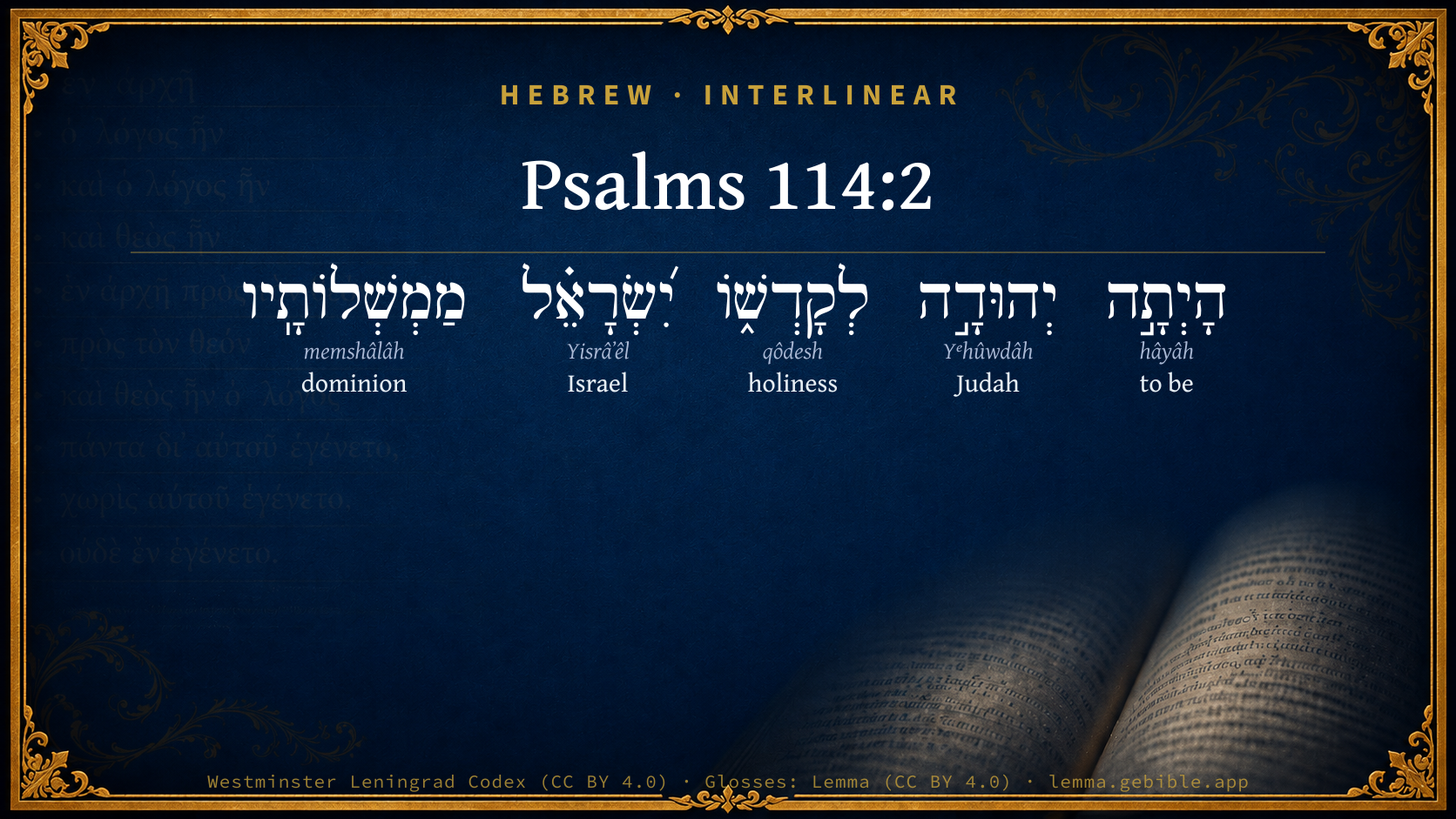
Hebrew (Westminster Leningrad Codex) Psalms 114:2 appears in the Hebrew Old Testament. The text above is from the Westminster Leningrad Codex. Each word links to its Strong’s number, a concise gloss, and parsing drawn from the Open Scriptures Hebrew Bible morphology. Click any word for its full Brown-Driver-Briggs (BDB) entry.
Download image
Cite this verse

Psalms 114:2 (World English Bible). Public Domain. Lemma interlinear Bible study tool, https://lemma.gebible.app/v/psalms/114/2.

Show BibTeX & RIS
BibTeX
RIS
English Translation
Judah became his sanctuary, Israel his dominion.
World English Bible · Public Domain
Download a study sheet

One document with this verse’s original text, its word-by-word gloss line, the meaning frame, cross-references with their text, attributed commentary, and full source and license credits — printable, and it pastes into notes with its structure intact.

This verse Autodidact and up

Study sheet (.html) Plain text (.txt)

A passage Seminary Student

Up to 50 verses in one chapter. A passage sheet keeps up to 6 commentary sources and 12 cross-references per verse, in the order this page ranks them, and says so on the sheet whenever that leaves anything out. Ask for a single verse and you get the Autodidact verse sheet above.

Everything on this page stays free to read, with no account — the sheet is a download of what is already on screen, not access to it.

Want to remove ads? Support Godless Engineer
Compare translations 3

The same verse in 3 English versions, stacked beneath the original-language interlinear above. Click any original word for its lexicon entry.

Each is an independent rendering of the whole verse — the interlinear is not word-aligned to these translations.

Highlighted words mark where these versions differ — a whole-verse word diff, not a word-by-word alignment.

  • World English Bible Public Domain
    Judah became his sanctuary, Israel his dominion.
  • King James Version Public Domain
    Judah was his sanctuary, and Israel his dominion.
  • unfoldingWord Literal Text CC BY-SA 4.0
    Judah became his sanctuary, Israel his realm.

unfoldingWord Literal Text — © unfoldingWord, licensed CC BY-SA 4.0. Word-aligned USFM3 via Door43 (git.door43.org/unfoldingWord/en_ult).

Versions to compare (up to 4)

3 of 4 selected

Show all 18 translations

Every available English version of this verse, each an independent rendering of the whole verse.

  • World English Bible Public Domain
    Judah became his sanctuary, Israel his dominion.
  • Berean Standard Bible Public Domain
    Judah became God’s sanctuary, and Israel His dominion.
  • Majority Standard Bible Public Domain
    Judah became God’s sanctuary, Israel His dominion.
  • King James Version Public Domain
    Judah was his sanctuary, and Israel his dominion.
  • American Standard Version (1901) Public Domain
    Judah became his sanctuary, Israel his dominion.
  • Revised Version (1885) Public Domain
    Judah became his sanctuary, Israel his dominion.
  • Geneva Bible (1599) Public Domain
    Iudah was his sanctification, and Israel his dominion.
  • Douay-Rheims (1899) Public Domain
    Judea made his sanctuary, Israel his dominion.
  • Young's Literal Translation Public Domain
    Judah became His sanctuary, Israel his dominion.
  • Literal Standard Version CC BY-SA 4.0
    Judah became His sanctuary, || Israel his dominion.
  • Unlocked Literal Bible CC BY-SA 4.0
    Judah became his holy place, Israel his kingdom.
  • unfoldingWord Literal Text CC BY-SA 4.0
    Judah became his sanctuary, Israel his realm.
  • Darby Bible Public Domain
    Judah was his sanctuary, Israel his dominion.
  • World Messianic Bible Public Domain
    Judah became his sanctuary, Israel his dominion.
  • Webster's Bible Public Domain
    Judah was his sanctuary, and Israel his dominion.
  • Free Bible Version CC BY-SA 4.0
    the land of Judah became the Lord's sanctuary, Israel his kingdom.
  • Bible in Basic English Public Domain
    Judah became his holy place, and Israel his kingdom.
  • JPS Tanakh (1917) Public Domain
    Judah became His sanctuary, Israel His dominion.

Literal Standard Version (2020), Covenant Press — licensed CC BY-SA 4.0. Text via the HelloAO Bible API (eBible.org). Unlocked Literal Bible (unfoldingWord) — licensed CC BY-SA 4.0. Text via the HelloAO Bible API (eBible.org). unfoldingWord Literal Text — © unfoldingWord, licensed CC BY-SA 4.0. Word-aligned USFM3 via Door43 (git.door43.org/unfoldingWord/en_ult). Free Bible Version, Dr. Jonathan Gallagher — licensed CC BY-SA 4.0. Text via the HelloAO Bible API (eBible.org).

Word by word

More ways to search: Search by grammar → Find every occurrence → Compare this word →

Practice this passage: Drill this verse → Learn its vocabulary →

About this verse

These counts appear in no published source. They are computed here, from the morphology-tagged text and Lemma’s own curated glosses. What Lemma adds →

5
words
5
distinct lemmas
Wisdom
section

Notable vocabulary

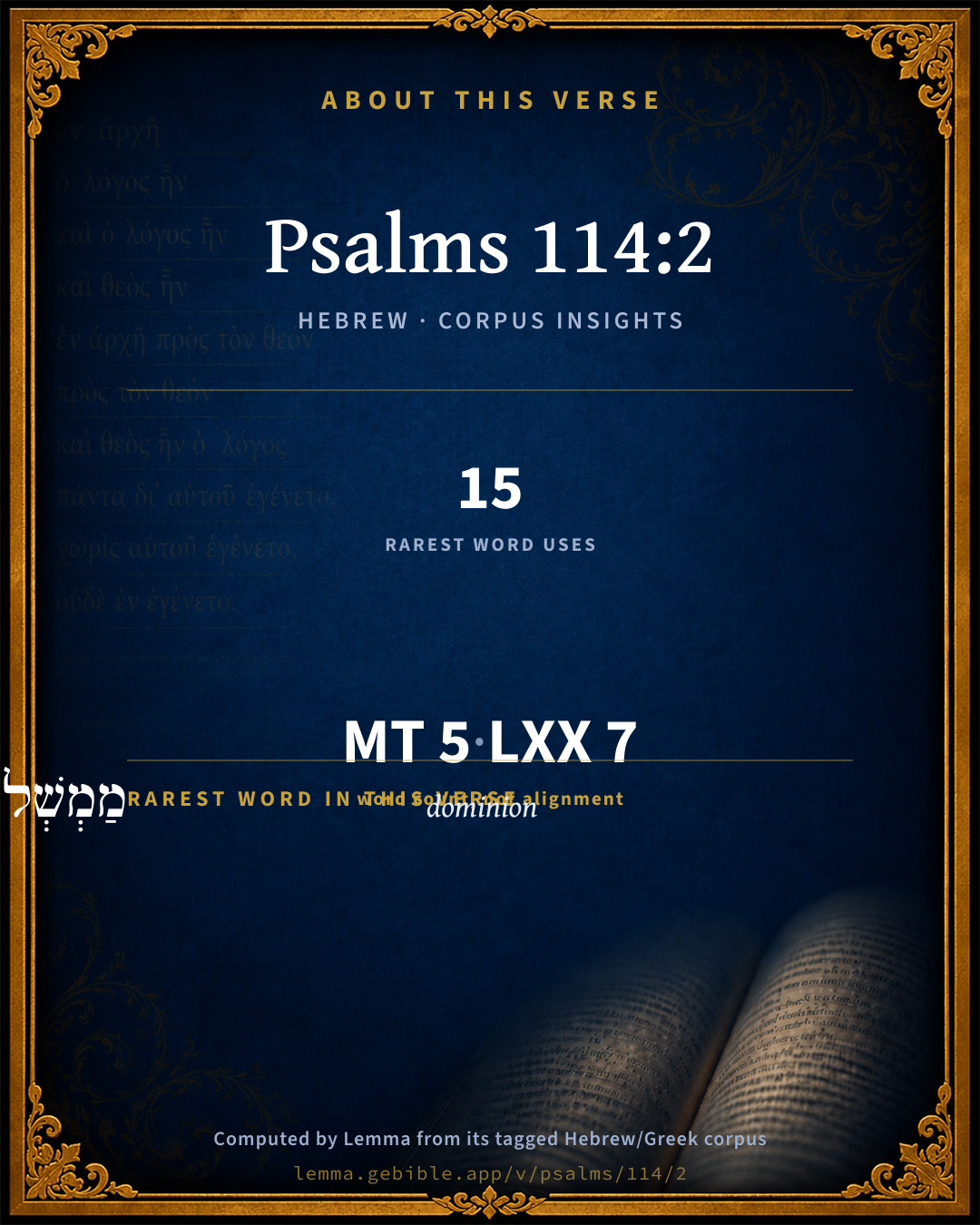
The rarest word here is מַמְשְׁלוֹתָֽיו dominion H4475 — appearing just 15 times in the whole Hebrew Bible.

Shared distinctive vocabulary

מַמְשְׁלוֹתָֽיו dominion H4475 occurs in 14 verses of the Hebrew Bible. Also found in:

Grammatical profile

  • 1 verb
  • 4 nouns

Verb forms

  • הָיְתָ֣ה Qal · Perfect

Hebrew & Septuagint length

In English translation the verse runs 7 words from the Hebrew and 8 from the Septuagint (LXX English) — closely comparable.

A rough comparison of the two English renderings, which tokenize alike — not a word-level alignment.

Word counts can differ between the Hebrew and the Greek without any difference in meaning — e.g. the Hebrew direct-object marker אֵת has no separate Greek word, and Greek often adds the article ὁ.

In the original languages it is 5 Hebrew tokens and 7 Greek tokens — but the two are counted differently (Hebrew bundles its prefixes and suffixes into one token; the Greek is in lemma form), so that isn’t a like-for-like length.

Cross-references

12

Topical passages linked to Psalms 114:2 in the Treasury of Scripture Knowledge — connected by theme and wording, ordered by reader-vote popularity; previews shown in the World English Bible.

  • Exodus 15:17 You shall bring them in, and plant them in the mountain of your inheritance, The place, Yahweh, which you have made for yourself to dwell in; The sanctuary, Lord, which your hands have established.
  • Exodus 25:8 Let them make me a sanctuary, that I may dwell among them.
  • Psalms 78:68–69 But chose the tribe of Judah, Mount Zion which he loved.
  • Exodus 6:7 and I will take you to me for a people, and I will be to you a God; and you shall know that I am Yahweh your God, who brings you out from under the burdens of the Egyptians.
  • Exodus 19:5–6 Now therefore, if you will indeed obey my voice, and keep my covenant, then you shall be my own possession from among all peoples; for all the earth is mine;
  • Exodus 29:45–46 I will dwell among the children of Israel, and will be their God.
  • Ezekiel 37:26–28 Moreover I will make a covenant of peace with them; it shall be an everlasting covenant with them; and I will place them, and multiply them, and will set my sanctuary in the midst of them forevermore.
  • Leviticus 11:45 For I am Yahweh who brought you up out of the land of Egypt, to be your God. You shall therefore be holy, for I am holy.
  • Deuteronomy 23:14 for Yahweh your God walks in the midst of your camp, to deliver you, and to give up your enemies before you; therefore shall your camp be holy, that he may not see an unclean thing in you, and turn away from you.
  • Deuteronomy 27:9 Moses and the priests the Levites spoke to all Israel, saying, Keep silence, and listen, Israel: this day you are become the people of Yahweh your God.
  • 2 Corinthians 6:16–17 What agreement has a temple of God with idols? For you are a temple of the living God. Even as God said, "I will dwell in them, and walk in them; and I will be their God, and they will be my people."
  • Revelation 21:3 I heard a loud voice out of heaven saying, "Behold, God's dwelling is with people, and he will dwell with them, and they will be his people, and God himself will be with them as their God.

Cross-references courtesy of OpenBible.info (CC BY 4.0).

Hebrew and Greek witnesses Masoretic Hebrew ↔ Greek Septuagint

The same verse in the two great witnesses to the Old Testament, shown verse-for-verse.

You’re reading Greek Psalm 113 (Hebrew Psalm 114). The Septuagint counts the superscription, so verse numbers can differ from the Hebrew — chapter-level alignment, not verse-by-verse. Numbering follows Rahlfs.

These are two independent witnesses, not word-aligned to each other, and the Septuagint is shown in lemma (dictionary) form.

Hebrew Psalms 114:2 Masoretic · Westminster Leningrad Codex

הָיְתָ֣ה יְהוּדָ֣ה לְקָדְשׁ֑וֹ יִ֝שְׂרָאֵ֗ל מַמְשְׁלוֹתָֽיו

Judah became his sanctuary, Israel his dominion.

World English Bible · Public Domain

Greek LXX Greek Psalm 113:2 Septuagint · lemma form

γίγνομαι ἰουδαία ἁγίασμα αὐτός ἰσραήλ ἐξουσία αὐτός

Judea became his sanctuary, and Israel his dominion.

LXX2012 (modern English Septuagint) · Public Domain

On this verse, The Cambridge Bible for Schools and Colleges discusses the Septuagint’s reading. Read the note in Commentary ↓

Hebrew: Westminster Leningrad Codex (CC BY 4.0). Greek: Septuagint (public domain); English from LXX2012 (modern English Septuagint) (Public Domain). How the Septuagint differs from the Hebrew →

Commentary

Notes on Psalms 114:2 from classic Christian and Jewish commentators (each source and its license shown beneath its notes). The classic Christian expositions comment on the surrounding passage and are grouped to its opening verse, so a note may address several verses; the Jewish commentaries on the Tanakh (Rashi and others) are per-verse, so they appear only where the commentator wrote on this verse.

Lemma curates 59 commentaries, every one of them public domain or Creative Commons licensed, each selected and text-cleaned for this edition rather than reprinted as found. About our sources →

Trapp's Complete Commentary

John Trapp

Psa 114:2 Judah was his sanctuary, [and] Israel his dominion.

Ver. 2. Judah was his sanctuary] Or sanctity, or sanctification. This was a happy change for them, from their Egyptian idolatry, Eze 23:19, like as it was from their Egyptian servitude, when Israel became God’s dominions, dominations, and signiories.

John Trapp, A Commentary or Exposition upon All the Books of the Old and New Testament (1647–1656) — public domain. Text from a community e-Sword module.

J. A. Alexander on Psalms

Joseph Addison Alexander

2. (Psa 114:2) Judah became his sanctuary, Israel his dominion. Judah is put as an equivalent to Israel, hot only because it had really become so, when the psalm was written, but because it was destined to become so from the first. See Gen 49:10. Became, literally was for, which might mean nothing more than served as or was treated as; but this construction of the verb to be with to or for is the only representative in Hebrew of our word become. The sense thus obtained is entirely consistent with the call- ing of Abraham, because what is here meant is that Israel, as a nation, was now publicly declared to be the chosen or peculiar people, an idea expressed by the phrase his sanctuary or holy thing, i. e. something set apart exclusively to his use and service. The parallel word in the original is plural, dominions or domains, in reference, as some suppose, to the plurality of tribes, but according to others, in contrast with the lordships and dominions of the world, to all which Israel is described as more than equipollent, just as the infinite superiority of the true God to all false gods is expressed or suggested by the plural name Elohim. Here, as in Psa 87:1, the pronouns are without an antecedent in the sentence. The reference to God is so self-evident, that the only question has respect to the unusual form, which some explain by supposing that the psalm was originally part of the preceding one, or at leak designed to be always read or sung directly after it. The latest interpreters prefer the explanation, that the name of God. was designedly suppressed, in order that the questions in Psa 114:5-6, might appear more natural and yet more striking.

Joseph Addison Alexander, The Psalms Translated and Explained (1850) — public domain. Text from a community e-Sword module.

Geneva Bible (1599)

Geneva Bible translators

The whole people were witnesses of his holy majesty, in adopting them, and of his mighty power in delivering them.

Geneva Bible (1599) marginal notes — public domain. Text via Bolls.life.

Adam Clarke's Commentary

Verse 2. Judah was his sanctuary] He set up his true worship among the Jews, and took them for his peculiar people.

And Israel his dominion.] These words are a proof, were there none other, that this Psalm was composed after the days of David, and after the division of the tribes, for then the distinction of Israel and Judah took place.

Adam Clarke's Commentary on the Bible (1810–1826) — public domain. Text from a community e-Sword/MySword module.

Ellicott's Commentary for English Readers

(2) Judah was.—Better, became. The feminine verb shows that the country is intended, and not the tribe, and the parallelism directs us to think not of the territory of the tribe of Judah alone, but of the whole country. Notice the art with which the name of God is reserved, and the simple pronoun, His, used. (Comp. Exo_19:6.)

A Bible Commentary for English Readers, edited by Charles John Ellicott (1878–1897) — public domain. Text from a community e-Sword module.

The Cambridge Bible for Schools and Colleges

gen. ed. J. J. S. Perowne

2. Judah became his sanctuary,

Israel his dominion (R.V.).

The division of the lines is rhythmical not logical. Israel became Jehovah’s sanctuary and dominion. No contrast is intended between Judah and Israel, as though one was preeminent as the centre of religious life, the other as the chief civil power, but for the sake of the parallelism the whole nation is designated by its two principal divisions in later times as in 1Ki_4:20, and often. By His act of Redemption Jehovah consecrated it to be His dwelling place, and marked His choice of it as His kingdom. See the fundamental passage in Exo_19:3-6; and cp. Exo_15:13; Exo_15:16; Deu_4:20; Deu_7:6 ff; Deu_32:9 ff.; 1Ki_8:51; Hos_13:4; Amo_3:1-2; Jer_2:2-3 : &c.

It is commonly noted as an indication of the poet’s art that the simple pronoun His is used, and the name of God not introduced till Psa_114:7, as though to excite the reader’s curiosity. The suggestion is fanciful. “The whole of the preceding Psalm had been saying who the object of their praise was” (Kay); and the two Psalms were probably intended to be used liturgically together, as we know they actually were used. Moreover a Hallelujah preceded the Psalm as in the LXX, and supplied the antecedent for the pronoun.

The Cambridge Bible for Schools and Colleges (gen. ed. J. J. S. Perowne; Cambridge University Press, 1878–1918) — public domain. Text from a community e-Sword module.

John Gill's Exposition

Judah was his sanctuary,.... Meaning not the tribe of Judah only, though that in many things had the preeminence; the kingdom belonging to it, the chief ruler being out of it, especially the Messiah; its standard was pitched and moved first; it offered first to the service of the Lord; and the Jews have a tradition, mentioned by Jarchi and Kimchi, that this tribe, with its prince at the head of it, went into the Red sea first; the others fearing, but afterwards followed, encouraged by their example: but rather all the tribes are meant, the whole body of the people; for this is not to be understood of the tabernacle or temple in the tribe of Judah, sometimes called a sanctuary; for neither of these were in being when Israel came out of Egypt; but it may be rendered, "Judah was his holiness" (u), or was holiness to the Lord, the Lord's holy people; see Jer 2:2, not all internally holy; for there were many that came out of Egypt that were unholy, rebellious, and disobedient, and whose carcasses fell in the wilderness; but externally, when brought out of Egypt they were separated from all other people, and in this sense sanctified, and became a holy and special people, chosen by the Lord to be so; with whom, he made a covenant, and to whom he gave holy laws and righteous statutes: and in this they were typical of those who are effectually called by grace with an holy calling, and unto holiness; have principles of grace and holiness wrought in them, and have Holiness to the Lord written upon them; they have the sanctification of the Spirit, and Christ is made sanctification to them; and they are the Lord's sanctuary, in which he dwells.

And Israel his dominion: for, though all the world is his kingdom and his government, yet the people of Israel were in a very particular and remarkable manner his dominion; from the time of their coming out of Egypt to their having a king, their government was properly a theocracy; God was their King, and by him they were immediately ruled and governed, and had a body of laws given them from him, and were under his immediate care and protection, Exo 19:5. In this they were typical of the saints called by grace, who are then translated from the power of Satan into the kingdom of Christ; whom they acknowledge to be their Lord and King, and whose laws, commands, and ordinances, they willingly observe; the people of God are often represented as a kingdom, and Christ as King of saints; the Targum is

"the congregation of the house of Judah was united to his holiness, and Israel to his power.''

(u) "sanctificatio ejus", Pagninus, Vatablus; "sanctitas ejus", Gejerus, Michaelis.

John Gill's Exposition of the Whole Bible (1746–1763) — public domain (CC PDM 1.0). Text via the HelloAO Bible API.

Albert Barnes' Notes on the Bible

Judah was his sanctuary - His home; his abode; his sacred dwelling-place. Judah was the principal or leading tribe, recognized as the tribe where power was to be concentrated, and from which the Messiah was to proceed Gen 49:8-12; and hence, the name was early used to denote the entire people, and ultimately, as modified in the word Jews, became the common name of the nation.

And Israel his dominion - The nation that he ruled; the nation that had his law; the nation that he governed by his presence - or, of which he was the recognized king. There can be no doubt that the reference here is to God, but it is remarkable that the name “God” is not used. Perhaps the reason may be that this psalm was designed to be employed in connection with the preceding one, and as that consists entirely of the praises of God, it was not necessary to repeat the name when his praise was to be continued under another form, and in connection with another line of thought.

Albert Barnes' Notes on the Bible (1834–1885) — public domain. Text from a community e-Sword/MySword module.

Matthew Poole's English Annotations

Judah, or Israel, as it is explained in the next clause; one tribe being put for all; which is a common synecdoche. Judah he mentions as the chief of all the tribes, not only in number and power, but also in dignity, in which the kingdom was to be seated, Gen 49:10, &c., as at this time it actually was, and from which the Messias was to spring. His, i.e. God’s, which is easily understood from the whole context, and from the nature of the thing.

Sanctuary; or, holiness; the people of God’s holiness, as they are called, Isa 63:18; or, his holy people, as Deu 26:19; Dan 8:24; sanctified or set apart from all the nations of the world to be his peculiar people and possession. His dominion, in a peculiar manner, to be governed by his laws, and honoured with his special presence and favour.

Matthew Poole's English Annotations on the Holy Bible (1683–1685) — public domain. Text from a community e-Sword/MySword module.

The Treasury of David

Charles H. Spurgeon

Ver. 2. Judah was his sanctuary, and Israel his dominion. These people were God's sanctification and dominion, that is, witnesses of his holy majesty in adopting them, and of his mighty power in delivering them: or, his sanctification, as having his holy priests to govern them in the points of piety; and dominion, as having godly magistrates ordained from above to rule them in matters of policy: or, his sanctuary, both actually, because sanctifying him; and passively, because sanctified of him...This one verse expounds and exemplifies two prime petitions of the Lord's Prayer. "Hallowed be thy name, thy kingdom come": for Judah was God's sanctuary, because hallowing his name;and Israel his dominion, as desiring his kingdom to come. Let every man examine himself by this pattern, whether he be truly the servant of Jesus his Saviour, or the vassal of Satan the destroyer. If any man submit himself willingly to the domineering of the devil, and suffer sin to reign in his mortal members, obeying the lusts thereof, and working all uncleanness even with greediness; assuredly that man is yet a chapel of Satan, and a slave to sin. On the contrary, whosoever unfeignedly desires that God's kingdom may come, being ever ready to be ruled according to his holy word, acknowledging it a lantern to his feet, and a guide to his paths; admitting obediently his laws, and submitting himself alway to the same; what is he, but a citizen of heaven, a subject of God, a saint, a sanctuary? John Boys.

Ver. 2. Judah was his sanctuary, etc. Reader, do not fail to remark, when Israel was brought out of Egypt the Lord set up his tabernacle among them, and manifested his presence to them. And what is it now, when the Lord Jesus brings out his people from the Egypt of the world? Doth he not fulfil that sweet promise, "Lo, I am with you alway, even unto the end of the world"? Is it not the privilege of his people, to live to him, to live with him, and to live upon him? Doth he not in every act declare, "I will say, it is my people; and they shall say, the Lord is my God"? Mt 28:20; Zec 13:9. Robert Hawker.

Ver. 2. Judah was his sanctuary. Meaning not the tribe of Judah only, though they in many things had the preeminence; the kingdom belonged to it, the chief ruler being out of it, especially the Messiah; its standard was pitched and moved first; it offered first to the service of the Lord; and the Jews have a tradition, mentioned by Jarchi and Kimchi, that this tribe with its prince at the head of it, went into the Red Sea first: the others fearing, but afterwards followed, encouraged by their example. In this place all the tribes are meant, the whole body of the people. John Gill.

Ver. 2. One peculiarity of the second verse requires attention. It twice uses the word "his", without naming any one. There are two theories to account for this circumstance. One is that Psalm 114 was always sung in immediate connection with 113, in which the name of God occurs no less than six times, so that the continuance of the train of thought made a fresh repetition of it here unnecessary. But this view, to be fully consistent with itself, must assume that the two Psalms are really one, with a merely arbitrary division, which does not, on the face of the matter, seem by any means probable, as the scope of thought in the two is perfectly distinct. The other, which is more satisfactory, regards the omission of the Holy Name in this part of the Psalm as a practical artifice to heighten the effect of the answer to the sudden apostrophe in verses five and six. There would be nothing marvellous in the agitation of the sea, and river, and mountains in the presence of God, but it may well appear wonderful till that potent cause is revealed, as it is most forcibly in the dignified words of the seventh verse. Ewald and Perowne, in Neale and Littledale.

Ver. 2. The church the temple of sanctity and the domain of obedience.

Psalms 114:3*

Ver. 3. The sea saw it, and fled; or rather, "The sea saw and fled" it saw God and all his people following his lead, and it was struck with awe and fled away. A bold figure! The Red Sea mirrored the hosts which had come down to its shore, and reflected the cloud which towered high over all, as the symbol of the presence of the Lord: never had such a scene been imaged upon the surface of the Red Sea, or any other sea, before. It could not endure the unusual and astounding sight, and fleeing to the right and to the left, opened a passage for the elect people. A like miracle happened at the end of the great march of Israel, for "Jordan, was driven back." This was a swiftly flowing river, pouring itself down a steep decline, and it was not merely divided, but its current was driven back so that the rapid torrent, contrary to nature, flowed uphill. This was God's work: the poet does not sing of the suspension of natural laws, or of a singular phenomenon not readily to be explained; but to him the presence of God with his people is everything, and in his lofty song he tells how the river was driven back because the Lord was there. In this case poetry is nothing but the literal fact, and the fiction lies on the side of the atheistic critics who will suggest any explanation of the miracle rather than admit that the Lord made bare his holy arm in the eyes of all his people. The division of the sea and the drying up of the river are placed together though forty years intervened, because they were the opening and closing scenes of one great event. We may thus unite by faith our new birth and our departure out of the world into the promised inheritance, for the God who led us out of the Egypt of our bondage under sin will also conduct us through the Jordan of death out of our wilderness wanderings in the desert of this tried and changeful life. It is all one and the same deliverance, and the beginning ensures the end.

Charles H. Spurgeon's The Treasury of David (1869–1885) — public domain. Psalms only. Text from a community e-Sword/MySword module.

Whedon's Commentary on the Bible

Daniel D. Whedon

2. Judah was his sanctuary—That is, after the departure of Israel from Egypt, “Judah” became “his sanctuary.” The author certainly belonged to a late period, when the rivalry of Ephraim had yielded to the power of Judah; and Jerusalem, then belonging to the kingdom of Judah, became, in the eyes of the nation, the holy city. The pronoun “his” refers to God, though the name is suppressed till Psa_114:7—a peculiarity of the psalm.

Daniel D. Whedon (gen. ed.), Commentary on the Old and New Testaments (1874–1909) — public domain. Text from a community e-Sword module.

The Pulpit Commentary

Judah was his sanctuary; or "became his sanctuary;" Judahi.e. the land of Judah received the special honor of being chosen for the seat of God"s sanctuary. And Israel his dominion. While all the rest of Israel was accepted as constituting his kingdom or dominion. The whole people came under God"s special protection.

HOMILIES BY R. TUCK Ver. 2. Man is God"s temple.

"Judah became his sanctuary." Though neither the author nor the occasion of this psalm can be definitely known, it clearly belongs to the time of the returned exiles, when the remaking of the nation was the matter most prominent in the interests of the people. It was quite a familiar thing to compare the remaking of the nation with the first making of it; and to get the comforting assurance that God was presiding over the remaking, by realizing, in as forcible a manner as possible, how he had presided over the making. In the making there had indeed been very remarkable, truly miraculous, outward and visible signs of the Divine presence the dividing of the Red Sea at the beginning, the quaking mountains in the earlier part, the smitten rock and flowing water in the latter part, the divided Jordan at the end. After these signs had fixed their impressions, the people could act as a nation.

I GOD"S PRESENCE AND POWER WERE THE GLORIES OF THE NATION FROM THE FIRST. This truth was impressed by the marvels which were wrought in connection with their deliverance from Egypt. The plagues were indeed judgments; but they were, even more truly, teachings, sanctifying impressions made upon the people of Israel. They taught them God, and helped them to realize what God with them would involve. The truth was impressed by such signs as dividing the sea; but this only illustrated God"s presence as the Ruler, Rewarder, and Judge of the people. From all material signs of the Divine relations, we should rise to discern the far more important moral signs. God himself moulding the national life; God himself directly ruling the moral and religious life of the nation; these are the marvels of grace and wisdom which the Jews never tired of contemplating.

II GOD"S PRESENCE AND POWER WERE THE GLORIES OF THE RESTORED NATION. But what a moral advance had been made when men could discern God"s working in ordinary providences, and no longer needed miracles of astonishment! To the restored exiles common providences became signs of direct working on their behalf. And they were right in so thinking. God was making things work together to work out the fulfillment of his promise.

III GOD"S PRESENCE AND POWER ARE THE GLORIES OF THE CHURCH TO-DAY. But we have risen above the reach of the restored exiles. To us God is present and working not in miraculous act, not specially even in providential orderings, but in the spiritual indwelling of the Holy Ghost. Then we may be reminded that there are conditions of this abiding in us, and that jealousy of our supreme possession is our fitting attitude of mind and feeling. R.T.

The Pulpit Commentary (1880–1919), ed. H.D.M. Spence-Jones & Joseph S. Exell — public domain. Text from a community e-Sword module.

John Wesley's Explanatory Notes

Judah - Or Israel, one tribe being put for all. Judah he mentions as the chief of all the tribes.

John Wesley, Explanatory Notes Upon the Whole Bible (1754–1765) — public domain. Text via the GEBible commentary corpus.

Rashi

Rabbi Shlomo Yitzchaki (Rashi)

Judah became His holy nation He took Judah as the lot of His portion and His sanctity, and even they sanctified His name when they descended into the sea, as the matter that is stated (above 68: 28): “the princes of Judah pelt them with stones.” Similarly, this verse is explained in the Aggadah (Mid. Ps. 114:8): Judah became His holy people, for Nahshon sprang into the sea and said, “I shall descend first,” and that is what [the Psalmist] says: Judah became His holy people.

Rashi on the Tanakh — English translations: “The Judaica Press complete Tanach with Rashi, translated by A. J. Rosenberg” (CC BY 4.0); “Pentateuch with Rashi's commentary by M. Rosenbaum and A.M. Silbermann, 1929-1934” (public domain); “The Metsudah Tanach series, Lakewood, N.J” (CC BY 4.0); and “The Book of Joshua, Metsudah Publications, 1997” (CC BY 4.0). Text via Sefaria.

Lesson kit

Teaching starters — assembled from the data on this page, not authored interpretation. Every prompt links to the verse data it draws on. Edit before teaching.

Psalms, in the Wisdom, opens this verse with 5 words (5 distinct Hebrew lemmas). Its most distinctive word is memshâlâh (“dominion”). A historical commentator’s framing appears above. Read the whole chapter for the surrounding context.

Discussion questions

  1. The word memshâlâh carries the sense “dominion.” How does it shape the verse?
  2. Genesis 1:16 shares the word «dominion» with this verse. How do the two illuminate each other?
  3. These translations render this verse differently; the difference is in the English rendering, not the original. What questions does that raise?
  4. The verb «הָיְתָ֣ה» is Qal Perfect. How does its form color the action?
  5. Reading how Trapp's Complete Commentary and J. A. Alexander on Psalms read this verse, where do the two commentators agree and where do they part?

Things to notice

Reading settings

Reading text

Shown beneath each verse's original-language words.

Old Testament
Old Testament edition

Read the OT as the Masoretic Hebrew (MT) or the Greek Septuagint (LXX).

English shown for the Greek Septuagint (in the Hebrew ↔ Greek comparison).

Comparing translations? Open the Compare panel on any verse page to stack up to four side by side.