
Jeremiah 23:38

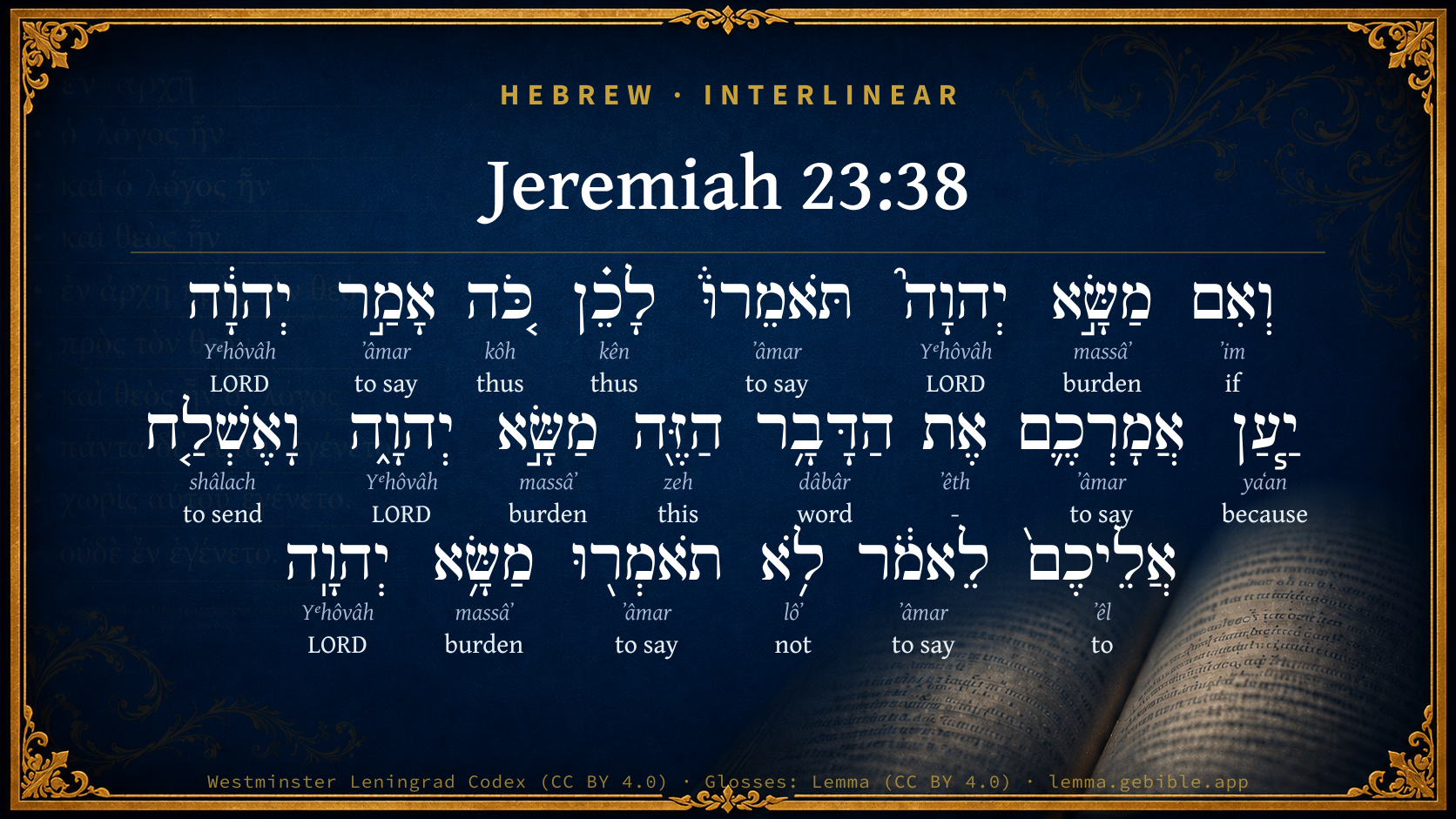
Hebrew (Westminster Leningrad Codex) Jeremiah 23:38 appears in the Hebrew Old Testament. The text above is from the Westminster Leningrad Codex. Each word links to its Strong’s number, a concise gloss, and parsing drawn from the Open Scriptures Hebrew Bible morphology. Click any word for its full Brown-Driver-Briggs (BDB) entry.
Download image
Cite this verse

Jeremiah 23:38 (World English Bible). Public Domain. Lemma interlinear Bible study tool, https://lemma.gebible.app/v/jeremiah/23/38.

Show BibTeX & RIS
BibTeX
RIS
English Translation
But if you say, The burden of Yahweh; therefore thus says Yahweh: Because you say this word, The burden of Yahweh, and I have sent to you, saying, You shall not say, The burden of Yahweh;
World English Bible · Public Domain
Download a study sheet

One document with this verse’s original text, its word-by-word gloss line, the meaning frame, cross-references with their text, attributed commentary, and full source and license credits — printable, and it pastes into notes with its structure intact.

This verse Autodidact and up

Study sheet (.html) Plain text (.txt)

A passage Seminary Student

Up to 50 verses in one chapter. A passage sheet keeps up to 6 commentary sources and 12 cross-references per verse, in the order this page ranks them, and says so on the sheet whenever that leaves anything out. Ask for a single verse and you get the Autodidact verse sheet above.

Everything on this page stays free to read, with no account — the sheet is a download of what is already on screen, not access to it.

Want to remove ads? Support Godless Engineer
Compare translations 3

The same verse in 3 English versions, stacked beneath the original-language interlinear above. Click any original word for its lexicon entry.

Each is an independent rendering of the whole verse — the interlinear is not word-aligned to these translations.

Highlighted words mark where these versions differ — a whole-verse word diff, not a word-by-word alignment.

  • World English Bible Public Domain
    But if you say, The burden of Yahweh; therefore thus says Yahweh: Because you say this word, The burden of Yahweh, and I have sent to you, saying, You shall not say, The burden of Yahweh;
  • King James Version Public Domain
    But since ye say, The burden of the LORD; therefore thus saith the LORD; Because ye say this word, The burden of the LORD, and I have sent unto you, saying, Ye shall not say, The burden of the LORD;
  • unfoldingWord Literal Text CC BY-SA 4.0
    But if you say, ‘The burden of Yahweh,’ therefore thus says Yahweh: ‘Because you say this word, “The burden of Yahweh,” when I sent to you, saying, “You shall not say, ‘The burden of Yahweh,’”

unfoldingWord Literal Text — © unfoldingWord, licensed CC BY-SA 4.0. Word-aligned USFM3 via Door43 (git.door43.org/unfoldingWord/en_ult).

Versions to compare (up to 4)

3 of 4 selected

Show all 18 translations

Every available English version of this verse, each an independent rendering of the whole verse.

  • World English Bible Public Domain
    But if you say, The burden of Yahweh; therefore thus says Yahweh: Because you say this word, The burden of Yahweh, and I have sent to you, saying, You shall not say, The burden of Yahweh;
  • Berean Standard Bible Public Domain
    But if you claim, ‘This is the burden of the LORD,’ then this is what the LORD says: Because you have said, ‘This is the burden of the LORD,’ and I specifically told you not to make this claim,
  • Majority Standard Bible Public Domain
    But if you claim, ‘This is the burden of the LORD,’ then this is what the LORD says: Because you have said, ‘This is the burden of the LORD,’ and I specifically told you not to make this claim,
  • King James Version Public Domain
    But since ye say, The burden of the LORD; therefore thus saith the LORD; Because ye say this word, The burden of the LORD, and I have sent unto you, saying, Ye shall not say, The burden of the LORD;
  • American Standard Version (1901) Public Domain
    But if ye say, The burden of Jehovah; therefore thus saith Jehovah: Because ye say this word, The burden of Jehovah, and I have sent unto you, saying, Ye shall not say, The burden of Jehovah;
  • Revised Version (1885) Public Domain
    But if ye say, The burden of the LORD; therefore thus saith the LORD: Because ye say this word, The burden of the LORD, and I have sent unto you, saying, Ye shall not say, The burden of the LORD;
  • Geneva Bible (1599) Public Domain
    And if you say, The burden of the Lord, Then thus saith the Lord, Because yee say this word, The burden of the Lord, and I haue sent vnto you, saying, Ye shall not say, The burden of the Lord,
  • Douay-Rheims (1899) Public Domain
    But if you shall say: The burden of the Lord: therefore thus saith the Lord: Because you have said this word: The burden of the Lord: and I have sent to you saying: Say not, Tne burden of the Lord:
  • Young's Literal Translation Public Domain
    And if the burden of Jehovah ye say, Therefore thus said Jehovah: Because of your saying this word, The burden of Jehovah, And I do send unto you, saying, Ye do not say, The burden of Jehovah.
  • Literal Standard Version CC BY-SA 4.0
    And if you say, The burden of YHWH, || Therefore, thus said YHWH: Because of your saying this word, || The burden of YHWH, || And I send to you, saying, || You do not say, The burden of YHWH.
  • Unlocked Literal Bible CC BY-SA 4.0
    But if you say, 'The burden of Yahweh', this is what Yahweh says: 'Because you have said these words, 'The burden of Yahweh,' when I sent to you, saying, 'You will not say, “The burden of Yahweh,”'
  • unfoldingWord Literal Text CC BY-SA 4.0
    But if you say, ‘The burden of Yahweh,’ therefore thus says Yahweh: ‘Because you say this word, “The burden of Yahweh,” when I sent to you, saying, “You shall not say, ‘The burden of Yahweh,’”
  • Darby Bible Public Domain
    But since ye say, The burden of Jehovah, therefore thus saith Jehovah: Because ye say this word, The burden of Jehovah, and I have sent unto you, saying, Ye shall not say, The burden of Jehovah;
  • World Messianic Bible Public Domain
    Although you say, ‘The message from the LORD,’ therefore the LORD says: ‘Because you say this word, “The message from the LORD,” and I have sent to you, telling you not to say, “The message from the LORD,”
  • Webster's Bible Public Domain
    But since ye say, The burden of the LORD; therefore thus saith the LORD; Because ye say this word, The burden of the LORD, and I have sent to you, saying, Ye shall not say, The burden of the LORD;
  • Free Bible Version CC BY-SA 4.0
    If they say, “This is the burden of the Lord,” then this is the Lord's response: Because you said, “This is the burden of the Lord,” and I warned you not to,
  • Bible in Basic English Public Domain
    But if you say, The word of weight of the Lord; this is what the Lord has said: Because you say, The weight of the Lord, and I have sent to you, saying, You are not to say, The weight of the Lord;
  • JPS Tanakh (1917) Public Domain
    But if ye say: 'The burden of the LORD'; therefore thus saith the LORD: Because ye say this word: 'The burden of the LORD', and I have sent unto you, saying: 'Ye shall not say: The burden of the LORD';

Literal Standard Version (2020), Covenant Press — licensed CC BY-SA 4.0. Text via the HelloAO Bible API (eBible.org). Unlocked Literal Bible (unfoldingWord) — licensed CC BY-SA 4.0. Text via the HelloAO Bible API (eBible.org). unfoldingWord Literal Text — © unfoldingWord, licensed CC BY-SA 4.0. Word-aligned USFM3 via Door43 (git.door43.org/unfoldingWord/en_ult). Free Bible Version, Dr. Jonathan Gallagher — licensed CC BY-SA 4.0. Text via the HelloAO Bible API (eBible.org).

Word by word

More ways to search: Search by grammar → Find every occurrence → Compare this word →

Practice this passage: Drill this verse → Learn its vocabulary →

מַשָּׂ֣א
massâʼ
H4853
“burden of”
Noun, Common, Masculine, Singular, Construct
Part of Speech
Noun
Type
Common
Gender
Masculine
Number
Singular
State
Construct
Full BDB Definition

Origin: from H5375

TWOT: 1421d , 1421e

Massa = "burden" - load, bearing, tribute, burden, lifting (noun masculine) - load, burden - lifting, uplifting, that to which the soul lifts itself up - bearing, carrying - tribute, that which is carried or brought or borne - utterance, oracle, burden (noun masculine) - a son of Ishmael (noun proper masculine)
  1. וְאִם ʼim H518 “and · if” Conjunction + Conjunction
  2. יְהוָה֮ Yᵉhôvâh H3068 “LORD” Noun, Proper
  3. תֹּאמֵרוּ֒ ʼâmar H559 “to say” Verb, Qal, Imperfect, 2nd Person, Masculine, Plural
  4. לָכֵ֗ן kên H3651 “to/for · thus” Preposition + Adverb
  5. כֹּ֚ה kôh H3541 “thus” Adverb
  6. אָמַ֣ר ʼâmar H559 “to say” Verb, Qal, Perfect, 3rd Person, Masculine, Singular
  7. יְהוָ֔ה Yᵉhôvâh H3068 “LORD” Noun, Proper
  8. יַ֧עַן yaʻan H3282 “because” Conjunction
  9. אֲמָרְכֶ֛ם ʼâmar H559 “to say · you” Verb, Qal, Infinitive Construct + Suffix, Personal, 2nd Person, Masculine, Plural
  10. אֶת ʼêth H853 “-” Particle, Direct Object
  11. הַדָּבָ֥ר dâbâr H1697 “the · word” Particle, Definite Article + Noun, Common, Masculine, Singular, Absolute
  12. הַזֶּ֖ה zeh H2088 “the · this” Particle, Definite Article + Pronoun, Demonstrative, Masculine, Singular
  13. מַשָּׂ֣א massâʼ H4853 “burden of” Noun, Common, Masculine, Singular, Construct
  14. יְהוָ֑ה Yᵉhôvâh H3068 “LORD” Noun, Proper
  15. וָאֶשְׁלַ֤ח shâlach H7971 “and · to send” Conjunction + Verb, Qal, Sequential Imperfect, 1st Person, Common, Singular
  16. אֲלֵיכֶם֙ ʼêl H413 “to · you” Preposition + Suffix, Personal, 2nd Person, Masculine, Plural
  17. לֵאמֹ֔ר ʼâmar H559 “to say” Preposition + Verb, Qal, Infinitive Construct
  18. לֹ֥א lôʼ H3808 “not” Particle, Negative
  19. תֹאמְר֖וּ ʼâmar H559 “to say” Verb, Qal, Imperfect, 2nd Person, Masculine, Plural
  20. מַשָּׂ֥א massâʼ H4853 “burden of” Noun, Common, Masculine, Singular, Construct
  21. יְהוָֽה Yᵉhôvâh H3068 “LORD” Noun, Proper

About this verse

These counts appear in no published source. They are computed here, from the morphology-tagged text and Lemma’s own curated glosses. What Lemma adds →

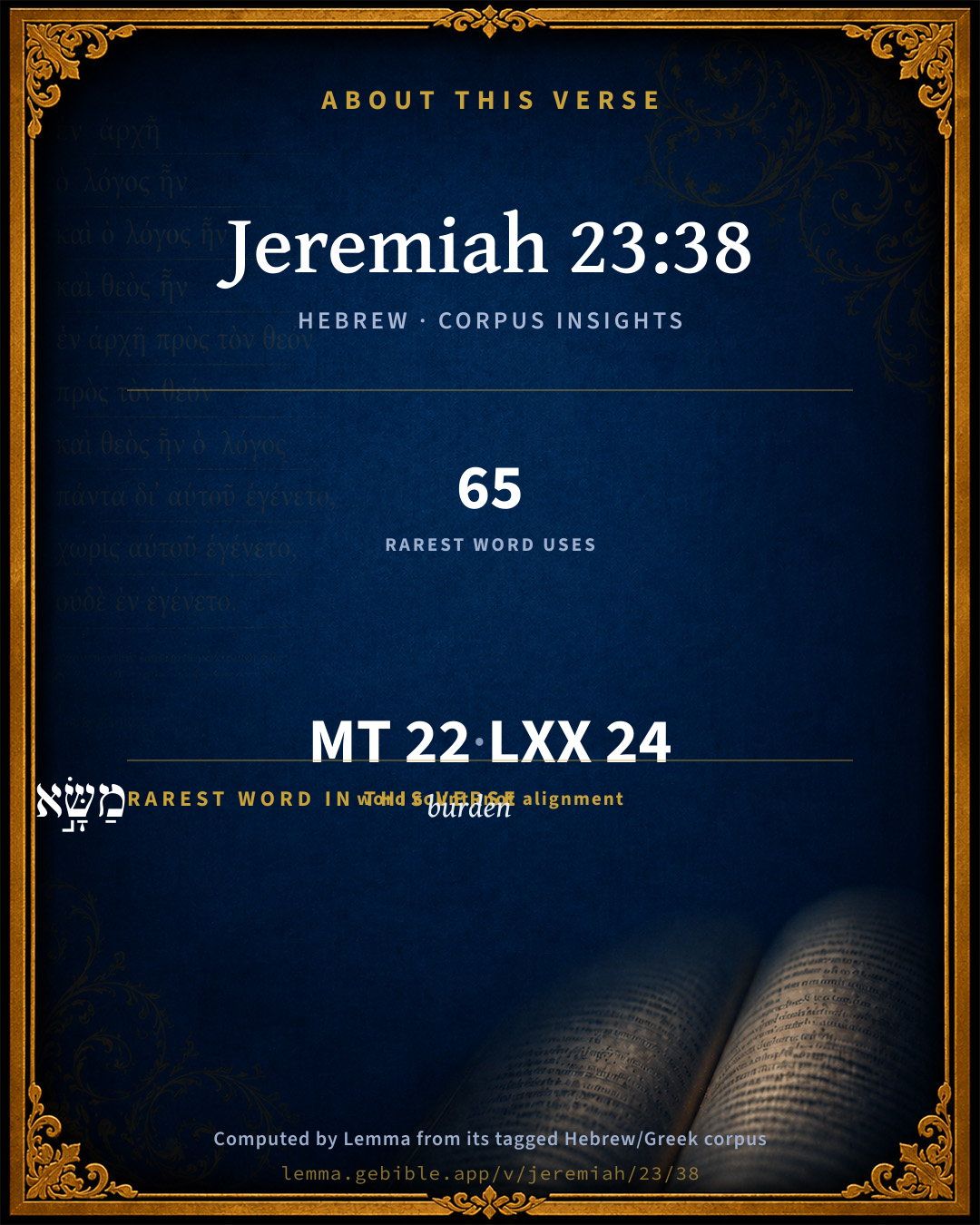
22
words
13
distinct lemmas
Prophets
section

Grammatical profile

  • 6 verbs
  • 8 nouns
  • 1 pronoun
  • 1 preposition
  • 2 conjunctions
  • 2 adverbs
  • 2 particles

Verb forms

  • תֹּאמֵרוּ֒ Qal · Imperfect
  • אָמַ֣ר Qal · Perfect
  • אֲמָרְכֶ֛ם Qal · Infinitive Construct
  • וָאֶשְׁלַ֤ח Qal · Sequential Imperfect
  • לֵאמֹ֔ר Qal · Infinitive Construct
  • תֹאמְר֖וּ Qal · Imperfect

Repetition

Words recur within this verse — often emphatic in Hebrew:

  • תֹּאמֵרוּ֒ to say H559 ×5
  • יְהוָה֮ LORD H3068 ×4
  • מַשָּׂ֣א burden H4853 ×3

Hebrew & Septuagint length

In the original languages it is 22 Hebrew tokens and 24 Greek tokens — but the two are counted differently (Hebrew bundles its prefixes and suffixes into one token; the Greek is in lemma form), so that isn’t a like-for-like length.

Cross-references

1

Topical passages linked to Jeremiah 23:38 in the Treasury of Scripture Knowledge — connected by theme and wording, ordered by reader-vote popularity; previews shown in the World English Bible.

  • 2 Chronicles 11:13–14 The priests and the Levites who were in all Israel resorted to him out of all their border.

Cross-references courtesy of OpenBible.info (CC BY 4.0).

Hebrew and Greek witnesses Masoretic Hebrew ↔ Greek Septuagint

The same verse in the two great witnesses to the Old Testament, shown verse-for-verse.

These are two independent witnesses, not word-aligned to each other, and the Septuagint is shown in lemma (dictionary) form.

Hebrew Jeremiah 23:38 Masoretic · Westminster Leningrad Codex

וְאִם מַשָּׂ֣א יְהוָה֮ תֹּאמֵרוּ֒ לָכֵ֗ן כֹּ֚ה אָמַ֣ר יְהוָ֔ה יַ֧עַן אֲמָרְכֶ֛ם אֶת הַדָּבָ֥ר הַזֶּ֖ה מַשָּׂ֣א יְהוָ֑ה וָאֶשְׁלַ֤ח אֲלֵיכֶם֙ לֵאמֹ֔ר לֹ֥א תֹאמְר֖וּ מַשָּׂ֥א יְהוָֽה

But if you say, The burden of Yahweh; therefore thus says Yahweh: Because you say this word, The burden of Yahweh, and I have sent to you, saying, You shall not say, The burden of Yahweh;

World English Bible · Public Domain

Greek LXX Structure differs

In the Septuagint, Jeremiah is about an eighth shorter than the Hebrew and arranges its material differently — the Oracles Against the Nations (Hebrew chapters 46–51) appear in the middle of the Greek book, after 25:13. Because the chapter and verse boundaries do not line up, a verse-for-verse comparison with the Hebrew is not shown.

A verse-for-verse comparison isn’t shown here because the chapters and verses don’t line up. Switch to the LXX edition with the MT / LXX toggle above to read the Greek directly.

On this verse, The Cambridge Bible for Schools and Colleges discusses the Septuagint’s reading. Read the note in Commentary ↓

Hebrew: Westminster Leningrad Codex (CC BY 4.0). Greek: Septuagint (public domain); English from a public-domain English Septuagint. How the Septuagint differs from the Hebrew →

Targum (Aramaic paraphrase)

1

The Targum is the ancient Jewish Aramaic paraphrase of the Hebrew Scriptures — an interpretive translation, not the Hebrew text itself. Onkelos (literal) and Pseudo-Jonathan (expansive) render the Torah, and Jonathan the Prophets. Coverage is partial: where no permissively-licensed English translation exists for a verse, only the Aramaic is shown. This is verse-level text, not a word-by-word alignment to the Hebrew.

  1. Targum Jonathan Prophets (Joshua–Malachi)
    וְאִם נְבוּאָה בִשְׁמָא דַייָ תֵימְרוּן בְּכֵן כִּדְנַן אֲמַר יְיָ חֲלַף דַאֲמַרְתּוּן יַת פִּתְגָמָא הָדֵין נְבוּאָה בִּשְׁמָא דַייָ וְשַׁלְחֵית לְוַתְכוֹן לְמֵימָר לָא תֵימְרוּן נְבוּאֲתָא מִקָדָם יְיָ:

    (no public-domain English translation for this verse)

    Targum Jonathan — Aramaic: “Mikraot Gedolot” (public domain). English: “Sefaria Community Translation” (CC0 1.0 (public-domain dedication)); “London "Chaldee Paraphrase," 1871” (public domain). Text via Sefaria.

Commentary

Notes on Jeremiah 23:38 from classic Christian and Jewish commentators (each source and its license shown beneath its notes). The classic Christian expositions comment on the surrounding passage and are grouped to its opening verse, so a note may address several verses; the Jewish commentaries on the Tanakh (Rashi and others) are per-verse, so they appear only where the commentator wrote on this verse.

Lemma curates 59 commentaries, every one of them public domain or Creative Commons licensed, each selected and text-cleaned for this edition rather than reprinted as found. About our sources →

Trapp's Complete Commentary

John Trapp

Jer 23:38 But since ye say, The burden of the LORD; therefore thus saith the LORD; Because ye say this word, The burden of the LORD, and I have sent unto you, saying, Ye shall not say, The burden of the LORD;

Ver. 38. But since ye say, The burden of the Lord.] Since ye accuse me as unmerciful, my Word as a ponderous burden, and my messengers as telling you nothing but terrible things and bloody businesses, which therefore you are resolved to slight and neglect; -

John Trapp, A Commentary or Exposition upon All the Books of the Old and New Testament (1647–1656) — public domain. Text from a community e-Sword module.

John Calvin's Commentaries

Here the Prophet confirms what he had said, for God might have seemed to be too indignant, having been so grievously offended at one short expression. The Jews had borrowed from the prophets themselves, when they called prophecies burdens, as we have already said, and as we find in many places. Now as the lubricity of language is great, though the Jews might have done wrong as to one word, it might yet have appeared an insufficient reason for the punishment which God threatened to inflict. But the Prophet here shews that God was justly angry with them, for he had sent to them, and often warned them not to use this form of speaking, which was a manifest evidence of their impiety. As then they had thus disregarded God and his warnings, was it an excusable mistake? In short, Jeremiah shews that they had not erred inconsiderately, as it often happens as to those who speak rashly and thoughtlessly, but that this perverted way of speaking proceeded from determined wickedness, from a wish to affix some mark of disgrace to God’s word; and thus they acted in disdain towards God himself. This then is the import of the words.

John Calvin's Commentaries (1540-1563) — public domain. Text from the Calvin Translation Society English edition (1840s-50s) via the Christian Classics Ethereal Library (ccel.org). Calvin's coverage is partial (roughly two-thirds of the Bible); uncommented books and verses are honest gaps, never fabricated. The 19th-century editor's footnotes and remarks are omitted so the notes are faithfully Calvin's own voice.

Ellicott's Commentary for English Readers

(38) But since ye say.—Better, if ye say.

A Bible Commentary for English Readers, edited by Charles John Ellicott (1878–1897) — public domain. Text from a community e-Sword module.

The Cambridge Bible for Schools and Colleges

gen. ed. J. J. S. Perowne

38. But if ye say … of the Lord] LXX omit.

The Cambridge Bible for Schools and Colleges (gen. ed. J. J. S. Perowne; Cambridge University Press, 1878–1918) — public domain. Text from a community e-Sword module.

John Gill's Exposition

But since ye say, the burden of the Lord,.... Seeing, notwithstanding all prohibitions of it, and directions to the contrary, they still persisted to call prophecy by this name, and that in a jocose and bantering way, and asked for it, and what it was, in a scoffing manner:

therefore thus saith the Lord, because you say this word, the burden of the Lord; will continue to use it, though so displeasing to me:

and I have sent unto you, saying, ye shall not say, the burden of the Lord; and therefore could not plead ignorance of his will, or excuse themselves, by saying they would have avoided it, had they known it was disagreeable to him: this was an aggravation of their impiety, that they should obstinately persist in it, after he had remonstrated against it by his messages to them.

John Gill's Exposition of the Whole Bible (1746–1763) — public domain (CC PDM 1.0). Text via the HelloAO Bible API.

Albert Barnes' Notes on the Bible

Since - Or, But if ye say.

Albert Barnes' Notes on the Bible (1834–1885) — public domain. Text from a community e-Sword/MySword module.

Matthew Poole's English Annotations

Because you go on in your scoffing and deriding my word and my prophets; and that when I have expressly forbidden you those profane speeches, or that deriding form of speech; adding further contempt to your former profaneness.

Matthew Poole's English Annotations on the Holy Bible (1683–1685) — public domain. Text from a community e-Sword/MySword module.

The Pulpit Commentary

But since ye say, etc.; rather, But if ye say, etc. In case the false prophets disobey, and persist in using the old expression, the threatening already uttered shall come into operation.

The Pulpit Commentary (1880–1919), ed. H.D.M. Spence-Jones & Joseph S. Exell — public domain. Text from a community e-Sword module.

John Wesley's Explanatory Notes

Because - Because you go on in your scoffing.

John Wesley, Explanatory Notes Upon the Whole Bible (1754–1765) — public domain. Text via the GEBible commentary corpus.

Lesson kit

Teaching starters — assembled from the data on this page, not authored interpretation. Every prompt links to the verse data it draws on. Edit before teaching.

Jeremiah, in the Prophets, opens this verse with 22 words (13 distinct Hebrew lemmas). Its most distinctive word is massâʼ (“burden”). A historical commentator’s framing appears above. Read the whole chapter for the surrounding context.

Discussion questions

  1. How does “burden” (massâʼ) shape what this verse is saying?
  2. How does 2 Chronicles 11:13–14, which shares this passage’s theme, read alongside this verse?
  3. What does the repetition of “to say” (5× in this one verse) do in this verse?
  4. The translations on this page render this verse differently — a whole-verse word diff, not a word-by-word alignment. What might account for the different wordings?
  5. «תֹּאמֵרוּ֒» is a Qal Imperfect verb. How does that grammatical form shape the action described?
  6. Compare how Trapp's Complete Commentary and John Calvin's Commentaries read this verse. Where do they agree or differ?

Things to notice

Reading settings

Reading text

Shown beneath each verse's original-language words.

Old Testament
Old Testament edition

Read the OT as the Masoretic Hebrew (MT) or the Greek Septuagint (LXX).

English shown for the Greek Septuagint (in the Hebrew ↔ Greek comparison).

Comparing translations? Open the Compare panel on any verse page to stack up to four side by side.