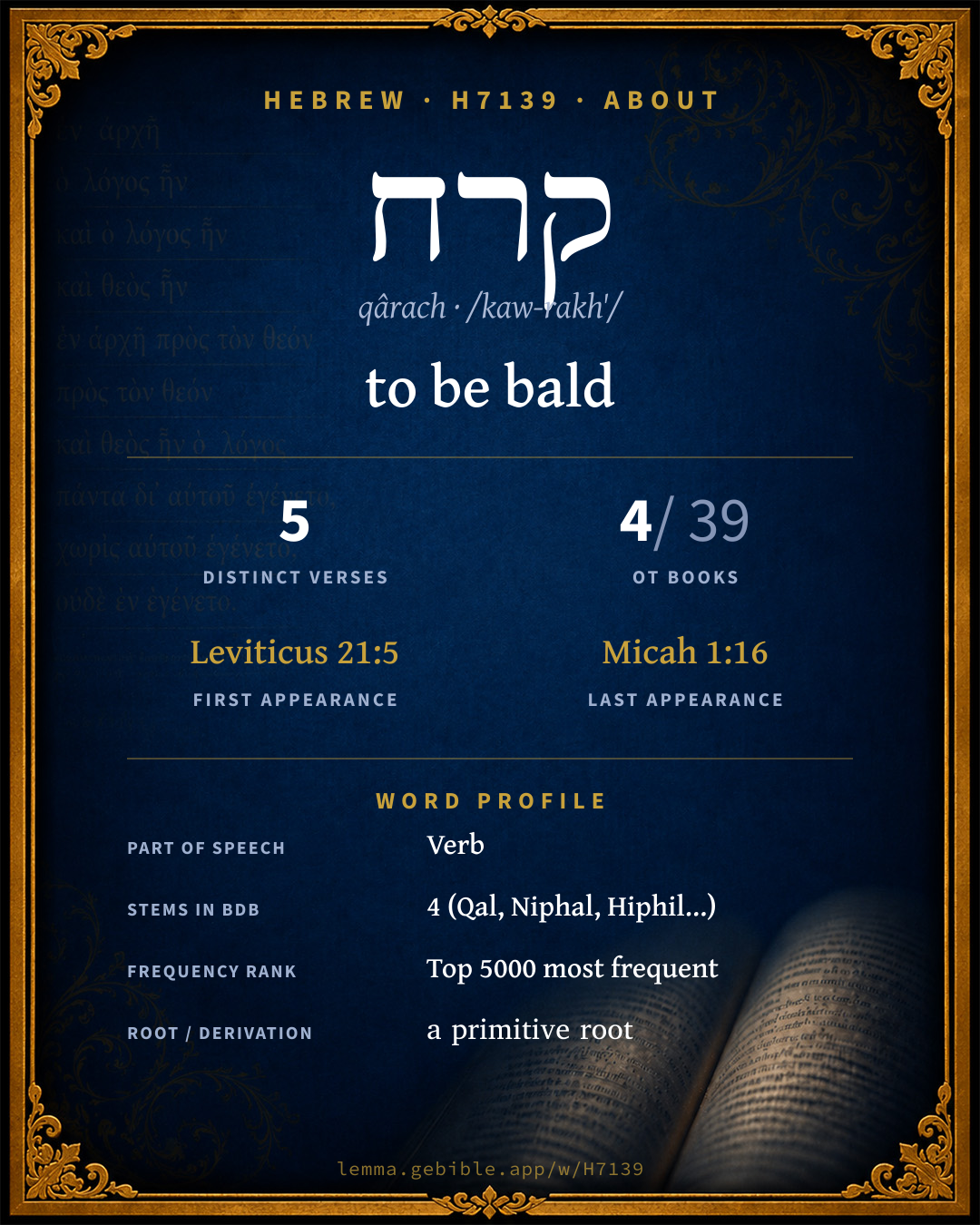
קָרַח
to be bald
‘to be bald’ is one of 5 main senses fuller range ↓
Full lexicon entry — Brown-Driver-Briggs (BDB)
From Brown-Driver-Briggs (BDB)
Where this word appears
See every Qal verb in the Hebrew Bible →
Grammar key — what these labels mean
Part of speech
- Verb
- An action or state-of-being word.
Stem
- Hiphil
- The causative active stem (“he caused / brought about”).
- Hophal
- The passive counterpart of the Hiphil (“he was caused to…”).
- Niphal
- Usually the simple passive or reflexive of the Qal (“he was written”).
- Qal
- The basic, simple active stem — the plain form of the verb (“he wrote”).
Form
- Sequential Perfect
- A perfect with prefixed waw continuing a preceding imperfect or command (waw-consecutive perfect).
- Participle Passive
- A verbal adjective expressing action received (“written”).
- Imperfect
- An incomplete, ongoing, or future action (“he will / would write”).
- Imperative
- A direct command (“write!”).
State
- Absolute
- The independent form of a noun, not bound to a following word.
Person
- 3rd Person
- The one spoken about (“he / she / it / they”).
- 2nd Person
- The one addressed (“you”).
Gender
- Common
- Either gender — not distinguished for this form.
- Masculine
- Grammatically masculine.
- Feminine
- Grammatically feminine.
Number
- Plural
- More than one (in Hebrew, generally three or more).
- Singular
- One.
Grammatical forms
- Verb, Hiphil, Sequential Perfect, 3rd Person, Common, Plural 1 time (17%)
- Verb, Hophal, Participle Passive, Masculine, Singular, Absolute 1 time (17%)
- Verb, Niphal, Imperfect, 3rd Person, Masculine, Singular 1 time (17%)
- Verb, Qal, Imperfect, 3rd Person, Feminine, Singular 1 time (17%)
- Verb, Qal, Imperfect, 3rd Person, Masculine, Plural 1 time (17%)
- Verb, Qal, Imperative, 2nd Person, Feminine, Singular 1 time (17%)
Parsed forms decoded from the imported morphology (morphhb / Westminster Leningrad Codex — WLC text public domain, morphhb tagging CC BY 4.0), counted across 6 parsed occurrences — not distinct verses.
Every verse where H7139 appears — 5 distinct verses across 4 books. Click any verse to open its interlinear word-by-word view. Verse text shown in the World English Bible for context — . Each verse’s Hebrew form is shown with its reference; the English is not keyword-highlighted, since the data carries no word-level English alignment. Use “Compare translations” on any verse to read it across multiple English versions. This concordance covers the Hebrew Bible; Septuagint (Greek Old Testament) occurrences are not indexed here.
Leviticus 1 verse
Jeremiah 1 verse
Ezekiel 2 verses
- Ezekiel 27:31 וְ/הִקְרִ֤יחוּ conj + Hiphil wpf 3cp and they shall make themselves bald for you, and gird them with sackcloth, and they shall weep for you in bitterness of soul with bitter mourning.
- Ezekiel 29:18 מֻקְרָ֔ח Hophal ptcp.pass ms Son of man, Nebuchadrezzar king of Babylon caused his army to serve a great service against Tyre: every head was made bald, and every shoulder was worn; yet had he no wages, nor his army, from Tyre, for the service that he had served against it.
Micah 1 verse
About this entry
At a glance — auto-summarized from this page’s data, not written by a person. Every figure links to its source below. This summary describes the numbers; it doesn’t interpret them.
“to be bald” is the headline sense of the Hebrew verb קרח (qârach). It occurs a mere 5 verses across Scripture. More than a third of its appearances fall in Ezekiel. Debuting at Leviticus 21:5, it then recurs through the corpus. Across 4 stems, its meaning turns on the binyan (Qal, Niphal). Each statement above links to its evidence; the full detail follows below.
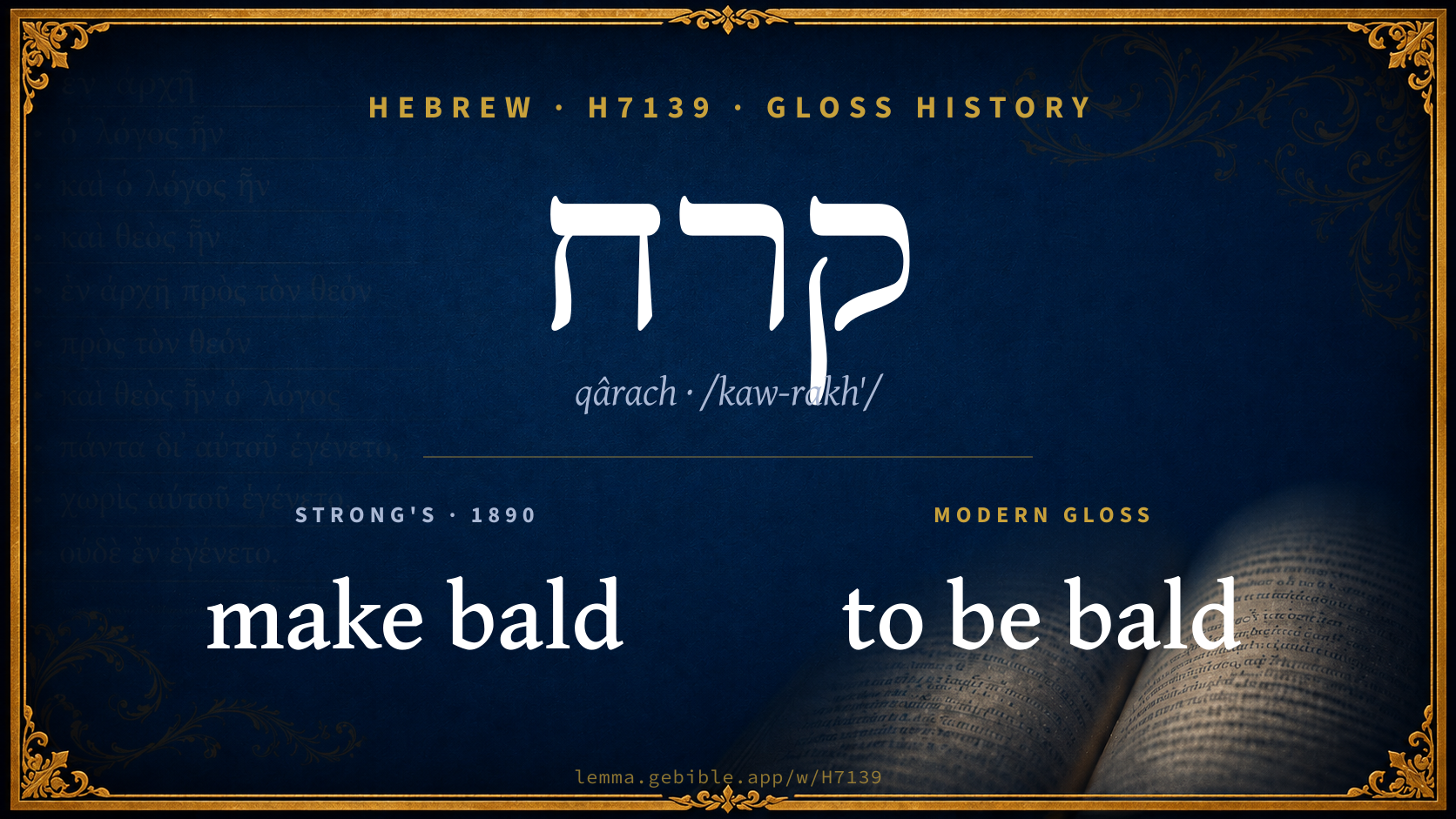
Gloss history
Strong's 1890 vs modern scholarship
About this word
Strong's H7139 catalogs a Hebrew word from the Hebrew Old Testament.
These counts are not copied from any lexicon or concordance. They are computed here, from the morphology-tagged Hebrew Old Testament. What Lemma adds →
- 5
- distinct verses
- The word appears in 5 distinct verses.
- 4 / 39
- OT books
- The word appears in 4 of 39 Old Testament books.
- #3,040
- by frequency
- Top 5000 most frequent Hebrew words (rank 3,040 of 8,640 Hebrew words by occurrence).
View all 5 occurrences in the concordance →
By section of the Old Testament
By traditional corpus
Conventional, traditional groupings — biblical authorship is debated, so this is a traditional corpus grouping, not an authorship claim. Each share is this word’s portion of its verses in that division of the Hebrew canon. Each figure is a share of the word’s 5 distinct verses.
- Prophets (Nevi'im) 4 verses · 80%
- Torah (Pentateuch) 1 verse · 20%
How translations render this word
Counts come from each version’s own published word-to-Strong’s tagging or interlinear alignment — an approximate guide to how each version renders this word, not a word-level alignment the data otherwise carries. Because each total is that version’s own tagged count, the per-version totals vary from one another and need not match the appearance or distinct-verse counts above. These counts may also differ from a printed concordance because Lemma counts each distinctly tagged rendering and does not collapse phrase taggings into a single head-word total. This is a fixed set of word-tagged versions (KJV, ASV, BSB, ULT) and does not change with the reading translation you choose elsewhere. Each version’s license is shown beside its name below (and on Sources).
- King James Version: Bald 1×, Make thee bald 1×, Themselves nor make themselves bald 1×
- American Standard Version: Cut themselves 1×, Make thee bald 1×, Themselves bald 1×
- Berean Standard Bible: Make bald 1×, Or shave his head 1×, Shave yourselves bald 1×
- unfoldingWord Literal Text: Bald 1×, Be bald 1×, He shall 1×
King James Version Public Domain
Renders H7139 across 5 tagged occurrences — most commonly:
American Standard Version Public Domain
Renders H7139 across 5 tagged occurrences — most commonly:
Berean Standard Bible Public Domain
Renders H7139 across 5 tagged occurrences — most commonly:
unfoldingWord Literal Text CC BY-SA 4.0
Renders H7139 across 8 tagged occurrences — most commonly:
Senses in the full BDB
Hebrew verbs can shift meaning by stem (binyan): Qal is the basic action, Niphal is often passive or reflexive, Piel often intensifies or makes it factitive, and Hiphil is typically causative. The senses below are grouped under the stem BDB assigns to each. This entry also uses Hophal (the passive of Hiphil).
What do BDB’s symbols mean?
BDB uses these scholarly abbreviations:
| Symbol | Meaning |
|---|---|
| 𝔊 | the Septuagint (the ancient Greek translation, LXX) |
| 𝔙 | the Vulgate (the Latin translation) |
| 𝔖 | the Syriac version (the Peshitta) |
| 𝔗 | the Targum (the Aramaic translation) |
| ψ | the Psalms |
| √ | root (the underlying root or stem) |
| ‖ | parallel passage (a synonymous or contrasted parallel) |
| † | the dagger: every passage where the word occurs is cited |
The 4 senses and sub-senses the full Brown-Driver-Briggs lexicon distinguishes for this word, in lexicon order (not ranked by frequency), with BDB’s own verbatim wording and sub-sense lettering. Shown in Hebrew script with BDB’s own scholarly abbreviations. The condensed entry is in the Lexicon Entry tab. See also the Forms in the corpus table below.
Qal
- Impf. 3 mpl. יִקְרְחוּ קָרְחָה בְּרֹאשָׁם Lv 21:5 Qr (> Kt יקרחה; ‖ יְגַלֵּ֑חוּ cf. Dt 14:1); Imv. fs. קָרְחִי וָגֹ֫זִּי עַל Mi 1:16 make a baldness … for. e.g. Leviticus 21:5
Niphal
- Impf. 3 ms. יִקָּרֵחַ לָהֶם Je 16:6 men shall not make themselves bald for them. e.g. Jeremiah 16:6
Hiphil
- Pf. 3 pl. consec. וְהִקְרִיחוּ אֵלַיִךְ קָרְחָה Ez 27:31 and they shall make a baldness (cf. Qal) for thee. e.g. Ezekiel 27:31
Hophal
- Pt. כָּל־רֹאשׁ מֻקְרָח Ez 29:18 every head made bald (by carrying load). e.g. Ezekiel 29:18
Senses from the full Brown-Driver-Briggs lexicon (Brown, Driver, Briggs; Oxford 1906 — public domain), digitized via Sefaria, supplemented by the OpenScriptures HebrewLexicon (CC BY 4.0). Full attribution on Sources.
Word origin
vb. make bald, or a baldness, usually (by mourners) for the dead, cf. RSSem. i. 306, 2nd ed. 324 (Arabic parallels) (NH id. Hiph. shew baldness; Arabic قَرَحَ wound, make sores, قُرْحَةٌ whiteness in face of horse (but قَرَعَ be bald, أَقْرَعُ bald); Ethiopic ቀርሐ make bald (rare); Aramaic קְרַח, ܩܪܰܚ, chiefly deriv. (and der. meanings); cf. Sin. n.pr.m. קרחה, קרחו; MI3, 21, 24, 25 n.pr.loc. קרחה);—
— Brown-Driver-Briggs (Oxford 1906, public domain), digitized via Sefaria, supplemented by the OpenScriptures HebrewLexicon (CC BY 4.0). See Sources.
Origin: a primitive root
Jastrow Dictionary
A second Hebrew/Aramaic lexicon for comparison, covering Aramaic and post-biblical (Talmudic, Targumic, Midrashic) usage that the biblical-Hebrew BDB does not. Matched by lemma rather than by Strong’s number, so a lemma may carry more than one Jastrow headword (shown separately below), and the entries cover usage well beyond the Bible.
קֵרֵחַ
- v. next w.) bald, bald head. Gen. R. s. 65, v. קִיוֵּוץ. Bekh. VII, 2 הק׳ פסול a bald-headed person is unfit for priestly functions; איזה ק׳ כל וכ׳ bald-headed (in a legal sense) is he who has not a line of hair from ear to ear. Ib. 58ᵃ הק׳ הזה that bald head (R. Akiba). B. Kam. 60ᵇ נמצא ק׳ מכאן וק׳ מכאן finally he is bald from here and bald from there (has neither white nor black hair); a. fr.—Gitt. VIII, 9, a. e. גט ק׳ a letter of divorce that lacks signatures on each of its folds (v. קָשַׁר).—Pl. קֵרְחִים, קֵרְחִין. Y. Yoma II, end, 40ᵃ הכהנים לרבות הק׳ ‘the priests’ (Lev. I, 5), this includes the bald heads (as fit for that function); Sifra Vayikra, N’dab., Par. 4, ch. VI קַרְחָנִים; Bekh. 43ᵇ קרְחָנִין.—Fem. קֵרַחַת. B. Bath. 132ᵃ ק׳ מכאן ומכאן she is bald on both sides, i.e. has forfeited both claims on her husband’s estate. e.g. Leviticus 1:5
קֵרֵחַ ²
- Targ. O. Lev. XIII, 40 (ed. Berl. קְרֵיחַ; some ed. קְרַח); Y. קְרוּחַ.
קָרַח
- (b. h.) [to be round and smooth,] (denom. of קֵרֵחַ) to make a bald spot. Macc. III, 5 הקוֹרִחַ קרחה וכ׳ he that makes a baldness upon his head. Ib. 20ᵃ יכול אפי׳ ק׳ … קריחות וכ׳ lest you think that even if one makes four or five spots, he is guilty only of one act; Kidd. 36ᵃ; a. e.
- to become bald, hairless, smooth. Maasr. I, 3 האגסים … משיִקָּרְהוּ (Y. ed. משׁיַקְרִיחוּ, a. משיקרחו) pears … are subject to tithes when their surface begins to grow smooth, v. infra. Neg. VIII, 5 חזר … ונִקְרְחוּ if head and chin changed and became bald; Tosef. ib. III, 10 (not שנ׳); a. e.
- 1. same. Tosef. Maasr. I, 2 משיַקְרִיחוּ (not משיקד׳), v. supra. Y. ib. I, 48ᵈ bot. משיקריחו … משיעשו קרחות … לבנות ‘when they get smooth’ (Mish. ib. I, 3, v. supra) …, that means, when they begin to get white, smooth spots (cmp. קְרוּחַ). Ib. וכי מחמת האוכל הן מַקְרִיחִין וכ׳ do the fruits get white spots because of the development of the eatable matter (flesh), is it not on account of worms?; a. e.
- 2. to make bare, raze. Y. Kil. IV, beg. 29ᵃ קרחת … מקריחין אותו וכ׳ ‘a bald portion of a vineyard’ (Mish. ib. IV, 1) is one which is razed in the centre; כרם שחרב מקריחין וכ׳ ‘a waste vineyard’ (ib. 2) is one which is razed on all sides. Sot. 46ᵇ (play on קרח, II Kings II, 23) שהִקְרַחְתָּ עלינו את המקום thou hast made the place bare for us (ruined our water trade by healing the well); a. e.—Part. pass. מוּקְרָח; pl. מוּקְרָחִין. Y. Kil. I, 27ᵇ bot. ששה על ששה מוק׳ וכ׳ when one throws mixed seeds into a plot of six (cubits) by six which lies vacant within a field of grains or which is fenced in. e.g. 2 Kings 2:23
קְרַח I
- , to make bald; to become bald. Pes. 110ᵃ bot. (in an incantation) ק׳ קרחייכי bald be your baldness (may the hair with which you practice your witchcraft fall out). Y. Sabb. XX, end, 17ᵈ (perh. Hebrew) קְרוֹחַ קריחה make bald a bald head (?), v. צְנִינִים.—[Snh. 109ᵇ עד דקרחא some ed., read: דקדחא, v. קְדַח.]
קֶרַח
- (preced. wds.) baldness. Kidd. 36ᵃ (ref. to קרחה Lev. XXI, 5) א"כ נכתוב קרא ק׳ וכ׳ if this were so, the text should read ḳeraḥ, why is it ḳorḥah? e.g. Leviticus 21:5
קרח
- , Sifra Thazr., Neg. ch. I; Yalk. Lev. 550, read: קֶדַח.
קֹרַח
- (b. h.) pr. n. m. Korah, leader of a rebellion against Moses. Tosef. Snh. XIII, 9 ק׳ ועדתו וכ׳ Korah and his followers have no share in the world to come; Snh. 109ᵇ עדת ק׳ וכ׳ the followers of K. have &c. Ib. ק׳ שנעשה קרחה וכ׳ (Ms. M. שעשה) he is named Korah (Bald), because baldness (depopulation) was created in Israel; a. v. fr.
קְרַח II
- 1. = h. קֵרֵחַ, v. קֵרֵחַ ch.—Targ. II Kings II, 23 קרְ׳ (ed. Ven. קָרָ׳).—Snh. 63ᵇ ברחא ק׳, v. אֲשִׁימָא. Sabb. 152ᵃ, v. בַּרְחָא, a. מַצּוּיָינָא.
- 2. (cmp. גולבינא a. גלב) a species of peas (P. Sm. s. v. קרחא, 3740 ‘peanuts’).—Pl. קַרְחִין. Y. Ned. IV, 38ᵈ top מי סורס וק׳ an infusion of sores and ḳarḥim
A Dictionary of the Targumim, the Talmud Babli and Yerushalmi, and the Midrashic Literature (Marcus Jastrow; London, Luzac, 1903) — Public Domain. Digitized via Sefaria. Digitized via Sefaria. Full attribution on Sources.
Forms in the corpus
The 6 distinct written forms H7139 takes in the Hebrew Bible, most frequent first — each parse links to that stem’s occurrences in the concordance. Hebrew forms include their vowel points and cantillation, so a single lemma takes many written forms.
| Form | Parsing | Example | Uses |
|---|---|---|---|
| וְ/הִקְרִ֤יחוּ | Verb, Hiphil, Sequential Perfect, 3rd Person, Common, Plural | Ezekiel 27:31 | 1 |
| יִקְרְח֤וּ | Verb, Qal, Imperfect, 3rd Person, Masculine, Plural | Leviticus 21:5 | 1 |
| יִקָּרֵ֖חַ | Verb, Niphal, Imperfect, 3rd Person, Masculine, Singular | Jeremiah 16:6 | 1 |
| יקרחה | Verb, Qal, Imperfect, 3rd Person, Feminine, Singular | Leviticus 21:5 | 1 |
| מֻקְרָ֔ח | Verb, Hophal, Participle Passive, Masculine, Singular, Absolute | Ezekiel 29:18 | 1 |
| קָרְחִ֣י | Verb, Qal, Imperative, 2nd Person, Feminine, Singular | Micah 1:16 | 1 |
Same root — word family
Other BDB entries built from the same root as H7139, grouped by Strong’s listed origin. These share a root / origin per the lexicon — not necessarily a shared meaning. Each links to that word’s own entry.
Derived from this word
- קרח qerach H7140 frost
- קרח qêrêach H7142 bald
- קרחה qorchâh H7144 baldness
- קרחת qârachath H7146 bald spot
Proper names from this root
People and places named from this root — a name, not an additional meaning of the word.
Compare all same-root words → Showing 4 of 7 — not the complete family. 2 of the same-root words are proper names (people or places). They share a root, not necessarily a meaning.
Septuagint verse parallels
This word appears in 4 verses that also exist in the Greek Old Testament (Septuagint), out of the 5 Hebrew verses it occurs in. You can read those verses in Greek by switching the Old Testament edition to the Septuagint.
Read these verses in the Septuagint
This is a verse-level parallel only — the same verses exist in both the Hebrew and Greek Old Testaments. No word-level Hebrew↔Greek correspondence is claimed: the data carries no such alignment, so no Greek word is shown as this Hebrew word’s translation. Coverage is not total — the Septuagint omits the deuterocanon and renumbers the Psalms, so some Hebrew verses have no direct Greek parallel.