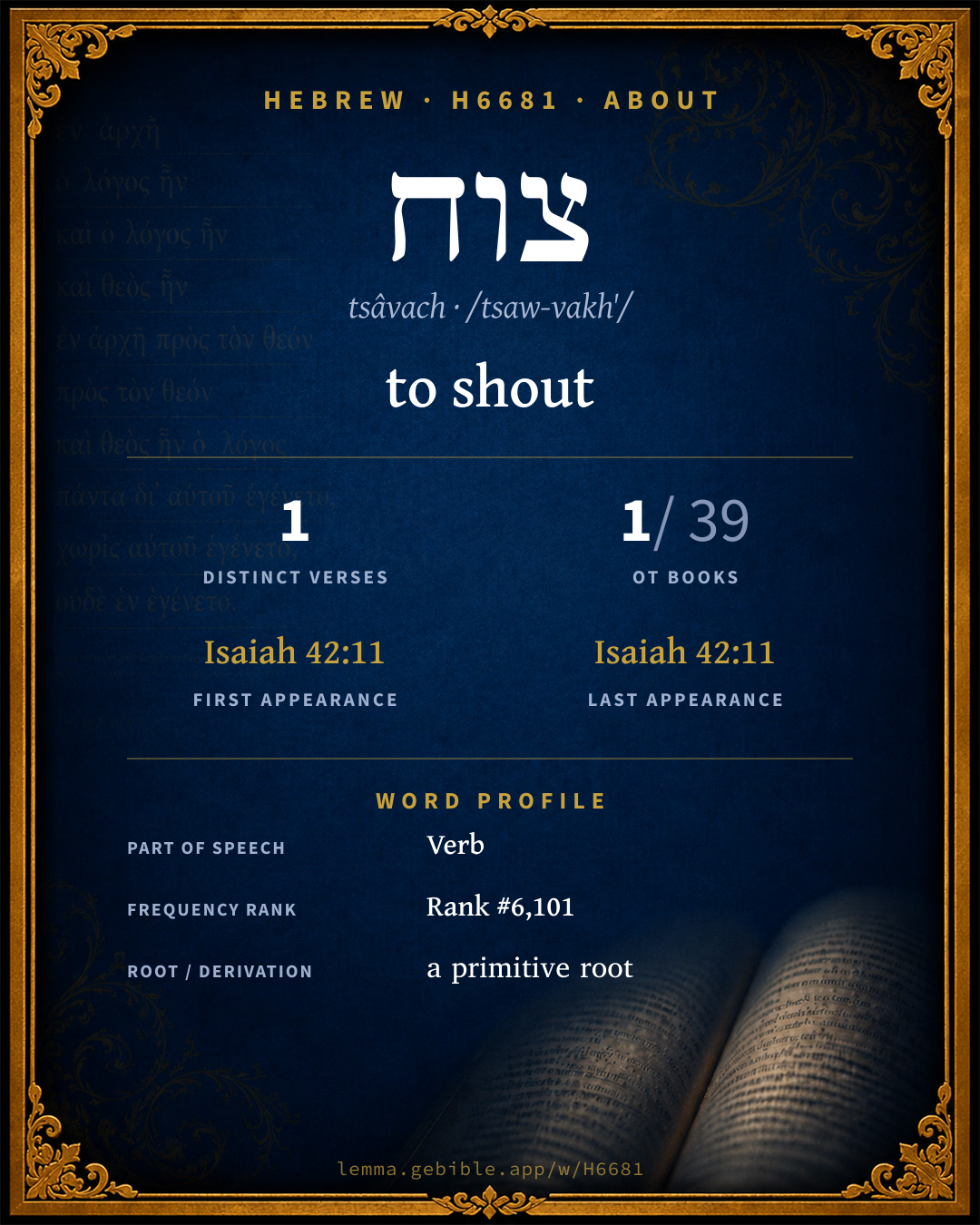
צָוַח
to shout
Full lexicon entry — Brown-Driver-Briggs (BDB)
From Brown-Driver-Briggs (BDB)
Where this word appears
Grammar key — what these labels mean
Part of speech
- Verb
- An action or state-of-being word.
Stem
- Qal
- The basic, simple active stem — the plain form of the verb (“he wrote”).
Form
- Imperfect
- An incomplete, ongoing, or future action (“he will / would write”).
Person
- 3rd Person
- The one spoken about (“he / she / it / they”).
Gender
- Masculine
- Grammatically masculine.
Number
- Plural
- More than one (in Hebrew, generally three or more).
Every verse where H6681 appears — 1 distinct verse across 1 book. Click any verse to open its interlinear word-by-word view. Verse text shown in the World English Bible for context — . Each verse’s Hebrew form is shown with its reference; the English is not keyword-highlighted, since the data carries no word-level English alignment. Use “Compare translations” on any verse to read it across multiple English versions. This concordance covers the Hebrew Bible; Septuagint (Greek Old Testament) occurrences are not indexed here.
Isaiah 1 verse
About this entry
At a glance — auto-summarized from this page’s data, not written by a person. Every figure links to its source below. This summary describes the numbers; it doesn’t interpret them.
צוח — transliterated tsâvach — is a Hebrew verb carrying the sense “to shout.” With only 1 verse it sits in the long tail of Hebrew Bible vocabulary. Its uses cluster heavily in Isaiah (100% of all occurrences). Found nowhere else but Isaiah 42:11. From the same root come צוחה. Each statement above links to its evidence; the full detail follows below.
Gloss history
Strong's 1890 vs modern scholarship
About this word
Strong's H6681 catalogs a Hebrew word from the Hebrew Old Testament.
These counts are not copied from any lexicon or concordance. They are computed here, from the morphology-tagged Hebrew Old Testament. What Lemma adds →
- 1
- distinct verses
- The word appears in 1 distinct verse.
- 1 / 39
- OT books
- The word appears in 1 of 39 Old Testament books.
- #6,101
- by frequency
- Rank #6,101 (rank 6,101 of 8,640 Hebrew words by occurrence).
View all 1 occurrence in the concordance →
Most concentrated in
- Isaiah 1 verse 100%
By section of the Old Testament
By traditional corpus
Conventional, traditional groupings — biblical authorship is debated, so this is a traditional corpus grouping, not an authorship claim. Each share is this word’s portion of its verses in that division of the Hebrew canon. Each figure is a share of the word’s 1 distinct verse.
- Prophets (Nevi'im) 1 verse · 100%
How translations render this word
Counts come from each version’s own published word-to-Strong’s tagging or interlinear alignment — an approximate guide to how each version renders this word, not a word-level alignment the data otherwise carries. Because each total is that version’s own tagged count, the per-version totals vary from one another and need not match the appearance or distinct-verse counts above. These counts may also differ from a printed concordance because Lemma counts each distinctly tagged rendering and does not collapse phrase taggings into a single head-word total. This is a fixed set of word-tagged versions (KJV, ASV, BSB, ULT) and does not change with the reading translation you choose elsewhere. Each version’s license is shown beside its name below (and on Sources).
- King James Version: Let them shout 1×
- American Standard Version: Let them shout 1×
- Berean Standard Bible: Let them cry out 1×
- unfoldingWord Literal Text: Let them shout 1×
King James Version Public Domain
Renders H6681 across 1 tagged occurrence — most commonly:
American Standard Version Public Domain
Renders H6681 across 1 tagged occurrence — most commonly:
Berean Standard Bible Public Domain
Renders H6681 across 1 tagged occurrence — most commonly:
unfoldingWord Literal Text CC BY-SA 4.0
Renders H6681 across 1 tagged occurrence — most commonly:
Senses in BDB
The 1 sense BDB distinguishes for this word, in lexicon order (not ranked by frequency or importance). The full entry — with sub-senses — is in the Lexicon Entry tab.
- (Qal) to shout, cry aloud, cry out
Word origin
[ צָוַח ] vb. cry aloud;— Qal Is 42:11
— Brown-Driver-Briggs (Oxford 1906, public domain), digitized via Sefaria, supplemented by the OpenScriptures HebrewLexicon (CC BY 4.0). See Sources.
Origin: a primitive root
Jastrow Dictionary
A second Hebrew/Aramaic lexicon for comparison, covering Aramaic and post-biblical (Talmudic, Targumic, Midrashic) usage that the biblical-Hebrew BDB does not. Matched by lemma rather than by Strong’s number, so a lemma may carry more than one Jastrow headword (shown separately below), and the entries cover usage well beyond the Bible.
צָוַוח
- to cry, shout; to complain. Keth. 14ᵇ ממזר וצוֹוֵחַ one that is called a bastard and brings complaint, opp. שותק. B. Mets. 24ᵇ והלא עומד וצווֵֹחַ but does he (the loser) not stand up and cry (which shows that he has not given up the hope of recovery)? נעשה כצווח על וכ׳ it is like one crying over his house that has fallen in &c. B. Bath. 138ᵃ בצָ׳ מעיקרא (or בצוֵֹחַ), בצָ׳ מעיקרו when he cried out (refused the gift) at the start (when it was offered to him). Sot. 42ᵇ צוְֹחִין וכ׳ (better צווְֹ׳) they (the gentile soldiers) shout (before they attack) and stamp; Sifré Deut. 192 צווְֹחִים; a. fr.
- same. Y. M. Kat. III, 82ᵈ top (ref. to דֹּם, Ez. XXIV, 17) מכן שצריך לְצַוֵּוחַ (or לִצְו̇ Kal) from here we learn that ordinarily a mourner must cry out (lament). Bab. M. Kat. 24ᵇ מְצַוְּוחִין Ms. M. (v. צָהַב). Tosef. Sabb. VI (VII), 14 המְצַוַּוחַת לתנור וכ׳ a woman that shouts at the stove that the bread may not fall apart (a superstitious practice). Midr. Till. to Ps. XX מְצוַּחַת; a. fr. e.g. Ezekiel 24:17
- to cause to shout. Sabb. 67ᵇ … המשתקת והמַצָוַוחַת לגריסין who tells people around her to be silent, when lentils are cooked, or to shout, when grits are cooked (a superstitious practice; Tosef. l. c. 15 והמציצת, v. צָיַץ).
צְיַוח
- 1. same. Targ. Gen. XXVII, 34. Targ. Ex. V, 8 (O. ed. Berl. Pa.); a. fr.—Y. Taan. IV, 68ᵃ [read:] בגין דצָוְוחִין עלויי ציפוראיי because the people of Sepphoris cry out against him (dislike him). B. Mets. 6ᵃ דקא צ׳ when he cried (complained of being wronged). Succ. 31ᵃ צָוְוחָה ולא אשגח וכ׳ (h. form) she complained, but R. N. did not mind her. Ib. איתתא … צָוְוחָא קמייכו a woman whose father kept three hundred and eighteen servants is complaining before you. B. Kam. 86ᵃ וצ׳ מהנהו קרטופני Ms. M. (v. Pa.) and he cries (feels pain) on account of the sores; a. fr.
- 2. (= h. קרא) to invite. Lev. R. s. 28 … מאן דלא צַוְוחִינָן ליה וכ׳ who is he whom we did not invite, and who wrote these words?; a. e.
- 3. (= h. קרא) to call, name, surname. Targ. I Chr. II, 55; a. fr.—Y. Sabb. IX, 11ᵈ; Gen. R. s. 39, end, a. e. תמן צָוְוחִין וכ׳, v. עֲמֵילָא. Gen. R. s. 87, beg., v. פַּתְיָא I; a. fr.—[Pes. 110ᵇ צווח דיקלא, v. צְוֵי II.]
- 1. same, same, to cry. Targ. O. Ex. V, 8, v. supra. Targ. II Kings II, 12; a. fr.
- 2. to cause to cry, to pain. Sabb. 33ᵇ וקא נתרן … וקא מְצַוְּוחָן ליה (Ms. M. מצערין) the tears fell (upon his sore body) and gave him pain. B. Kam. l. c. וצַוְּוחי ליה (הנהו וכ׳) Ar. (Rashi מְצַוְּוחֵי; ed. וצווחי מהנהו וכ׳, read וצווח, v. supra) and these sores gave him pain.
- to cause to cry out, excite to discontent. Erub. 60ᵃ חזי דלא מַצְוַוחַת עלה בבי מדרשא (Ms. M. עלי) see to it that thou do not create discontent with it (me) at college; Ab. Zar. 74ᵇ
צָוַח
- , v. sub צווח, צווח׳.
A Dictionary of the Targumim, the Talmud Babli and Yerushalmi, and the Midrashic Literature (Marcus Jastrow; London, Luzac, 1903) — Public Domain. Digitized via Sefaria. Digitized via Sefaria. Full attribution on Sources.
Same root — word family
Other BDB entries built from the same root as H6681, grouped by Strong’s listed origin. These share a root / origin per the lexicon — not necessarily a shared meaning. Each links to that word’s own entry.
Derived from this word
Compare all same-root words → They share a root, not necessarily a meaning.
Septuagint verse parallels
This word appears in 1 verse that also exists in the Greek Old Testament (Septuagint), out of the 1 Hebrew verse it occurs in. You can read those verses in Greek by switching the Old Testament edition to the Septuagint.
Read these verses in the Septuagint
This is a verse-level parallel only — the same verses exist in both the Hebrew and Greek Old Testaments. No word-level Hebrew↔Greek correspondence is claimed: the data carries no such alignment, so no Greek word is shown as this Hebrew word’s translation. Coverage is not total — the Septuagint omits the deuterocanon and renumbers the Psalms, so some Hebrew verses have no direct Greek parallel.