
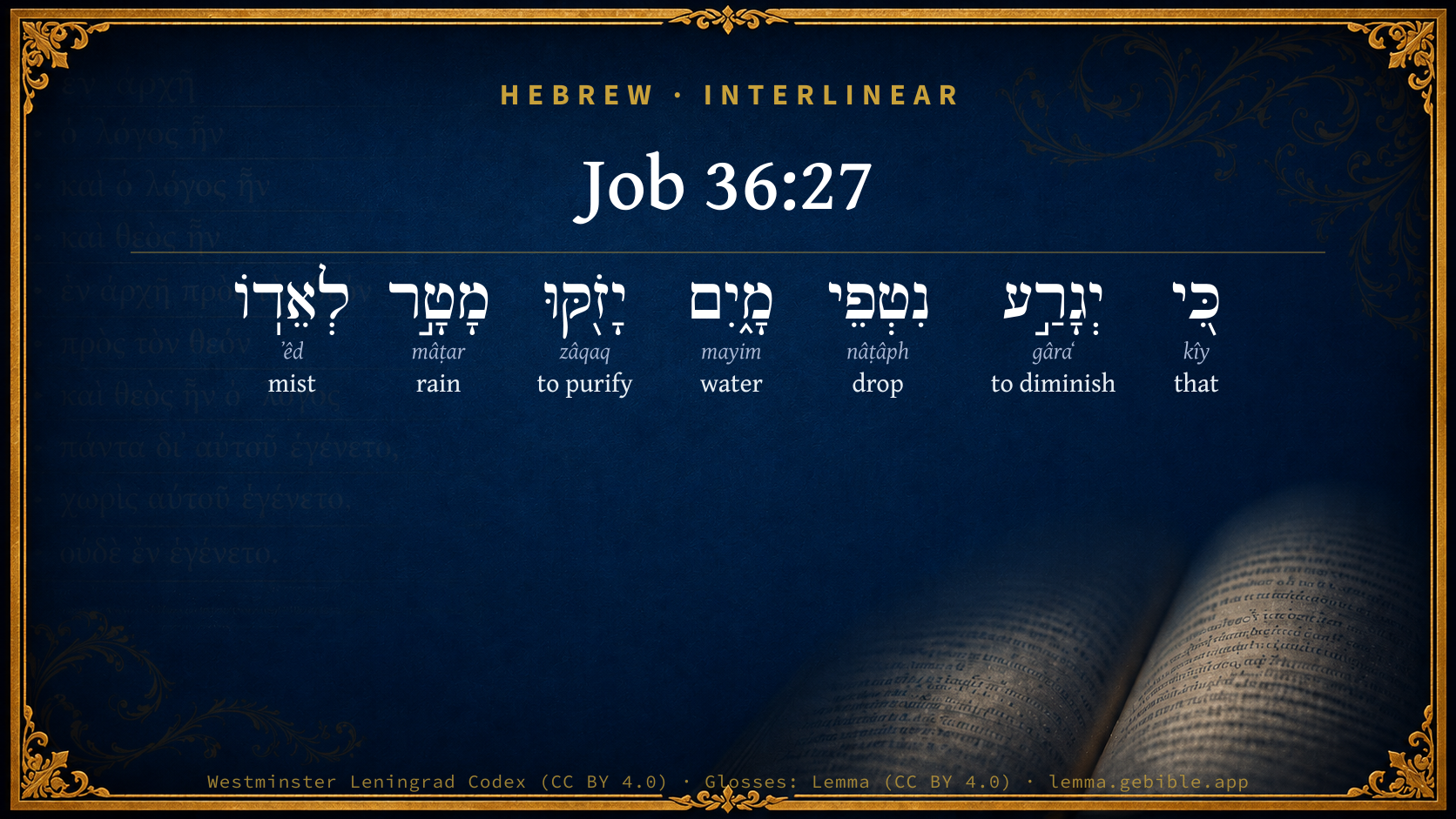
Job 36:27

Hebrew (Westminster Leningrad Codex) Job 36:27 appears in the Hebrew Old Testament. The text above is from the Westminster Leningrad Codex. Each word links to its Strong’s number, a concise gloss, and parsing drawn from the Open Scriptures Hebrew Bible morphology. Click any word for its full Brown-Driver-Briggs (BDB) entry.
Download image
Cite this verse

Job 36:27 (World English Bible). Public Domain. Lemma interlinear Bible study tool, https://lemma.gebible.app/v/job/36/27.

Show BibTeX & RIS
BibTeX
RIS
English Translation
For he draws up the drops of water, Which distill in rain from his vapor,
World English Bible · Public Domain
Download a study sheet

One document with this verse’s original text, its word-by-word gloss line, the meaning frame, cross-references with their text, attributed commentary, and full source and license credits — printable, and it pastes into notes with its structure intact.

This verse Autodidact and up

Study sheet (.html) Plain text (.txt)

A passage Seminary Student

Up to 50 verses in one chapter. A passage sheet keeps up to 6 commentary sources and 12 cross-references per verse, in the order this page ranks them, and says so on the sheet whenever that leaves anything out. Ask for a single verse and you get the Autodidact verse sheet above.

Everything on this page stays free to read, with no account — the sheet is a download of what is already on screen, not access to it.

Want to remove ads? Support Godless Engineer
Compare translations 3

The same verse in 3 English versions, stacked beneath the original-language interlinear above. Click any original word for its lexicon entry.

Each is an independent rendering of the whole verse — the interlinear is not word-aligned to these translations.

Highlighted words mark where these versions differ — a whole-verse word diff, not a word-by-word alignment.

  • World English Bible Public Domain
    For he draws up the drops of water, Which distill in rain from his vapor,
  • King James Version Public Domain
    For he maketh small the drops of water: they pour down rain according to the vapour thereof:
  • unfoldingWord Literal Text CC BY-SA 4.0
    For he draws up the drops of water; they distill rain into his stream,

unfoldingWord Literal Text — © unfoldingWord, licensed CC BY-SA 4.0. Word-aligned USFM3 via Door43 (git.door43.org/unfoldingWord/en_ult).

Versions to compare (up to 4)

3 of 4 selected

Show all 18 translations

Every available English version of this verse, each an independent rendering of the whole verse.

  • World English Bible Public Domain
    For he draws up the drops of water, Which distill in rain from his vapor,
  • Berean Standard Bible Public Domain
    For He draws up drops of water which distill the rain from the mist,
  • Majority Standard Bible Public Domain
    For He draws up drops of water which distill the rain from the mist,
  • King James Version Public Domain
    For he maketh small the drops of water: they pour down rain according to the vapour thereof:
  • American Standard Version (1901) Public Domain
    For he draweth up the drops of water, Which distil in rain from his vapor,
  • Revised Version (1885) Public Domain
    For he draweth up the drops of water, which distil in rain from his vapour:
  • Geneva Bible (1599) Public Domain
    When he restraineth the droppes of water, the rayne powreth down by the vapour thereof,
  • Douay-Rheims (1899) Public Domain
    He lifteth up the drops of rain, and poureth out showers like floods:
  • Young's Literal Translation Public Domain
    When He doth diminish droppings of the waters, They refine rain according to its vapour,
  • Literal Standard Version CC BY-SA 4.0
    When He diminishes droppings of the waters, || They refine rain according to its vapor,
  • Unlocked Literal Bible CC BY-SA 4.0
    For he draws up the drops of water that he distills as rain from his vapor,
  • unfoldingWord Literal Text CC BY-SA 4.0
    For he draws up the drops of water; they distill rain into his stream,
  • Darby Bible Public Domain
    For he draweth up the drops of water: they distil in rain from the vapour which he formeth,
  • World Messianic Bible Public Domain
    For he draws up the drops of water, which distill in rain from his vapor,
  • Webster's Bible Public Domain
    For he maketh small the drops of water: they pour down rain according to the vapor of it.
  • Free Bible Version CC BY-SA 4.0
    He draws up the water and distils it into the dew and the rain.
  • Bible in Basic English Public Domain
    For he takes up the drops from the sea; he sends them through his mist as rain,
  • JPS Tanakh (1917) Public Domain
    For He draweth away the drops of water, which distil rain from His vapour;

Literal Standard Version (2020), Covenant Press — licensed CC BY-SA 4.0. Text via the HelloAO Bible API (eBible.org). Unlocked Literal Bible (unfoldingWord) — licensed CC BY-SA 4.0. Text via the HelloAO Bible API (eBible.org). unfoldingWord Literal Text — © unfoldingWord, licensed CC BY-SA 4.0. Word-aligned USFM3 via Door43 (git.door43.org/unfoldingWord/en_ult). Free Bible Version, Dr. Jonathan Gallagher — licensed CC BY-SA 4.0. Text via the HelloAO Bible API (eBible.org).

Word by word

More ways to search: Search by grammar → Find every occurrence → Compare this word →

Practice this passage: Drill this verse → Learn its vocabulary →

About this verse

These counts appear in no published source. They are computed here, from the morphology-tagged text and Lemma’s own curated glosses. What Lemma adds →

7
words
7
distinct lemmas
Wisdom
section

Notable vocabulary

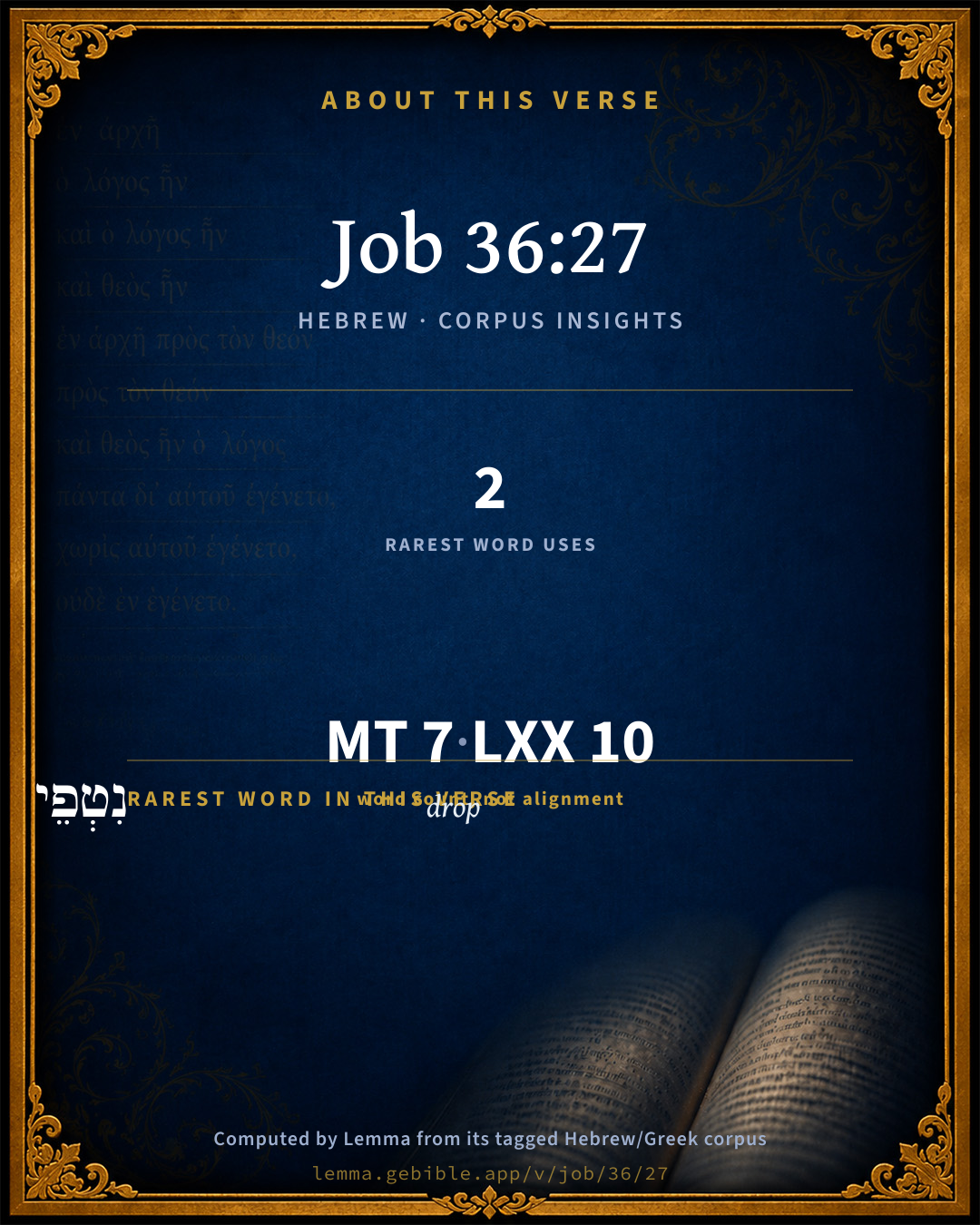
The rarest word here is נִטְפֵי drop H5198 — appearing just 2 times in the whole Hebrew Bible.

Shared distinctive vocabulary

נִטְפֵי drop H5198 occurs in 2 verses of the Hebrew Bible. Also found in:

Grammatical profile

  • 2 verbs
  • 4 nouns
  • 1 conjunction

Verb forms

  • יְגָרַ֣ע Piel · Imperfect
  • יָזֹ֖קּוּ Qal · Imperfect

Hebrew & Septuagint length

In English translation the verse runs 15 words from the Hebrew and 20 from the Septuagint (LXX English) — closely comparable.

A rough comparison of the two English renderings, which tokenize alike — not a word-level alignment.

Word counts can differ between the Hebrew and the Greek without any difference in meaning — e.g. the Hebrew direct-object marker אֵת has no separate Greek word, and Greek often adds the article ὁ.

In the original languages it is 7 Hebrew tokens and 10 Greek tokens — but the two are counted differently (Hebrew bundles its prefixes and suffixes into one token; the Greek is in lemma form), so that isn’t a like-for-like length.

Cross-references

10

Topical passages linked to Job 36:27 in the Treasury of Scripture Knowledge — connected by theme and wording, ordered by reader-vote popularity; previews shown in the World English Bible.

  • Psalms 147:8 Who covers the sky with clouds, Who prepares rain for the earth, Who makes grass grow on the mountains.
  • Job 5:9 Who does great things that can't be fathomed, Marvelous things without number;
  • Job 38:25–28 Who has cut a channel for the flood water, Or the path for the thunderstorm;
  • Psalms 65:9–13 You visit the earth, and water it. You greatly enrich it. The river of God is full of water. You provide them grain, for so you have ordained it.
  • Psalms 148:8 Lightning and hail, snow and clouds; Stormy wind, fulfilling his word;
  • Genesis 2:5–6 No plant of the field was yet in the earth, and no herb of the field had yet sprung up; for Yahweh God had not caused it to rain on the earth. There was not a man to till the ground,
  • Job 36:33 The noise of it tells about him, And the cattle also concerning the storm that comes up.
  • Job 38:34 "Can you lift up your voice to the clouds, That abundance of waters may cover you?
  • Isaiah 5:6 I will lay it a wasteland. It won't be pruned nor hoed, But it will grow briers and thorns. I will also command the clouds that they rain no rain on it."
  • Jeremiah 14:22 Are there any among the vanities of the nations that can cause rain? or can the sky give showers? Aren't you he, Yahweh our God? therefore we will wait for you; for you have made all these things.

Cross-references courtesy of OpenBible.info (CC BY 4.0).

Hebrew and Greek witnesses Masoretic Hebrew ↔ Greek Septuagint

The same verse in the two great witnesses to the Old Testament, shown verse-for-verse.

These are two independent witnesses, not word-aligned to each other, and the Septuagint is shown in lemma (dictionary) form.

Hebrew Job 36:27 Masoretic · Westminster Leningrad Codex

כִּ֭י יְגָרַ֣ע נִטְפֵי מָ֑יִם יָזֹ֖קּוּ מָטָ֣ר לְאֵדֽוֹ

For he draws up the drops of water, Which distill in rain from his vapor,

World English Bible · Public Domain

Greek LXX Job 36:27 Septuagint · lemma form

ἀριθμέω δέ αὐτός σταγών ὑετός καί ἐπιχέω ὑετός εἰς νεφέλη

And the drops of rain are numbered by him, and shall be poured out in rain to form a cloud.

LXX2012 (modern English Septuagint) · Public Domain

Hebrew: Westminster Leningrad Codex (CC BY 4.0). Greek: Septuagint (public domain); English from LXX2012 (modern English Septuagint) (Public Domain). How the Septuagint differs from the Hebrew →

Commentary

Notes on Job 36:27 from classic Christian and Jewish commentators (each source and its license shown beneath its notes). The classic Christian expositions comment on the surrounding passage and are grouped to its opening verse, so a note may address several verses; the Jewish commentaries on the Tanakh (Rashi and others) are per-verse, so they appear only where the commentator wrote on this verse.

Lemma curates 59 commentaries, every one of them public domain or Creative Commons licensed, each selected and text-cleaned for this edition rather than reprinted as found. About our sources →

Trapp's Complete Commentary

John Trapp

Job 36:27 For he maketh small the drops of water: they pour down rain according to the vapour thereof:

Ver. 27. For he maketh small the drops of water] Here Elihu beginneth to instance the greatness of God in his works, and particularly in the meteors; many of which Aristotle confesseth he understood not. And this I dare say, saith a learned interpreter here, that there is not extant any poem, either of the Greeks or Latins, which may be compared with this stately eloquence of Elihu in describing those natural effects which are caused in the air; and for the same cause are of the philosophers called meteors, or airy impressions; as namely, clouds, rain, hail, snow, thunder, lightning, and such like; whereof he here discourseth very gravely and learnedly; and first of rain, which he describeth, 1. By the form or manner of producing it, Job 36:27-28 2. By the largeness of the clouds, and their noise, Job 36:29 3. By the sudden succession of fair weather and foul, Job 36:30. And lastly, by the different use thereof in the three last verses of this chapter: God maketh small the drops of water; that is, he raineth by dividing the drops in the cloud, causing them to come down guttatim, piece-meal; and not by whole spouts, or pail fulls. Others read it, Subtrahit Deus, God draweth up drops of water, viz. out of the sea, the rivers, and other moist places, whence those vapours do ascend, of which are generated those drops of rain: Psa 147:8, "He covereth the heaven with clouds, he prepareth rain for the earth," &c.

They pour down rain according to the vapours thereof] As the vapours are greater or lesser, so is the rain. The rain ascendeth in thin vapours, but descendeth oft in thick showers; so do our poor prayers come down in greatest blessings; and we are sure of as much mercy as we bring faith to carry it away.

John Trapp, A Commentary or Exposition upon All the Books of the Old and New Testament (1647–1656) — public domain. Text from a community e-Sword module.

Joseph Benson's Commentary

Job 36:27-28. For he maketh small, &c. — Having affirmed that God’s works are incomprehensibly great and glorious, he now proves it from the most common works of nature and providence. And hence he leaves it to Job to consider how much more deep and inconceivable the secret counsels of God must be. The drops of water — He orders matters so wisely, that the waters which are in the clouds do not fall down at once in spouts, which would be pernicious to the earth and to mankind, but by degrees and in drops. According to the vapour thereof — According to the proportion of vapours which the heat of the sun hath drawn up from the earth or sea. So it denotes that great work of God by which the rain is first made of vapours, and afterward resolved into vapours, or into the matter of succeeding vapours, by a constant rotation. Which the clouds distil abundantly — In such plenty as the necessities of the earth require; which also is a wonderful work of God.

Joseph Benson's Commentary on the Old and New Testaments (1811–1818) — public domain. Text from a community e-Sword module.

Geneva Bible (1599)

Geneva Bible translators

That is, the rain cometh of those drops of water, which he keepeth in the clouds.

Geneva Bible (1599) marginal notes — public domain. Text via Bolls.life.

Jamieson, Fausset & Brown

Robert Jamieson, A. R. Fausset & David Brown

The marvellous formation of rain (so Job 5:9-10).

maketh small--Rather, "He draweth (up) to Him, He attracts (from the earth below) the drops of water; they (the drops of water) pour down rain, (which is) His vapor." "Vapor" is in apposition with "rain," marking the way in which rain is formed; namely, from the vapor drawn up by God into the air and then condensed into drops, which fall (Psa 147:8). The suspension of such a mass of water, and its descent not in a deluge, but in drops of vapory rain, are the marvel. The selection of this particular illustration of God's greatness forms a fit prelude to the storm in which God appears (Job 40:1).

Jamieson, Fausset & Brown — Commentary Critical and Explanatory on the Whole Bible (1871) — public domain (CC PDM 1.0). Text via the HelloAO Bible API.

Adam Clarke's Commentary

Verse 27. He maketh small the drops of water] This appears simply to refer to evaporation, and perhaps it would be better to translate יגרע yegara, "he exhales;" detaches the smallest particles of the aqueous mass from the surface in order to form clouds, as reservoirs for the purpose of furnishing rain for the watering of the earth. God is seen in little things, as well as great things; and the inconceivably little, as well as the stupendously great, are equally the work of Omnipotence.

They pour down rain] These exceedingly minute drops or vapour become collected in clouds; and then, when agitated by winds, &c. many particles being united, they become too heavy to be sustained by the air in which they before were suspended, and so fall down in rain, which is either a mist, a drizzle, a shower, a storm, or a waterspout, according to the influence of different winds, or the presence and quantum of the electric fluid. And all this is proportioned, לאדו le-edo, "to its vapour," to the quantity of the fluid evaporated and condensed into clouds.

Adam Clarke's Commentary on the Bible (1810–1826) — public domain. Text from a community e-Sword/MySword module.

Ellicott's Commentary for English Readers

(27) The drops of water.—The origin and first beginnings of the tempest are described. “He maketh small,” or draweth up by exhalation. “They pour down rain,” or “they distil in rain from His vapour,” or “belonging to the vapour thereof.” The rain is first absorbed, and then distilled and poured down.

A Bible Commentary for English Readers, edited by Charles John Ellicott (1878–1897) — public domain. Text from a community e-Sword module.

The Cambridge Bible for Schools and Colleges

gen. ed. J. J. S. Perowne

27, 28. The wonder of the rain-drops.

27. For he maketh small the rain-drops;

They distil the rain of his vapour;

28. Which the clouds pour down,

And drop upon the multitude of mankind.

27. he maketh small] lit. he draweth away, the reference being probably to the formation of the rain, which God draweth away in drops from the great mass of waters above. Others render, he draweth up, supposing the reference to be to the ascent of the rain in the form of vapour, as it then comes down in rain-drops. But this is rather scientific and complete; neither does the word mean to draw up.

The Cambridge Bible for Schools and Colleges (gen. ed. J. J. S. Perowne; Cambridge University Press, 1878–1918) — public domain. Text from a community e-Sword module.

John Gill's Exposition

For he maketh small the drops of rain,.... Elihu proceeds to give instances and proofs of the greatness of God, and begins with rain, as Eliphaz does, Job 5:9; a common phenomenon, what is very frequent, and well known in all ages and countries, and by all men, more or less; and yet there are some things relative to it which are beyond the comprehension of men, and show the greatness and incomprehensibleness of God: and the design of this, and all other instances of this kind, is to convince Job of his folly in searching out the causes and reasons of God's works of providence, when the common works of nature lie out of the reach of men; and to reconcile him to them, and bring him patiently to submit to the will of God, whose ways are past finding out; and some render the words, "he restrains the drops of rain" (g); he withholds it from the earth, which causes a drought, and so brings on a famine; others, "he subtracts", or draws out, or draws up, the drops of water (h), which he exhales by the heat of the sun out of the earth and out of the sea; see Psa 135:7, Amo 5:8; and which are drawn up in small particles, but form large bodies of waters in the clouds; and which are let down again upon the earth in small drops, in an easy and gentle manner, and so soak into the earth and make it fruitful; which is what is meant by our version here: this is a wonderful instance of God's power, wisdom, and goodness, and is beyond our comprehension; for no mortal man can tell how the Almighty parts and divides those large quantities of water in the clouds, that sometimes hang over our heads, into millions and ten thousand times ten thousand millions of drops, even innumerable; and causes these waters in such a manner to descend on the earth; lets them not fall at once, or in waterspouts, which would wash away the inhabitants of cities and towns, the cattle of the field, and the produce of the earth, as at the general deluge;

they pour down rain according to the vapour thereof: the water, drawn up and formed into large bodies in the heavens, pours down rain in a gentle and plentiful manner, according to the quantity of vapours exhaled out of the earth and sea; if a small quantity is drawn up, a small quantity is let down; and if a large quantity is attracted, a large quantity, or a plentiful shower, is given: some think that a small rain is meant in the preceding clause, and a great rain in this; for there is the small rain and the great rain of his strength, Job 37:6. The word translated "pour" has the signification of liquefying, melting, and dissolving, and of purging and purifying; and which is applicable to clouds which melt and dissolve gradually as they descend in drops upon the earth; and the water which they let down is of all the most clear and pure, as Galen and Hippocrates (i), those eminent physicians, have observed; and a late celebrated one tells us (k), that rain water is so truly distilled by nature, that the chemist, with all his distilling art, cannot produce purer water; for, though it is exhaled out of the dirty earth, out of miry places, bogs, and ditches, yet, being bound up in the clouds as in a garment, and passing through the atmosphere, it comes down to us pure as if it had been percolated or strained through a linen cloth; and though the water as drawn up out of the sea is salt, yet carried up into the air, and there, as in an alembic, distilled, it descends to us sweet and fresh, and has not the least brackishness in it.

(g) "aufert stillas pluviae et prohibebit", Pagninus; so Vatablus, Tigurine version, Targum, & Ben Gersom. (h) "Attrahit", Codurcus; "subtrahit", i.e. "a mare", Junius & Tremellius, Piscator, Schultens. (i) Apud Pinedam in loc. (k) Boerhaav. Elem. Chem. p. 600. apud Schultens in loc.

John Gill's Exposition of the Whole Bible (1746–1763) — public domain (CC PDM 1.0). Text via the HelloAO Bible API.

Albert Barnes' Notes on the Bible

For he maketh small the drops of water - Elihu now appeals, as he proposed to do, to the works of God, and begins with what appeared so remarkable and inexplicable, the wisdom of God in the rain and the dew, the tempest and the vapor. That which excited his wonder was, the fact in regard to the suspension of water in the clouds, and the distilling of it on the earth in the form of rain and dew. This very illustration had been used by Eliphaz for a similar purpose (Notes, Job 5:9-10), and whether we regard it as it “appears” to people without the light which science has thrown upon it, or look at the manner in which God suspends water in the clouds and sends it down in the form of rain and dew, with all the light which has been furnished by science, the fact is one that evinces in an eminent degree the wisdom of God. The word which is rendered “maketh small” (גרע gâra‛), means properly “to scrape off, to detract, to diminish, to take away from.” In the Piel, the form used here, it means, according to Gesenius, “to take to one’s self, to attract;” and the sense here, according to this, is, that God attracts, or draws upward the drops of water. So it is rendered by Herder, Noyes, Umbreit, and Rosenmuller. The idea is, that he “draws up” the drops of the water to the clouds, and then pours them down in rain. If the meaning in our common version be retained, the idea would be, that it was proof of great wisdom in God that the water descended in “small drops,” instead of coming down in a deluge; compare the notes at Job 26:8.

They pour down rain - That is, the clouds pour down the rain.

According to the vapour thereof - - לאדו le'êdô. The idea seems to be, that the water thus drawn up is poured down again in the form of a “vapory rain,” and which does not descend in torrents. The subject of admiration in the mind of Elihu was, that water should evaporate and ascend to the clouds, and be held there, and then descend again in the form of a gentle rain or fine mist. The reason for admiration is not lessened by becoming more fully acquainted with the laws by which it is done than Elihu can be supposed to have been.

Albert Barnes' Notes on the Bible (1834–1885) — public domain. Text from a community e-Sword/MySword module.

Haydock's Catholic Bible Commentary

Floods. God causes the water on the earth to evaporate, (Calmet) to form the clouds, (Haydock) which afterwards fall in torrents. (Menochius) --- Theodotion, "the drops of rain are numbered by him," &c., chap. xxvi. 8.

George Leo Haydock (1774–1849), Haydock's Catholic Family Bible and Commentary, 1859 edition — public domain. Excludes Psalms (Douay-Rheims chapter numbering differs from Protestant) and Deuterocanonical books (Catholic canon only).

Matthew Poole's English Annotations

Having affirmed that God’s works are incomprehensibly great and glorious, he now enters upon the proof of it; and he proveth it from the most common and visible works of nature and providence, which if thoroughly considered, are full of wonder, and past the reach of the greatest philosophers, who indeed speak of them only by guess, and by their innumerable disputations about them discover their ignorance in them. And hence he leaves it to Job to consider how incomparably more deep and unconceivable the secret counsels and judgments of God must needs be, and therefore how foolish and presumptuous a thing it was for him to judge and censure them.

He maketh small the drops of water, i.e. he orders matters so wisely and graciously, that the waters which are in the clouds do not fall down at once in spouts, or rivers, or seas; which would be both unprofitable and pernicious to the earth, and to mankind; but by degrees, and in drops; which is best for men’s safety and comfort, and for the refreshment of the earth. And this he observes as a wonderful work of God, without whose providence herein those waters might constantly or commonly fall in spouts, as sometimes part of them hath done.

They; either the waters, last mentioned; or the clouds, as it is expressed in the next verse; or the active verb is used impersonally, which is frequent in the Hebrew language, they pour down rain, for the rain is poured down.

Pour down; or, melt or dissolve; which word is borrowed from metallists, who dissolve metals with fire, and then pour them forth by degrees and in parcels; as the clouds are dissolved, and then poured forth in drops, as was now expressed.

According to the vapour thereof, i.e. according to the proportion of vapours which the heat of the sun hath drawn up from the earth or sea into the clouds. Or,

into the vapour thereof. So it notes that great work of God, by which the rain is first made of vapours, and afterwards resolved into vapours, or into the matter of succeeding vapours, by a constant rotation and reciprocation.

Matthew Poole's English Annotations on the Holy Bible (1683–1685) — public domain. Text from a community e-Sword/MySword module.

Whedon's Commentary on the Bible

Daniel D. Whedon

27. Maketh small — Rather, draweth up; exhaleth (Dr. Clarke) through the process of evaporation.

According to the vapour thereof — Through his vapour-cloud, (Furst,) or from its vapour, (Gesenius,) which Dr. T. Lewis renders in place of mist, in allusion to Gen_2:6. Science still uses the same term “vapour-cloud” to designate the mysterious birthplace of the rain. The ancients looked upon rain not only as coming from their deity, (Aratus,) but as the special gift of God. (Herodotus, Job_2:13.) The Talmud (in Taanith, ch. i) records an ancient saying of the Jews, that there be three keys which God hath reserved in his own hand, and hath not delivered to any minister or substitute, namely, the keys of life, and of rain, and of the resurrection of the dead. See notes on Job_5:10-11; Job_26:8.

Man abundantly — Or the multitude of men, so widespread is the fall of rain.

Daniel D. Whedon (gen. ed.), Commentary on the Old and New Testaments (1874–1909) — public domain. Text from a community e-Sword module.

The Pulpit Commentary

For he maketh small the drops of water; rather, he drawth up the drops of water; i.e. by the heat of his sun he causes exhalations to arise from the sea and the moist earth, and draws them up into the higher regions of the atmosphere, where they are condensed into clouds, that hang suspended in the air. They pour down rain according to the vapour thereof; literally, they flow down as rain for his mist. The water collected in the clouds flows down in the shape of rain for the purpose of watering the earth. (see Gen_2:6, where the same word (da) occurs)

The Pulpit Commentary (1880–1919), ed. H.D.M. Spence-Jones & Joseph S. Exell — public domain. Text from a community e-Sword module.

John Wesley's Explanatory Notes

For - Having affirmed that God's works are incomprehensibly great and glorious, he now proves it from the most common works of nature and providence. And hence he leaves it to Job to consider how much more deep and inconceivable the secret counsels of God must be. Water - He orders matters so wisely, that the waters which are in the clouds, do not fall down at once in spouts, which would be pernicious to the earth and to mankind; but by degrees, and in drops. According - According to the proportion of vapors which the heat of the sun hath drawn up by the earth or sea. So it notes that great work of God by which the rain is first made of vapors, and afterwards resolved into vapors, or into the matter of succeeding vapors, by a constant rotation.

John Wesley, Explanatory Notes Upon the Whole Bible (1754–1765) — public domain. Text via the GEBible commentary corpus.

unfoldingWord translationNotes

Door43 World Missions Community

that he distills as rain from his vapor

The word "distills" can also mean "refine" or "filter." Elihu describes how God turns the drops of water, or vapor, that he draws up into rain. AT: "that he turns into rain" (See: Assumed Knowledge and Implicit Information)

can anyone understand the extensive spread of the clouds and the thunder from his hut?

Elihu asks this rhetorical question to emphasize that no one can do these things. AT: "no one can understand the extensive spread of the clouds and the thunder from his hut." (See: Rhetorical Question)

the extensive spread of the clouds

The phrase "the extensive spread" can be translated with a verbal phrase. AT: "how the clouds spread across the sky" (See: Abstract Nouns)

from his hut

Elihu speaks of the sky as if it were a "hut" in which God lives. AT: "from the sky, where God lives" (See: Metaphor)

unfoldingWord translationNotes — © Distant Shores Media and the Door43 World Missions Community, licensed CC BY-SA 4.0. Source: git.door43.org/Door43/en_tn.

Rashi

Rabbi Shlomo Yitzchaki (Rashi)

For He increases Heb. יגרע, for He increases, like (above 15:4), “and increase (ותגרע) speech.” Others interpret: He withdraws them from the heavens to bring them down to earth.

they pour The firmaments [pour] the rain.

into His cloud Heb. לְאֵדוֹ, into His cloud.

Rashi on the Tanakh — English translations: “The Judaica Press complete Tanach with Rashi, translated by A. J. Rosenberg” (CC BY 4.0); “Pentateuch with Rashi's commentary by M. Rosenbaum and A.M. Silbermann, 1929-1934” (public domain); “The Metsudah Tanach series, Lakewood, N.J” (CC BY 4.0); and “The Book of Joshua, Metsudah Publications, 1997” (CC BY 4.0). Text via Sefaria.

Lesson kit

Teaching starters — assembled from the data on this page, not authored interpretation. Every prompt links to the verse data it draws on. Edit before teaching.

Job, in the Wisdom, opens this verse with 7 words (7 distinct Hebrew lemmas). Its most distinctive word is nâṭâph (“drop”). A historical commentator’s framing appears above. Read the whole chapter for the surrounding context.

Discussion questions

  1. The word nâṭâph carries the sense “drop.” How does it shape the verse?
  2. How does Exodus 30:34, which shares the word «drop», read alongside this verse?
  3. These translations render this verse differently; the difference is in the English rendering, not the original. What questions does that raise?
  4. «יְגָרַ֣ע» is a Piel Imperfect verb. How does that grammatical form shape the action described?
  5. Compare how Trapp's Complete Commentary and Joseph Benson's Commentary read this verse. Where do they agree or differ?

Things to notice

Reading settings

Reading text

Shown beneath each verse's original-language words.

Old Testament
Old Testament edition

Read the OT as the Masoretic Hebrew (MT) or the Greek Septuagint (LXX).

English shown for the Greek Septuagint (in the Hebrew ↔ Greek comparison).

Comparing translations? Open the Compare panel on any verse page to stack up to four side by side.