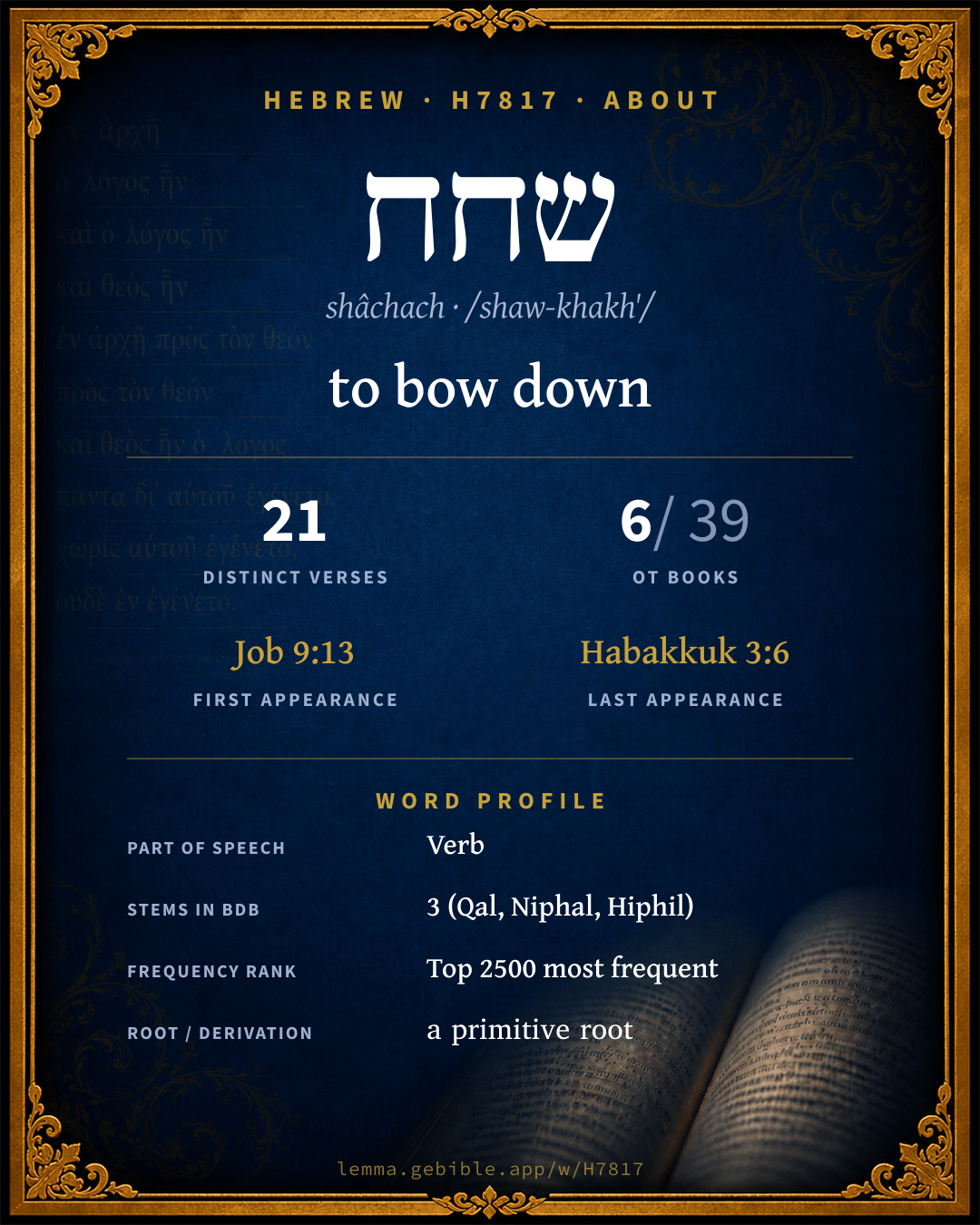
שָׁחַח
to bow down
‘to bow down’ is one of 4 main senses fuller range ↓
Full lexicon entry — Brown-Driver-Briggs (BDB)
From Brown-Driver-Briggs (BDB)
Where this word appears
See every Qal verb in the Hebrew Bible →
Grammar key — what these labels mean
Part of speech
- Verb
- An action or state-of-being word.
Stem
- Qal
- The basic, simple active stem — the plain form of the verb (“he wrote”). Here: ‘be bowed down’
- Hithpolel
- The reflexive counterpart of the Polel.
- Niphal
- Usually the simple passive or reflexive of the Qal (“he was written”).
- Hiphil
- The causative active stem (“he caused / brought about”). Here: ‘prostrate’
Form
- Perfect
- A completed action or state — Hebrew marks aspect (completeness) more than strict tense (“he wrote”).
- Imperfect
- An incomplete, ongoing, or future action (“he will / would write”).
- Sequential Imperfect
- An imperfect with prefixed waw — the standard past-narrative form (waw-consecutive imperfect).
- Sequential Perfect
- A perfect with prefixed waw continuing a preceding imperfect or command (waw-consecutive perfect).
- Infinitive Construct
- A bound verbal noun, frequently with prepositions (“to write / in writing”).
Person
- 3rd Person
- The one spoken about (“he / she / it / they”).
- 2nd Person
- The one addressed (“you”).
- 1st Person
- The speaker (“I / we”).
Gender
- Common
- Either gender — not distinguished for this form.
- Feminine
- Grammatically feminine.
- Masculine
- Grammatically masculine.
Number
- Plural
- More than one (in Hebrew, generally three or more).
- Singular
- One.
Grammatical forms 14 distinct
- Verb, Qal, Perfect, 3rd Person, Common, Plural 3 times (14%)
- Verb, Hithpolel, Imperfect, 2nd Person, Feminine, Singular 3 times (14%)
- Verb, Niphal, Sequential Imperfect, 3rd Person, Masculine, Singular 2 times (10%)
- Verb, Hiphil, Perfect, 3rd Person, Masculine, Singular 2 times (10%)
- Verb, Qal, Perfect, 1st Person, Common, Singular 2 times (10%)
- Verb, Niphal, Imperfect, 3rd Person, Masculine, Plural 1 time (5%)
- Verb, Qal, Perfect, 3rd Person, Masculine, Singular 1 time (5%)
- Verb, Qal, Sequential Perfect, 3rd Person, Masculine, Singular 1 time (5%)
+6 more forms (6 occurrences)
Parsed forms decoded from the imported morphology (morphhb / Westminster Leningrad Codex — WLC text public domain, morphhb tagging CC BY 4.0), counted across 21 parsed occurrences — not distinct verses.
Every verse where H7817 appears — 21 distinct verses across 6 books. Click any verse to open its interlinear word-by-word view. Verse text shown in the World English Bible for context — . Each verse’s Hebrew form is shown with its reference; the English is not keyword-highlighted, since the data carries no word-level English alignment. Use “Compare translations” on any verse to read it across multiple English versions. This concordance covers the Hebrew Bible; Septuagint (Greek Old Testament) occurrences are not indexed here.
Job 2 verses
Psalms 8 verses
- Psalms 10:10 יָשֹׁ֑חַ Qal impf 3ms The helpless are crushed, they collapse, They fall under his strength.
- Psalms 35:14 שַׁחֽוֹתִי Qal pf 1cs I behaved myself as though it had been my friend or my brother. I bowed down mourning, as one who mourns his mother.
- Psalms 38:6 שַׁחֹ֣תִי Qal pf 1cs I am pained and bowed down greatly. I go mourning all day long.
- Psalms 42:5 תִּשְׁתּ֬וֹחֲחִ֨י Hithpolel impf 2fs Why are you in despair, my soul? Why are you disturbed within me? Hope in God! For I shall still praise him for the saving help of his presence.
- Psalms 42:6 תִשְׁתּ֫וֹחָ֥ח Hithpolel impf 3fs My God, my soul is in despair within me. Therefore I remember you from the land of the Jordan, The heights of Hermon, from the hill Mizar.
- Psalms 42:11 תִּשְׁתּ֬וֹחֲחִ֨י Hithpolel impf 2fs Why are you in despair, my soul? Why are you disturbed within me? Hope in God! For I shall still praise him, The saving help of my countenance, and my God.
- Psalms 43:5 תִּשְׁתּ֬וֹחֲחִ֨י Hithpolel impf 2fs Why are you in despair, my soul? Why are you disturbed within me? Hope in God! For I shall still praise him: My Savior, my helper, and my God.
- Psalms 107:39 וַ/יָּשֹׁ֑חוּ conj + Qal wimpf 3mp Again, they are diminished and bowed down Through oppression, trouble, and sorrow.
Proverbs 1 verse
Ecclesiastes 1 verse
Isaiah 8 verses
- Isaiah 2:9 וַ/יִּשַּׁ֥ח conj + Niphal wimpf 3ms Man is brought low, And mankind is humbled; Therefore don't forgive them.
- Isaiah 2:11 וְ/שַׁ֖ח conj + Qal pf 3ms The lofty looks of man will be brought low, The haughtiness of men will be bowed down, And Yahweh alone will be exalted in that day.
- Isaiah 2:17 וְ/שַׁח֙ conj + Qal wpf 3ms The loftiness of man shall be bowed down, And the haughtiness of men shall be brought low; And Yahweh alone shall be exalted in that day.
- Isaiah 5:15 וַ/יִּשַּׁ֥ח conj + Niphal wimpf 3ms So man is brought low, Mankind is humbled, And the eyes of the arrogant ones are humbled;
- Isaiah 25:12 הֵשַׁ֥ח Hiphil pf 3ms The high fortress of your walls has he brought down, laid low, and brought to the ground, even to the dust.
- Isaiah 26:5 הֵשַׁח֙ Hiphil pf 3ms For he has brought down those who dwell on high, the lofty city: he lays it low, he lays it low even to the ground; he brings it even to the dust.
- Isaiah 29:4 תִּשַּׁ֣ח Niphal impf 3fs You shall be brought down, and shall speak out of the ground, and your speech shall be low out of the dust; and your voice shall be as of one who has a familiar spirit, out of the ground, and your speech shall whisper out of the dust.
- Isaiah 60:14 שְׁח֨וֹחַ֙ Qal inf.cs The sons of those who afflicted you shall come bending to you; and all those who despised you shall bow themselves down at the soles of your feet; and they shall call you The city of Yahweh, The Zion of the Holy One of Israel.
Habakkuk 1 verse
About this entry
At a glance — auto-summarized from this page’s data, not written by a person. Every figure links to its source below. This summary describes the numbers; it doesn’t interpret them.
At its core, שחח (shâchach) means “to bow down.” First canonically at Job 9:13, it enters the text early. It appears 21 verses across 6 books of the Hebrew Bible, among its uncommon vocabulary. The word gravitates to Psalms (38%), then Isaiah and Job. Read the stem: it spans 3 stems, including Qal and Niphal. Each statement above links to its evidence; the full detail follows below.
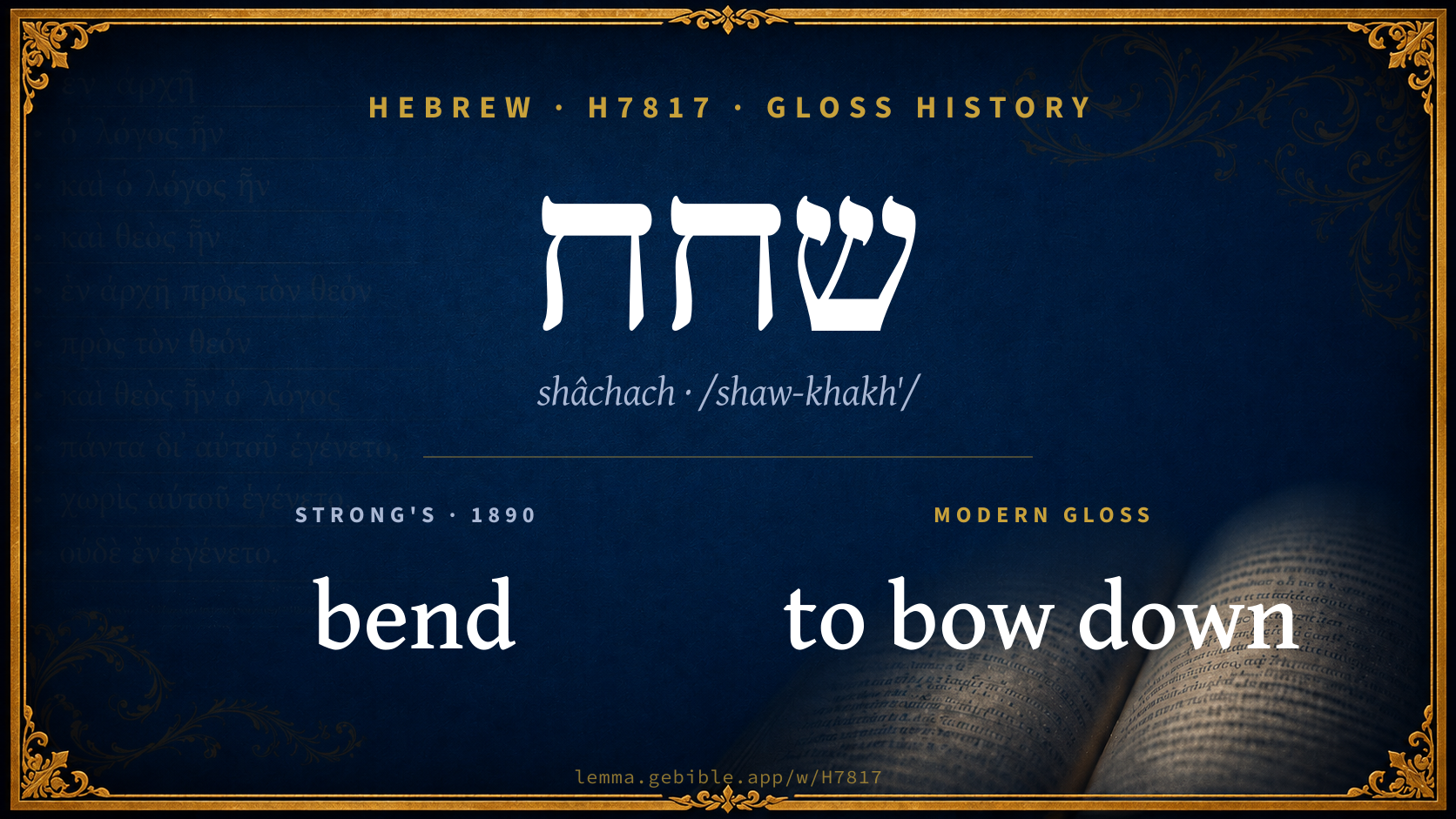
Gloss history
Strong's 1890 vs modern scholarship
About this word
Strong's H7817 catalogs a Hebrew word from the Hebrew Old Testament.
These counts are not copied from any lexicon or concordance. They are computed here, from the morphology-tagged Hebrew Old Testament. What Lemma adds →
- 21
- distinct verses
- The word appears in 21 distinct verses.
- 6 / 39
- OT books
- The word appears in 6 of 39 Old Testament books.
- #1,462
- by frequency
- Top 2500 most frequent Hebrew words (rank 1,462 of 8,640 Hebrew words by occurrence).
View all 21 occurrences in the concordance →
By section of the Old Testament
By traditional corpus
Conventional, traditional groupings — biblical authorship is debated, so this is a traditional corpus grouping, not an authorship claim. Each share is this word’s portion of its verses in that division of the Hebrew canon. Each figure is a share of the word’s 21 distinct verses.
- Writings (Ketuvim) 12 verses · 57%
- Prophets (Nevi'im) 9 verses · 43%
How translations render this word
Counts come from each version’s own published word-to-Strong’s tagging or interlinear alignment — an approximate guide to how each version renders this word, not a word-level alignment the data otherwise carries. Because each total is that version’s own tagged count, the per-version totals vary from one another and need not match the appearance or distinct-verse counts above. These counts may also differ from a printed concordance because Lemma counts each distinctly tagged rendering and does not collapse phrase taggings into a single head-word total. This is a fixed set of word-tagged versions (KJV, ASV, BSB, ULT) and does not change with the reading translation you choose elsewhere. Each version’s license is shown beside its name below (and on Sources).
- King James Version: Why art thou cast down 3×, Shall be bowed down 2×
- American Standard Version: Why art thou cast down 3×, Is bowed down 2×, Shall be bowed down 2×
- Berean Standard Bible: Are you downcast 3×, Brought low 2×, Will be brought low 2×
- unfoldingWord Literal Text: And 5×, Have you bowed yourself down 3×, Will bow down 2×
King James Version Public Domain
Renders H7817 across 21 tagged occurrences — most commonly:
Plus 16 renderings that appear only once — usually multi-word phrases or single function words the recovered tagging swept in, not distinct renderings.
American Standard Version Public Domain
Renders H7817 across 21 tagged occurrences — most commonly:
Plus 14 renderings that appear only once — usually multi-word phrases or single function words the recovered tagging swept in, not distinct renderings.
Berean Standard Bible Public Domain
Renders H7817 across 21 tagged occurrences — most commonly:
Plus 14 renderings that appear only once — usually multi-word phrases or single function words the recovered tagging swept in, not distinct renderings.
unfoldingWord Literal Text CC BY-SA 4.0
Renders H7817 across 27 tagged occurrences — most commonly:
Plus 17 renderings that appear only once — usually multi-word phrases or single function words the recovered tagging swept in, not distinct renderings.
7 senses and sub-senses in the full BDB
Hebrew verbs can shift meaning by stem (binyan): Qal is the basic action, Niphal is often passive or reflexive, Piel often intensifies or makes it factitive, and Hiphil is typically causative. The senses below are grouped under the stem BDB assigns to each.
What do BDB’s symbols mean?
BDB uses these scholarly abbreviations:
| Symbol | Meaning |
|---|---|
| 𝔊 | the Septuagint (the ancient Greek translation, LXX) |
| 𝔙 | the Vulgate (the Latin translation) |
| 𝔖 | the Syriac version (the Peshitta) |
| 𝔗 | the Targum (the Aramaic translation) |
| ψ | the Psalms |
| √ | root (the underlying root or stem) |
| ‖ | parallel passage (a synonymous or contrasted parallel) |
| † | the dagger: every passage where the word occurs is cited |
The 7 senses and sub-senses the full Brown-Driver-Briggs lexicon distinguishes for this word, in lexicon order (not ranked by frequency), with BDB’s own verbatim wording and sub-sense lettering. Shown in Hebrew script with BDB’s own scholarly abbreviations. The condensed entry is in the Lexicon Entry tab. See also the Forms in the corpus table below.
Qal
- Pf. 3 ms. consec. וְשַׁח Is 2:11, 17, 1 s. שַׁח֫וֹתִי ψ 38:7, שַׁחֹ֫תִי 35:14, 3 pl. שָֽׁתֲחוּ Jb 9:13, שַׁחוּ Hb 3:6; Pr 14:19; Impf. 3 ms. יָשֹׁחַ ψ 10:10, 3 mpl. יָשֹׁ֫חוּ Jb 38:40, וַיָּשֹׁ֫חוּ ψ 107:39; Inf. cstr. (= abs., as adv., Ges§ 118 q Köii. 2, §§ 221, 402 d cf. also BaNB 164) שְׁחוֹח Is 60:14;— e.g. Isaiah 2:11
- 1. be bowed down, prostrated, humbled, by י׳, Is 2:11, 17 (both ‖ שָׁפֵל), Hb 3:6 (of hills), Jb 9:13 (תַּחְתָּו שׁ׳), ψ 107:39 (+ מָעַט); by man 10:10. e.g. Isaiah 2:11
- 2. bow in homage, לִפְנֵי pers. Pr 14:19; וְהָֽלְכוּ אֵלַיִךְ שְׁחוֹחַ Is 60:14 (‖ הִשְׁתַּחֲווּ). e.g. Proverbs 14:19
- 3. bow, of mourner (קֹדֵר), ψ 35:14; 38:7. e.g. Psalms 35:14
- 4. crouch, of wild beast in lair Jb 38:40. e.g. Job 38:40
Niphal
- Impf. be prostrated, humbled: וַיִּשַּׁח אָדָם Is 2:9 (‖ שָׁפֵל) = 5:15 (‖ id.); be reduced, weakened, יִשַּׁ֫חוּ כָּל־בְּנוֹת הַשִּׁיר Ec 12:4; = proceed humbly, of words מֵעָפָר Is 29:4 (‖ שָׁפֵל). e.g. Isaiah 2:9
Hiphil
- prostrate, lay low, city, walls, etc.; Pf. 3 ms. הֵשַׁח Is 25:12; 26:5 (both ‖ הִשְׁפִּיל). Hithpōʿ. be cast down, despairing: Impf. 3 fs. תִּשְׁתּוֹחָ֑ח ψ 42:7, 2 fs. תִּשְׁתּוֹחֲחִי v 6, 12; 43:5 (all c. subj. נַפְשִׁי). e.g. Isaiah 25:12
Senses from the full Brown-Driver-Briggs lexicon (Brown, Driver, Briggs; Oxford 1906 — public domain), digitized via Sefaria, supplemented by the OpenScriptures HebrewLexicon (CC BY 4.0). Full attribution on Sources.
Word origin
vb. bow, be bowed down, crouch (NH id.; TelAm. šaḫâḫu (Wkl TelAm. Vocab.), prostrate oneself, prob. Canaanism; Assyrian šaḫâḫu is oppress, torment);—
— Brown-Driver-Briggs (Oxford 1906, public domain), digitized via Sefaria, supplemented by the OpenScriptures HebrewLexicon (CC BY 4.0). See Sources.
Origin: a primitive root
Jastrow Dictionary
A second Hebrew/Aramaic lexicon for comparison, covering Aramaic and post-biblical (Talmudic, Targumic, Midrashic) usage that the biblical-Hebrew BDB does not. Matched by lemma rather than by Strong’s number, so a lemma may carry more than one Jastrow headword (shown separately below), and the entries cover usage well beyond the Bible.
שָׁחַח
- (b. h.) to bend, bow (interch. with שָׁחָה a. שׁוּחַ). Y. Ber. I, 3ᶜ bot. אלו … ששׁוֹחֲחִין וכ׳ these are the benedictions at which you must bow &c.; השׁוֹחֵחַ … שלא יָשׁוֹחַ (or יָשׁוּחַ) if one bows at every benediction, we teach him that he must not do so; Ber. 34ᵃ; Gen. R. s. 39 והשׁוֹחֶה … לָשׁוֹחַ (or לָשׁוּחַ); Tosef. Ber. I, 9 השׁוֹחֶה … שלא יִשְׁחֶה. Ruth R. to II, 5 כל הנשים שׁוֹחֲחוֹת וכ׳ all other women stooped in gleaning, but she (Ruth) sat down; (Yalk. ib. 601 עומדות).
A Dictionary of the Targumim, the Talmud Babli and Yerushalmi, and the Midrashic Literature (Marcus Jastrow; London, Luzac, 1903) — Public Domain. Digitized via Sefaria. Digitized via Sefaria. Full attribution on Sources.
Forms in the corpus
The 18 distinct written forms H7817 takes in the Hebrew Bible, most frequent first — each parse links to that stem’s occurrences in the concordance. Hebrew forms include their vowel points and cantillation, so a single lemma takes many written forms.
Same root — word family
Other BDB entries built from the same root as H7817, grouped by Strong’s listed origin. These share a root / origin per the lexicon — not necessarily a shared meaning. Each links to that word’s own entry.
Derived from this word
Compare all same-root words → They share a root, not necessarily a meaning.
Septuagint verse parallels
This word appears in 16 verses that also exist in the Greek Old Testament (Septuagint), out of the 21 Hebrew verses it occurs in. You can read those verses in Greek by switching the Old Testament edition to the Septuagint.
Read these verses in the Septuagint
This is a verse-level parallel only — the same verses exist in both the Hebrew and Greek Old Testaments. No word-level Hebrew↔Greek correspondence is claimed: the data carries no such alignment, so no Greek word is shown as this Hebrew word’s translation. Coverage is not total — the Septuagint omits the deuterocanon and renumbers the Psalms, so some Hebrew verses have no direct Greek parallel.