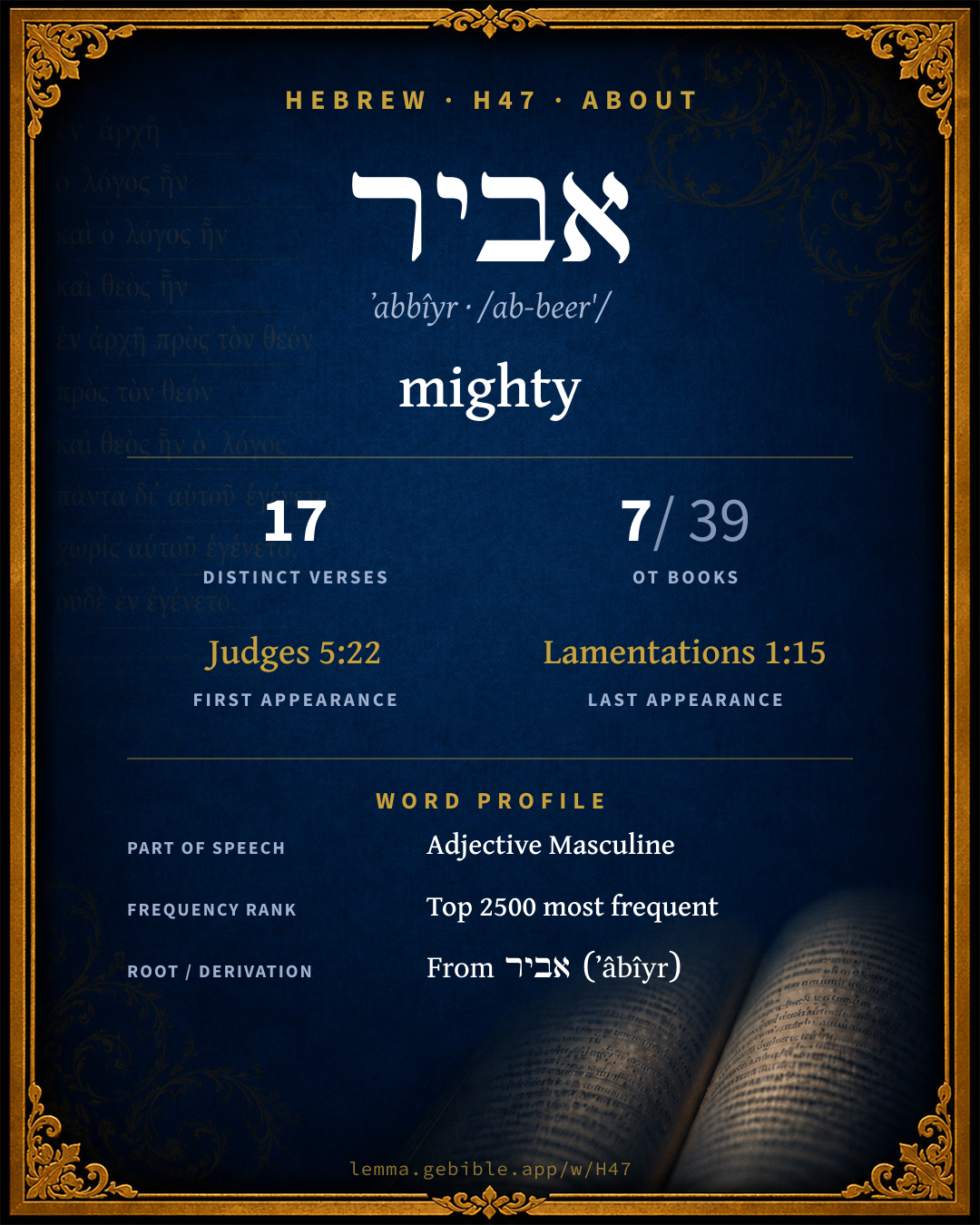
אַבִּיר
mighty
‘mighty’ is one of 5 main senses fuller range ↓
Full lexicon entry — Brown-Driver-Briggs (BDB)
From Brown-Driver-Briggs (BDB)
Where this word appears
See every Construct-state word in the Hebrew Bible →
Grammar key — what these labels mean
Part of speech
- Adjective
- A word that describes or qualifies a noun.
State
- Absolute
- The independent form of a noun, not bound to a following word.
- Construct
- A noun bound to a following noun in a possessive / “of” relationship (the construct chain).
Gender
- Masculine
- Grammatically masculine.
Number
- Plural
- More than one (in Hebrew, generally three or more).
- Singular
- One.
Grammatical forms
- Adjective, Adjective, Masculine, Plural, Construct 8 times (47%)
- Adjective, Adjective, Masculine, Plural, Absolute 6 times (35%)
- Adjective, Adjective, Masculine, Singular, Absolute 2 times (12%)
- Adjective, Adjective, Masculine, Singular, Construct 1 time (6%)
Parsed forms decoded from the imported morphology (morphhb / Westminster Leningrad Codex — WLC text public domain, morphhb tagging CC BY 4.0), counted across 17 parsed occurrences — not distinct verses.
Every verse where H47 appears — 17 distinct verses across 7 books. Click any verse to open its interlinear word-by-word view. Verse text shown in the World English Bible for context — . Each verse’s Hebrew form is shown with its reference; the English is not keyword-highlighted, since the data carries no word-level English alignment. Use “Compare translations” on any verse to read it across multiple English versions. This concordance covers the Hebrew Bible; Septuagint (Greek Old Testament) occurrences are not indexed here.
Judges 1 verse
1 Samuel 1 verse
Job 2 verses
Psalms 5 verses
- Psalms 22:12 אַבִּירֵ֖י adj Adjective mp cs Many bulls have surrounded me. Strong bulls of Bashan have encircled me.
- Psalms 50:13 אַבִּירִ֑ים adj Adjective mp Will I eat the flesh of bulls, Or drink the blood of goats?
- Psalms 68:30 אַבִּירִ֨ים adj Adjective mp Rebuke the wild animal of the reeds, The multitude of the bulls, with the calves of the peoples. Being humbled, may it bring bars of silver. Scatter the nations that delight in war.
- Psalms 76:5 אַבִּ֣ירֵי adj Adjective mp cs Valiant men lie plundered, They have slept their last sleep. None of the men of war can lift their hands.
- Psalms 78:25 אַ֭בִּירִים adj Adjective mp Man ate the bread of angels. He sent them food to the full.
Isaiah 3 verses
- Isaiah 10:13 כַּ/אבִּ֖יר prep + Adjective Adjective ms For he has said, By the strength of my hand I have done it, and by my wisdom; for I have understanding: and I have removed the bounds of the peoples, and have robbed their treasures, and like a valiant man I have brought down those who sit [on thrones]:
- Isaiah 34:7 אַבִּירִ֑ים adj Adjective mp The wild-oxen shall come down with them, and the bulls with the bulls: and their land shall be drunken with blood, and their dust made fat with fatness.
- Isaiah 46:12 אַבִּ֣ירֵי adj Adjective mp cs Listen to me, you stout-hearted, who are far from righteousness:
Jeremiah 4 verses
- Jeremiah 8:16 אַבִּירָ֔י/ו adj Adjective mp cs + sfx pers 3ms The snorting of his horses is heard from Dan: at the sound of the neighing of his strong ones the whole land trembles; for they are come, and have devoured the land and all that is in it; the city and those who dwell therein.
- Jeremiah 46:15 אַבִּירֶ֑י/ךָ adj Adjective mp cs + sfx pers 2ms Why are your strong ones swept away? they didn't stand, because Yahweh did drive them.
- Jeremiah 47:3 אַבִּירָ֔י/ו adj Adjective mp cs + sfx pers 3ms At the noise of the stamping of the hoofs of his strong ones, at the rushing of his chariots, at the rumbling of his wheels, the fathers don't look back to their children for feebleness of hands;
- Jeremiah 50:11 כָּ/אֲבִּרִֽים prep det + Adjective Adjective mp Because you are glad, because you rejoice, O you who plunder my heritage, because you are wanton as a heifer that treads out [the grain], and neigh as strong horses;
Lamentations 1 verse
About this entry
At a glance — auto-summarized from this page’s data, not written by a person. Every figure links to its source below. This summary describes the numbers; it doesn’t interpret them.
“mighty” is the headline sense of the Hebrew adjective אביר (ʼabbîyr). Its meaning spans more than one sense — see its full sense range. It turns up in 17 verses across 7 books, an uncommon footprint. It concentrates in Psalms, which alone accounts for 29% of its uses. Its earliest occurrence is Judges 5:22. See the sense tree, 17-verse concordance, and the renderings breakdown below.
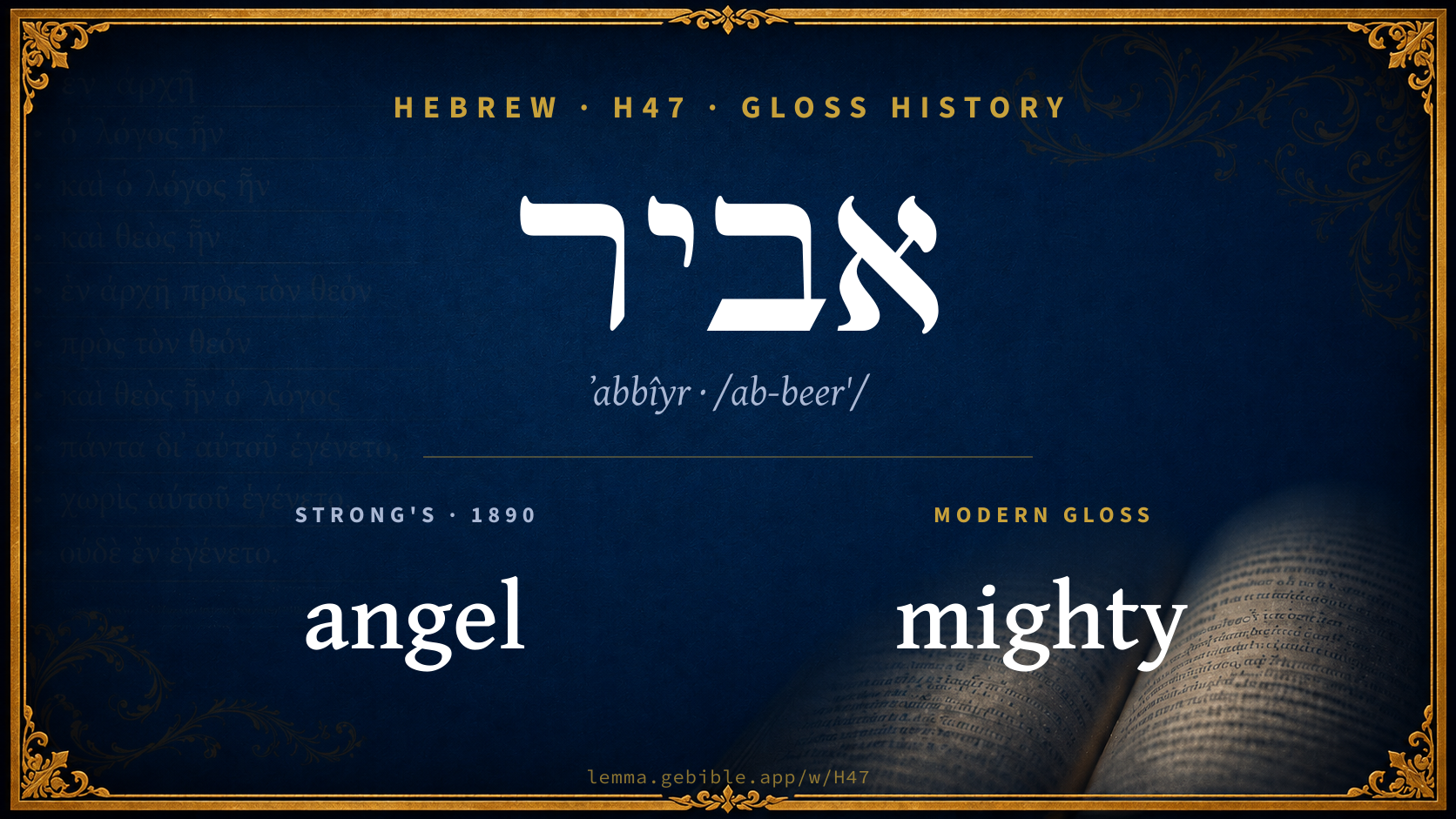
Gloss history
Strong's 1890 vs modern scholarship
About this word
Strong's H47 catalogs a Hebrew word from the Hebrew Old Testament.
These counts are not copied from any lexicon or concordance. They are computed here, from the morphology-tagged Hebrew Old Testament. What Lemma adds →
- 17
- distinct verses
- The word appears in 17 distinct verses.
- 7 / 39
- OT books
- The word appears in 7 of 39 Old Testament books.
- #1,671
- by frequency
- Top 2500 most frequent Hebrew words (rank 1,671 of 8,640 Hebrew words by occurrence).
View all 17 occurrences in the concordance →
By section of the Old Testament
By traditional corpus
Conventional, traditional groupings — biblical authorship is debated, so this is a traditional corpus grouping, not an authorship claim. Each share is this word’s portion of its verses in that division of the Hebrew canon. Each figure is a share of the word’s 17 distinct verses.
- Prophets (Nevi'im) 9 verses · 53%
- Writings (Ketuvim) 8 verses · 47%
How translations render this word
Counts come from each version’s own published word-to-Strong’s tagging or interlinear alignment — an approximate guide to how each version renders this word, not a word-level alignment the data otherwise carries. Because each total is that version’s own tagged count, the per-version totals vary from one another and need not match the appearance or distinct-verse counts above. These counts may also differ from a printed concordance because Lemma counts each distinctly tagged rendering and does not collapse phrase taggings into a single head-word total. This is a fixed set of word-tagged versions (KJV, ASV, BSB, ULT) and does not change with the reading translation you choose elsewhere. Each version’s license is shown beside its name below (and on Sources).
- King James Version: Bulls 4×, Mighty 2×, Strong 2×
- American Standard Version: Mighty 3×, Bulls 2×, Me 2×
- Berean Standard Bible: Bulls 2×, Mighty 2×, Stallions 2×
- unfoldingWord Literal Text: Mighty 5×
King James Version Public Domain
Renders H47 across 17 tagged occurrences — most commonly:
Plus 9 renderings that appear only once — usually multi-word phrases or single function words the recovered tagging swept in, not distinct renderings.
American Standard Version Public Domain
Renders H47 across 17 tagged occurrences — most commonly:
Plus 8 renderings that appear only once — usually multi-word phrases or single function words the recovered tagging swept in, not distinct renderings.
Berean Standard Bible Public Domain
Renders H47 across 17 tagged occurrences — most commonly:
Plus 9 renderings that appear only once — usually multi-word phrases or single function words the recovered tagging swept in, not distinct renderings.
unfoldingWord Literal Text CC BY-SA 4.0
Renders H47 across 16 tagged occurrences — most commonly:
Plus 11 renderings that appear only once — usually multi-word phrases or single function words the recovered tagging swept in, not distinct renderings.
Senses in the full BDB
What do BDB’s symbols mean?
BDB uses these scholarly abbreviations:
| Symbol | Meaning |
|---|---|
| 𝔊 | the Septuagint (the ancient Greek translation, LXX) |
| 𝔙 | the Vulgate (the Latin translation) |
| 𝔖 | the Syriac version (the Peshitta) |
| 𝔗 | the Targum (the Aramaic translation) |
| ψ | the Psalms |
| √ | root (the underlying root or stem) |
| ‖ | parallel passage (a synonymous or contrasted parallel) |
| † | the dagger: every passage where the word occurs is cited |
The 3 senses and sub-senses the full Brown-Driver-Briggs lexicon distinguishes for this word, in lexicon order (not ranked by frequency), with BDB’s own verbatim wording and sub-sense lettering. Shown in Hebrew script with BDB’s own scholarly abbreviations. The condensed entry is in the Lexicon Entry tab. See also the Forms in the corpus table below.
- 1. men Jb 24:22(= violent) 34:20 Je 46:15 1 S 21:8 (read א׳ הָרָצִים Gr Dr, cf. 22:17; but LagProbebibel אֹבִיל הָעֲיָרִים v. Id. BN 45; Klo גִּבּוֹר), La 1:15; אַבִּירֵי לֵב stout of heart Is 46:12 (= obstinate) ψ 76:6. e.g. Job 24:22
- 2. angels ψ 78:25 (cf. 103:20). e.g. Psalms 78:25
- 3. animals; bull, sim. of king of Assyr. Is 10:13 (rd.כְּאַבִּיר & v. Di); elsewh. pl.; metaph. for enemies אַבִּירֵי בָשָׁן ψ 22:13 (‖ פּרים); for princes ψ 68:31; for Edomites Is 34:7; hence even as sacrif. ψ 50:13 (‖ עַתּוּדִים); of horses Ju 5:22 Je 8:16; 47:3; 50:11 but Je 46:15 many MSS. 𝔊 Aq Symm Theod 𝔙 many moderns read אַבִּירֶ֑ךָ thy bull, i.e. Apis e.g. Isaiah 10:13
Senses from the full Brown-Driver-Briggs lexicon (Brown, Driver, Briggs; Oxford 1906 — public domain), digitized via Sefaria, supplemented by the OpenScriptures HebrewLexicon (CC BY 4.0). Full attribution on Sources.
Word origin
adj. mighty, valiant—א׳ Jb 34:20 + Is 10:13 Kt (Qr כַּבִּיר; cstr. id. 1 S 21:8; pl. אַבִּירִים Jb 24:22 +;—mighty (alw. = subst. & poet. exc.1 S 21:8).
— Brown-Driver-Briggs (Oxford 1906, public domain), digitized via Sefaria, supplemented by the OpenScriptures HebrewLexicon (CC BY 4.0). See Sources.
Derived from אביר (ʼâbîyr) (H46) — mighty.
Jastrow Dictionary
A second Hebrew/Aramaic lexicon for comparison, covering Aramaic and post-biblical (Talmudic, Targumic, Midrashic) usage that the biblical-Hebrew BDB does not. Matched by lemma rather than by Strong’s number, so a lemma may carry more than one Jastrow headword (shown separately below), and the entries cover usage well beyond the Bible.
אַבִּיר
- strong, mighty, eminent (opp. קל light, of no influence); noble. — Pl. אַבִּירִים. R. Hash. 25ᵇ אביר שבא׳ the noblest of the nobility. Y. ib. II, 58ᵇ bot. אַבִּירֵי עולם (Babli ib. l. c. חֲמוּרֵי; Koh. R. to I, 4 גדולי) the world’s noblest sons. [Esth. R. to II, 4, v. אַבִּירָם.]
A Dictionary of the Targumim, the Talmud Babli and Yerushalmi, and the Midrashic Literature (Marcus Jastrow; London, Luzac, 1903) — Public Domain. Digitized via Sefaria. Digitized via Sefaria. Full attribution on Sources.
Forms in the corpus
The 14 distinct written forms H47 takes in the Hebrew Bible, most frequent first — each parse links to that state’s occurrences in the concordance. Hebrew forms include their vowel points and cantillation, so a single lemma takes many written forms.
Septuagint verse parallels
This word appears in 14 verses that also exist in the Greek Old Testament (Septuagint), out of the 17 Hebrew verses it occurs in. You can read those verses in Greek by switching the Old Testament edition to the Septuagint.
Read these verses in the Septuagint
This is a verse-level parallel only — the same verses exist in both the Hebrew and Greek Old Testaments. No word-level Hebrew↔Greek correspondence is claimed: the data carries no such alignment, so no Greek word is shown as this Hebrew word’s translation. Coverage is not total — the Septuagint omits the deuterocanon and renumbers the Psalms, so some Hebrew verses have no direct Greek parallel.