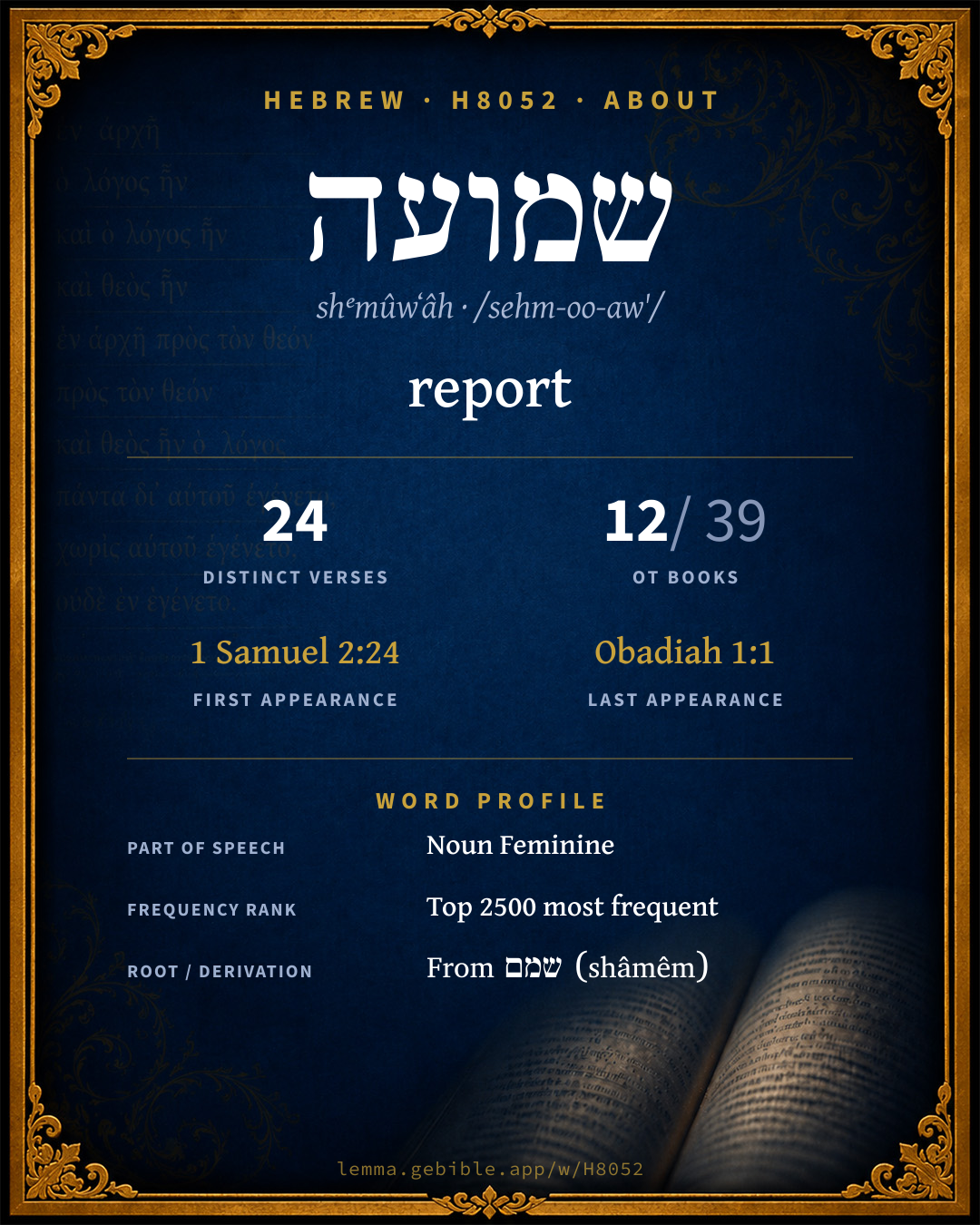
שְׁמוּעָה
report
also: news, rumour fuller range ↓
Full lexicon entry — Brown-Driver-Briggs (BDB)
From Brown-Driver-Briggs (BDB)
Where this word appears
See every Absolute-state word in the Hebrew Bible →
Grammar key — what these labels mean
Part of speech
- Noun
- A naming word — a person, place, thing, or idea.
Noun type
- Common
- A common noun — a general class of person, place, or thing (“king,” “city,” “water”), not a specific name.
State
- Absolute
- The independent form of a noun, not bound to a following word.
- Construct
- A noun bound to a following noun in a possessive / “of” relationship (the construct chain).
Gender
- Feminine
- Grammatically feminine.
Number
- Singular
- One.
- Plural
- More than one (in Hebrew, generally three or more).
Grammatical forms
- Noun, Common, Feminine, Singular, Absolute 24 times (89%)
- Noun, Common, Feminine, Singular, Construct 2 times (7%)
- Noun, Common, Feminine, Plural, Absolute 1 time (4%)
Parsed forms decoded from the imported morphology (morphhb / Westminster Leningrad Codex — WLC text public domain, morphhb tagging CC BY 4.0), counted across 27 parsed occurrences — not distinct verses.
Every verse where H8052 appears — 24 distinct verses across 12 books. Click any verse to open its interlinear word-by-word view. Verse text shown in the World English Bible for context — . Each verse’s Hebrew form is shown with its reference; the English is not keyword-highlighted, since the data carries no word-level English alignment. Use “Compare translations” on any verse to read it across multiple English versions. This concordance covers the Hebrew Bible; Septuagint (Greek Old Testament) occurrences are not indexed here.
1 Samuel 2 verses
- 1 Samuel 2:24 הַ/שְּׁמֻעָה֙ ptcl def.art + n c fs No, my sons; for it is no good report that I hear: you make Yahweh's people to disobey.
- 1 Samuel 4:19 הַ/שְּׁמֻעָ֔ה ptcl def.art + n c fs His daughter-in-law, Phinehas' wife, was with child, near to be delivered: and when she heard the news that the ark of God was taken, and that her father-in-law and her husband were dead, she bowed herself and brought forth; for her pains came on her.
2 Samuel 2 verses
- 2 Samuel 4:4 שְׁמֻעַת֩ n c fs cs Now Jonathan, Saul's son, had a son who was lame of his feet. He was five years old when the news came of Saul and Jonathan out of Jezreel; and his nurse took him up, and fled: and it happened, as she made haste to flee, that he fell, and became lame. His name was Mephibosheth.
- 2 Samuel 13:30 וְ/הַ/שְּׁמֻעָ֣ה conj + ptcl def.art + n c fs It happened, while they were in the way, that the news came to David, saying, Absalom has slain all the king's sons, and there is not one of them left.
1 Kings 2 verses
- 1 Kings 2:28 וְ/הַ/שְּׁמֻעָה֙ conj + ptcl def.art + n c fs The news came to Joab; for Joab had turned after Adonijah, though he didn't turn after Absalom. Joab fled to the Tent of Yahweh, and caught hold on the horns of the altar.
- 1 Kings 10:7 הַ/שְּׁמוּעָ֖ה ptcl def.art + n c fs However I didn't believe the words, until I came, and my eyes had seen it: and, behold, the half was not told me; your wisdom and prosperity exceed the fame which I heard.
2 Kings 1 verse
2 Chronicles 1 verse
Psalms 1 verse
Proverbs 2 verses
Isaiah 4 verses
- Isaiah 28:9 שְׁמוּעָ֑ה n c fs Whom will he teach knowledge? and whom will he make to understand the message? those who are weaned from the milk, and drawn from the breasts?
- Isaiah 28:19 שְׁמוּעָֽה n c fs As often as it passes though, it shall take you; for morning by morning shall it pass through, by day and by night: and it shall be nothing but terror to understand the message.
- Isaiah 37:7 שְׁמוּעָ֖ה n c fs Behold, I will put a spirit in him, and he shall hear news, and shall return to his own land; and I will cause him to fall by the sword in his own land.
- Isaiah 53:1 לִ/שְׁמֻעָתֵ֑/נוּ prep + n c fs cs + sfx pers 1cp Who has believed our message? and to whom has the arm of Yahweh been revealed?
Jeremiah 4 verses
- Jeremiah 10:22 שְׁמוּעָה֙ n c fs The voice of news, behold, it comes, and a great commotion out of the north country, to make the cities of Judah a desolation, a dwelling-place of jackals.
- Jeremiah 49:14 שְׁמוּעָ֤ה n c fs I have heard news from Yahweh, and an ambassador is sent among the nations, [saying], Gather yourselves together, and come against her, and rise up to the battle.
- Jeremiah 49:23 שְׁמֻעָ֥ה n c fs Of Damascus. Hamath is confounded, and Arpad; for they have heard evil news, they are melted away: there is sorrow on the sea; it can't be quiet.
- Jeremiah 51:46 בַּ/שְּׁמוּעָ֖ה הַ/שְּׁמוּעָ֗ה הַ/שְּׁמוּעָ֔ה prep det + n c fs ptcl def.art + n c fs ptcl def.art + n c fs Don't let your heart faint, neither fear for the news that shall be heard in the land; for news shall come one year, and after that in another year [shall come] news, and violence in the land, ruler against ruler.
Ezekiel 3 verses
- Ezekiel 7:26 וּ/שְׁמֻעָ֥ה שְׁמוּעָ֖ה conj + n c fs n c fs Mischief shall come on mischief, and rumor shall be on rumor; and they shall seek a vision of the prophet; but the law shall perish from the priest, and counsel from the elders.
- Ezekiel 16:56 לִ/שְׁמוּעָ֖ה prep + n c fs For your sister Sodom was not mentioned by your mouth in the day of your pride,
- Ezekiel 21:7 שְׁמוּעָ֣ה n c fs It shall be, when they tell you, Why do you sigh? that you shall say, Because of the news, for it comes; and every heart shall melt, and all hands shall be feeble, and every spirit shall faint, and all knees shall be weak as water: behold, it comes, and it shall be done, says the Lord Yahweh.
Daniel 1 verse
Obadiah 1 verse
About this entry
At a glance — auto-summarized from this page’s data, not written by a person. Every figure links to its source below. This summary describes the numbers; it doesn’t interpret them.
שמועה — transliterated shᵉmûwʻâh — is a Hebrew noun carrying the sense “report.” Translators differ — “tidings” in the King James Version, then “news” (Berean Standard Bible) and “report” (unfoldingWord Literal Text), as the renderings breakdown shows. With 24 verses in 12 books, it is an uncommon word in the Hebrew Bible. It first appears in 1 Samuel 2:24. It also covers “news” and “rumour”, alongside “report” — see its full sense range. Each statement above links to its evidence; the full detail follows below.
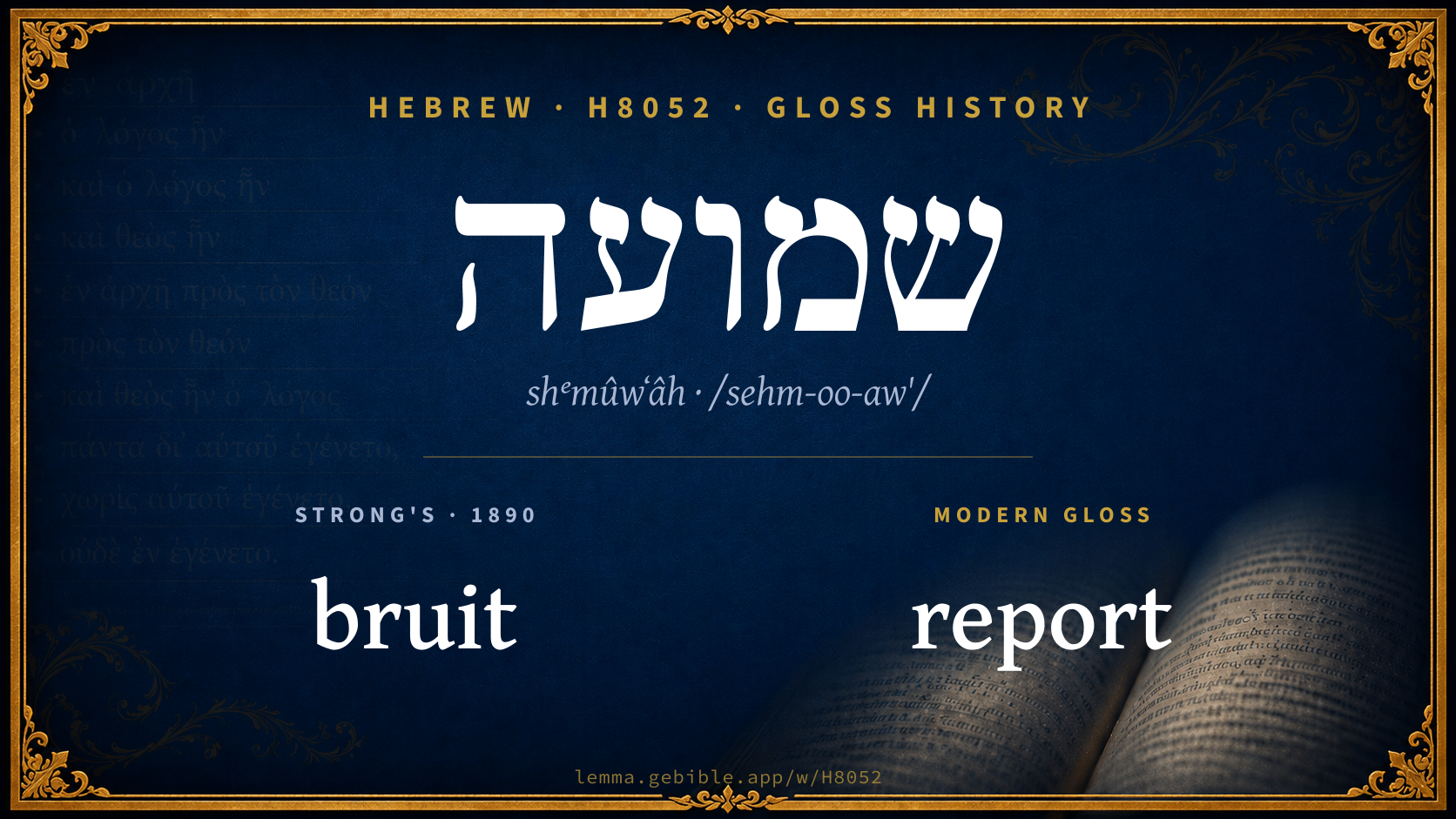
Gloss history
Strong's 1890 vs modern scholarship
About this word
Strong's H8052 catalogs a Hebrew word from the Hebrew Old Testament.
These counts are not copied from any lexicon or concordance. They are computed here, from the morphology-tagged Hebrew Old Testament. What Lemma adds →
- 24
- distinct verses
- The word appears in 24 distinct verses.
- 12 / 39
- OT books
- The word appears in 12 of 39 Old Testament books.
- #1,226
- by frequency
- Top 2500 most frequent Hebrew words (rank 1,226 of 8,640 Hebrew words by occurrence).
View all 24 occurrences in the concordance →
By section of the Old Testament
By traditional corpus
Conventional, traditional groupings — biblical authorship is debated, so this is a traditional corpus grouping, not an authorship claim. Each share is this word’s portion of its verses in that division of the Hebrew canon. Each figure is a share of the word’s 24 distinct verses.
- Prophets (Nevi'im) 19 verses · 79%
- Writings (Ketuvim) 5 verses · 21%
How translations render this word
Counts come from each version’s own published word-to-Strong’s tagging or interlinear alignment — an approximate guide to how each version renders this word, not a word-level alignment the data otherwise carries. Because each total is that version’s own tagged count, the per-version totals vary from one another and need not match the appearance or distinct-verse counts above. These counts may also differ from a printed concordance because Lemma counts each distinctly tagged rendering and does not collapse phrase taggings into a single head-word total. This is a fixed set of word-tagged versions (KJV, ASV, BSB, ULT) and does not change with the reading translation you choose elsewhere. Each version’s license is shown beside its name below (and on Sources).
- King James Version: Tidings 8×, Rumour 7×, Report 4×
- American Standard Version: Tidings 11×, Message 3×, He shall hear tidings 2×
- Berean Standard Bible: News 7×, Report 7×, Rumor 6×
- unfoldingWord Literal Text: Report 12×, News 3×, Is 2×
King James Version Public Domain
Renders H8052 across 27 tagged occurrences — most commonly:
Plus 6 renderings that appear only once — usually multi-word phrases or single function words the recovered tagging swept in, not distinct renderings.
American Standard Version Public Domain
Renders H8052 across 27 tagged occurrences — most commonly:
Plus 11 renderings that appear only once — usually multi-word phrases or single function words the recovered tagging swept in, not distinct renderings.
Berean Standard Bible Public Domain
Renders H8052 across 27 tagged occurrences — most commonly:
Plus 2 renderings that appear only once — usually multi-word phrases or single function words the recovered tagging swept in, not distinct renderings.
unfoldingWord Literal Text CC BY-SA 4.0
Renders H8052 across 25 tagged occurrences — most commonly:
Plus 8 renderings that appear only once — usually multi-word phrases or single function words the recovered tagging swept in, not distinct renderings.
Senses in the full BDB
What do BDB’s symbols mean?
BDB uses these scholarly abbreviations:
| Symbol | Meaning |
|---|---|
| 𝔊 | the Septuagint (the ancient Greek translation, LXX) |
| 𝔙 | the Vulgate (the Latin translation) |
| 𝔖 | the Syriac version (the Peshitta) |
| 𝔗 | the Targum (the Aramaic translation) |
| ψ | the Psalms |
| √ | root (the underlying root or stem) |
| ‖ | parallel passage (a synonymous or contrasted parallel) |
| † | the dagger: every passage where the word occurs is cited |
The 2 senses and sub-senses the full Brown-Driver-Briggs lexicon distinguishes for this word, in lexicon order (not ranked by frequency), with BDB’s own verbatim wording and sub-sense lettering. Shown in Hebrew script with BDB’s own scholarly abbreviations. The condensed entry is in the Lexicon Entry tab. See also the Forms in the corpus table below.
- 1. report, sometimes after שָׁמַע 1 S 2:24; 4:19 (= news), 1 K 10:7 = 2 Ch 9:6, 2 K 19:7 = Is 37:7, Je 51:46; שׁ׳ רָעָה Je 49:23, cf. ψ 112:7, and שׁ׳ טוֹבָה Pr 15:30; 25:25; tidings about Saul 2 S 4:4; c. בָּאָה 13:30 (+ לֵאמֹר), 1 K 2:28 Ez 21:12 Je 10:22, cf. 51:46 + (בָּאָה om.) v 46; תָּבוֹא שׁ׳ אֶל־שׁ׳ Ez 7:26; שׁ׳ יְבַהֲלֻהוּ Dn 11:44; שְׁמוּעָתֵנוּ Is 53:1 the report that reached us, cf. also Is 28:9, 19 Je 49:14 Ob 1 (De Du al. specif. of prophetic message, but v. Gie Beiträge 155 f. We Now Ob 1). e.g. 1 Samuel 2:24
- 2. = mention, לֹא הֽיְתָה סְדֹם לִשׁ׳ בְּפִיךְ Ez 16:56. e.g. Ezekiel 16:56
Senses from the full Brown-Driver-Briggs lexicon (Brown, Driver, Briggs; Oxford 1906 — public domain), digitized via Sefaria, supplemented by the OpenScriptures HebrewLexicon (CC BY 4.0). Full attribution on Sources.
Word origin
n.f. report;—abs. שׁ׳ 1 S 4:19 +, שְׁמֻעָה 2:24 +; cstr. שְׁמֻעַת 2 S 4:4; sf. שְׁמֻעָתֵ֫נוּ Is 53:1; pl. abs. שְׁמֻעוֹת Dn 11:44;—
— Brown-Driver-Briggs (Oxford 1906, public domain), digitized via Sefaria, supplemented by the OpenScriptures HebrewLexicon (CC BY 4.0). See Sources.
Derived from שמם (shâmêm) (H8074) — to be desolate.
Jastrow Dictionary
A second Hebrew/Aramaic lexicon for comparison, covering Aramaic and post-biblical (Talmudic, Targumic, Midrashic) usage that the biblical-Hebrew BDB does not. Matched by lemma rather than by Strong’s number, so a lemma may carry more than one Jastrow headword (shown separately below), and the entries cover usage well beyond the Bible.
שָׁמוּעָה
- , v. preced.
שְׁמוּעָה
- 1. report, news. R. Hash. 3ᵃ (ref. to Num. XXI, 1) מה ש׳ שמע וכ׳ what was the report he heard? He heard that Aaron was dead. Ib. 18ᵇ שבו באת ש׳ וכ׳ on it (the fifth of Tebeth) came the report to the captivity that the city was taken (Ez. XXXIII, 21); עשו יום ש׳ וכ׳ they observed mourning on the day they heard the news, as they would have done on the day when the Temple was burnt. Keth. 62ᵃ ש׳ דבית המקדש the news of the destruction of the Temple. M. Kat. 20ᵇ, a. fr. ש׳ רחוקה the news of the death of a relative received after thirty days from the time of death; ש׳ קרובה news received within thirty days. Snh. 110ᵃ; a. fr.—Pl. שְׁמוּעוֹת. Ber. IX, 2, v. בְּשׂוֹרָה. M. Kat. 26ᵃ ש׳ הרעות bad news; a. v. fr. e.g. Numbers 21:1
- 2. tradition, traditional decision, legal discussion (הֲלָכָה). Ib. 23ᵃ אין אומרים ש׳ והגדה וכ׳ you must not speak of legal subjects or homiletical interpretations in the house of mourning. Snh. 88ᵃ הוא אומר מפי הש׳ if he says, I gave my decision on the basis of a tradition, opp. כך הוא בעיני it is my own opinion. Eduy. V, 7 אני עמדתי בשְׁמוּעָתִי … בשְׁמוּעָתָן I stood by my tradition, and they by theirs. Erub. 64ᵃ כל האומר ש׳ זו וכ׳ he who says, this traditional decision is good, the other is not &c. Men. 18ᵃ כמדומה אני שלא כיווננו שְׁמוּעָתֵינוּ וכ׳ it seems to me that until now our traditions did not correspond; Tosef. Zeb. II, 17 שמועתן (corr. acc.); a. fr.—Pl. as ab. Ḥag. 14ᵃ גבור בעל ש׳ ‘a mighty man’ (Is. III, 2) that means a man knowing many legal traditions.—[שְׁמוּעָה in Chald. dict., v. next w.] e.g. Isaiah 3:2
A Dictionary of the Targumim, the Talmud Babli and Yerushalmi, and the Midrashic Literature (Marcus Jastrow; London, Luzac, 1903) — Public Domain. Digitized via Sefaria. Digitized via Sefaria. Full attribution on Sources.
Forms in the corpus
The 24 distinct written forms H8052 takes in the Hebrew Bible, most frequent first — each parse links to that state’s occurrences in the concordance. Hebrew forms include their vowel points and cantillation, so a single lemma takes many written forms.
Same root — word family
Other BDB entries built from the same root as H8052, grouped by Strong’s listed origin. These share a root / origin per the lexicon — not necessarily a shared meaning. Each links to that word’s own entry.
Derives from
Shares the same root
- משמה mᵉshammâh H4923 devastation
- שמה shammâh H8047 desolation
- שמם shᵉmam H8075 to be appalled
- שמם shâmêm H8076 desolate
- שממון shimmâmôwn H8078 horror
- שממית sᵉmâmîyth H8079 lizard
Proper names from this root
People and places named from this root — a name, not an additional meaning of the word.
Compare all same-root words → Showing 4 of 10 — not the complete family. 2 of the same-root words are proper names (people or places). They share a root, not necessarily a meaning.
Septuagint verse parallels
This word appears in 22 verses that also exist in the Greek Old Testament (Septuagint), out of the 24 Hebrew verses it occurs in. You can read those verses in Greek by switching the Old Testament edition to the Septuagint.
Read these verses in the Septuagint
- 1 Samuel 2:24
- 2 Samuel 4:4
- 1 Kings 2:28
- 2 Kings 19:7
- 2 Chronicles 9:6
- Psalms 112:7
- Proverbs 15:30
- Isaiah 28:9
- Jeremiah 10:22
- Ezekiel 7:26
- Daniel 11:44
- Obadiah 1:1
This is a verse-level parallel only — the same verses exist in both the Hebrew and Greek Old Testaments. No word-level Hebrew↔Greek correspondence is claimed: the data carries no such alignment, so no Greek word is shown as this Hebrew word’s translation. Coverage is not total — the Septuagint omits the deuterocanon and renumbers the Psalms, so some Hebrew verses have no direct Greek parallel.