
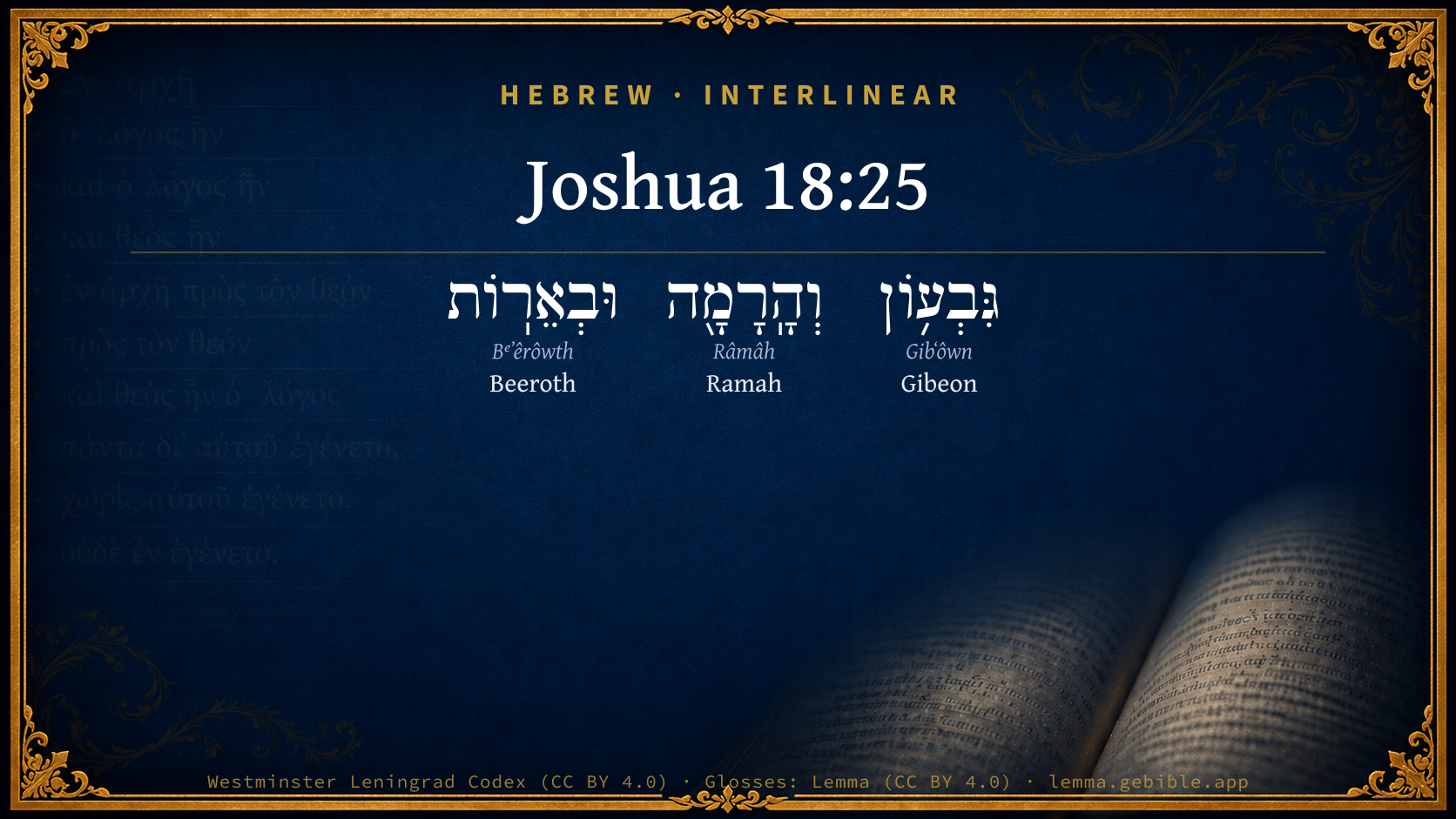
Joshua 18:25

Hebrew (Westminster Leningrad Codex) Joshua 18:25 appears in the Hebrew Old Testament. The text above is from the Westminster Leningrad Codex. Each word links to its Strong’s number, a concise gloss, and parsing drawn from the Open Scriptures Hebrew Bible morphology. Click any word for its full Brown-Driver-Briggs (BDB) entry.
Download image
Cite this verse

Joshua 18:25 (World English Bible). Public Domain. Lemma interlinear Bible study tool, https://lemma.gebible.app/v/joshua/18/25.

Show BibTeX & RIS
BibTeX
RIS
English Translation
Gibeon, and Ramah, and Beeroth,
World English Bible · Public Domain
Highlights
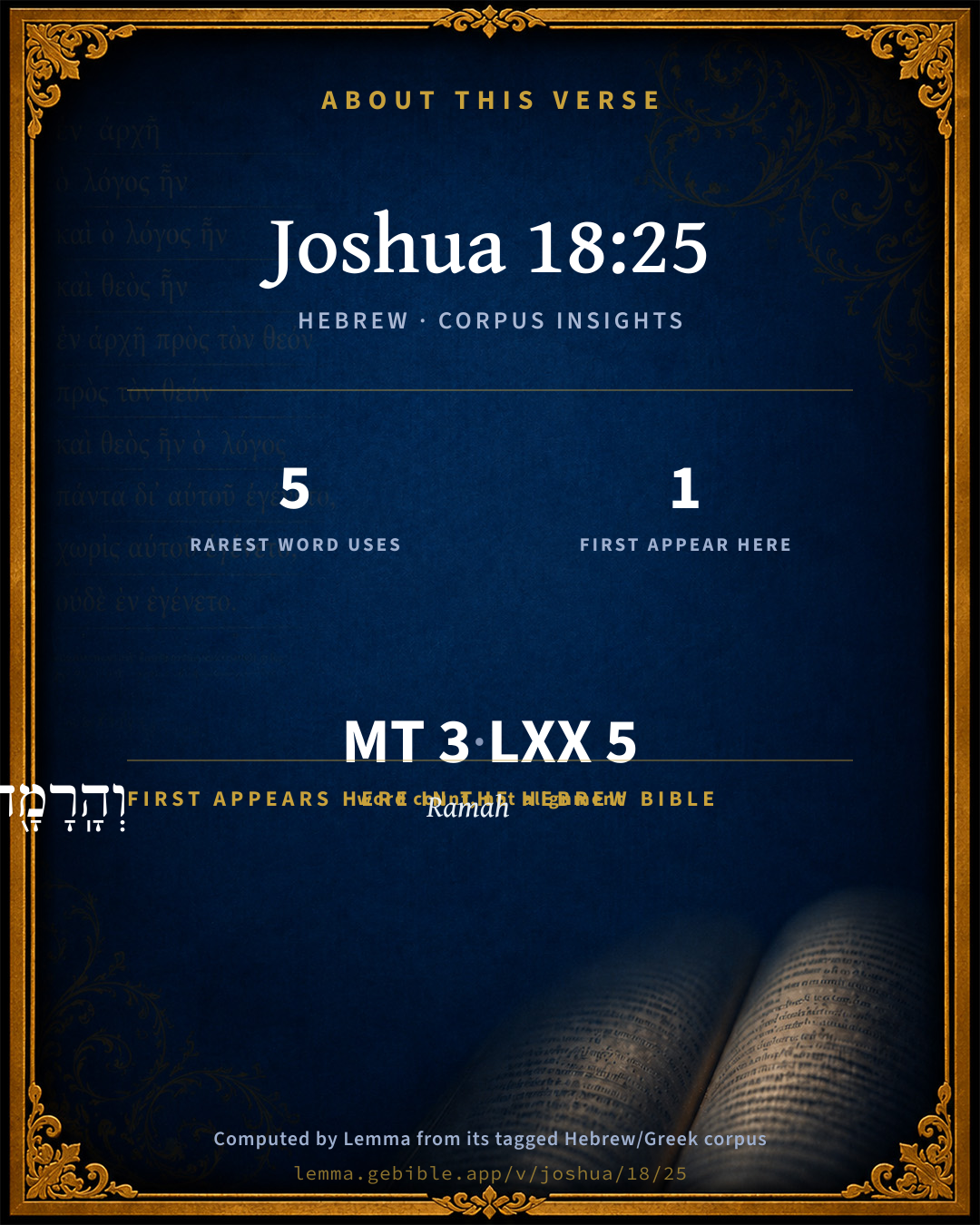
  • 1 first appearance in the Hebrew Bible
Full analysis ↓
Download a study sheet

One document with this verse’s original text, its word-by-word gloss line, the meaning frame, cross-references with their text, attributed commentary, and full source and license credits — printable, and it pastes into notes with its structure intact.

This verse Autodidact and up

Study sheet (.html) Plain text (.txt)

A passage Seminary Student

Up to 50 verses in one chapter. A passage sheet keeps up to 6 commentary sources and 12 cross-references per verse, in the order this page ranks them, and says so on the sheet whenever that leaves anything out. Ask for a single verse and you get the Autodidact verse sheet above.

Everything on this page stays free to read, with no account — the sheet is a download of what is already on screen, not access to it.

Want to remove ads? Support Godless Engineer
Compare translations 3

The same verse in 3 English versions, stacked beneath the original-language interlinear above. Click any original word for its lexicon entry.

Each is an independent rendering of the whole verse — the interlinear is not word-aligned to these translations.

Highlighted words mark where these versions differ — a whole-verse word diff, not a word-by-word alignment.

  • World English Bible Public Domain
    Gibeon, and Ramah, and Beeroth,
  • King James Version Public Domain
    Gibeon, and Ramah, and Beeroth,
  • unfoldingWord Literal Text CC BY-SA 4.0
    Gibeon and Ramah and Beeroth

unfoldingWord Literal Text — © unfoldingWord, licensed CC BY-SA 4.0. Word-aligned USFM3 via Door43 (git.door43.org/unfoldingWord/en_ult).

Versions to compare (up to 4)

3 of 4 selected

Show all 18 translations

Every available English version of this verse, each an independent rendering of the whole verse.

  • World English Bible Public Domain
    Gibeon, and Ramah, and Beeroth,
  • Berean Standard Bible Public Domain
    Gibeon, Ramah, Beeroth,
  • Majority Standard Bible Public Domain
    Gibeon, Ramah, Beeroth,
  • King James Version Public Domain
    Gibeon, and Ramah, and Beeroth,
  • American Standard Version (1901) Public Domain
    Gibeon, and Ramah, and Beeroth,
  • Revised Version (1885) Public Domain
    Gibeon, and Ramah, and Beeroth;
  • Geneva Bible (1599) Public Domain
    Gibeon, and Ramah, and Beeroth,
  • Douay-Rheims (1899) Public Domain
    The town Emona and Ophni and Gabee: twelve cities, and their villages.
  • Young's Literal Translation Public Domain
    Gibeon, and Ramah, and Beeroth,
  • Literal Standard Version CC BY-SA 4.0
    Gibeon, and Ramah, and Beeroth,
  • Unlocked Literal Bible CC BY-SA 4.0
    There were also the cities of Gibeon, Ramah, Beeroth,
  • unfoldingWord Literal Text CC BY-SA 4.0
    Gibeon and Ramah and Beeroth
  • Darby Bible Public Domain
    Gibeon, and Ramah, and Beeroth,
  • World Messianic Bible Public Domain
    Gibeon, Ramah, Beeroth,
  • Webster's Bible Public Domain
    Gibeon, and Ramah, and Beeroth,
  • Free Bible Version CC BY-SA 4.0
    In addition: Gibeon, Ramah, Beeroth,
  • Bible in Basic English Public Domain
    Gibeon and Ramah and Beeroth
  • JPS Tanakh (1917) Public Domain
    Gibeon, and Ramah, and Beeroth;

Literal Standard Version (2020), Covenant Press — licensed CC BY-SA 4.0. Text via the HelloAO Bible API (eBible.org). Unlocked Literal Bible (unfoldingWord) — licensed CC BY-SA 4.0. Text via the HelloAO Bible API (eBible.org). unfoldingWord Literal Text — © unfoldingWord, licensed CC BY-SA 4.0. Word-aligned USFM3 via Door43 (git.door43.org/unfoldingWord/en_ult). Free Bible Version, Dr. Jonathan Gallagher — licensed CC BY-SA 4.0. Text via the HelloAO Bible API (eBible.org).

Word by word

More ways to search: Search by grammar → Find every occurrence → Compare this word →

Practice this passage: Drill this verse → Learn its vocabulary →

וּבְאֵרֽוֹת
Bᵉʼêrôwth
H881
“and · Beeroth”
Conjunction + Noun, Proper
Part of Speech
Conjunction + Noun
Type
Proper
Full BDB Definition

Origin: fem. pl. of H875

TWOT: None

Beeroth = "wells" - a Gibeonite city allotted to Benjamin
  1. גִּבְע֥וֹן Gibʻôwn H1391 “Gibeon” Noun, Proper
  2. וְהָֽרָמָ֖ה Râmâh H7414 “and · the · Ramah” Conjunction + Particle, Definite Article + Noun, Proper

About this verse

These counts appear in no published source. They are computed here, from the morphology-tagged text and Lemma’s own curated glosses. What Lemma adds →

3
words
3
distinct lemmas
Historical
section

Notable vocabulary

The rarest word here is וּבְאֵרֽוֹת Beeroth H881 — appearing just 5 times in the whole Hebrew Bible.

First appearance in Scripture

This word makes its first canonical appearance in the Hebrew Bible here:

  • וְהָֽרָמָ֖ה Ramah H7414

Shared distinctive vocabulary

וּבְאֵרֽוֹת Beeroth H881 occurs in 5 verses of the Hebrew Bible. Also found in:

Grammatical profile

  • 3 nouns

Hebrew & Septuagint length

In English translation the verse runs 5 words from the Hebrew and 5 from the Septuagint (LXX English) — the same length.

A rough comparison of the two English renderings, which tokenize alike — not a word-level alignment.

Word counts can differ between the Hebrew and the Greek without any difference in meaning — e.g. the Hebrew direct-object marker אֵת has no separate Greek word, and Greek often adds the article ὁ.

In the original languages it is 3 Hebrew tokens and 5 Greek tokens — but the two are counted differently (Hebrew bundles its prefixes and suffixes into one token; the Greek is in lemma form), so that isn’t a like-for-like length.

Cross-references

10

Topical passages linked to Joshua 18:25 in the Treasury of Scripture Knowledge — connected by theme and wording, ordered by reader-vote popularity; previews shown in the World English Bible.

  • Joshua 9:17 The children of Israel traveled, and came to their cities on the third day. Now their cities were Gibeon, and Chephirah, and Beeroth, and Kiriath Jearim.
  • Joshua 7:17 and he brought near the family of Judah; and he took the family of the Zerahites: and he brought near the family of the Zerahites man by man; and Zabdi was taken:
  • Joshua 10:2 that they feared greatly, because Gibeon was a great city, as one of the royal cities, and because it was greater than Ai, and all the men of it were mighty.
  • Joshua 15:34 and Zanoah, and En Gannim, Tappuah, and Enam,
  • 1 Samuel 1:1 Now there was a certain man of Ramathaim Zophim, of the hill-country of Ephraim, and his name was Elkanah, the son of Jeroham, the son of Elihu, the son of Tohu, the son of Zuph, an Ephraimite:
  • 1 Kings 3:4–5 The king went to Gibeon to sacrifice there; for that was the great high place: a thousand burnt offerings did Solomon offer on that altar.
  • 1 Kings 9:2 that Yahweh appeared to Solomon the second time, as he had appeared to him at Gibeon.
  • Isaiah 28:21 For Yahweh will rise up as on Mount Perazim, he will be angry as in the valley of Gibeon; that he may do his work, his strange work, and bring to pass his act, his strange act.
  • Jeremiah 31:15 Thus says Yahweh: A voice is heard in Ramah, lamentation, and bitter weeping, Rachel weeping for her children; she refuses to be comforted for her children, because they are no more.
  • Matthew 27:57 When evening had come, a rich man from Arimathaea, named Joseph, who himself was also Jesus' disciple came.

Cross-references courtesy of OpenBible.info (CC BY 4.0).

Hebrew and Greek witnesses Masoretic Hebrew ↔ Greek Septuagint

The same verse in the two great witnesses to the Old Testament, shown verse-for-verse.

These are two independent witnesses, not word-aligned to each other, and the Septuagint is shown in lemma (dictionary) form.

Hebrew Joshua 18:25 Masoretic · Westminster Leningrad Codex

גִּבְע֥וֹן וְהָֽרָמָ֖ה וּבְאֵרֽוֹת

Gibeon, and Ramah, and Beeroth,

World English Bible · Public Domain

Greek LXX Joshua 18:25 Septuagint · lemma form

γαβαων καί ραμα καί βεηρωθα

Gabaon, and Rama, and Beerotha;

LXX2012 (modern English Septuagint) · Public Domain

Hebrew: Westminster Leningrad Codex (CC BY 4.0). Greek: Septuagint (public domain); English from LXX2012 (modern English Septuagint) (Public Domain). How the Septuagint differs from the Hebrew →

Targum (Aramaic paraphrase)

1

The Targum is the ancient Jewish Aramaic paraphrase of the Hebrew Scriptures — an interpretive translation, not the Hebrew text itself. Onkelos (literal) and Pseudo-Jonathan (expansive) render the Torah, and Jonathan the Prophets. Coverage is partial: where no permissively-licensed English translation exists for a verse, only the Aramaic is shown. This is verse-level text, not a word-by-word alignment to the Hebrew.

  1. Targum Jonathan Prophets (Joshua–Malachi)
    גִבְעוֹן וְרָמָתָא וּבְאֵרוֹת:

    (no public-domain English translation for this verse)

    Targum Jonathan — Aramaic: “Mikraot Gedolot” (public domain). English: “Sefaria Community Translation” (CC0 1.0 (public-domain dedication)); “London "Chaldee Paraphrase," 1871” (public domain). Text via Sefaria.

Commentary

Notes on Joshua 18:25 from classic Christian and Jewish commentators (each source and its license shown beneath its notes). The classic Christian expositions comment on the surrounding passage and are grouped to its opening verse, so a note may address several verses; the Jewish commentaries on the Tanakh (Rashi and others) are per-verse, so they appear only where the commentator wrote on this verse.

Lemma curates 59 commentaries, every one of them public domain or Creative Commons licensed, each selected and text-cleaned for this edition rather than reprinted as found. About our sources →

Adam Clarke's Commentary

Verse 25. Gibeon] See before, Jos 10:1-14. This place is famous for the confederacy of the five kings against Israel, and their miraculous defeat. Ramah, a place about six or eight miles north of Jerusalem. Beeroth, i.e., wells; one of the four cities which belonged to the Gibeonites, who made peace with the Israelites by stratagem. See Jos 9:3-15.

Adam Clarke's Commentary on the Bible (1810–1826) — public domain. Text from a community e-Sword/MySword module.

The Cambridge Bible for Schools and Colleges

gen. ed. J. J. S. Perowne

25. Gibeon] We have now enumerated the second group of fourteen cities lying on the west of Benjamin. 1. Gibeon, see note above, ch. Jos_9:3; Joshua 2. Ramah, not the Ramah of Samuel or Ramathaim. In Isa_10:28-32, the king of Assyria is described as crossing the ravine at Michmash, and successively dislodging or alarming Geba, Ramah, and Gibeah of Saul. This Ramah is the modern er-Râm, a wretched village on an elevation. It was the place where Jeremiah was set free (Jer_31:15; Jer_40:1). It was inhabited again after the exile (Ez. 2:26; Neh_7:30). 3. Beeroth, el-Bireh, mentioned above, Jos_9:17, where see note. It belonged to or was in alliance with Gibeon. It was the home of (a) the murderers of Ishbosheth (2Sa_4:2), and (b) of Joab’s armour-bearer (2Sa_23:37).

The Cambridge Bible for Schools and Colleges (gen. ed. J. J. S. Perowne; Cambridge University Press, 1878–1918) — public domain. Text from a community e-Sword module.

John Gill's Exposition

Gibeon,.... Gibeon is the place from whence the Gibeonites came, who deceived Joshua, Jos 9:3. Jerom says (p), in his time there was a village shown of this name, four miles from Bethel to the east, near Ramah, next mentioned:

and Ramah, which Jerom relates (q) was six miles from Aelia or Jerusalem to the north, against Bethel. Rauwolff, a traveller in those parts, says (r), that the town of Rama is situated on an ascent, in plain fields, which extend themselves for two leagues to the hill of the city of Jerusalem; these fields are very fruitful and well tilled, and sown with corn, cotton, and Indian millet; the town is pretty large, but very open, like unto a village, very pitifully built, where one may still see here and there some signs of old buildings:

and Beeroth was a city that belonged to the Gibeonites, Jos 9:17; and Jerom says (s), in his time was shown the village, seven miles from Aelia or Jerusalem, as you go to Neapolis or Shechem.

(p) De loc. Heb. fol. 92. A. (q) Ibid. fol. 94. B. (r) Travels, par. 3. c. 1. p. 215. Ed. Ray. (s) Vid. Reland. Palestin. Illustrat. tom. 2. p. 618.

John Gill's Exposition of the Whole Bible (1746–1763) — public domain (CC PDM 1.0). Text via the HelloAO Bible API.

Matthew Poole's English Annotations

Zemaraim; which either gave name to, or took name from, that mountain, 2Ch 13:4.

Matthew Poole's English Annotations on the Holy Bible (1683–1685) — public domain. Text from a community e-Sword/MySword module.

Whedon's Commentary on the Bible

Daniel D. Whedon

25. Gibeon — See Jos_9:3. Ramah is associated with many interesting incidents in the subsequent history of Israel. It is to be found in the modern er-Ram, six miles north of Jerusalem. It stands on the top of a conical hill, half a mile east of the great northern road from Jerusalem. Broken columns are found in the vicinity, and many large hewn stones, remains of the ancient city, are still to be seen in the walls and foundations of the modern houses.

Beeroth — See Jos_9:17.]

Daniel D. Whedon (gen. ed.), Commentary on the Old and New Testaments (1874–1909) — public domain. Text from a community e-Sword module.

unfoldingWord translationNotes

Door43 World Missions Community

General Information:

The writer continues to list the cities that were in the land that the tribe of Benjamin received as an inheritance. (See: How to Translate Names)

This was the inheritance of Benjamin

The land and cities that the tribe of Benjamin received are spoken of as if they were an inheritance that they received as a permanent possession. AT: "This was the land and the cities that the tribe of Benjamin received as an inheritance" (See: Metaphor)

translationWords

Gibeon

Ramah

Jerusalem

inherit

Benjamin

clan

unfoldingWord translationNotes — © Distant Shores Media and the Door43 World Missions Community, licensed CC BY-SA 4.0. Source: git.door43.org/Door43/en_tn.

Lesson kit

Teaching starters — assembled from the data on this page, not authored interpretation. Every prompt links to the verse data it draws on. Edit before teaching.

Joshua, in the Historical, opens this verse with 3 words (3 distinct Hebrew lemmas). Its most distinctive word is Bᵉʼêrôwth (“Beeroth”). A historical commentator’s framing appears above. Read the whole chapter for the surrounding context.

Discussion questions

  1. How does “Beeroth” (Bᵉʼêrôwth) shape what this verse is saying?
  2. The word “Ramah” first appears here in Scripture. What is being introduced at this debut?
  3. Joshua 9:17 shares the word «Beeroth» with this verse. How do the two illuminate each other?
  4. Reading how Adam Clarke's Commentary and The Cambridge Bible for Schools and Colleges read this verse, where do the two commentators agree and where do they part?

Things to notice

Reading settings

Reading text

Shown beneath each verse's original-language words.

Old Testament
Old Testament edition

Read the OT as the Masoretic Hebrew (MT) or the Greek Septuagint (LXX).

English shown for the Greek Septuagint (in the Hebrew ↔ Greek comparison).

Comparing translations? Open the Compare panel on any verse page to stack up to four side by side.