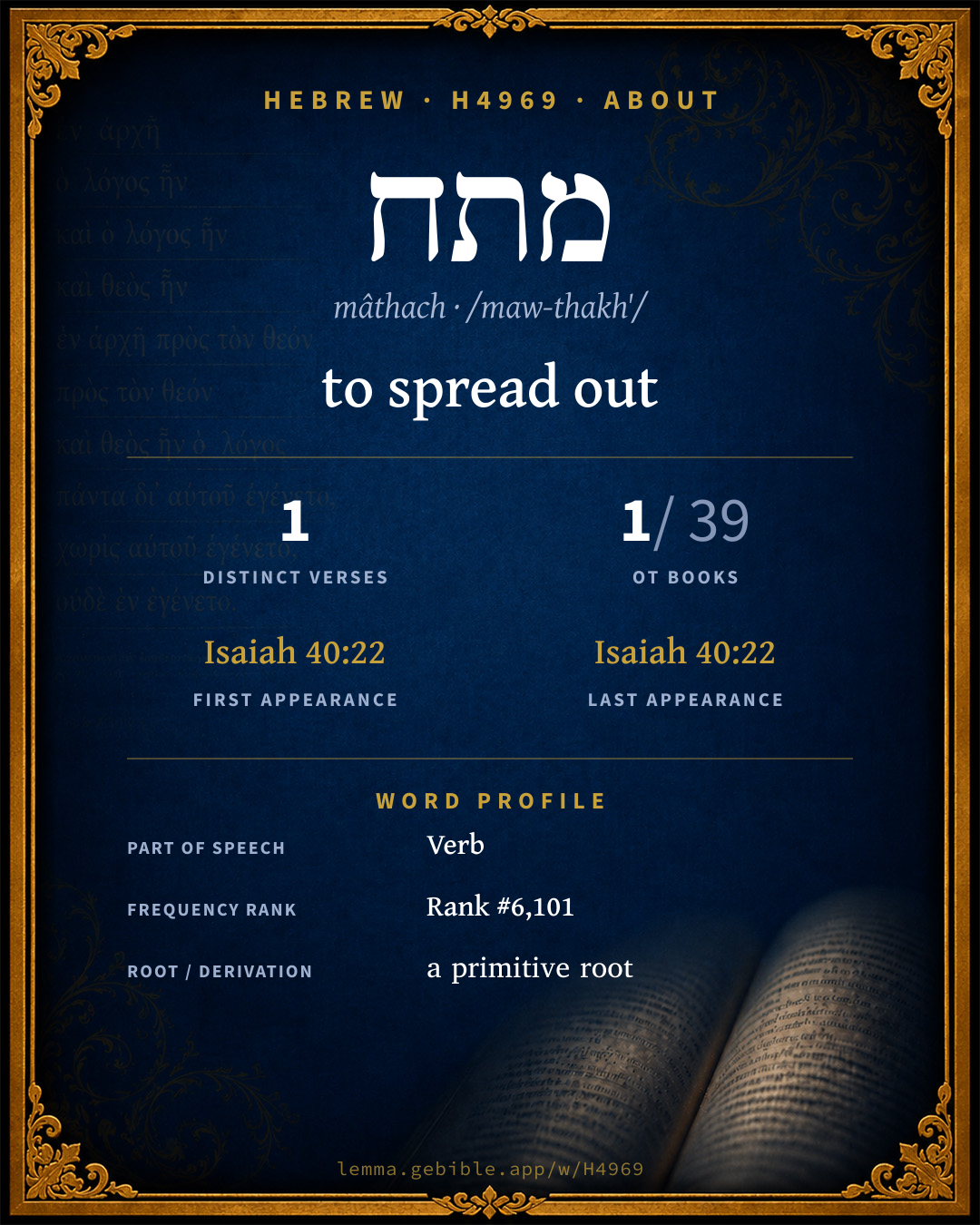
מָתַח
to spread out
Full lexicon entry — Brown-Driver-Briggs (BDB)
From Brown-Driver-Briggs (BDB)
Where this word appears
Grammar key — what these labels mean
Stem
- Qal
- The basic, simple active stem — the plain form of the verb (“he wrote”).
Form
- Sequential Imperfect
- An imperfect with prefixed waw — the standard past-narrative form (waw-consecutive imperfect).
Person
- 3rd Person
- The one spoken about (“he / she / it / they”).
Gender
- Masculine
- Grammatically masculine.
Number
- Singular
- One.
Every verse where H4969 appears — 1 distinct verse across 1 book. Click any verse to open its interlinear word-by-word view. Verse text shown in the World English Bible for context — . Each verse’s Hebrew form is shown with its reference; the English is not keyword-highlighted, since the data carries no word-level English alignment. Use “Compare translations” on any verse to read it across multiple English versions. This concordance covers the Hebrew Bible; Septuagint (Greek Old Testament) occurrences are not indexed here.
Isaiah 1 verse
About this entry
At a glance — auto-summarized from this page’s data, not written by a person. Every figure links to its source below. This summary describes the numbers; it doesn’t interpret them.
“to spread out” is the headline sense of the Hebrew verb מתח (mâthach). With only 1 verse it sits in the long tail of Hebrew Bible vocabulary. It clusters heavily in Isaiah, which alone accounts for 100% of its uses. Its lone occurrence is Isaiah 40:22. It clusters with אמתחת under a shared root. See the sense tree, 1-verse concordance, and the renderings breakdown below.
Gloss history
Strong's 1890 vs modern scholarship
About this word
Strong's H4969 catalogs a Hebrew word from the Hebrew Old Testament.
These counts are not copied from any lexicon or concordance. They are computed here, from the morphology-tagged Hebrew Old Testament. What Lemma adds →
- 1
- distinct verses
- The word appears in 1 distinct verse.
- 1 / 39
- OT books
- The word appears in 1 of 39 Old Testament books.
- #6,101
- by frequency
- Rank #6,101 (rank 6,101 of 8,640 Hebrew words by occurrence).
View all 1 occurrence in the concordance →
Most concentrated in
- Isaiah 1 verse 100%
By section of the Old Testament
By traditional corpus
Conventional, traditional groupings — biblical authorship is debated, so this is a traditional corpus grouping, not an authorship claim. Each share is this word’s portion of its verses in that division of the Hebrew canon. Each figure is a share of the word’s 1 distinct verse.
- Prophets (Nevi'im) 1 verse · 100%
How translations render this word
Counts come from each version’s own published word-to-Strong’s tagging or interlinear alignment — an approximate guide to how each version renders this word, not a word-level alignment the data otherwise carries. Because each total is that version’s own tagged count, the per-version totals vary from one another and need not match the appearance or distinct-verse counts above. These counts may also differ from a printed concordance because Lemma counts each distinctly tagged rendering and does not collapse phrase taggings into a single head-word total. This is a fixed set of word-tagged versions (KJV, ASV, BSB, ULT) and does not change with the reading translation you choose elsewhere. Each version’s license is shown beside its name below (and on Sources).
- King James Version: Spreadeth them out 1×
- American Standard Version: Spreadeth them out 1×
- Berean Standard Bible: Spreads them out 1×
- unfoldingWord Literal Text: He spreads them out 1×
King James Version Public Domain
Renders H4969 across 1 tagged occurrence — most commonly:
American Standard Version Public Domain
Renders H4969 across 1 tagged occurrence — most commonly:
Berean Standard Bible Public Domain
Renders H4969 across 1 tagged occurrence — most commonly:
unfoldingWord Literal Text CC BY-SA 4.0
Renders H4969 across 1 tagged occurrence — most commonly:
Senses in BDB
The 1 sense BDB distinguishes for this word, in lexicon order (not ranked by frequency or importance). The full entry — with sub-senses — is in the Lexicon Entry tab.
- (Qal) to spread out
Word origin
[ מָתַח ] vb. spread out;—only Qal Is 40:22
— Brown-Driver-Briggs (Oxford 1906, public domain), digitized via Sefaria, supplemented by the OpenScriptures HebrewLexicon (CC BY 4.0). See Sources.
Origin: a primitive root
Jastrow Dictionary
A second Hebrew/Aramaic lexicon for comparison, covering Aramaic and post-biblical (Talmudic, Targumic, Midrashic) usage that the biblical-Hebrew BDB does not. Matched by lemma rather than by Strong’s number, so a lemma may carry more than one Jastrow headword (shown separately below), and the entries cover usage well beyond the Bible.
מָתַח
- (b. h.) to extend, stretch (cmp. משך, משח). Kil. VI, 9 המוֹתֵחַ זמורה וכ׳ if one trains a vine from one tree to another. Sabb. 75ᵃ המותח חוט וכ׳ he who pulls the thread of a seam (bringing the ends closer together), v. infra. Gen. R. s. 3, a. e. שלא תאמר מיכאל היה מותח וכ׳ lest you say, Michael stretched (the world) in the south &c., v. מָדַד; Midr. Till. to Ps. XXIV מְמַתֵּחַ. Y. Ber. I, 2ᵈ top אדם מותח אהל וכ׳ when one stretches a tent-cover, in course of time it becomes loose; Gen. R. s. 12, end; Yalk. Is. 314.—Gen. R. s. 10, end, v. Nif.—[Yalk. Prov. 961 סופו להיות מותח v. מָתַק.]—Part. pass. מָתוּחַ; f. מְתוּחָה; pl. מְתוּחִים, מְתוּחִין; מְתוּחוֹת stretched, extended; (of a bow) bent; trnsf. (of judgment) ready to be discharged, aimed. Kel. XXI, 3. Gen. R. s. 35 אותה מדת הדין שהיתה מ׳ כנגד … ומְתָחָהּ וכ׳ that very judgment which was aimed against Israel, did the Lord turn and aim against the Egyptians. Y. M. Kat. III, 83ᶜ top הדין מ׳ כנגד וכ׳ judgment is ready against the whole family. Pesik. R. s. 38; a. fr.
- same, esp. to straiten straps; to bring objects closer together. M. Kat. I, 8 אף מְמַתְּהִין you may also straigten (bed-straps). Ib. 10ᵃ וממתחין שאם … מְמַתְּחוֹ ‘you may stretch’, means when it (a strap) is lax, you may straiten it; Y. ib. I, 80ᵈ bot. Tosef. Kel. B. Bath. IV, 10 מחוסרין … למַתֵּחַ need … stretching. Midr. Till. l. c., v. supra.—Y. Sabb. XIII, beg. 14ᵃ המְמַתֵּחַ צדדין (ed. Krot. הממחה צדדיו, corr. acc.) he who brings the ends of two pieces close together (by pulling the thread up and knotting it), v. supra; Y. Kil. IX, end, 32ᵈ המְמַתֵּיחַ צדדין (or המַמְתִּיחַ Hif.; not צדדיו); a. e.
- to be stretched, spread, drawn. Snh. 38ᵇ נִמְתְּחוּ אבריו his limbs were stretched (shaped); (Ab. d’ R. N. ch. I נתקשרו); Yalk. Gen. 15. Ib. 16 היו נִמְתָּחִין והולכין (ib. also מוֹתְחִין; Gen. R. s. 10, end מותחין) they (the works of creation) continued to extend (develop). Y. Ber. I, 2ᶜ bot. יִמָּתֵחַ הרקיע (or יִמְתַּח) let the firmament be stretched out. R. Hash. 22ᵇ יִמָּתֵחַ על העמוד shall be stretched on the pillory. Y. Hor. II, 46ᵈ נִמְתְּחָה הקשת the bow was bent (euphem. for erection). Yalk. Ps. 796 נמתחה החרב the sword (of judgment) was drawn; (Tanḥ. B’midb. 7 נמשכה; ib. ed. Bub. 7 נשמטה).
- same. Tanḥ. Ḥayé 3 והיו הולכין ומִתְמַתְּחִין וכ׳ they would have gone on spreading &c.
מְתַח
- Targ. Ps. CIV, 2. Ib. LXIV, 4 Ms. (ed. משחו, v. מְשַׁח II).—Ib. L, 4; a. e.—Part. pass. מְתִיחַ, מְתִיחָא (מְתוּ׳). Ib. VII, 13; a. e.—Gen. R. s. 63, a. e., v. זַרְתָּא.
- same. B. Mets. 107ᵇ משום אַמְתּוּחֵי אשליהן for pulling their ropes (to drag boats), v. כַּתְפָּא. Ib. אי מַמְתְּחֵי וכ׳ (v. Rabb. D. S. a. l. note) if they can pull their ropes all along the shore, they will walk there. Keth. 85ᵃ, v. אַשְׁלָא; a. e.
- to extend, spread. Targ. Job XV, 29.
A Dictionary of the Targumim, the Talmud Babli and Yerushalmi, and the Midrashic Literature (Marcus Jastrow; London, Luzac, 1903) — Public Domain. Digitized via Sefaria. Digitized via Sefaria. Full attribution on Sources.
Same root — word family
Other BDB entries built from the same root as H4969, grouped by Strong’s listed origin. These share a root / origin per the lexicon — not necessarily a shared meaning. Each links to that word’s own entry.
Derived from this word
Compare all same-root words → They share a root, not necessarily a meaning.
Septuagint verse parallels
This word appears in 1 verse that also exists in the Greek Old Testament (Septuagint), out of the 1 Hebrew verse it occurs in. You can read those verses in Greek by switching the Old Testament edition to the Septuagint.
Read these verses in the Septuagint
This is a verse-level parallel only — the same verses exist in both the Hebrew and Greek Old Testaments. No word-level Hebrew↔Greek correspondence is claimed: the data carries no such alignment, so no Greek word is shown as this Hebrew word’s translation. Coverage is not total — the Septuagint omits the deuterocanon and renumbers the Psalms, so some Hebrew verses have no direct Greek parallel.