
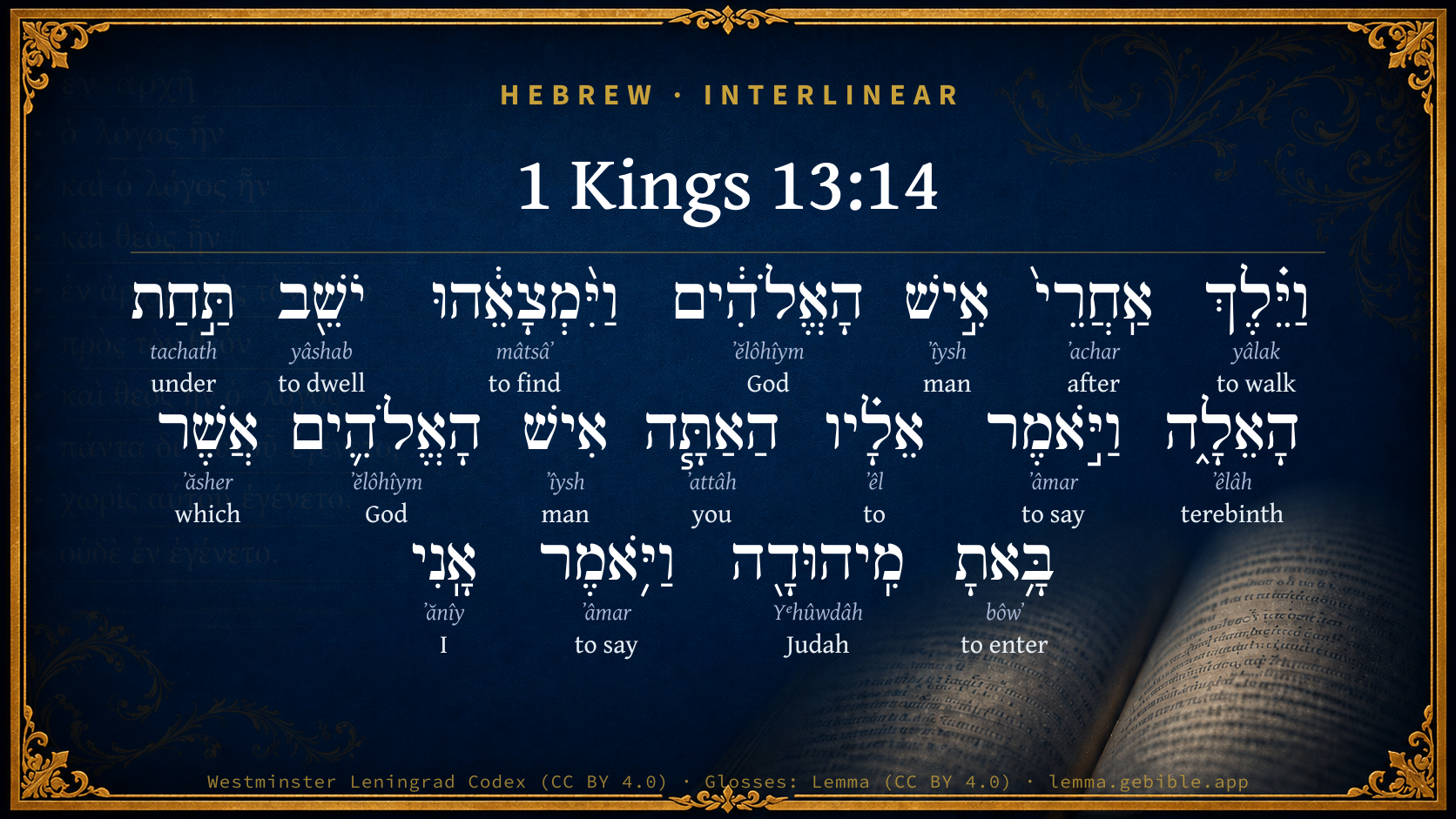
1 Kings 13:14

Hebrew (Westminster Leningrad Codex) 1 Kings 13:14 appears in the Hebrew Old Testament. The text above is from the Westminster Leningrad Codex. Each word links to its Strong’s number, a concise gloss, and parsing drawn from the Open Scriptures Hebrew Bible morphology. Click any word for its full Brown-Driver-Briggs (BDB) entry.
Download image
Cite this verse

1 Kings 13:14 (World English Bible). Public Domain. Lemma interlinear Bible study tool, https://lemma.gebible.app/v/1-kings/13/14.

Show BibTeX & RIS
BibTeX
RIS
English Translation
He went after the man of God, and found him sitting under an oak; and he said to him, Are you the man of God who came from Judah? He said, I am.
World English Bible · Public Domain
Download a study sheet

One document with this verse’s original text, its word-by-word gloss line, the meaning frame, cross-references with their text, attributed commentary, and full source and license credits — printable, and it pastes into notes with its structure intact.

This verse Autodidact and up

Study sheet (.html) Plain text (.txt)

A passage Seminary Student

Up to 50 verses in one chapter. A passage sheet keeps up to 6 commentary sources and 12 cross-references per verse, in the order this page ranks them, and says so on the sheet whenever that leaves anything out. Ask for a single verse and you get the Autodidact verse sheet above.

Everything on this page stays free to read, with no account — the sheet is a download of what is already on screen, not access to it.

Want to remove ads? Support Godless Engineer
Compare translations 3

The same verse in 3 English versions, stacked beneath the original-language interlinear above. Click any original word for its lexicon entry.

Each is an independent rendering of the whole verse — the interlinear is not word-aligned to these translations.

Highlighted words mark where these versions differ — a whole-verse word diff, not a word-by-word alignment.

  • World English Bible Public Domain
    He went after the man of God, and found him sitting under an oak; and he said to him, Are you the man of God who came from Judah? He said, I am.
  • King James Version Public Domain
    And went after the man of God, and found him sitting under an oak: and he said unto him, Art thou the man of God that camest from Judah? And he said, I am.
  • unfoldingWord Literal Text CC BY-SA 4.0
    And he went after the man of God, and he found him sitting under the oak tree. And he said to him, “ you the man of God who came from Judah?” And he said, “I.”

unfoldingWord Literal Text — © unfoldingWord, licensed CC BY-SA 4.0. Word-aligned USFM3 via Door43 (git.door43.org/unfoldingWord/en_ult).

Versions to compare (up to 4)

3 of 4 selected

Show all 18 translations

Every available English version of this verse, each an independent rendering of the whole verse.

  • World English Bible Public Domain
    He went after the man of God, and found him sitting under an oak; and he said to him, Are you the man of God who came from Judah? He said, I am.
  • Berean Standard Bible Public Domain
    and went after the man of God. He found him sitting under an oak tree and asked, “Are you the man of God who came from Judah?” “I am,” he replied.
  • Majority Standard Bible Public Domain
    and went after the man of God. He found him sitting under an oak tree and asked, “Are you the man of God who came from Judah?” “I am,” he replied.
  • King James Version Public Domain
    And went after the man of God, and found him sitting under an oak: and he said unto him, Art thou the man of God that camest from Judah? And he said, I am.
  • American Standard Version (1901) Public Domain
    And he went after the man of God, and found him sitting under an oak; and he said unto him, Art thou the man of God that camest from Judah? And he said, I am.
  • Revised Version (1885) Public Domain
    And he went after the man of God, and found him sitting under an oak: and he said unto him, Art thou the man of God that camest from Judah? And he said, I am.
  • Geneva Bible (1599) Public Domain
    And went after the man of God, and found him sitting vnder an oke: and he saide vnto him, Art thou the man of God that camest from Iudah? And he sayd, Yea.
  • Douay-Rheims (1899) Public Domain
    And went after the man of God, and found him sitting under a turpentine tree: and he said to him: Art thou the man of God that camest from Juda? He answered: I am.
  • Young's Literal Translation Public Domain
    and goeth after the man of God, and findeth him sitting under the oak, and saith unto him, `Art thou the man of God who hast come from Judah?' and he saith, `I `am'.'
  • Literal Standard Version CC BY-SA 4.0
    and goes after the man of God, and finds him sitting under the oak, and says to him, “Are you the man of God who has come from Judah?” And he says, “I [am].”
  • Unlocked Literal Bible CC BY-SA 4.0
    The old prophet went after the man of God and found him sitting under an oak tree; and he said to him, “Are you the man of God who came from Judah?” He answered, “I am.”
  • unfoldingWord Literal Text CC BY-SA 4.0
    And he went after the man of God, and he found him sitting under the oak tree. And he said to him, “ you the man of God who came from Judah?” And he said, “I.”
  • Darby Bible Public Domain
    and went after the man of God, and found him sitting under a terebinth; and he said to him, Art thou the man of God that camest from Judah? And he said, I am.
  • World Messianic Bible Public Domain
    He went after the man of God, and found him sitting under an oak. He said to him, “Are you the man of God who came from Judah?” He said, “I am.”
  • Webster's Bible Public Domain
    And went after the man of God, and found him sitting under an oak: and he said to him, Art thou the man of God that camest from Judah? And he said, I am.
  • Free Bible Version CC BY-SA 4.0
    He rode after the man of God and found him sitting under an oak tree. “Are you the man of God who came from Judah?” he asked him. “Yes I am,” the man replied.
  • Bible in Basic English Public Domain
    And went after the man of God, and came up with him while he was seated under an oak-tree. And he said to him, Are you the man of God who came from Judah? And he said, I am.
  • JPS Tanakh (1917) Public Domain
    And he went after the man of God, and found him sitting under a terebinth; and he said unto him: 'Art thou the man of God that camest from Judah?' And he said: 'I am.'

Literal Standard Version (2020), Covenant Press — licensed CC BY-SA 4.0. Text via the HelloAO Bible API (eBible.org). Unlocked Literal Bible (unfoldingWord) — licensed CC BY-SA 4.0. Text via the HelloAO Bible API (eBible.org). unfoldingWord Literal Text — © unfoldingWord, licensed CC BY-SA 4.0. Word-aligned USFM3 via Door43 (git.door43.org/unfoldingWord/en_ult). Free Bible Version, Dr. Jonathan Gallagher — licensed CC BY-SA 4.0. Text via the HelloAO Bible API (eBible.org).

Word by word

More ways to search: Search by grammar → Find every occurrence → Compare this word →

Practice this passage: Drill this verse → Learn its vocabulary →

הָאֵלָ֑ה
ʼêlâh
H424
“the · terebinth”
Particle, Definite Article + Noun, Common, Feminine, Singular, Absolute
Part of Speech
Particle + Noun
Type
Common
Gender
Feminine
Number
Singular
State
Absolute
Full BDB Definition

Origin: from H352

TWOT: 45h

terebinth, terebinth tree - valley where David killed Goliath
  1. וַיֵּ֗לֶךְ yâlak H3212 “and · to walk” Conjunction + Verb, Qal, Sequential Imperfect, 3rd Person, Masculine, Singular
  2. אַֽחֲרֵי֙ ʼachar H310 “after” Preposition
  3. אִ֣ישׁ ʼîysh H376 “man of” Noun, Common, Masculine, Singular, Construct
  4. הָאֱלֹהִ֔ים ʼĕlôhîym H430 “the · God(s)” Particle, Definite Article + Noun, Common, Masculine, Plural, Absolute
  5. וַיִּ֨מְצָאֵ֔הוּ mâtsâʼ H4672 “and · to find · him” Conjunction + Verb, Qal, Sequential Imperfect, 3rd Person, Masculine, Singular + Suffix, Personal, 3rd Person, Masculine, Singular
  6. יֹשֵׁ֖ב yâshab H3427 “dwelling” Verb, Qal, Participle Active, Masculine, Singular, Absolute
  7. תַּ֣חַת tachath H8478 “under” Preposition
  8. וַיֹּ֣אמֶר ʼâmar H559 “and · to say” Conjunction + Verb, Qal, Sequential Imperfect, 3rd Person, Masculine, Singular
  9. אֵלָ֗יו ʼêl H413 “to · him” Preposition + Suffix, Personal, 3rd Person, Masculine, Singular
  10. הַאַתָּ֧ה ʼattâh H859 “you” Particle, Interrogative + Pronoun, Personal, 2nd Person, Masculine, Singular
  11. אִישׁ ʼîysh H376 “man of” Noun, Common, Masculine, Singular, Construct
  12. הָאֱלֹהִ֛ים ʼĕlôhîym H430 “the · God(s)” Particle, Definite Article + Noun, Common, Masculine, Plural, Absolute
  13. אֲשֶׁר ʼăsher H834 “which” Particle, Relative
  14. בָּ֥אתָ bôwʼ H935 “to enter” Verb, Qal, Perfect, 2nd Person, Masculine, Singular
  15. מִֽיהוּדָ֖ה Yᵉhûwdâh H3063 “from · Judah” Preposition + Noun, Proper
  16. וַיֹּ֥אמֶר ʼâmar H559 “and · to say” Conjunction + Verb, Qal, Sequential Imperfect, 3rd Person, Masculine, Singular
  17. אָֽנִי ʼănîy H589 “I” Pronoun, Personal, 1st Person, Common, Singular

About this verse

These counts appear in no published source. They are computed here, from the morphology-tagged text and Lemma’s own curated glosses. What Lemma adds →

18
words
15
distinct lemmas
Historical
section

Notable vocabulary

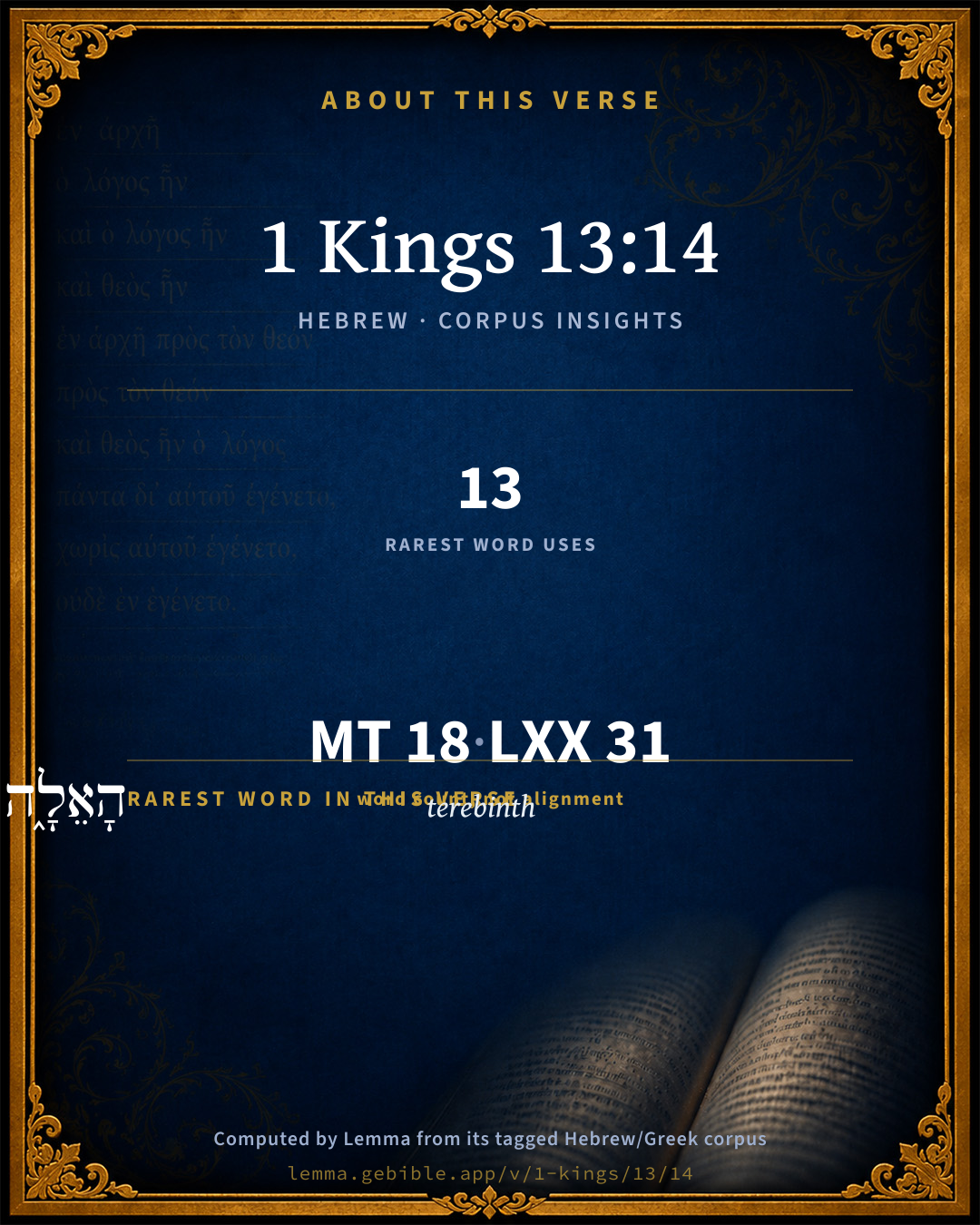
The rarest word here is הָאֵלָ֑ה terebinth H424 — appearing just 13 times in the whole Hebrew Bible.

Shared distinctive vocabulary

הָאֵלָ֑ה terebinth H424 occurs in 12 verses of the Hebrew Bible. Also found in:

Grammatical profile

  • 6 verbs
  • 6 nouns
  • 2 pronouns
  • 3 prepositions
  • 1 particle

Verb forms

  • וַיֵּ֗לֶךְ Qal · Sequential Imperfect
  • וַיִּ֨מְצָאֵ֔הוּ Qal · Sequential Imperfect
  • יֹשֵׁ֖ב Qal · Participle Active
  • וַיֹּ֣אמֶר Qal · Sequential Imperfect
  • בָּ֥אתָ Qal · Perfect
  • וַיֹּ֥אמֶר Qal · Sequential Imperfect

Repetition

Words recur within this verse — often emphatic in Hebrew:

  • אִ֣ישׁ man H376 ×2
  • הָאֱלֹהִ֔ים God H430 ×2
  • וַיֹּ֣אמֶר to say H559 ×2

Hebrew & Septuagint length

In English translation the verse runs 33 words from the Hebrew and 37 from the Septuagint (LXX English) — closely comparable.

A rough comparison of the two English renderings, which tokenize alike — not a word-level alignment.

Word counts can differ between the Hebrew and the Greek without any difference in meaning — e.g. the Hebrew direct-object marker אֵת has no separate Greek word, and Greek often adds the article ὁ.

In the original languages it is 18 Hebrew tokens and 31 Greek tokens — but the two are counted differently (Hebrew bundles its prefixes and suffixes into one token; the Greek is in lemma form), so that isn’t a like-for-like length.

Cross-references

6

Topical passages linked to 1 Kings 13:14 in the Treasury of Scripture Knowledge — connected by theme and wording, ordered by reader-vote popularity; previews shown in the World English Bible.

  • 1 Kings 19:4 But he himself went a day's journey into the wilderness, and came and sat down under a juniper tree: and he requested for himself that he might die, and said, It is enough; now, O Yahweh, take away my life; for I am not better than my fathers.
  • John 4:6 Jacob's well was there. Jesus therefore, being tired from his journey, sat down by the well. It was about the sixth hour.
  • John 4:34 Jesus said to them, "My food is to do the will of him who sent me, and to accomplish his work.
  • 1 Corinthians 4:11–12 Even to this present hour we hunger, thirst, are naked, are beaten, and have no certain dwelling place.
  • 2 Corinthians 11:27 in labor and travail, in watchings often, in hunger and thirst, in fastings often, and in cold and nakedness.
  • Philippians 4:12–13 I know how to be humbled, and I know also how to abound. In everything and in all things I have learned the secret both to be filled and to be hungry, both to abound and to be in need.

Cross-references courtesy of OpenBible.info (CC BY 4.0).

Hebrew and Greek witnesses Masoretic Hebrew ↔ Greek Septuagint

The same verse in the two great witnesses to the Old Testament, shown verse-for-verse.

These are two independent witnesses, not word-aligned to each other, and the Septuagint is shown in lemma (dictionary) form.

Hebrew 1 Kings 13:14 Masoretic · Westminster Leningrad Codex

וַיֵּ֗לֶךְ אַֽחֲרֵי֙ אִ֣ישׁ הָאֱלֹהִ֔ים וַיִּ֨מְצָאֵ֔הוּ יֹשֵׁ֖ב תַּ֣חַת הָאֵלָ֑ה וַיֹּ֣אמֶר אֵלָ֗יו הַאַתָּ֧ה אִישׁ הָאֱלֹהִ֛ים אֲשֶׁר בָּ֥אתָ מִֽיהוּדָ֖ה וַיֹּ֥אמֶר אָֽנִי

He went after the man of God, and found him sitting under an oak; and he said to him, Are you the man of God who came from Judah? He said, I am.

World English Bible · Public Domain

Greek LXX 1 Kings 13:14 Septuagint · lemma form

καί πορεύομαι κατόπισθεν ὁ ἄνθρωπος ὁ θεός καί εὑρίσκω αὐτός καταἧμαι ὑπό δρῦς καί εἶπον αὐτός εἰ σύ εἰμί ὁ ἄνθρωπος ὁ θεός ὁ ἔρχομαι ἐκ ιουδα καί εἶπον αὐτός ἐγώ

and went after the man of God, and found him sitting under an oak: and he said to him, Are you the man of God that came out of Juda? And he said to him, I am.

LXX2012 (modern English Septuagint) · Public Domain

Hebrew: Westminster Leningrad Codex (CC BY 4.0). Greek: Septuagint (public domain); English from LXX2012 (modern English Septuagint) (Public Domain). How the Septuagint differs from the Hebrew →

Targum (Aramaic paraphrase)

1

The Targum is the ancient Jewish Aramaic paraphrase of the Hebrew Scriptures — an interpretive translation, not the Hebrew text itself. Onkelos (literal) and Pseudo-Jonathan (expansive) render the Torah, and Jonathan the Prophets. Coverage is partial: where no permissively-licensed English translation exists for a verse, only the Aramaic is shown. This is verse-level text, not a word-by-word alignment to the Hebrew.

  1. Targum Jonathan Prophets (Joshua–Malachi)
    וַאֲזַל בָּתַר נְבִיָא דַייָ וְאַשְׁכְּחֵיהּ יָתֵיב תְּחוֹת בּוּטְמָא וַאֲמַר לֵיהּ הַאַתְּ נְבִיָא דַייָ דַאֲתֵיתָא מִשִׁבְטָא יְהוּדָה וַאֲמַר אֲנָא:

    (no public-domain English translation for this verse)

    Targum Jonathan — Aramaic: “Mikraot Gedolot” (public domain). English: “Sefaria Community Translation” (CC0 1.0 (public-domain dedication)); “London "Chaldee Paraphrase," 1871” (public domain). Text via Sefaria.

Commentary

Notes on 1 Kings 13:14 from classic Christian and Jewish commentators (each source and its license shown beneath its notes). The classic Christian expositions comment on the surrounding passage and are grouped to its opening verse, so a note may address several verses; the Jewish commentaries on the Tanakh (Rashi and others) are per-verse, so they appear only where the commentator wrote on this verse.

Lemma curates 59 commentaries, every one of them public domain or Creative Commons licensed, each selected and text-cleaned for this edition rather than reprinted as found. About our sources →

Trapp's Complete Commentary

John Trapp

1Ki 13:14 And went after the man of God, and found him sitting under an oak: and he said unto him, [Art] thou the man of God that camest from Judah? And he said, I [am].

Ver. 14. Sitting under an oak.] Or, An elm, as some render it; Insignem arborem significat, saith Vatablus. He was hungry and weary, as was likewise Elias when he sat under the juniper. God oft holdeth his best children to strait allowance here, and causeth them to suffer hardship.

John Trapp, A Commentary or Exposition upon All the Books of the Old and New Testament (1647–1656) — public domain. Text from a community e-Sword module.

Joseph Benson's Commentary

1Ki 13:14. And found him sitting under an oak — Being faint and weary with his journey, and possibly with the heat also, (which made him choose to rest in this shady place,) and especially with hunger and thirst, 1Ki 13:9. And the old prophet might easily guess that this was the prophet from Judah, by his age and carriage, and, it may be, by his prophetic mantle, and by the character which his sons had given of him.

Joseph Benson's Commentary on the Old and New Testaments (1811–1818) — public domain. Text from a community e-Sword module.

Geneva Bible (1599)

Geneva Bible translators

Hebrew, I am.

Geneva Bible (1599) marginal notes — public domain. Text via Bolls.life.

Adam Clarke's Commentary

Verse 14. And went after the man of God] I can hardly think that this was with any evil design. His sons had given him such an account of the prediction, the power, and influence of this prophet, that he wished to have a particular acquaintance with him, in order that he might get farther information relative to the solemn import of the prophecy which he had denounced against the idolatry at Beth-el. This good man could not have been an object of the old prophet's malevolence.

Adam Clarke's Commentary on the Bible (1810–1826) — public domain. Text from a community e-Sword/MySword module.

Ellicott's Commentary for English Readers

(14) An oak.—Properly, the oak, or terebinth; supposed to be known in that comparatively treeless country, like the oak at Shechem (Gen_35:4; Gen_35:8; Jos_24:26; Jdg_9:6), the oak at Ophrah (Jdg_6:11), and the palm-tree of Deborah (Jdg_4:5). This expression is an evident mark of the antiquity of the document from which the history is taken. It has been suggested that the narrative implies a needless loitering of the prophet of Judah on the way. Taken by itself, it would not necessarily convey this; but in relation to the temper indicated in the whole story, the thing may be not improbable.

A Bible Commentary for English Readers, edited by Charles John Ellicott (1878–1897) — public domain. Text from a community e-Sword module.

The Cambridge Bible for Schools and Colleges

gen. ed. J. J. S. Perowne

14. under an oak] The tree named in the Hebrew is probably the terebinth. The noun has the article in the original, and it refers perhaps to some well-known tree which was a landmark in the neighbourhood. The terebinth is a very longlived tree, and an aged one would be sure to become noted.

The Cambridge Bible for Schools and Colleges (gen. ed. J. J. S. Perowne; Cambridge University Press, 1878–1918) — public domain. Text from a community e-Sword module.

John Gill's Exposition

Then said he unto him, come home with me, and eat bread. In which invitation no doubt he was hearty, and might have no ill design in it, only to have some conversation with him, as being a good man, and a prophet of the Lord, especially upon the subject of his prophecies at Bethel.

Then said he unto him, come home with me, and eat bread. In which invitation no doubt he was hearty, and might have no ill design in it, only to have some conversation with him, as being a good man, and a prophet of the Lord, especially upon the subject of his prophecies at Bethel.

1 Kings 13:16

kg1 13:16

kg1 13:16

kg1 13:16And he said, I may not return with thee, nor go in with thee,.... Into the city, and into his house in it, being such an idolatrous place, and especially being forbidden of God:

neither will I eat bread nor drink water with thee in this place; he was resolute and determined to abide by the commandment of the Lord, though there is reason to believe that he was now both hungry and thirsty.

John Gill's Exposition of the Whole Bible (1746–1763) — public domain (CC PDM 1.0). Text via the HelloAO Bible API.

Albert Barnes' Notes on the Bible

Under an oak - literally, “under the oak,” or “the terebinth-tree.” There was a single well-known tree of the kind, standing by itself in the vicinity of Bethel, which the author supposed his readers to be acquainted with.

Albert Barnes' Notes on the Bible (1834–1885) — public domain. Text from a community e-Sword/MySword module.

Matthew Poole's English Annotations

Sitting under an oak; being faint and weary with his journey, and possibly with the heat, which makes him choose this shady place; and especially with hunger and thirst, 1Ki 13:9. And he might easily guess that this was the old prophet, by his age and carriage, and, it may be, by his prophetical mantle, and by the character which his sons had given him.

Matthew Poole's English Annotations on the Holy Bible (1683–1685) — public domain. Text from a community e-Sword/MySword module.

Whedon's Commentary on the Bible

Daniel D. Whedon

14. Went after the man of God — What was his object? Some have surmised that it was merely to show him becoming hospitality. But he must have learned from his sons that the man was forbidden to accept the hospitality of any one. More probable is the opinion that he was moved with jealousy and chagrin that a prophet should come from a distance to reprove the king’s idolatry, while he himself had uttered no word of disapproval; and to this may be added Kitto’s supposition, “That his single but guileful object was to lay his king under an essential obligation, by making the man of God contradict himself in a matter which he alleged to be most binding and urgent upon him, and of thus reducing the moral weight and authority of the message he had delivered.” But he adds, “We entirely acquit him of intending to involve the man of God in the disastrous consequences which ensued.” It is nowise impossible that still other impulses also moved him, for his soul at such a time might well have been the seat of excited and conflicting feelings. And while his first emotions were probably those of jealousy and shame, he may also have felt a burning desire to meet and talk with some true prophet, in hope that such intercourse might raise him from his present spiritual poverty and indifference. It was this very conflict of opposing impulses that makes his character so strangely mysterious.

Sitting under an oak — Rather, the oak; some tree well known from its association with this or some other memorable incident. There was nothing necessarily wrong in his thus resting under the tree; but some find here the beginning of his fall. This stay delayed his journey, and enabled the tempter to overtake him; and while sitting under the oak the thought of Jeroboam’s promised rewards may have inclined him, Balaam-like, to yearn for the wages of unrighteousness.

Daniel D. Whedon (gen. ed.), Commentary on the Old and New Testaments (1874–1909) — public domain. Text from a community e-Sword module.

The Pulpit Commentary

And he went after the man of God and found him sitting under an oak Heb. the oak; i.e., the well-known oak. Possibly there was but one, or one of great size, in the neighbourhood such trees are comparatively rare in Palestine. Possibly also this tree became well known from these events. It is singular that in another place (Gen_35:8) we read of "the oak" (wOLa) of Bethel, whilst in Jud_1:4:5 we read of the "palm tree" (rmTo) of Deborah, between Ramah and Bethel." And it is not at all improbable, seeing that in 1Sa_10:3 we read of the terebinth (wOlae) of Tabor in the A.V rendered plain of Tabor which Ewald ("Hist. Israel," 3:21; 4:31) considers to be only a dialectic variation of Deborah, and remembering the great age to which these trees attain, that the same tree is referred to throughout. The word here used, it is true, is hlae (which is generally supposed to indicate the terebinth, but is also "used of any large tree" (Gesenius), and which, therefore, may be used of the wOLa of Bethel. Both names are derived from the same root lWa fortis. (Cf., Amo_2:9) and both indicate varietieswhat varieties it is not quite clear of the oak. Some expositors have seen in this brief rest the beginning of his sin, and certainly it would seem against the spirit of his instructions to remain so near a place (see note on ver. 16) from which he was to vanish speedily, and, if possible, unperceived. In any case the action betrays his fatigue and exhaustion, and he said unto him, Art thou the man of God that camest from Judah? And he said, I am.

The Pulpit Commentary (1880–1919), ed. H.D.M. Spence-Jones & Joseph S. Exell — public domain. Text from a community e-Sword module.

unfoldingWord translationNotes

Door43 World Missions Community

The old prophet

This refers to the prophet who lived in Bethel.

he said to him

"the old prophet said to the man of God"

He answered

"The man of God answered"

go in with you

"go into your house"

in this place

"in Bethel"

it was commanded to me by the word of Yahweh

This can be stated in active form. AT: "Yahweh commanded me by his word" (See: Active or Passive)

the word of Yahweh

"the message of Yahweh" or "Yahweh's message"

translationWords

God

oak

word of God

unfoldingWord translationNotes — © Distant Shores Media and the Door43 World Missions Community, licensed CC BY-SA 4.0. Source: git.door43.org/Door43/en_tn.

Lesson kit

Teaching starters — assembled from the data on this page, not authored interpretation. Every prompt links to the verse data it draws on. Edit before teaching.

1 Kings, in the Historical, opens this verse with 18 words (15 distinct Hebrew lemmas). Its most distinctive word is ʼêlâh (“terebinth”). A historical commentator’s framing appears above. Read the whole chapter for the surrounding context.

Discussion questions

  1. How does “terebinth” (ʼêlâh) shape what this verse is saying?
  2. Genesis 35:4 shares the word «terebinth» with this verse. How do the two illuminate each other?
  3. “man” occurs 2× in this one verse. What is the effect of the repetition?
  4. These translations render this verse differently; the difference is in the English rendering, not the original. What questions does that raise?
  5. The verb «וַיֵּ֗לֶךְ» is Qal Sequential Imperfect. How does its form color the action?
  6. Reading how Trapp's Complete Commentary and Joseph Benson's Commentary read this verse, where do the two commentators agree and where do they part?

Things to notice

Reading settings

Reading text

Shown beneath each verse's original-language words.

Old Testament
Old Testament edition

Read the OT as the Masoretic Hebrew (MT) or the Greek Septuagint (LXX).

English shown for the Greek Septuagint (in the Hebrew ↔ Greek comparison).

Comparing translations? Open the Compare panel on any verse page to stack up to four side by side.