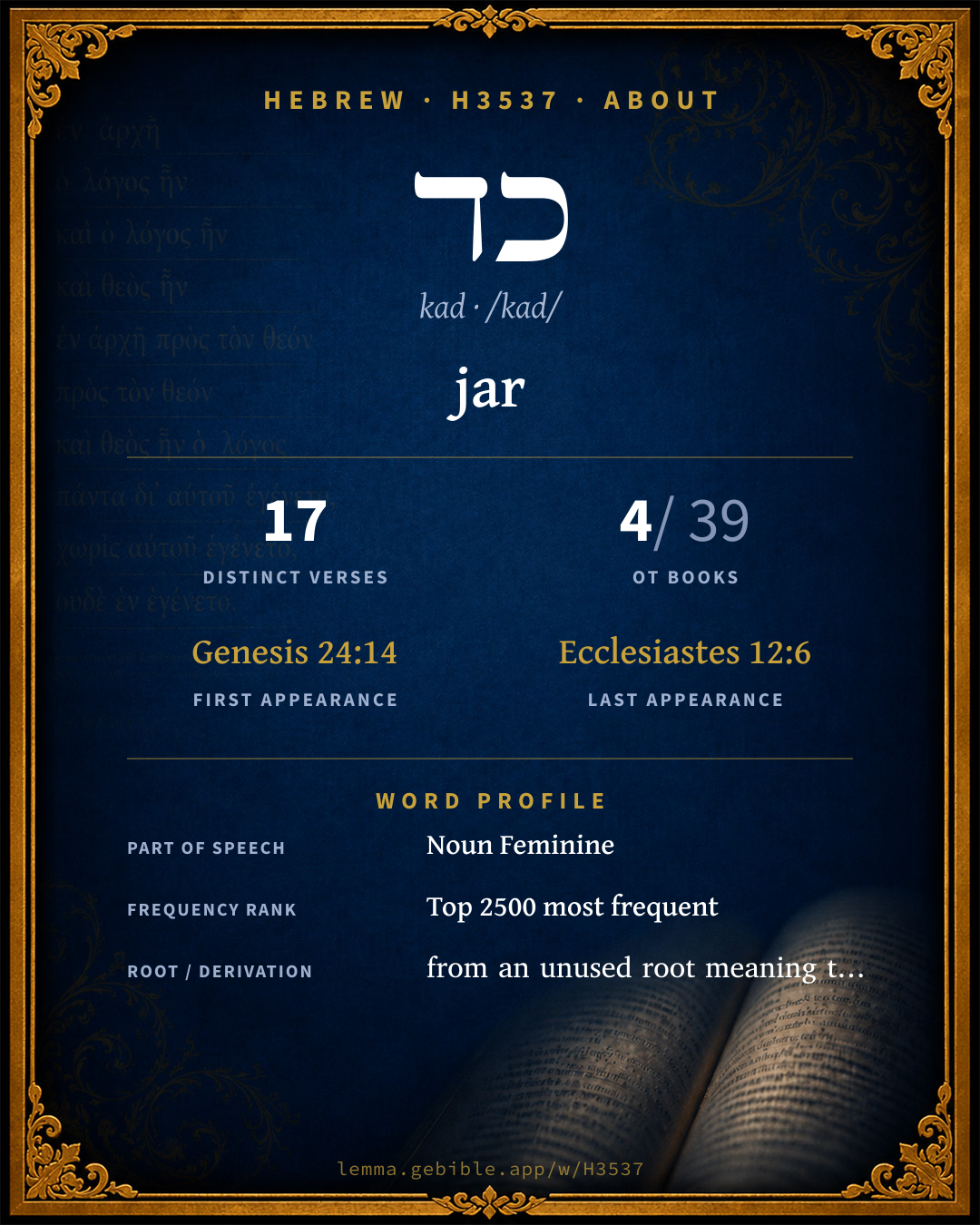
כַּד
jar
Full lexicon entry — Brown-Driver-Briggs (BDB)
From Brown-Driver-Briggs (BDB)
Where this word appears
See every Construct-state word in the Hebrew Bible →
Grammar key — what these labels mean
Part of speech
- Noun
- A naming word — a person, place, thing, or idea.
Noun type
- Common
- A common noun — a general class of person, place, or thing (“king,” “city,” “water”), not a specific name.
State
- Construct
- A noun bound to a following noun in a possessive / “of” relationship (the construct chain).
- Absolute
- The independent form of a noun, not bound to a following word.
Gender
- Feminine
- Grammatically feminine.
Number
- Singular
- One.
- Plural
- More than one (in Hebrew, generally three or more).
Grammatical forms
- Noun, Common, Feminine, Singular, Construct 11 times (61%)
- Noun, Common, Feminine, Plural, Absolute 5 times (28%)
- Noun, Common, Feminine, Singular, Absolute 2 times (11%)
Parsed forms decoded from the imported morphology (morphhb / Westminster Leningrad Codex — WLC text public domain, morphhb tagging CC BY 4.0), counted across 18 parsed occurrences — not distinct verses.
Every verse where H3537 appears — 17 distinct verses across 4 books. Click any verse to open its interlinear word-by-word view. Verse text shown in the World English Bible for context — . Each verse’s Hebrew form is shown with its reference; the English is not keyword-highlighted, since the data carries no word-level English alignment. Use “Compare translations” on any verse to read it across multiple English versions. This concordance covers the Hebrew Bible; Septuagint (Greek Old Testament) occurrences are not indexed here.
Genesis 9 verses
- Genesis 24:14 כַדֵּ/ךְ֙ n c fs cs + sfx pers 2fs Let it happen, that the young lady to whom I will say, 'Please let down your pitcher, that I may drink.' She will say, 'Drink, and I will also give your camels a drink.' Let the same be she who you have appointed for your servant Isaac. Thereby will I know that you have shown kindness to my master."
- Genesis 24:15 וְ/כַדָּ֖/הּ conj + n c fs cs + sfx pers 3fs It happened, before he had done speaking, that behold, Rebekah came out, who was born to Bethuel the son of Milcah, the wife of Nahor, Abraham's brother, with her pitcher on her shoulder.
- Genesis 24:16 כַדָּ֖/הּ n c fs cs + sfx pers 3fs The young lady was very beautiful to look at, a virgin, neither had any man known her. She went down to the spring, filled her pitcher, and came up.
- Genesis 24:17 מִ/כַּדֵּֽ/ךְ prep + n c fs cs + sfx pers 3fs The servant ran to meet her, and said, "Please give me a drink, a little water from your pitcher."
- Genesis 24:18 כַּדָּ֛/הּ n c fs cs + sfx pers 3fs She said, "Drink, my lord." She hurried, and let down her pitcher on her hand, and gave him drink.
- Genesis 24:20 כַּדָּ/הּ֙ n c fs cs + sfx pers 3fs She hurried, and emptied her pitcher into the trough, and ran again to the well to draw, and drew for all his camels.
- Genesis 24:43 מִ/כַּדֵּֽ/ךְ prep + n c fs cs + sfx pers 2fs Behold, I am standing by the spring of water. Let it happen, that the maiden who comes forth to draw, to whom I will say, Give me, I pray you, a little water from your pitcher to drink.
- Genesis 24:45 וְ/כַדָּ֣/הּ conj + n c fs cs + sfx pers 3fs Before I had done speaking in my heart, behold, Rebekah came forth with her pitcher on her shoulder. She went down to the spring, and drew. I said to her, 'Please let me drink.'
- Genesis 24:46 כַּדָּ/הּ֙ n c fs cs + sfx pers 3fs She hurried and let down her pitcher from her shoulder, and said, 'Drink, and I will also give your camels a drink.' So I drank, and she made the camels drink also.
Judges 3 verses
- Judges 7:16 וְ/כַדִּ֣ים הַ/כַּדִּֽים conj + n c fp ptcl def.art + n c fp He divided the three hundred men into three companies, and he put into the hands of all of them trumpets, and empty pitchers, with torches within the pitchers.
- Judges 7:19 הַ/כַּדִּ֖ים ptcl def.art + n c fp So Gideon, and the hundred men who were with him, came to the outermost part of the camp in the beginning of the middle watch, when they had but newly set the watch: and they blew the trumpets, and broke in pieces the pitchers that were in their hands.
- Judges 7:20 הַ/כַּדִּים֒ ptcl def.art + n c fp The three companies blew the trumpets, and broke the pitchers, and held the torches in their left hands, and the trumpets in their right hands with which to blow; and they cried, The sword of Yahweh and of Gideon.
1 Kings 4 verses
- 1 Kings 17:12 בַּ/כַּ֔ד prep det + n c fs She said, As Yahweh your God lives, I don't have a cake, but a handful of meal in the jar, and a little oil in the jar: and, behold, I am gathering two sticks, that I may go in and bake it for me and my son, that we may eat it, and die.
- 1 Kings 17:14 כַּ֤ד n c fs cs For thus says Yahweh, the God of Israel, The jar of meal shall not empty, neither shall the jar of oil fail, until the day that Yahweh sends rain on the earth.
- 1 Kings 17:16 כַּ֤ד n c fs cs The jar of meal didn't empty, neither did the jar of oil fail, according to the word of Yahweh, which he spoke by Elijah.
- 1 Kings 18:33 כַדִּים֙ n c fp He put the wood in order, and cut the bull in pieces, and laid it on the wood. He said, Fill four jars with water, and pour it on the burnt offering, and on the wood.
Ecclesiastes 1 verse
About this entry
At a glance — auto-summarized from this page’s data, not written by a person. Every figure links to its source below. This summary describes the numbers; it doesn’t interpret them.
The Hebrew noun כד centers on the idea of “jar.” The word gravitates to Genesis (53%), then 1 Kings and Judges. It turns up in 17 verses across 4 books, an uncommon footprint. First canonically at Genesis 24:14, it enters the text early. Translators differ — “pitcher” in the King James Version, then “jar” (Berean Standard Bible), as the renderings breakdown shows. For the data behind this summary, explore the sense tree and the renderings breakdown below.
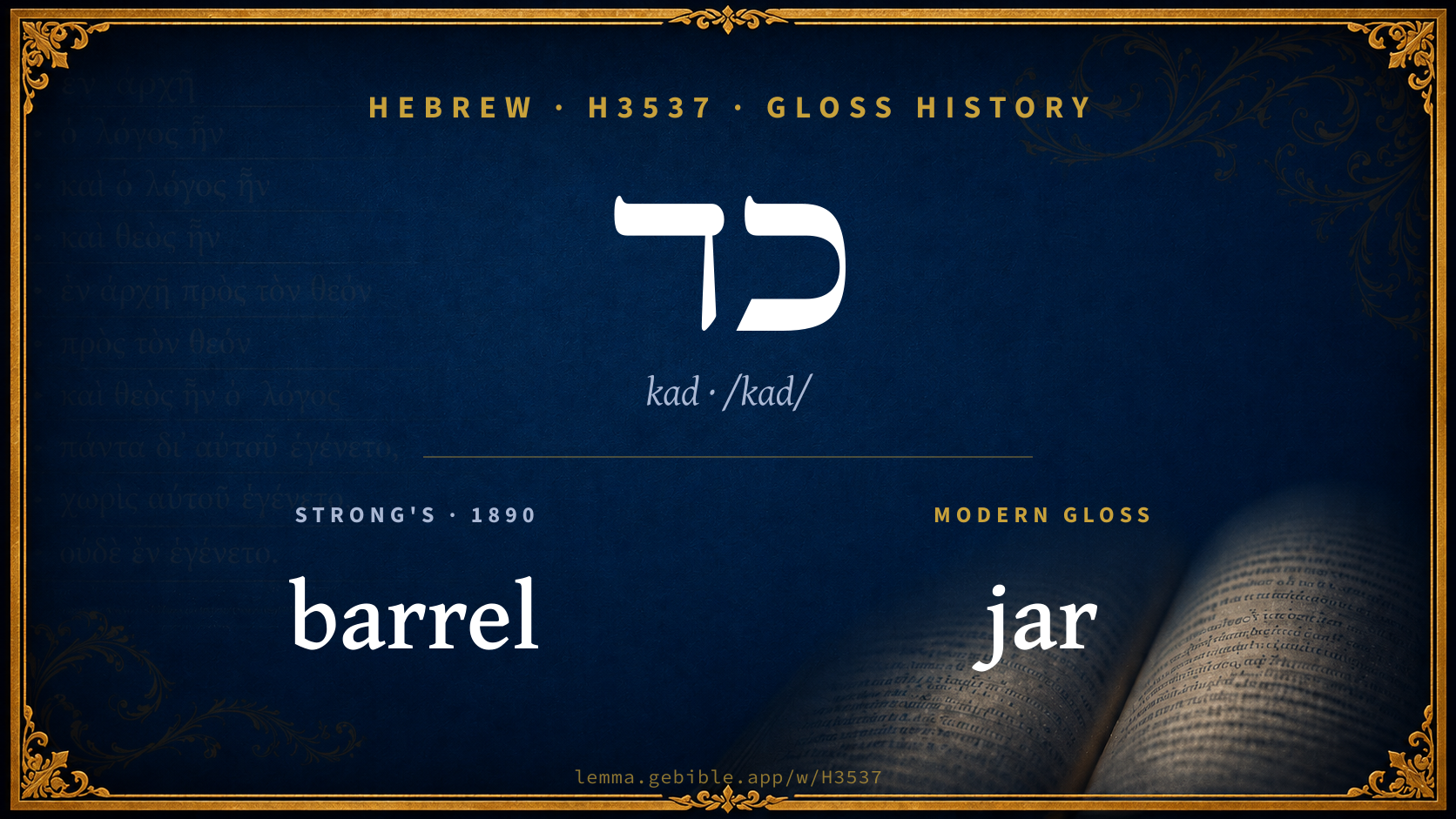
Gloss history
Strong's 1890 vs modern scholarship
About this word
Strong's H3537 catalogs a Hebrew word from the Hebrew Old Testament.
These counts are not copied from any lexicon or concordance. They are computed here, from the morphology-tagged Hebrew Old Testament. What Lemma adds →
- 17
- distinct verses
- The word appears in 17 distinct verses.
- 4 / 39
- OT books
- The word appears in 4 of 39 Old Testament books.
- #1,612
- by frequency
- Top 2500 most frequent Hebrew words (rank 1,612 of 8,640 Hebrew words by occurrence).
View all 17 occurrences in the concordance →
By section of the Old Testament
By traditional corpus
Conventional, traditional groupings — biblical authorship is debated, so this is a traditional corpus grouping, not an authorship claim. Each share is this word’s portion of its verses in that division of the Hebrew canon. Each figure is a share of the word’s 17 distinct verses.
- Torah (Pentateuch) 9 verses · 53%
- Prophets (Nevi'im) 7 verses · 41%
- Writings (Ketuvim) 1 verse · 6%
How translations render this word
Counts come from each version’s own published word-to-Strong’s tagging or interlinear alignment — an approximate guide to how each version renders this word, not a word-level alignment the data otherwise carries. Because each total is that version’s own tagged count, the per-version totals vary from one another and need not match the appearance or distinct-verse counts above. These counts may also differ from a printed concordance because Lemma counts each distinctly tagged rendering and does not collapse phrase taggings into a single head-word total. This is a fixed set of word-tagged versions (KJV, ASV, BSB, ULT) and does not change with the reading translation you choose elsewhere. Each version’s license is shown beside its name below (and on Sources).
- King James Version: Pitcher 9×, Pitchers 4×, Barrel 3×
- American Standard Version: Pitcher 9×, Jar 3×, Pitchers 3×
- Berean Standard Bible: Jar 13×, Jars 2×
- unfoldingWord Literal Text: Jar 9×, Jars 5×, Jar of 2×
King James Version Public Domain
Renders H3537 across 18 tagged occurrences — most commonly:
Plus 2 renderings that appear only once — usually multi-word phrases or single function words the recovered tagging swept in, not distinct renderings.
American Standard Version Public Domain
Renders H3537 across 18 tagged occurrences — most commonly:
Plus 3 renderings that appear only once — usually multi-word phrases or single function words the recovered tagging swept in, not distinct renderings.
Berean Standard Bible Public Domain
Renders H3537 across 16 tagged occurrences — most commonly:
Plus 1 rendering that appears only once — usually multi-word phrases or single function words the recovered tagging swept in, not distinct renderings. Not rendered by a distinct English word in 1 further occurrence.
unfoldingWord Literal Text CC BY-SA 4.0
Renders H3537 across 19 tagged occurrences — most commonly:
Plus 3 renderings that appear only once — usually multi-word phrases or single function words the recovered tagging swept in, not distinct renderings.
Senses in BDB
The 1 sense BDB distinguishes for this word, in lexicon order (not ranked by frequency or importance). The full entry — with sub-senses — is in the Lexicon Entry tab.
- jar, large jar (portable)
Word origin
n.f. jar (NH id.; Aramaic כַּדָּא)—כַּד abs. 1 K 17:12 Ec 12:6; cstr. 1 K 17:14, 16; כַּדֵּךְ Gn 24:14, 17, 43 etc.; pl. כַּדִּים Ju 7:16(×2) + 3 times;—water-jar, carried on woman’s shoulder Gn 24:14, 15, 16, 17, 18, 20, 43, 45, 46 (all J), 1 K 18:34 Ec 12:6; empty (of water), containing lamps Ju 7:16, 19, 20; containing meal 1 K 17:12, 14, 16. (On extra-Palest. hist. of this word cf. LagBN 104.)
— Brown-Driver-Briggs (Oxford 1906, public domain), digitized via Sefaria, supplemented by the OpenScriptures HebrewLexicon (CC BY 4.0). See Sources.
Origin: from an unused root meaning to deepen
Jastrow Dictionary
A second Hebrew/Aramaic lexicon for comparison, covering Aramaic and post-biblical (Talmudic, Targumic, Midrashic) usage that the biblical-Hebrew BDB does not. Matched by lemma rather than by Strong’s number, so a lemma may carry more than one Jastrow headword (shown separately below), and the entries cover usage well beyond the Bible.
כַּד I
- (a comp. of כ a. ד, corresp. to h. כַּאֲשֶׁר or כְּשֶׁ־) when, as, as though. Targ. Ex. XVII, 11. Targ. Ps. CXIX, 109 כיד על גב Ms. (ed. only ע"ג) as though (carried) on &c.; a. v. fr.—Targ. Is. XXIX, 15 כִּדְבְּקִבְלָא (ed. Lag. כיד בק׳) as though in darkness. Targ. O. Num. XXIX, 18 כדחזי, v. חֲזִי, as it is proper; a. fr.—Y. Ab. Zar. III, 42ᶜ top. Y. Yoma VII, 44ᵇ top כד דהיא וכ׳ when there is &c. Y. Taan. I, 64ᵃ bot. כד הוינן; Y. Meg. III, 74ᵇ bot. כרי דהוינן, v. נְהַר I. B. Kam. 52ᵃ (prov.) כד רגיז וכ׳ when the shepherd is angry with his flock, he makes a blind sheep the leader. Ib. 64ᵇ, a. fr. כִּדְּאַמְרֵי וכ׳ as they say &c. Ib. 64ᵇ כִּדְּתָנָא דבי וכ׳ as (that which) the scholars of the school of … said. Ib. מיבעי ליה לכִדְּתָנִי it is needed for (something like) what has been taught. Ib. לְכִדְּרָבָא for what Raba said. B. Mets. 99ᵇ כדרבא agreeably to what R. said; a. v. fr.—[Num. R. s. 14 א"ת כדרבונות אלא כִּדֵּרַבָּניּת read not (Koh. XII, 11) kaddarbonoth, but kidd’rabbanuth, like a command of authority.] e.g. Ecclesiastes 12:11
כַּד II
- (כדד, cmp. כָּדַר, to be rounded)
- 1. (adj.) arched, opp. חד pointed. Ab. Zar. 40ᵃ; Ḥull. 64ᵃ, v. חַד I.—Pl. כַּדִּין, Ib.
- 2. c. (b. h.) an arched, pouched vessel, jug &c.; cmp. חָבִית. Num. R. s. 12 מתגלגל ככד rolling like a jug. B. Kam. III, 1 (identical with חבית). Tosef. Kel. B. Mets. X, 1 כַּדּוֹ ריקנית (fem.) one’s vessel when empty; a. fr.—Pl. כַּדִּים, כַּדִּין. Tanḥ. Vayigg. 11 (ref. to Ps. XVI, 7) נעשו … כשתי כ׳ של מים וכ׳ his two kidneys became like two water pitchers and they were giving forth a flow of religious wisdom; ib. ed. Bub. 12 שלמים (corr. acc.); Gen. R. s. 61 כמין שני רבנים (corr. acc.); Midr. Till. to Ps. I כעין שני כדים ed. Bub. (oth. ed. כשני רבנן, corr. acc.); Ab. d’R. Nath. ch. XXXIII חכמים (corr. acc.).—Keth. XIII, 4 כַּדֵּי שמן vessels with oil, opp. קנקנים empty vessels; a. fr. e.g. Psalms 16:7
A Dictionary of the Targumim, the Talmud Babli and Yerushalmi, and the Midrashic Literature (Marcus Jastrow; London, Luzac, 1903) — Public Domain. Digitized via Sefaria. Digitized via Sefaria. Full attribution on Sources.
Forms in the corpus
The 15 distinct written forms H3537 takes in the Hebrew Bible, most frequent first — each parse links to that state’s occurrences in the concordance. Hebrew forms include their vowel points and cantillation, so a single lemma takes many written forms.
Same root — word family
Other BDB entries built from the same root as H3537, grouped by Strong’s listed origin. These share a root / origin per the lexicon — not necessarily a shared meaning. Each links to that word’s own entry.
Derived from this word
Compare all same-root words → They share a root, not necessarily a meaning.
Septuagint verse parallels
This word appears in 17 verses that also exist in the Greek Old Testament (Septuagint), out of the 17 Hebrew verses it occurs in. You can read those verses in Greek by switching the Old Testament edition to the Septuagint.
Read these verses in the Septuagint
This is a verse-level parallel only — the same verses exist in both the Hebrew and Greek Old Testaments. No word-level Hebrew↔Greek correspondence is claimed: the data carries no such alignment, so no Greek word is shown as this Hebrew word’s translation. Coverage is not total — the Septuagint omits the deuterocanon and renumbers the Psalms, so some Hebrew verses have no direct Greek parallel.