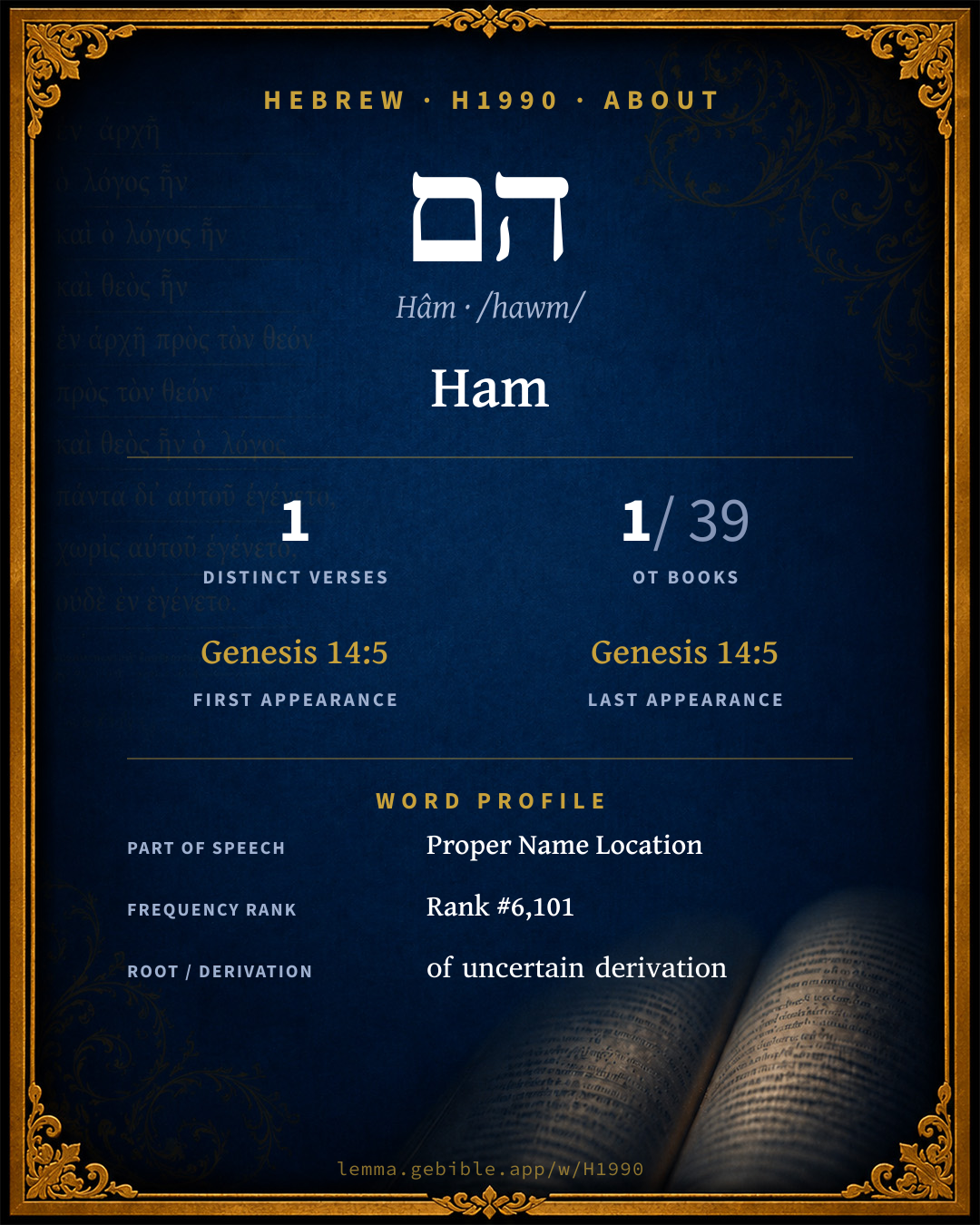
הָ֑ם
Ham
BDB lists 2 entries for ‘Ham’ fuller range ↓
Full lexicon entry — Brown-Driver-Briggs (BDB)
From Brown-Driver-Briggs (BDB)
Where this word appears
Grammar key — what these labels mean
Noun type
- Proper
- A name of a specific person, place, or people (e.g. Abraham, Zion, Israel).
Every verse where H1990 appears — 1 distinct verse across 1 book. Click any verse to open its interlinear word-by-word view. Verse text shown in the World English Bible for context — . Each verse’s Hebrew form is shown with its reference; the English is not keyword-highlighted, since the data carries no word-level English alignment. Use “Compare translations” on any verse to read it across multiple English versions. This concordance covers the Hebrew Bible; Septuagint (Greek Old Testament) occurrences are not indexed here.
Genesis 1 verse
About this entry
At a glance — auto-summarized from this page’s data, not written by a person. Every figure links to its source below. This summary describes the numbers; it doesn’t interpret them.
“Ham” is the headline sense of the Hebrew name הם (Hâm). The Hebrew Bible uses it only 1 verse. More than three-quarters of its appearances fall in Genesis. Found nowhere else but Genesis 14:5. See 1-verse concordance and the renderings breakdown below.
Gloss history
Strong's 1890 vs modern scholarship
About this word
Strong's H1990 catalogs a Hebrew word from the Hebrew Old Testament.
These counts are not copied from any lexicon or concordance. They are computed here, from the morphology-tagged Hebrew Old Testament. What Lemma adds →
- 1
- distinct verses
- The word appears in 1 distinct verse.
- 1 / 39
- OT books
- The word appears in 1 of 39 Old Testament books.
- #6,101
- by frequency
- Rank #6,101 (rank 6,101 of 8,640 Hebrew words by occurrence).
View all 1 occurrence in the concordance →
Most concentrated in
- Genesis 1 verse 100%
By section of the Old Testament
By traditional corpus
Conventional, traditional groupings — biblical authorship is debated, so this is a traditional corpus grouping, not an authorship claim. Each share is this word’s portion of its verses in that division of the Hebrew canon. Each figure is a share of the word’s 1 distinct verse.
- Torah (Pentateuch) 1 verse · 100%
How translations render this word
Counts come from each version’s own published word-to-Strong’s tagging or interlinear alignment — an approximate guide to how each version renders this word, not a word-level alignment the data otherwise carries. Because each total is that version’s own tagged count, the per-version totals vary from one another and need not match the appearance or distinct-verse counts above. These counts may also differ from a printed concordance because Lemma counts each distinctly tagged rendering and does not collapse phrase taggings into a single head-word total. This is a fixed set of word-tagged versions (KJV, ASV, BSB, ULT) and does not change with the reading translation you choose elsewhere. Each version’s license is shown beside its name below (and on Sources).
- King James Version: Ham 1×
- American Standard Version: Ham 1×
- Berean Standard Bible: Ham 1×
- unfoldingWord Literal Text: Ham 1×
King James Version Public Domain
Renders H1990 across 1 tagged occurrence — most commonly:
American Standard Version Public Domain
Renders H1990 across 1 tagged occurrence — most commonly:
Berean Standard Bible Public Domain
Renders H1990 across 1 tagged occurrence — most commonly:
unfoldingWord Literal Text CC BY-SA 4.0
Renders H1990 across 1 tagged occurrence — most commonly:
Senses in BDB
The 2 senses BDB distinguishes for this word, in lexicon order (not ranked by frequency or importance). The full entry — with sub-senses — is in the Lexicon Entry tab.
- Ham = "hot" or " sunburnt"
- the place where Chedorlaomer and his allies smote the Zuzim…
Word origin
n.pr.loc. only in הַזּוּזִים בְּהָ֑ם Gn 14:5; not otherwise known; Vrss בָּהֶם; JerQuaest. in libr. Genes. בְּחֹם; Ol conj. בַּחֲמָת; Tu Di think perhaps old name of Rabbath Ammon.
— Brown-Driver-Briggs (Oxford 1906, public domain), digitized via Sefaria, supplemented by the OpenScriptures HebrewLexicon (CC BY 4.0). See Sources.
Origin: of uncertain derivation
Jastrow Dictionary
A second Hebrew/Aramaic lexicon for comparison, covering Aramaic and post-biblical (Talmudic, Targumic, Midrashic) usage that the biblical-Hebrew BDB does not. Matched by lemma rather than by Strong’s number, so a lemma may carry more than one Jastrow headword (shown separately below), and the entries cover usage well beyond the Bible.
הוּא
- (b. h.) he, it; she; it is &c. Snh. III, 3 (24ᵇ) if he has no trade אלא הוא (Y. ed., Erub. 82ᵃ היא) except this (gambling &c.); יש לו אומנות שלא הוא (היא) if he has a trade besides this (v. Rabb. D. S. a. l. note 80).—הוא—הוא, היא—היא it is the same, i.e. there is no difference between the two. Y. Ber. I, 3ᵇ היא היא both are equally precious. Gen. R. s. 9, end הוא מאד הוא אדם the word מאד has the same letters as אדם. Ber. 2ᵇ דילמא ביאת אורו הוא perhaps it is (means) the arrival of his day, v. אוֹר II; a. v. fr.—[Shebi. III, 8 עושה הוא; IV, 5 מכסה הוא, Y. ed. עוֹשֵׂהוּ, מְכַסֵּהוּ; ib. X, 6 מזכה הוא; Ms. M., Gitt. 37ᵃ מְזַכֵּהוּ.]—ולא היא but it is not so (it has a different reason &c.). Ber. 57ᵃ; a. fr.—כל שהוא (כל שהיא) a) whosoever, whatsoever (is). Peah II, 4 כל ש׳ אוכל whatever is eatable &c.; a. fr.—b) whatever it may be, a minimum, v. כָּל. Shebi. X, 6 כל שהוא; Gitt. l. c. כל שֶׁהוּ; a. fr.—ספר היא the Book Hi, name of a Pentateuch scroll in the Temple in which היא occurs nine times (for the archaic הִוא), whereas in others it appears eleven times (v. Ab. d’R. N. ch. XXXIV, ed. Schechter). Sifré Deut. 356; Y. Taan. IV, 68ᵃ bot.—הַהוּא, הַהִיא, mostly in Chald. diction, v. next w.—Pl. הֵם m., הֵן c. Ber. 2ᵇ והלא כהנים … הם טובלים but do not priests bathe &c.?—Meg. 14ᵇ רהמניות הן are compassionate. Ḥull. 127ᵇ הרי הן וכ׳ they are to be treated as if &c.; a. v. fr.—הן … הן are the same. Y. Ab. Zar. II, end, 42ᵃ, v. אִסְטַגְיוֹת.—With prep. מֵהֶם, מֵהֶן, לָהֶם &c.
הֵם
- m. pl. of הוּא.
A Dictionary of the Targumim, the Talmud Babli and Yerushalmi, and the Midrashic Literature (Marcus Jastrow; London, Luzac, 1903) — Public Domain. Digitized via Sefaria. Digitized via Sefaria. Full attribution on Sources.
Bible dictionary
Public-domain dictionary articles matched to this entry by name (Ham). A biblical name can be shared by more than one person or place, so an article may treat several.
Easton's Bible Dictionary · M. G. Easton, 1897
Warm, hot, and hence the south; also an Egyptian word meaning "black", the youngest son of Noah (Gen. 5:32; comp. 9:22, 24). The curse pronounced by Noah against Ham, properly against Canaan his fourth son, was accomplished when the Jews subsequently exterminated the Canaanites.
One of the most important facts recorded in Gen. 10 is the foundation of the earliest monarchy in Babylonia by Nimrod the grandson of Ham (6, 8, 10). The primitive Babylonian empire was thus Hamitic, and of a cognate race with the primitive inhabitants of Arabia and of Ethiopia. (See ACCAD.)
The race of Ham were the most energetic of all the descendants of Noah in the early times of the post-diluvian world.
Smith's Bible Dictionary · William Smith, 1863
(hot; sunburnt).
+ The name of one of the three sons of Noah, apparently the second in age. (B.C. 2448.) Of the history of Ham nothing is related except his irreverence to his father and the curse which that patriarch pronounced. The sons of Ham are stated, to have been "Cush and Mizraim and Phut and Canaan." (Genesis 10:6) comp. 1Chr 1:8 Egypt is recognized as the "land of Ham" in the Bible. (Psalms 78:51; 105:23; 106:22) The other settlements of the sons of Ham are discussed under their respective names. The three most illustrious Hamite nations--the Cushites, the Phoenicians and the Egyptians--were greatly mixed with foreign peoples. Their architecture has a solid grandeur that we look for in vain elsewhere. + According to the present text, (Genesis 14:5) Chedorlaomer and his allies smote the Zuzim in a place called Ham, probably in the territory of the Ammonites (Gilead), east of the Jordan.
Hitchcock's Bible Names Dictionary · Roswell D. Hitchcock, 1869
hot; heat; brown
Classic public-domain reference works; full attribution on Sources.
Septuagint verse parallels
This word appears in 1 verse that also exists in the Greek Old Testament (Septuagint), out of the 1 Hebrew verse it occurs in. You can read those verses in Greek by switching the Old Testament edition to the Septuagint.
Read these verses in the Septuagint
This is a verse-level parallel only — the same verses exist in both the Hebrew and Greek Old Testaments. No word-level Hebrew↔Greek correspondence is claimed: the data carries no such alignment, so no Greek word is shown as this Hebrew word’s translation. Coverage is not total — the Septuagint omits the deuterocanon and renumbers the Psalms, so some Hebrew verses have no direct Greek parallel.