
Joshua 13:19

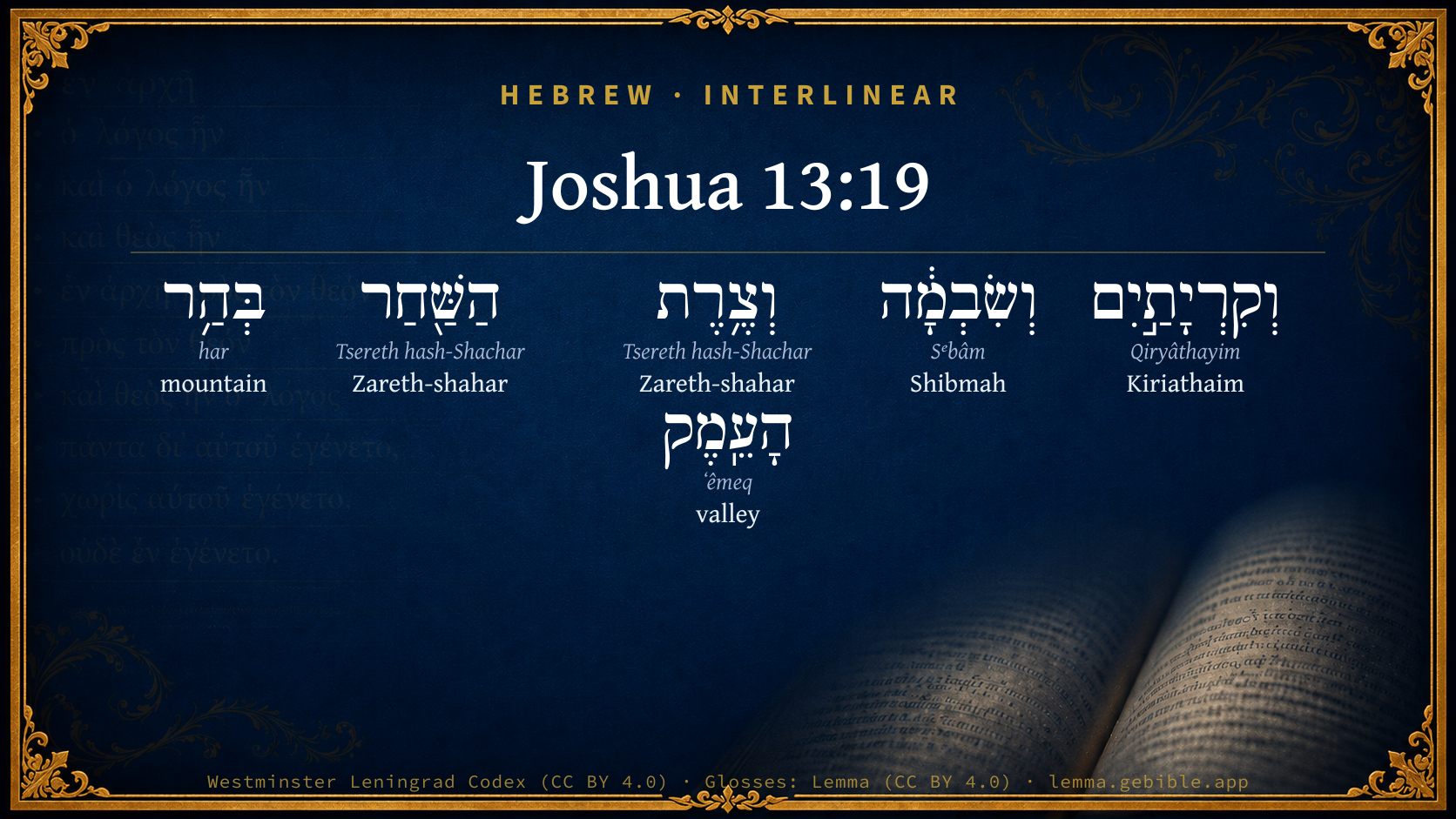
Hebrew (Westminster Leningrad Codex) Joshua 13:19 appears in the Hebrew Old Testament. The text above is from the Westminster Leningrad Codex. Each word links to its Strong’s number, a concise gloss, and parsing drawn from the Open Scriptures Hebrew Bible morphology. Click any word for its full Brown-Driver-Briggs (BDB) entry.
Download image
Cite this verse

Joshua 13:19 (World English Bible). Public Domain. Lemma interlinear Bible study tool, https://lemma.gebible.app/v/joshua/13/19.

Show BibTeX & RIS
BibTeX
RIS
English Translation
and Kiriathaim, and Sibmah, and Zereth-shahar in the mount of the valley,
World English Bible · Public Domain
Highlights
  • 1 first appearance in the Hebrew Bible
Full analysis ↓
Download a study sheet

One document with this verse’s original text, its word-by-word gloss line, the meaning frame, cross-references with their text, attributed commentary, and full source and license credits — printable, and it pastes into notes with its structure intact.

This verse Autodidact and up

Study sheet (.html) Plain text (.txt)

A passage Seminary Student

Up to 50 verses in one chapter. A passage sheet keeps up to 6 commentary sources and 12 cross-references per verse, in the order this page ranks them, and says so on the sheet whenever that leaves anything out. Ask for a single verse and you get the Autodidact verse sheet above.

Everything on this page stays free to read, with no account — the sheet is a download of what is already on screen, not access to it.

Want to remove ads? Support Godless Engineer
Compare translations 3

The same verse in 3 English versions, stacked beneath the original-language interlinear above. Click any original word for its lexicon entry.

Each is an independent rendering of the whole verse — the interlinear is not word-aligned to these translations.

Highlighted words mark where these versions differ — a whole-verse word diff, not a word-by-word alignment.

  • World English Bible Public Domain
    and Kiriathaim, and Sibmah, and Zereth-shahar in the mount of the valley,
  • King James Version Public Domain
    And Kirjathaim, and Sibmah, and Zarethshahar in the mount of the valley,
  • unfoldingWord Literal Text CC BY-SA 4.0
    and Kiriathai and Sibmah and Zereth Shahar on the hill of the valley

unfoldingWord Literal Text — © unfoldingWord, licensed CC BY-SA 4.0. Word-aligned USFM3 via Door43 (git.door43.org/unfoldingWord/en_ult).

Versions to compare (up to 4)

3 of 4 selected

Show all 18 translations

Every available English version of this verse, each an independent rendering of the whole verse.

  • World English Bible Public Domain
    and Kiriathaim, and Sibmah, and Zereth-shahar in the mount of the valley,
  • Berean Standard Bible Public Domain
    Kiriathaim, Sibmah, Zereth-shahar on the hill in the valley,
  • Majority Standard Bible Public Domain
    Kiriathaim, Sibmah, Zereth-shahar on the hill in the valley,
  • King James Version Public Domain
    And Kirjathaim, and Sibmah, and Zarethshahar in the mount of the valley,
  • American Standard Version (1901) Public Domain
    and Kiriathaim, and Sibmah, and Zereth-shahar in the mount of the valley,
  • Revised Version (1885) Public Domain
    and Kiriathaim, and Sibmah, and Zereth-shahar in the mount of the valley;
  • Geneva Bible (1599) Public Domain
    Kiriathaim also, and Sibmah, and Zerethshahar in the mount of Emek:
  • Douay-Rheims (1899) Public Domain
    And Cariathaim, and Sabama, and Sarathasar in the mountain of the valley.
  • Young's Literal Translation Public Domain
    and Kirjathaim, and Sibmah, and Zareth-Shahar, in the mount of the valley,
  • Literal Standard Version CC BY-SA 4.0
    and Kirjathaim, and Sibmah, and Zareth-Shahar, on the mountain of the valley,
  • Unlocked Literal Bible CC BY-SA 4.0
    and Kiriathaim, and Sibmah, and Zereth Shahar on the hill of the valley.
  • unfoldingWord Literal Text CC BY-SA 4.0
    and Kiriathai and Sibmah and Zereth Shahar on the hill of the valley
  • Darby Bible Public Domain
    and Kirjathaim, and Sibmah, and Zereth-shahar in the mountain of the vale,
  • World Messianic Bible Public Domain
    Kiriathaim, Sibmah, Zereth Shahar in the mount of the valley,
  • Webster's Bible Public Domain
    And Kirjathaim, and Sibmah, and Zareth-shahar in the mount of the valley,
  • Free Bible Version CC BY-SA 4.0
    Kiriathaim, Sibmah, Zereth-shahar, on a hill in the valley,
  • Bible in Basic English Public Domain
    And Kiriathaim, and Sibmah, and Zereth-shahar in the mountain of the valley;
  • JPS Tanakh (1917) Public Domain
    and Kiriathaim, and Sibmah, and Zerethshahar in the mount of the valley;

Literal Standard Version (2020), Covenant Press — licensed CC BY-SA 4.0. Text via the HelloAO Bible API (eBible.org). Unlocked Literal Bible (unfoldingWord) — licensed CC BY-SA 4.0. Text via the HelloAO Bible API (eBible.org). unfoldingWord Literal Text — © unfoldingWord, licensed CC BY-SA 4.0. Word-aligned USFM3 via Door43 (git.door43.org/unfoldingWord/en_ult). Free Bible Version, Dr. Jonathan Gallagher — licensed CC BY-SA 4.0. Text via the HelloAO Bible API (eBible.org).

Word by word

More ways to search: Search by grammar → Find every occurrence → Compare this word →

Practice this passage: Drill this verse → Learn its vocabulary →

About this verse

These counts appear in no published source. They are computed here, from the morphology-tagged text and Lemma’s own curated glosses. What Lemma adds →

6
words
5
distinct lemmas
Historical
section

Notable vocabulary

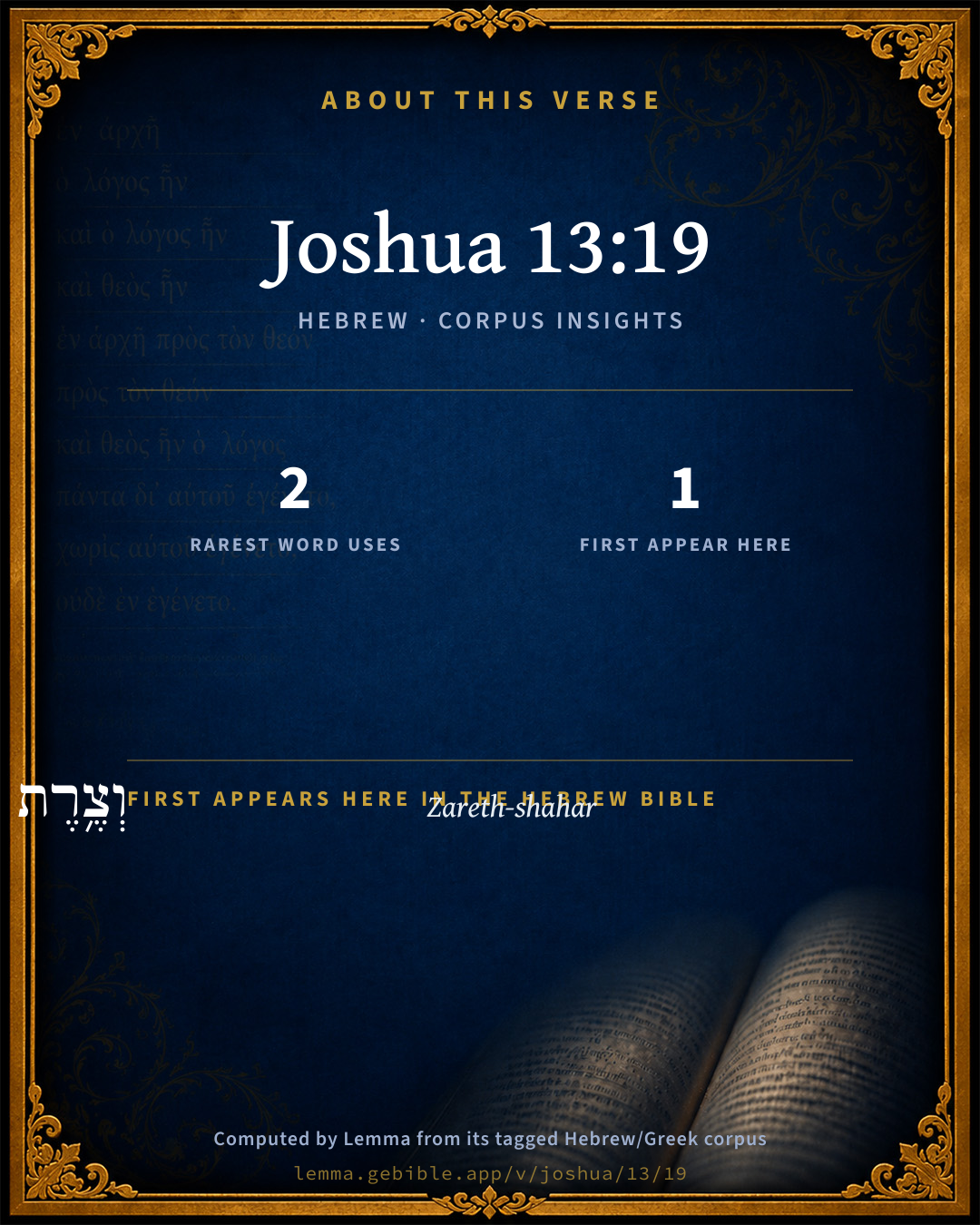
The rarest word here is וְצֶ֥רֶת Zareth-shahar H6890 — appearing just 2 times in the whole Hebrew Bible.

First appearance in Scripture

This word makes its first canonical appearance in the Hebrew Bible here:

  • וְצֶ֥רֶת Zareth-shahar H6890

Grammatical profile

  • 6 nouns

Repetition

A word recurs within this verse — often emphatic in Hebrew:

  • וְצֶ֥רֶת Zareth-shahar H6890 ×2

Hebrew & Septuagint length

In English translation the verse runs 12 words from the Hebrew and 11 from the Septuagint (LXX English) — closely comparable.

A rough comparison of the two English renderings, which tokenize alike — not a word-level alignment.

Word counts can differ between the Hebrew and the Greek without any difference in meaning — e.g. the Hebrew direct-object marker אֵת has no separate Greek word, and Greek often adds the article ὁ.

Cross-references

1

Topical passages linked to Joshua 13:19 in the Treasury of Scripture Knowledge — connected by theme and wording, ordered by reader-vote popularity; previews shown in the World English Bible.

Cross-references courtesy of OpenBible.info (CC BY 4.0).

Hebrew and Greek witnesses Masoretic Hebrew ↔ Greek Septuagint

The same verse in the two great witnesses to the Old Testament, shown verse-for-verse.

These are two independent witnesses, not word-aligned to each other, and the Septuagint is shown in lemma (dictionary) form.

Hebrew Joshua 13:19 Masoretic · Westminster Leningrad Codex

וְקִרְיָתַ֣יִם וְשִׂבְמָ֔ה וְצֶ֥רֶת הַשַּׁ֖חַר בְּהַ֥ר הָעֵֽמֶק

and Kiriathaim, and Sibmah, and Zereth-shahar in the mount of the valley,

World English Bible · Public Domain

Greek LXX Joshua 13:19 Septuagint · lemma form

καί καριαθαιμ καί σεβαμα καί σεραδα καί σιωρ ἐν ὁ ὄρος εμακ

and Kariathaim, and Sebama, and Serada, and Sion in mount Enab;

LXX2012 (modern English Septuagint) · Public Domain

Hebrew: Westminster Leningrad Codex (CC BY 4.0). Greek: Septuagint (public domain); English from LXX2012 (modern English Septuagint) (Public Domain). How the Septuagint differs from the Hebrew →

Targum (Aramaic paraphrase)

1

The Targum is the ancient Jewish Aramaic paraphrase of the Hebrew Scriptures — an interpretive translation, not the Hebrew text itself. Onkelos (literal) and Pseudo-Jonathan (expansive) render the Torah, and Jonathan the Prophets. Coverage is partial: where no permissively-licensed English translation exists for a verse, only the Aramaic is shown. This is verse-level text, not a word-by-word alignment to the Hebrew.

  1. Targum Jonathan Prophets (Joshua–Malachi)
    וְקִרְיָתַיִם וְשִׂבְמָה וְצֶרֶת הַשַׁחַר בְּטוּרָא דְמֵישְׁרָא:

    (no public-domain English translation for this verse)

    Targum Jonathan — Aramaic: “Mikraot Gedolot” (public domain). English: “Sefaria Community Translation” (CC0 1.0 (public-domain dedication)); “London "Chaldee Paraphrase," 1871” (public domain). Text via Sefaria.

Commentary

Notes on Joshua 13:19 from classic Christian and Jewish commentators (each source and its license shown beneath its notes). The classic Christian expositions comment on the surrounding passage and are grouped to its opening verse, so a note may address several verses; the Jewish commentaries on the Tanakh (Rashi and others) are per-verse, so they appear only where the commentator wrote on this verse.

Lemma curates 59 commentaries, every one of them public domain or Creative Commons licensed, each selected and text-cleaned for this edition rather than reprinted as found. About our sources →

The Cambridge Bible for Schools and Colleges

gen. ed. J. J. S. Perowne

19. and Kirjathaim] In Jer_48:1; Jer_48:23 and Eze_25:9 the name is given in our version as Kiriathaim. This place, as well as Dibon, Beth-baal-meon, and Medeba, is found among the proper names recorded on the now celebrated “Moabite stone.” Canon Tristram would identify it with the modern Kureiyat. “The twin hills explain the Hebrew dual and plural terminations.” Land of Moab, p. 275.

Sibmah] Hardly 500 paces from Heshbon, according to Jerome. Isaiah and Jeremiah mention it in the lament pronounced over Moab (Isa_16:8-9; Jer_48:32).

and Zareth-shahar] = “the Splendour of the Dawn,” in Mount Ira-Emak = “the Mountain of the Valley.” Menke places it west of Mount Pisgah, towards the Dead Sea. “Having climbed the hills and traced the feeders of the Callirrhoe to their mountain sources, our next aim was to get down to the shore of the Dead Sea by the unvisited Zara, the ‘Zareth-shahar in the mountain of the valley’ of Jos_13:19.… At length we reached the Dead Sea shore at Zara, which … is really three miles south of the mouth of the Callirrhoe, and in a wide open belt of land, beyond the opening of Wady Z’gara. The surrounding mountain crescent is beautiful, both in form and colour. The sandstone, gilded by the sun, presents the most gorgeous colouring, red predominating, but white, yellow, and brown patches and streaks abound. Groves of tamarisk and acacia, and all the strange tropical shrubs of Engedi and the Sáfieh, gradually give place to huge tufts of a sort of Pampas-grass ten feet high; and then to impenetrable cane-brakes, which reach to within a few feet of the pebbly shore.… Of Zara, the old Hebrew town of Zareth-shahar, but little remains. A few broken basaltic columns and pieces of wall, about 200 yards back from the shore, and a ruined fort rather nearer the sea, about the middle of the coast-line of the plain, are all that are left, beyond the identity of name. Of Rome, or later work, there is not a vestige. Yet these poor relics have an interest of their own. We are looking here on, perhaps, the only surviving relic of the buildings of the semi-nomad tribe of Reuben, prior to the Babylonish captivity.” Tristram’s Land of Moab, pp. 281–284. See the photograph of the Remains, p. 283.

The Cambridge Bible for Schools and Colleges (gen. ed. J. J. S. Perowne; Cambridge University Press, 1878–1918) — public domain. Text from a community e-Sword module.

Joseph Benson's Commentary

Jos 13:19. In the mount of the valley — In the mount which overlooked the great plain before mentioned, or which bordered upon the valley, a mount which, it seems, was then famous among the Israelites; whether that where Moses was buried, which was near to Beth-peor, or some other.

Joseph Benson's Commentary on the Old and New Testaments (1811–1818) — public domain. Text from a community e-Sword module.

Geneva Bible (1599)

Geneva Bible translators

Or, the valley.

Geneva Bible (1599) marginal notes — public domain. Text via Bolls.life.

Adam Clarke's Commentary

Verse 19. Kirjathaim] This city, according to Eusebius, was nine miles distant from Medeba, towards the east. It passed from the Emim to the Moabites, from the Moabites to the Amorites, and from the Amorites to the Israelites, Ge 14:6; De 2:20. Calmet supposes the Reubenites possessed it till the time they were carried away by the Assyrians; and then the Moabites appear to have taken possession of it anew, as he collects from Jer 48:1 c., and Eze 25:9 &c.

Sibmah] A place remarkable for its vines. See Isa 16:8-9, Jer 48:32.

Zareth-shahar, in the mount of the valley] This probably means a town situated on or near to a hill in some flat country.

Adam Clarke's Commentary on the Bible (1810–1826) — public domain. Text from a community e-Sword/MySword module.

John Gill's Exposition

And Bethpeor,.... So called from Peor, the idol of the Moabites, and where very likely there had been a temple built to the honour of it; over against this place was a valley, where Israel abode some time, Deu 3:29,

and Ashdodpisgah; of which see Deu 3:17,

and Bethjeshimoth; of which see Num 33:49.

John Gill's Exposition of the Whole Bible (1746–1763) — public domain (CC PDM 1.0). Text via the HelloAO Bible API.

Matthew Poole's English Annotations

In the mountain bordering upon that valley, which then was famous among the Israelites, whether that where Moses was buried, which was near to the place here following, Beth-peor, Deu 34:1,6, or some other. And this clause is thought to belong to all the cities now mentioned.

Matthew Poole's English Annotations on the Holy Bible (1683–1685) — public domain. Text from a community e-Sword/MySword module.

Whedon's Commentary on the Bible

Daniel D. Whedon

19. Kirjathaim — The word means the double city, and in the English version is sometimes written Kiriathaim. In its plain Chedorlaomer and his confederate kings smote the Emim in the days of Abraham. Gen_14:5. There is some uncertainty as to its site, but J.L. Porter very plausibly identifies it with Kureijat, a ruined town on the southwestern slope of Jebel Attarus.

Sibmah — From Isa_16:8-9, and Jer_48:32, this place seems to have been famous for the cultivation of the vine. According to Jerome it was hardly five hundred paces distant from Heshbon, but no trace of its name has yet been found among the ruined cities of that district.

Zareth-shahar — This place was in a mount of the valley, that is, a mountain overlooking the valley of the Jordan and Dead Sea. Seetzen conjectured that its name still lingered in the ruins of Sara, a little northwest of Jebel Attarus, and near the mouth of the Wady Zerka.

Daniel D. Whedon (gen. ed.), Commentary on the Old and New Testaments (1874–1909) — public domain. Text from a community e-Sword module.

The Pulpit Commentary

Sibmah. (see Num_32:38) The vine of Sibmah forms a feature in the lament of Isaiah (Isa_16:8) and Jeremiah (Jer_48:32) over Moab. It was close by Heshbon, on the borders of Reuben and Gad. (cf. ver. 17 with Jos_21:39) Zareth-shahar, or the splendour of the dawn, now garar, was on the borders of the Dead Sea. Canon Tristram, in his "Land of Moab," mentions the gorgeous colouring of the landscape here, more beautiful and varied, no doubt, at dawn than at any other time of the day.

The Pulpit Commentary (1880–1919), ed. H.D.M. Spence-Jones & Joseph S. Exell — public domain. Text from a community e-Sword module.

John Wesley's Explanatory Notes

In the mount of the valley - In the mountain bordering upon that valley, which then was famous among the Israelites; whether that where Moses was buried, which was near to Beth-peor, Deut. xxxiv, 1, 6, or some other. And this clause is thought to belong to all the cities now mentioned.

John Wesley, Explanatory Notes Upon the Whole Bible (1754–1765) — public domain. Text via the GEBible commentary corpus.

Keil & Delitzsch

C. F. Keil & F. Delitzsch

Kirjathaim, where Chedorlaomer defeated the Emim, is probably to be found in the ruins of et-Teym, half an hour to the west of Medaba (see at Gen 14:5). Sibmah (Num 32:38), according to Jerome (on Isa 16:8), only 500 paces from Heshbon, appears to have hopelessly disappeared. Zereth-hashachar, i.e., splendor aurorae, which is only mentioned here, was situated "upon a mountain of the valley." According to Jos 13:27, the valley was the Jordan valley, or rather (according to Gen 14:3, Gen 14:8) the vale of Siddim, a valley running down on the eastern side of the Dead Sea. Seetzen conjectures that the town referred to is the present ruin of Sar, on the south of Zerka Maein. - Beth-peor, opposite to Jericho, six Roman miles higher than (to the east of) Libias: see at Num 23:28. The "slopes of Pisgah" (Jos 12:3; Deu 3:17): to the south of the former, on the north-eastern shore of the Dead Sea (see at Num 27:12). Beth-jeshimoth (Jos 12:3), in the Ghor el Seisabn, on the north-east side of the Dead Sea (see at Num 22:1). In Jos 13:21, the places which Reuben received in addition to those mentioned by name are all summed up in the words, "and all the (other) towns of the plain, and all the kingdom of Sihon," sc., so far as it extended over the plain. These limitations of the words are implied in the context: the first in the fact that towns in the plain are mentioned in Jos 13:17; the second in the fact that, according to Jos 13:27, "the rest of the kingdom of Sihon," i.e., the northern portion of it, was given to the Gadites. The allusion to Sihon induced the author to mention his defeat again; see at Num 31, where the five Midianitish vassals who were slain with Sihon are noticed in Num 31:8, and the death of Balaam is also mentioned. "Dukes of Sihon," properly vassals of Sihon; נסיכים does not signify anointed, however, but means literally poured out, i.e., cast, moulded, enfeoffed. The word points to the "creation of a prince by the communication or pouring in of power" (Gusset, s. v.).

Keil & Delitzsch — Biblical Commentary on the Old Testament (1861–1891) — public domain (CC PDM 1.0). Text via the HelloAO Bible API. (Old Testament only.)

Rashi

Rabbi Shlomo Yitzchaki (Rashi)

On the Mountain of the valley. The mountain of the plain.

Rashi on the Tanakh — English translations: “The Judaica Press complete Tanach with Rashi, translated by A. J. Rosenberg” (CC BY 4.0); “Pentateuch with Rashi's commentary by M. Rosenbaum and A.M. Silbermann, 1929-1934” (public domain); “The Metsudah Tanach series, Lakewood, N.J” (CC BY 4.0); and “The Book of Joshua, Metsudah Publications, 1997” (CC BY 4.0). Text via Sefaria.

Lesson kit

Teaching starters — assembled from the data on this page, not authored interpretation. Every prompt links to the verse data it draws on. Edit before teaching.

Joshua, in the Historical, opens this verse with 6 words (5 distinct Hebrew lemmas). Its most distinctive word is Tsereth hash-Shachar (“Zareth-shahar”). A historical commentator’s framing appears above. Read the whole chapter for the surrounding context.

Discussion questions

  1. What does “Zareth-shahar” (Tsereth hash-Shachar) contribute to the verse as a whole?
  2. The word “Zareth-shahar” first appears here in Scripture. What is being introduced at this debut?
  3. Numbers 32:37–38 shares this passage’s theme. How do the two illuminate each other?
  4. “Zareth-shahar” occurs 2× in this one verse. What is the effect of the repetition?
  5. The translations on this page render this verse differently — a whole-verse word diff, not a word-by-word alignment. What might account for the different wordings?
  6. Reading how The Cambridge Bible for Schools and Colleges and Joseph Benson's Commentary read this verse, where do the two commentators agree and where do they part?

Things to notice

  • 1 word makes its first canonical appearance in Scripture here.
  • These translations choose different wording for 9 words in this verse.
  • “Zareth-shahar” occurs 2× in this single verse.
  • 5 distinct Hebrew lemmas span 6 words in this verse.

Reading settings

Reading text

Shown beneath each verse's original-language words.

Old Testament
Old Testament edition

Read the OT as the Masoretic Hebrew (MT) or the Greek Septuagint (LXX).

English shown for the Greek Septuagint (in the Hebrew ↔ Greek comparison).

Comparing translations? Open the Compare panel on any verse page to stack up to four side by side.