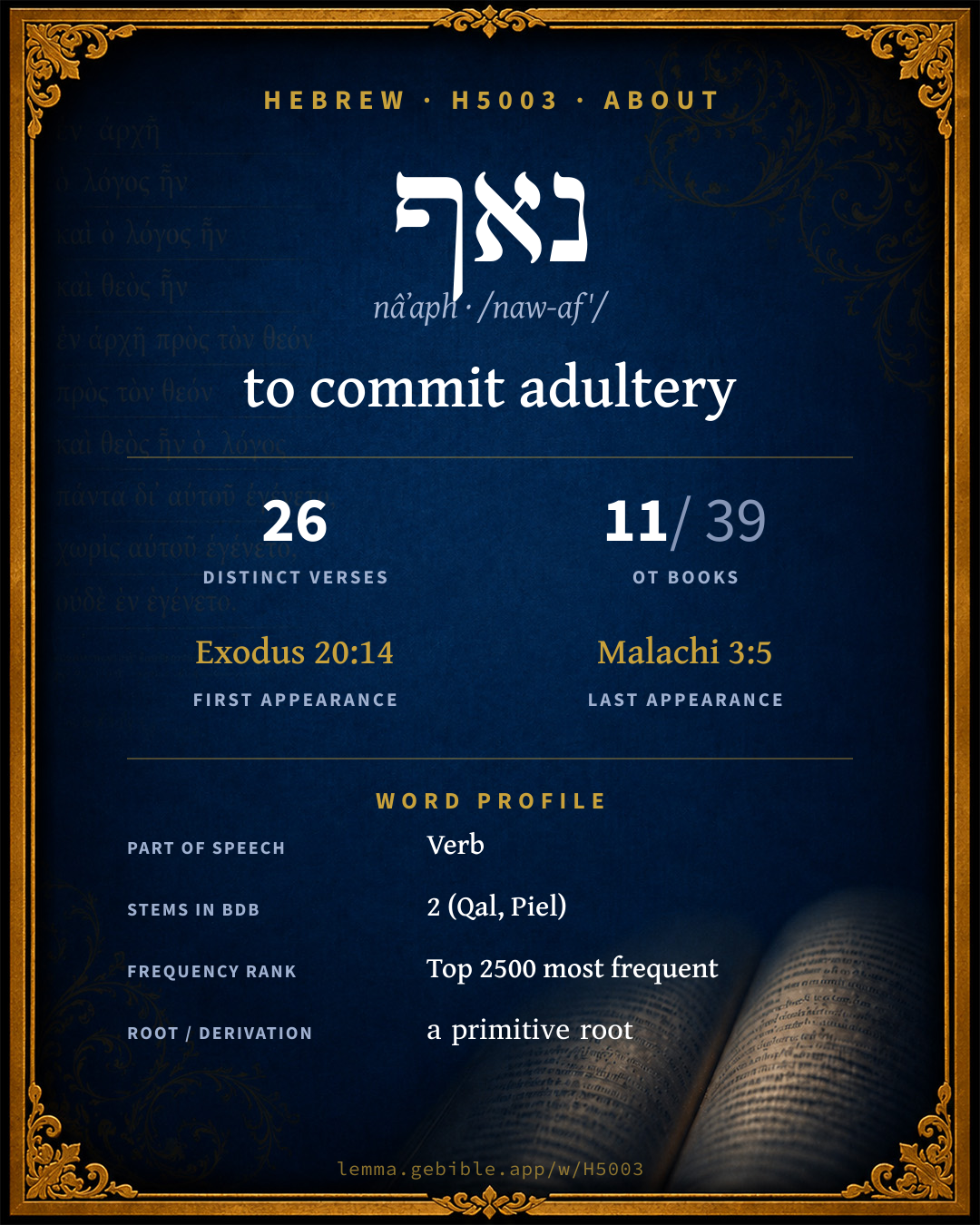
נָאַף
to commit adultery
‘to commit adultery’ is one of 5 main senses fuller range ↓
Full lexicon entry — Brown-Driver-Briggs (BDB)
From Brown-Driver-Briggs (BDB)
Where this word appears
See every Piel verb in the Hebrew Bible →
Grammar key — what these labels mean
Part of speech
- Verb
- An action or state-of-being word.
Stem
- Piel
- An intensive or resultative active stem. Here: ‘lit. commit adultery’
- Qal
- The basic, simple active stem — the plain form of the verb (“he wrote”). Here: ‘lit. commit adultery’
Form
- Participle Active
- A verbal adjective expressing ongoing or characteristic action (“writing / one who writes”).
- Infinitive Absolute
- An unbound verbal noun, often intensifying or standing in for a finite verb.
- Imperfect
- An incomplete, ongoing, or future action (“he will / would write”).
- Perfect
- A completed action or state — Hebrew marks aspect (completeness) more than strict tense (“he wrote”).
- Sequential Imperfect
- An imperfect with prefixed waw — the standard past-narrative form (waw-consecutive imperfect).
State
- Absolute
- The independent form of a noun, not bound to a following word.
Person
- 3rd Person
- The one spoken about (“he / she / it / they”).
- 2nd Person
- The one addressed (“you”).
Gender
- Masculine
- Grammatically masculine.
- Feminine
- Grammatically feminine.
- Common
- Either gender — not distinguished for this form.
Number
- Plural
- More than one (in Hebrew, generally three or more).
- Singular
- One.
Grammatical forms 15 distinct
- Verb, Piel, Participle Active, Masculine, Plural, Absolute 5 times (16%)
- Verb, Qal, Participle Active, Feminine, Plural, Absolute 3 times (10%)
- Verb, Qal, Infinitive Absolute 3 times (10%)
- Verb, Qal, Participle Active, Masculine, Singular, Absolute 3 times (10%)
- Verb, Piel, Participle Active, Feminine, Singular, Absolute 3 times (10%)
- Verb, Piel, Imperfect, 3rd Person, Feminine, Plural 2 times (6%)
- Verb, Piel, Perfect, 3rd Person, Common, Plural 2 times (6%)
- Verb, Qal, Imperfect, 2nd Person, Masculine, Singular 2 times (6%)
+7 more forms (8 occurrences)
Parsed forms decoded from the imported morphology (morphhb / Westminster Leningrad Codex — WLC text public domain, morphhb tagging CC BY 4.0), counted across 31 parsed occurrences — not distinct verses.
Every verse where H5003 appears — 26 distinct verses across 11 books. Click any verse to open its interlinear word-by-word view. Verse text shown in the World English Bible for context — . Each verse’s Hebrew form is shown with its reference; the English is not keyword-highlighted, since the data carries no word-level English alignment. Use “Compare translations” on any verse to read it across multiple English versions. This concordance covers the Hebrew Bible; Septuagint (Greek Old Testament) occurrences are not indexed here.
Exodus 1 verse
Leviticus 1 verse
Deuteronomy 1 verse
Job 1 verse
Psalms 1 verse
Proverbs 2 verses
Isaiah 1 verse
Jeremiah 8 verses
- Jeremiah 3:8 נִֽאֲפָה֙ Piel pf 3fs I saw, when, for this very cause that backsliding Israel had committed adultery, I had put her away and given her a bill of divorce, yet treacherous Judah, her sister, didn't fear; but she also went and played the prostitute.
- Jeremiah 3:9 וַ/תִּנְאַ֥ף conj + Qal wimpf 3fs It happened through the lightness of her prostitution, that the land was polluted, and she committed adultery with stones and with stocks.
- Jeremiah 5:7 וַ/יִּנְאָ֔פוּ conj + Qal wimpf 3mp How can I pardon you? your children have forsaken me, and sworn by them that are no gods: when I had fed them to the full, they committed adultery, and assembled themselves in troops at the prostitutes' houses.
- Jeremiah 7:9 וְֽ/נָאֹ֔ף conj + Qal inf.abs Will you steal, murder, and commit adultery, and swear falsely, and burn incense to Baal, and walk after other gods that you have not known,
- Jeremiah 9:2 מְנָ֣אֲפִ֔ים Piel ptcp.act mp Oh that I had in the wilderness a lodging-place of wayfaring men; that I might leave my people, and go from them! for they are all adulterers, an assembly of treacherous men.
- Jeremiah 23:10 מְנָֽאֲפִים֙ Piel ptcp.act mp For the land is full of adulterers; for because of swearing the land mourns; the pastures of the wilderness are dried up. Their course is evil, and their might is not right;
- Jeremiah 23:14 נָא֞וֹף Qal inf.abs In the prophets of Jerusalem also I have seen a horrible thing: they commit adultery, and walk in lies; and they strengthen the hands of evil-doers, so that none does return from his wickedness: they are all of them become to me as Sodom, and the inhabitants of it as Gomorrah.
- Jeremiah 29:23 וַ/יְנַֽאֲפוּ֙ conj + Piel wimpf 3mp because they have worked folly in Israel, and have committed adultery with their neighbors' wives, and have spoken words in my name falsely, which I didn't command them; and I am he who knows, and am witness, says Yahweh.
Ezekiel 4 verses
- Ezekiel 16:32 הַ/מְּנָאָ֑פֶת ptcl def.art + Piel ptcp.act fs A wife who commits adultery! who takes strangers instead of her husband!
- Ezekiel 16:38 נֹאֲפ֔וֹת Qal ptcp.act fp I will judge you, as women who break wedlock and shed blood are judged; and I will bring on you the blood of wrath and jealousy.
- Ezekiel 23:37 נִאֵ֗פוּ נִאֵ֑פוּ Piel pf 3cp Piel pf 3cp For they have committed adultery, and blood is in their hands; and with their idols have they committed adultery; and they have also caused their sons, whom they bore to me, to pass through [the fire] to them to be devoured.
- Ezekiel 23:45 נֹֽאֲפ֔וֹת נֹֽאֲפֹת֙ Qal ptcp.act fp Qal ptcp.act fp Righteous men, they shall judge them with the judgment of adulteresses, and with the judgment of women who shed blood; because they are adulteresses, and blood is in their hands.
Hosea 5 verses
- Hosea 3:1 וּ/מְנָאָ֑פֶת conj + Piel ptcp.act fs Yahweh said to me, "Go again, love a woman loved by another, and an adulteress, even as Yahweh loves the children of Israel, though they turn to other gods, and love cakes of raisins."
- Hosea 4:2 וְ/נָאֹ֑ף conj + Qal inf.abs There is cursing, lying, murder, stealing, and committing adultery; They break boundaries, and bloodshed causes bloodshed.
- Hosea 4:13 תְּנָאַֽפְנָה Piel impf 3fp They sacrifice on the tops of the mountains, And burn incense on the hills, under oaks and poplars and terebinths, Because its shade is good. Therefore your daughters play the prostitute, And your brides commit adultery.
- Hosea 4:14 תְנָאַ֔פְנָה Piel impf 3fp I will not punish your daughters when they play the prostitute, Nor your brides when they commit adultery; Because the men consort with prostitutes, And they sacrifice with the shrine prostitutes; And the people that does not understand will come to ruin.
- Hosea 7:4 מְנָ֣אֲפִ֔ים Piel ptcp.act mp They are all adulterers. They are burning like an oven that the baker stops stirring, From the kneading of the dough, until it is leavened.
Malachi 1 verse
About this entry
At a glance — auto-summarized from this page’s data, not written by a person. Every figure links to its source below. This summary describes the numbers; it doesn’t interpret them.
At its core, נאף (nâʼaph) means “to commit adultery.” It first appears in Exodus 20:14. It turns up in 26 verses across 11 books, a moderately common footprint. The word gravitates to Jeremiah (31%), then Hosea and Ezekiel. Read the stem: it spans 2 stems, including Qal and Piel. Each statement above links to its evidence; the full detail follows below.
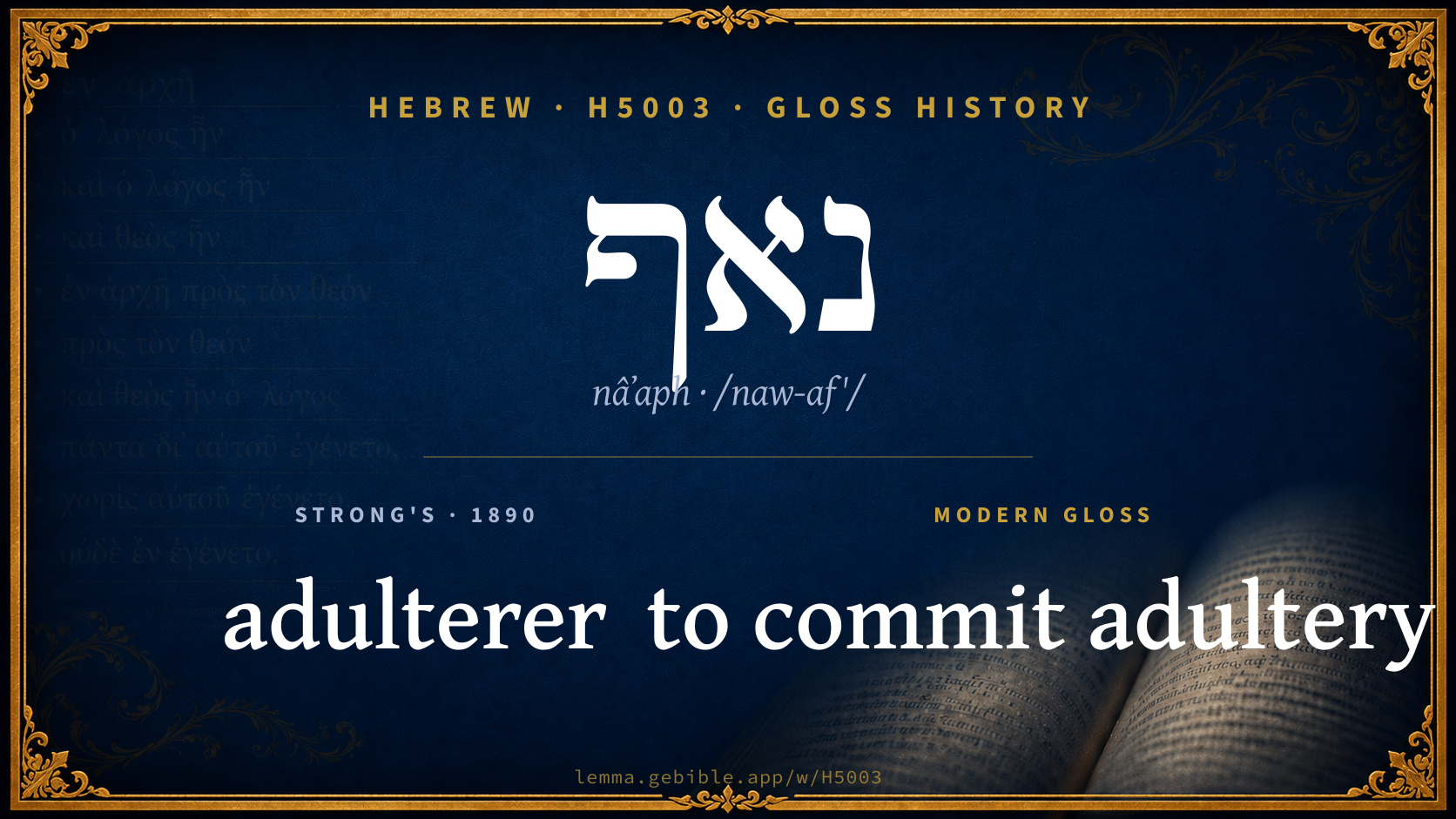
Gloss history
Strong's 1890 vs modern scholarship
About this word
Strong's H5003 catalogs a Hebrew word from the Hebrew Old Testament.
These counts are not copied from any lexicon or concordance. They are computed here, from the morphology-tagged Hebrew Old Testament. What Lemma adds →
- 26
- distinct verses
- The word appears in 26 distinct verses.
- 11 / 39
- OT books
- The word appears in 11 of 39 Old Testament books.
- #1,120
- by frequency
- Top 2500 most frequent Hebrew words (rank 1,120 of 8,640 Hebrew words by occurrence).
View all 26 occurrences in the concordance →
By section of the Old Testament
By traditional corpus
Conventional, traditional groupings — biblical authorship is debated, so this is a traditional corpus grouping, not an authorship claim. Each share is this word’s portion of its verses in that division of the Hebrew canon. Each figure is a share of the word’s 26 distinct verses.
- Prophets (Nevi'im) 19 verses · 73%
- Writings (Ketuvim) 4 verses · 15%
- Torah (Pentateuch) 3 verses · 12%
How translations render this word
Counts come from each version’s own published word-to-Strong’s tagging or interlinear alignment — an approximate guide to how each version renders this word, not a word-level alignment the data otherwise carries. Because each total is that version’s own tagged count, the per-version totals vary from one another and need not match the appearance or distinct-verse counts above. These counts may also differ from a printed concordance because Lemma counts each distinctly tagged rendering and does not collapse phrase taggings into a single head-word total. This is a fixed set of word-tagged versions (KJV, ASV, BSB, ULT) and does not change with the reading translation you choose elsewhere. Each version’s license is shown beside its name below (and on Sources).
- King James Version: Adulterer 3×, Adulterers 2×, Adulteress 2×
- American Standard Version: Adulterer 3×, Adulteress 2×, Commit adultery 2×
- Berean Standard Bible: Adulterers 6×, Commit adultery 4×, Adultery 2×
- unfoldingWord Literal Text: Commit adultery 4×, Adulterer 3×, Commits adultery 3×
King James Version Public Domain
Renders H5003 across 31 tagged occurrences — most commonly:
Plus 18 renderings that appear only once — usually multi-word phrases or single function words the recovered tagging swept in, not distinct renderings.
American Standard Version Public Domain
Renders H5003 across 31 tagged occurrences — most commonly:
Plus 18 renderings that appear only once — usually multi-word phrases or single function words the recovered tagging swept in, not distinct renderings.
Berean Standard Bible Public Domain
Renders H5003 across 29 tagged occurrences — most commonly:
Plus 13 renderings that appear only once — usually multi-word phrases or single function words the recovered tagging swept in, not distinct renderings. Not rendered by a distinct English word in 2 further occurrences.
unfoldingWord Literal Text CC BY-SA 4.0
Renders H5003 across 32 tagged occurrences — most commonly:
Plus 13 renderings that appear only once — usually multi-word phrases or single function words the recovered tagging swept in, not distinct renderings.
10 senses and sub-senses in the full BDB
Hebrew verbs can shift meaning by stem (binyan): Qal is the basic action, Niphal is often passive or reflexive, Piel often intensifies or makes it factitive, and Hiphil is typically causative. The senses below are grouped under the stem BDB assigns to each.
What do BDB’s symbols mean?
BDB uses these scholarly abbreviations:
| Symbol | Meaning |
|---|---|
| 𝔊 | the Septuagint (the ancient Greek translation, LXX) |
| 𝔙 | the Vulgate (the Latin translation) |
| 𝔖 | the Syriac version (the Peshitta) |
| 𝔗 | the Targum (the Aramaic translation) |
| ψ | the Psalms |
| √ | root (the underlying root or stem) |
| ‖ | parallel passage (a synonymous or contrasted parallel) |
| † | the dagger: every passage where the word occurs is cited |
The 10 senses and sub-senses the full Brown-Driver-Briggs lexicon distinguishes for this word, in lexicon order (not ranked by frequency), with BDB’s own verbatim wording and sub-sense lettering. Shown in Hebrew script with BDB’s own scholarly abbreviations. The condensed entry is in the Lexicon Entry tab. See also the Forms in the corpus table below.
Qal
- Impf. 3 ms. יִנְאַף Lv 20:10(×2); 3 mpl. וַיִּנְאָ֑פוּ Je 5:7 + 3 times Impf., Inf. abs. נָאוֹף 23:14; נָאֹף Ho 4:2 Je 7:9; Pt. נֹאֵף Pr 6:32 Jb 24:15; fs. נֹאָ֑פֶת Lv 20:10; fpl. נֹאֲפוֹת Ez 16:38 + 2 times;— e.g. Leviticus 20:10
- 1. lit. commit adultery:
- a. usually of man, always with wife of another; c. acc. woman, Lv 20:10(×2) (H), Pr 6:32; elsewhere abs. Ex 20:14 = Dt 5:17 (Ten Words), Je 5:7; 7:9; 23:14 Ho 4:2; pt. m. Lv 20:10 (H), Jb 24:15. e.g. Leviticus 20:10
- b. of women, only pt. Lv 20:10 (H), Ez 16:38; 23:45(×2). e.g. Leviticus 20:10
- 2. fig. of idolatrous worship, את האבן ואת העץ Je 3:9. e.g. Jeremiah 3:9
Piel
- Pf. 3 fs. נִאֲפָה Je 3:8; 3 mpl. נִאֵ֑פוּ Ez 23:37(×2); Impf. 3 mpl. יְנַאֲפוּ Je 29:23; 3 fpl. תְּנָאַפְנָה Ho 4:13, 14; Pt. מְנָאֵף Is 57:3; pl. מְנָאֲפִים Je 9:1 + 4 times; f. מְנָאָ֑פֶת Pr 30:20 + 2 times;— e.g. Jeremiah 3:8
- 1. lit. commit adultery:
- a. of man, c. acc. woman, Je 29:23; pt. pl. Je 9:2; 23:10 Ho 7:4 Mal 3:5 ψ 50:18. e.g. Jeremiah 29:23
- b. of woman, abs. Ho 4:13, 14; pt. 3:1 Pr 30:20; pl. Ez 16:32; 23:37. e.g. Hosea 4:13
- 2. fig. of idolatrous worship, אֶת־גִּלּוּלֵיהֶן Ez 23:37; abs. Je 3:8, זֶרַע מְנָאֵף Is 57:3. e.g. Ezekiel 23:37
Senses from the full Brown-Driver-Briggs lexicon (Brown, Driver, Briggs; Oxford 1906 — public domain), digitized via Sefaria, supplemented by the OpenScriptures HebrewLexicon (CC BY 4.0). Full attribution on Sources.
Word origin
vb. commit adultery (NH id.; Aramaic נְאַף (rare));—
— Brown-Driver-Briggs (Oxford 1906, public domain), digitized via Sefaria, supplemented by the OpenScriptures HebrewLexicon (CC BY 4.0). See Sources.
Origin: a primitive root
Jastrow Dictionary
A second Hebrew/Aramaic lexicon for comparison, covering Aramaic and post-biblical (Talmudic, Targumic, Midrashic) usage that the biblical-Hebrew BDB does not. Matched by lemma rather than by Strong’s number, so a lemma may carry more than one Jastrow headword (shown separately below), and the entries cover usage well beyond the Bible.
נָאַף
- (b. h.) to be unchaste, voluptuous, esp. to have illicit intercourse; to commit adultery. Lev. R. s. 23 (ref. to Job XXIV, 15) [read:] שלא תאמר שכל מי שהוא נוֹאֵף בגופו נקרא נוֹאֵף אפי׳ נוֹאֵף בעיניו נקרא נוֹאֵף do not say, he only who is unchaste with his body is called a noëf, but even he who is unchaste with his eye &c.; Pesik. R. s. 24 (corr. acc.); a. fr.—Esp. נוֹאֵף adulterer, paramour; f. נוֹאֶפֶת adulteress. Ib. Num. R. s. 9; Tanḥ. Naso 4; a. fr. e.g. Job 24:15
- same. Pes. 113ᵇ זקן מְנָאֵף a lewd old man. Nidd. 13ᵇ המְנָאֲפִים ביד who commit masturbation. Ex. R. s. 31, end, a. e. (prov.) מְנָאֶפֶת בתפוחים וכ׳ she prostitutes herself for apples and distributes them among the sick, v. גּוּף I ch.—Sot. IX, 9 משרבו המְנָאֲפִים וכ׳ when the lewd men became numerous, the proceedings against the faithless woman (סוֹטָה) were abolished. Shebu. 47ᵇ עוקב אחר מנאף Ms. M. a. Rashi (ed. נואף) he who follows up the voluptuous (to procure prostitutes for him); a. fr.—(Ḥull. 63ᵃ, v. אָנַף.]
- to cause illicit intercourse; to bawd. Shebu. l. c. ת"ל לא תנאף לא תַנְאִיף (Ms. M. only לא תנאף) it says (Ex. XX, 14) ‘thou shalt not be lewd’, (which implies) thou shalt not assist lewdness. e.g. Exodus 20:14
נְאַף
- Pa. נָאֵף same. Targ. Is. LVII, 3.
A Dictionary of the Targumim, the Talmud Babli and Yerushalmi, and the Midrashic Literature (Marcus Jastrow; London, Luzac, 1903) — Public Domain. Digitized via Sefaria. Digitized via Sefaria. Full attribution on Sources.
Forms in the corpus
The 29 distinct written forms H5003 takes in the Hebrew Bible, most frequent first — each parse links to that stem’s occurrences in the concordance. Hebrew forms include their vowel points and cantillation, so a single lemma takes many written forms.
Same root — word family
Other BDB entries built from the same root as H5003, grouped by Strong’s listed origin. These share a root / origin per the lexicon — not necessarily a shared meaning. Each links to that word’s own entry.
Derived from this word
Compare all same-root words → They share a root, not necessarily a meaning.
Septuagint verse parallels
This word appears in 25 verses that also exist in the Greek Old Testament (Septuagint), out of the 26 Hebrew verses it occurs in. You can read those verses in Greek by switching the Old Testament edition to the Septuagint.
Read these verses in the Septuagint
- Exodus 20:14
- Leviticus 20:10
- Deuteronomy 5:18
- Job 24:15
- Psalms 50:18
- Proverbs 6:32
- Isaiah 57:3
- Jeremiah 3:8
- Ezekiel 16:32
- Hosea 3:1
- Malachi 3:5
This is a verse-level parallel only — the same verses exist in both the Hebrew and Greek Old Testaments. No word-level Hebrew↔Greek correspondence is claimed: the data carries no such alignment, so no Greek word is shown as this Hebrew word’s translation. Coverage is not total — the Septuagint omits the deuterocanon and renumbers the Psalms, so some Hebrew verses have no direct Greek parallel.