Job 24:15

Hebrew (Westminster Leningrad Codex) Job 24:15 appears in the Hebrew Old Testament. The text above is from the Westminster Leningrad Codex. Each word links to its Strong’s number, a concise gloss, and parsing drawn from the Open Scriptures Hebrew Bible morphology. Click any word for its full Brown-Driver-Briggs (BDB) entry.
Download image
Cite this verse

Job 24:15 (World English Bible). Public Domain. Lemma interlinear Bible study tool, https://lemma.gebible.app/v/job/24/15.

Show BibTeX & RIS
BibTeX
RIS
English Translation
The eye also of the adulterer waits for the twilight, Saying, 'No eye shall see me.' He disguises his face.
World English Bible · Public Domain
Download a study sheet

One document with this verse’s original text, its word-by-word gloss line, the meaning frame, cross-references with their text, attributed commentary, and full source and license credits — printable, and it pastes into notes with its structure intact.

This verse Autodidact and up

Study sheet (.html) Plain text (.txt)

A passage Seminary Student

Up to 50 verses in one chapter. A passage sheet keeps up to 6 commentary sources and 12 cross-references per verse, in the order this page ranks them, and says so on the sheet whenever that leaves anything out. Ask for a single verse and you get the Autodidact verse sheet above.

Everything on this page stays free to read, with no account — the sheet is a download of what is already on screen, not access to it.

Want to remove ads? Support Godless Engineer
Compare translations 3

The same verse in 3 English versions, stacked beneath the original-language interlinear above. Click any original word for its lexicon entry.

Each is an independent rendering of the whole verse — the interlinear is not word-aligned to these translations.

Highlighted words mark where these versions differ — a whole-verse word diff, not a word-by-word alignment.

  • World English Bible Public Domain
    The eye also of the adulterer waits for the twilight, Saying, 'No eye shall see me.' He disguises his face.
  • King James Version Public Domain
    The eye also of the adulterer waiteth for the twilight, saying, No eye shall see me: and disguiseth his face.
  • unfoldingWord Literal Text CC BY-SA 4.0
    And the eye of the adulterer watches twilight, saying, ‘No eye will perceive me,’ and he puts a cover face.

unfoldingWord Literal Text — © unfoldingWord, licensed CC BY-SA 4.0. Word-aligned USFM3 via Door43 (git.door43.org/unfoldingWord/en_ult).

Versions to compare (up to 4)

3 of 4 selected

Show all 18 translations

Every available English version of this verse, each an independent rendering of the whole verse.

  • World English Bible Public Domain
    The eye also of the adulterer waits for the twilight, Saying, 'No eye shall see me.' He disguises his face.
  • Berean Standard Bible Public Domain
    The eye of the adulterer watches for twilight. Thinking, ‘No eye will see me,’ he covers his face.
  • Majority Standard Bible Public Domain
    The eye of the adulterer watches for twilight. Thinking, ‘No eye will see me,’ he covers his face.
  • King James Version Public Domain
    The eye also of the adulterer waiteth for the twilight, saying, No eye shall see me: and disguiseth his face.
  • American Standard Version (1901) Public Domain
    The eye also of the adulterer waiteth for the twilight, Saying, No eye shall see me: And he disguiseth his face.
  • Revised Version (1885) Public Domain
    The eye also of the adulterer waiteth for the twilight, saying, No eye shall see me: and he disguiseth his face.
  • Geneva Bible (1599) Public Domain
    The eye also of the adulterer waiteth for the twilight, and sayth, None eye shall see me, and disguiseth his face.
  • Douay-Rheims (1899) Public Domain
    The eye of the adulterer observeth darkness, saying: No eye shall see me: and he will cover his face.
  • Young's Literal Translation Public Domain
    And the eye of an adulterer Hath observed the twilight, Saying, `No eye doth behold me.' And he putteth the face in secret.
  • Literal Standard Version CC BY-SA 4.0
    And the eye of an adulterer || Has observed the twilight, || Saying, No eye beholds me. And he puts the face in secret.
  • Unlocked Literal Bible CC BY-SA 4.0
    Also, the eye of the adulterer waits for the twilight; he says, 'No eye will see me.' He disguises his face.
  • unfoldingWord Literal Text CC BY-SA 4.0
    And the eye of the adulterer watches twilight, saying, ‘No eye will perceive me,’ and he puts a cover face.
  • Darby Bible Public Domain
    And the eye of the adulterer waiteth for the twilight, saying, No eye shall see me; and he putteth a covering on [his] face.
  • World Messianic Bible Public Domain
    The eye also of the adulterer waits for the twilight, saying, ‘No eye will see me.’ He disguises his face.
  • Webster's Bible Public Domain
    The eye also of the adulterer waiteth for the twilight, saying, No eye shall see me: and disguiseth his face.
  • Free Bible Version CC BY-SA 4.0
    The adulterer waits for dusk, saying to himself, ‘No one will see me now,’ and he covers his face.
  • Bible in Basic English Public Domain
    And the man whose desire is for the wife of another is waiting for the evening, saying, No eye will see me; and he puts a cover on his face. And in the night the thief goes about;
  • JPS Tanakh (1917) Public Domain
    The eye also of the adulterer waiteth for the twilight, saying: 'No eye shall see me'; and he putteth a covering on his face.

Literal Standard Version (2020), Covenant Press — licensed CC BY-SA 4.0. Text via the HelloAO Bible API (eBible.org). Unlocked Literal Bible (unfoldingWord) — licensed CC BY-SA 4.0. Text via the HelloAO Bible API (eBible.org). unfoldingWord Literal Text — © unfoldingWord, licensed CC BY-SA 4.0. Word-aligned USFM3 via Door43 (git.door43.org/unfoldingWord/en_ult). Free Bible Version, Dr. Jonathan Gallagher — licensed CC BY-SA 4.0. Text via the HelloAO Bible API (eBible.org).

Word by word

More ways to search: Search by grammar → Find every occurrence → Compare this word →

Practice this passage: Drill this verse → Learn its vocabulary →

נֶ֣שֶׁף
nesheph
H5399
“twilight”
Noun, Common, Masculine, Singular, Absolute
Part of Speech
Noun
Type
Common
Gender
Masculine
Number
Singular
State
Absolute
Full BDB Definition

Origin: from H5398

TWOT: 1434a

twilight - evening twilight - morning twilight
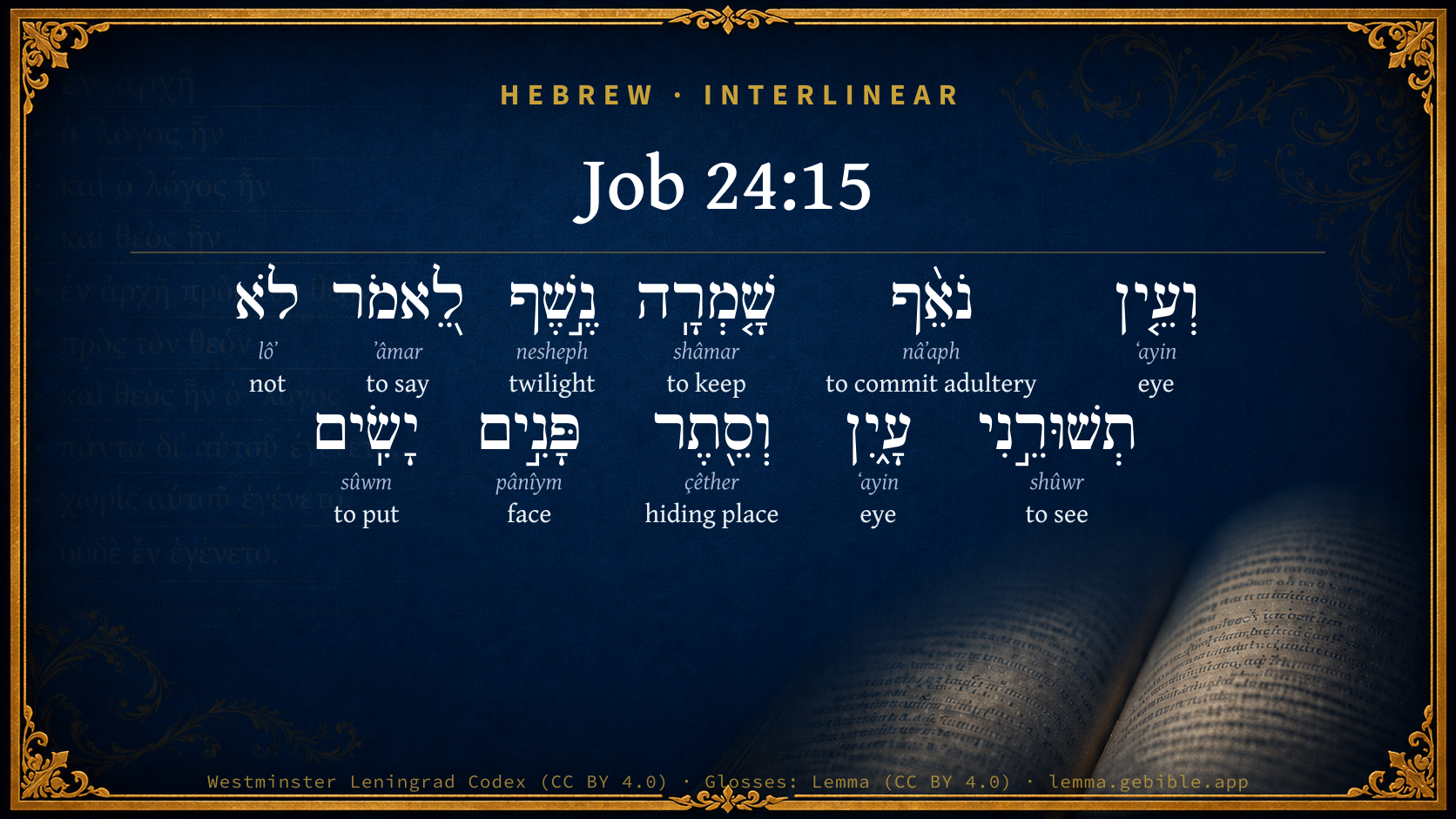
  1. וְעֵ֤ין ʻayin H5869 “and · eye of” Conjunction + Noun, Common, Both, Singular, Construct
  2. נֹאֵ֨ף nâʼaph H5003 “committing adultery” Verb, Qal, Participle Active, Masculine, Singular, Absolute
  3. שָׁ֤מְרָֽה shâmar H8104 “to keep” Verb, Qal, Perfect, 3rd Person, Feminine, Singular
  4. לֵ֭אמֹר ʼâmar H559 “to say” Preposition + Verb, Qal, Infinitive Construct
  5. לֹא lôʼ H3808 “not” Particle, Negative
  6. תְשׁוּרֵ֣נִי shûwr H7789 “to see · me” Verb, Qal, Imperfect, 3rd Person, Feminine, Singular + Suffix, Personal, 1st Person, Common, Singular
  7. עָ֑יִן ʻayin H5869 “eye” Noun, Common, Both, Singular, Absolute
  8. וְסֵ֖תֶר çêther H5643 “and · hiding place of” Conjunction + Noun, Common, Masculine, Singular, Construct
  9. פָּנִ֣ים pânîym H6440 “face(s)” Noun, Common, Both, Plural, Absolute
  10. יָשִֽׂים sûwm H7760 “to put” Verb, Qal, Imperfect, 3rd Person, Masculine, Singular

About this verse

These counts appear in no published source. They are computed here, from the morphology-tagged text and Lemma’s own curated glosses. What Lemma adds →

11
words
10
distinct lemmas
Wisdom
section

Notable vocabulary

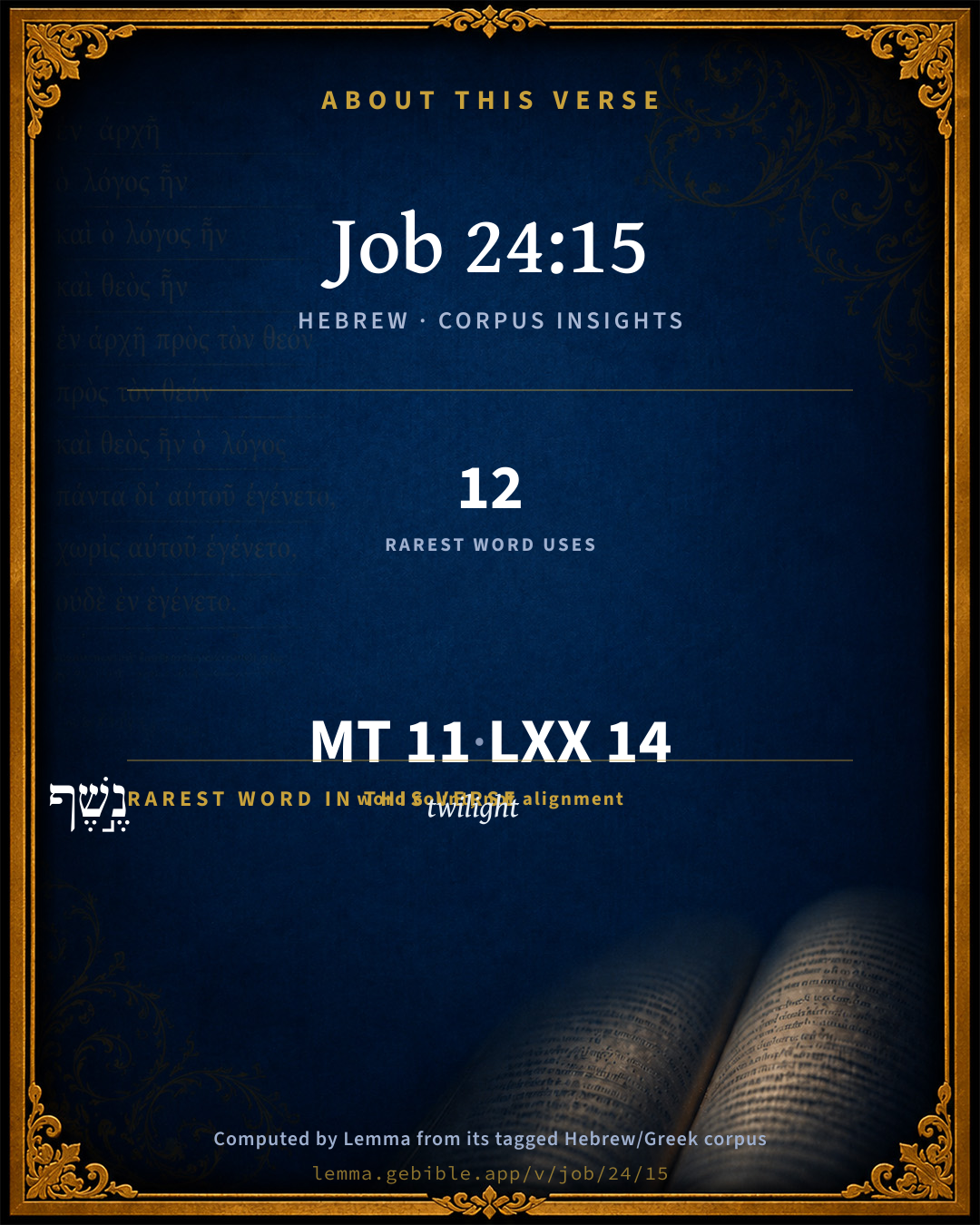
The rarest word here is נֶ֣שֶׁף twilight H5399 — appearing just 12 times in the whole Hebrew Bible.

Shared distinctive vocabulary

נֶ֣שֶׁף twilight H5399 occurs in 12 verses of the Hebrew Bible. Also found in:

Grammatical profile

  • 5 verbs
  • 5 nouns
  • 1 particle

Verb forms

  • נֹאֵ֨ף Qal · Participle Active
  • שָׁ֤מְרָֽה Qal · Perfect
  • לֵ֭אמֹר Qal · Infinitive Construct
  • תְשׁוּרֵ֣נִי Qal · Imperfect
  • יָשִֽׂים Qal · Imperfect

Repetition

A word recurs within this verse — often emphatic in Hebrew:

  • וְעֵ֤ין eye H5869 ×2

Hebrew & Septuagint length

In English translation the verse runs 20 words from the Hebrew and 25 from the Septuagint (LXX English) — closely comparable.

A rough comparison of the two English renderings, which tokenize alike — not a word-level alignment.

Word counts can differ between the Hebrew and the Greek without any difference in meaning — e.g. the Hebrew direct-object marker אֵת has no separate Greek word, and Greek often adds the article ὁ.

In the original languages it is 11 Hebrew tokens and 14 Greek tokens — but the two are counted differently (Hebrew bundles its prefixes and suffixes into one token; the Greek is in lemma form), so that isn’t a like-for-like length.

Cross-references

13

Topical passages linked to Job 24:15 in the Treasury of Scripture Knowledge — connected by theme and wording, ordered by reader-vote popularity; previews shown in the World English Bible.

  • Psalms 10:11 He says in his heart, "God has forgotten. He hides his face. He will never see it."
  • Proverbs 7:9–10 In the twilight, in the evening of the day, In the middle of the night and in the darkness.
  • Psalms 94:7 They say, "Yah will not see, Neither will Jacob's God consider."
  • Proverbs 6:32–35 He who commits adultery with a woman is void of understanding. He who does it destroys his own soul.
  • Ezekiel 8:12 Then said he to me, Son of man, have you seen what the elders of the house of Israel do in the dark, every man in his chambers of imagery? for they say, Yahweh doesn't see us; Yahweh has forsaken the land.
  • Ezekiel 9:9 Then said he to me, The iniquity of the house of Israel and Judah is exceeding great, and the land is full of blood, and the city full of wrestling [of judgment]: for they say, Yahweh has forsaken the land, and Yahweh doesn't see.
  • Genesis 38:14–15 She took off of her the garments of her widowhood, and covered herself with her veil, and wrapped herself, and sat in the gate of Enaim, which is by the way to Timnah; for she saw that Shelah was grown up, and she wasn't given to him as a wife.
  • Exodus 20:14 "You shall not commit adultery.
  • 2 Samuel 11:4–13 David sent messengers, and took her; and she came in to him, and he lay with her (for she was purified from her uncleanness); and she returned to her house.
  • 2 Samuel 12:12 For you did it secretly, but I will do this thing before all Israel, and before the sun.'"
  • Job 22:13–14 You say, 'What does God know? Can he judge through the thick darkness?
  • Psalms 50:18 When you saw a thief, you consented with him, And have participated with adulterers.
  • Psalms 73:11 They say, "How does God know? Is there knowledge in the Most High?"

Cross-references courtesy of OpenBible.info (CC BY 4.0).

Hebrew and Greek witnesses Masoretic Hebrew ↔ Greek Septuagint

The same verse in the two great witnesses to the Old Testament, shown verse-for-verse.

These are two independent witnesses, not word-aligned to each other, and the Septuagint is shown in lemma (dictionary) form.

Hebrew Job 24:15 Masoretic · Westminster Leningrad Codex

וְעֵ֤ין נֹאֵ֨ף שָׁ֤מְרָֽה נֶ֣שֶׁף לֵ֭אמֹר לֹא תְשׁוּרֵ֣נִי עָ֑יִן וְסֵ֖תֶר פָּנִ֣ים יָשִֽׂים

The eye also of the adulterer waits for the twilight, Saying, 'No eye shall see me.' He disguises his face.

World English Bible · Public Domain

Greek LXX Job 24:15 Septuagint · lemma form

καί ὀφθαλμός μοιχός φυλάσσω σκότος λέγω οὐ προςνοέω ἐγώ ὀφθαλμός καί ἀποκρυβή πρόσωπον τίθημι

and the eye of the adulterer has watched for the darkness, saying, Eye shall not perceive me, and he puts a covering on his face.

LXX2012 (modern English Septuagint) · Public Domain

On this verse, Haydock's Catholic Bible Commentary discusses the Septuagint’s reading. Read the note in Commentary ↓

Hebrew: Westminster Leningrad Codex (CC BY 4.0). Greek: Septuagint (public domain); English from LXX2012 (modern English Septuagint) (Public Domain). How the Septuagint differs from the Hebrew →

Commentary

Notes on Job 24:15 from classic Christian and Jewish commentators (each source and its license shown beneath its notes). The classic Christian expositions comment on the surrounding passage and are grouped to its opening verse, so a note may address several verses; the Jewish commentaries on the Tanakh (Rashi and others) are per-verse, so they appear only where the commentator wrote on this verse.

Lemma curates 59 commentaries, every one of them public domain or Creative Commons licensed, each selected and text-cleaned for this edition rather than reprinted as found. About our sources →

Adam Clarke's Commentary

Verse 15. The eye also of the adulterer] This is another sin particularly of the city. The adulterer has made his assignation; he has marked the house of her into whose good graces he has insinuated himself, called digging through the house; he waits impatiently for the dusk; and then goes forth, having muffled or disguised his face, and spends a criminal night with the faithless wife of another man. The morning dawns: but it is to him as the shadow of death, lest he should be detected before he can reach his own home. And if one know him - if he happen to be recognized in coming out of the forbidden house; the terrors of death seize upon him, being afraid that the thing shall be brought to light, or that he shall be called to account, a sanguinary account, by the injured husband.

This seems to be the general sense of the very natural picture which Job draws in the 15th, 16th, and 17th verses. Job 24:15-17

Adam Clarke's Commentary on the Bible (1810–1826) — public domain. Text from a community e-Sword/MySword module.

Trapp's Complete Commentary

John Trapp

Job 24:15 The eye also of the adulterer waiteth for the twilight, saying, No eye shall see me: and disguiseth [his] face.

Ver. 15. The eye also of the adulterer waiteth] Observeth, expecteth, and longeth till it cometh. Ut videas illum non peccare infirmitate sed malitin, saith Vatablus. This showeth that he sinneth not of infirmity, but of forethought, malice, and wickedness; which he plotteth and plougheth, as the Scripture phraseth it, purveying for the flesh, Rom 13:14, putrefying alive, under a tabes of impure lusts, and daily perishing therein, as Tiberius, at Capreae, by his own confession, Quotidie perire me sentio (Suet.). This beast was not ashamed of his detestable filthiness; as being a most impure and impudent defiler of other men’s beds. But the adulterer here spoken of seeks the covert of the twilight, and another of a disguise. He putteth his face in a secret place, so the Hebrew hath it, wrapping it in his cloak, or getting on a vizard, which, saith he, shall render me unknown, and no eye shall see me. For as for God’s eye, either he conceits him blind or presumes him indulgent, not doubting an easy and speedy pardon. This is charged upon David, 2Sa 12:10, "because thou hast despised me," &c., viz. in thinking to sin secretly, not considering mine all seeing eye, not caring though I looked on, &c., therefore shall all come to light, Job 24:12. Sin secretly committed shall be strangely discovered; yea, perhaps the sinner himself shall confess his sins, as Judas. So, sooner or later, "God will bring every work into judgment, with every secret thing," Ecc 12:14; see also /Apc Sir 33:13-17

John Trapp, A Commentary or Exposition upon All the Books of the Old and New Testament (1647–1656) — public domain. Text from a community e-Sword module.

Geneva Bible (1599)

Geneva Bible translators

By these particular vices and the licence thereunto, he would prove that God punished not the wicked, and rewardeth the just.

Geneva Bible (1599) marginal notes — public domain. Text via Bolls.life.

Jamieson, Fausset & Brown

Robert Jamieson, A. R. Fausset & David Brown

(Pro 7:9; Psa 10:11).

disguiseth--puts a veil on.

Jamieson, Fausset & Brown — Commentary Critical and Explanatory on the Whole Bible (1871) — public domain (CC PDM 1.0). Text via the HelloAO Bible API.

The Cambridge Bible for Schools and Colleges

gen. ed. J. J. S. Perowne

15. The adulterer waits for the “twilight,” i. e. of even. Then he disguises himself, or puts a cover on his face, that he may enter undetected the house of his neighbour.

The Cambridge Bible for Schools and Colleges (gen. ed. J. J. S. Perowne; Cambridge University Press, 1878–1918) — public domain. Text from a community e-Sword module.

John Gill's Exposition

The eye also of the adulterer waiteth for the twilight,.... Not of the morning, which would not give him time enough to satiate his lust, but of the evening, that he may have the whole night before him to gratify his impure desires, and that these may be indulged in the most private and secret manner; and having fixed the time in the evening with his adulteress, he waits with impatience, and earnestly wishes and longs for its coming, and diligently looks out for the close of day, and takes the first opportunity of the darkness of the evening to set out on his adventure, see Pro 7:7; and the "eye" is particularly observed, not only because that is the instrument by which the twilight is discerned, and is industriously employed in looking out for it, but is full of adultery, as the Apostle Peter expresses it, Pe2 2:14; it is what is the inlet to this sin, the leader on to it, the caterer for it, and the nourisher, and cherisher of it, see Job 30:1;

saying, no eye shall see me; no eye of man, which such an one is careful to guard against; and especially the eye of the husband of the adulteress, whose raging jealousy will not spare the adulterer, but take revenge on him by an immediate dispatch of him. And few care to have it known by any that they are guilty of this sin, because it brings dishonour and reproach upon them, which cannot be wiped off: the fact of Absalom going in to his father's concubines in the sight of all Israel, Sa2 16:21, and lying with them in the face of the sun, is the most notorious instance of this kind to be read; usually both sexes choose the utmost secrecy. Potiphar's wife took the opportunity to tempt Joseph when none of the men of the house were within, Gen 35:10; and when Amnon intended to force his sister, he ordered all the men to be had out of the room, Sa2 13:9, and moreover, the adulterer foolishly fancies that God sees him not, or at least is not concerned about that; though there is no darkness where such workers of iniquity can hide themselves from his all seeing eye, the darkness and the light are both alike to him. These men are like the ostrich, which thrusting its head into a thicket, as Tertullian (t) observes, fancies it is not seen; so children cover their faces, and, because they see none, think that nobody sees them; and as weak and childish a part do such act, who imagine that their evil deeds, done in the dark, are not seen by him, before whom every creature is made manifest, and all things are naked and open:

and disguiseth his face; puts a mask upon it, that he may not be known by any he meets, when upon his amorous adventure, as harlots used to cover themselves with a vail, Gen 38:14.

(t) De Virgin, Veland. c. 17.

John Gill's Exposition of the Whole Bible (1746–1763) — public domain (CC PDM 1.0). Text via the HelloAO Bible API.

Albert Barnes' Notes on the Bible

The eye also of the adulterer waiteth for the twilight; - compare the description in Pro 7:8-9, “He went the way to her house; in the twilight, in the evening, in the black and dark night.”

And disguiseth his face - Margin, “setteth his face in secret.” The meaning is, that he put a mask on his face, lest he should be recognized. So Juvenal, Sat. viii. 144, as quoted by Noyes:

- si nocturnus adulter

Tempora Santonico velas adoperta cucullo.

These deeds of wickedness were then performed in the night, as they are still; and yet, though the eye of God beheld them, he did not punish them. The meaning of Job is, that people were allowed to commit the blackest crimes, but that God did not come forth to cut them off.

Albert Barnes' Notes on the Bible (1834–1885) — public domain. Text from a community e-Sword/MySword module.

Haydock's Catholic Bible Commentary

Face. Septuagint insinuate "with a mask." Protestants, "disguiseth his face."

George Leo Haydock (1774–1849), Haydock's Catholic Family Bible and Commentary, 1859 edition — public domain. Excludes Psalms (Douay-Rheims chapter numbering differs from Protestant) and Deuterocanonical books (Catholic canon only).

Matthew Poole's English Annotations

The eye of the adulterer, i.e. the adulterer; but he mentions his eye, because the eye discerns the difference between light and darkness.

The twilight, to wit, for the evening twilight, which is his opportunity.

Saying in his heart, comforting himself with the thoughts of secretness and impunity.

Disguiseth his face, Heb. putteth his face in secret; covers it with a vizard or cloak, that he may be undiscovered.

Matthew Poole's English Annotations on the Holy Bible (1683–1685) — public domain. Text from a community e-Sword/MySword module.

Whedon's Commentary on the Bible

Daniel D. Whedon

15. Disguiseth his face — Puts a veil over the face: Wetzstein thinks a woman’s veil. “In Syrian towns,” he says, “women’s clothing is always chosen for such nocturnal sin. The man disguises himself in an izar, which covers him from head to foot, takes the mendil, veil, and goes with a lantern (without which at night every person is seized by the street watchman as a suspicious person) unhindered into a strange house.” Juvenal speaks of the rank adulterer with his head muffled in a Gallic hood, 8:144.

Daniel D. Whedon (gen. ed.), Commentary on the Old and New Testaments (1874–1909) — public domain. Text from a community e-Sword module.

The Pulpit Commentary

The eye also of the adulterer waiteth for the twilight, saying, No eye shall see me. There is an analogy between moral and physical light, and between moral and physical darkness. The class of men here spoken of (vers. 14-16), who have rebelled against moral light (ver. 13), and refused its ways, and rejected its paths, are no great lovers of physical light. Their deeds of darkness are only suited to be done in the dark, and they wait for the evening twilight or the dusk of dawn to engage in them. (comp. Joh_3:19-21, "And this is the condemnation, that light is come into the world, and men loved darkness rather than light, because their deeds were evil. For every one that doeth evil hateth the light, neither cometh to the light, lest his deeds should be reproved. But he that doeth truth cometh to the light, that his deeds may be made manifest, that they are wrought in God." See also Joh_8:12 Joh 12:35 Rom_13:12 Eph_5:8-14, etc.) And he disguiseth his face. As a further precaution against discovery, the adulterer disguiseth, or covereth up, his face. The same is often done by thieves and murderers.

The Pulpit Commentary (1880–1919), ed. H.D.M. Spence-Jones & Joseph S. Exell — public domain. Text from a community e-Sword module.

unfoldingWord translationNotes

Door43 World Missions Community

Connecting Statement:

Job continues speaking.

the eye of the adulterer

Here "eye" refers to the whole person. AT: "the adulterer" (See: Synecdoche)

for the twilight

"for the sunset"

No eye will see me

Here "eye" refers to the whole person. AT: "No one will see me" (See: Synecdoche)

wicked people dig into houses

They dig into the houses in order to steal from them. This can be stated explicitly. AT: "wicked people dig into houses to steal from them" (See: Assumed Knowledge and Implicit Information)

they shut themselves up

"they hide inside"

For all of them, thick darkness is like the morning

The thick darkness is as comfortable for the wicked as light of the morning is for normal people. (See: Simile)

the terrors of thick darkness

"the scary things that happen at night"

translationWords

adultery

darkness

house

terror

unfoldingWord translationNotes — © Distant Shores Media and the Door43 World Missions Community, licensed CC BY-SA 4.0. Source: git.door43.org/Door43/en_tn.

Rashi

Rabbi Shlomo Yitzchaki (Rashi)

And the eye of the adulterer And the adulterer among them would wait until evening, saying...

a mask And he puts a mask on his face to commit a transgression, for the generation of the Flood was suspected of all these: of robbery, for it is stated (Gen. 6:11): “and the earth was filled with violence,” and of immorality, for it is stated (ibid. verse 12): “for all flesh had corrupted [its way on the earth].”

Rashi on the Tanakh — English translations: “The Judaica Press complete Tanach with Rashi, translated by A. J. Rosenberg” (CC BY 4.0); “Pentateuch with Rashi's commentary by M. Rosenbaum and A.M. Silbermann, 1929-1934” (public domain); “The Metsudah Tanach series, Lakewood, N.J” (CC BY 4.0); and “The Book of Joshua, Metsudah Publications, 1997” (CC BY 4.0). Text via Sefaria.

Lesson kit

Teaching starters — assembled from the data on this page, not authored interpretation. Every prompt links to the verse data it draws on. Edit before teaching.

Job, in the Wisdom, opens this verse with 11 words (10 distinct Hebrew lemmas). Its most distinctive word is nesheph (“twilight”). A historical commentator’s framing appears above. Read the whole chapter for the surrounding context.

Discussion questions

  1. What does “twilight” (nesheph) contribute to the verse as a whole?
  2. How does 1 Samuel 30:17, which shares the word «twilight», read alongside this verse?
  3. What does the repetition of “eye” (2× in this one verse) do in this verse?
  4. These translations render this verse differently. What is at stake in choosing one wording over another?
  5. «נֹאֵ֨ף» is a Qal Participle Active verb. How does that grammatical form shape the action described?
  6. Compare how Adam Clarke's Commentary and Trapp's Complete Commentary read this verse. Where do they agree or differ?

Things to notice

Reading settings

Reading text

Shown beneath each verse's original-language words.

Old Testament
Old Testament edition

Read the OT as the Masoretic Hebrew (MT) or the Greek Septuagint (LXX).

English shown for the Greek Septuagint (in the Hebrew ↔ Greek comparison).

Comparing translations? Open the Compare panel on any verse page to stack up to four side by side.