
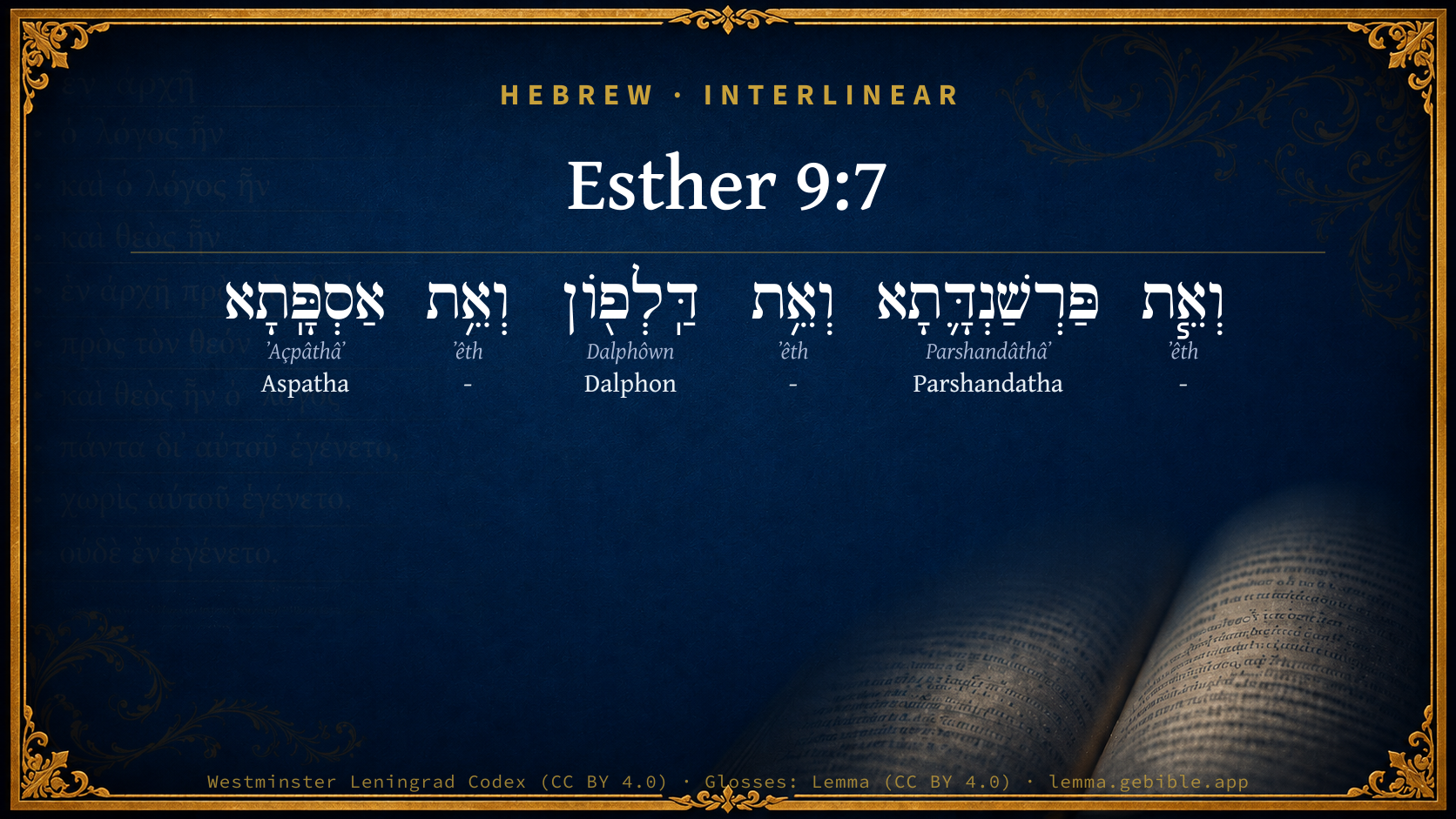
Esther 9:7

Hebrew (Westminster Leningrad Codex) Esther 9:7 appears in the Hebrew Old Testament. The text above is from the Westminster Leningrad Codex. Each word links to its Strong’s number, a concise gloss, and parsing drawn from the Open Scriptures Hebrew Bible morphology. Click any word for its full Brown-Driver-Briggs (BDB) entry.
Download image
Cite this verse

Esther 9:7 (World English Bible). Public Domain. Lemma interlinear Bible study tool, https://lemma.gebible.app/v/esther/9/7.

Show BibTeX & RIS
BibTeX
RIS
English Translation
Parshandatha, and Dalphon, and Aspatha,
World English Bible · Public Domain
Highlights
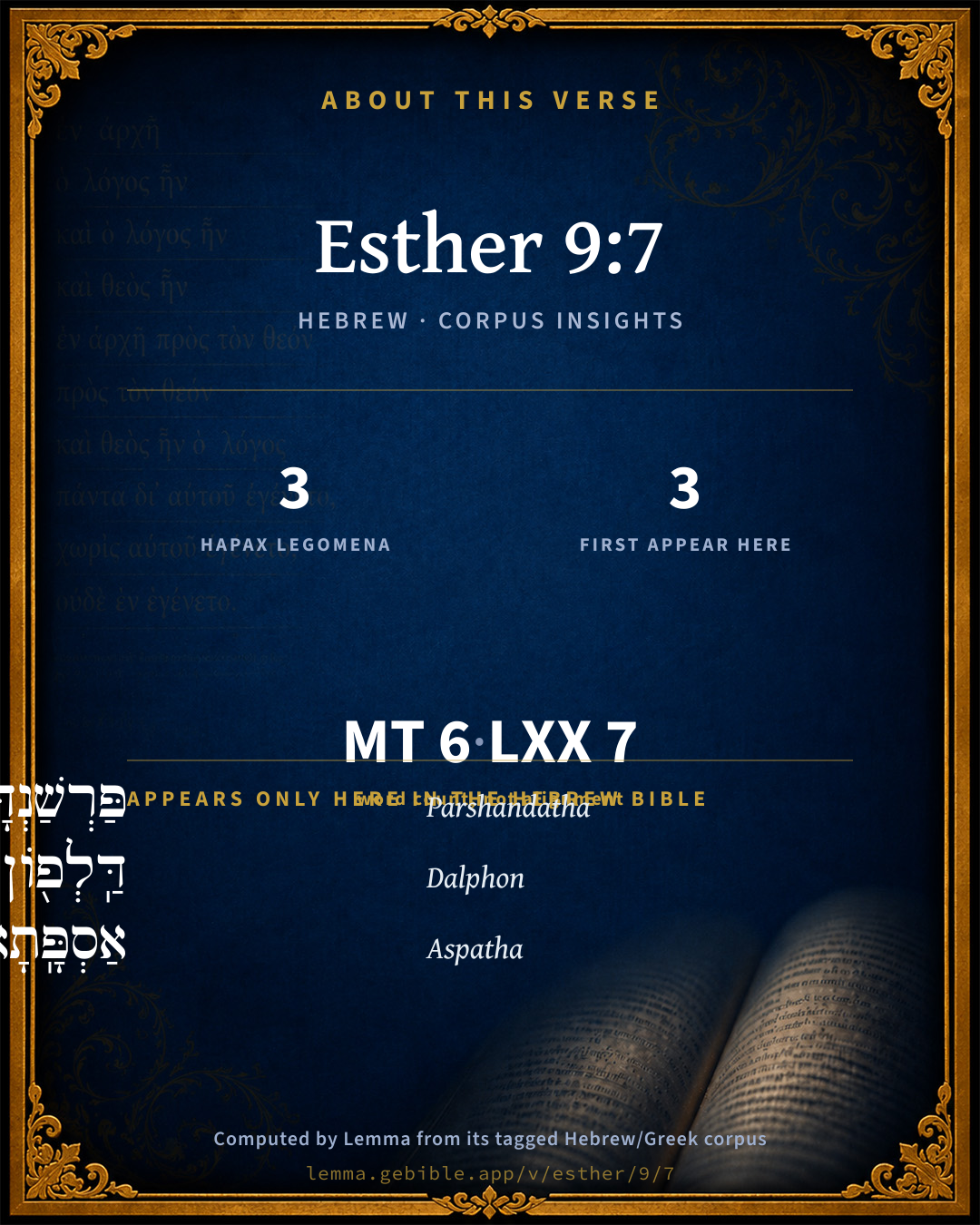
  • 3 hapax legomena — only here in the Hebrew Bible
  • 3 first appearances in the Hebrew Bible
Full analysis ↓
Download a study sheet

One document with this verse’s original text, its word-by-word gloss line, the meaning frame, cross-references with their text, attributed commentary, and full source and license credits — printable, and it pastes into notes with its structure intact.

This verse Autodidact and up

Study sheet (.html) Plain text (.txt)

A passage Seminary Student

Up to 50 verses in one chapter. A passage sheet keeps up to 6 commentary sources and 12 cross-references per verse, in the order this page ranks them, and says so on the sheet whenever that leaves anything out. Ask for a single verse and you get the Autodidact verse sheet above.

Everything on this page stays free to read, with no account — the sheet is a download of what is already on screen, not access to it.

Want to remove ads? Support Godless Engineer
Compare translations 3

The same verse in 3 English versions, stacked beneath the original-language interlinear above. Click any original word for its lexicon entry.

Each is an independent rendering of the whole verse — the interlinear is not word-aligned to these translations.

Highlighted words mark where these versions differ — a whole-verse word diff, not a word-by-word alignment.

  • World English Bible Public Domain
    Parshandatha, and Dalphon, and Aspatha,
  • King James Version Public Domain
    And Parshandatha, and Dalphon, and Aspatha,
  • unfoldingWord Literal Text CC BY-SA 4.0
    And Parshandatha and Dalphon and Aspatha

unfoldingWord Literal Text — © unfoldingWord, licensed CC BY-SA 4.0. Word-aligned USFM3 via Door43 (git.door43.org/unfoldingWord/en_ult).

Versions to compare (up to 4)

3 of 4 selected

Show all 18 translations

Every available English version of this verse, each an independent rendering of the whole verse.

  • World English Bible Public Domain
    Parshandatha, and Dalphon, and Aspatha,
  • Berean Standard Bible Public Domain
    including Parshandatha, Dalphon, Aspatha,
  • Majority Standard Bible Public Domain
    including Parshandatha, Dalphon, Aspatha,
  • King James Version Public Domain
    And Parshandatha, and Dalphon, and Aspatha,
  • American Standard Version (1901) Public Domain
    And Parshandatha, and Dalphon, and Aspatha,
  • Revised Version (1885) Public Domain
    And Parshandatha, and Dalphon, and Aspatha,
  • Geneva Bible (1599) Public Domain
    And Parshandatha, and Dalphon, and Aspatha,
  • Douay-Rheims (1899) Public Domain
    Pharsandatha, and Delphon, and Esphatha,
  • Young's Literal Translation Public Domain
    and Parshandatha, and Dalphon, and Aspatha,
  • Literal Standard Version CC BY-SA 4.0
    and Parshandatha, and Dalphon, and Aspatha,
  • Unlocked Literal Bible CC BY-SA 4.0
    They killed Parshandatha, Dalphon, Aspatha,
  • unfoldingWord Literal Text CC BY-SA 4.0
    And Parshandatha and Dalphon and Aspatha
  • Darby Bible Public Domain
    And Parshandatha, and Dalphon, and Aspatha,
  • World Messianic Bible Public Domain
    They killed Parshandatha, Dalphon, Aspatha,
  • Webster's Bible Public Domain
    And Parshandatha, and Dalphon, and Aspatha,
  • Free Bible Version CC BY-SA 4.0
    This included Parshandatha, Dalphon, Aspatha,
  • Bible in Basic English Public Domain
    They put to death Parshandatha, Dalphon, Aspatha,
  • JPS Tanakh (1917) Public Domain
    And Parshandatha, and Dalphon, and Aspatha,

Literal Standard Version (2020), Covenant Press — licensed CC BY-SA 4.0. Text via the HelloAO Bible API (eBible.org). Unlocked Literal Bible (unfoldingWord) — licensed CC BY-SA 4.0. Text via the HelloAO Bible API (eBible.org). unfoldingWord Literal Text — © unfoldingWord, licensed CC BY-SA 4.0. Word-aligned USFM3 via Door43 (git.door43.org/unfoldingWord/en_ult). Free Bible Version, Dr. Jonathan Gallagher — licensed CC BY-SA 4.0. Text via the HelloAO Bible API (eBible.org).

Word by word

More ways to search: Search by grammar → Find every occurrence → Compare this word →

Practice this passage: Drill this verse → Learn its vocabulary →

About this verse

These counts appear in no published source. They are computed here, from the morphology-tagged text and Lemma’s own curated glosses. What Lemma adds →

6
words
4
distinct lemmas
Historical
section

Notable vocabulary

3 hapax legomena — words that appear only here in the entire Hebrew Bible:

  • פַּרְשַׁנְדָּ֛תָא Parshandatha H6577
  • דַּֽלְפ֖וֹן Dalphon H1813
  • אַסְפָּֽתָא Aspatha H630

First appearance in Scripture

These words make their first canonical appearance in the Hebrew Bible here:

  • פַּרְשַׁנְדָּ֛תָא Parshandatha H6577
  • דַּֽלְפ֖וֹן Dalphon H1813
  • אַסְפָּֽתָא Aspatha H630

Grammatical profile

  • 3 nouns
  • 3 particles

Hebrew & Septuagint length

In English translation the verse runs 5 words from the Hebrew and 6 from the Septuagint (LXX English) — closely comparable.

A rough comparison of the two English renderings, which tokenize alike — not a word-level alignment.

Word counts can differ between the Hebrew and the Greek without any difference in meaning — e.g. the Hebrew direct-object marker אֵת has no separate Greek word, and Greek often adds the article ὁ.

In the original languages it is 6 Hebrew tokens and 7 Greek tokens — but the two are counted differently (Hebrew bundles its prefixes and suffixes into one token; the Greek is in lemma form), so that isn’t a like-for-like length.

Hebrew and Greek witnesses Masoretic Hebrew ↔ Greek Septuagint

The same verse in the two great witnesses to the Old Testament, shown verse-for-verse.

These are two independent witnesses, not word-aligned to each other, and the Septuagint is shown in lemma (dictionary) form.

Hebrew Esther 9:7 Masoretic · Westminster Leningrad Codex

וְאֵ֧ת פַּרְשַׁנְדָּ֛תָא וְאֵ֥ת דַּֽלְפ֖וֹן וְאֵ֥ת אַסְפָּֽתָא

Parshandatha, and Dalphon, and Aspatha,

World English Bible · Public Domain

Greek LXX Esther 9:7 Septuagint · lemma form

ὁ τε φαρσαννεσταιν καί δελφων καί φασγα

both Pharsannes, and Delphon and Phasga,

LXX2012 (modern English Septuagint) · Public Domain

On this verse, The Cambridge Bible for Schools and Colleges discusses the Septuagint’s reading. Read the note in Commentary ↓

Hebrew: Westminster Leningrad Codex (CC BY 4.0). Greek: Septuagint (public domain); English from LXX2012 (modern English Septuagint) (Public Domain). How the Septuagint differs from the Hebrew →

Commentary

Notes on Esther 9:7 from classic Christian and Jewish commentators (each source and its license shown beneath its notes). The classic Christian expositions comment on the surrounding passage and are grouped to its opening verse, so a note may address several verses; the Jewish commentaries on the Tanakh (Rashi and others) are per-verse, so they appear only where the commentator wrote on this verse.

Lemma curates 59 commentaries, every one of them public domain or Creative Commons licensed, each selected and text-cleaned for this edition rather than reprinted as found. About our sources →

Trapp's Complete Commentary

John Trapp

Est 9:7 And Parshandatha, and Dalphon, and Aspatha,

Ver. 7-9. And Parshandatha, and Dalphon … and Vajezatha] This Vajezatha was the youngest, but most malicious of them all against the Jews, as their doctors guess and gather from the little Zain and great Vau found in his name. {Hebrew Text Note}

John Trapp, A Commentary or Exposition upon All the Books of the Old and New Testament (1647–1656) — public domain. Text from a community e-Sword module.

Tyndale Open Study Notes

Tyndale Open Resources

9:7-10 They also killed . . . the ten sons of Haman: Now everything that Haman had boasted about (5:11) was gone, even his ten sons.

Tyndale Open Study Notes — © Tyndale Open Resources, licensed CC BY-SA 4.0. Text via the HelloAO Bible API.

Ellicott's Commentary for English Readers

(7-9) The names of the ten sons of Haman are, except Adalia, all readily traceable to old Persian roots. It may be noted that in a Hebrew Bible the ten names are written vertically, one under the other, in a column; and the Targum or Chaldee paraphrase says that the ten sons were hanged one above the other at fixed distances.

A Bible Commentary for English Readers, edited by Charles John Ellicott (1878–1897) — public domain. Text from a community e-Sword module.

The Cambridge Bible for Schools and Colleges

gen. ed. J. J. S. Perowne

7–9. Most if not all of these names are apparently of Persian origin, and this circumstance is against the supposition that this was not Haman’s nationality as well. The Heb. text exhibits peculiarities in arrangement and orthography. The ten names are placed vertically. According to Jewish tradition this is to indicate that they were hung one above another on an exceedingly lofty gallows. Moreover, the first letter of the last name is written large, and one of those composing the second, seventh, and tenth names is made smaller than its neighbours. The reason for these peculiarities remains obscure. Evidently at an early date the words became subject to extensive corruption. The LXX. text differs widely.

The Cambridge Bible for Schools and Colleges (gen. ed. J. J. S. Perowne; Cambridge University Press, 1878–1918) — public domain. Text from a community e-Sword module.

John Gill's Exposition

On that day the number of those that were slain in Shushan the palace was brought before the king. Either by order of the king, that he might know how many enemies the Jews had in the city, and how many of subjects had been slain; or officiously by others, with an intention to irritate the king against the Jews.

On that day the number of those that were slain in Shushan the palace was brought before the king. Either by order of the king, that he might know how many enemies the Jews had in the city, and how many of subjects had been slain; or officiously by others, with an intention to irritate the king against the Jews.

Esther 9:12

est 9:12

est 9:12

est 9:12And the king said unto Esther the queen,.... After the account had been brought in to him:

the Jews have slain and destroyed five hundred men in Shushan the palace; the Targum adds, of the seed of Amalek:

and the ten sons of Haman: which very probably were all he had; though the Targum, in Est 9:14, makes mention of seventy sons that Zeresh his wife fled with:

what have they done in the rest of the king's provinces? that could not be said; but it might be concluded, that if so many were slain in Shushan, the number must be great in all the provinces:

now what is thy petition and it shall be granted thee: or "what is thy request further? and it shall be done"; if this was not sufficient and satisfactory, whatever else she should ask for should be granted.

John Gill's Exposition of the Whole Bible (1746–1763) — public domain (CC PDM 1.0). Text via the HelloAO Bible API.

Albert Barnes' Notes on the Bible

Most of these names are Persian, and readily traceable to Old Persian roots.

Est 9:10

On the spoil laid they not their hand - As they might have done (see the margin reference).

Albert Barnes' Notes on the Bible (1834–1885) — public domain. Text from a community e-Sword/MySword module.

Whedon's Commentary on the Bible

Daniel D. Whedon

7-9. Parshandatha… Vajezatha — These names of Haman’s ten sons are written in Hebrew MSS. in perpendicular columns, and it is said that the reader in the synagogue is required to pronounce them all at one breath. The Targum says they were all suspended, one above another, upon one cross, fifty cubits high, which Mordecai had prepared for the purpose. In the Masoretic text the letters תand שׁ, in the names of Parshandatha and Parmashta, are written in smaller form than the rest, and in the last name, Vajezatha, the וis written large, and the זsmall — all which, perhaps, represents some mystic Rabbinical conceit. Most of these names are of Persian origin, a fact which has great weight in showing the genuineness of the Book of Esther.

Daniel D. Whedon (gen. ed.), Commentary on the Old and New Testaments (1874–1909) — public domain. Text from a community e-Sword module.

The Pulpit Commentary

And Parshandatha. Haman"s ten sons have unmistakably Persian names, so that no countenance is given by them to the theory that he was a foreigner. Formerly it was customary that they should be written in each MS. of the Book of Esther in three perpendicular lines, to signify (as it was said) that they were hanged on three parallel cords. In reading them the ten names were uttered in one breath, in memory of the supposed fact that they all died in one instant. It would be wrong, however, to attach credit to these traditions, which simply show the persistent hatred with which the Jews regarded their great enemy. Slew they. With the sword, probably (see ver. 5), and in fair fight.

The Pulpit Commentary (1880–1919), ed. H.D.M. Spence-Jones & Joseph S. Exell — public domain. Text from a community e-Sword module.

Lesson kit

Teaching starters — assembled from the data on this page, not authored interpretation. Every prompt links to the verse data it draws on. Edit before teaching.

Esther, in the Historical, opens this verse with 6 words (4 distinct Hebrew lemmas). Its most distinctive word is Parshandâthâʼ (“Parshandatha”). A historical commentator’s framing appears above. Read the whole chapter for the surrounding context.

Discussion questions

  1. How does “Parshandatha” (Parshandâthâʼ) shape what this verse is saying?
  2. 3 words here appear nowhere else in the Hebrew Bible. Why might the author reach for such rare wording?
  3. 3 words make their first appearance in Scripture here. What does this debut establish?
  4. Compare how Trapp's Complete Commentary and Tyndale Open Study Notes read this verse. Where do they agree or differ?

Things to notice

Reading settings

Reading text

Shown beneath each verse's original-language words.

Old Testament
Old Testament edition

Read the OT as the Masoretic Hebrew (MT) or the Greek Septuagint (LXX).

English shown for the Greek Septuagint (in the Hebrew ↔ Greek comparison).

Comparing translations? Open the Compare panel on any verse page to stack up to four side by side.