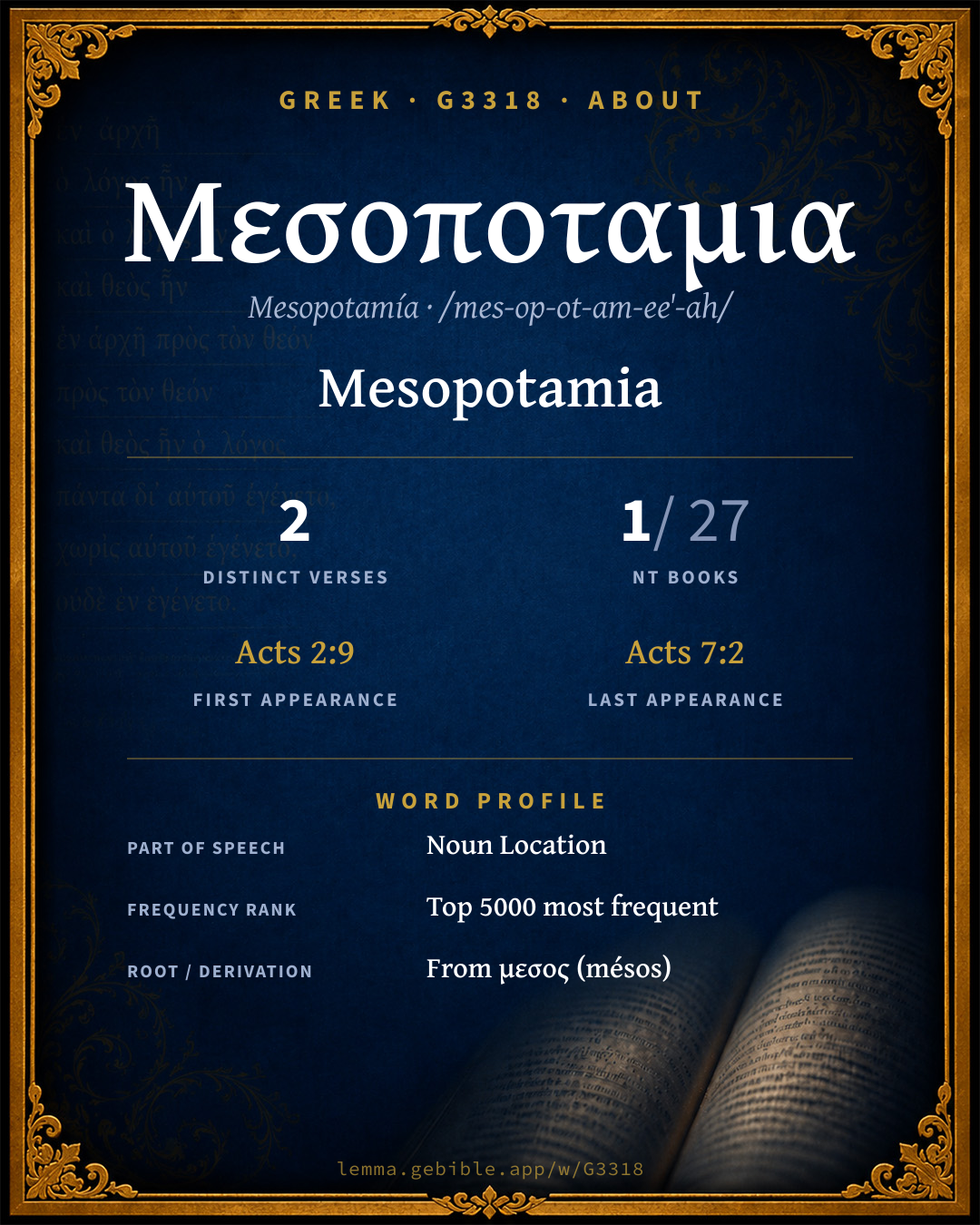
Μεσοποταμία
Mesopotamia
Thayer's lists 2 entries for ‘Mesopotamia’ fuller range ↓
Full lexicon entry — Thayer's Greek Lexicon
From Thayer's Greek Lexicon
Where this word appears
See every Accusative-case word in the Greek New Testament →
Grammar key — what these labels mean
Part of speech
- Noun
- A naming word — a person, place, thing, or idea.
Case
- Accusative
- The case of the direct object and of extent.
- Dative
- The case of the indirect object, means, or location — “to / for / with / in.”
Gender
- Feminine
- Grammatically feminine.
Number
- Singular
- One.
Grammatical forms
- Noun, Accusative, Singular, Feminine 1 time (50%)
- Noun, Dative, Singular, Feminine 1 time (50%)
Parsed forms decoded from the imported morphology (Robinson–Tischendorf, public domain), counted across 2 parsed occurrences — not distinct verses.
Every verse where G3318 appears — 2 distinct verses across 1 book. Click any verse to open its interlinear word-by-word view. Verse text shown in the World English Bible for context — . Each verse’s Greek form is shown with its reference; the English is not keyword-highlighted, since the data carries no word-level English alignment. Use “Compare translations” on any verse to read it across multiple English versions. This concordance covers the Greek New Testament; Septuagint (Greek Old Testament) occurrences of this word are not indexed here.
Acts 2 verses
- Acts 2:9 Μεσοποταμίαν n acc sg fem Parthians, Medes, Elamites, and people from Mesopotamia, Judea, Cappadocia, Pontus, Asia,
- Acts 7:2 Μεσοποταμίᾳ n dat sg fem He said, "Brothers and fathers, listen. The God of glory appeared to our father Abraham, when he was in Mesopotamia, before he lived in Haran,
About this entry
At a glance — auto-summarized from this page’s data, not written by a person. Every figure links to its source below. This summary describes the numbers; it doesn’t interpret them.
The Greek name Μεσοποταμια centers on the idea of “Mesopotamia.” The Greek New Testament uses it only 2 verses. The word gravitates to Acts (100%). First canonically at Acts 2:9, it enters the text early. Dig into 2-verse concordance and the renderings breakdown below.
Gloss history
Strong's 1890 vs modern scholarship
About this word
Strong's G3318 catalogs a Greek word from the Greek New Testament.
These counts are not copied from any lexicon or concordance. They are computed here, from the morphology-tagged Greek New Testament. What Lemma adds →
- 2
- distinct verses
- The word appears in 2 distinct verses.
- 1 / 27
- NT books
- The word appears in 1 of 27 New Testament books.
- #2,678
- by frequency
- Top 5000 most frequent Greek words (rank 2,678 of 5,347 Greek words by occurrence).
View all 2 occurrences in the concordance →
Most concentrated in
- Acts 2 verses 100%
By section of the New Testament
By traditional corpus
Conventional, traditional groupings — biblical authorship is debated, so this is a traditional corpus grouping, not an authorship claim. Some books belong to more than one corpus (Luke is in both the Gospels and the Lukan corpus, and so on), so these shares overlap and need not total 100%. Each figure is a share of the word’s 2 distinct verses.
- Lukan (Luke–Acts) 2 verses · 100%
How translations render this word
Counts come from each version’s own published word-to-Strong’s tagging or interlinear alignment — an approximate guide to how each version renders this word, not a word-level alignment the data otherwise carries. Because each total is that version’s own tagged count, the per-version totals vary from one another and need not match the appearance or distinct-verse counts above. These counts may also differ from a printed concordance because Lemma counts each distinctly tagged rendering and does not collapse phrase taggings into a single head-word total. This is a fixed set of word-tagged versions (KJV, ASV, BSB, ULT) and does not change with the reading translation you choose elsewhere. Each version’s license is shown beside its name below (and on Sources).
- King James Version: Mesopotamia 2×
- American Standard Version: Mesopotamia 2×
- Berean Standard Bible: Mesopotamia 2×
- unfoldingWord Literal Text: Mesopotamia 2×
King James Version Public Domain
Renders G3318 across 2 tagged occurrences — most commonly:
American Standard Version Public Domain
Renders G3318 across 2 tagged occurrences — most commonly:
Berean Standard Bible Public Domain
Renders G3318 across 2 tagged occurrences — most commonly:
unfoldingWord Literal Text CC BY-SA 4.0
Renders G3318 across 2 tagged occurrences — most commonly:
Senses in Thayer's
The 2 senses Thayer's distinguishes for this word, in lexicon order (not ranked by frequency or importance). The full entry — with sub-senses — is in the Lexicon Entry tab.
- Mesopotamia = "between two rivers"
- the entire country between the two rivers, the Tigris and the Euphrates
Word origin
Derived from μεσος (mésos) (G3319) — middle.
Forms in the corpus
The 2 distinct written forms G3318 takes in the Greek New Testament, most frequent first — each parse links to that case’s occurrences in the concordance.
| Form | Parsing | Example | Uses |
|---|---|---|---|
| Μεσοποταμίαν Mesopotamían | Noun, Accusative, Singular, Feminine | Acts 2:9 | 1 |
| Μεσοποταμίᾳ Mesopotamía | Noun, Dative, Singular, Feminine | Acts 7:2 | 1 |
Same root — word family
Other Thayer's entries built from the same root as G3318, grouped by Strong’s listed origin. These share a root / origin per the lexicon — not necessarily a shared meaning. Each links to that word’s own entry.
Derives from
Shares the same root
- μεσημβρια mesēmbría G3314 noon
- μεσιτης mesítēs G3316 mediator
- μεσονυκτιον mesonýktion G3317 midnight
- μεσοτοιχον mesótoichon G3320 partition wall
- μεσουρανημα mesouránēma G3321 mid-heaven
- μεσοω mesóō G3322 to be midway
Compare all same-root words → Showing 4 of 8 — not the complete family. They share a root, not necessarily a meaning.
Bible dictionary
Public-domain dictionary articles matched to this entry by name (Mesopotamia). A biblical name can be shared by more than one person or place, so an article may treat several.
Easton's Bible Dictionary · M. G. Easton, 1897
The country between the two rivers (Heb. Aram-naharaim; i.e., "Syria of the two rivers"), the name given by the Greeks and Romans to the region between the Euphrates and the Tigris (Gen. 24:10; Deut. 23:4; Judg. 3:8, 10). In the Old Testament it is mentioned also under the name "Padan-aram;" i.e., the plain of Aram, or Syria (Gen. 25:20). The northern portion of this fertile plateau was the original home of the ancestors of the Hebrews (Gen. 11; Acts 7:2). From this region Isaac obtained his wife Rebecca (Gen. 24:10, 15), and here also Jacob sojourned (28:2-7) and obtained his wives, and here most of his sons were born (35:26; 46:15). The petty, independent tribes of this region, each under its own prince, were warlike, and used chariots in battle. They maintained their independence till after the time of David, when they fell under the dominion of Assyria, and were absorbed into the empire (2 Kings 19:13).
Smith's Bible Dictionary · William Smith, 1863
(between the rivers), the entire country between the two rivers, the Tigris and the Euphrates. This is a tract nearly 700 miles long and from 20 to 250 miles broad, extending in a southeasterly direction from Telek to Kurnah . The Arabian geographers term it "the Island," a name which is almost literally correct, since a few miles only intervene between the source of the Tigris and the Euphrates at Telek . But the region which bears the name of Mesopotamia, par excellence, both in Scripture and in the classical writers, is the northwestern portion of this tract, or the country between the great bend of the Euphrates, lat. 35 degrees to 37 degrees 30', and the upper Tigris. We first hear of Mesopotamia in Scripture as the country where Nahor and his family settled after quitting Ur of the Chaldees. (Genesis 24:10) Here lived Bethuel and Laban; and hither Abraham sent his servants to fetch Isaac a wife. Ibid. ver. 38. Hither too, a century later, came Jacob on the same errand; and hence he returned with his two wives after an absence of twenty-one years. After this we have no mention of Mesopotamia till the close of the wanderings int he wilderness. (23:4) About half a century later we find, for the first and last time, Mesopotamia the seat of a powerful monarchy. (Judges 3:1) ... Finally, the children of Ammon, having provoked a war with David, "sent a thousand talents of silver to hire them chariots and horsemen out of Mesopotamia, and out of Syria-maachah, and out of Zobah." (1 Chronicles 19:6) According to the Assyrian inscriptions Mesopotamia was inhabited in the early times of the empire, B.C. 1200-1100, by a vast number of petty tribes, each under its own prince, and all quite independent of one another. The Assyrian monarchs contended with these chiefs at great advantage, and by the time of Jehu, B.C. 880, had fully established their dominion over them. On the destruction of the Assyrian empire, Mesopotamia seems to have been divided between the Medes and the Babylonians. The conquests of Cyrus brought it wholly under the Persian yoke; and thus it continued to the time of Alexander. Since 1516 it has formed a part of the Turkish empire. It is full of ruins and mounds of ancient cities, some of which are now throwing much light on the Scripture.
Hitchcock's Bible Names Dictionary · Roswell D. Hitchcock, 1869
between two rivers
Classic public-domain reference works; full attribution on Sources.
Septuagint usage
The same Greek word Μεσοποταμια appears 17 times in the Greek Old Testament (Septuagint), across 17 verses in 5 books.
- 17
- LXX occurrences
- Tagged occurrences of this Greek word in the Septuagint.
- 17
- verses
- Distinct Septuagint verses containing this word.
- 5 / 39
- OT books
- The word appears in 5 of the 39 Old Testament books.
Sample Septuagint occurrences
- Genesis 24:10 μεσοποταμία
- Numbers 23:7 μεσοποταμία
- Deuteronomy 23:5 μεσοποταμία
- 1 Chronicles 19:6 μεσοποταμία
- Psalms 59:2 μεσοποταμία
Septuagint occurrences (same lexeme)
Every verse where the same Strong’s number (G3318) appears in the Greek Septuagint. Verse text shown in the World English Bible for context; the Greek form is the matched word — the English is not keyword-highlighted.
- Genesis 24:10 μεσοποταμία The servant took ten camels, of his master's camels, and departed, having all goodly things of his master's in his hand. He arose, and went to Mesopotamia, to the city of Nahor.
- Genesis 25:20 μεσοποταμία Isaac was forty years old when he took Rebekah, the daughter of Bethuel the Syrian of Paddan Aram, the sister of Laban the Syrian, to be his wife.
- Genesis 27:43 μεσοποταμία Now therefore, my son, obey my voice. Arise, flee to Laban, my brother, in Haran.
- Genesis 28:2 μεσοποταμία Arise, go to Paddan Aram, to the house of Bethuel your mother's father. Take a wife from there from the daughters of Laban, your mother's brother.
- Genesis 28:5 μεσοποταμία Isaac sent Jacob away. He went to Paddan Aram to Laban, son of Bethuel the Syrian, Rebekah's brother, Jacob's and Esau's mother.
- Genesis 28:6 μεσοποταμία Now Esau saw that Isaac had blessed Jacob and sent him away to Paddan Aram, to take him a wife from there, and that as he blessed him he gave him a charge, saying, "You shall not take a wife of the daughters of Canaan,"
- Genesis 28:7 μεσοποταμία and that Jacob obeyed his father and his mother, and was gone to Paddan Aram.
- Genesis 31:18 μεσοποταμία and he carried away all his cattle, and all his substance which he had gathered, the cattle of his getting, which he had gathered in Paddan Aram, to go to Isaac his father to the land of Canaan.
- Genesis 33:18 μεσοποταμία Jacob came in peace to the city of Shechem, which is in the land of Canaan, when he came from Paddan Aram; and encamped before the city.
- Genesis 35:9 μεσοποταμία God appeared to Jacob again, when he came from Paddan Aram, and blessed him.
- Genesis 35:26 μεσοποταμία The sons of Zilpah (Leah's handmaid): Gad and Asher. These are the sons of Jacob, who were born to him in Paddan Aram.
- Genesis 46:15 μεσοποταμία These are the sons of Leah, whom she bore to Jacob in Paddan Aram, with his daughter Dinah. All the souls of his sons and his daughters were thirty-three.
- Genesis 48:7 μεσοποταμία As for me, when I came from Paddan, Rachel died by me in the land of Canaan in the way, when there was still some distance to come to Ephrath, and I buried her there in the way to Ephrath (the same is Bethlehem)."
- Numbers 23:7 μεσοποταμία He took up his parable, and said, From Aram has Balak brought me, The king of Moab from the mountains of the East: Come, curse me Jacob, Come, defy Israel.
- Deuteronomy 23:5 μεσοποταμία Nevertheless Yahweh your God wouldn't listen to Balaam; but Yahweh your God turned the curse into a blessing to you, because Yahweh your God loved you.
- 1 Chronicles 19:6 μεσοποταμία When the children of Ammon saw that they had made themselves odious to David, Hanun and the children of Ammon sent one thousand talents of silver to hire them chariots and horsemen out of Mesopotamia, and out of Arammaacah, and out of Zobah.
- Psalms 59:2 μεσοποταμία Deliver me from the workers of iniquity. Save me from the bloodthirsty men.
These are occurrences of the same Greek lexeme (G3318) in the Septuagint — not a translation of any one Hebrew word. The store carries no word-level Hebrew↔Greek alignment, so no Hebrew original is asserted here. Counts come from the recovered LXX Strong's tagging — high-frequency vocabulary is well covered, while rare or late forms may be untagged — so they reflect tagged occurrences and may slightly undercount.