
Ephesians 6:7

Greek (Tischendorf 8th ed.) Ephesians 6:7 appears in the Greek New Testament. The text above is from the Tischendorf 8th edition. Each word links to its Strong’s number and a concise gloss. Click any word for its full Thayer’s Greek Lexicon entry.
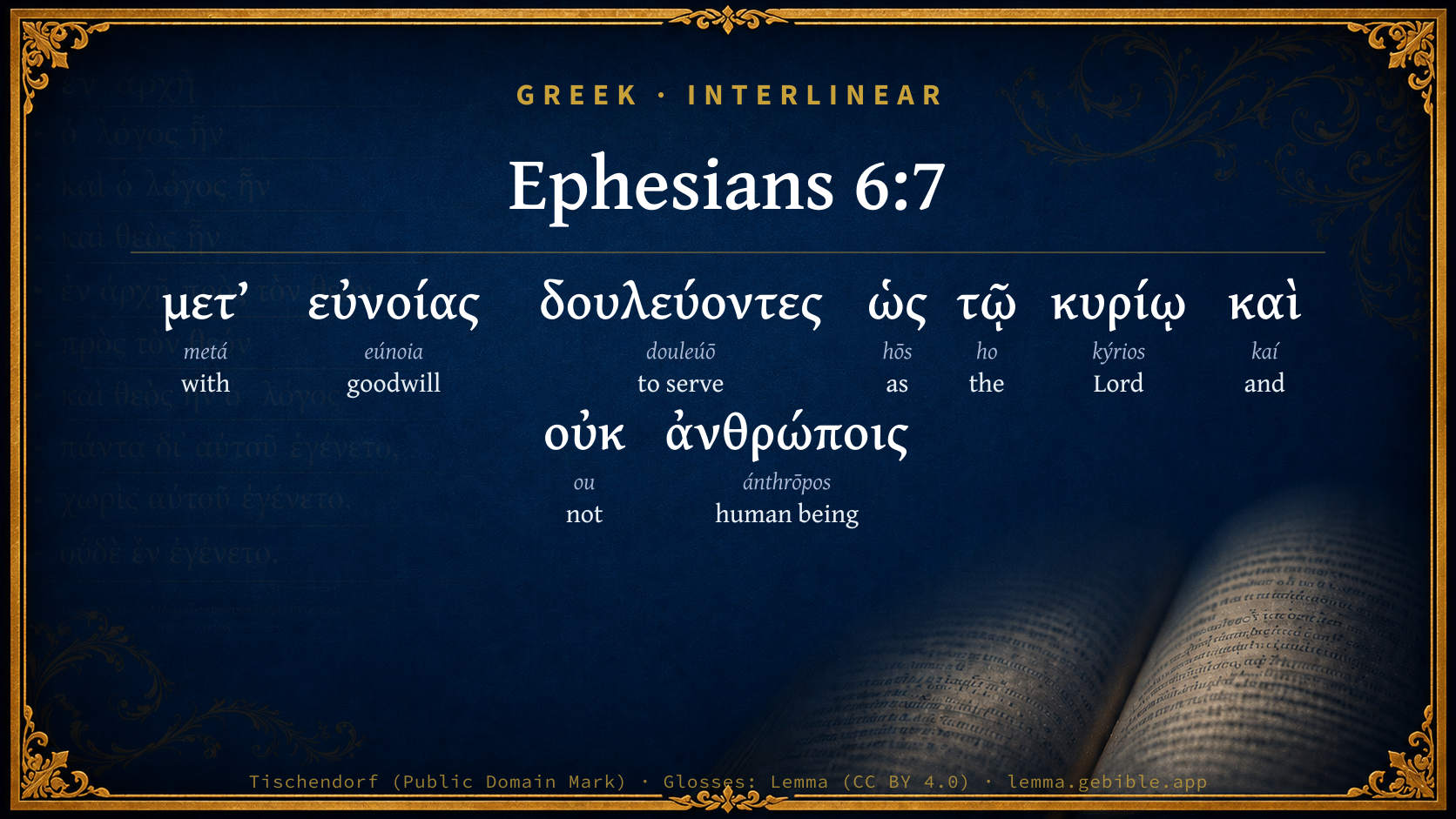
Download image
Cite this verse

Ephesians 6:7 (World English Bible). Public Domain. Lemma interlinear Bible study tool, https://lemma.gebible.app/v/ephesians/6/7.

Show BibTeX & RIS
BibTeX
RIS
English Translation
with good will doing service, as to the Lord, and not to men;
World English Bible · Public Domain
Highlights
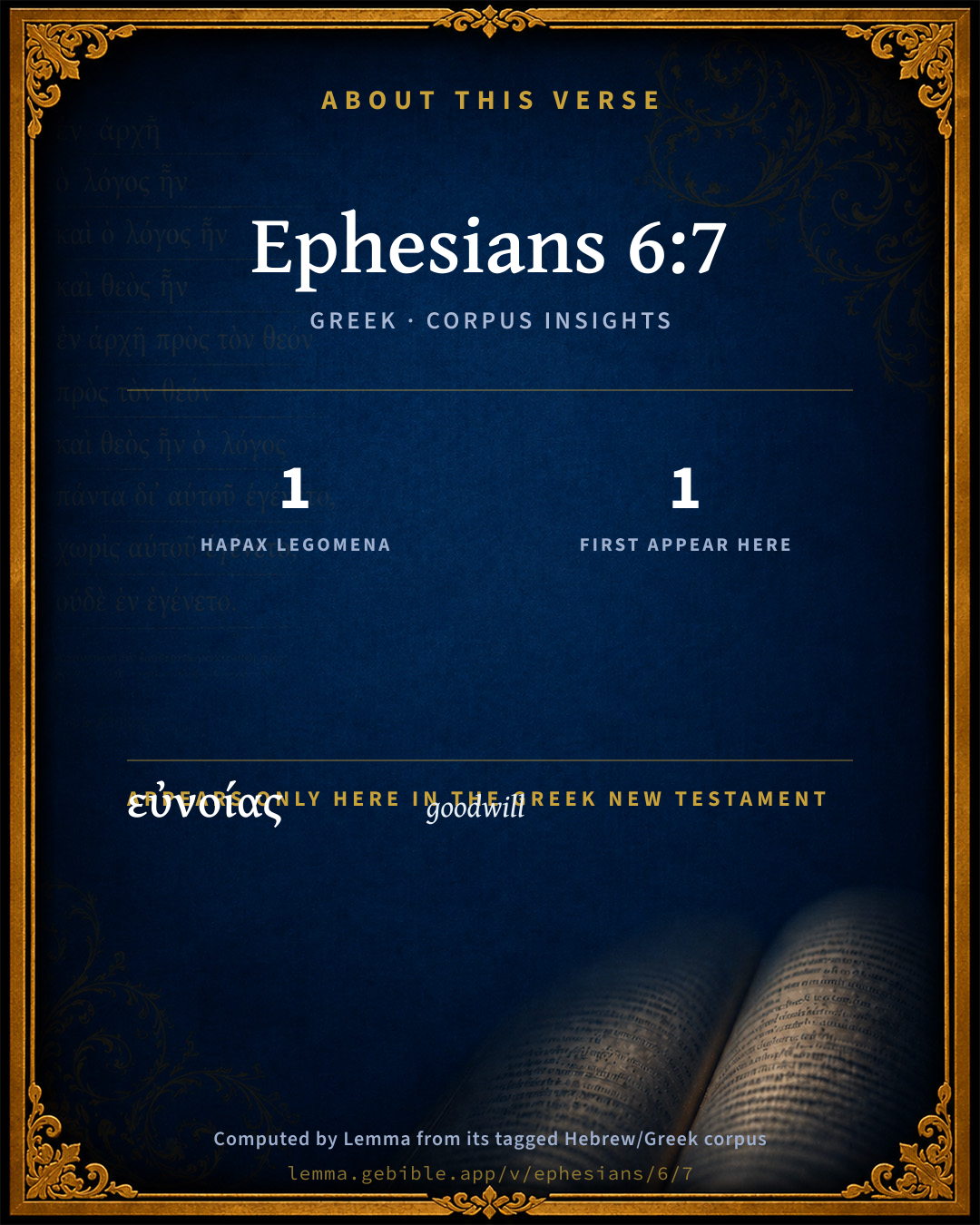
  • 1 hapax legomenon — only here in the Greek New Testament
  • 1 first appearance in the Greek New Testament
Full analysis ↓
Download a study sheet

One document with this verse’s original text, its word-by-word gloss line, the meaning frame, cross-references with their text, attributed commentary, and full source and license credits — printable, and it pastes into notes with its structure intact.

This verse Autodidact and up

Study sheet (.html) Plain text (.txt)

A passage Seminary Student

Up to 50 verses in one chapter. A passage sheet keeps up to 6 commentary sources and 12 cross-references per verse, in the order this page ranks them, and says so on the sheet whenever that leaves anything out. Ask for a single verse and you get the Autodidact verse sheet above.

Everything on this page stays free to read, with no account — the sheet is a download of what is already on screen, not access to it.

Want to remove ads? Support Godless Engineer
Compare translations 3

The same verse in 3 English versions, stacked beneath the original-language interlinear above. Click any original word for its lexicon entry.

Each is an independent rendering of the whole verse — the interlinear is not word-aligned to these translations.

Highlighted words mark where these versions differ — a whole-verse word diff, not a word-by-word alignment.

  • World English Bible Public Domain
    with good will doing service, as to the Lord, and not to men;
  • King James Version Public Domain
    With good will doing service, as to the Lord, and not to men:
  • unfoldingWord Literal Text CC BY-SA 4.0
    serving with a good attitude, as to the Lord and not to men,

unfoldingWord Literal Text — © unfoldingWord, licensed CC BY-SA 4.0. Word-aligned USFM3 via Door43 (git.door43.org/unfoldingWord/en_ult).

Versions to compare (up to 4)

3 of 4 selected

Show all 19 translations

Every available English version of this verse, each an independent rendering of the whole verse.

  • World English Bible Public Domain
    with good will doing service, as to the Lord, and not to men;
  • Berean Standard Bible Public Domain
    Serve with good will, as to the Lord and not to men,
  • Majority Standard Bible Public Domain
    Serve with good will, as to the Lord and not to men,
  • King James Version Public Domain
    With good will doing service, as to the Lord, and not to men:
  • American Standard Version (1901) Public Domain
    with good will doing service, as unto the Lord, and not unto men:
  • Revised Version (1885) Public Domain
    with good will doing service, as unto the Lord, and not unto men:
  • Geneva Bible (1599) Public Domain
    With good will, seruing the Lord, and not men.
  • Douay-Rheims (1899) Public Domain
    With a good will serving, as to the Lord, and not to men.
  • Young's Literal Translation Public Domain
    with good-will serving, as to the Lord, and not to men,
  • Literal Standard Version CC BY-SA 4.0
    serving with goodwill, as to the LORD, and not to men,
  • Unlocked Literal Bible CC BY-SA 4.0
    Serve with all your heart, as though you were serving the Lord and not people,
  • unfoldingWord Literal Text CC BY-SA 4.0
    serving with a good attitude, as to the Lord and not to men,
  • Darby Bible Public Domain
    serving with good will as to the Lord, and not to men;
  • World Messianic Bible Public Domain
    with good will doing service as to the Lord and not to men,
  • Webster's Bible Public Domain
    With good will doing service, as to the Lord, and not to men:
  • Free Bible Version CC BY-SA 4.0
    happily serving as if you were doing it for the Lord, and not for people.
  • Bible in Basic English Public Domain
    Doing your work readily, as to the Lord, and not to men:
  • Text-Critical English NT CC BY 4.0
    Serve with a good attitude, as serving the Lord and not men,
  • Tyndale New Testament (1534) Public Domain
    with good will servinge the Lorde and not men.

Literal Standard Version (2020), Covenant Press — licensed CC BY-SA 4.0. Text via the HelloAO Bible API (eBible.org). Unlocked Literal Bible (unfoldingWord) — licensed CC BY-SA 4.0. Text via the HelloAO Bible API (eBible.org). unfoldingWord Literal Text — © unfoldingWord, licensed CC BY-SA 4.0. Word-aligned USFM3 via Door43 (git.door43.org/unfoldingWord/en_ult). Free Bible Version, Dr. Jonathan Gallagher — licensed CC BY-SA 4.0. Text via the HelloAO Bible API (eBible.org).

Word by word

More ways to search: Search by grammar → Find every occurrence → Compare this word →

Practice this passage: Drill this verse → Learn its vocabulary →

About this verse

These counts appear in no published source. They are computed here, from the morphology-tagged text and Lemma’s own curated glosses. What Lemma adds →

9
words
9
distinct lemmas
Pauline Epistles
section

Notable vocabulary

1 hapax legomenon — a word that appears only here in the entire Greek New Testament:

  • εὐνοίας goodwill G2133

First appearance in Scripture

This word makes its first canonical appearance in the Greek New Testament here:

  • εὐνοίας goodwill G2133

Shared distinctive vocabulary

δουλεύοντες to serve G1398 occurs in 23 verses of the Greek New Testament. Also found in:
Cross-references

7

Topical passages linked to Ephesians 6:7 in the Treasury of Scripture Knowledge — connected by theme and wording, ordered by reader-vote popularity; previews shown in the World English Bible.

  • Colossians 3:23 And whatever you do, work heartily, as for the Lord, and not for men,
  • 1 Corinthians 10:31 Whether therefore you eat, or drink, or whatever you do, do all to the glory of God.
  • Ephesians 6:5–6 Servants, be obedient to those who according to the flesh are your masters, with fear and trembling, in singleness of your heart, as to Christ;
  • 2 Kings 5:13 His servants came near, and spoke to him, and said, My father, if the prophet had bid you do some great thing, wouldn't you have done it? how much rather then, when he says to you, Wash, and be clean?
  • Genesis 31:38–40 These twenty years have I been with you. Your ewes and your female goats have not cast their young, and I haven't eaten the rams of your flocks.
  • 2 Kings 5:2–3 The Syrians had gone out in bands, and had brought away captive out of the land of Israel a little maiden; and she waited on Naaman's wife.
  • Genesis 31:6 You know that I have served your father with all of my strength.

Cross-references courtesy of OpenBible.info (CC BY 4.0).

Commentary

Notes on Ephesians 6:7 from classic Christian and Jewish commentators (each source and its license shown beneath its notes). The classic Christian expositions comment on the surrounding passage and are grouped to its opening verse, so a note may address several verses; the Jewish commentaries on the Tanakh (Rashi and others) are per-verse, so they appear only where the commentator wrote on this verse.

Lemma curates 59 commentaries, every one of them public domain or Creative Commons licensed, each selected and text-cleaned for this edition rather than reprinted as found. About our sources →

The Biblical Illustrator

Joseph S. Exell

Eph_6:7-8

With goodwill doing service, as to the Lord, and not to men.

The honour of serving

Is it not possible that a man can look upon all the inequalities of human life, and upon the varieties of condition out of which come such discontent, such hardship, such injustice, and such torment, and say, I am not a servant of these things; I am a servant of my God; and wherever He puts me, I am going to stand for His sake. Whatever may be the experience of that position, I am going to take it as becomes a child of God? A poor woman washes for a living, and has a flock of children to support; and it is for her to split the wood, to draw the water, to wash the clothes, rubbing on the soap, and putting in the blueing, and to shove the iron; and what does she do all these things for? What is the stimulus that enables her to cheerfully perform all these duties? It is the thought of those dear children. There is not an hour when she does not think, I am working for my darlings. It is hard for her to get up at four oclock in the morning, but she thinks of her children, and of the warm meals, and pleasant fire, and cheerful light that she will be able to supply for them; and these thoughts are her consolation. Whatever she does, she does for her children. Now, seeing it in this humbler sphere and lower instance, can you not magnify it and carry it up, and think that a man can come to a state in which he thinks that the world, nature, life, human society, all the endless events into which time and the experiences of men are broken up, are Gods, and that out of the vast and mighty mixture are being evolved final qualities, and say, I will do all things to the honour and glory of God, and whether I eat or drink, work or rest, go or stay, whether I am in prosperity or adversity (and more in adversity, because, that being harder to bear, shows more manhood), I am Gods child; and loving Him, and being loved of Him, all these things are easy and noble to me? (H. W. Beecher.)

The fruits of life

You have heard of the old deaf musician who used to sit in twilight and roll from his instrument the most wonderful symphonies and harmonies that seemed to run down to the very source and centre of all things, and that, emerging, bore upon them all sweet treasures of melody. Though he heard not one note of it, it was poured out, and poured out upon the darkness and upon the silence sometimes to select listening ears. We are like musicians playing in the dark who are deaf to the sounds which they produce in human conduct, and which run clear through to the other life. The fruits of life are not to be recognized here; but they are sounding, and sounding forever. Whatever right thing you do, here is the endorsement of the Lord for it: Knowing that whatsoever good thing any man doeth, the same shall he receive of the Lord, whether he be bond or free. (H. W. Beecher.)

Our motto

Notice well that the Holy Spirit does not bid us leave our stations in order to serve the Lord. Our great Captain would not have you hope to win the victory by leaving your post. Grace does not transplant the tree, but bids it overshadow the old house at home as before, and bring forth good fruit where it is. Grace does not make us unearthly, though it makes us unworldly. Grace makes us the servants of God while still we are the servants of men; it enables us to do the business of heaven while we are attending to the business of earth.

I. Our subject opens with this reflection, that if henceforth whether we live, we live unto the Lord, or whether we die, we die unto the Lord, this consecration will greatly influence our entire work.

1. You will have to live with a single eye to Gods glory. The Lord Jesus is a most engrossing Master. He will have everything or nothing. As no dog can follow two hares at one time, or he will lose both, certainly no man can follow two contrary objects and hope to secure either of them.

2. To do service to the Lord we must live with holy carefulness. In the service of God we should use great care to accomplish our very best, and we should feel a deep anxiety to please Him in all things, There is a trade called paper staining, in which a man flings colours upon the paper to make common wall decorations, and by rapid processes acres of paper can be speedily finished. Suppose that the paper stainer should laugh at an eminent artist because he had covered such a little space, having been stippling and shading a little tiny piece of his picture by the hour together, such ridicule would itself be ridiculous. Now the worlds way of religion is the paper stainers way, the daubing way; there is plenty of it, and it is quickly done; but Gods way, the narrow way, is a careful matter: there is but little of it, and it costs thought, effort, watchfulness, and care. Yet see how precious is the work of art when it is done, and how long it lasts, and you will not wonder that a man spends his time upon it; even so true godliness is acceptable with God, and it endures forever, and therefore it well repays the earnest effort of the man of God. The miniature painter has to be very careful of every touch and tint, for a very little may spoil his work. Let our life be miniature painting; with fear and trembling let it be wrought out.

3. Further, if henceforth our desire is to live as to the Lord, and not unto men, then what we do must be done with the heart. in singleness of your heart, says the context; and again in the sixth verse, As the servants of Christ, doing the will of God from the heart. Our work for Jesus must be the outgrowth of the soil of the heart. Our service must not be performed as a matter of routine; there must be vigour, power, freshness, reality, eagerness, and warmth about it, or it will be good for nothing.

4. Under subjection. Doing the will of God--not our own. The freedom of a Christian lies in what I will venture to call an absolute slavery to Christ; we never become truly free till every thought is brought into subjection to the will of the Most High.

5. Again, we must do all this under a sense of the Divine oversight. Notice in Eph_6:6 it is said of servants, Not with eye-service, as men-pleasers. What a mean and beggarly thing it is for a man only to do his work well when he is watched. Such oversight is for boys at school and mere hirelings. You never think of watching noble-spirited men. Here is a young apprentice set to copy a picture: his master stands over him and looks over each line, for the young scapegrace will grow careless and spoil his work, or take to his games if he be not well looked after. Did anybody thus dream of supervising Raphael and Michael Angelo to keep them to their work? No, the master artist requires no eye to urge him on.

6. One more thought, and it is this. If henceforth we are to serve the Lord, and not men, then we must look to the Lord for our reward, and not to men. Knowing, saith the eighth verse, that whatsoever good thing any man doeth, the same shall he receive of the Lord, whether he be bond or free. Wage! Is that the motive of a Christian? Yes, in the highest sense, for the greatest of the saints, such as Moses, have had respect unto the recompense of the reward, and it were like despising the reward which God promises to His people if we had no respect whatever for it.

II. Should this text become the inspiration of our life, it would greatly elevate our spirits.

1. It would lift us above complaining about the hardness of our lot, or the difficulty of our service. What wonders men can do when influenced by enthusiastic love for a leader! Alexanders troops marched thousands of miles on foot, and they would have been utterly wearied had it not been for their zeal for Alexander. He led them forth conquering and to conquer. Alexanders presence was the life of their valour, the glory of their strength.

2. This lifts the Christian above the spirit of stinting. Christs servants delight to give so much as to be thought wasteful, for they feel that when they have in the judgment of others done extravagantly for Christ, they have but begun to show their hearts love for His dear name.

3. This raises us above all boasting of our work. Is the work good enough? said one to his servant. The man replied, Sir, it is good enough for the price, and it is good enough for the man who is going to have it. Just so, and when we serve men we may perhaps rightly judge in that fashion, but when we come to serve Christ, is anything good enough for Him?

4. It elevates above that craving for recognition which is a disease with many. It is a sad fault in many Christians that they cannot do anything unless all the world is told of it.

5. It lifts above the discouragement which sometimes comes of human censure. The nightingale charms the ear of night. A fool passes by, and declares that he hates such distracting noises. The nightingale sings on, for it never entered the little minstrels head or heart that it was singing for critics; it sings because He who created it gave it this sweet faculty.

6. This, too, will elevate you above the disappointments of non-success, ay, even of the saddest kind.

7. This lifts us above disappointment in the prospect of death. We shall have to go away from our work soon, so men tell us, and we are apt to fret about it.

8. Ay, and this lifts us above the deadening influence of age and the infirmities which come with multiplied years.

III. I close by saying, that if we enter into the very spirit of this discourse, or even go beyond it--if henceforth we live for Jesus only, so as never to know pleasure apart from Him, nor to have treasure out of Him, nor honour but in His honour, nor success save in the progress of His kingdom, we shall even then have done no more than he deserves at our hands. For, first, we are Gods creatures. For whom should a creature live but for his Creator? Secondly, we are His new creatures, we are the twice-born of heaven; should we not live for Him by whom we have been begotten for glory? (C. H. Spurgeon.)

The Biblical Illustrator, edited by Joseph S. Exell (c. 1880s–1900s) — public domain. Text from a community e-Sword module.

Expositor's Greek Testament

ed. W. Robertson Nicoll

Eph 6:7 . μετʼ εὐνοίας δουλεύοντες [ ὡς ] τῷ κυρίῳ καὶ οὐκ ἀνθρώποις : with good will doing service [as] to the Lord and not to men . Further explanation of what is meant by the bond-service of Christ, viz. , a service rendered with good will and as a service to the Lord Himself, not to men. μετʼ εὐνοίας means not simply with readiness , but with the disposition that wishes one well. In the NT the noun occurs only here; in 1Co 7:3 the accredited reading is not εὐνοίαν but ὀφειλήν . The TR omits ὡς before τῷ Κυρίῳ (with [748] 3 [749] [750] , etc.). It is given, however, by [751] [752] [753] [754] * [755] [756] , Vulg., Syr., etc., and is rightly inserted by LTTrWHRV. It got a place in Beza’s edition of 1598.

[748] Codex Claromontanus (sæc. vi.), a Græco-Latin MS. at Paris, edited by Tischendorf in 1852.

[749] Codex Mosquensis (sæc. ix.), edited by Matthæi in 1782.

[750] Codex Angelicus (sæc. ix.), at Rome, collated by Tischendorf and others.

[751] Codex Vaticanus (sæc. iv.), published in photographic facsimile in 1889 under the care of the Abbate Cozza-Luzi.

[752] Codex Sinaiticus (sæc. iv.), now at St. Petersburg, published in facsimile type by its discoverer, Tischendorf, in 1862.

[753] Codex Alexandrinus (sæc. v.), at the British Museum, published in photographic facsimile by Sir E. M. Thompson (1879).

[754] Codex Claromontanus (sæc. vi.), a Græco-Latin MS. at Paris, edited by Tischendorf in 1852.

[755] Codex Boernerianus (sæc. ix.), a Græco-Latin MS., at Dresden, edited by Matthæi in 1791. Written by an Irish scribe, it once formed part of the same volume as Codex Sangallensis ( δ ) of the Gospels. The Latin text, g, is based on the O.L. translation.

[756] Codex Porphyrianus (sæc. ix.), at St. Petersburg, collated by Tischendorf. Its text is deficient for chap. Eph 2:13-16 .

The Expositor's Greek Testament, edited by W. Robertson Nicoll (1897–1910) — public domain. Text from a community e-Sword module.

Hodge's Commentary on Romans, Ephesians & First Corinthians

Charles Hodge

Eph_6:7

The whole character of the obedience of the slave is summed up in this verse, δουλεύοντες ὡς τῷ Κυρίῳ καὶ οὐκ ἀνθρώποις, doing service, to the Lord and not to men. This, as the Scriptures teach, is not peculiar to the obedience of the slave to his master, but applies to all other cases in which obedience is required from one man to another. It applies to children in relation to their parents, wives to husbands, people to magistrates. Those invested with lawful authority are the representatives of God. The powers (i.e. those invested with authority) are ordained by God; and therefore all obedience rendered to them out of regard to his will, is obedience to Him. And as obedience to God is rendered to one infinitely true and good, it is even more elevating than obedience to truth and goodness. Foreign as all this is to the proud and rebellious heart of man, which spurns all superiority and authority, it is daily illustrated by the cheerful and patient submission of the people of God even to the capricious and unreasonable exercise of the authority of those to whom God has placed them in subjection. It is to be remarked that the apostle presents this principle not merely in a religious, but a Christian form. We are required to do service, as to the Lord, and not to men. It is to Christ, God manifested in the flesh; to him, who being in the form of God, thought it no robbery to be equal with God, but humbled himself, taking on him the condition of a slave, μοπφὴν δούλου λαβών; it is to this infinitely exalted and infinitely condescending Savior, who came not to be served, but to serve, that the obedience of every Christian, whether servant, child, wife, or subject, is really and consciously rendered. Thus the most galling yoke is made easy, and the heaviest burden light.

The words μετ ̓ εὐωοίας qualify δουλεύοντες, with a willing mind doing service. This stands opposed to the sullenness and inward indignation with which a service extorted by fear of punishment is often rendered. No service rendered to Christ can be of that character. It is rendered with alacrity and cheerfulness.

Charles Hodge — Commentary on Romans (1835), First Corinthians (1857), and Ephesians (1856) — public domain. Text from a community e-Sword module.

Geneva Bible (1599)

Geneva Bible translators

Being moved with a reverence so Godward, as though ye served God himself.

Geneva Bible (1599) marginal notes — public domain. Text via Bolls.life.

Jamieson, Fausset & Brown

Robert Jamieson, A. R. Fausset & David Brown

good will--expressing his feeling towards his master; as "doing the will of God from the heart" expresses the source of that feeling (Col 3:23). "Good will" is stated by XENOPHON [Economics] to be the principal virtue of a slave towards his master: a real regard to his master's interest as if his own, a good will which not even a master's severity can extinguish.

Jamieson, Fausset & Brown — Commentary Critical and Explanatory on the Whole Bible (1871) — public domain (CC PDM 1.0). Text via the HelloAO Bible API.

Adam Clarke's Commentary

Verse 7. With good will] μετ ευνοιας. With cheerfulness; do not take up your service as a cross, or bear it as a burden; but take it as coming in the order of God's providence, and a thing that is pleasing to him.

Adam Clarke's Commentary on the Bible (1810–1826) — public domain. Text from a community e-Sword/MySword module.

John Calvin's Commentaries

With good will doing service. (Ver. 7.) This is contrasted with the suppressed indignation which swells the bosom of slaves. Though they dare not openly break out or give signs of obstinacy, their dislike of the authority exercised over them is so strong, that it is with the greatest unwillingness and reluctance that they obey their masters.

Whoever reads the accounts of the dispositions and conduct of slaves, which are scattered through the writings of the ancients, will be at no loss to perceive that the number of injunctions here given does not exceed that of the diseases which prevailed among this class, and which it was of importance to cure. But the same instruction applies to male and female servants of our own times. It is God who appoints and regulates all the arrangements of society. As the condition of servants is much more agreeable than that of slaves in ancient times, they ought to consider themselves far less excusable, if they do not endeavor, in every way, to comply with Paul’s injunctions.

Masters according to the flesh. (Ver. 5.) This expression is used to soften the harsh aspect of slavery. He reminds them that their spiritual freedom, which was by far the most desirable, remained untouched.

Eye-service (ὀφθαλμοδουλεία) is mentioned; because almost all servants are addicted to flattery, but, as soon as their master’s back is turned, indulge freely in contempt, or perhaps in ridicule. Paul therefore enjoins godly persons to keep at the greatest distance from such deceitful pretences.

John Calvin's Commentaries (1540-1563) — public domain. Text from the Calvin Translation Society English edition (1840s-50s) via the Christian Classics Ethereal Library (ccel.org). Calvin's coverage is partial (roughly two-thirds of the Bible); uncommented books and verses are honest gaps, never fabricated. The 19th-century editor's footnotes and remarks are omitted so the notes are faithfully Calvin's own voice.

Ellicott's Commentary for English Readers

(7) With good will doing service, as to the Lord, and not to men.—Here we ascend to a still higher quality than “singleness of heart.” To do service “with good will,” that is, gladly and cheerfully, “counting it joy to spend and to be spent” in the service, is really to serve, not as a slave, but as a freeman. Only so far as in the relation of slaves to masters there is, or has been, any shadow of the filial and parental relation, is this possible on merely human grounds. But St. Paul urges, in 1Co_7:22, that the slave “when called in the Lord, becomes the Lord’s freeman,” entering a “service which is perfect freedom.” That conception, logically worked out, has ultimately destroyed slavery. Meanwhile it gave to the slave in his slavery—lightened though not yet removed—the power of service “with good will, as to the Lord.”

A Bible Commentary for English Readers, edited by Charles John Ellicott (1878–1897) — public domain. Text from a community e-Sword module.

John Gill's Exposition

With good will doing service,.... To their masters; not grudgingly, with an ill will; no otherwise, nor longer than when they are forced to it; but of a ready mind, and with a cheerful spirit, taking delight in their work, and reckoning it a pleasure to serve their masters; as an Israelite that is not sold, who does his work "with his good will", and according to his own mind (b); doing what they do

as to the Lord, and not to men; not merely because it is the will of men, and they are commanded by them, and in order to please them, but because it is the will of the Lord, and is wellpleasing in his sight.

(b) Maimon. Hilchot Abadim, c. 1. sect. 7.

John Gill's Exposition of the Whole Bible (1746–1763) — public domain (CC PDM 1.0). Text via the HelloAO Bible API.

Trapp's Complete Commentary

John Trapp

7 With good will doing service, as to the Lord, and not to men:

Ver. 7. As to the Lord] In obedience to his will, and with reference to his glory.

John Trapp, A Commentary or Exposition upon All the Books of the Old and New Testament (1647–1656) — public domain. Text from a community e-Sword module.

Albert Barnes' Notes on the Bible

As to the Lord, and not to men - That is, he should regard his lot in life as having been ordered by Divine Providence for some wise and good purpose; and until he may be permitted to enjoy his liberty in a quiet and peaceable manner (notes, 1Co 7:21), he should perform his duties with fidelity, and feel that he was rendering acceptable service to God. This would reconcile him to much of the hardships of his lot. The feeling that “God” has ordered the circumstances of our lives, and that he has some wise and good ends to answer by it, makes us contented there; though we may feel that our fellowman may be doing us injustice. It was this principle that made the martyrs so patient under the wrongs done them by people; and this may make even a slave patient and submissive under the wrongs of a master. But let not a master think, because a pious slave shows this spirit, that, therefore, the slave feels that the master is right in withholding his freedom; nor let him suppose, because religion requires the slave to be submissive and obedient, that, therefore, it approves of what the master does. It does this no more than it sanctioned the conduct of Nero and Mary, because religion required the martyrs to be unresisting, and to allow themselves to be led to the stake. A conscientious slave may find happiness in submitting to God, and doing his will, just as a conscientious martyr may. But this does not sanction the wrong, either of the slave-owner or of the persecutor.

Albert Barnes' Notes on the Bible (1834–1885) — public domain. Text from a community e-Sword/MySword module.

Matthew Poole's English Annotations

With good will doing service; not grudgingly or as of constraint, but freely and cheerfully.

As to the Lord, and not to men; not only regarding men your masters, but Christ your great Master. That which is done for the worst masters, and in the hardest things, is service done to Christ, when out of love to him servants bear their masters’ folly or cruelty.

Matthew Poole's English Annotations on the Holy Bible (1683–1685) — public domain. Text from a community e-Sword/MySword module.

Whedon's Commentary on the Bible

Daniel D. Whedon

7. From the heart, (Eph_6:6,) with good will—There should be a hearty good will to truly serve the master. This feeling will ever constitute the great distinction of a true servant.

Daniel D. Whedon (gen. ed.), Commentary on the Old and New Testaments (1874–1909) — public domain. Text from a community e-Sword module.

The Pulpit Commentary

With good will doing service, as to the Lord, and not to men. Some join the last words of the preceding verse to this clause, "from the heart with good will," etc., on the ground that it is not needed for ver. 6, for if you do the will of God at all, you must do it from the heart. But one may do the will of God in a sense outwardly and formally, therefore the clause is not superfluous in ver. 6, whereas, if one does service with good will, one surely does it from the heart, so that the clause would be more superfluous here. Jesus is the Overlord of every earthly lord, and his follower has but to substitute him by faith for his earthly master to enable him to do service with good will.

The Pulpit Commentary (1880–1919), ed. H.D.M. Spence-Jones & Joseph S. Exell — public domain. Text from a community e-Sword module.

John Wesley's Explanatory Notes

Unto the Lord, and not to men - That is, rather than to men; and by making every action of common life a sacrifice to God; having an eye to him in all things, even as if there were no other master.

John Wesley, Explanatory Notes Upon the Whole Bible (1754–1765) — public domain. Text via the GEBible commentary corpus.

The People's New Testament

B. W. Johnson

7. With good will. With a well disposed mind towards the master. As to the Lord. It pleases the Lord, whatever may be the relations of life, for us to do our service well. We may engage in very lowly duties to the glory of the Lord.

B. W. Johnson's The People's New Testament with Notes (1889–1891) — public domain. Electronic text from the Christian Classics Ethereal Library (CCEL) ThML edition.

Cambridge Greek Testament for Schools and Colleges

7. ἐκ ψυχῆς μετʼ εὐνοίας δουλεύοντες. It is better to connect ἐκ ψυχῆς what follows. It marks the transition to the second characteristic of whole-hearted service. It is capable of standing the most searching inspection not only in itself but in its motive.

ἐκ ψυχῆς. Col 3:23 only. It is done heartily, the whole man is in the act. μετʼ εὐνοίας. It is permeated by a genuine devotion to his master’s interest. ὡς τῷ κυρίᾳ καὶ οὐκ ἀνθρώποις. The thought is repeated, but this time to show how the ultimate destination of the work can be a source of enthusiasm.

Cambridge Greek Testament for Schools and Colleges (Cambridge University Press, 1896; 21 vols, various authors incl. Carr, Maclear, Plummer, Farrar, Lumby, Moule, M. R. James, Simcox) — public domain. Text from a community e-Sword module.

Vincent's Word Studies in the New Testament

Marvin R. Vincent

With good - will. Bengel quotes Xenophon : "The slave that is a steward must have good - will if he is to on thy place adequately." Compare Col 3:23.

Marvin R. Vincent, Word Studies in the New Testament (1887–1900) — public domain. Text from a community e-Sword/MySword module.

Lesson kit

Teaching starters — assembled from the data on this page, not authored interpretation. Every prompt links to the verse data it draws on. Edit before teaching.

Ephesians, in the Pauline Epistles, opens this verse with 9 words (9 distinct Greek lemmas). Its most distinctive word is eúnoia (“goodwill”). A historical commentator’s framing appears above. Read the whole chapter for the surrounding context.

Discussion questions

  1. How does “goodwill” (eúnoia) shape what this verse is saying?
  2. 1 word here appears nowhere else in the Greek New Testament. Why might the author reach for such rare wording?
  3. This is the first place “goodwill” appears in Scripture (first appears here). What does its debut here establish?
  4. How does Matthew 6:24, which shares the word «to serve», read alongside this verse?
  5. These translations render this verse differently; the difference is in the English rendering, not the original. What questions does that raise?
  6. Compare how The Biblical Illustrator and Expositor's Greek Testament read this verse. Where do they agree or differ?

Things to notice

  • 1 word in this verse appears nowhere else in the Greek New Testament.
  • 1 word makes its first canonical appearance in Scripture here.
  • These translations choose different wording for 5 words in this verse.
  • 9 distinct Greek lemmas span 9 words in this verse.

Reading settings

Reading text

Shown beneath each verse's original-language words.

Old Testament
Old Testament edition

Read the OT as the Masoretic Hebrew (MT) or the Greek Septuagint (LXX).

English shown for the Greek Septuagint (in the Hebrew ↔ Greek comparison).

Comparing translations? Open the Compare panel on any verse page to stack up to four side by side.