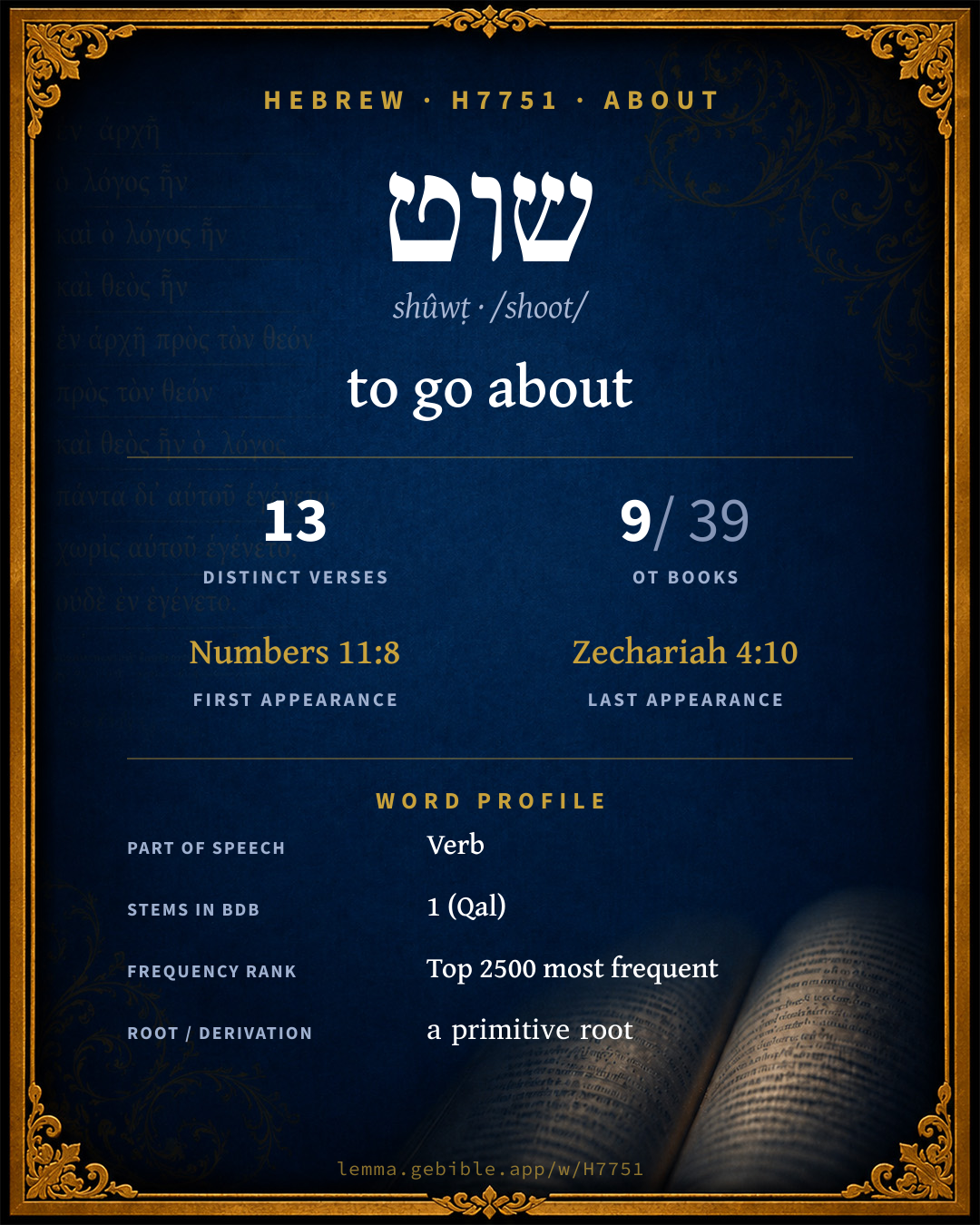
שׁוּט
to go about
‘to go about’ is one of 2 main senses fuller range ↓
Full lexicon entry — Brown-Driver-Briggs (BDB)
From Brown-Driver-Briggs (BDB)
Where this word appears
See every Qal verb in the Hebrew Bible →
Grammar key — what these labels mean
Part of speech
- Verb
- An action or state-of-being word.
Stem
- Qal
- The basic, simple active stem — the plain form of the verb (“he wrote”). Here: ‘go or rove about’
- Polel
- A stem of hollow/geminate roots functioning like the Piel — intensive active.
- Hithpolel
- The reflexive counterpart of the Polel.
Form
- Infinitive Construct
- A bound verbal noun, frequently with prepositions (“to write / in writing”).
- Imperfect
- An incomplete, ongoing, or future action (“he will / would write”).
- Sequential Imperfect
- An imperfect with prefixed waw — the standard past-narrative form (waw-consecutive imperfect).
- Imperative
- A direct command (“write!”).
- Participle Active
- A verbal adjective expressing ongoing or characteristic action (“writing / one who writes”).
- Perfect
- A completed action or state — Hebrew marks aspect (completeness) more than strict tense (“he wrote”).
State
- Absolute
- The independent form of a noun, not bound to a following word.
Person
- 3rd Person
- The one spoken about (“he / she / it / they”).
- 2nd Person
- The one addressed (“you”).
Gender
- Masculine
- Grammatically masculine.
- Feminine
- Grammatically feminine.
- Common
- Either gender — not distinguished for this form.
Number
- Plural
- More than one (in Hebrew, generally three or more).
- Singular
- One.
Grammatical forms 10 distinct
- Verb, Qal, Infinitive Construct 2 times (15%)
- Verb, Polel, Imperfect, 3rd Person, Masculine, Plural 2 times (15%)
- Verb, Qal, Participle Active, Masculine, Plural, Absolute 2 times (15%)
- Verb, Qal, Sequential Imperfect, 3rd Person, Masculine, Plural 1 time (8%)
- Verb, Hithpolel, Imperative, 2nd Person, Feminine, Plural 1 time (8%)
- Verb, Polel, Participle Active, Feminine, Plural, Absolute 1 time (8%)
- Verb, Polel, Participle Active, Masculine, Plural, Absolute 1 time (8%)
- Verb, Polel, Imperative, 2nd Person, Masculine, Plural 1 time (8%)
+2 more forms (2 occurrences)
Parsed forms decoded from the imported morphology (morphhb / Westminster Leningrad Codex — WLC text public domain, morphhb tagging CC BY 4.0), counted across 13 parsed occurrences — not distinct verses.
Every verse where H7751 appears — 13 distinct verses across 9 books. Click any verse to open its interlinear word-by-word view. Verse text shown in the World English Bible for context — . Each verse’s Hebrew form is shown with its reference; the English is not keyword-highlighted, since the data carries no word-level English alignment. Use “Compare translations” on any verse to read it across multiple English versions. This concordance covers the Hebrew Bible; Septuagint (Greek Old Testament) occurrences are not indexed here.
Numbers 1 verse
2 Samuel 2 verses
- 2 Samuel 24:2 שֽׁוּט Qal impv 2ms The king said to Joab the captain of the host, who was with him, Go now back and forth through all the tribes of Israel, from Dan even to Beersheba, and number you the people, that I may know the sum of the people.
- 2 Samuel 24:8 וַ/יָּשֻׁ֖טוּ conj + Qal wimpf 3mp So when they had gone back and forth through all the land, they came to Jerusalem at the end of nine months and twenty days.
2 Chronicles 1 verse
Job 2 verses
- Job 1:7 מִ/שּׁ֣וּט prep + Qal inf.cs Yahweh said to Satan, "Where have you come from?" Then Satan answered Yahweh, and said, "From going back and forth in the earth, and from walking up and down in it."
- Job 2:2 מִ/שֻּׁ֣ט prep + Qal inf.cs Yahweh said to Satan, "Where have you come from?" Satan answered Yahweh, and said, "From going back and forth in the earth, and from walking up and down in it."
Jeremiah 2 verses
- Jeremiah 5:1 שׁוֹטְט֞וּ Polel impv 2mp Run you back and forth through the streets of Jerusalem, and see now, and know, and seek in the broad places of it, if you can find a man, if there are any who does justly, who seeks truth; and I will pardon her.
- Jeremiah 49:3 וְ/הִתְשׁוֹטַ֖טְנָה conj + Hithpolel impv 2fp Wail, Heshbon, for Ai is laid waste; cry, you daughters of Rabbah, gird you with sackcloth: lament, and run back and forth among the fences; for Malcam shall go into captivity, his priests and his princes together.
Ezekiel 2 verses
- Ezekiel 27:8 שָׁטִ֖ים Qal ptcp.act mp The inhabitants of Sidon and Arvad were your rowers: your wise men, Tyre, were in you, they were your pilots.
- Ezekiel 27:26 הַ/שָּׁטִ֖ים ptcl def.art + Qal ptcp.act mp Your rowers have brought you into great waters: the east wind has broken you in the heart of the seas.
Daniel 1 verse
Amos 1 verse
Zechariah 1 verse
About this entry
At a glance — auto-summarized from this page’s data, not written by a person. Every figure links to its source below. This summary describes the numbers; it doesn’t interpret them.
שוט (shûwṭ) is a Hebrew verb most often rendered “to go about.” It first appears in Numbers 11:8. With 13 verses in 9 books, it is an uncommon word in the Hebrew Bible. Not a single-sense word: explore its full sense range. It clusters with משוט, שוט and שיט under a shared root. For the data behind this summary, explore the sense tree and the renderings breakdown below.
Gloss history
Strong's 1890 vs modern scholarship
About this word
Strong's H7751 catalogs a Hebrew word from the Hebrew Old Testament.
These counts are not copied from any lexicon or concordance. They are computed here, from the morphology-tagged Hebrew Old Testament. What Lemma adds →
- 13
- distinct verses
- The word appears in 13 distinct verses.
- 9 / 39
- OT books
- The word appears in 9 of 39 Old Testament books.
- #2,001
- by frequency
- Top 2500 most frequent Hebrew words (rank 2,001 of 8,640 Hebrew words by occurrence).
View all 13 occurrences in the concordance →
By section of the Old Testament
By traditional corpus
Conventional, traditional groupings — biblical authorship is debated, so this is a traditional corpus grouping, not an authorship claim. Each share is this word’s portion of its verses in that division of the Hebrew canon. Each figure is a share of the word’s 13 distinct verses.
- Prophets (Nevi'im) 8 verses · 62%
- Writings (Ketuvim) 4 verses · 31%
- Torah (Pentateuch) 1 verse · 8%
How translations render this word
Counts come from each version’s own published word-to-Strong’s tagging or interlinear alignment — an approximate guide to how each version renders this word, not a word-level alignment the data otherwise carries. Because each total is that version’s own tagged count, the per-version totals vary from one another and need not match the appearance or distinct-verse counts above. These counts may also differ from a printed concordance because Lemma counts each distinctly tagged rendering and does not collapse phrase taggings into a single head-word total. This is a fixed set of word-tagged versions (KJV, ASV, BSB, ULT) and does not change with the reading translation you choose elsewhere. Each version’s license is shown beside its name below (and on Sources).
BDB lists this Strong’s number as 3 distinct words (homographs). Each count above pools all of them and is not split by sense — see the Senses section below. A low-frequency rendering may belong to a different one of those words, not the primary meaning.
- King James Version†: Run to and fro 3×, Going to and fro 2×
- American Standard Version†: Run to and fro 3×, Going to and fro 2×
- Berean Standard Bible†: Oarsmen 2×, Roaming 2×
- unfoldingWord Literal Text†: Wandering 2×
King James Version Public Domain
Renders H7751 across 13† tagged occurrences — most commonly:
Plus 8 renderings that appear only once — usually multi-word phrases or single function words the recovered tagging swept in, not distinct renderings.
American Standard Version Public Domain
Renders H7751 across 13† tagged occurrences — most commonly:
Plus 8 renderings that appear only once — usually multi-word phrases or single function words the recovered tagging swept in, not distinct renderings.
Berean Standard Bible Public Domain
Renders H7751 across 13† tagged occurrences — most commonly:
Plus 9 renderings that appear only once — usually multi-word phrases or single function words the recovered tagging swept in, not distinct renderings.
unfoldingWord Literal Text CC BY-SA 4.0
Renders H7751 across 12† tagged occurrences — most commonly:
Plus 10 renderings that appear only once — usually multi-word phrases or single function words the recovered tagging swept in, not distinct renderings.
Senses in the full BDB
What do BDB’s symbols mean?
BDB uses these scholarly abbreviations:
| Symbol | Meaning |
|---|---|
| 𝔊 | the Septuagint (the ancient Greek translation, LXX) |
| 𝔙 | the Vulgate (the Latin translation) |
| 𝔖 | the Syriac version (the Peshitta) |
| 𝔗 | the Targum (the Aramaic translation) |
| ψ | the Psalms |
| √ | root (the underlying root or stem) |
| ‖ | parallel passage (a synonymous or contrasted parallel) |
| † | the dagger: every passage where the word occurs is cited |
The 2 senses and sub-senses the full Brown-Driver-Briggs lexicon distinguishes for this word, in lexicon order (not ranked by frequency), with BDB’s own verbatim wording and sub-sense lettering. Shown in Hebrew script with BDB’s own scholarly abbreviations. The condensed entry is in the Lexicon Entry tab. See also the Forms in the corpus table below.
שוט I go or rove about (NH Aramaic שׁוּט rove, row (Jon 1
Qal
- go or rove about: Pf. 3 pl., abs. שָׁטוּ הָעָם Nu 11:8 (J; gathering manna), so, c. ב loc., Impf. 3 mpl. וַיָּשֻׁטוּ 2 S 24:8, Imv. ms. שׁוּט־נָא v 2, Inf. cstr. שׁוּט Jb 1:7, שֻׁט 2:2 (both ‖ הִתְהַלֵּךְ), perhaps also Gn 24:63 (לָשׁוּט for לָשׂוּחַ, so 𝔖 Thes 1322 cf. Di Gunk Dr); Je 8:6 Du reads שָׁט for שָׁב.—Pt. שָׁטִים v. שׁוּט denom. infr. Pōʿl. go eagerly, quickly, to and fro: Impf. 3 ms. יְשׁוֹטְטוּ לְבַקֵּשׁ Am 8:12 (‖ וְנָעוּ); abs. יְשֹׁטְטוּ Dn 12:4; c. ב loc., Imv. mpl. שׁוֹטְטוּ Je 5:1, Pt. pl. מְשׁוֹטְטִים Zc 4:10, מְשֹׁטְטוֹת 2 Ch 16:9 (both of עֵינֵי י׳). Hithpōʿl. Imv. fpl., ב loc., הִתְשׁוֹטַטְנָה Je 49:3 run to and fro. e.g. Numbers 11:8
שוט II denom. row
שוט III treat with despite, only Ezek. (Aramaic שׁוּט, ܫܳܛ despise
Qal
- Pt., c. acc. pers.: mpl. (subst.) הַשָּׁאטִים אוֹתָם Ez 28:24, 26 (Köii. 1, 108, 346 Ges§ 72 p); fpl. בְּנוֹת פְּלִשְׁתִּים הַשָּׁאטוֹת אוֹתָךְ 16:57 (Köib. 189). e.g. Ezekiel 28:24
Senses from the full Brown-Driver-Briggs lexicon (Brown, Driver, Briggs; Oxford 1906 — public domain), digitized via Sefaria, supplemented by the OpenScriptures HebrewLexicon (CC BY 4.0). Full attribution on Sources.
Word origin
I. vb. go or rove about (NH Aramaic שׁוּט rove, row (Jon 1:13), swim (Is 25:11), stroke, besmear; v. also שׁוֹט);—
II. vb.denom. row;—Pt. pl. שָׁטִים rowers Ez 27:8, 26 (of Tyre as ship).
III. vb. treat with despite, only Ezek. (Aramaic שׁוּט, ܫܳܛ despise; cf. perhaps Assyrian šâṭu, rebel, Meissn);—only
— Brown-Driver-Briggs (Oxford 1906, public domain), digitized via Sefaria, supplemented by the OpenScriptures HebrewLexicon (CC BY 4.0). See Sources.
Origin: a primitive root
Jastrow Dictionary
A second Hebrew/Aramaic lexicon for comparison, covering Aramaic and post-biblical (Talmudic, Targumic, Midrashic) usage that the biblical-Hebrew BDB does not. Matched by lemma rather than by Strong’s number, so a lemma may carry more than one Jastrow headword (shown separately below), and the entries cover usage well beyond the Bible.
שׁוּט I
- (b. h.) [to swing, be light, move to and fro; v. שׁוֹט II,] to roam, fly, float, swim. M. Kat. 14ᵃ לָשׁוּט if he goes abroad to roam (for mere pleasure), opp. למזונות for support, להרויחא for profit in business. B. Bath. 15ᵇ (Satan says) שַׁטְתִּי בכל וכ׳ I roamed all over the world, but have found none so faithful as &c. Bets. V, 2 (36ᵇ) לא שָׁטִין על פני המים you must not float on the water (swim on the Sabbath). Y. Shek. VI, 50ᵃ top (ref. to Ez. XLVII, 5) כי גאו המים מי שחו מִלָּשׁוּט (omit מהו מי שחו, v. Rabb. D. S. a. l., p. 55) the waters were risen … too high for swimming; a. e.—[Y. B. Mets. VIII, end, 11ᵈ בששטן, read: בששטפן, v. שָׁטַף.] e.g. Ezekiel 47:5
- same. Yalk. Gen. 101 עד שהיתה קומתו מְשׁוֹטֶטֶת בדמעות until his body swam in tears.
- to cause to swim, teach swimming. Kidd. 30ᵇ אף לַהֲשִׁיטוֹ בנהר a father is also bound to have his son taught swimming; Tosef. ib. I, 11; Koh. R. to IX, 9 להושיטו (corr. acc.).
שׁוּט
- , to roam, fly, swim, row. Targ. Lam. III, 54 (h. text צפו); a. e.—Part. שָׁיט, שָׁיֵיט; f. שָׁיְיטָא; pl. שָׁיְיטִין; שָׁיְיטָן. Targ. O. Num. XI, 8 שָׁיְטִין (ed. Berl. נפקין). Targ. Jon. I, 13; a. e.—B. Kam. 83ᵃ מֵישַׁט שייטא טובא וכ׳ (a dove) flies (for exercise) farther out, but fills her belly within fifty cubits (from the dove-cote). Ib. ומישט שלשים וכ׳ for exercise do they fly thirty Rises only and no more? Sot. 48ᵇ (transl. Deut. I, 44) כמא דנתזין דבריאתא ושייטן ברומי וכ׳ as bees rush forth and fly about on the heights of the world, and bring honey from the herbs of the mountains; a. e. e.g. Deuteronomy 1:44
- (with עינא) to look up and down. Targ. Y. II, Gen. XXII, 10.
שׁוּט II
- [to make light of (cmp. קָלַל,] to despise, reject. Tanḥ. Sh’moth 1 ושָׁט את הבכורה and despised the birthright; (Ex. R. s. 1 וביזה).
שׁוּט ²
- Targ. Gen. XXV, 34. Targ. I Sam. X, 27. Ib. XVII, 42 שַׁטְיֵה (fr. שטי). Targ. Prov. I, 25 ושַׁטְתּוּן Ms. (ed. ושניתון); a. fr.—Part. שָׁט, שָׁאֵט, שָׁיֵיט, שָׁיֵט; f. שָׁיְיטָא; pl. שָׁיְיטִין. Ib. XI, 12. Ib. XXIII, 9 (ed. Wil. שְׁיֵט, corr. acc.). Ib. I, 7; a. fr.—Part. pass. שִׁיט, שָׁט. Targ. I Kings XVI, 31 (h. text נקל). Targ. I Sam. XV, 9 (h. text נמבזה). Targ. Ps. XV, 4 (h. text נבזה); a. fr.
- same. Targ. II Sam. XII, 10. Targ. Prov. XV, 20. Ib. XIX, 16 (ed. Lag. מוֹשִׁיט, cmp. מוקים fr. קום); a. e.
- to be despised. Targ. I Sam. II, 30 יִתְשָׁטוּן (ed. Lag. יִשְׁתָּטוּן, Var. ישטתון, prob. meant for יתשט׳; h. text יקלו).
*שׁוּט III
- (v.שׁוּט I) [to move in all directions,] to strike, smear over, polish with a fatty substance. Pes. 30ᵇ אין שָׁטִין … ואם שָׁט Ar. a. Ms. M. 2 (v. Rabb. D. S. a. l. note 7; ed. טָשִׁין … טָשׁ), v. טוּשׁ I; Zeb. 95ᵇ Ms. M. (v. Rabb. D. S. a. l. note). Bets. 34ᵃ Ar. (ed. טשין).
שׁוּט ³
- Targ. Y. I Deut. XXVIII, 40 תשוטון (Ar. תטושון).
שׁוֹט
- Shoṭ-Mishoṭ, Samosata, one of the fords of the Euphrates (v. Neub. Géogr. p. 331, a. Sm. Dict. of Gr. a. Rom. Geogr. s. v. Euphrates). Kidd. 72ᵃ ש׳ מ׳ בין וכ׳ Samosata is situated between the rivers (Euphrates and Tigris).
שׁוֹט II
- rod, scourge. Mekh. B’shall., Amalek, s. 2 כך מדה … ש׳ שישראל לוקין וכ׳ such is the rule going through all generations, the scourge (nation) with which the Israelites are smitten, will finally be smitten; Yalk. Ex. 265.
A Dictionary of the Targumim, the Talmud Babli and Yerushalmi, and the Midrashic Literature (Marcus Jastrow; London, Luzac, 1903) — Public Domain. Digitized via Sefaria. Digitized via Sefaria. Full attribution on Sources.
Forms in the corpus
The 13 distinct written forms H7751 takes in the Hebrew Bible, most frequent first — each parse links to that stem’s occurrences in the concordance. Hebrew forms include their vowel points and cantillation, so a single lemma takes many written forms.
Same root — word family
Other BDB entries built from the same root as H7751, grouped by Strong’s listed origin. These share a root / origin per the lexicon — not necessarily a shared meaning. Each links to that word’s own entry.
Derived from this word
Compare all same-root words → They share a root, not necessarily a meaning.
Septuagint verse parallels
This word appears in 13 verses that also exist in the Greek Old Testament (Septuagint), out of the 13 Hebrew verses it occurs in. You can read those verses in Greek by switching the Old Testament edition to the Septuagint.
Read these verses in the Septuagint
- Numbers 11:8
- 2 Samuel 24:2
- 2 Chronicles 16:9
- Job 1:7
- Jeremiah 5:1
- Ezekiel 27:8
- Daniel 12:4
- Amos 8:12
- Zechariah 4:10
This is a verse-level parallel only — the same verses exist in both the Hebrew and Greek Old Testaments. No word-level Hebrew↔Greek correspondence is claimed: the data carries no such alignment, so no Greek word is shown as this Hebrew word’s translation. Coverage is not total — the Septuagint omits the deuterocanon and renumbers the Psalms, so some Hebrew verses have no direct Greek parallel.