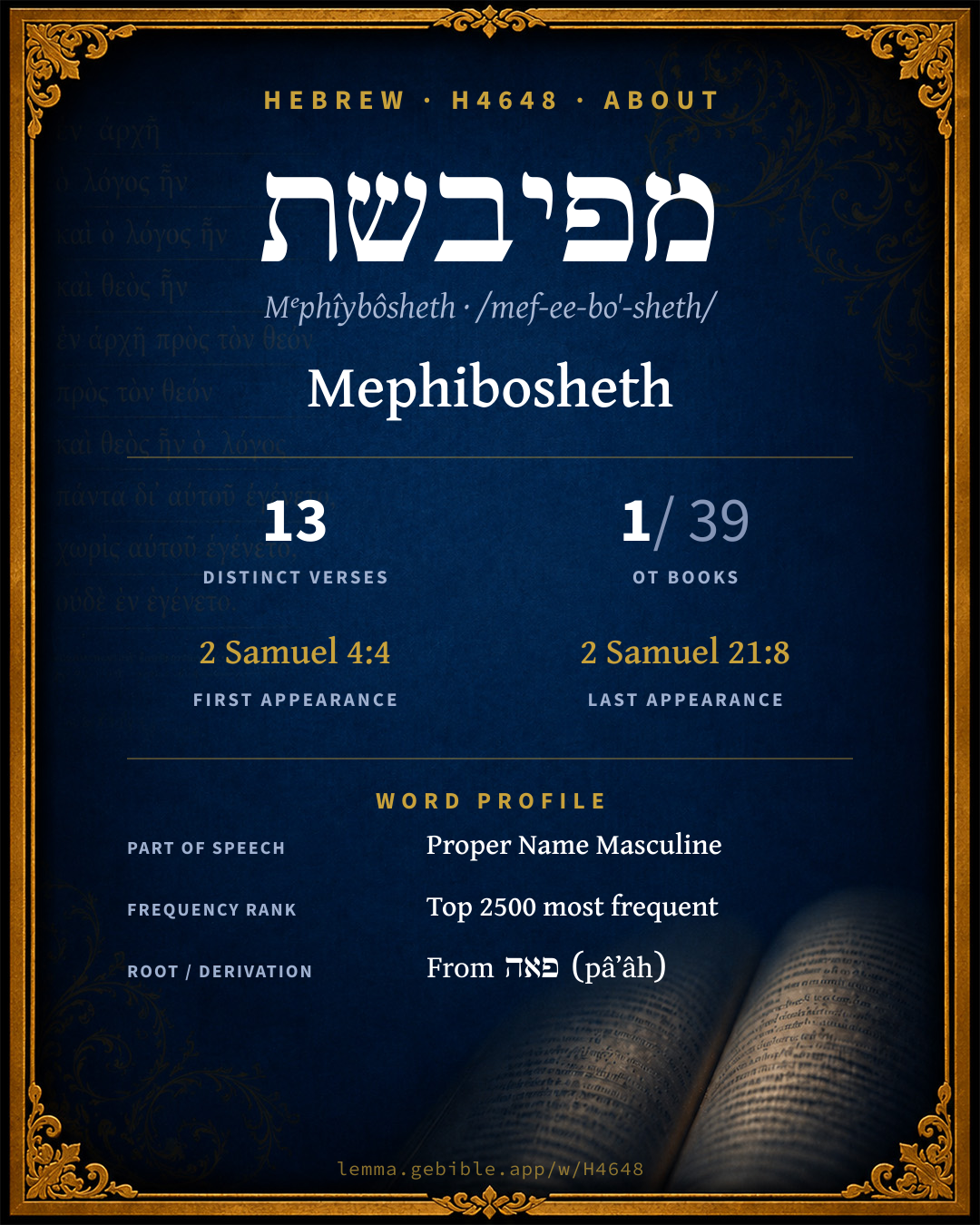
מְפִיבֹשֶׁת
Mephibosheth
BDB lists 3 entries for ‘Mephibosheth’ fuller range ↓
Full lexicon entry — Brown-Driver-Briggs (BDB)
From Brown-Driver-Briggs (BDB)
Where this word appears
Grammar key — what these labels mean
Part of speech
- Noun
- A naming word — a person, place, thing, or idea.
Noun type
- Proper
- A name of a specific person, place, or people (e.g. Abraham, Zion, Israel).
Every verse where H4648 appears — 13 distinct verses across 1 book. Click any verse to open its interlinear word-by-word view. Verse text shown in the World English Bible for context — . Each verse’s Hebrew form is shown with its reference; the English is not keyword-highlighted, since the data carries no word-level English alignment. Use “Compare translations” on any verse to read it across multiple English versions. This concordance covers the Hebrew Bible; Septuagint (Greek Old Testament) occurrences are not indexed here.
2 Samuel 13 verses
- 2 Samuel 4:4 מְפִיבֹֽשֶׁת n Proper Now Jonathan, Saul's son, had a son who was lame of his feet. He was five years old when the news came of Saul and Jonathan out of Jezreel; and his nurse took him up, and fled: and it happened, as she made haste to flee, that he fell, and became lame. His name was Mephibosheth.
- 2 Samuel 9:6 מְפִיבֹ֨שֶׁת מְפִיבֹ֔שֶׁת n Proper n Proper Mephibosheth, the son of Jonathan, the son of Saul, came to David, and fell on his face, and did obeisance. David said, Mephibosheth. He answered, Behold, your servant!
- 2 Samuel 9:10 וּ/מְפִיבֹ֨שֶׁת֙ conj + n Proper You shall till the land for him, you, and your sons, and your servants; and you shall bring in [the fruits], that your master's son may have bread to eat: but Mephibosheth your master's son shall eat bread always at my table." Now Ziba had fifteen sons and twenty servants.
- 2 Samuel 9:11 וּ/מְפִיבֹ֗שֶׁת conj + n Proper Then said Ziba to the king, According to all that my lord the king commands his servant, so shall your servant do. As for Mephibosheth, [said the king], he shall eat at my table, as one of the king's sons.
- 2 Samuel 9:12 וְ/לִ/מְפִיבֹ֥שֶׁת לִ/מְפִיבֹֽשֶׁת conj + prep + n Proper prep + n Proper Mephibosheth had a young son, whose name was Mica. All that lived in the house of Ziba were servants to Mephibosheth.
- 2 Samuel 9:13 וּ/מְפִיבֹ֗שֶׁת conj + n Proper So Mephibosheth lived in Jerusalem; for he ate continually at the king's table. He was lame in both his feet.
- 2 Samuel 16:1 מְפִי בֹ֖שֶׁת n Proper n Proper When David was a little past the top [of the ascent], behold, Ziba the servant of Mephibosheth met him, with a couple of donkeys saddled, and on them two hundred loaves of bread, and one hundred clusters of raisins, and one hundred summer fruits, and a bottle of wine.
- 2 Samuel 16:4 לִ/מְפִי בֹ֑שֶׁת prep + n Proper n Proper Then said the king to Ziba, Behold, all that pertains to Mephibosheth is yours. Ziba said, I do obeisance; let me find favor in your sight, my lord, O king.
- 2 Samuel 19:24 וּ/מְפִבֹ֨שֶׁת֙ conj + n Proper Mephibosheth the son of Saul came down to meet the king; and he had neither dressed his feet, nor trimmed his beard, nor washed his clothes, from the day the king departed until the day he came home in peace.
- 2 Samuel 19:25 מְפִיבֹֽשֶׁת n Proper It happened, when he was come to Jerusalem to meet the king, that the king said to him, Why didn't you go with me, Mephibosheth?
- 2 Samuel 19:30 מְפִיבֹ֨שֶׁת֙ n Proper Mephibosheth said to the king, yes, let him take all, because my lord the king is come in peace to his own house.
- 2 Samuel 21:7 מְפִי n Proper But the king spared Mephibosheth, the son of Jonathan the son of Saul, because of Yahweh's oath that was between them, between David and Jonathan the son of Saul.
- 2 Samuel 21:8 מְפִבֹ֑שֶׁת n Proper But the king took the two sons of Rizpah the daughter of Aiah, whom she bore to Saul, Armoni and Mephibosheth; and the five sons of Michal the daughter of Saul, whom she bore to Adriel the son of Barzillai the Meholathite:
About this entry
At a glance — auto-summarized from this page’s data, not written by a person. Every figure links to its source below. This summary describes the numbers; it doesn’t interpret them.
מפיבשת (Mᵉphîybôsheth) is a Hebrew name most often rendered “Mephibosheth.” 2 Samuel dominates its distribution — 13 of 13 verses. The Hebrew Bible uses it across 13 verses — uncommon. It first appears in 2 Samuel 4:4. For the data behind this summary, explore 13-verse concordance and the renderings breakdown below.
Gloss history
Strong's 1890 vs modern scholarship
About this word
Strong's H4648 catalogs a Hebrew word from the Hebrew Old Testament.
These counts are not copied from any lexicon or concordance. They are computed here, from the morphology-tagged Hebrew Old Testament. What Lemma adds →
- 13
- distinct verses
- The word appears in 13 distinct verses.
- 1 / 39
- OT books
- The word appears in 1 of 39 Old Testament books.
- #1,671
- by frequency
- Top 2500 most frequent Hebrew words (rank 1,671 of 8,640 Hebrew words by occurrence).
View all 13 occurrences in the concordance →
Most concentrated in
- 2 Samuel 13 verses 100%
By section of the Old Testament
By traditional corpus
Conventional, traditional groupings — biblical authorship is debated, so this is a traditional corpus grouping, not an authorship claim. Each share is this word’s portion of its verses in that division of the Hebrew canon. Each figure is a share of the word’s 13 distinct verses.
- Prophets (Nevi'im) 13 verses · 100%
How translations render this word
Counts come from each version’s own published word-to-Strong’s tagging or interlinear alignment — an approximate guide to how each version renders this word, not a word-level alignment the data otherwise carries. Because each total is that version’s own tagged count, the per-version totals vary from one another and need not match the appearance or distinct-verse counts above. These counts may also differ from a printed concordance because Lemma counts each distinctly tagged rendering and does not collapse phrase taggings into a single head-word total. This is a fixed set of word-tagged versions (KJV, ASV, BSB, ULT) and does not change with the reading translation you choose elsewhere. Each version’s license is shown beside its name below (and on Sources).
- King James Version: Mephibosheth 11×
- American Standard Version: Mephibosheth 12×
- Berean Standard Bible: Mephibosheth 14×
- unfoldingWord Literal Text: Mephibosheth 13×, Was to mephibosheth 2×
King James Version Public Domain
Renders H4648 across 15 tagged occurrences — most commonly:
Plus 4 renderings that appear only once — usually multi-word phrases or single function words the recovered tagging swept in, not distinct renderings.
American Standard Version Public Domain
Renders H4648 across 15 tagged occurrences — most commonly:
Plus 3 renderings that appear only once — usually multi-word phrases or single function words the recovered tagging swept in, not distinct renderings.
Berean Standard Bible Public Domain
Renders H4648 across 16 tagged occurrences — most commonly:
Plus 2 renderings that appear only once — usually multi-word phrases or single function words the recovered tagging swept in, not distinct renderings. Not rendered by a distinct English word in 1 further occurrence.
unfoldingWord Literal Text CC BY-SA 4.0
Renders H4648 across 17 tagged occurrences — most commonly:
Plus 2 renderings that appear only once — usually multi-word phrases or single function words the recovered tagging swept in, not distinct renderings.
Senses in BDB
The 3 senses BDB distinguishes for this word, in lexicon order (not ranked by frequency or importance). The full entry — with sub-senses — is in the Lexicon Entry tab.
- Mephibosheth = "exterminating the idol"
- grandson of Saul and son of Rizpah the daughter of Aiah…
- son of Jonathan and grandson of Saul
Word origin
Derived from פאה (pâʼâh) (H6284) — to shatter.
Jastrow Dictionary
A second Hebrew/Aramaic lexicon for comparison, covering Aramaic and post-biblical (Talmudic, Targumic, Midrashic) usage that the biblical-Hebrew BDB does not. Matched by lemma rather than by Strong’s number, so a lemma may carry more than one Jastrow headword (shown separately below), and the entries cover usage well beyond the Bible.
מְפִיבֹשֶׁת
- (b. h.) pr. n. m. Mephibosheth, son of Jonathan, fabled to be a great scholar and acknowledged by David as his teacher. Ber. 4ᵃ. Num. R. s. 8; a. fr.—Erub. 53ᵇ, v. נָגַב.
A Dictionary of the Targumim, the Talmud Babli and Yerushalmi, and the Midrashic Literature (Marcus Jastrow; London, Luzac, 1903) — Public Domain. Digitized via Sefaria. Digitized via Sefaria. Full attribution on Sources.
Forms in the corpus
The 14 distinct written forms H4648 takes in the Hebrew Bible, most frequent first — each parse links to that state’s occurrences in the concordance. Hebrew forms include their vowel points and cantillation, so a single lemma takes many written forms.
| Form | Parsing | Example | Uses |
|---|---|---|---|
| וּ/מְפִיבֹ֗שֶׁת | Noun, Proper | 2 Samuel 9:11 | 2 |
| מְפִי | Noun, Proper | 2 Samuel 16:1 | 2 |
| מְפִיבֹֽשֶׁת | Noun, Proper | 2 Samuel 4:4 | 2 |
| בֹ֑שֶׁת | Noun, Proper | 2 Samuel 16:4 | 1 |
| בֹ֖שֶׁת | Noun, Proper | 2 Samuel 16:1 | 1 |
| וְ/לִ/מְפִיבֹ֥שֶׁת | Noun, Proper | 2 Samuel 9:12 | 1 |
| וּ/מְפִבֹ֨שֶׁת֙ | Noun, Proper | 2 Samuel 19:24 | 1 |
| וּ/מְפִיבֹ֨שֶׁת֙ | Noun, Proper | 2 Samuel 9:10 | 1 |
| לִ/מְפִי | Noun, Proper | 2 Samuel 16:4 | 1 |
| לִ/מְפִיבֹֽשֶׁת | Noun, Proper | 2 Samuel 9:12 | 1 |
| מְפִבֹ֑שֶׁת | Noun, Proper | 2 Samuel 21:8 | 1 |
| מְפִיבֹ֔שֶׁת | Noun, Proper | 2 Samuel 9:6 | 1 |
| מְפִיבֹ֨שֶׁת | Noun, Proper | 2 Samuel 9:6 | 1 |
| מְפִיבֹ֨שֶׁת֙ | Noun, Proper | 2 Samuel 19:30 | 1 |
Same root — word family
Other BDB entries built from the same root as H4648, grouped by Strong’s listed origin. These share a root / origin per the lexicon — not necessarily a shared meaning. Each links to that word’s own entry.
Derives from
Shares the same root
Proper names from this root
People and places named from this root — a name, not an additional meaning of the word.
Compare all same-root words → 1 of the same-root words is a proper name (a person or place). They share a root, not necessarily a meaning.
Bible dictionary
Public-domain dictionary articles matched to this entry by name (Mephibosheth). A biblical name can be shared by more than one person or place, so an article may treat several.
Easton's Bible Dictionary · M. G. Easton, 1897
Exterminator of shame; i.e., of idols. (1.) The name of Saul's son by the concubine Rizpah (q.v.), the daughter of Aiah. He and his brother Armoni were with five others "hanged on a hill before the Lord" by the Gibeonites, and their bodies exposed in the sun for five months (2 Sam. 21:8-10). (2.) The son of Jonathan, and grandson of Saul (2 Sam. 4:4). He was but five years old when his father and grandfather fell on Mount Gilboa. The child's nurse hearing of this calamity, fled with him from Gibeah, the royal residence, and stumbling in her haste, the child was thrown to the ground and maimed in both his feet, and ever after was unable to walk (19:26). He was carried to the land of Gilead, where he found a refuge in the house of Machir, the son of Ammiel, at Lo-debar, by whom he was brought up.
Some years after this, when David had subdued all the adversaries of Israel, he began to think of the family of Jonathan, and discovered that Mephibosheth was residing in the house of Machir. Thither he sent royal messengers, and brought him and his infant son to Jerusalem, where he ever afterwards resided (2 Sam. 9).
When David was a fugitive, according to the story of Ziba (2 Sam. 16:1-4) Mephibosheth proved unfaithful to him, and was consequently deprived of half of his estates; but according to his own story, however (19:24-30), he had remained loyal to his friend. After this incident he is only mentioned as having been protected by David against the vengeance the Gibeonites were permitted to execute on the house of Saul (21:7). He is also called Merib-baal (1 Chr. 8:34; 9:40). (See ZIBA.)
Smith's Bible Dictionary · William Smith, 1863
(exterminating the idol), the name borne by two members of the family of Saul--his son and his grandson.
+ Saul's son by Rizpah the daughter of Aiah, his concubine. (2 Samuel 21:8) He and his brother Armoni were among the seven victims who were surrendered by David to the Gibeonites, and by them crucified to avert a famine from which the country was suffering. + The son of Jonathan, grandson of Saul and nephew of the preceding; called also Merib-baal. (1 Chronicles 8:34) His life seems to have been, from beginning to end, one of trial and discomfort. When his father and grandfather were slain on Gilboa he was an infant but five years old. At this age he met with an accident which deprived him for life of the use of both feet. (2 Samuel 4:4) After this he is found a home with Machir ben-Ammiel a powerful Gadite, who brought him up, and while here was married. Later on David invited him to Jerusalem, and there treated him and his son Micha with the greatest kindness. From this time forward he resided at Jerusalem, of Mephibosheth's behavior during the rebellion of Absalom we possess two accounts--his own, (2 Samuel 13:24-30) and that of Ziba, (2 Samuel 16:1-4) They are naturally at variance with each other. In consequence of the story of Ziba, he was rewarded by the possessions of his master. Mephibosheth's story--which however, he had not the opportunity of telling until several days later, when he met David returning to his kingdom at the western bank of Jordan--was very different from Ziba's. That David did not disbelieve it is shown by his revoking the judgment he had previously given. That he did not entirely reverse his decision, but allowed Ziba to retain possession of half the lands of Mephibosheth, is probably due partly to weariness at the whole transaction, but mainly to the conciliatory frame of mind in which he was at that moment. "Shall there any man be put to death this day?" is the keynote of the whole proceeding.
Hitchcock's Bible Names Dictionary · Roswell D. Hitchcock, 1869
out of my mouth proceeds reproach
Classic public-domain reference works; full attribution on Sources.
Septuagint verse parallels
This word appears in 13 verses that also exist in the Greek Old Testament (Septuagint), out of the 13 Hebrew verses it occurs in. You can read those verses in Greek by switching the Old Testament edition to the Septuagint.
Read these verses in the Septuagint
This is a verse-level parallel only — the same verses exist in both the Hebrew and Greek Old Testaments. No word-level Hebrew↔Greek correspondence is claimed: the data carries no such alignment, so no Greek word is shown as this Hebrew word’s translation. Coverage is not total — the Septuagint omits the deuterocanon and renumbers the Psalms, so some Hebrew verses have no direct Greek parallel.