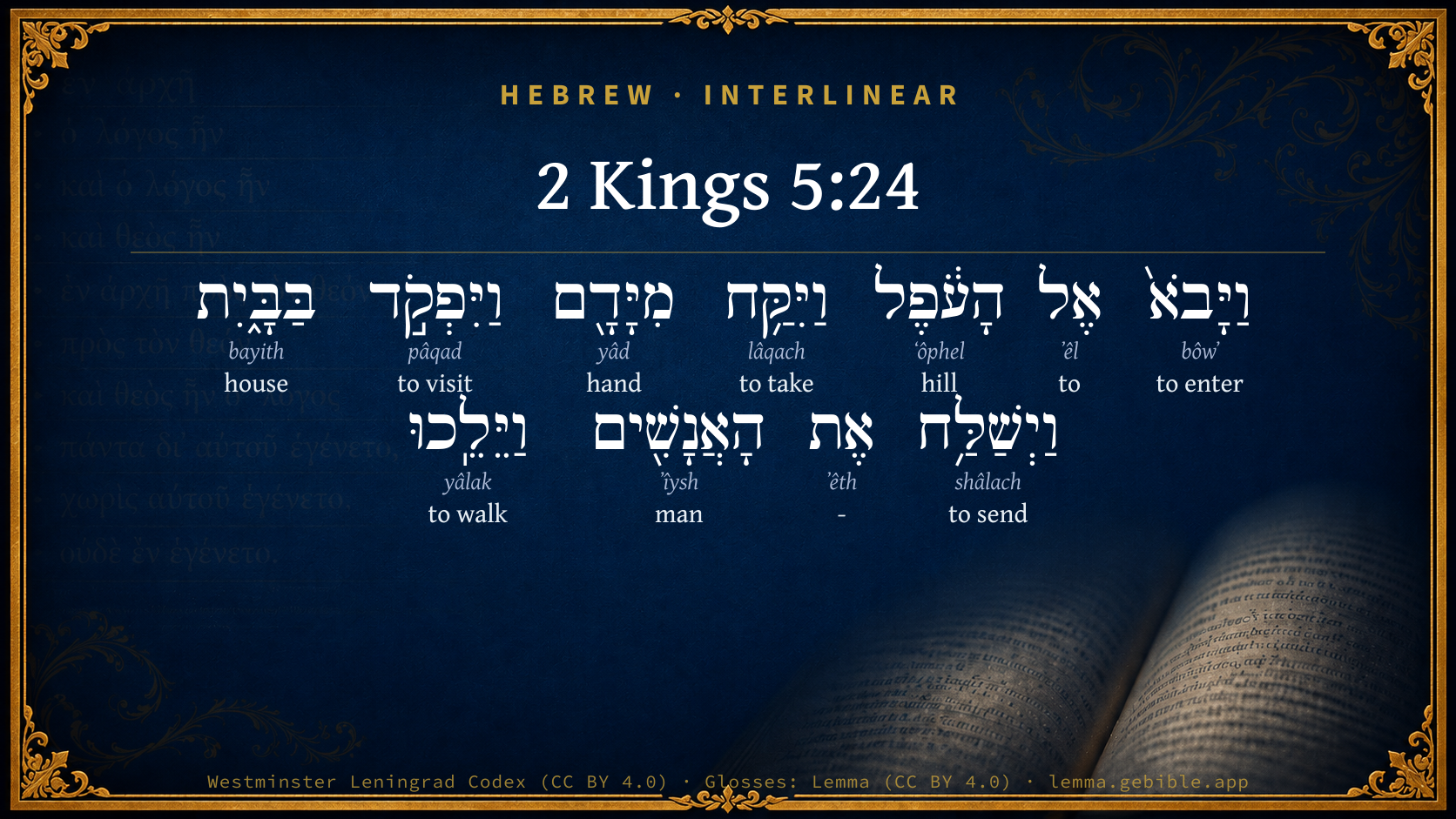
2 Kings 5:24

Hebrew (Westminster Leningrad Codex) 2 Kings 5:24 appears in the Hebrew Old Testament. The text above is from the Westminster Leningrad Codex. Each word links to its Strong’s number, a concise gloss, and parsing drawn from the Open Scriptures Hebrew Bible morphology. Click any word for its full Brown-Driver-Briggs (BDB) entry.
Download image
Cite this verse

2 Kings 5:24 (World English Bible). Public Domain. Lemma interlinear Bible study tool, https://lemma.gebible.app/v/2-kings/5/24.

Show BibTeX & RIS
BibTeX
RIS
English Translation
When he came to the hill, he took them from their hand, and bestowed them in the house; and he let the men go, and they departed.
World English Bible · Public Domain
Download a study sheet

One document with this verse’s original text, its word-by-word gloss line, the meaning frame, cross-references with their text, attributed commentary, and full source and license credits — printable, and it pastes into notes with its structure intact.

This verse Autodidact and up

Study sheet (.html) Plain text (.txt)

A passage Seminary Student

Up to 50 verses in one chapter. A passage sheet keeps up to 6 commentary sources and 12 cross-references per verse, in the order this page ranks them, and says so on the sheet whenever that leaves anything out. Ask for a single verse and you get the Autodidact verse sheet above.

Everything on this page stays free to read, with no account — the sheet is a download of what is already on screen, not access to it.

Want to remove ads? Support Godless Engineer
Compare translations 3

The same verse in 3 English versions, stacked beneath the original-language interlinear above. Click any original word for its lexicon entry.

Each is an independent rendering of the whole verse — the interlinear is not word-aligned to these translations.

Highlighted words mark where these versions differ — a whole-verse word diff, not a word-by-word alignment.

  • World English Bible Public Domain
    When he came to the hill, he took them from their hand, and bestowed them in the house; and he let the men go, and they departed.
  • King James Version Public Domain
    And when he came to the tower, he took them from their hand, and bestowed them in the house: and he let the men go, and they departed.
  • unfoldingWord Literal Text CC BY-SA 4.0
    And he came to the hill, and he took from their hand, and he deposited in the house. And he sent the men away, and they went.

unfoldingWord Literal Text — © unfoldingWord, licensed CC BY-SA 4.0. Word-aligned USFM3 via Door43 (git.door43.org/unfoldingWord/en_ult).

Versions to compare (up to 4)

3 of 4 selected

Show all 18 translations

Every available English version of this verse, each an independent rendering of the whole verse.

  • World English Bible Public Domain
    When he came to the hill, he took them from their hand, and bestowed them in the house; and he let the men go, and they departed.
  • Berean Standard Bible Public Domain
    When Gehazi came to the hill, he took the gifts from the servants and stored them in the house. Then he dismissed the men, and they departed.
  • Majority Standard Bible Public Domain
    When Gehazi came to the hill, he took the gifts from the servants and stored them in the house. Then he dismissed the men, and they departed.
  • King James Version Public Domain
    And when he came to the tower, he took them from their hand, and bestowed them in the house: and he let the men go, and they departed.
  • American Standard Version (1901) Public Domain
    And when he came to the hill, he took them from their hand, and bestowed them in the house; and he let the men go, and they departed.
  • Revised Version (1885) Public Domain
    And when he came to the hill, he took them from their hand, and bestowed them in the house: and he let the men go, and they departed.
  • Geneva Bible (1599) Public Domain
    And when he came to the towre, he tooke them out of their handes, and laide them in the house, and sent away the men: and they departed.
  • Douay-Rheims (1899) Public Domain
    And when he was come, and now it was the evening, he took them from their hands, and laid them up in the house, and sent the men away, and they departed.
  • Young's Literal Translation Public Domain
    and he cometh in unto the high place, and taketh out of their hand, and layeth up in the house, and sendeth away the men, and they go.
  • Literal Standard Version CC BY-SA 4.0
    and he comes to the high place, and takes [them] out of their hand, and lays [them] up in the house, and sends the men away, and they go.
  • Unlocked Literal Bible CC BY-SA 4.0
    When Gehazi came to the hill, he took the bags of silver from their hands and hid them in the house; he sent the men away, and they left.
  • unfoldingWord Literal Text CC BY-SA 4.0
    And he came to the hill, and he took from their hand, and he deposited in the house. And he sent the men away, and they went.
  • Darby Bible Public Domain
    And when he came to the hill, he took them from their hand, and stowed them in the house; and he let the men go, and they departed.
  • World Messianic Bible Public Domain
    When he came to the hill, he took them from their hand, and stored them in the house. Then he let the men go, and they departed.
  • Webster's Bible Public Domain
    And when he came to the tower, he took them from their hand, and bestowed them in the house: and he let the men go, and they departed.
  • Free Bible Version CC BY-SA 4.0
    When Gehazi arrived at the hill fortress, he took the gifts from the servants and put them in the house. He told the men they could go, and they left.
  • Bible in Basic English Public Domain
    When he came to the hill, he took them from their hands, and put them away in the house; and he sent the men away, and they went.
  • JPS Tanakh (1917) Public Domain
    And when he came to the hill, he took them from their hand, and deposited them in the house; and he let the men go, and they departed.

Literal Standard Version (2020), Covenant Press — licensed CC BY-SA 4.0. Text via the HelloAO Bible API (eBible.org). Unlocked Literal Bible (unfoldingWord) — licensed CC BY-SA 4.0. Text via the HelloAO Bible API (eBible.org). unfoldingWord Literal Text — © unfoldingWord, licensed CC BY-SA 4.0. Word-aligned USFM3 via Door43 (git.door43.org/unfoldingWord/en_ult). Free Bible Version, Dr. Jonathan Gallagher — licensed CC BY-SA 4.0. Text via the HelloAO Bible API (eBible.org).

Word by word

More ways to search: Search by grammar → Find every occurrence → Compare this word →

Practice this passage: Drill this verse → Learn its vocabulary →

הָעֹ֔פֶל
ʻôphel
H6076
“the · hill”
Particle, Definite Article + Noun, Common, Masculine, Singular, Absolute
Part of Speech
Particle + Noun
Type
Common
Gender
Masculine
Number
Singular
State
Absolute
Full BDB Definition

Origin: from H6075

TWOT: 1662a , 1662b

hill, mound, fort, stronghold, Ophel - tumour, hemorrhoid
  1. וַיָּבֹא֙ bôwʼ H935 “and · to enter” Conjunction + Verb, Qal, Sequential Imperfect, 3rd Person, Masculine, Singular
  2. אֶל ʼêl H413 “to” Preposition
  3. וַיִּקַּ֥ח lâqach H3947 “and · to take” Conjunction + Verb, Qal, Sequential Imperfect, 3rd Person, Masculine, Singular
  4. מִיָּדָ֖ם yâd H3027 “from · hand · their” Preposition + Noun, Common, Both, Singular, Construct + Suffix, Personal, 3rd Person, Masculine, Plural
  5. וַיִּפְקֹ֣ד pâqad H6485 “and · to visit” Conjunction + Verb, Qal, Sequential Imperfect, 3rd Person, Masculine, Singular
  6. בַּבָּ֑יִת bayith H1004 “in/at the · house” Preposition, Determined + Noun, Common, Masculine, Singular, Absolute
  7. וַיְשַׁלַּ֥ח shâlach H7971 “and · to send” Conjunction + Verb, Piel, Sequential Imperfect, 3rd Person, Masculine, Singular
  8. אֶת ʼêth H853 “-” Particle, Direct Object
  9. הָאֲנָשִׁ֖ים ʼîysh H376 “the · men” Particle, Definite Article + Noun, Common, Masculine, Plural, Absolute
  10. וַיֵּלֵֽכוּ yâlak H3212 “and · to walk” Conjunction + Verb, Qal, Sequential Imperfect, 3rd Person, Masculine, Plural

About this verse

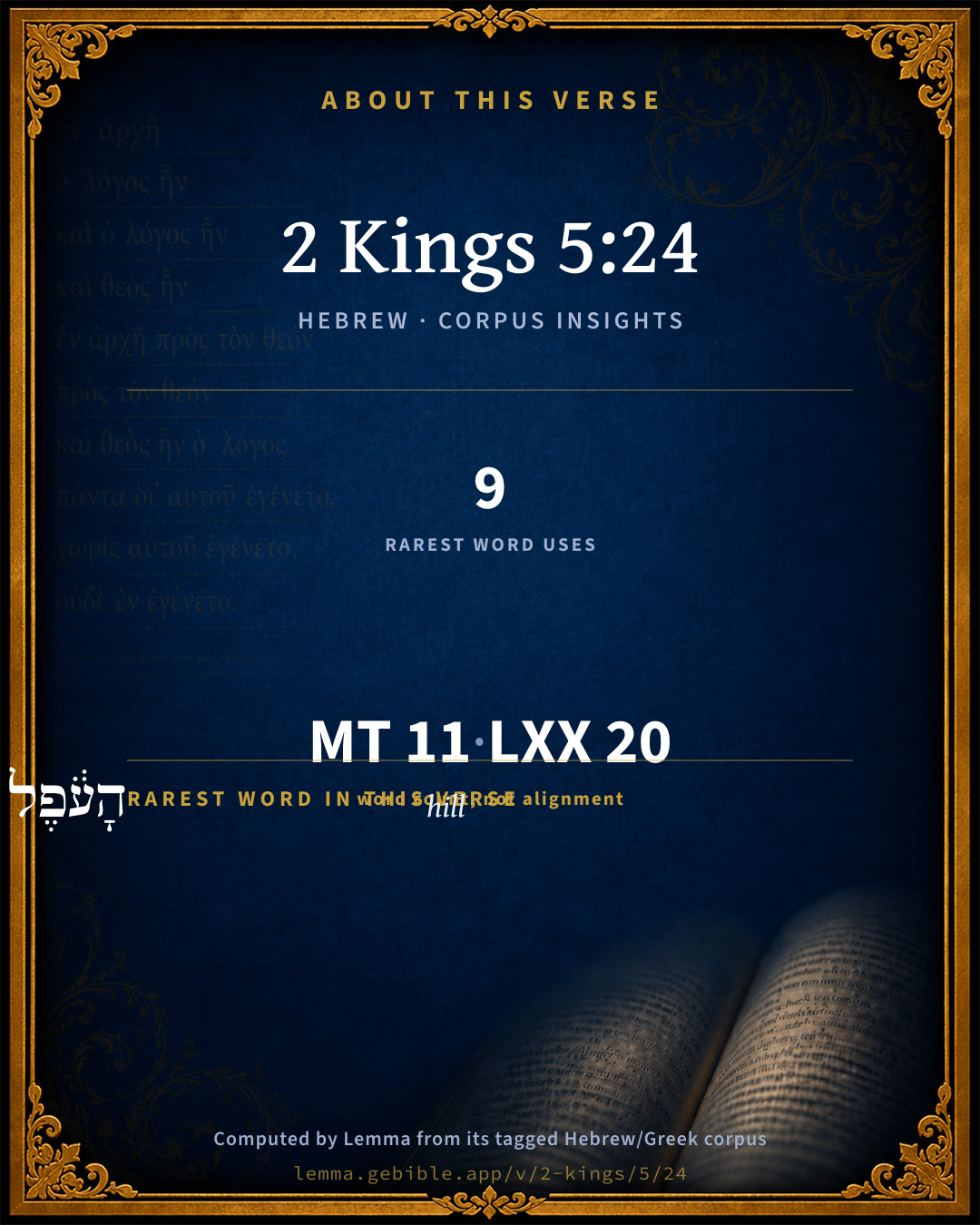
These counts appear in no published source. They are computed here, from the morphology-tagged text and Lemma’s own curated glosses. What Lemma adds →

11
words
11
distinct lemmas
Historical
section

Notable vocabulary

The rarest word here is הָעֹ֔פֶל hill H6076 — appearing just 9 times in the whole Hebrew Bible.

Shared distinctive vocabulary

הָעֹ֔פֶל hill H6076 occurs in 9 verses of the Hebrew Bible. Also found in:

Grammatical profile

  • 5 verbs
  • 4 nouns
  • 1 preposition
  • 1 particle

Verb forms

  • וַיָּבֹא֙ Qal · Sequential Imperfect
  • וַיִּקַּ֥ח Qal · Sequential Imperfect
  • וַיִּפְקֹ֣ד Qal · Sequential Imperfect
  • וַיְשַׁלַּ֥ח Piel · Sequential Imperfect
  • וַיֵּלֵֽכוּ Qal · Sequential Imperfect

Hebrew & Septuagint length

In English translation the verse runs 27 words from the Hebrew and 24 from the Septuagint (LXX English) — closely comparable.

A rough comparison of the two English renderings, which tokenize alike — not a word-level alignment.

Word counts can differ between the Hebrew and the Greek without any difference in meaning — e.g. the Hebrew direct-object marker אֵת has no separate Greek word, and Greek often adds the article ὁ.

In the original languages it is 11 Hebrew tokens and 20 Greek tokens — but the two are counted differently (Hebrew bundles its prefixes and suffixes into one token; the Greek is in lemma form), so that isn’t a like-for-like length.

Cross-references

7

Topical passages linked to 2 Kings 5:24 in the Treasury of Scripture Knowledge — connected by theme and wording, ordered by reader-vote popularity; previews shown in the World English Bible.

  • Joshua 7:1 But the children of Israel committed a trespass in the devoted thing; for Achan, the son of Carmi, the son of Zabdi, the son of Zerah, of the tribe of Judah, took of the devoted thing: and the anger of Yahweh was kindled against the children of Israel.
  • Joshua 7:11–12 Israel has sinned; yes, they have even transgressed my covenant which I commanded them: yes, they have even taken of the devoted thing, and have also stolen, and dissembled also; and they have even put it among their own stuff.
  • Joshua 7:21 when I saw among the spoil a goodly Babylonian mantle, and two hundred shekels of silver, and a wedge of gold of fifty shekels weight, then I coveted them, and took them; and, behold, they are hid in the earth in the midst of my tent, and the silver under it.
  • 1 Kings 21:16 It happened, when Ahab heard that Naboth was dead, that Ahab rose up to go down to the vineyard of Naboth the Jezreelite, to take possession of it.
  • Isaiah 29:15 Woe to those who hide deep their counsel from Yahweh, and whose works are in the dark, and who say, Who sees us? and who knows us?
  • Habakkuk 2:6 Won't all these take up a parable against him, and a taunting proverb against him, and say, 'Woe to him who increases that which is not his, and who enriches himself by extortion! How long?'
  • Zechariah 5:3–4 Then he said to me, "This is the curse that goes out over the surface of the whole land; for everyone who steals shall be cut off according to it on the one side; and everyone who swears falsely shall be cut off according to it on the other side.

Cross-references courtesy of OpenBible.info (CC BY 4.0).

Hebrew and Greek witnesses Masoretic Hebrew ↔ Greek Septuagint

The same verse in the two great witnesses to the Old Testament, shown verse-for-verse.

These are two independent witnesses, not word-aligned to each other, and the Septuagint is shown in lemma (dictionary) form.

Hebrew 2 Kings 5:24 Masoretic · Westminster Leningrad Codex

וַיָּבֹא֙ אֶל הָעֹ֔פֶל וַיִּקַּ֥ח מִיָּדָ֖ם וַיִּפְקֹ֣ד בַּבָּ֑יִת וַיְשַׁלַּ֥ח אֶת הָאֲנָשִׁ֖ים וַיֵּלֵֽכוּ

When he came to the hill, he took them from their hand, and bestowed them in the house; and he let the men go, and they departed.

World English Bible · Public Domain

Greek LXX 2 Kings 5:24 Septuagint · lemma form

καί ἔρχομαι εἰς ὁ σκοτεινός καί λαμβάνω ἐκ ὁ χείρ αὐτός καί παρατίθημι ἐν οἶκος καί ἐκ ἀποστέλλω ὁ ἀνήρ

And he came to a secret place, and took them from their hands, and laid them up in the house, and dismissed the men.

LXX2012 (modern English Septuagint) · Public Domain

On this verse, Adam Clarke's Commentary discusses the Septuagint’s reading. Read the note in Commentary ↓

Hebrew: Westminster Leningrad Codex (CC BY 4.0). Greek: Septuagint (public domain); English from LXX2012 (modern English Septuagint) (Public Domain). How the Septuagint differs from the Hebrew →

Targum (Aramaic paraphrase)

1

The Targum is the ancient Jewish Aramaic paraphrase of the Hebrew Scriptures — an interpretive translation, not the Hebrew text itself. Onkelos (literal) and Pseudo-Jonathan (expansive) render the Torah, and Jonathan the Prophets. Coverage is partial: where no permissively-licensed English translation exists for a verse, only the Aramaic is shown. This is verse-level text, not a word-by-word alignment to the Hebrew.

  1. Targum Jonathan Prophets (Joshua–Malachi)
    וְעַל לַאֲתַר כַּסִי וּנְסֵיב מִיֶדְהוֹן וּפַקֵיד בְּבֵיתָא וּשְׁלַח יַת גַבְרַיָא וַאֲזַלוּ:

    (no public-domain English translation for this verse)

    Targum Jonathan — Aramaic: “Mikraot Gedolot” (public domain). English: “Sefaria Community Translation” (CC0 1.0 (public-domain dedication)); “London "Chaldee Paraphrase," 1871” (public domain). Text via Sefaria.

Commentary

Notes on 2 Kings 5:24 from classic Christian and Jewish commentators (each source and its license shown beneath its notes). The classic Christian expositions comment on the surrounding passage and are grouped to its opening verse, so a note may address several verses; the Jewish commentaries on the Tanakh (Rashi and others) are per-verse, so they appear only where the commentator wrote on this verse.

Lemma curates 59 commentaries, every one of them public domain or Creative Commons licensed, each selected and text-cleaned for this edition rather than reprinted as found. About our sources →

Trapp's Complete Commentary

John Trapp

2Ki 5:24 And when he came to the tower, he took [them] from their hand, and bestowed [them] in the house: and he let the men go, and they departed.

Ver. 24: He took them from their hand.] A cunning thief; but his cunning deceived him, as familiars do witches, at the last, when they are in hold.

And they departed.] Quietly and quickly: sed Nemesis in tergo. Conscience and vengeance stuck to him.

John Trapp, A Commentary or Exposition upon All the Books of the Old and New Testament (1647–1656) — public domain. Text from a community e-Sword module.

Joseph Benson's Commentary

2Ki 5:24. When he came to the tower — A safe and private place, which he chose for the purpose, and where possibly he hid and kept other things, which he had got by such like frauds and artifices. And let the men go — Before they came within sight of his master.

Joseph Benson's Commentary on the Old and New Testaments (1811–1818) — public domain. Text from a community e-Sword module.

Tyndale Open Study Notes

Tyndale Open Resources

5:24 the citadel: The Hebrew word means hill or high point in a city. Citadels were often erected in such places (2 Chr 27:3).

Tyndale Open Study Notes — © Tyndale Open Resources, licensed CC BY-SA 4.0. Text via the HelloAO Bible API.

Geneva Bible (1599)

Geneva Bible translators

Or, fortress, or secret place.

Naaman’s servants.

Geneva Bible (1599) marginal notes — public domain. Text via Bolls.life.

Adam Clarke's Commentary

Verse 24. When he came to the tower] The Chaldee, Septuagint, Syriac, and Arabic understand the word עפל ophel, which we translate tower, as signifying a secret, dark, or hiding place. He was doing a deed of darkness, and he sought darkness to conceal it. He no doubt put them in a place little frequented, or one to which few had access besides himself. But the prophet's discerning spirit found him out.

Adam Clarke's Commentary on the Bible (1810–1826) — public domain. Text from a community e-Sword/MySword module.

Ellicott's Commentary for English Readers

(24) The tower.—Heb., the ’ôphel, the mound, on which the prophet’s house may have stood. There would be no window in the exterior wall from which Gehazi and his companions might have been observed approaching. Perhaps, however, a fortified hill, forming part of the system of defences surrounding Samaria, like the Ophel at Jerusalem, is to be understood. (Comp. 2Ch_27:3.) Elisha’s house lay within the city wall (2Ki_6:30, seq.). Keil explains the hill on which Samaria was built. (Comp. Isa_32:14, and Cheyne’s Note; Mic_4:8 : “And thou, O tower of the flock; O mound of the daughter of Zion.”) This note of place is also a note of historical truth.

Bestowed them in the house.—Stowed them away, laid them up carefully in the (prophet’s) house. LXX., παρέθετο.

Let the men go.—Before he “bestowed” their burdens in the house.

A Bible Commentary for English Readers, edited by Charles John Ellicott (1878–1897) — public domain. Text from a community e-Sword module.

The Cambridge Bible for Schools and Colleges

gen. ed. J. J. S. Perowne

24. when he came to the tower] R.V. hill. The word (Heb., Ophel) is often used in connexion with the description of the wall of Jerusalem (2Ch_27:3; 2Ch_33:14; Neh_3:26-27; Neh_11:21). From its use in Mic_4:8, of Mount Zion, the sense ‘hill’ rather than ‘tower’ appears well established. The margin of A.V., has here ‘secret place’ as also the LXX., but that seems to have come from connecting the word with a root of slightly different consonants (אפל instead of עפל). The question arises: What hill is meant? And it appears best to understand it of some eminence near the house of Elisha. All Samaria was hilly in character (see 1Ki_16:24). The narrative by this allusion to a locality, as though it were well known, shews its historic character, and appears to go back in its early form to close upon the date of the events.

he took them from their hand] Though they were heavy enough for two men, yet he must contrive to carry them himself that he may attract less notice, and run no risk of being found out.

The Cambridge Bible for Schools and Colleges (gen. ed. J. J. S. Perowne; Cambridge University Press, 1878–1918) — public domain. Text from a community e-Sword module.

John Gill's Exposition

And when he came to the tower,.... Of Samaria, or which was near it; a fortified place, and where was a watch, to whom he could safely commit the money and clothes:

he took them from their hand; not willing they should go any further with him, lest the affair should be discovered to his master:

and bestowed them in the house; deposited them there in the hands of some person whom he could trust; or laid them out, or ordered them to be laid out, in the purchase of houses, lands, vineyards, &c. see Kg2 5:26.

and he let the men go, and they departed; to their master.

John Gill's Exposition of the Whole Bible (1746–1763) — public domain (CC PDM 1.0). Text via the HelloAO Bible API.

Albert Barnes' Notes on the Bible

The tower - Rather, “the hill,” the well-known hill by Elisha’s house. The hill interrupted the view in the direction taken by Naaman, and Gehazi dismissed Naaman’s servants at this point lest they should be seen from his master’s residence.

Albert Barnes' Notes on the Bible (1834–1885) — public domain. Text from a community e-Sword/MySword module.

Haydock's Catholic Bible Commentary

Evening. Septuagint, Syriac, &c., seems to have read aupol, instead of the present Hebrew hopel, eminence," (Calmet) Protestants, "tower," (Haydock) at or near Samaria; when Giezi thought proper to take the burden himself to prevent detection. Eliseus would hardly dismiss the Syrians, when the night was so near at hand. (Calmet) --- It might however be found more eligible to travel in the evening, (Haydock) as it was now the spring or summer season, (Tirinus) or at least warm, ver. 10. (Haydock)

George Leo Haydock (1774–1849), Haydock's Catholic Family Bible and Commentary, 1859 edition — public domain. Excludes Psalms (Douay-Rheims chapter numbering differs from Protestant) and Deuterocanonical books (Catholic canon only).

Matthew Poole's English Annotations

The tower; a safe and private place which he chose for that purpose, and where possibly he hid and kept other things which he had got by such-like frauds and artifices.

He let the men go before they came within sight of his master.

Matthew Poole's English Annotations on the Holy Bible (1683–1685) — public domain. Text from a community e-Sword/MySword module.

Whedon's Commentary on the Bible

Daniel D. Whedon

24. Came to the tower — Rather, To the hill. העפל, the hill, here means either the hill on which Samaria was built, or the particular eminence on which Elisha’s house stood.

Daniel D. Whedon (gen. ed.), Commentary on the Old and New Testaments (1874–1909) — public domain. Text from a community e-Sword module.

The Pulpit Commentary

And when he came to the tower; rather, to the hill (Revised Version). Some well-known eminence at a little distance from the Damascus gate of Samaria must be intended. Here Gehazi stopped the slaves, and took the money from them. It was important for his purpose that they should not be seen re-entering the city, as that would have occasioned remark, and might naturally have led to inquiry. He took themi.e. , the bagsfrom their hand i.e. from the hands of Naaman"s servantsand bestowed them in the house; i.e. by himself or deputy brought them to Elisha"s house, and there hid them away. And he let the men Naaman"s servants go, and they departed. They hastened, no doubt, to rejoin their master.

The Pulpit Commentary (1880–1919), ed. H.D.M. Spence-Jones & Joseph S. Exell — public domain. Text from a community e-Sword module.

Keil & Delitzsch

C. F. Keil & F. Delitzsch

When Gehazi came to the hill (העפל, the well-known hill before the city) he took the presents from the bearers, and dismissing the men, laid them up in the house. בּ פּקד, to bring into safe custody.

Keil & Delitzsch — Biblical Commentary on the Old Testament (1861–1891) — public domain (CC PDM 1.0). Text via the HelloAO Bible API. (Old Testament only.)

Rashi

Rabbi Shlomo Yitzchaki (Rashi)

And he came to a concealed place. [Targum] Yonoson rendered, “to a hidden place.”

And took from their hands. From the hands of Na’amon’s two servants.

And he dismissed the men so that Elisha would not see them.

Rashi on the Tanakh — English translations: “The Judaica Press complete Tanach with Rashi, translated by A. J. Rosenberg” (CC BY 4.0); “Pentateuch with Rashi's commentary by M. Rosenbaum and A.M. Silbermann, 1929-1934” (public domain); “The Metsudah Tanach series, Lakewood, N.J” (CC BY 4.0); and “The Book of Joshua, Metsudah Publications, 1997” (CC BY 4.0). Text via Sefaria.

Lesson kit

Teaching starters — assembled from the data on this page, not authored interpretation. Every prompt links to the verse data it draws on. Edit before teaching.

2 Kings, in the Historical, opens this verse with 11 words (11 distinct Hebrew lemmas). Its most distinctive word is ʻôphel (“hill”). A historical commentator’s framing appears above. Read the whole chapter for the surrounding context.

Discussion questions

  1. The word ʻôphel carries the sense “hill.” How does it shape the verse?
  2. How does Deuteronomy 28:27, which shares the word «hill», read alongside this verse?
  3. The translations on this page render this verse differently — a whole-verse word diff, not a word-by-word alignment. What might account for the different wordings?
  4. «וַיָּבֹא֙» is a Qal Sequential Imperfect verb. How does that grammatical form shape the action described?
  5. Compare how Trapp's Complete Commentary and Joseph Benson's Commentary read this verse. Where do they agree or differ?

Things to notice

Reading settings

Reading text

Shown beneath each verse's original-language words.

Old Testament
Old Testament edition

Read the OT as the Masoretic Hebrew (MT) or the Greek Septuagint (LXX).

English shown for the Greek Septuagint (in the Hebrew ↔ Greek comparison).

Comparing translations? Open the Compare panel on any verse page to stack up to four side by side.