Joshua 11:1

Hebrew (Westminster Leningrad Codex) Joshua 11:1 appears in the Hebrew Old Testament. The text above is from the Westminster Leningrad Codex. Each word links to its Strong’s number, a concise gloss, and parsing drawn from the Open Scriptures Hebrew Bible morphology. Click any word for its full Brown-Driver-Briggs (BDB) entry.
Download image
Cite this verse

Joshua 11:1 (World English Bible). Public Domain. Lemma interlinear Bible study tool, https://lemma.gebible.app/v/joshua/11/1.

Show BibTeX & RIS
BibTeX
RIS
English Translation
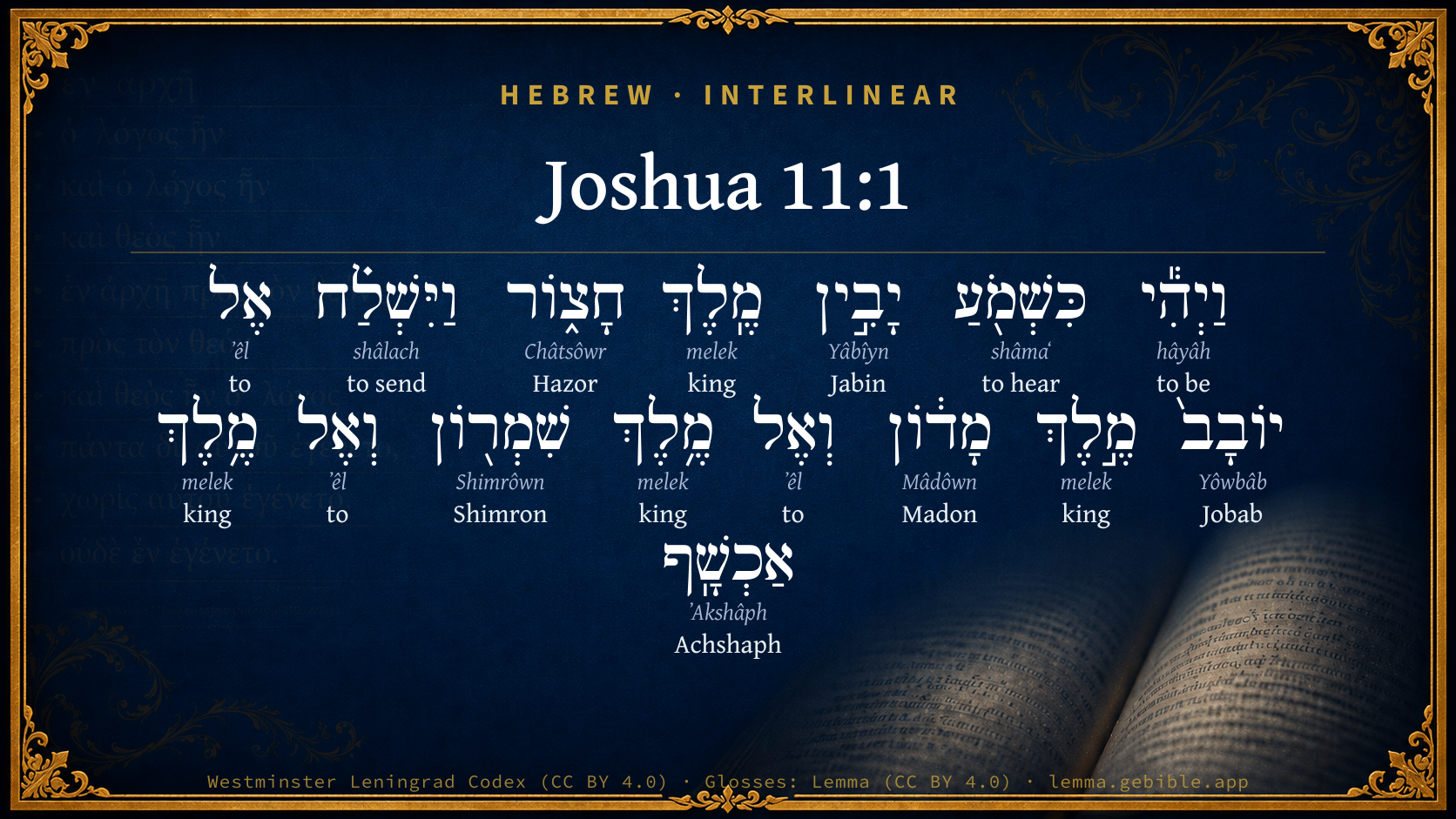
It happened, when Jabin king of Hazor heard of it, that he sent to Jobab king of Madon, and to the king of Shimron, and to the king of Achshaph,
World English Bible · Public Domain
Highlights
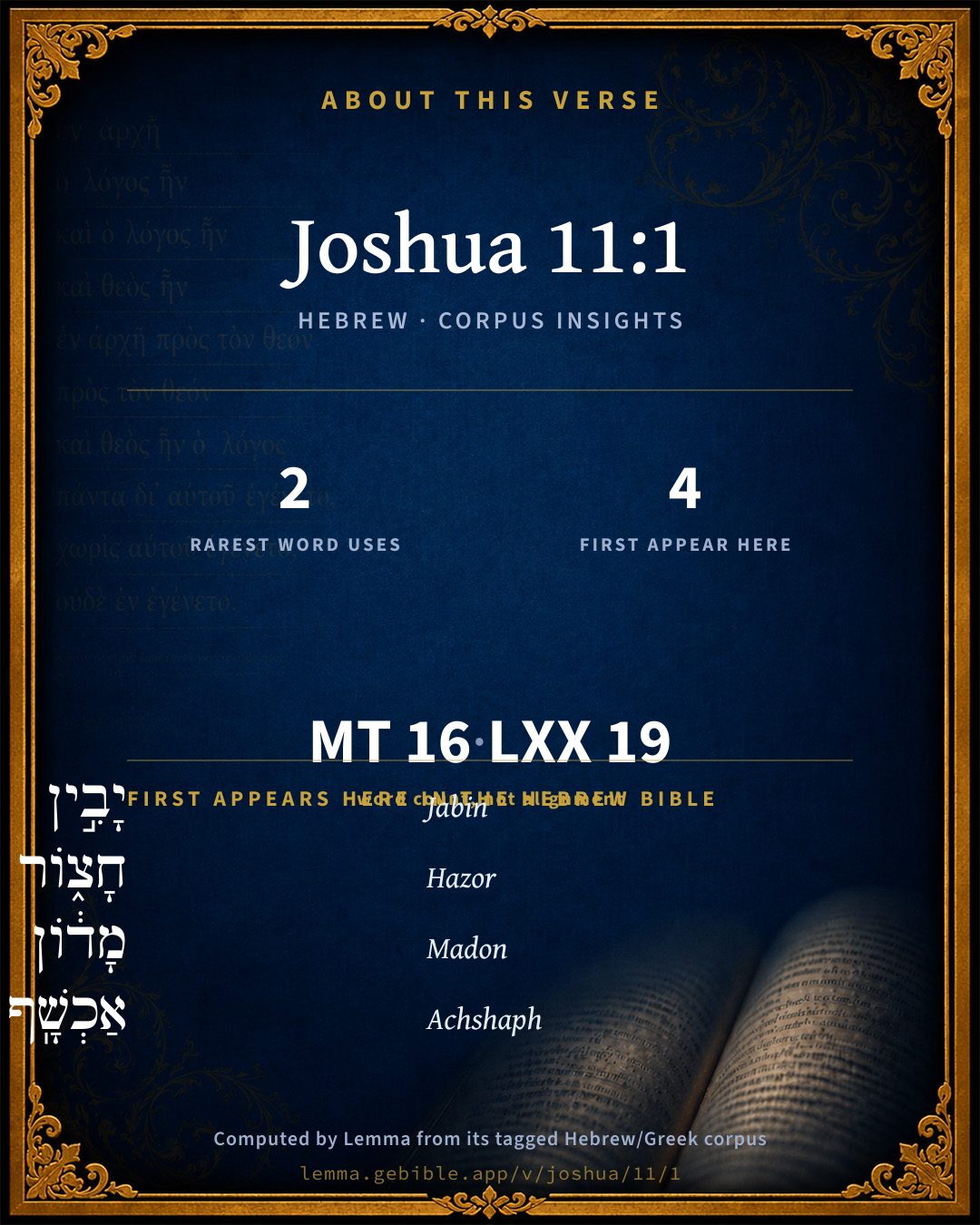
  • 4 first appearances in the Hebrew Bible
Full analysis ↓
Download a study sheet

One document with this verse’s original text, its word-by-word gloss line, the meaning frame, cross-references with their text, attributed commentary, and full source and license credits — printable, and it pastes into notes with its structure intact.

This verse Autodidact and up

Study sheet (.html) Plain text (.txt)

A passage Seminary Student

Up to 50 verses in one chapter. A passage sheet keeps up to 6 commentary sources and 12 cross-references per verse, in the order this page ranks them, and says so on the sheet whenever that leaves anything out. Ask for a single verse and you get the Autodidact verse sheet above.

Everything on this page stays free to read, with no account — the sheet is a download of what is already on screen, not access to it.

Want to remove ads? Support Godless Engineer
Compare translations 3

The same verse in 3 English versions, stacked beneath the original-language interlinear above. Click any original word for its lexicon entry.

Each is an independent rendering of the whole verse — the interlinear is not word-aligned to these translations.

Highlighted words mark where these versions differ — a whole-verse word diff, not a word-by-word alignment.

  • World English Bible Public Domain
    It happened, when Jabin king of Hazor heard of it, that he sent to Jobab king of Madon, and to the king of Shimron, and to the king of Achshaph,
  • King James Version Public Domain
    And it came to pass, when Jabin king of Hazor had heard those things, that he sent to Jobab king of Madon, and to the king of Shimron, and to the king of Achshaph,
  • unfoldingWord Literal Text CC BY-SA 4.0
    And it happened, when Jabin, the king of Hazor, heard, that he sent to Jobab, the king of Madon, and to the king of Shimron and to the king of Achshaph

unfoldingWord Literal Text — © unfoldingWord, licensed CC BY-SA 4.0. Word-aligned USFM3 via Door43 (git.door43.org/unfoldingWord/en_ult).

Versions to compare (up to 4)

3 of 4 selected

Show all 18 translations

Every available English version of this verse, each an independent rendering of the whole verse.

  • World English Bible Public Domain
    It happened, when Jabin king of Hazor heard of it, that he sent to Jobab king of Madon, and to the king of Shimron, and to the king of Achshaph,
  • Berean Standard Bible Public Domain
    Now when Jabin king of Hazor heard about these things, he sent word to Jobab king of Madon; to the kings of Shimron and Achshaph;
  • Majority Standard Bible Public Domain
    Now when Jabin king of Hazor heard about these things, he sent word to Jobab king of Madon; to the kings of Shimron and Achshaph;
  • King James Version Public Domain
    And it came to pass, when Jabin king of Hazor had heard those things, that he sent to Jobab king of Madon, and to the king of Shimron, and to the king of Achshaph,
  • American Standard Version (1901) Public Domain
    And it came to pass, when Jabin king of Hazor heard thereof, that he sent to Jobab king of Madon, and to the king of Shimron, and to the king of Achshaph,
  • Revised Version (1885) Public Domain
    And it came to pass, when Jabin king of Hazor heard thereof, that he sent to Jobab king of Madon, and to the king of Shimron, and to the king of Achshaph,
  • Geneva Bible (1599) Public Domain
    And whe Iabin King of Hazor had heard this, then he sent to Iobab King of Madon, and to the king of Shimron, and to the king of Achshaph,
  • Douay-Rheims (1899) Public Domain
    And when Jabin king of Asor had heard these things, he sent to Jobab king of Madon, and to the king of Semeron, and to the king of Achsaph:
  • Young's Literal Translation Public Domain
    And it cometh to pass when Jabin king of Hazor heareth, that he sendeth unto Jobab king of Madon, and unto the king of Shimron, and unto the king of Achshaph,
  • Literal Standard Version CC BY-SA 4.0
    And it comes to pass, when Jabin king of Hazor hears, that he sends to Jobab king of Madon, and to the king of Shimron, and to the king of Achshaph,
  • Unlocked Literal Bible CC BY-SA 4.0
    When Jabin, king of Hazor, heard this, he sent a message to Jobab, king of Madon, to the king of Shimron, and to the king of Akshaph.
  • unfoldingWord Literal Text CC BY-SA 4.0
    And it happened, when Jabin, the king of Hazor, heard, that he sent to Jobab, the king of Madon, and to the king of Shimron and to the king of Achshaph
  • Darby Bible Public Domain
    And it came to pass when Jabin king of Hazor heard [this], that he sent to Jobab king of Madon, and to the king of Shimron, and to the king of Achshaph,
  • World Messianic Bible Public Domain
    When Jabin king of Hazor heard of it, he sent to Jobab king of Madon, to the king of Shimron, to the king of Achshaph,
  • Webster's Bible Public Domain
    And it came to pass, when Jabin king of Hazor had heard those things, that he sent to Jobab king of Madon, and to the king of Shimron, and to the king Achshaph,
  • Free Bible Version CC BY-SA 4.0
    When Jabin, king of Hazor, heard about what happened, he sent a message to Jobab, king of Madon, to the kings of Shimron and Achshaph,
  • Bible in Basic English Public Domain
    Now Jabin, king of Hazor, hearing of these things, sent to Jobab, king of Madon, and to the king of Shimron, and to the king of Achshaph,
  • JPS Tanakh (1917) Public Domain
    And it came to pass, when Jabin king of Hazor heard thereof, that he sent to Jobab king of Madon, and to the king of Shimron, and to the king of Achshaph,

Literal Standard Version (2020), Covenant Press — licensed CC BY-SA 4.0. Text via the HelloAO Bible API (eBible.org). Unlocked Literal Bible (unfoldingWord) — licensed CC BY-SA 4.0. Text via the HelloAO Bible API (eBible.org). unfoldingWord Literal Text — © unfoldingWord, licensed CC BY-SA 4.0. Word-aligned USFM3 via Door43 (git.door43.org/unfoldingWord/en_ult). Free Bible Version, Dr. Jonathan Gallagher — licensed CC BY-SA 4.0. Text via the HelloAO Bible API (eBible.org).

Word by word

More ways to search: Search by grammar → Find every occurrence → Compare this word →

Practice this passage: Drill this verse → Learn its vocabulary →

מָד֔וֹן
Mâdôwn
H4068
“Madon”
Noun, Proper
Part of Speech
Noun
Type
Proper
Full BDB Definition

Origin: the same as H4067

TWOT: None

Madon = "strife" - one of the principal cities of Canaan who joined Jabin and his confederates in their battle against Joshua at the waters of Merom and were defeated
  1. וַיְהִ֕י hâyâh H1961 “and · to be” Conjunction + Verb, Qal, Sequential Imperfect, 3rd Person, Masculine, Singular
  2. כִּשְׁמֹ֖עַ shâmaʻ H8085 “like/as · to hear” Preposition + Verb, Qal, Infinitive Construct
  3. יָבִ֣ין Yâbîyn H2985 “Jabin” Noun, Proper
  4. מֶֽלֶךְ melek H4428 “king of” Noun, Common, Masculine, Singular, Construct
  5. חָצ֑וֹר Châtsôwr H2674 “Hazor” Noun, Proper
  6. וַיִּשְׁלַ֗ח shâlach H7971 “and · to send” Conjunction + Verb, Qal, Sequential Imperfect, 3rd Person, Masculine, Singular
  7. אֶל ʼêl H413 “to” Preposition
  8. יוֹבָב֙ Yôwbâb H3103 “Jobab” Noun, Proper
  9. מֶ֣לֶךְ melek H4428 “king of” Noun, Common, Masculine, Singular, Construct
  10. וְאֶל ʼêl H413 “and · to” Conjunction + Preposition
  11. מֶ֥לֶךְ melek H4428 “king of” Noun, Common, Masculine, Singular, Construct
  12. שִׁמְר֖וֹן Shimrôwn H8110 “Shimron” Noun, Proper
  13. וְאֶל ʼêl H413 “and · to” Conjunction + Preposition
  14. מֶ֥לֶךְ melek H4428 “king of” Noun, Common, Masculine, Singular, Construct
  15. אַכְשָֽׁף ʼAkshâph H407 “Achshaph” Noun, Proper

About this verse

These counts appear in no published source. They are computed here, from the morphology-tagged text and Lemma’s own curated glosses. What Lemma adds →

16
words
11
distinct lemmas
Historical
section

Notable vocabulary

The rarest word here is מָד֔וֹן Madon H4068 — appearing just 2 times in the whole Hebrew Bible.

First appearance in Scripture

These words make their first canonical appearance in the Hebrew Bible here:

  • יָבִ֣ין Jabin H2985
  • חָצ֑וֹר Hazor H2674
  • מָד֔וֹן Madon H4068
  • אַכְשָֽׁף Achshaph H407

Shared distinctive vocabulary

מָד֔וֹן Madon H4068 occurs in 2 verses of the Hebrew Bible. Also found in:

Grammatical profile

  • 3 verbs
  • 10 nouns
  • 3 prepositions

Verb forms

  • וַיְהִ֕י Qal · Sequential Imperfect
  • כִּשְׁמֹ֖עַ Qal · Infinitive Construct
  • וַיִּשְׁלַ֗ח Qal · Sequential Imperfect

Repetition

Words recur within this verse — often emphatic in Hebrew:

  • מֶֽלֶךְ king H4428 ×4
  • אֶל to H413 ×3

Hebrew & Septuagint length

In English translation the verse runs 30 words from the Hebrew and 27 from the Septuagint (LXX English) — closely comparable.

A rough comparison of the two English renderings, which tokenize alike — not a word-level alignment.

Word counts can differ between the Hebrew and the Greek without any difference in meaning — e.g. the Hebrew direct-object marker אֵת has no separate Greek word, and Greek often adds the article ὁ.

In the original languages it is 16 Hebrew tokens and 19 Greek tokens — but the two are counted differently (Hebrew bundles its prefixes and suffixes into one token; the Greek is in lemma form), so that isn’t a like-for-like length.

Cross-references

11

Topical passages linked to Joshua 11:1 in the Treasury of Scripture Knowledge — connected by theme and wording, ordered by reader-vote popularity; previews shown in the World English Bible.

  • Joshua 11:10 Joshua turned back at that time, and took Hazor, and struck the king of it with the sword: for Hazor before was the head of all those kingdoms.
  • Joshua 10:3–4 Therefore Adoni-zedek king of Jerusalem sent to Hoham king of Hebron, and to Piram king of Jarmuth, and to Japhia king of Lachish, and to Debir king of Eglon, saying,
  • Judges 4:2 Yahweh sold them into the hand of Jabin king of Canaan, who reigned in Hazor; the captain of whose host was Sisera, who lived in Harosheth of the Gentiles.
  • Psalms 2:1–4 Why do the nations rage, And the peoples plot a vain thing?
  • Isaiah 43:5–7 Don't be afraid; for I am with you: I will bring your seed from the east, and gather you from the west;
  • Joshua 12:19 the king of Madon, one; the king of Hazor, one;
  • Joshua 19:36 and Adamah, and Ramah, and Hazor,
  • Judges 4:17 However Sisera fled away on his feet to the tent of Jael the wife of Heber the Kenite; for there was peace between Jabin the king of Hazor and the house of Heber the Kenite.
  • Psalms 83:1–3 God, don't keep silent. Don't keep silent, And don't be still, God.
  • Isaiah 26:11 Yahweh, your hand is lifted up, yet they don't see: but they shall see [your] zeal for the people, and be disappointed; yes, fire shall devour your adversaries.
  • Isaiah 43:2 When you pass through the waters, I will be with you; and through the rivers, they shall not overflow you: when you walk through the fire, you shall not be burned, neither shall the flame kindle on you.

Cross-references courtesy of OpenBible.info (CC BY 4.0).

Hebrew and Greek witnesses Masoretic Hebrew ↔ Greek Septuagint

The same verse in the two great witnesses to the Old Testament, shown verse-for-verse.

These are two independent witnesses, not word-aligned to each other, and the Septuagint is shown in lemma (dictionary) form.

Hebrew Joshua 11:1 Masoretic · Westminster Leningrad Codex

וַיְהִ֕י כִּשְׁמֹ֖עַ יָבִ֣ין מֶֽלֶךְ חָצ֑וֹר וַיִּשְׁלַ֗ח אֶל יוֹבָב֙ מֶ֣לֶךְ מָד֔וֹן וְאֶל מֶ֥לֶךְ שִׁמְר֖וֹן וְאֶל מֶ֥לֶךְ אַכְשָֽׁף

It happened, when Jabin king of Hazor heard of it, that he sent to Jobab king of Madon, and to the king of Shimron, and to the king of Achshaph,

World English Bible · Public Domain

Greek LXX Joshua 11:1 Septuagint · lemma form

ὡς δέ ἀκούω ιαβιν βασιλεύς ασωρ ἀποστέλλω πρός ιωβαβ βασιλεύς μαρρων καί πρός βασιλεύς συμοων καί πρός βασιλεύς αζιφ

And when Jabis the king of Asor heard, he sent to Jobab king of Maron, and to the king of Symoon, and to the king of Aziph,

LXX2012 (modern English Septuagint) · Public Domain

On this verse, The Preacher's Complete Homiletical Commentary discusses the Septuagint’s reading. Read the note in Commentary ↓

Hebrew: Westminster Leningrad Codex (CC BY 4.0). Greek: Septuagint (public domain); English from LXX2012 (modern English Septuagint) (Public Domain). How the Septuagint differs from the Hebrew →

Targum (Aramaic paraphrase)

1

The Targum is the ancient Jewish Aramaic paraphrase of the Hebrew Scriptures — an interpretive translation, not the Hebrew text itself. Onkelos (literal) and Pseudo-Jonathan (expansive) render the Torah, and Jonathan the Prophets. Coverage is partial: where no permissively-licensed English translation exists for a verse, only the Aramaic is shown. This is verse-level text, not a word-by-word alignment to the Hebrew.

  1. Targum Jonathan Prophets (Joshua–Malachi)
    וַהֲוָה כַּד שְׁמַע יָבִין מַלְכָּא דְחָצוֹר וּשְׁלַח לְוַת יוֹבָב מַלְכָּא דְמָדוֹן וּלְוַת מַלְכָּא דְשִׁמְרוֹן וּלְוַת מַלְכָּא דְאַכְשָׁף:

    (no public-domain English translation for this verse)

    Targum Jonathan — Aramaic: “Mikraot Gedolot” (public domain). English: “Sefaria Community Translation” (CC0 1.0 (public-domain dedication)); “London "Chaldee Paraphrase," 1871” (public domain). Text via Sefaria.

Commentary

Notes on Joshua 11:1 from classic Christian and Jewish commentators (each source and its license shown beneath its notes). The classic Christian expositions comment on the surrounding passage and are grouped to its opening verse, so a note may address several verses; the Jewish commentaries on the Tanakh (Rashi and others) are per-verse, so they appear only where the commentator wrote on this verse.

Lemma curates 59 commentaries, every one of them public domain or Creative Commons licensed, each selected and text-cleaned for this edition rather than reprinted as found. About our sources →

Matthew Henry's Commentary

We are here entering upon the story of another campaign that Joshua made, and it was a glorious one, no less illustrious than the former in the success of it, though in respect of miracles it was inferior to it in glory. The wonders God then wrought for them were to animate and encourage them to act vigorously themselves. Thus the war carried on by the preaching of the gospel against Satan's kingdom was at first forwarded by miracles; but, the war being by them sufficiently proved to be of God, the managers of it are now left to the ordinary assistance of divine grace in the use of the sword of the Spirit, and must not expect hail-stones nor the standing still of the sun. In this story we have,

I. The Canaanites taking the field against Israel. They were the aggressors, God hardening their hearts to begin the war, that Israel might be justified beyond exception in destroying them. Joshua and all Israel had returned to the camp at Gilgal, and perhaps these kings knew no other than that they intended to sit down content with the conquest they had already made, and yet they prepare war against them. Note, Sinners bring ruin upon their own heads, so that God will be justified when he speaks, and they alone shall bear the blame for ever. Judah had now couched as a lion gone up from the prey; if the northern kings rouse him up, it is at their peril, Gen 49:9. Now, 1. Several nations joined in this confederacy, some in the mountains and some in the plains, Jos 11:2. Canaanites from east and west, Amorites, Hittites, Perizzites, etc. (Jos 11:3), of different constitutions and divided interests among themselves, and yet they here unite against Israel as against a common enemy. Thus are the children of this world more unanimous, and therein wiser, than the children of light. The oneness of the church's enemies should shame the church's friends out of their discords and divisions, and engage them to be one. 2. The head of this confederacy was Jabin king of Hazor (Jos 11:1), as Adoni-zedec was of the former; it is said (Jos 11:10) Hazor had been the head of all those kingdoms, which could not have revolted without occasioning ill-will; but this was forgotten and laid aside upon this occasion, by consent of parties, Luk 23:12. When they had all drawn up their forces together, every kingdom bringing in its quota, they were a very great army, much greater than the former, as the sand on the sea shore in multitude, and upon this account much stronger and more formidable, that they had horses and chariots very many, which we do not find the southern kings had; hereby they had a great advantage against Israel, for their army consisted only of foot, and they never brought horses nor chariots into the field. Josephus tells us that the army of the Canaanites consisted of 300,000 foot, 10,000 horses, and 20,000 chariots. Many there be that rise up against God's Israel; doubtless their numbers made them very confident of success, but it proved that so much the greater slaughter was made of them.

II. The encouragement God gave to Joshua to give them the meeting, even upon the ground of their own choosing (Jos 11:6): Be not afraid because of them. Joshua was remarkable for his courage - it was his master grace, and yet it seems he had need to be again and again cautioned not to be afraid. Fresh dangers and difficulties make it necessary to fetch in fresh supports and comforts from the word of God, which we have always nigh unto us, to be made use of in every time of need. Those that have God on their side need not be disturbed at the number and power of their enemies; more are those that are with us than those that are against us; those have the hosts of the Lord that have the Lord of hosts engaged for them. For his encouragement, 1. God assures him of success, and fixes the hour: Tomorrow about this time, when an engagement (it is probable) was expected and designed on both sides, I will deliver them up slain. Though they were to be slain by the sword of Israel, yet it is spoken of as God's work, that he would deliver them up. 2. He appoints him to hough their horses, hamstring them, lame them, and burn their chariots, not only that Israel might not use them hereafter, but that they might not fear them now, their God designing this contempt to be put upon them. Let Israel look upon their chariots but as rotten wood designed for the fire, and their horses of war as disabled things, scarcely good enough for the cart. This encouragement which God here gave to Joshua no doubt he communicated to the people, who perhaps were under some apprehensions of danger from this vast army, notwithstanding the experience they had had of God's power engaged for them. And the wisdom and goodness of God are to be observed, (1.) In infatuating the counsels of the enemy, that all the kings of Canaan, who were not dispersed at such a distance from each other but that they might have got all together in a body, did not at first confederate against Israel, but were divided into the southern and northern combination, and so became the less formidable. And, (2.) In preparing his people to encounter the greater force, by breaking the less. They first engage with five kings together, and now with many more. God proportions our trials to our strength and our strength to our trials.

III. Joshua's march against these confederate forces, Jos 11:7. He came upon them suddenly, and surprised them in their quarters. He made this haste, 1. That he might put them into the greater confusion, by giving them an alarm, when they little thought he was near them. 2. That he might be sure not to come short of the honour God had fixed, to give him the meeting at the enemies' camp, tomorrow about this time. It is fit we should keep time with God.

IV. His success, Jos 11:8. He obtained the honour and advantage of a complete victory; he smote them and chased them, in the several ways they took in their flight; some fled towards Zidon, which lay to the northwest, others towards Mizpeh, eastward, but the parties Joshua sent out pursued them each way. So the Lord delivered them into the hand of Israel; they would not deliver themselves into the hands of Israel to be made proselytes and tributaries, and so offered up to God's grace (Rom 15:16), and therefore God delivered them into their hands to be made sacrifices to his justice; for God will be honoured by us or upon us.

V. His obedience to the orders given him, in destroying the horses and chariots (Jos 11:9), which was an instance, 1. Of his subjection to the divine will, as one under authority, that must do as he is bidden. 2. Of his self-denial, and crossing his own genius and inclination in compliance with God's command. 3. Of his confidence in the power of God engaged for Israel, which enabled them to despise the chariots and horses which others trusted in, Psa 20:7; Psa 33:17. 4. Of his care to keep up in the people the like confidence in God, by taking that from them which they would be tempted to trust too much to. This was cutting of a right hand.

Matthew Henry's Commentary on the Whole Bible (1708–1710) — public domain (CC PDM 1.0). Text via the HelloAO Bible API.

The Cambridge Bible for Schools and Colleges

gen. ed. J. J. S. Perowne

Ch. Jos_11:1-15. Confederacy of the Kings of Northern Canaan

1. And it came to pass] We now enter upon a different scene in the conquests of Joshua. Just as before Adoni-Zedek, the king of Jerusalem, had summoned the five kings of southern Canaan, so now Jabin, the king of Hazor, summons the chiefs of the north against the Israelitish leader.

Jabin] This was an hereditary and official title of the chief of Hazor. It denotes “the wise” or “intelligent” Here we find a king of the same name at a considerably later date (Jdg_4:2).

Hazor]= “enclosed,” “fortified” was an important, and apparently almost impregnable, stronghold of the Canaanites of the north, situated in the mountains, north of the waters of Merom. We find it afterwards fortified by Solomon (1Ki_9:15), and its inhabitants were carried away captive by Tiglath-pileser (2Ki_15:29). The most probable site is Tell Khuraibeh. It lay apparently between Ramah and Kedesh, on the high ground overlooking the Lake of Merom.

Jobab king of Madon] The three places here mentioned, Madon, Shimron, and Achshaph, were probably in the neighbourhood of Hazor, but their sites cannot be determined. Schwarz on very slight grounds proposes to identify Madon with Kefr Menda, a village at the western end of the Plain of Buttauf, four or five miles N. of Sepphoris.

the king of Shimron] Its full name appears to have been Shimron-Meron. It was afterwards included in the tribe of Zebulun (Jos_19:15).

the king of Achshaph] This place was afterwards included within the territory of Asher (Jos_12:20; Jos_19:25). It has been identified with Chaifa, a place which, from its situation, must always have been of great importance.

The Cambridge Bible for Schools and Colleges (gen. ed. J. J. S. Perowne; Cambridge University Press, 1878–1918) — public domain. Text from a community e-Sword module.

Trapp's Complete Commentary

John Trapp

Jos 11:1 And it came to pass, when Jabin king of Hazor had heard [those things], that he sent to Jobab king of Madon, and to the king of Shimron, and to the king of Achshaph,

Ver. 1. When Jabin king of Hazor had heard those things.] In policy he should have done this sooner, before the five southern kings had been destroyed. But Jabin was an Epimetheus, a postmaster, wise after the fact; and sped accordingly. God’s holy hand was in it also, that his people might not be over matched or disheartened. Our temptations are in like sort disposed of by Christ, the great Aγωνοθετης.

John Trapp, A Commentary or Exposition upon All the Books of the Old and New Testament (1647–1656) — public domain. Text from a community e-Sword module.

The Biblical Illustrator

Joseph S. Exell

Jos_11:1-23

When Jabin king of Hazor had heard.

Take heed how ye hear

I. Healing and not hearing. The tidings of the overthrow of Sihon and Og, and the fall of Jericho, seem to have made almost no impression on the sleepy King of Hazor.

II. Hearing, but hearing in vain. When Ai fell there seems to have been a general movement all through Canaan west of Jordan (Jos_9:1). Before Jabin had gathered the northern legions southern Canaan had been destroyed.

III. Hearing, and hearing to ruin. When Jabin did exert himself, it was but to proceed straight to destruction. Thus do the wicked delay heedlessly, awaken slowly, and finally bestir themselves to anticipate judgment. (F. G. Marchant.)

Be not afraid because of them.

Divine directions for the fight

I. The directions which God gave Joshua on this occasion were prefaced by words of encouragement according to the Divine custom. Though Jehovah is not to interpose with mighty power as on former occasions, yet He supports and strengthens His servant with timely encouragement. Nothing could be better timed than these words as a preparation for the work that had to be done. Joshua had been made fully acquainted with the foe. His scouts have returned covered with dust, and reported the position and numbers and equipment of this new enemy. As these particulars were all told we can imagine that the boldest held his breath for a time. Joshuas generals would look at each other as if to say, What shall we do now? God knows human nature, therefore at this emergency He steps in with the words, Be not afraid because of them, for to-morrow about this time will I deliver them up all slain before Israel. God is always well timed in His announcements. When we seek with all our hearts to do His will we shall never lack encouragement, and the greater the enemy, the harder the task, the more emphatic will that encouragement be. And the encouragement God gave was very definite. He did not speak in a general way. He fixed the day, the hour, and the extent of the victory. Whatever our difficulties may be, if we only search Gods Word we will find definite encouragement, that which exactly meets our circumstances. The encouragement was also emphatic. We lose somewhat, in our translation, the emphasis of the original. The I is most emphatic. The army before Joshua may be as the sand of the sea for multitude, but what are the hosts of Jabin to the hosts of Jehovah? And the man who has on his side Jehovah of hosts can also count on the hosts of Jehovah. Therefore Joshua, even in the sight of such a foe, has no cause for fear. Does not God deal in the very same way with us? With what emphasis does He point to Himself as the glorious source of light and love and life, so that our hearts may be encouraged to put all their trust in Him, to the casting out of every fear. And the encouragement was also suggestive. Gods words bring to remembrance other scenes and other victories. Joshua was not the only one whom God had helped in similar emergencies. All the difficulties that may come upon us may be new to us, but not one of them is new to God. He has brought His people triumphantly through the same or worse before, and He can do so again.

II. This Divine encouragement was coupled with a divine command. The chief object of Israels fear would naturally be the horses and chariots which were Jabins pride and confidence; and it is to them that the command has special reference. God ordered His servants not to seize them and turn them against the enemy, but to destroy them utterly. This command is given for the express purpose of removing a temptation to carnal confidence. Jehovah wishes His people to look to Him alone for victory. This is to be their constant attitude, the holy habit of their souls. The bearing of this command on us is plain, and the lesson is much needed in our day. We are to carry on Gods work in Gods way. There are many of the weapons and devices of the world which ought not to be pressed into the service of the Church. To handle the iron chariots and the prancing horses of human philosophy against the hosts of unbelief, at the same time retaining our confidence in God as the Giver of every victory, and the consciousness that not a single soul can be savingly convinced except by His might--this is an attainment which the history of the Church from the beginning has proved a practical impossibility. Our one work in the prosecution of the campaign of salvation is to preach Christ and Him crucified, though fully conscious of the fact that to some it is foolishness, not worth a row of pins; and to others a stumbling-block, utterly repugnant. There is, and has always been, a fatal tendency to use the worlds weapons in the Churchs work; to worship intellect, learning, genius, scholarship, eloquence; to look on these things as the treasury and armoury of the Church; to depend on what is outward and human, instead of what is spiritual; to depend on that which appeals to the eye, the ear, the intellect, the emotions, rather than on the living God and His glorious gospel. They are the mightiest champions who, like the Master, do all the fighting not with enticing words of mans wisdom, but in demonstration of the Spirit, and with power. Thus encouraged and commanded, Joshua brought his army into close proximity to the foe. He rested during that night, and when the grey dawn was lighting up the rushy marshes round the waters of Merom, he burst like a thunderbolt upon Jabins camp. The victory could not have been more complete; and it was speedily followed up, as in the south, by the subjugation of all the leading cities in the northern portion of Canaan; the city of Hazor, Jabins capital, being destroyed with fire. As we think on this crowning victory we remember the words, An horse is a vain thing for safety, neither shall he deliver any by his great strength. Jabin found this out in that dire encounter. So will it be with all who harden themselves against the gospel of Christ. The more stout in heart they are to resist, the more terrible will be their overthrow. And if Jabins overthrow reminds us of these things, this last great victory of Joshua also places very emphatically before us the conditions of success in the work of the Lord. They are few and simple, and easy to be understood. They comprise wise purpose, believing courage, sleepless energy, scrupulous obedience, hard blows. As a young student said to a friend when they were speaking of the work to which they had devoted themselves, Our great work in preaching to people is not to dish up dainty ideas, but to pound them with the truth. Let us only listen to Gods encouragement, obey Gods command, march with unfeigned faith, and strike with all our might, and victory is sure. (A. B. Mackay.)

Types of Christian warfare

1. The enemies of Christ are very many in number.

2. Not only are the enemies of Christ very numerous, but they are perfectly united. There is a common consent amongst them. They hate the good. They are unanimous, and their unanimity is power.

3. The forces of evil are many, united, and desperate. They have made up their minds to work rack and ruin. (J. Parker, D. D.)

All the spoil of these cities, and the cattle, the children of Israel took for a prey unto themselves.--

Sharing the spoil

These at the end would amply make up for the toils and sufferings of conflict, and for all the privations and prohibitions they had been laid under. This is that which should engage the Christians hopes, and on which his whole heart should be set, the end of warfare, when He who poured out his soul unto death, and was numbered with transgressors, will, in assigning the fruits of His eternal conquests, divide the spoil with the strong, and His portion with the great. Unsearchable the riches, and invaluable the spoils, to be shared in the heavenly world: treasures of everlasting bliss and glory that await every holy warrior. These are appropriate only to the elevation of perfect being and blessedness; and then to be enjoyed, when the conflicts of time end in the triumphs of eternity. Nothing will be found marked with a prohibition, nor anything less be obtained, than an unwithering crown of life. This will compensate for all the sufferings that can now be endured, and for all the sacrifices that may ever be made, the hope of which, as realised in the mind, yields no small support. (W. Seaton.)

The Biblical Illustrator, edited by Joseph S. Exell (c. 1880s–1900s) — public domain. Text from a community e-Sword module.

Joseph Benson's Commentary

Jos 11:1. King of Hazor — This was the principal city of the northern part of Canaan, Jos 11:10; and fell to the share of the tribe of Naphtali in the division of the land, Jos 19:36. Jabin was the name of the king of the Canaanites in this part of the country, in future times, as well as now. Had heard — This was a remarkable instance of the wisdom and goodness of Divine Providence, which so governed the minds of the Canaanites, that they were not all united under one king but divided among many petty kings; and next, that these did not all unanimously join their counsels and forces together to oppose the Israelites at their first entrance, but quietly suffered the destruction of their brethren, thereby preparing the way for their own.

Joseph Benson's Commentary on the Old and New Testaments (1811–1818) — public domain. Text from a community e-Sword module.

Dummelow's Commentary on the Holy Bible

J. R. Dummelow

The Campaign in the North

Here there is no trace, as in the former case, of miraculous interposition. Joshua's generalship, courage, swiftness and loyalty are the prominent factors in the achievement. Yet it is made clear here (Jos_11:6-8) as ever, that those qualities attained their object because they were under the direct guidance of the God of Israel.

1. Jabin] king of Hazor. Hazor] may be Tell el-Hurrawiyeh, 2½ m. S. of Kedesh-Naphtali. Shimron] (=Shimron-meron 12:20) is Semûnieh, W. of Nazareth. Achshaph] el Yasîf, the port of Accho. Hazor is again a powerful Canaanite centre in the time of Deborah (Judges 4) and its king bears the same name, or title, Jabin (=wise) and may have been of the same dynasty. 2, 3. RV 'that were on the north, in the hill-country, and in the Arabah south of Chinneroth, and in the lowland, and in the heights, of Dor on the west, to the Canaanite on the east..' The 'Arabah S. of Chinneroth 'means the plain S. of the lake of Gennesaret (Luk_5:1). Dor] near Mt. Carmel.

3. The Canaanite on the east and on the west] The name 'Canaanite' is more probably geographical than racial. It means 'lowlanders.' In the Amama tablets (14th cent. b.c.) the Land of Canaan means the Phoenician coast; in later Egyptian monuments it includes all W. Syria.

5. Waters of Merom] Probably Lake Huleh, a marshy lake near the sources of the Jordan.

6. Thou shalt hough, etc.] To 'hough' or 'hock'=to hamstring a horse. This was done, no doubt, during the battle, to stop the charge. The chariots were destroyed afterwards.

16-23. General retrospect of Joshua's campaigns. This paragraph covers the preceding chapters as well as chapter Jos_11:1-15. The war, which has been presented to us in graphic sketches following one another in swift succession, is said to have been a 'long' one (Jos_11:18), and the natural inference from Jos_14:7-10 (where see note) is that it lasted seven years.

16. The mountain country and Negeb (dry southern uplands) and Shephelah (low hills skirting the mountains) first mentioned are those of Judah (see on Jos_10:40), from which the inference has been drawn that the writer was a native of that tribe, because he does not qualify the terms. Then follows the Arabah (deep valley of Jordan), and finally the mountain of Israel and its Shephelah, i.e. the N. Israelite part of this central range and the low hills (valley) between it and Carmel. The stretch of country described reaches from Halak in Edomite territory S. of the Dead Sea to Baal Gad at the foot of Hermon, N. of Lake Huleh.

22. The Anakims] This hill-tribe had by their stature made an alarming impression on the original spies (Num_13:28-33 cp. Jos_14:12). It was from Gath that Goliath came (1Sa_17:4) and other giants (2Sa_21:18-22).

J. R. Dummelow, A Commentary on the Holy Bible (Macmillan, 1909) — public domain. Text from a community e-Sword module.

Whedon's Commentary on the Bible

Daniel D. Whedon

THE GREAT BATTLE OF MEROM, Jos_11:1-15.

[“The battle of Beth-boron is represented as the most important battle of the Conquest, because, being the first, it struck the decisive blow. But in all such struggles there is usually one last effort made for the defeated cause. This, in the subjugation of Canaan, was the battle of Merom. Round Jabin were assembled the heads of all the tribes who had not yet fallen under Joshua’s sword. As the British chiefs were driven to the Land’s End before the advance of the Saxon, so at this Land’s End of Palestine were gathered for the last struggle, not only the kings of the north, in the immediate neighbourhood, but from the desert valley of the Jordan south of the Sea of Galilee, from the maritime plain of Philistia, from the heights above Sharon, and from the still unconquered Jebus, to the Hivite who dwelt in the valley of Baal-gad under Hermon.” — Stanley.]

1. Jabin (signifying he shall know, or he is wise) was probably the royal title of the kings of Hazor.

Hazor was a Phenician fortified city in the north of Palestine. It was the principal city of the whole of the North, “the head of all those kingdoms.” Jos_11:10. [After its destruction by Joshua it was rebuilt and occupied by another Jabin, who attained vast power, and for twenty years greatly oppressed Israel, (Jdg_4:2-3,) but was in turn defeated by Barak. It was subsequently fortified by Solomon, (1Ki_9:15,) but was afterward captured by Tiglath-pileser, king of Assyria. 2Ki_15:29. Travellers are not agreed as to its site. Dr. Thomson thinks it is at the modern Hazere, about twelve miles west of the Lake Merom. Stanley locates it on an eminence just above Cesarea Philippi; Robinson at Tell Khureibeh, a rocky peak three miles west of Lake Merom; and Porter inclines to locate it a few miles south of this, on a bank of the Wady Hendaj.]

Madon was a leading city in the same vicinity, but its locality is now unknown.

Shimron, called also Shimron-Merom, (Jos_12:20,) was the chief place in a small district afterward belonging to Zebulun, eleven miles northeast of Nazareth. Schwarz thinks that it is the same as the modern Semuniyeh, a few miles west of Nazareth.

Achshaph was in the territory of Asher. Jos_19:25. Robinson identifies it with the ruined town now called Kasaf, ten or twelve miles northwest of Lake Merom.

Daniel D. Whedon (gen. ed.), Commentary on the Old and New Testaments (1874–1909) — public domain. Text from a community e-Sword module.

The Preacher's Complete Homiletical Commentary

Joseph S. Exell (gen. ed.)

THE OVERTHROW OF THE CITIES OF THE NORTH, AND GENERAL RETROSPECT

CRITICAL NOTES.—

Jos_11:1. Hazor] In Jos_11:11, Hazor is described as “the head” of all the kingdoms named in Jos_11:1-3. It was in his capacity of principal monarch of North-West Canaan that Jabin summoned the other kings. Hazor was burned by Joshua (Jos_11:13), but was afterwards rebuilt (Jdg_4:2; 1Sa_12:9); it was fortified by Solomon (1Ki_9:15), and its inhabitants, in the time of Pekah, were carried into captivity by Tiglath-Pileser (2Ki_15:29). Jabin]= “the wise,” “the intelligent.” It is uncertain if Jdg_4:2 shews merely a coincidence of names, or whether the recurrence of the word points to the term as a title given to the kings of Hazor. Madon] Only mentioned here and in chap. Jos_12:19. The site is unknown. Shimron] In chap. Jos_12:20, called Shimron-Meron; it was probably situated near the Waters of Merom. It became part of the lot of Zebulon (chap. Jos_19:15). Achshaph] Not identified. It fell to the lot of Asher (chap. Jos_19:25).

Jos_11:2. On the north of the mountains] Heb. = “in the north on the mountains;” i.e., on the mountains of Naphtali (cf. chap. Jos_20:7). The plains south of Chinneroth] Chinneroth may be used here for the Lake of Gennesareth itself (Num_34:11; Jos_12:3); the Arabah, or desert (not “plains”) on the south, indicates the Ghor, or Jordan valley, immediately below the lake. In the valley] Lit. in “the Shephelah,” or lowlands. “Probably the strip bordering the sea between Akko and Sidon, to which the following Naphoth-Dor on the sea directs us (chap. Jos_12:23).” [Fay.] The lowlands, south of Cape Carmel, situated on the sea coast, may, however, be intended.

Jos_11:3. Land of Mizpeh] Gesenius traces several places bearing this and the similar name “Mizpah.” Both words signify “a watch-tower,” “a lofty place,” “an outlook.” “The land of Mizpeh (here intended) cannot be any other than the tract of country at the foot of the Jebel-esh-Sheikh between the Jebel Heisch and Nahr Hasbeya, through which a broad arm or line of hills of inconsiderable height runs southwards from the foot of the loftiest part of the Jebel-esh-Sheikh, forming the high land which shuts in Lake Huleh on the east. This tract is called Jebel Heisch according to Burckhardt (cf. Robinson iii. 344).” [Keil.] “Descriptive names are always liable to be duplicated; hence the Newtons and Moretons, the Sandfords and Uptons, the Fairfields and Stokes of our own country.” [Groser.]

Jos_11:4. Horses and chariots very many] The Israelites were not strangers to the use of war chariots. They had seen them in Egypt. They had been pursued by Pharaoh and his host with this rude kind of cavalry. These were not chariots with scythes. Keil has shewn that these were first introduced by Cyrus, being quite unknown at any earlier period.

Jos_11:5. Waters of Merom] The only places in which the name Merom occurs in the Scriptures are Jos_11:5; Jos_11:7, of this chapter. It has been almost universally identified with the Bahr-el-Hûleh of the modern Arabs, which is called by Josephus, Semechonitis and Samochonitis; but the identification is supported by no documentary evidence, and has been disputed recently by two or three careful expositors.

Jos_11:6. Thou shalt hough their horses] The LXX. translate by νευροκοπήσεις. To hough means to hamstring, to sever the tendons of the hind legs. It seems by no means certain that this was done on this occasion by Joshua. “The Heb. ‘akar’ is used in 2Sa_8:4, and in 1Ch_18:4, of chariots (‘horses’ is inserted in the English version), and in Zep_2:4 it is used (in a paronomasia it is true) of the city of Ekron. In the passage in Gen_49:6, if we read ‘shur’ instead of ‘shor’ (as is done by some, and as seems to be the most probable reading), the word ‘akar’ is used of a wall. The word seems to be of the same stock with ‘achar’ (compare the roots ‘kanan’ and ‘chanan,’ and many other examples), and the primary idea seems to be ‘to strike’ or ‘to smite.’ Proof is wanting that the ordinary translation of ‘hough’ is a correct one. It would have been a difficult and useless task to hamstring an enemy’s horse in battle, when a blow on the head or body would be easy and efficacious. And, moreover, there would have been a cruelty in it utterly at war with the kindly care enjoined upon the Jews in the law with respect to dumb animals (Deu_25:4).” [Crosby.]

Jos_11:8. Great Zidon] Called “the great,” both here and in chap. Jos_19:28, not to assert its superiority over any other city of the same name, but to indicate its large number of inhabitants, and that it was the chief city of Phœnicia. In the time of David and Solomon, Tyre had become the superior city of the two. Misrephothmaim] Various meanings have been given to the word. The place, though evidently near to Sidon, has not been satisfactorily identified.

Jos_11:13. Stood still in their strength] Heb.= “stood upon their hill;” marg.=“on their heap.” This does not mean that Joshua spared the cities which stood on hills, and destroyed cities which were not on hills. The historian simply points to the fact that the customary situation of the cities of the neighbourhood was upon some eminence. Freely paraphrased, the sense is: “Of the cities which stood each upon its hill, Israel burned,” etc. (Cf. Jer_30:18.)

MAIN HOMILETICS OF THE PARAGRAPH.—Jos_11:1-14

THE VICTORY AT THE WATERS OF MEROM

I. The multiplied number of Joshua’s enemies. The great battle at Gibeon had been against five kings; this was against many kings. It was the largest force that the Israelites had yet encountered. Josephus (Ant. v. 1. 18), in what seems to be merely his own estimate, says: “The number of the whole army was three hundred thousand armed footmen, and ten thousand horsemen, and twenty thousand chariots; so that the multitude of the enemies affrighted both Joshua himself and the Israelites.” While this statement must not be taken as proved, the Scripture reference to “all these kings,” with an army “even as the sand that is upon the sea shore in multitude, with horses and chariots very many,” plainly shews that the force was the largest which had yet confronted the army of Joshua.

God leads His people on to increasingly difficult conflicts:

1. For severer discipline;

2. For greater trust;

3. For higher victories. The path of the just shines more and more, through conflicts which are sterner, through dependence which is humbler, and through victories which are nobler. The number of our foes, when God fights for us, is but the visible pledge of the greatness of our victory.

II. The gracious encouragement given by Jehovah. “Be not afraid,” etc. (Jos_11:6).

1. This encouragement seems to have been unsolicited. Joshua seems to have been on the march to meet his foes when God spake to him. The distance from Gilgal, a little south of Mount Ebal, was too great for the march to Merom in less than one day, the time intimated by this verse. The spirit of obedience and the spirit of prayer are one, and God reads our plea for all necessary help in the very acts in which we seek to keep His commandments.

2. The encouragement meets the new cause for fear. For the first time in their experience, the Israelites had to encounter horsemen and war chariots. So the promise runs, “Thou shalt hough their horses, and burn their chariots with fire.” The promise takes an old form (cf. chap. Jos_10:8, etc.), but is adapted to the new emergency. God would have us give to His old encouragements such new meanings as our circumstances require.

3. The encouragement is made emphatic by being made definite. “To-morrow about this time,” etc. God speaks to us as a mother might speak to her timid child; He accentuates the tones of His comforting assurances, according to the measure of our necessity and the depth of our fear.

4. The encouragement points to help from God only. “Will I deliver them.” Keil says, “There is a peculiar emphasis intended in the I which precedes the participle.” Similarly Masius wrote, “There is great force in the pronoun I. It is as if God had said, ‘There is no cause for you to estimate the greatness of the present war by comparing it with your own strength. For that which I have so often manifested to you, I will now provide by My invincible power, and My nod, which shakes heaven and earth, shall perform these things.’ ” The Divine promises are generally so framed as to lead every devout man to say to his own soul, Hope thou in God.

5. There was great encouragement in the very neighbourhood in which the battle was fought. Here, it is thought, Abraham defeated Chedorlaomer and the three kings acting with him, and rescued Lot. Dr. Thompson says, in “The Land and the Book”: “Often have I sat and gazed in dreamy delight upon the luxuriant plain of the Hûleh. No wonder the spies exclaimed, ‘We have seen the land, and, behold, it is very good; a place where there is no want of anything that is in the earth’ (Jdg_18:9-10). We have spread out before us one of the great battle-fields of the Bible—a vast theatre built by the Architect of the universe; and upon its splendid stage has many a bloody tragedy been played out in downright earnest.” The first of these recorded battles by the waters of Merom was the victory of Abraham. Did Joshua know of and remember this as he proceeded to attack his foes? If so, the very site of the battle must have re-echoed back to him again and again during the conflict the gracious promise of this verse.

III. The complete fulfilment of the Divine assurance (Jos_11:7-9). The prospect of our conflicts shews the need of God. The hour of our necessity reveals the promise of God. The retrospect of our victories manifests the hand of God. “The Lord delivered them into the hand of Israel,” as He said He would. It was, beyond all doubt, a God-given triumph. Every jot and tittle of the promise was fulfilled. The army was broken up into three great divisions, and the horses were “houghed,” or rather, perhaps, smitten and slain. “Those that have God on their side, need not be disturbed at the number and power of their enemies; ‘more are they that are with us than they that are against us.’ They that have the Lord of hosts engaged for them have also the hosts of the Lord.” [Henry.]

IV. The deep degradation and conspicuous ruin of those who are exalted highest in fighting against Jehovah (Jos_11:10-14). As the King of Ai (chap. Jos_8:29), and the five kings at Makkedah (chap. Jos_10:26-27), were singled out for a peculiar measure of punishment and shame, so also was Jabin the king of Hazor. With many of the Lord’s people, the measure of their present humiliation will prove the measure of their future glory; for “He that humbleth himself shall be exalted.” With those who are enemies of God, the dignity of the present is but an index of the degradation of the future.

OUTLINES AND COMMENTS ON THE VERSES

Jos_11:1-6. TAUGHT OF THE LORD.

About seven centuries after this period in the national history, one of the prophets, portraying the blessings of the Church of the Messiah, made use of this expression: “All thy children shall be taught of the Lord.” Many of the more pious of the Old Testament saints had previously poured forth their praise of Jehovah in similar utterances. It was out of events like these in the conquest of Canaan that the more devout Israelites became so deeply impressed with the beauty of the Divine leading and teaching. Mark the gentleness and care of the Lord in the instruction given, up to this point, as outlined in the previous history of the war.

I. God’s care in teaching His people to rely on His unseen help. At Jericho the hand of Jehovah had been conspicuously manifest; at Ai it was less visible. The conflict at Beth-horon was altogether greater, and more calculated to fill the Israelites with fear; God therefore gave manifest help in the miraculous hail-storm, and in the wonderful extension of the day. In the presence of the mighty host of the five kings, God stilled the fear of His people by revealing His own presence. In the minor conflicts of the south, God more concealed Himself. Still victory was sure. Jehovah was teaching His people to believe that His help was as potent when unseen as when plainly manifest. Then came this second great battle. Israel had to fight this also without manifest miraculous aid. Yet, not to withdraw Himself too fully, God graciously gave the assurance recorded in the sixth verse. Before Jericho, in the first battle, God had given comforting words, an assuring vision, and a miraculous overthrow of the walls. At the smaller battle of Ai there was merely a promise. At Beth-horon, the first really great battle in the land, the sun and moon and the hail, in addition to direct words of assurance, told the people of a present God. Then followed the minor battles in which they had to “walk by faith, and not by sight.” In this second great battle the cheering words were given, but not the manifest works.

God would have us “endure as seeing Him who is invisible.” God ever leads us from the sensuous to the spiritual. It has been so in the history of the Church. The ministry of Christ had many miracles. In the days of the apostles miracles were fewer. In subsequent times miracles were entirely withdrawn. True faith believes when little can be seen. True faith works when success seems small.

II. God’s care in regulating the temptations by which His people are overtaken. This huge battle with “all these kings” does not come at the beginning of the war. The Lord directly claimed to be dealing with the hearts of the Canaanites (Jos_11:20); He did not suffer Jabin to be moved to this mighty effort till he “heard of those things” which had happened at Beth-horon. Not till Israel had proved the help of God did God suffer them to be confronted by the mighty host of Jabin.

1. God tries His people gradually.

2. God never suffers His people to be tempted beyond that which they are able to bear.

3. God does but try His people that they may prove Him. He prays well, who cries, “Lead us not into temptation.” He believes well, who, when temptation comes, remembers that his Lord is counting upon him as able to endure.

III. God’s care in directly nourishing His people’s faith. (Jos_11:6.) Faith is the gift of God. It is no less necessary that it should be maintained by God. Calvin aptly says, on this verse: “Unless new nourishment is every now and then given to faith, it forthwith melts and vanishes.”

1. God cultivates in us the rest of faith. “Be not afraid.”

2. God points us to the one object of faith. “I will deliver.”

3. God enables us to confirm our faith. “To-morrow about this time.”

4. God expects from us the obedience of faith. “Thou shalt hough their horses,” etc. That part of the spoil was not to be retained.

IV. God’s care in cultivating His people’s dependence. The horses and chariots were to be destroyed for wise reasons. The Israelites had long before been forbidden to accumulate horses (Deu_17:16). They were not to make war an art, as did the idolatrous nations around them. They were to deny themselves the facilities for, and thus keep themselves from the temptations to, that offensive warfare which would be likely to result from maintaining a force of cavalry. Above all, God would teach His people to say, “Some trust in chariots, and some in horses, but we will remember the name of the Lord our God.”

1. The choicest spoil from our victories by God is an increased sense of dependence upon God.

2. Some of the incidental spoils in most of our spiritual triumphs have need to be sacrificed for our own spiritual safety.

Jos_11:1. TAKE HEED HOW YE HEAR.

I. Hearing and not hearing. The tidings of the overthrow of Sihon and Og, and of the fall of Jericho, seem to have made almost no impression on the sleepy king of Hazor.

II. Hearing, but hearing in vain. When Ai fell, there seems to have been a general movement all through Canaan west of Jordan, to combine against Joshua (chap. Jos_9:1). Before Jabin had gathered the northern legions, southern Canaan had been destroyed.

III. Hearing, and hearing to ruin. When Jabin did exert himself, it was but to arise and proceed straight to destruction. Thus do the wicked delay heedlessly, awaken slowly, and finally bestir themselves to anticipate judgment.

Jos_11:4-8. THE MULTITUDE OF EVIL-DOERS.

I. Unity is not always strength. (Jos_11:4.) To bind them together in might that is invincible, numbers need truth.

II. The visible does not always correspond to the actual. The world ever loves to lean upon the host which is manifestly “as the sand that is upon the sea shore in multitude,” and yet, all unwittingly, even upon its own ground of safety, the world ever miscalculates. (Cf. 2Ki_6:16-17; 2Ch_32:7-8; Psa_55:18.)

III. To walk “in the light of the eyes” is sometimes to lose the consolation that is of the ears. (Jos_11:6.) The deaf and the dumb have marvellous intuitive perception. The blind are wonderfully quick in feeling. The loss of power in one physical sense compensated by an increased power in other senses. This emphatically the case in the spiritual world. Constant perception by sight the dulness of faith. Men who are ever depending on what they can see, hear few of the whispers of the Lord. Jabin and his host caught not a word of this heavenly consolation that fell so sweetly upon the open ears of Joshua.

IV. To be strong in evil means presently to be tremendous in ruin. (Jos_11:7-8.) The height of evil-doers is but the distance of their fall. To be very strong, and yet surely destined to break, is only to break violently. The mighty hosts of Jabin only represented so much additional horror in the moments of his overthrow. Directly the great multitude fled, numbers did but accelerate and aggravate the end. The fear of a single man may be sore; the panic of the multitude, in which the fears of the host are multiplied into and focused upon the soul of the individual, is simply terrible. What will be the horror of that great day in which the infinitely larger host of all the wicked of all time flee away before the presence of the Lord, crying to the mountains and rocks, “Fall on us, and hide us from the face of Him that sitteth on the throne, and from the wrath of the Lamb: for the great day of His wrath is come; and who shall be able to stand?”

The Preacher's Complete Homiletical Commentary (gen. ed. Joseph S. Exell; Funk & Wagnalls, c. 1892) — public domain (pre-1929). A full-Bible homiletical/sermon-outline anthology covering 65 of 66 books (2 John is absent from the source module). Text from a community e-Sword module.

Keil & Delitzsch

C. F. Keil & F. Delitzsch

The War in Northern Canaan. - Jos 11:1-3. On receiving intelligence of what had occurred in the south, the king of Hazor formed an alliance with the kings of Madon, Shimron, and Achshaph, and other kings of the north, to make a common attack upon the Israelites. This league originated with Jabin the king of Hazor, because Hazor was formerly the head of all the kingdoms of northern Canaan (Jos 11:10). Hazor, which Joshua conquered and burned to the ground (Jos 11:10, Jos 11:11), was afterwards restored, and became a capital again (Jdg 4:2; Sa1 12:9); it was fortified by Solomon (Kg1 9:15), and taken by Tiglath-Pileser (Kg2 15:29). It belonged to the tribe of Naphtali (Jos 19:36), but has not yet been discovered. According to Josephus (Ant. v. 5, 1), it was above the Lake of Samochonitis, the present Bahr el Huleh. Robinson conjectures that it is to be found in the ruins upon Tell Khuraibeh, opposite to the north-west corner of the lake of Huleh, the situation of which would suit Hazor quite well, as it is placed between Ramah and Kedesh in Jos 19:35-36 (see Bibl. Res. p. 364). On the other hand, the present ruins of Huzzur or Hazireh, where there are the remains of large buildings of a very remote antiquity (see Rob. Bibl. Res. p. 62), with which Knobel identifies Hazor, cannot be thought of for a moment, as these ruins, which are about an hour and a quarter to the south-west of Yathir, are so close to the Ramah of Asher (Jos 19:29) that Hazor must also have belonged to Asher, and could not possibly have been included in the territory of Naphtali. There would be more reason for thinking of Tell Hazr or Khirbet Hazr, on the south-west of Szafed (see Rob. Bibl. Res. p. 81); but these ruins are not very ancient, and only belong to an ordinary village, and not to a town at all. Madon is only mentioned again in Jos 12:19, and its situation is quite unknown. Shimron, called Shimron-meron in Jos 12:20, was allotted to the tribe of Zebulun (Jos 19:15), and is also unknown. For Meron cannot be connected, as Knobel supposes, with the village and ruins of Marn, not far from Kedesh, on the south-west (see Rob. Pal. iii. p. 371), or Shimron with the ruins of Khuraibeh, an hour to the south of Kedesh; as the territory of Zebulun, to which Shimron belonged, did not reach so far north, and there is not the slightest ground for assuming that there were two Shimrons, or for making a distinction between the royal seat mentioned here and the Shimron of Zebulun. There is also no probability in Knobel's conjecture, that the Shimron last named is the same as the small village of Semunieh, probably the Simonias of Josephus (Vita, 24), on the west of Nazareth (see Rob. Pal. iii. p. 201). Achshaph, a border town of Ashwer (Jos 19:25), is also unknown, and is neither to be sought, as Robinson supposes (Bibl. Res. pp. 55), in the ruins of Kesf, which lie even farther north than Abel (Abil), in the tribe of Naphtali, and therefore much too far to the north to have formed the boundary of Asher; nor to be identified with Acco (Ptolemais), as Knobel imagines, since Acco has nothing in common with Achshaph except the letter caph (see also at Jos 19:25).

Jos 11:2

Jabin also allied himself with the kings of the north "upon the mountains," i.e., the mountains of Naphtali (Jos 20:7), and "in the Arabah to the south of Chinnereth" (Jos 19:35), i.e., in the Ghor to the south of the sea of Galilee, and "in the lowland," i.e., the northern portion of it, as far down as Joppa, and "upon the heights of Dor." The town of Dor, which was built by Phoenicians, who settled there on account of the abundance of the purple mussels (Steph. Byz. s. v. Δῶρος), was allotted to the Manassites in the territory of Asher (Jos 17:11; cf. Jos 19:26), and taken possession of by the children of Joseph (Ch1 7:29). It was situated on the Mediterranean Sea, below the promontory of Carmel, nine Roman miles north of Caesarea, and is at the present time a hamlet called Tantura or Tortura, with very considerable ruins (Wilson, The Holy Land, ii. 249, and V. de Velde, Journey, i. p. 251). The old town was a little more than a mile to the north, on a small range of hills, which is covered with ruins (Ritter, Erdk. xvi. pp. 608-9; V. de Velde, Mem. p. 307), and on the north of which there are rocky ranges, with many grottos, and houses cut in the rock itself (Buckingham, Syria, i. pp. 101-2). These are "the heights of Dor," or "the high range of Dor" (Jos 12:23; Kg1 4:11).

Jos 11:3

"Namely, with the Canaanites on the east and west, the Amorites" and other tribes dwelling upon the mountains (vid., Jos 3:10), and "the Hivites under the Hermon in the land of Mizpah," i.e., the country below Hasbeya, between Nahr Hasbany on the east, and Merj. Ayn on the west, with the village of Mutulleh or Mtelleh, at present inhabited by Druses, which stands upon a hill more than 200 feet high, and from which there is a splendid prospect over the Huleh basin. It is from this that it has derived its name, which signifies prospect, specula, answering to the Hebrew Mizpah (see Robinson, Bibl. Res. p. 372).

Jos 11:4-5

These came out with their armies, a people as numerous as the sand by the sea-shore (vid., Gen 22:17, etc.), and very many horses and chariots. All these kings agreed together, sc., concerning the war and the place of battle, and encamped at Merom to fight against Israel. The name Merom (Meirm in the Arabic version) answers to Meirm, a village whose name is also pronounced Meirm, a celebrated place of pilgrimage among the Jews, because Hillel, Shammai, Simeon ben Jochai, and other noted Rabbins are said to be buried there (see Robinson, Pal. iii. p. 333), about two hours' journey north-west of Szafed, upon a rocky mountain, at the foot of which there is a spring that forms a small brook and flows away through the valley below Szafed (Seetzen, R. ii. pp. 127-8; Robinson, Bibl. Res. pp. 73ff.). This stream, which is said to reach the Lake of Tiberias, in the neighbourhood of Bethsaida, is in all probability to be regarded as the "waters of Merom," as, according to Josephus (Ant. v. 1, 18), "these kings encamped at Berothe (de. Bell. Jud. xx. 6, and Vit. 37, 'Meroth'), a city of Upper Galilee, not far from Kedese."

(Note: The traditional opinion that "waters of Merom" is the Old Testament name for the Lake of Samochonitis, or Huleh, is not founded upon any historical evidence, but is simply an inference of Hadr. Reland (Pal. Ill. p. 262), (1) from the statement made by Josephus (Ant. v. 5, 1), that Hazor was above the Lake of Somochonitis, it being taken for granted without further reason that the battle occurred at Hazor, and (2) from the supposed similarity in the meaning of the names, viz., that Samochonitis is derived from an Arabic word signifying to be high, and therefore means the same as Merom (height), though here again the zere is disregarded, and Merom is arbitrarily identified with Marom.)

Jos 11:6

On account of this enormous number, and the might of the enemy, who were all the more to be dreaded because of their horses and chariots, the Lord encouraged Joshua again,

(Note: "As there was so much more difficulty connected with the destruction of so populous and well-disciplined an army, it was all the more necessary that he should be inspired with fresh confidence. For this reason God appeared to Joshua, and promised him the same success as He had given him so many times before." - Calvin.)

as in Jos 8:1, by promising him that on the morrow He would deliver them all up slain before Israel; only Joshua was to lame their horses (Gen 49:6) and burn their chariots. אנכי before נתן gives emphasis to the sentence: "I will provide for this; by my power, which is immeasurable, as I have shown thee so many times, and by my nod, by which heaven and earth are shaken, shall these things be done" (Masius).

Jos 11:7-8

With this to inspirit them, the Israelites fell upon the enemy and smote them, chasing them towards the north-west to Sidon, and westwards as far as Misrephothmaim, and into the plain of Mizpah on the east. Sidon is called the great (as in Jos 19:28), because at that time it was the metropolis of Phoenicia; whereas even by the time of David it had lost its ancient splendour, and was outstripped by its daughter city Tyre. It is still to be seen in the town of Saida, a town of five or six thousand inhabitants, with many large and well-built houses (see Rob. Pal. iii. p. 415, and Movers, Phnizier, ii. 1, pp. 86ff.). Misrephothmaim (mentioned also at Jos 13:6), which the Greek translators have taken as a proper name, though the Rabbins and some Christian commentators render it in different ways, such as salt-pits, smelting-huts, or glass-huts (see Ges. Thes. p. 1341), is a collection of springs, called Ain Mesherfi, at the foot of the promontory to which with its steep pass the name of Ras el Nakhra is given, the scala Tyriorum or Passepoulain of the Crusaders (see V. de Velde, Mem. p. 335, and Ritter, Erdk. xvi. p. 807). מצפּה בּקעת (Eng. Ver. "the valley of Mizpeh") is probably the basin of the Huleh lake and of Nahr Hasbany, on the western side of which lay the land of Mizpah (Jos 11:3).

Jos 11:9

Joshua carried out the command of the Lord with regard to the chariots and horses.

Jos 11:10-15

After destroying the foe, and returning from the pursuit, Joshua took Hazor, smote its king and all the inhabitants with the edge of the sword, and burned the town, the former leader of all those kingdoms. He did just the same to the other towns, except that he did not burn them, but left them standing upon their hills. על־תּלּם העמחות (Jos 11:13) neither contains an allusion to any special fortification of the towns, nor implies a contrast to the towns built in the valleys and plains, but simply expresses the thought that these towns were still standing upon their hill, i.e., upon the old site (cf. Jer 30:18 : the participle does not express the preterite, but the present). At the same time, the expression certainly implies that the towns were generally built upon hills. The pointing in תּלּם is not to be altered, as Knobel suggests. The singular "upon their hill" is to be taken as distributive: standing, now as then, each upon its hill. - With Jos 11:15, "as Jehovah commanded His servant Moses" (cf. Num 33:52.; Deu 7:1., Deu 20:16), the account of the wars of Joshua is brought to a close, and the way opened for proceeding to the concluding remarks with reference to the conquest of the whole land (Jos 11:16-23). דּבר הסיר לא, he put not away a word, i.e., left nothing undone.

Keil & Delitzsch — Biblical Commentary on the Old Testament (1861–1891) — public domain (CC PDM 1.0). Text via the HelloAO Bible API. (Old Testament only.)

Lange's Commentary on the Holy Scriptures

5. The Victory over the Northern Canaanites. Capture of their Land. General Retrospect of the Conquest of the Country West of the Jordan

Joshua 11

a. The Second League of Canaanite Kings

Jos_11:1-6

1And it came to pass, when Jabin king of Hazor had [omit: had] heard those things, that he sent to Jobab king of Madon, and to the king of Shimron, and to the king of Achshaph, 2And to the kings that were on [in] the north of [on] the mountains, and of the plains [and in the Jordan valley] south of Cinneroth, and 3in the valley [the low-land], and in the borders [heights] of Dor on the west, And to the Canaanite on the east and on the west, and to the Amorite, and the Hittite, and the Perizzite, and the Jebusite in the mountains, and to the Hivite under Hermon in the land of Mizpeh. 4And they went out, they and all their hosts [camps] with them, much people, even [omit: even] as the sand that is upon the sea-shore in multitude, with [and] horses and chariots very many. 5And when all these kings were met together, they came and pitched [encamped] together at the waters of Merom, to fight against Israel. 6And the Lord [Jehovah] said unto Joshua, Be not afraid because of them: for to-morrow about this time will I deliver them all up [give them all] slain before Israel: thou shalt hough their horses, and burn their chariots with fire.

b. The great Victory at the Waters of Merom

Jos_11:7-9

7So [And] Joshua came, and all the people of war with him, against them by the waters of Merom suddenly, and they fell upon them. 8And the Lord [Jehovah] delivered them into the hand of Israel, who smote them, and chased them unto great Zidon, and unto Misrephoth-maim, and unto the valley of Mizpeh eastward; and they smote them, until they left them none remaining. 9And Joshua did unto them as the Lord [Jehovah] bade [had said unto] him: he houghed their horses, and burnt their chariots with fire.

c. The Capture of the remaining Portions of Northern Palestine

Jos_11:10-23

10And Joshua at that time turned back, and took Hazor, and smote the king thereof with the sword: for Hazor beforetime was the head of all those kingdoms. 11And they smote all the souls that were therein with the edge of the sword, utterly destroying [devoting] them: there was not any left to breathe: and he burnt Hazor with fire. 12And all the cities of those kings, and all the kings of them, did Joshua take, and smote them with the edge of the sword, and [omit: and] he utterly destroyed [devoted] them, as Moses the servant of the Lord commanded 13But as for1 the cities that stood still in their strength [on their hill], Israel burned none of them, save Hazor only; that did Joshua burn. 14And all the spoil of these cities, and the cattle, the children of Israel took for a prey unto themselves: but every man they smote with the edge of the sword, until they had destroyed them, neither left they any to breathe. 15As the Lord [Jehovah] commanded Moses his servant, so did Moses command Joshua, and so did Joshua: he left nothing undone of all that the Lord [Jehovah] commanded Moses.

d. General Retrospect of the Conquest of West Palestine

Jos_11:16-23

16So [And] Joshua took all that land, the hills [mountain], and all the south country, and all the land of Goshen, and the valley [the low-land], and the plain [the Arabah or Jordan-valley], and the mountain of Israel, and the valley [low-land] 17of the same; Even from the mount Halak [the bald mountain], that goeth up to Seir, even unto Baal-gad, in the valley of Lebanon, under mount Hermon: and all their kings he took, and smote them, and slew them. 18Joshua made war a long time [Fay, exactly: many days] with all those kings. 19There was not a city which made peace with [Fay, De Wette: peacefully submitted to] the children [sons] of Israel, save the Hivites the inhabitants of Gibeon: all other [omit: other] they took in battle. 20For it was of the Lord [Jehovah] to harden [prop. strengthen, LXX.: κατισχῦσαι] their hearts, that they should come against Israel in battle [LXX.: συναντᾷν εἰς πόλεμον], that he might destroy them utterly [devote them], and that they might have no favour, but that he might destroy them, as the Lord [Jehovah] commanded Moses.

21And at that time came Joshua and cut off the Anakims from the mountains, from Hebron, from Debir, from Anab, and from all the mountains of Judah, and from all the mountains of Israel: Joshua destroyed them utterly [devoted them] with their cities. 22There was none of the Anakims left in the land of the children [sons] of Israel: only in Gaza, in Gath, and in Ashdod, there remained. 23So [And] Joshua took the whole land, according to all that the Lord [Jehovah] said unto Moses, and Joshua gave it for an inheritance [possession] unto Israel, according to their divisions by their tribes. And the land rested from war.

EXEGETICAL AND CRITICAL

With this chapter we enter upon a new theatre of the conquests of Joshua, the northern part of West Palestine. Just as before Adoni-Zedek, the king of Jerusalem (Jos_10:1 ff.), had summoned the five kings of the south to resist Joshua, so now Jabin, the king of Hazor, who occupied a prominent position, since his city is designated as the chief city of all the northern kingdoms (Jos_11:10), collects the military forces of this portion of the country against the conqueror at Gibeon. But the Lord encourages his servant, and now again, as before, exhorts him not to fear them, although they had encamped by the water of Merom, like the sand of the sea for multitude (Jos_11:1-6), Joshua falls upon them suddenly, before they had fully got together, smites them utterly, pursues them to the seacoast, in the region of Sidon, lames their horses, and burns their chariots with fire. The account which we have in Jos_11:7-9 is brief but all the more vividly impressive. Next follows a history of the capture of the remaining parts of western Palestine, in the style of the chronicler, as in Jos_10:28-43. To all this is appended, finally, a general review of the conquest of all Palestine, with a special notice of the extirpation of the Anakim.

a. The Second League of Canaanite Kings, Jos_11:1-6.—Jabin king of Hazor. Hazor (Jos_12:19; Jos_19:36) was an important royal seat of the Canaanites, which Joshua destroyed, according to the statement in this chapter (Jos_11:13), but which was afterwards rebuilt, and became again a kingly capital (Jdg_4:2; Jdg_4:17; 1Sa_12:9). Here dwelt, in the time of the Judges, another Jabin whose general was Sisera. Solomon fortified the place (1Ki_9:15), the population of which was carried away by the Assyrians under Tiglath-pileser (2Ki_15:29). According to Josephus (Antiq. v. 5, 1), ὑπέρκειται τῆς Σεμεχωνίτιδος λίμνης), Hazor lay on the range of hills which stretches itself on the west of the sea of Merom, now the Jebel Safed. Porter (i. 304) found here a place Hafur; Robinson, on the same ridge an hour south of Kedesh, with which Hazor is mentioned both in our Book Jos_19:36, and in 2Ki_15:29, found a hill Tel Khureibeh, which he would identify with Hazor. Knobel seeks for it on a hill north of Ramah, south-west of Safed, where a collection of ruins, Huzzur or Hazireh, occurs. This suits his view of the “water of Merom;” see below. But as we cannot share in this, for reasons to be given, we accept the statement of Josephus, which seems to us sufficiently supported by the researches of Porter and Robinson. Such a point was well adapted to the residence of a prominent monarch.

Madon, Jos_12:19. A city not yet discovered, perhaps to be sought in southern Galilee, more probably, however, like the other cities west of the sea of Merom (Knob.).

Shimron is called, Jos_12:20, Shimron-Meron, therefore Shimron in the vicinity of Meron = Maron, southwest of Kedesh.

Achshaph (Jos_12:20) a border city of Asher (Jos_19:25). According to Robinson (Later Bibl. Res. p. 55), perhaps the present Kesâf, about midway between Tyre and Banias; almost certainly not Akko, as Knobel on Jos_19:25 conjectures.

Jos_11:2. On the mountain. The mountain of Naphthali (Jos_19:32) is meant.

In the plain, south of Cinneroth, i.e., the Ghor of the Jordan, south of the sea of Gennesaret.

In the lowland; here probably the strip bordering the sea between Akko and Sidon, to which the following, Naphoth-Dor on the sea, directs us (Jos_12:23). This Dor (Jos_17:11, Joseph. Ant. v. 1, 22) belonged later to Manasseh (Jos_17:11), by which tribe its Canaanite inhabitants were not driven out (Jdg_1:27). From 1Ch_8:29, we learn that children of Joseph dwelt in it. The population was accordingly a mixed one. Under Solomon it was the chief place of a revenue district (1Ki_4:11); now called Tortura, also Tantura, with forty or fifty dwellings, five hundred Mohammedan inhabitants, and ruins of a Frank castle (von Raumer). נפות דוֹר or נפת דור (Jos_12:23; 1Ki_4:11) = heights of Dor. The place was so called because it lay on an elevation, where Van de Velde found the ruins (Mem. p. 307), nine miles north of Cæsarea towards Tyre.

Jos_11:3. Jabin sent, accordingly, to the Canaanites in the east and west, and to the other tribes, e.g. to the Hivites dwelling in the land of Mizpeh. This region lay, according to the present passage, under Hermon, and was, from Jos_11:8, a plain, perhaps the level strip south of Hasbeiya, and to the west of Tel el-Kadi. There, on a hill, from which one has a glorious view of the great basin of Hule, lies the place Mutelleh or Metelleh (Robinson, iii. 347, and Later Bibl. Res. 372 f., Van de Velde, Narrative, ii. p. 428). The name signifies “outlook,” and corresponds to the Heb. מִצְפָּה (Knobel). The name Mizpeh occurs in two other places, in Judah (von Raumer, p. 213), and probably twice also in Gilead (von Raumer, p. 265), as a designation of localities; very naturally, since the country abounded in positions affording beautiful and extensive prospects. Compare the similar names to be met with in our mountain regions: Lookout, Fairview, etc.

Jos_11:4. The Canaanite princes and their tribes obey and march out, much people even as the sand that is on the sea-shore in multitude, with horses and chariots very many. The comparison with the sand by the sea is very often met with in the Book of Gen_32:13; Gen_32:31; Gen_41:49, as an emblem of multitude; as an emblem of weight again, Job_6:3 : Pro_27:3. The horses were particularly formidable to the Israelites, who had none. The chariots likewise, of which it is said, Jos_17:18, that they were iron chariots, i.e. had wheels with iron tires. Comp. Bertheau [and Cassel] on Jdg_1:19 : “The scythe-chariots were first introduced by Cyrus,” (Xen. Cyrop. iv. 1, 27, 30), Keil.

Jos_11:5. And when all these kings were met together they came and pitched together at the waters of Merom, to fight against Israel.This water of Merom,מי מרוֹם = highest, upper, water is, according to the traditional explanation, the λίμνη Σεμεχωνῖτις of Josephus (Ant. v. 5, 1; Bell. Jud. iii. 9, 7; iv. 1, 1); now called by the Arabs Bahr el-Huleh, or el-Khait. “The sea is two and a half hours long, one hour wide [about three miles in each direction, Grove, Dict. of Bibl. p. 1898], muddy, abounding in fish, its surface forty feet [Van de Velde: 140] above the level of the sea; in summer mostly dried up, full of reeds, in which wild boars and serpents dwell, only its eastern shore is inhabited” (von Raumer). It is mentioned nowhere else in the Bible. The allied kings, judging from Jos_11:7, had, probably, pitched their camp in a strong position, covered by Hazor and other cities as, e.g. Kedesh, on the Jebel Safed. From thence they might launch forth with their horses and chariots against Joshua, who would be likely to come up through the Jordan valley. But if this were their plan it was frustrated by the truly strategic promptness of the Hebrew commander. Knobel, followed lately by Keil (Bibl. Com. ii. 1, in h. l.) seeks this water of Merom in a little brook flowing in the valley below Safed, and which has its source in the mountain lying two hours northwest of Safed. There lies a place called Meirum or Merun (Rob. iii. 333 f.). A glance at the map shows that this valley was ill suited to be the camp of the multitudinous Canaanites. And when Knobel, to support his peculiar opinion, brings up the circumstance, that “there is no proof that the Bahr el-Huleh was ever called by the ancients the “water of Merom,” we reply, that the Bahr el-Huleh is mentioned at all only in this single passage, so that the only question is, How did the ancients understand this passage? What did they think of the מי מרוֹם? Answer: According to Josephus they thought it to be the Sea Semechonitis, or Samochonitis, the present Bahr el-Huleh, near which the battle was fought. To this traditional view, Hitzig also holds. He briefly remarks (Hist. of People of Isr. i. p. 103): “He (Joshua) conquered, it is said, at the water of Merom (i.e. El Huleh) King Jabin.”

Jos_11:6. Encouraging appeal of God to Joshua, as Jos_10:8 and often. We have to conceive of Joshua as already on the march, when this word was addressed to him, since the distance from Gilgal to the sea of Merom was too great for him to reach the latter between one day and the next (“tomorrow about this time”).

Thou shalt hough their horses and burn their chariots with fire. So David does with the horses of Hadad-ezer, king of Zoba (2Sa_8:4; 1Ch_18:4. עִקֵּר = νευροκοπε͂ιν). The tendons of the hind legs were severed (they were hamstrung), and thus they were rendered completely useless.—The burning of the chariots is mentioned also, Psa_46:10; they were therefore certainly of wood.

b. The great Victory at the Sea of Merom, Jos_11:7-9.

Jos_11:7. Suddenly, פִּתְאֹם from פֶּתַּע with the adverbial ending ֹם, as in שִׁלְשֹׁם, and metathesis of א and ע. They said also בְּפִתאֹם, 2Ch_29:36, or בְּפִתַע פִּתְאֹם, Num_6:9, or לְפֶתַע פִּתאֹם, Isa_29:5, or פִּתְאֹם לְפֶהַע, Isa_30:13. Joshua proves himself by his rapidity a true general, as Jos_10:9.

Jos_11:8. Pursued them unto great Zidon and unto Misrephoth-maim, and unto the valley of Mizpeh eastward. Joshua followed the enemy partly in a northwestern direction (toward Sidon), and westward (Misrephoth-m.), partly towards the northeast (valley of Mizpeh). Sidon is here as Jos_19:28, the great (רַבָּה), i.e. the populous (רַבָּה not גְּדֹלָה), and thus is designated as the capital of the land of the Sidonians (Phœnicians). It was older than Tyre, and allotted to the tribe of Asher (Jos_19:28), but not conquered by it (Jdg_1:31). Sidon is repeatedly mentioned by Homer (Il. vi. 289; xxiii. 743; Od. xv. 425). The city, once so powerful, has now not more than 5,000 inhabitants (Rob. iii. 417 ff.). In his prophecy against Tyrus, Isaiah remembers Sidon also (Isa_23:2; Isa_23:4; Isa_23:12). Jeremiah comprehends Sidon with Tyre (Jer_47:4, compared with Joshua 27:3), which is very often done in the N. T. (Mat_11:21-22; Mar_7:24-31; Mat_15:21; Luk_10:13; Mar_3:8). A charming description of Sidon is given by Furrer, Wanderungen d. Palest. p. 351.—

Misrephoth-maim. Luther: “warm water”; Gesen.: “perhaps lime-kilns or smelting-furnaces (from שָׂרַף) situated near water;” Knobel, from the Arab.: “water-heights,” among which should be understood the promontories Ras en-Nakura and Ras el-Aibab (Scala Tyriorum). Not both promontories, however, but only one, and not the sea but a spring, is meant, we believe, namely, the southern Ras en-Nakura, which, from a spring lying at the southern foot of the mountain, and a place called Muschairifeh (plainly, as even Knobel admits, the same name as Misrephoth), is called also Ras el-Muschairifeh (Ritter, xvi. 807). Here once stood perhaps furnaces (glass furnaces?) in the vicinity of the spring, and from these it received its name. This view suits excellently with Jos_13:6, where Misrephoth-maim is mentioned as a known boundary point. Joshua, therefore, cast the Canaanites over the mountain, here precipitously steep, down into the plain by the sea, by which, certainly, thousands were destroyed. But while two divisions of the army thus followed the enemy toward the southwest [N. W.?] and west, another moves at the same time toward the northeast, and chases them into the valley of Mizpeh, called above in Jos_11:3, Mizpah.

Jos_11:9. Finally, Joshua does as Jehovah had bidden, houghs the horses, and burns the chariots.

c. The Capture of what remained of Northern Palestine (Jos_11:10-15). Jos_11:10-11. First, Hazor, the chief city of these petty northern kingdoms, is taken, and, because of its prominence, more hardly dealt with than the rest. For Joshua purned Hazor with fire (Jos_11:11; Jos_11:13).—On the inf. הַחֲרֵם, comp. Deu_3:6, and הָכֵן Jos_3:17.

Jos_11:12-13. Fate of the other cities. The sense of the two verses is that the cities in the plain were totally burned and devoted, while those, on the contrary, which stood on their hill, i.e. the fortified mountain cities, with the sole exception of Hazor, were not burned. The Israelites were content to sack them (Jos_11:12).

Jos_11:14. The spoils were not devoted but divided, as at Ai, Jos_8:2; Jos_8:27. The men, all that had breath (comp. Jos_11:11), were destroyed.

Jos_11:15. This command of God to Moses is found before in Exo_34:11-16; and again Num_33:51-56, strengthened by threatenings; finally, also, Deu_20:16, where it is said, “Thou shalt save alive nothing that breathes,” as Joshua here actually does. For the transfer of this command to Joshua, compare in general the often-cited passage, Num_27:18-23, and particularly Deu_3:21. The author states emphatically, to show the conscientiousness of Joshua: he left nothing undone of all that Jehovah had commanded Moses, comp. Jos_11:12, as well as Jos_1:7-8.

d. General Retrospect of the Conquest of Western Palestine (Jos_11:16-23).—”Joshua captured the whole land of Canaan, namely, in the south, the portions mentioned Jos_10:40 ff., together with the Arabah (Jos_11:2), the mountain of Israel, i.e. Ephraim (Jos_17:15), and its lowland on the west (Jos_16:1), and so the land from the Bald Mountain in the south to Baal-gad in the north; the kings he took captive, smote and slew” (Knobel).

Jos_11:17. From the Mount Halak (smooth, or bald mountain), that goes up to Seir (Jos_12:7). This smooth mountain can hardly be Mount Madurah, as Knobel thinks (he writes Madara), and hence translates חר חלק by “smooth mountain” (mentioned by Robinson, ii. 589); because this mountain does not go up to Mount Seir, but rather lies on the west side of the Wady el-Fikreh. It is more probably identical with the “ascent of Akrabbim,” mentioned Jos_15:3, and Num_34:4, which Robinson believes he has discovered in the remarkable line of cliffs that run across the entire Ghor, a few miles south of the Dead Sea (ii. 489, 490). This divides the great valley into two parts, both physically and in respect to its names down even to the present day, the northern portion from hence to the sea of Tiberias being called el-Ghor [formerly, the Arabah], the southern, even to Akabah, being called el-Araba (Rob. l.c.) This ridge, consisting of whitish cliffs (Rob. l.c.) goes up in fact to Seir, i.e. towards the mountains of Edom which constitute the eastern boundary of the Arabah, now Jebâl (Gebalene), and lies exactly opposite to Baal-gad which is named as the northern limit. So Keil in l. accepts it. On the map accompanying the last edition of von Raumer’s Palästina, from Stieler’s Hand Atlas (No. 42 b), the points in question are very clearly marked.

Even unto Baal-gad in the valley of Lebanon under Mount Hermon. Not Baalbec (Knobel), which lies much too far north, but the later Cæsarea-Philippi, earlier Panias, now Baneas, comp. Jos_12:7; Jos_13:5; Jdg_3:3; von Raumer, Paläst. p. 245, Gesen. Lexicon. The city was called Baal-gad, because Baal, according to Isa_65:11, was worshipped as Baal-Gad (גָּד, fortune) = the God of fortune In Jdg_3:3 it is called Baal-hermon. According to Jerome (Onom. s. v. Aermon), a temple of Baal must have stood on Mount Hermon.

Jos_11:18. Joshua made war with those kings a long time. From Jos_14:7; Jos_14:10, at least five years. For Caleb was forty years old when Moses sent him out of Kadesh-barnea as a spy; eighty-five years old was he when, immediately after the conquest of the land, he received his possession from Joshua. Since the former date, accordingly, forty-five years have past, as Caleb also himself says, forty of which belong to the pilgrimage in the Arabah, leaving five for the subjugation of the land; not too long certainly, and yet long enough to be called a long time. Heb.: “many days.” So also Joseph. Ant. v. 1, 19. Comp. Introd. § 4.

Jos_11:19. Gibeon’s peaceful surrender is mentioned again, Jos_9:7; Jos_9:15; Jos_10:1; Jos_10:6. The others had all to be taken in battle.

Jos_11:20. For it was of Jehovah, to harden their hearts, that they should come against Israel in battle, that he might devote them, and that they might have no favor, but that he might destroy them, as Jehovah had commanded Moses. God dealt with them as He had done with Pharaoh, Exo_4:21; Exo_7:3; Exo_14:4; Rom_9:17; Calvin: In hunc finem illos Deus obdurat, ut a se misericordiam avertant; unde et durities ista vocatur ejus opus, quia effectum consilii ejus stabilit.” See Doctrinal and Ethical below.

Verses 21–23 contain in part a supplementary notice of the extirpation of the Anakim, in the cities of Hebron and Debir, the destruction of which has already (Jos_10:36 ff.) been reported, and in part a general conclusion substantially as given before in Jos_11:16. We may observe, however, that here, (1) the division of the land is expressly mentioned, and (2) it is added that the land had rest from war.

Jos_11:21. Cut off the Anakim. See the Introd. p. 30. Hebron and Debir were mentioned in Jos_10:36 ff. but not Anab which, and also Eshtemo, is joined with Debir in Jos_15:50. Robinson found both as neighboring places south of Hebron (ii. 94, 195). Anab wears its ancient name even to the present day; Eshtemo is now called Semua.

Jos_11:22. Gaza, Jos_10:41; Jos_13:3; Jos_15:47, the well-known city of the Philistines, first mentioned Gen_10:19, familiar from the history of Samson, Judges 16, the utterances of the prophets (Jer_25:20; Jer_47:5; Amo_1:6-7; Zep_2:4; Zec_9:5), the eunuch from Ethiopia (Act_8:26). It stands in a fertile region, and is even now an important town with fifteen thousand inhabitants. These derive great profit from the caravans.

Gath, now lost without a trace discoverable, another city of the Philistines, the home of Goliath and other giants (1Sa_17:4; 1Ch_21:5-8; 2Sa_21:19-22) who were not exterminated here; familiar from the history of David (1Sa_21:10; 1Sa_27:2-4; Psalms 56; 2Sa_1:20, and often). Already in the time of the prophet Amos, the greatness of Gath had shrunk (Amo_6:2). Robinson (ii. 420 ff.) sought in vain for its site.

Ashdod, now Esdud, between two and three hours from Ashkelon, with 100 or 150 miserable hovels, mentioned in our book Jos_13:3; Jos_15:46-47; the city of Dagon, 1Sa_5:1-7, against which, as against Gaza, the prophets often direct their denunciations (Jer_25:20; Amo_1:8; Amo_3:9; Zep_2:4; Zec_9:6). To this place was Philip the Evangelist snatched away, Act_8:40. The city is said to have been very strong (Herod. ii. 157).

Jos_11:23. According to their divisions,כְּמַחְלְקֹתָם, elsewhere used principally of the divisions of the priests and Levites into twenty-four classes (ἐφημερίαι, κλῆροι) 1Ch_27:1 ff.; 2Ch_13:14; 2Ch_31:2; 2Ch_35:4; here, as in Jos_12:7; Jos_18:10, of the division of the people into tribes.

And the land had rest from war,i.e. “there were no more warlike disturbances in it (Jos_14:15; Jdg_3:11; Jdg_3:30; Jdg_5:31; Jdg_8:28),” Knobel.

DOCTRINAL AND ETHICAL

1. Conscientiousness in carrying out the divine commands and in fulfilling God’s will, is a prominent characteristic of the holy men in both the old and the new Testaments. Thus Moses is praised because he in all his house was faithful to him that made him (Heb_3:2; Heb_3:5). Faithfulness, however, exists only where conscientiousness exists, for the faithless man is always void of conscience also. And so Joshua was faithful, as is intimated in Jos_11:15 of the chapter before us, since he left nothing undone of all which God had commanded Moses. The highest conscientiousness, which is at the same time perfect fidelity, is found in Jesus Christ, whose meat and drink it is to do the will of Him that sent him, and to finish his work (Joh_4:34); who seeks to do not his own will but the Father’s will (Joh_5:30); who therefore loses nothing of all which the father has given him (Joh_6:38-39); and who could, on the cross, exclaim with satisfaction, “It is finished” (Joh_19:30).

2. When the hostility of the Canaanites is ascribed to the hardening of their hearts by God (Jos_11:20), here, as everywhere in Scripture, when such hardening is spoken of, it is carefully to be borne in mind, that this is always inflicted as a judgment on those who have previously, somehow, acted contrary to his will. This is true of Pharaoh (Exo_4:21; Exo_7:13; Exo_10:20; Exo_11:10; Exo_14:4; Rom_9:17), of the people of Israel (Isa_6:10; Mat_13:12-14), and here of the Canaanites. They have all transgressed grievously in some way against God: Pharaoh through the oppression of Israel; Israel through impiety; the Canaanites through idolatry; and are therefore now hardened by God, i.e. their understanding is infatuated, their will audacious, so that they blindly run into destruction. That this ruin on their part, again, serves to glorify God’s power (Rom_9:17), is self-evident; only the matter should not be so under stood as it is by Calvin, who, while not denying indeed the guilt of the Canaanites, still leaves in the background the judicial providence of God revealing itself in their hardness of heart, and speaks only of God’s having made a way for his decree by hardening the ungodly (ubi reprobos obduravit). The absolute divine decree stands here also, with Calvin, high above all else. He does not indeed, here or ever, deny the guilt of men, but this guilt itself is not a free act of men, but is rather jointly included in the decree of God, as follows from the close of his explanation of Jos_11:19-20 : “Nunc si rem adeo dilucidam suis nebulis obscurare conentur, qui Deum e cœlo speculari fingunt, quid hominibus libeat, nec hominum corda arcano ejus instinctu frenari sustinent: quid aliud quam suam impudentiam prodent? Deo tantum concedunt ut permittat: hoc autem modo suspendunt ejus consilium ab hominum placito. Quid autem Spiritus? a Deo esse obdurationem ut prœcipitet quos vult perdere.” The final words in particular are intelligible enough, and remind of the verses of an anonymous Greek Tragic Poet, quoted in a scholium on Sophocles’ “Antigone” Jos_11:6; Jos_11:20 :—

’́Οταν δ’ δαίμων ἀνδρὶ πορσύνῃ κακά

Τὸν νοῦν ἔβλαψε πρῶτον, ᾧ βουλεύεται;

or of the Latin maxim, probably originating in what has just been quoted, Quos Deus perdere vultdementat prius (comp. Büchmann, p. 117, Geflügelte Wörte).

HOMILETICAL AND PRACTICAL

Although the Lord’s enemies may be like sand by the sea, yet we need not be disheartened, for He gives us confidence, courage, and victory, as He did once to Joshua. As Joshua always followed up his victory, so must we follow up every success on the field of our inner life, to its full results, that we be not cheated of the fruits.—The extirpation of the Canaanites, (1) due to their idolatry and immorality; (2) executed through a divine command; (3) set as a warning example for all times.—They left nothing remaining which had breath! So when a whole people have sinned, the less guilty and the guilty fall together.—Joshua’s conscientiousness.—Moses and Joshua, God’s faithful servants.—Men of God act not according to their own pleasure, but to the command of God.—A glance at Canaan.—A long time fought Joshua with the kings of the Canaanites, ever must we fight with sin, the flesh, the world.—The obduracy of the Canaanites regarded as a divine judgment upon them.—All obduracy is God’s judgment on men, who are sunk in sin and have forfeited their freedom.—Ah, if grace no more “prevented” men, how terrible!—The land ceased from war (sermon on the celebration of peace).

Starke: When it goes against the children of God, the ungodly blow the horn, join forces, and use all their might, Psa_2:2; Psa_3:1.—Whom God deserts with his grace that man runs into his own misfortune and destruction, Rom_2:5; Exo_14:27; Isa_6:11.

Cramer: The perverseness of the ungodly! when they hear of God’s wonderful deeds, and should justly be led to repentance thereby, they take the course of crabs, and become only the more obdurate and wicked, until they bring upon themselves utter ruin, Psa_78:31-32.—If not today, it may be better to-morrow, only wait the little while (Jos_11:6).—When enemies study and contrive how they may destroy the people of God, then God studies and contrives how they may be retrained and even entirely rooted out.—God’s word and promise cannot delay, and they remain unbound.—God’s hand has a twofold operation, by one He strikes his foes, and by the other He gives his people victory, power, and strength; and this hand is not yet shortened, Isa_59:1.—When men become hardened through the instigation of the devil, God draws back his hand and smites them with the most serious penalty of obduracy, appoints this as a punishment of sin and a warning to his elect, and yet becomes not a cause of sin, Psa_5:5.—Against God no giant even has any strength; Psa_33:16; Isa_49:25.

Bibl. Tub.: In war all depends not on the strength and multitude of the people, but on God, who gives the victory, Psa_46:10.

Osiander: Those who continue ever in their ungodly life, and think not at all with earnestness of true heart-conversion, those become finally so blinded by God, and are so entirely given up to a perverse heart that, like madmen, they run to meet their own destruction, until they are plunged at length into everlasting hell-fire.—God gives sometimes even to his Church on earth temporal peace, but they must not abuse this to temporal security.

Gerlach: Obduracy of the heart happens here also as a punishment, after grace has been previously offered, Exo_4:21. This offer of grace lay in the Lord’s great miracles in Egypt, which these people had heard of with astonishment before the coming of the Israelites.

[Matt. Henry: Several nations joined in this confederacy .… of different constitutions, and divided interests among themselves, and yet they here unite against Israel as against a common enemy. Thus are the children of this world more unanimous, and therein wiser than the children of light. The oneness of the Church’s enemies should shame the Church’s friends out of their discords and divisions, and engage them to be one.—Never let the sons of Anak be a terror to the Israel of God, for even their day will come, to fall.—Note: God sometimes reserves the sharpest trials of his people by affliction and temptation for the latter end of their days. Therefore let not him that girds on the harness boast as he that puts it off. Death, that tremendous son of Anak, is the last enemy that is to be encountered, but it is to be destroyed, 1Co_15:28. Thanks be to God who will give us the victory.—Tr.]

Footnotes:

[1][Jos_11:13. Literally: “Only all the cities which stood on their hill (תֵּל) Israel did not burn them.” In English phrase: “Only [or, yet] Israel burned none of the cities which stood on their hill; except that Hazor alone Joshua burned.” זוּלָתִי seems quite as truly to stand for “except that” here as in the one instance mentioned by Gesenius s. v., in 1Ki_3:18.—Tr.]

Lange's Commentary on the Holy Scriptures (Critical, Doctrinal, and Homiletical), ed. John Peter Lange, English translation edited by Philip Schaff (1864–1880) — public domain. Text from a community e-Sword module.

The Annotated Bible

Arno C. Gaebelein

Further Conquests

CHAPTER 11

1. Jabin and his confederacy (Jos 11:1-5)

2. The divine encouragement (Jos 11:6)

3. The victory (Jos 11:7-14)

4. The obedience of Joshua (Jos 11:15)

5. The continued conflict with the kings (Jos 11:16-23)

The Kings of the north formed the second confederacy, headed by Jabin, King of Hazor. Jabin means “understanding” and Hazor, “an enclosure.” He with other kings, and with them “much people even as the sand that is upon the seashore in multitude, with horses and chariots very many,” came to fight against Israel. These different confederacies opposing the rightful owners of the land may be taken as types of the opposition from confederate nations which Israel will have to face during the great tribulation.

Did Joshua fear in the presence of such a powerful enemy? If he feared, his fear must have vanished completely when Jehovah said, “Be not afraid of them, for tomorrow about this time will I deliver them up all slain before Israel; thou shalt hough their horses, and burn their chariots with fire.” The Lord assured Joshua, and with such an assurance he rushed at once against the enemy by the waters of Merom. It does not matter how strong the enemy is, how cunningly his plans are laid, how he may come upon us with an host to terrify; if we are right with the Lord and on the Lord’s side, we shall be more than conquerors. The victory is complete; their chariots are burned and the horses were disabled by cutting the sinews of their legs. The latter no doubt had for its purpose to make it impossible for His people to trust in human resources. If they had used these horses, they might have put their confidence in them. “Some trust in chariots and some in horses; but we will remember the LORD our God” (Psa 20:7).

At Hazor, as in other cities and places, the divine command of utter extermination of all human beings was literally carried out. “There was not any left to breathe.” An awful picture indeed it is! Infidels have made the best of it by denouncing these records and blaspheming the righteous and holy God. Others again have tried to excuse the Israelites by saying that it was the customary thing 1,500 years before Christ to treat conquered nations in this way. But it was God Himself who commanded their extermination. Joshua and Israel had no choice whatever in the matter. They acted in obedience to the divine will. God’s time for the execution of His righteous judgments had come and He used Israel as His instrument. To Abraham the word was spoken concerning his seed, “in the fourth generation they will come hither again; for the iniquity of the Amorites is not yet full.” The iniquity of these nations had reached such a degree, that God’s wrath and holy vengeance had to fall upon them. They were given to the most awful abominations and practised unspeakable immoralities. The hour of judgment had come. The whole race was to be swept away. And who dares to question God’s sovereign right to do so. Should not the judge of all the earth do right?

Nor must we forget that the judgment of Canaan, as well as the judgment of Egypt, is prophetic. Judgment and wrath are in store for this earth. The divine sword will some day be unsheathed again. The conditions of the earth are such that God must judge. Thousands are hardening their hearts; ere long, as it was with the Canaanites (Jos 11:20), the Lord will harden their hearts. These judgments are written in language which cannot be misunderstood.

Notice Joshua’s obedience. He left nothing undone. He obeyed the Word; he followed closely the divine instructions. That led to success and blessing.

Arno C. Gaebelein, The Annotated Bible (1913–1922) — public domain. Text from a community e-Sword module.

Tyndale Open Study Notes

Tyndale Open Resources

11:1-16 Through the more detailed accounts of Joshua’s campaign in southern Canaan (chs 6-10), the narrator established firmly that the Israelites needed God’s help to succeed. Because what had been true in the southern campaign would also be true in the northern campaign (ch 11), those details were unnecessary here.

11:1-3 Hazor lay along the international trade route and was by far the largest and most important inland city of Canaan (see 11:10). • Virtually all of northern Canaan joined the coalition of King Jabin against Israel. This region stretched from the Mediterranean Sea in the west to the desert in the east and from the borders of Phoenicia in the north to the hill country and the Jordan Valley in the south. • The term Jebusites typically refers to the people of Jerusalem and surrounding towns under its control. Perhaps men from Jebus were mercenaries to Jabin. • Mizpah means “watchtower” or “lookout.” Several places had this name; this one was the extensive region of the lower slopes of Mount Hermon, the highest peak of the Promised Land.

Tyndale Open Study Notes — © Tyndale Open Resources, licensed CC BY-SA 4.0. Text via the HelloAO Bible API.

Geneva Bible (1599)

Geneva Bible translators

The more that God’s power appeareth, the more the wicked rage against it.

Geneva Bible (1599) marginal notes — public domain. Text via Bolls.life.

Adam Clarke's Commentary

CHAPTER XI

The Kings of Hazor, Madon, Shimron, and Achshaph, with those

of the mountains, plains, c., and various chiefs of the

Canaanites and Amorites, confederate against Israel, 1-3.

They pitch their tents at the waters of Merom, 4, 5.

The Lord encourages Joshua, 6.

He attacks and discomfits them, 7, 8.

Houghs all their horses, and burns all their chariots, 9.

Takes and burns several of their cities, 10-13.

The Israelites take the spoils, 14, 15.

An account of the country taken by Joshua, 16-18.

The Gibeonites only make peace with Israel, 19.

All the rest resist and are overcome, 20.

Joshua cuts off the Anakim, 21, 22.

The conquered lands are given to Israel, and the war is

concluded, 23,

NOTES ON CHAP. XI

Verse 1. Jabin king of Hazor] It is probable that Jabin was the common name of all the kings of Hazor. That king, by whom the Israelites were kept in a state of slavery for twenty years, and who was defeated by Deborah and Barak, was called by this name see Jdg 4:2-3; Jdg 4:23. The name signifies wise or intelligent. The city of Hazor was situated above the Lake Semechon, in Upper Galilee, according to Josephus, Antiq. lib. v., c. 6. It was given to the tribe of Naphtali, Jos 19:36, who it appears did not possess it long; for though it was burnt by Joshua, Jos 11:11, it is likely that the Canaanites rebuilt it, and restored the ancient government, as we find a powerful king there about one hundred and thirty years after the death of Joshua, Jdg 4:1. It is the same that was taken by Tiglath-pileser, together with Kadesh, to which it is contiguous; see 2Kg 15:29. It is supposed to have given name to the Valley or Plain of Hazor or Nasor, situated between it and Kadesh, where Jonathan and Mattathias defeated the armies of Demetrius, and slew three thousand of their men, 1Mac 11:63-74. It was in ancient times the metropolitan city of all that district, and a number of petty kings or chieftains were subject to its king, see Jos 11:10; and it is likely that it was those tributary kings who were summoned to attend the king of Hazor on this occasion; for Joshua having conquered the southern part of the promised land, the northern parts seeing themselves exposed made now a common interest, and, joining with Jabin, endeavoured to put a stop to the progress of the Israelites. See Calmet.

Jobab king of Madon] This royal city is nowhere else mentioned in Scripture except in Jos 12:19. The Vatican copy of the Septuagint reads Μαρων, Maron, which, if legitimate, Calmet thinks may mean Maronia or Merath in Phoenicia, to the north of Mount Libanus. The Hebrew text reads מרון Meron, Jos 12:20, after Shimron, which is probably the same with מדון Madon, Jos 11:19, the word having casually dropped out of the preceding place into the latter, and the ר resh and ד daleth being interchanged, which might have easily happened from the great similarity of the letters. Hence Calmet conjectures that it may be the same place with מרוז Meroz, Jdg 5:23, the ז zain and final ן nun being interchanged, which they might easily, as they are so very similar.

King of Shimron] This city is supposed to be the same with Symira, in Coelosyria, joined to Maron or Marath, by Pliny and Pomponius Mela. It cannot be Samaria, as that had its name long after by Omri king of Israel. See 1Kg 16:24.

King of Achshaph] Calmet supposes this to have been the city of Ecdippe, mentioned by Pliny, Ptolemy, Josephus, and Eusebius. The latter places it within ten miles of Ptolemais, on the road to Tyre. It fell to the tribe of Asher. See Jos 19:26.

Adam Clarke's Commentary on the Bible (1810–1826) — public domain. Text from a community e-Sword/MySword module.

John Calvin's Commentaries

1. And it came to pass when Jabin, etc In this new league also we have a bright manifestation of the more than paternal care of God, in warding off dangers from his people, and also in assisting their weakness by kindness and indulgence. Had Jabin, with the confederates of whom mention is now made, openly declared himself the ally of the neighboring kings, a much more formidable war would have broken out against the Israelites, and greater solicitude and anxiety must have seized their minds. It would, indeed, have been easy for the Lord, as well to put all their forces at once to the rout, as to dissipate all fear and dread of them. He was unwilling, however, to press beyond measure his own people, who were otherwise feeble, lest the excessive numbers of the enemy should strike them with terror, and drive them to despair. He therefore kept the many nations, whose interest it was to have rushed hastily to arms, in a state of lethargy and amazement, until the chosen people had been animated by signal victories, to carry on the wars which still remained. They pillage and devastate a large territory, and leave it destitute of inhabitants and stript of resources. None of the neighboring powers, who were afterwards to act on the offensive, makes the least movement. The Israelites revisit their wives and children in safety. When they had gathered courage, and were ready for a new war, suddenly a very large army appears, composed of different nations, who had hitherto, by remaining quiet, furnished opportunity for victory. Their coming thus forward at a later period, was the same as if they had entered into a truce. Thus God not only fought for his chosen people, but by dividing the enemy, increased their strength manifold.

How formidable must the onset have been, had not the Israelites been gradually trained to confidence in battle, and at the same time experienced the manifest assistance of God? First, their numbers are compared to the sand of the sea, and then they have horses and chariots. As the Israelites were altogether destitute of cavalry, it is strange that they were not terrified at this array. Therefore they were gradually brought forward till they were able to bear it. For, in their former battles, he had only exercised them by a kind of pleasing preludes. It may be added, that the Lord had, by several victories, ever and anon borne testimony to his power, that they might not think more lightly of it than was meet. Had all their enemies been routed at once, they might, indeed, have magnificently celebrated the praises of God, but they might also have easily lost the remembrance of them. It was necessary, therefore, that repeated proofs distinct and apart from each other, should be held forth to their view, lest they might attribute one victory to a stroke of fortune.

John Calvin's Commentaries (1540-1563) — public domain. Text from the Calvin Translation Society English edition (1840s-50s) via the Christian Classics Ethereal Library (ccel.org). Calvin's coverage is partial (roughly two-thirds of the Bible); uncommented books and verses are honest gaps, never fabricated. The 19th-century editor's footnotes and remarks are omitted so the notes are faithfully Calvin's own voice.

Ellicott's Commentary for English Readers

XI.

JOSHUA’S NORTHERN CAMPAIGN.

(1) Jabin king of Hazor seems to have been in northern Palestine what Adonizedec, king of Jerusalem, was in the south. For the strength of this monarchy see the story in Judges 4, 5. From its formidable character when it recovered strength in the days of the judges, we may gather some notion of what it was at first.

Hazor is identified as Jebel Hadîrah, near Kedes, in Upper Galilee.

Madon, perhaps Madîn, west of the Sea of Galilee.

Shimron is identified as Simûnieh, west of Nazareth.

A Bible Commentary for English Readers, edited by Charles John Ellicott (1878–1897) — public domain. Text from a community e-Sword module.

John Gill's Exposition

And it came to pass, when Jabin king of Hazor had heard these things,.... The taking of Jericho and Ai, the defeat of the five kings, and the conquest of the southern part of the land of Canaan; he was alarmed by them, and sent to all the northern kings to join with him against Israel; and he the rather took this upon him, because as Adonizedek king of Jerusalem was the principal king in the southern part of the land, so was he in the northern part; see Jos 11:10; Hazor fell to the tribe of Naphtali, Jos 19:36. It was situated, as Josephus (n) says, on the lake Samachonitis, the same with the waters of Merom, Jos 11:5. According to Adrichomius (o), it was four miles from the castle Theron to the north, six miles from Caesarea Philippi to the southwest, and nine miles from the great sea to the east; and was, in the times of Christ, one of the ten principal cities of the region of Decapolis, in which he preached, Mat 4:25; and is now called Antiopia; and in the Arabic version here it is called Caesarea, and, according to Bunting (p), it lay eighty miles from Jerusalem to the north:

that he sent to Jobab king of Madon; of which place we nowhere else read but in Jos 12:19; though Brocard (q) finds a place near Dan, called Madan by the Turks at this day:

and to the king of Shimron; not Samaria, as many think, for that was built by Omri, king of Israel, and had its name from Shemer, the owner of the hill on which it was built some hundreds of years after this; besides Samaria was in the tribe of Ephraim, this in the tribe of Zebulun, Jos 19:15; and is called Shimronmeron, Jos 12:20; and in the Jerusalem Talmud (r) Simoniah, and here in the Septuagint version Symoson:

and to the king of Achshaph: a city which fell to the lot of the tribe of Asher, Jos 19:25. The Septuagint calls it Aziph, as if it was the same with Achzib, or Ecdippa, now called Zib: but Achshaph and Achzib are manifestly distinguished, Jos 19:25. Jerom says (s), in his time it was a little village, and went by the name of Chasalus, eight miles from Diocaesarea, at the foot of Mount Tabor. The Arabic version adds a fourth king that Jabin sent to, called "the king of Mausel"; but we read not of any such place in the land of Canaan.

(n) Antiqu. l. 5. c. 5. sect. 1. (o) Theatrum Terrae Sanct. p. 102. (p) Travels of the Patriarchs, &c. p. 101. (q) Apud Fuller's Pisgah Sight, B. 2. c. 4. p. 114. (r) Megillah, fol. 70. 1. (s) De loc. Heb. fol. 88. C. D.

John Gill's Exposition of the Whole Bible (1746–1763) — public domain (CC PDM 1.0). Text via the HelloAO Bible API.

Albert Barnes' Notes on the Bible

Jabin - Probably the hereditary and official title of the kings of Hazor (see Jdg 4:2). The word means literally “he shall understand,” and is equivalent to “the wise” or “intelligent.”

Hazor - This name, which means “enclosed or “fortified,” belonged also to two other towns in the south of Judah (compare Jos 15:23, Jos 15:25). The Hazor here in question, the head of the principalities of Northern Canaan Jos 11:10 overlooked the lake of Merom, and was afterward assigned to the tribe of Naphtali Jos 19:36. It doubtless was one of the strongest fortresses in the north, both by nature and art. It is mentioned in Egyptian inscriptions of an early date. Its situation in the midst of a plain, though itself on a hill, rendered it especially suitable as a stronghold for people whose main reliance was on horses and chariots Jos 11:4; Jdg 4:3. Its position on the northern frontier led to its being fortified by Solomon 1Ki 9:15. Its people were carried away captive, with those of the other cities of Naphtali, by Tiglath-Pileser 2Ki 15:29. By the “plain of Nasor,” where (1 Macc. 11:67) Jonathan gained a victory over the Syrians, is doubtless to be understood “the plain of Asor” (i. e. Hazor). Hazor is conjecturally identified with the modern Tell Kuraibeh.

Had heard those things - i. e. of the defeat of the southern Canaanites at Beth-horon and of the conquest of their country.

The sites of Madon, Shimron, and of Achshaph, are unknown.

Albert Barnes' Notes on the Bible (1834–1885) — public domain. Text from a community e-Sword/MySword module.

Haydock's Catholic Bible Commentary

Jabin, "the intelligent," was perhaps the common name of the kings of Asor, the most powerful city in the northern parts of the country, (ver. 10.; Calmet) not far from the Cæsarea, (Menochius) which was built by Philip, where Lais stood before. (Haydock) --- Josue burnt Asor to the ground; but it was rebuilt by the Chanaanites, and a powerful king reigned here, and subjugated the Israelites about 130 years after the death of Josue, Judges iv. 1. (Calmet) --- Being the most interested in this warfare, Jabin assembled all the petty kings of the country as far as Dor, to resist the common enemy. (Haydock) --- He was the generalissimo, (Grotius) and went to stop the progress of Josue, who had conquered the southern parts, and was making ready to march against the north.

George Leo Haydock (1774–1849), Haydock's Catholic Family Bible and Commentary, 1859 edition — public domain. Excludes Psalms (Douay-Rheims chapter numbering differs from Protestant) and Deuterocanonical books (Catholic canon only).

Matthew Poole's English Annotations

Hazor, the chief city of all those parts, Jos 11:10.

Had heard those things: this was a remarkable instance of the wisdom and goodness of Divine Providence, which so governed the minds and hearts of the Canaanites, that they were not at all united under one king, but divided amongst many petty kings; and next, that these did not all unanimously join their counsels and forces together to oppose the Israelites at their first entrance, which their own wisdom and interest obliged them to do; but quietly suffered the destruction of their brethren, thereby preparing the way for their own.

Shimron, called Shimron-meron, Jos 12:20.

Achshaph, a place in the tribe of Asher, the furthest part of the land toward the north and west.

Matthew Poole's English Annotations on the Holy Bible (1683–1685) — public domain. Text from a community e-Sword/MySword module.

The Pulpit Commentary

THE PROSECUTION OF THE WAR.

And it came to pass. The political constitution of Palestine was, humanly speaking, the cause of its overthrow. The division of the country into a host of petty states, and the consequent want of cohesion and concert, made its conquest a comparatively easy task. Had the kings of the north rallied round the standard set up in Central Palestine by Adonizedek, a far more formidable opposition would have been offered to Joshua at Gibeon. Calvin takes us, however, at once to the fountain head, and remarks how God fitted the burden to those who had to bear it. In spite of the great things God had done to them, they might have been driven to despair (and every one knows how weak their faith was) by the overwhelming numbers of the enemy. But by reason of the slackness of their opponents they were able to meet and overcome them in detail, without any opposition but what their weak faith enabled them courageously to confront. Jabin king of Hazer. Jabin (the Hebrew meaning of this word is intelligent) was, like Pharaoh in Egypt, the usual name for the king that reigned in Hazor. (see Jud_1:4:2, 23, 24) He was a powerful monarch, and if not before, at least after, the Israelitish invasion became the acknowledged head of the league formed among the Canaanites against the Israelites. The first mention we have of Hazor in history is before the Exodus. The temple at Karnak, in Egypt, contains an account of an expedition into Palestine by Thotmes III, in which Kedeshu, Magedi, Damesku, Khatzor or Hazara, and other places are mentioned. We may no doubt identify these with Kedesh-Naphtali, Megiddo, Damascus, and Hazor (see Palest. Expl. Quart. Paper, April, 1876). Hazor, like fort in French and German, caer in Welsh, and the termination cester in English (so also chester), signifies a castle or fortified town. Like the names above mentioned, it was by no means an uncommon name. Beside the present Hazer, which was in northern Palestine, two cities of that name are mentioned in the south. (Jos_15:23, Jos_15:25) It rose from its ashes during the period of inaction which followed the death of Joshua, and though (Jos_19:36) it was assigned to the tribe of Naphtali, became once more the centre of a strong Canaanitish organisation. It was, perhaps, the city Solomon is stated to have fortified, (1Ki_9:15) though this is not expressly stated. This becomes more probable when we find this Hazer among the cities of northern Israel captured by Tiglath-Pileser. (2Ki_15:29) "Yet still, in spite of the destruction by the Assyrians, the name lived on till the time of the Maccabees, and the great contest between King Demetrius and Jonathan the Maccabean took place upon the plain of Hazer" (Ritter, 2:225). Josephus also mentions the pedion Aswr in this connection. Robinson identifies it with Tel Khuraibeh, on the lake of Huleh, the ancient Merom. Conder regards it as represented by Jebel and Merj Hadireh, on the borders of this lake. Dean Stanley places it above the lake, while Vandevelde finds a place called Hazur, with extensive ruins, some distance westward. The names, however, Hazur and Haziri, are very common. Of Madon and Shimron nothing is known. Knobel would identify Achshaph with Aeco or Ptolemais. Robinson supposes it to be the modern Kesai. But this is not certain, for Aehshaph (Jos_19:25) formed the border of Asher, while Kesaf is in the extreme north. According to Conder, it is the present el Yasif.

Vers. 1-23. The continuation of the struggle.

The same class of thoughts is suggested by this chapter as by the former. We have, as before

(1) the confederacy of evil against good,

(2) the conflict,

(3) the victory,

(4) the utter destruction of the enemy.

But the course of the narrative gives a somewhat different form to our reflections.

I JOSHUA NEEDED SPECIAL ENCOURAGEMENT ONCE MORE, in spite of his previous signal victory. This was because he had a new class of enemies to contend against. These kings, with the king Hazor at their head, seem to have possessed a higher civilisation than the southern tribes. We read (vers. 4, 6) of their chariots, and these, as we have seen (see Exposition), seem to have been regarded with peculiar terror by the Israelites. So it is ever with the Christian Church. It was so at the beginning. At first she had only to contend with the obstinate jealousy and prejudice of the Jews, but as her sphere of operations enlarged she had to contend with the whole force of the civilised Roman empire. It is so still. The Church has confronted the barbarism of the middle ages, the superstition and formalism that followed it. But now she has to contend with modern civilisation, with its horses and chariots of iron that is to say, its modern developments of physical force, as well as knowledge. These have to be attacked and brought under Christ"s yoke.

II THE PROGRESS OF CHRISTIANITY INVITES COMBINATION AMONG HER ENEMIES. This, too, was the case at the outset of Christianity. As soon as our religion was seen to be a power in the world, capable of surviving the execution of its leader, and the punishment of His followers, and of spreading nevertheless from city to city, from country to country, a widespread combination, formed of elements the most opposite, arose against it. Jew joined with Gentile to put it down. The emperor waged war against it, because it had formed a secret society, dangerous, he thought, to the stability of his throne. The lawyer and statesman opposed it, because it had taken upon itself to exist without the permission of the law. The priest opposed it, because it set up an altar against his. The philosopher opposed it, because it struck a blow at his proud exclusiveness, and combated some of his favourite dogmas. The tradesman opposed it, (Act_19:27) because it struck at his gains. The mob opposed it, because it robbed them of their spectacles and brutalising amusements. The man of vicious life opposed it, because it put a curb upon his habits of sinful indulgence. Yet our heavenly Joshua led his forces against these enemies, and the unholy combination was utterly defeated. Nor is it altogether different now. To Christianity as a creed no such opposition is offered. But let us strive to put the practical precepts of Christianity in operation, and we still meet on many points with the combined opposition of various sections of society. The statesman is indifferent to measures which will array an interested opposition against him, or diminish his sources of revenue. The philosopher derides the movement, because success, from a human point of view, is improbable, or because it offends against the canons of his school of philosophy. The man of rank, perhaps, opposes it because it strikes a blow at his privileges; the man of fashion because he is incapable of earnest thought, and hates everything that gives him trouble. The vicious does his utmost against it for the same reason as of old; while it is still not impossible to array against it the clamours of an unthinking mob. Yet here, as elsewhere, perseverance is success.

III JOSHUA NOW WAS AT WAR WITH CIVILISATION. This is one of the enemies which must be brought under the yoke of Christ.

(a) Civilisation increases luxury. and luxury is a foe to Christian self denial. Luxury leads to ease and self pleasing, and ease and self pleasing are the very opposite of the Christian spirit. One great work of the Christian Church will be to teach men thankfully to accept the good gifts of their heavenly Father, and yet to consecrate those gifts to His service, and not to the formation of selfish habits.

(b) Civilisation augments enormously the power of man for evil as well as for good. Who can predict the tremendous results for evil which may result from modern discovery, unless, under our Joshua, we manfully confront its advance, destroy its power for evil, and convert what it might misuse into instruments of good? Again

(c) Modern discovery exalts the pride of man. And the first requirement of Christianity is that he shall lay that pride aside. Therefore it is our duty to show modern knowledge its limits, to remind him who is puffed up by it that there is a gulf which his highest efforts cannot pass. tie can but tell us what is; he cannot tell us how it is. He may consider himself entitled to overleap the barrier which separates us from the unknown, but the attempt involves as great an assumption as it ever did. The barrier is as wide as ever, though the ground on this side of it is undoubtedly better surveyed. Concerning God, we shall be always in need of a revelation, however much He may reveal Himself in His works. So that it is still as true as it ever was, in reference to our spiritual condition, that truth is hidden from the "wise and prudent" in their own sight, and is "revealed unto babes.

IV JOSHUA HAD STILL TO COMBAT NATURAL STRENGTH. To the men against Jabin succeeded the campaign against the uncivilised but powerful Anakim. So civilisation does not destroy our natural passions. It may

(a) give them another direction, but it rather augments them than otherwise. The refinements of civilised life are unfavourable to brutal violence, but brutal indifference is not less common, and not less cruel. Against vulgar license the civilised man sets his face, but is refined licentiousness less destructive to the soul? History has proved that civilisation, unchecked by Christianity, does but increase the natural appetite for sinful pleasure. And it is Christianity alone that keeps the temptations incidental to a life of luxury within bounds. Remove that obstacle, and Nature will assert her power, and the animal in man will once more dominate civilisation to its own cruel appetites, as in past times. But

(b) it is a noteworthy fact that civilised life has everywhere a fringe of aggravated naturalism. In the element that we call "rough," which is ever found where society is most highly organised, we find the most shocking perversion of natural appetites, combined with their utmost strength. Is there any place upon earth where brutality, ferocity, recklessness, animal indulgence, rages more uncontrolled by any moral considerations, than in the "slums," as we have named them, of our greatest cities? This is the direct product of the thoughtlessness, the selfishness, the recklessness of civilisation, which thrusts out of sight all that is foul and hideous of its own creation, and leaves it to fester alone. Civilisation may be won to Christianity; but there remains a long and terrible conflict with the Anakim, those giant perverted natural forces which hang on the outskirts of civilisation.

V JOSHUA DID NOT BURN ALL THE CITIES. That is to say, there are uses to which the discoveries of civilisation and the force of natural temperament may be put. Hazor, the centre of the combination against Joshua, was burnt. So civilisation and natural disposition, so far as they are employed for self, instead of for God and mankind, must be rooted out. But where discovery is used, not to exalt men"s pride, but to increase his knowledge of God"s ways; not to manufacture luxuries and enjoyments to be the exclusive privilege of the few, but to augment the happiness of all, then need we not destroy but welcome them. So natural disposition need not be destroyed, but converted to a good purpose. Thus the ardent temperament of a St. Paul, diverted from its misuse in fierce persecution, became the parent of burning zeal for the diffusion of Christianity. A cold, critical spirit may become useful in ridding the true cause of false allies. A calm, unimpassioned judgment may make its possessor a useful guide to the passionate and impulsive. The quiet, contemplative soul may furnish abundant stores of thought for those who have no leisure to think for themselves, and a busy, active disposition may find scope for its energies in the multiplicity of good works which our complicated state of society has brought into being. And even those passions which, wrongly directed, will cause widespread misery through sensual indulgence, may burn with a restrained and steady and harmless flame in the charities of family life.

VI THE WAR LASTED MANY DAYS. So does the struggle

(1) of the Christian Church against evil, and

(2) that of the Christian soul against temptation.

It is not

(1) until the final consummation of all things, and

(2) till the close of life, that "the land" can "rest from war.

VII GOD IS SAID TO HARDEN MEN"S HEARTS, but only in the sense in which this is done by the operation of His laws. He has so ordained, that if a man"s heart is not softened by His loving kindness, it is hardened. The man who resists the pleadings of His Spirit becomes insensible to their influence. The man who succumbs to temptation becomes incapable of resistance, indifferent to the beauty of holiness. The man who apologises for vice sees no excellence in virtue. The man who is puffed up by a sense of his own sufficiency is unable to perceive the evidence for God"s truth. And this is in a sense God"s doing, because He has willed that it shall be so. It is not an arbitrary law. It exists by a moral necessity. We can see that it is but an effect following a cause. "Wherefore the law is holy, and the commandment holy, just, and good." And if that which is good works evil to any, we may not blame God, but man, who has turned his meat into poison, and extracted death from God"s most righteous law.

HOMILIES BY R. GLOVER Ver. 1-5. Many adversaries.

Another league is here. One in the south destroyed; another in the north is formed. A formidable one scattered; one more so gathers. Four kings are mentioned, and probably a dozen others of those mentioned in the following chapter are associated with them. They marshal all the fighting power of the northern half of Palestine. As the land was then (as repeatedly afterwards) very populous; as war was the most familiar of all employments; as numbers of the cities almost impregnable by nature were fortified as well; as the army gathered was strong in chariots and horses, and had taken up a position on the great plain of Jezreel, where cavalry could operate with ease it seemed as if the outlook for Israel were very dark indeed. A nation of fugitive slaves assailing a Phoenician people of vast wealth, enterprise, civilisation, and numbers! What chance of success was there? But they unite only for their easier destruction. Cheered by God, falling thereon suddenly, the terrific shock of Israel"s charge was irresistible, and this "battle of the league" at once leads to Israel"s easy conquest of the whole of this half of the kingdom. Take this story as an example of the way in which God"s warriors have always "many adversaries." And observe

I THE NATURAL CHANCES ARE ALWAYS AGAINST GOD"S PEOPLE. The sacred history is little more than a list of conflicts of one sort and another, fought invariably against great odds, but followed invariably by victory. The chances were many against Israel getting away from Egypt, taking Jericho, winning at Beth-boron, gaming a victory here. It was not otherwise in the case of Jephthah, of Deborah, of Gideon. Who would have ventured to describe David as having a single chance in his conflict with Goliath? How pathetic is Elijah"s estimate of the odds against him in his fight for truth. Baal"s prophets and Astarte"s prophets are numbered by hundreds, backed by the whole power of the court and the perversity of the people. But "I am left alone, and they seek my life." The odds were heavily against Daniel and his three friends say 10, 000, 000 to 1. Neither Ezra nor Nehemiah felt they had anything approaching a level chance. The Babe of Bethlehem had all superstitions, vices, prejudices of the world against His cause. The Apostle of the Gentiles had all the philosophies, religions, and weaknesses of men against him and his simple gospel. The great theologian of the early centuries lamented that he stood "Athanasius against the world." Luther had Church and State throughout all Europe against him. Every missionary to a heathen land, every philanthropist seeking to remove abuses, have had the same experience. The Church today sometimes deems herself "hardly bested" by science, secularism, the preoccupation of men with their necessary cares, the sluggishness of the human heart to adopt a higher principle of life. Each Christian man finds such weaknesses and perversities within him and such obstacles without that it seems often as if it would be impossible to hold his ground, much less to make advance. Be not astonished if, in the part of the field assigned to you, the odds are altogether and absolutely against you. They always are against God"s people and God"s children. But observe secondly, though the chances are against them

II THE WINNING FORCES ARE ON THEIR SIDE. Inward forces are on their side. The heart makes the hero. Nelson"s Methodists were his best sailors. God infuses such energy of purpose, confidence, self sacrifice, that these intensify natural force a hundredfold. See Shakespeare"s "Cymbeline," for illustration of effect of moral energy in war. Good is the strongest and sturdiest thing under heaven; evil, cowardly and self ashamed in its presence. Duty, peace, hope, gracious memories, self respect, God"s smile these are forces which the world can never match, and which all operate in the direction of victory. Outward forces are also on their side. Divine guidance is imparted, Providence aids them, concurrently with their efforts the efforts of God are put forth. When God fights His battles of mercy there is no lukewarmness in His conflict. He uses us. The weapons of our warfare are heavenly, while the weapons of His warfare are often earthly. And so, while the world has the appearance, the Church has the reality, of a preponderant weight on her side. Is it a case of a battle of the northern league with you? Fight on, for they that are with you are far more than they flint are with them. G.

The Pulpit Commentary (1880–1919), ed. H.D.M. Spence-Jones & Joseph S. Exell — public domain. Text from a community e-Sword module.

John Wesley's Explanatory Notes

The confederacy of many kings against Israel, ver. 1-5. God's encouragement to Joshua, and his conquest of them and their cities, ver. 6-20. The destruction of the Anakims, ver. 21-23.

Hazor - The chief city of those parts, ver. 10. Had heard - This was a remarkable instance of the wisdom and goodness of Divine Providence, which so governed the minds of the Canaanites, that they were not all united under one king, but divided amongst many petty kings; and next, that these did not all unanimously join their counsels and forces together to oppose the Israelites at their first entrance, but quietly suffered the destruction of their brethren, thereby preparing the way for their own.

John Wesley, Explanatory Notes Upon the Whole Bible (1754–1765) — public domain. Text via the GEBible commentary corpus.

Kretzmann's Popular Commentary

Paul E. Kretzmann

The Second Alliance of Heathen Kings and their Defeat

v. 1. And it came to pass, when Jabin, king of Hazor, a city in the extreme northern part of Canaan, southeast of Tyre, had heard those things, the conquest of the entire southern part of Canaan, that he sent to Jobab, king of Madon, a city near the brook Kishon, and to the king of Shimron, and to the king of Achshaph,

v. 2. and to the kings that were on the north of the mountains, what was later the mountainous region of Naphtali, and of the plains south of Chinneroth, the wide part of the valley of Jordan, south of the Sea of Galilee, and in the valley, the strip bordering the Mediterranean Sea between Akko and Sidon, and in the borders of Dor on the west, a Phenician city south of Tyre, overlooking the sea, later occupied by Manassites,

v. 3. and to the Canaanite on the east and on the west, for their tribes occupied the lowlands, and to the Amorite, mainly in the mountain districts, and the Hittite, northwest of the Sea of Galileo, and the Perizzite, in the foothill country farther south, and the Jebusite in the mountains, the highlands of Judah, and to the Hivite under Hermon in the land of Mizpeh, in the far north, in the spurs of the Lebanon range. So the alliance included all the tribes from Mount Hermon to Mount Carmel, some of the mightiest being those of the Plain of Eadraelon.

v. 4. And they went out, they and all their hosts with them, much people, a mighty army, even as the sand that is upon the seashore in multitude, with horses and chariots very many.

v. 5. And when all these kings were met together, had joined their forces by definite appointment, they came and pitched together at the Waters of Merom, a small lake about three miles in diameter, north of the Sea of Galileo, hardly more than a swamp in the dry season, to fight against Israel. It was a strategically strong position, for the army shielded the important cities to the north and west, while it was ready to meet the army of Joshua with every prospect of victory.

v. 6. and the Lord said unto Joshua, Be not afraid because of them; for tomorrow about this time will I deliver them up all slain before Israel; thou shall hough, hamstring, their horses, and burn their chariots with fire. Evidently Joshua was already on his way to Northern Canaan when his scouts brought him the news of the enemy’s strength, and the words of the Lord were intended to reassure him.

v. 7. So Joshua came, after one of his characteristic rapid marches, and all the people of war with him, against them, the heathen armies, by the Waters of Merom suddenly, in a surprise attack; and they fell upon them.

v. 8. And the Lord delivered them into the hand of Israel, who smote them, and chased them unto great Zidon, the ancient capital of Phenicia, and unto Misrephoth-maim, a place of springs at the foot of a steep precipice, over which a part of the enemy’s army was forced, and, having dispersed the main body of their opponents, unto the Valley of Mizpeh eastward, into the foothills of the Lebanon toward the northeast; and they smote them until they left them none remaining.

v. 9. And Joshua did unto them as the Lord bade him: he houghed their horses, by severing the tendons of their hind legs, and burned their chariots with fire, whose bodies therefore were certainly of wood.

v. 10. And Joshua at that time turned back and took Hazor, whose king was the leader in the alliance, and smote the king thereof with the sword; for Hazor beforetime was the head of all these kingdoms, the chief city of the northern confederacy.

v. 11. And they, the Israelites, smote all the souls that were therein with the edge of the sword, utterly destroying them, as being under the ban of Jehovah; there was not any left to breathe. And he burned Hazor with fire, purposely dealing more harshly with this city than with the rest.

v. 12. And all the cities of those kings, who had been in the confederacy, and all the kings of them did Joshua take, and smote them with the edge of the sword; and he utterly destroyed them, as Moses, the servant of the Lord, commanded, Num 33:52; Deu 7:2.

v. 13. But as for the cities that stood still in their strength, every one on its height or hill, as the inland cities were usually built, Israel burned none of them, although it overthrew or destroyed them, save Hazor only; that did Joshua burn. These cities remained in their old locations, many of them rising out of their ruins to new splendor.

v. 14. And all the spoil of these cities and the cattle the children of Israel took for a prey unto themselves; but every man, all the human inhabitants, both young and old, they smote with the edge of the sword until they had destroyed them, neither left they any to breathe, Deu 20:16.

v. 15. As the Lord commanded Moses, His servant, so did Moses command Joshua, and so did Joshua; he left nothing undone of all that the Lord commanded Moses. If the children of God trust in Him with full obedience, the Lord gives them the victory over all their enemies.

Paul E. Kretzmann, Popular Commentary of the Bible (1921–1924) — public domain. Text from a community e-Sword module.

The Sermon Bible

William Robertson Nicoll (ed.)

Jos 11:23

This text is said to be directly at issue with other statements in the Book of Joshua. Thus the fifteenth chapter ends with these words: "As for the Jebusites, the children of Jerusalem could not drive them out," and in Joshua’s dying exhortation he foretells that "a remnant of these nations shall remain among them." From this the conclusion is drawn that the Book of Joshua was not cast at a single jet; that it is a thing of shreds and fragments; that it is made up of two pieces, one Jehovistic, the other Elohistic, patched together by a stupid, not to say dishonest, chronicler. To this we answer: (1) It is only right to notice the qualification in the text. "Joshua took the whole land, according to all that the Lord had said unto Moses." But the promise to Moses was that it should be taken "by little and little." (2) Viewed geographically and statistically, there were exceptions to be made to the statement contained in the text, and these are fully and fairly related in the sequel. But there was another point of view from which the map of Joshua’s conquests might be studied. The Canaanites might still lurk in the mountain fastnesses, in the depth of the primeval forest. But there were haunting voices that hung about the national heart. There were strange, mysterious lights that seemed to stream down from a deep sunset heaven, which touched the old stem of their history, and opened long lanes into the dark vistas of the future. Strengthened by the promises of God, cheered by the declarations of prophecy, animated by the miracles which had led the Israelites across the Jordan and caused the walls of Jericho to fall before the trumpet blast, Joshua, or whoever was the author of this book, wrote down—it was a venture of faith—"So Joshua took the whole land."

Bishop Alexander, Sermon Preached in St. Paul’s Cathedral, July 2nd, 1873.

References: 11—Parker, vol. v., pp. 211, 279. 12, 13—Ibid., p. 220. Jos 13:1.—T. Guthrie, The Way to Life, p. 297; Parker, vol. v., p. 279. Jos 13:22.—Expositor, 2nd series, vol. v., p. 413. Jos 13:33.—Parker, vol. V., p. 280. 14—Ibid., p. 228. Jos 15:15.—W. Lindsay Alexander, Sunday Magazine, 1865, p. 594; Parker, vol. v., p. 281. 15-19.—Ibid., pp. 237, 244. Jos 17:14.—Spurgeon, Sermons, vol. xxxii., No. 1882. Jos 19:47.—Expositor, 3rd series, vol. v., p. 59. Jos 19:49.—Parker, vol. v., p. 282. Jos 20:2.—Ibid. Jos 20:3.—Spurgeon, Evening by Evening, p. 35. Jos 20:5.—Parker, vol. v., p. 283. Jos 20:7.—Ibid., p. 284. 20-24.—Ibid., p. 254. Jos 21:2.—Ibid., p. 285. Jos 21:43, Jos 21:45.—Ibid. Jos 21:45.—Ibid., p. 286. Jos 22:16.—Ibid., p. 287. Jos 22:20. -G. Brooks, Outlines of Sermons, p. 412.

The Sermon Bible, ed. William Robertson Nicoll (1888–1900) — public domain. Text from a community e-Sword module.

unfoldingWord translationNotes

Door43 World Missions Community

Jabin ... Jobab

These are names of kings. (See: How to Translate Names)

Hazor ... Madon ... Shimron ... Akshaph ... Kinnereth ... Naphoth Dor ... Mount Hermon

These are the names of places. (See: How to Translate Names)

translationWords

king

Jordan River

Canaan

Amorite

Hittite

Perizzite

Jebus

Hivite

Mizpah

unfoldingWord translationNotes — © Distant Shores Media and the Door43 World Missions Community, licensed CC BY-SA 4.0. Source: git.door43.org/Door43/en_tn.

Lesson kit

Teaching starters — assembled from the data on this page, not authored interpretation. Every prompt links to the verse data it draws on. Edit before teaching.

Joshua, in the Historical, opens this verse with 16 words (11 distinct Hebrew lemmas). Its most distinctive word is Mâdôwn (“Madon”). A historical commentator’s framing appears above. Read the whole chapter for the surrounding context.

Discussion questions

  1. The word Mâdôwn carries the sense “Madon.” How does it shape the verse?
  2. 4 words make their first appearance in Scripture here. What does this debut establish?
  3. How does Joshua 12:19, which shares the word «Madon», read alongside this verse?
  4. What does the repetition of “king” (4× in this one verse) do in this verse?
  5. These translations render this verse differently. What is at stake in choosing one wording over another?
  6. «וַיְהִ֕י» is a Qal Sequential Imperfect verb. How does that grammatical form shape the action described?
  7. Compare how Matthew Henry's Commentary and The Cambridge Bible for Schools and Colleges read this verse. Where do they agree or differ?

Things to notice

Reading settings

Reading text

Shown beneath each verse's original-language words.

Old Testament
Old Testament edition

Read the OT as the Masoretic Hebrew (MT) or the Greek Septuagint (LXX).

English shown for the Greek Septuagint (in the Hebrew ↔ Greek comparison).

Comparing translations? Open the Compare panel on any verse page to stack up to four side by side.