
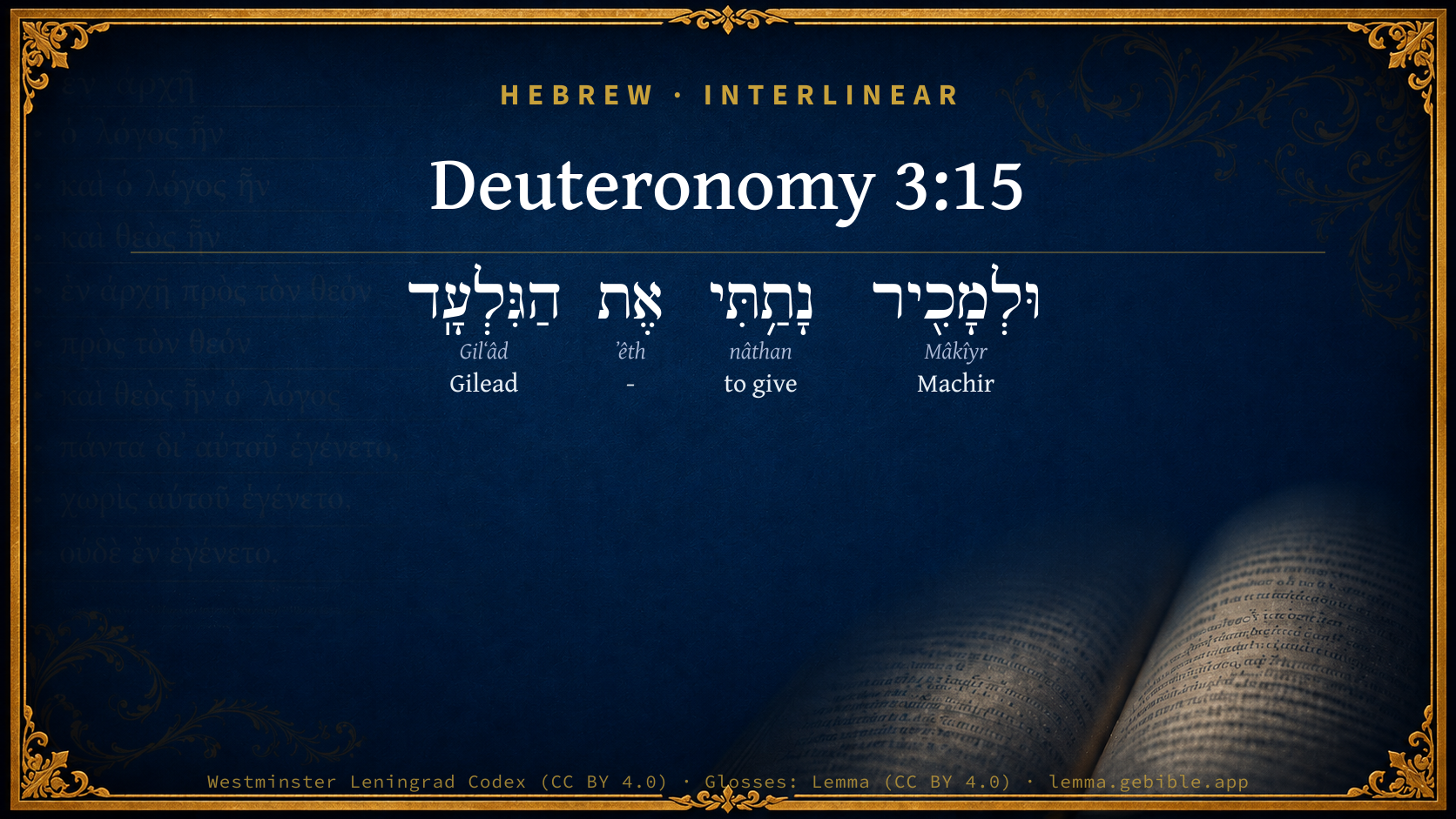
Deuteronomy 3:15

Hebrew (Westminster Leningrad Codex) Deuteronomy 3:15 appears in the Hebrew Old Testament. The text above is from the Westminster Leningrad Codex. Each word links to its Strong’s number, a concise gloss, and parsing drawn from the Open Scriptures Hebrew Bible morphology. Click any word for its full Brown-Driver-Briggs (BDB) entry.
Download image
Cite this verse

Deuteronomy 3:15 (World English Bible). Public Domain. Lemma interlinear Bible study tool, https://lemma.gebible.app/v/deuteronomy/3/15.

Show BibTeX & RIS
BibTeX
RIS
English Translation
I gave Gilead to Machir.
World English Bible · Public Domain
Download a study sheet

One document with this verse’s original text, its word-by-word gloss line, the meaning frame, cross-references with their text, attributed commentary, and full source and license credits — printable, and it pastes into notes with its structure intact.

This verse Autodidact and up

Study sheet (.html) Plain text (.txt)

A passage Seminary Student

Up to 50 verses in one chapter. A passage sheet keeps up to 6 commentary sources and 12 cross-references per verse, in the order this page ranks them, and says so on the sheet whenever that leaves anything out. Ask for a single verse and you get the Autodidact verse sheet above.

Everything on this page stays free to read, with no account — the sheet is a download of what is already on screen, not access to it.

Want to remove ads? Support Godless Engineer
Compare translations 3

The same verse in 3 English versions, stacked beneath the original-language interlinear above. Click any original word for its lexicon entry.

Each is an independent rendering of the whole verse — the interlinear is not word-aligned to these translations.

Highlighted words mark where these versions differ — a whole-verse word diff, not a word-by-word alignment.

  • World English Bible Public Domain
    I gave Gilead to Machir.
  • King James Version Public Domain
    And I gave Gilead unto Machir.
  • unfoldingWord Literal Text CC BY-SA 4.0
    “And to Machir I gave Gilead.

unfoldingWord Literal Text — © unfoldingWord, licensed CC BY-SA 4.0. Word-aligned USFM3 via Door43 (git.door43.org/unfoldingWord/en_ult).

Versions to compare (up to 4)

3 of 4 selected

Show all 18 translations

Every available English version of this verse, each an independent rendering of the whole verse.

  • World English Bible Public Domain
    I gave Gilead to Machir.
  • Berean Standard Bible Public Domain
    To Machir I gave Gilead,
  • Majority Standard Bible Public Domain
    To Machir I gave Gilead,
  • King James Version Public Domain
    And I gave Gilead unto Machir.
  • American Standard Version (1901) Public Domain
    And I gave Gilead unto Machir.
  • Revised Version (1885) Public Domain
    And I gave Gilead unto Machir.
  • Geneva Bible (1599) Public Domain
    And I gaue part of Gilead vnto Machir.
  • Douay-Rheims (1899) Public Domain
    To Machir also I gave Galaad.
  • Young's Literal Translation Public Domain
    And to Machir I have given Gilead.
  • Literal Standard Version CC BY-SA 4.0
    And I have given Gilead to Machir.
  • Unlocked Literal Bible CC BY-SA 4.0
    I gave Gilead to Machir.
  • unfoldingWord Literal Text CC BY-SA 4.0
    “And to Machir I gave Gilead.
  • Darby Bible Public Domain
    And I gave Gilead to Machir.
  • World Messianic Bible Public Domain
    I gave Gilead to Machir.
  • Webster's Bible Public Domain
    And I gave Gilead to Machir.
  • Free Bible Version CC BY-SA 4.0
    I assigned the rest of Gilead to the descendants of Machir,
  • Bible in Basic English Public Domain
    And Gilead I gave to Machir.
  • JPS Tanakh (1917) Public Domain
    And I gave Gilead unto Machir.

Literal Standard Version (2020), Covenant Press — licensed CC BY-SA 4.0. Text via the HelloAO Bible API (eBible.org). Unlocked Literal Bible (unfoldingWord) — licensed CC BY-SA 4.0. Text via the HelloAO Bible API (eBible.org). unfoldingWord Literal Text — © unfoldingWord, licensed CC BY-SA 4.0. Word-aligned USFM3 via Door43 (git.door43.org/unfoldingWord/en_ult). Free Bible Version, Dr. Jonathan Gallagher — licensed CC BY-SA 4.0. Text via the HelloAO Bible API (eBible.org).

Word by word

More ways to search: Search by grammar → Find every occurrence → Compare this word →

Practice this passage: Drill this verse → Learn its vocabulary →

וּלְמָכִ֖יר
Mâkîyr
H4353
“and · to/for · Machir”
Conjunction + Preposition + Noun, Proper
Part of Speech
Conjunction + Preposition + Noun
Type
Proper
Full BDB Definition

Origin: from H4376

TWOT: None

Machir = "sold" - eldest son of Manasseh by an Aramite or Syrian concubine and progenitor of a large family - son of Ammiel, a powerful chief of one of the Transjordanic tribes who rendered essential services to Saul and to David
  1. נָתַ֥תִּי nâthan H5414 “to give” Verb, Qal, Perfect, 1st Person, Common, Singular
  2. אֶת ʼêth H853 “-” Particle, Direct Object
  3. הַגִּלְעָֽד Gilʻâd H1568 “the · Gilead” Particle, Definite Article + Noun, Proper

About this verse

These counts appear in no published source. They are computed here, from the morphology-tagged text and Lemma’s own curated glosses. What Lemma adds →

4
words
4
distinct lemmas
Pentateuch
section

Notable vocabulary

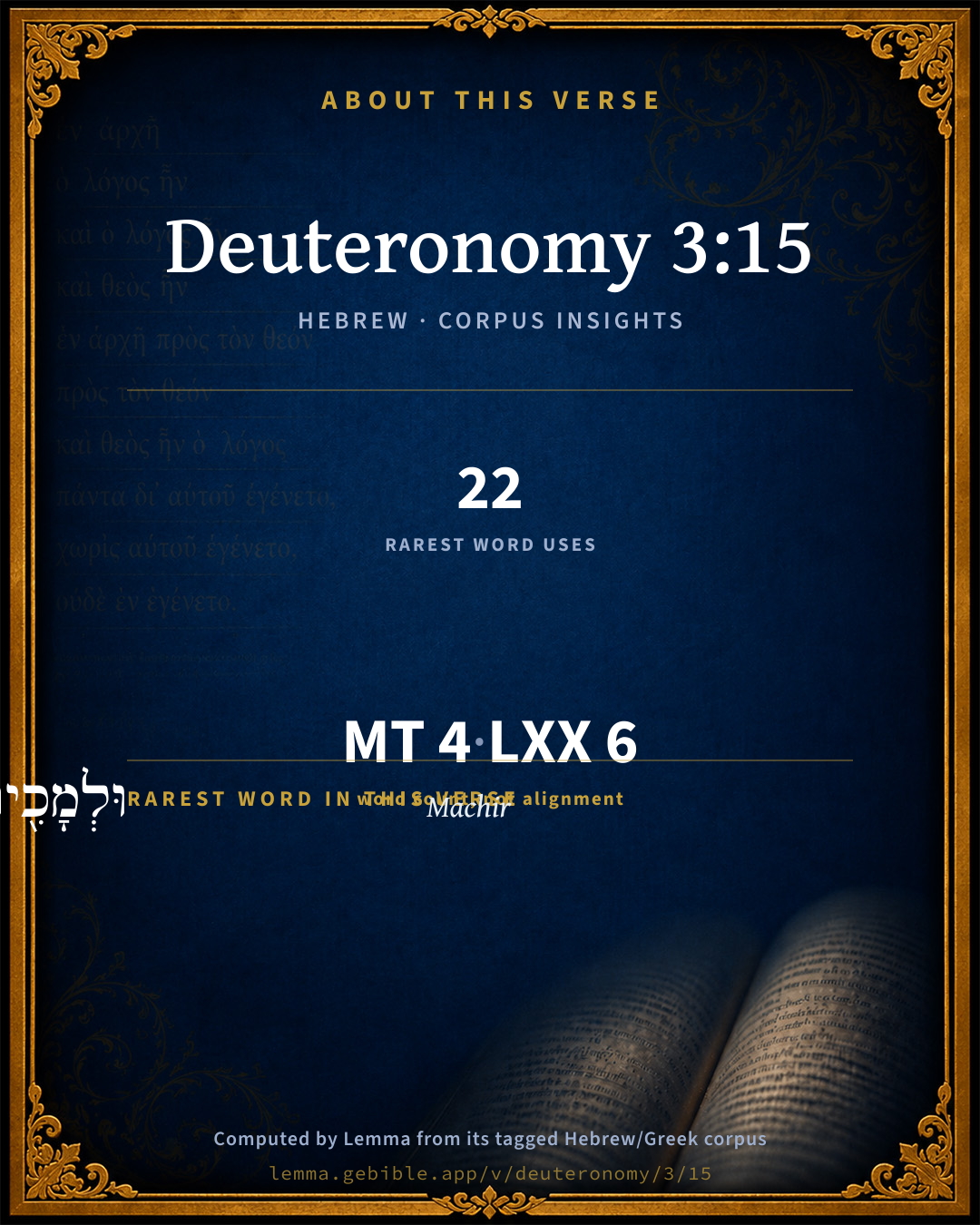
The rarest word here is וּלְמָכִ֖יר Machir H4353 — appearing just 22 times in the whole Hebrew Bible.

Shared distinctive vocabulary

וּלְמָכִ֖יר Machir H4353 occurs in 20 verses of the Hebrew Bible. Also found in:

Grammatical profile

  • 1 verb
  • 2 nouns
  • 1 particle

Verb forms

  • נָתַ֥תִּי Qal · Perfect

Hebrew & Septuagint length

In English translation the verse runs 5 words from the Hebrew and 6 from the Septuagint (LXX English) — closely comparable.

A rough comparison of the two English renderings, which tokenize alike — not a word-level alignment.

Word counts can differ between the Hebrew and the Greek without any difference in meaning — e.g. the Hebrew direct-object marker אֵת has no separate Greek word, and Greek often adds the article ὁ.

In the original languages it is 4 Hebrew tokens and 6 Greek tokens — but the two are counted differently (Hebrew bundles its prefixes and suffixes into one token; the Greek is in lemma form), so that isn’t a like-for-like length.

Cross-references

5

Topical passages linked to Deuteronomy 3:15 in the Treasury of Scripture Knowledge — connected by theme and wording, ordered by reader-vote popularity; previews shown in the World English Bible.

  • Numbers 32:39–40 The children of Machir the son of Manasseh went to Gilead, and took it, and dispossessed the Amorites who were therein.
  • Genesis 50:23 Joseph saw Ephraim's children to the third generation. The children also of Machir, the son of Manasseh, were born on Joseph's knees.
  • Numbers 26:29 The sons of Manasseh: of Machir, the family of the Machirites; and Machir became the father of Gilead; of Gilead, the family of the Gileadites.
  • Joshua 17:1–3 [This] was the lot for the tribe of Manasseh; for he was the firstborn of Joseph. As for Machir the firstborn of Manasseh, the father of Gilead, because he was a man of war, therefore he had Gilead and Bashan.
  • Joshua 22:7 Now to the one half-tribe of Manasseh Moses had given [inheritance] in Bashan; but to the other half gave Joshua among their brothers beyond the Jordan westward; moreover when Joshua sent them away to their tents, he blessed them,

Cross-references courtesy of OpenBible.info (CC BY 4.0).

Hebrew and Greek witnesses Masoretic Hebrew ↔ Greek Septuagint

The same verse in the two great witnesses to the Old Testament, shown verse-for-verse.

These are two independent witnesses, not word-aligned to each other, and the Septuagint is shown in lemma (dictionary) form.

Hebrew Deuteronomy 3:15 Masoretic · Westminster Leningrad Codex

וּלְמָכִ֖יר נָתַ֥תִּי אֶת הַגִּלְעָֽד

I gave Gilead to Machir.

World English Bible · Public Domain

Greek LXX Deuteronomy 3:15 Septuagint · lemma form

καί ὁ μαχιρ δίδωμι ὁ γαλαάδ

And to Machir I gave Galaad.

LXX2012 (modern English Septuagint) · Public Domain

On this verse, John Gill's Exposition discusses the Septuagint’s reading. Read the note in Commentary ↓

Hebrew: Westminster Leningrad Codex (CC BY 4.0). Greek: Septuagint (public domain); English from LXX2012 (modern English Septuagint) (Public Domain). How the Septuagint differs from the Hebrew →

Targum (Aramaic paraphrase)

2

The Targum is the ancient Jewish Aramaic paraphrase of the Hebrew Scriptures — an interpretive translation, not the Hebrew text itself. Onkelos (literal) and Pseudo-Jonathan (expansive) render the Torah, and Jonathan the Prophets. Coverage is partial: where no permissively-licensed English translation exists for a verse, only the Aramaic is shown. This is verse-level text, not a word-by-word alignment to the Hebrew.

  1. Targum Onkelos Torah (Genesis–Deuteronomy)
    וּלְמָכִיר יְהָבִית יָת גִלְעָד

    (no public-domain English translation for this verse)

    Targum Onkelos — Aramaic: “Onkelos Genesis” (public domain); “Onkelos Exodus” (public domain); “Onkelos Leviticus” (public domain); “Onkelos Numbers” (public domain); “Onkelos Deuteronomy” (public domain). English: “Sefaria Community Translation” (CC0 1.0 (public-domain dedication)); “J.W. Etheridge. The Targums of Onkelos and Jonathan Ben Uzziel on the Pentateuch. London: Longmans, Green, 1862” (public domain). Text via Sefaria.

  2. Targum Pseudo-Jonathan Torah (Genesis–Deuteronomy)
    וּלְמָכִיר יְהָבִית יַת גִּלְעָד

    But I gave Gilead to Makir.

    Targum Pseudo-Jonathan — Aramaic: “Targum Jonathan on Genesis” (public domain); “Targum Jonathan on Exodus” (public domain); “Targum Jonathan on Leviticus” (public domain); “Targum Jonathan on Numbers” (public domain); “Targum Jonathan on Deuteronomy” (public domain). English: “The Targum of Jonathan ben Uzziel, trans. J. W. Etheridge, London, 1862” (public domain). Text via Sefaria.

Commentary

Notes on Deuteronomy 3:15 from classic Christian and Jewish commentators (each source and its license shown beneath its notes). The classic Christian expositions comment on the surrounding passage and are grouped to its opening verse, so a note may address several verses; the Jewish commentaries on the Tanakh (Rashi and others) are per-verse, so they appear only where the commentator wrote on this verse.

Lemma curates 59 commentaries, every one of them public domain or Creative Commons licensed, each selected and text-cleaned for this edition rather than reprinted as found. About our sources →

The Cambridge Bible for Schools and Colleges

gen. ed. J. J. S. Perowne

15. And I gave Gilead unto Machir] Not irreconcilable with Deu_3:12 where the N. half of Gile‘ad is assigned to half-Manasseh, for Machir was held to have been the first and only son of Manasseh, and, apparently, is even taken for all Manasseh (Jdg_5:14; Num_26:29?). Yet there is force in Dillm.’s contention that the author who had just written 12 f. could hardly have immediately added the variant Deu_3:15; hence the latter is reasonably taken as, like Deu_3:14, a later insertion derived from Num_32:40.

The Cambridge Bible for Schools and Colleges (gen. ed. J. J. S. Perowne; Cambridge University Press, 1878–1918) — public domain. Text from a community e-Sword module.

Joseph Benson's Commentary

Deu 3:15-16. Gilead — That is, the half part of Gilead. To Machir —

That is, unto the children of Machir, son of Manasseh, for Machir was now dead. Half the valley — Or rather, to the middle of the river: for the word rendered half, signifies commonly middle, and the same Hebrew word means both a valley and a brook, or river. And this sense is agreeable to the truth, that their land extended from Gilead unto Arnon, and, to speak exactly, to the middle of that river; for as that river was the border between them and others, so one half of it belonged to them, as the other half did to others; see Jos 12:2, where the same thing is expressed in the same words, in the Hebrew, though our translators render them there, from the middle of the river, and here, half of the valley.

Joseph Benson's Commentary on the Old and New Testaments (1811–1818) — public domain. Text from a community e-Sword module.

Tyndale Open Study Notes

Tyndale Open Resources

3:15 Makir was a clan in the tribe of Manasseh (Num 26:29) to which Jair was related (1 Chr 2:21-23). The clan of Makir settled south of Bashan in the northern part of Gilead (see Deut 3:13).

Tyndale Open Study Notes — © Tyndale Open Resources, licensed CC BY-SA 4.0. Text via the HelloAO Bible API.

Jamieson, Fausset & Brown

Robert Jamieson, A. R. Fausset & David Brown

I gave Gilead unto Machir--It was only the half of Gilead (Deu 3:12-13) which was given to the descendants of Machir, who was now dead.

Jamieson, Fausset & Brown — Commentary Critical and Explanatory on the Whole Bible (1871) — public domain (CC PDM 1.0). Text via the HelloAO Bible API.

John Gill's Exposition

And I gave Gilead unto Machir. The son of Manasseh; not to him personally, who cannot be thought to have been living at this time, but to his posterity, to the Machirites; see Num 32:40.

.

Deuteronomy 3:16

deu 3:16

deu 3:16

deu 3:16And unto the Reubenites, and unto the Gadites,.... The tribes of Reuben and Gad:

I gave from Gilead even unto the river Arnon: see Deu 3:12.

half the valley and the border; or rather half the river, the river Arnon; and so it is rendered "the middle of the river", in Jos 12:2 and so here the middle of the torrent by the Vulgate Latin and Septuagint versions, and by Onkelos:

even unto the river Jabbok, which is the border of the children of Ammon; beyond which the land given to the tribes of Reuben and Gad reached not; see Deu 2:37.

John Gill's Exposition of the Whole Bible (1746–1763) — public domain (CC PDM 1.0). Text via the HelloAO Bible API.

Haydock's Catholic Bible Commentary

Machir’s posterity was settled in the same part of Galaad. (Menochius)

George Leo Haydock (1774–1849), Haydock's Catholic Family Bible and Commentary, 1859 edition — public domain. Excludes Psalms (Douay-Rheims chapter numbering differs from Protestant) and Deuterocanonical books (Catholic canon only).

Matthew Poole's English Annotations

i.e. The half part of Gilead, as appears from Deu 3:12,13. See Poole "Num 32:40". Unto Machir, i.e. unto the children of Machir son of Manasseh, for Machir was now dead.

Matthew Poole's English Annotations on the Holy Bible (1683–1685) — public domain. Text from a community e-Sword/MySword module.

Whedon's Commentary on the Bible

Daniel D. Whedon

15. Machir — He was the eldest son of Manasseh. His name is put for the tribe.

Daniel D. Whedon (gen. ed.), Commentary on the Old and New Testaments (1874–1909) — public domain. Text from a community e-Sword module.

The Pulpit Commentary

Cf. Num_32:40; 1Ch_2:22

The Pulpit Commentary (1880–1919), ed. H.D.M. Spence-Jones & Joseph S. Exell — public domain. Text from a community e-Sword module.

John Wesley's Explanatory Notes

Gilead - That is, the half part of Gilead. To Machir - That is, unto the children of Machir, son of Manasseh, for Machir was now dead.

John Wesley, Explanatory Notes Upon the Whole Bible (1754–1765) — public domain. Text via the GEBible commentary corpus.

Keil & Delitzsch

C. F. Keil & F. Delitzsch

Machir received Gilead (see Num 32:40). - In Deu 3:16 and Deu 3:17 the possession of the tribes of Reuben and Gad is described more fully according to its boundaries. They received the land of Gilead (to the south of the Jabbok) as far as the brook Arnon, the middle of the valley and its territory. הנּחל תּוך is a more precise definition of ארנן נחל, expressive of the fact that the territory of these tribes was not to reach merely to the northern edge of the Arnon valley, but into the middle of it, viz., to the river Arnon, which flowed through the middle of the valley; and וּגבוּל (and the border) is an explanatory apposition to what goes before, as in Num 34:6, signifying, "viz., the border of the Arnon valley as far as the river." On the east, "even unto Jabbok the brook, the (western) border of the Ammonites" (i.e., as far as the upper Jabbok, the Nahr Ammn: see at Num 21:24); and on the west "The Arabah (the Ghor: see Deu 1:1) and the Jordan with territory" (i.e., with its eastern bank), "from Chinnereth" (i.e., the town from which the Sea of Galilee received the name of Sea of Chinnereth: Num 34:11; see at Jos 19:35) "to the sea of the Arabah, the Salt Sea under the slopes of Pisgah (see at Num 21:15 and Num 27:12) eastward" (i.e., merely the eastern side of the Arabah and Jordan). - In Deu 3:18-20 Moses reminds them of the conditions upon which he had given the two tribes and a half the land referred to for their inheritance (cf. Num 32:20-32).

Keil & Delitzsch — Biblical Commentary on the Old Testament (1861–1891) — public domain (CC PDM 1.0). Text via the HelloAO Bible API. (Old Testament only.)

unfoldingWord translationNotes

Door43 World Missions Community

General Information:

Moses continues to speak to the people of Israel.

I gave

Here "I" refers to Moses.

to Machir

Machir was the son of Manasseh. He had died before Moses gave this land. The name is a metonym for the descendants of the person. AT: "to the descendants of Machir" (See: How to Translate Names)

the Valley of the Arnon

This is the name of the valley of the Arnon River. It creates the border between Moab and the Amorites. See how you translated this in Deuteronomy 2:24. (See: How to Translate Names)

Jabbok River

This is the name of a river that created the border between Sihon's land and the land of the Ammonites. See how you translated this in Deuteronomy 2:37. (See: How to Translate Names)

translationWords

Gilead

Reuben

Gad

descend

Ammon

unfoldingWord translationNotes — © Distant Shores Media and the Door43 World Missions Community, licensed CC BY-SA 4.0. Source: git.door43.org/Door43/en_tn.

Lesson kit

Teaching starters — assembled from the data on this page, not authored interpretation. Every prompt links to the verse data it draws on. Edit before teaching.

Deuteronomy, in the Pentateuch, opens this verse with 4 words (4 distinct Hebrew lemmas). Its most distinctive word is Mâkîyr (“Machir”). A historical commentator’s framing appears above. Read the whole chapter for the surrounding context.

Discussion questions

  1. What does “Machir” (Mâkîyr) contribute to the verse as a whole?
  2. Genesis 50:23 shares the word «Machir» with this verse. How do the two illuminate each other?
  3. The verb «נָתַ֥תִּי» is Qal Perfect. How does its form color the action?
  4. Reading how The Cambridge Bible for Schools and Colleges and Joseph Benson's Commentary read this verse, where do the two commentators agree and where do they part?

Things to notice

Reading settings

Reading text

Shown beneath each verse's original-language words.

Old Testament
Old Testament edition

Read the OT as the Masoretic Hebrew (MT) or the Greek Septuagint (LXX).

English shown for the Greek Septuagint (in the Hebrew ↔ Greek comparison).

Comparing translations? Open the Compare panel on any verse page to stack up to four side by side.