
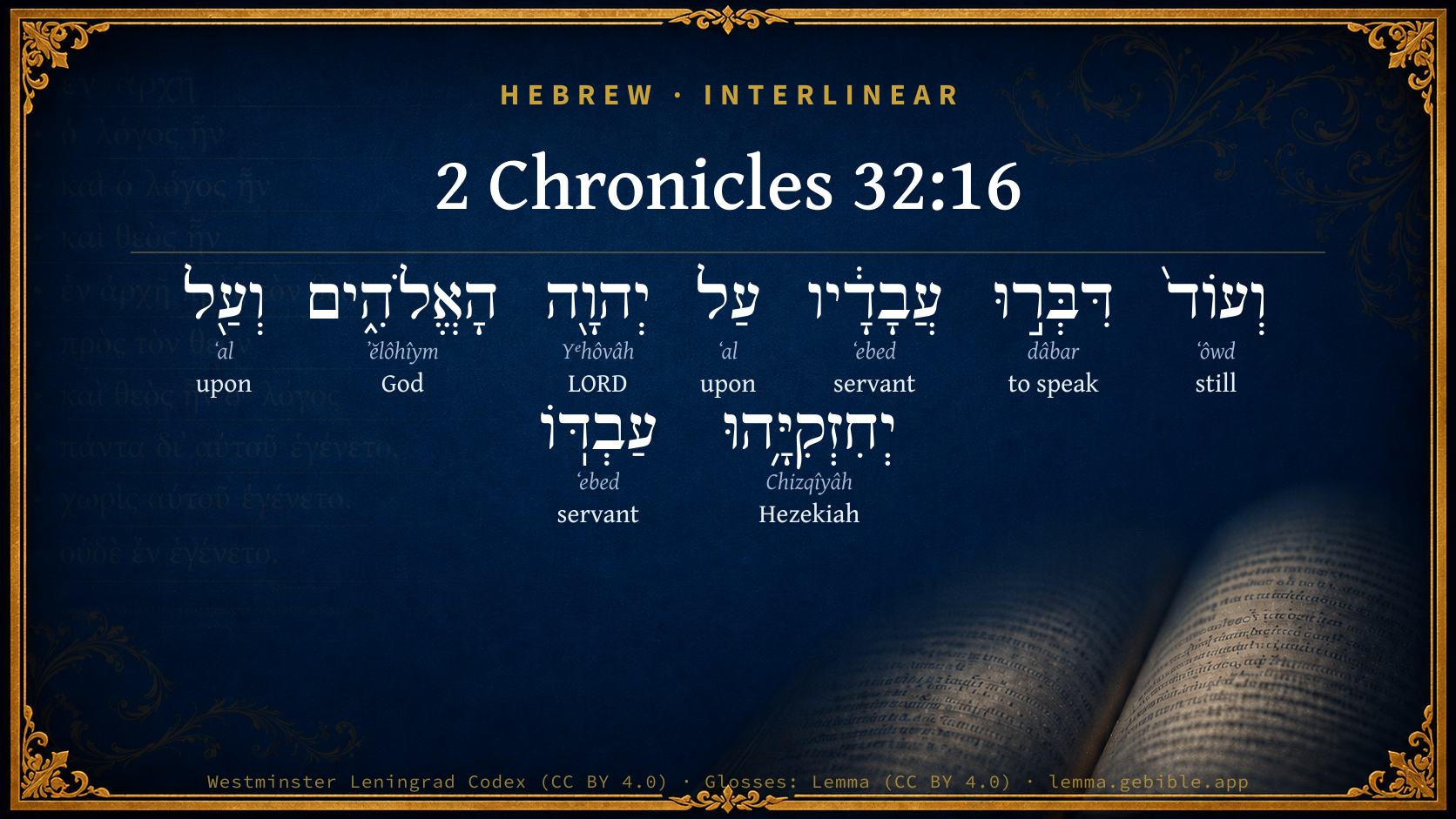
2 Chronicles 32:16

Hebrew (Westminster Leningrad Codex) 2 Chronicles 32:16 appears in the Hebrew Old Testament. The text above is from the Westminster Leningrad Codex. Each word links to its Strong’s number, a concise gloss, and parsing drawn from the Open Scriptures Hebrew Bible morphology. Click any word for its full Brown-Driver-Briggs (BDB) entry.
Download image
Cite this verse

2 Chronicles 32:16 (World English Bible). Public Domain. Lemma interlinear Bible study tool, https://lemma.gebible.app/v/2-chronicles/32/16.

Show BibTeX & RIS
BibTeX
RIS
English Translation
His servants spoke yet more against Yahweh God, and against his servant Hezekiah.
World English Bible · Public Domain
Download a study sheet

One document with this verse’s original text, its word-by-word gloss line, the meaning frame, cross-references with their text, attributed commentary, and full source and license credits — printable, and it pastes into notes with its structure intact.

This verse Autodidact and up

Study sheet (.html) Plain text (.txt)

A passage Seminary Student

Up to 50 verses in one chapter. A passage sheet keeps up to 6 commentary sources and 12 cross-references per verse, in the order this page ranks them, and says so on the sheet whenever that leaves anything out. Ask for a single verse and you get the Autodidact verse sheet above.

Everything on this page stays free to read, with no account — the sheet is a download of what is already on screen, not access to it.

Want to remove ads? Support Godless Engineer
Compare translations 3

The same verse in 3 English versions, stacked beneath the original-language interlinear above. Click any original word for its lexicon entry.

Each is an independent rendering of the whole verse — the interlinear is not word-aligned to these translations.

Highlighted words mark where these versions differ — a whole-verse word diff, not a word-by-word alignment.

  • World English Bible Public Domain
    His servants spoke yet more against Yahweh God, and against his servant Hezekiah.
  • King James Version Public Domain
    And his servants spake yet more against the LORD God, and against his servant Hezekiah.
  • unfoldingWord Literal Text CC BY-SA 4.0
    And again his servants spoke against Yahweh God and against Hezekiah, his servant.

unfoldingWord Literal Text — © unfoldingWord, licensed CC BY-SA 4.0. Word-aligned USFM3 via Door43 (git.door43.org/unfoldingWord/en_ult).

Versions to compare (up to 4)

3 of 4 selected

Show all 18 translations

Every available English version of this verse, each an independent rendering of the whole verse.

  • World English Bible Public Domain
    His servants spoke yet more against Yahweh God, and against his servant Hezekiah.
  • Berean Standard Bible Public Domain
    And the servants of Sennacherib spoke further against the LORD God and against His servant Hezekiah.
  • Majority Standard Bible Public Domain
    And the servants of Sennacherib spoke further against the LORD God and against His servant Hezekiah.
  • King James Version Public Domain
    And his servants spake yet more against the LORD God, and against his servant Hezekiah.
  • American Standard Version (1901) Public Domain
    And his servants spake yet more against Jehovah God, and against his servant Hezekiah.
  • Revised Version (1885) Public Domain
    And his servants spake yet more against the LORD God, and against his servant Hezekiah.
  • Geneva Bible (1599) Public Domain
    And his seruants spake yet more against the Lord God, and against his seruant Hezekiah.
  • Douay-Rheims (1899) Public Domain
    And many other things did his servants speak against the Lord God, and against Ezechias his servant.
  • Young's Literal Translation Public Domain
    And again have his servants spoken against Jehovah God, and against Hezekiah His servant,
  • Literal Standard Version CC BY-SA 4.0
    And again his servants have spoken against YHWH God and against His servant Hezekiah,
  • Unlocked Literal Bible CC BY-SA 4.0
    Sennacherib's servants spoke even more against Yahweh God and against his servant Hezekiah.
  • unfoldingWord Literal Text CC BY-SA 4.0
    And again his servants spoke against Yahweh God and against Hezekiah, his servant.
  • Darby Bible Public Domain
    And his servants spoke yet more against Jehovah, the [true] God, and against his servant Hezekiah.
  • World Messianic Bible Public Domain
    His servants spoke yet more against the LORD God and against his servant Hezekiah.
  • Webster's Bible Public Domain
    And his servants spoke yet more against the LORD God, and against his servant Hezekiah.
  • Free Bible Version CC BY-SA 4.0
    Sennacherib's officers continued criticizing the Lord God and his servant Hezekiah.
  • Bible in Basic English Public Domain
    And his servants said even more against the Lord God and against his servant Hezekiah.
  • JPS Tanakh (1917) Public Domain
    And his servants spoke yet more against the LORD God, and against His servant Hezekiah.

Literal Standard Version (2020), Covenant Press — licensed CC BY-SA 4.0. Text via the HelloAO Bible API (eBible.org). Unlocked Literal Bible (unfoldingWord) — licensed CC BY-SA 4.0. Text via the HelloAO Bible API (eBible.org). unfoldingWord Literal Text — © unfoldingWord, licensed CC BY-SA 4.0. Word-aligned USFM3 via Door43 (git.door43.org/unfoldingWord/en_ult). Free Bible Version, Dr. Jonathan Gallagher — licensed CC BY-SA 4.0. Text via the HelloAO Bible API (eBible.org).

Word by word

More ways to search: Search by grammar → Find every occurrence → Compare this word →

Practice this passage: Drill this verse → Learn its vocabulary →

יְחִזְקִיָּ֥הוּ
Chizqîyâh
H2396
“Hezekiah”
Noun, Proper
Part of Speech
Noun
Type
Proper
Full BDB Definition

Origin: from H2388 and H3050

TWOT: None

Hezekiah or Hizkiah or Hizkijah = "Jehovah is my strength" - 12th king of Judah, son of Ahaz and Abijah; a good king in that he served Jehovah and did away with idolatrous practices - great-great-grandfather of Zephaniah the prophet - son of Neariah, a descendant of David - head of a family of returning exiles in the time of Nehemiah
  1. וְעוֹד֙ ʻôwd H5750 “and · still” Conjunction + Adverb
  2. דִּבְּר֣וּ dâbar H1696 “to speak” Verb, Piel, Perfect, 3rd Person, Common, Plural
  3. עֲבָדָ֔יו ʻebed H5650 “servants · his” Noun, Common, Masculine, Plural, Construct + Suffix, Personal, 3rd Person, Masculine, Singular
  4. עַל ʻal H5921 “upon” Preposition
  5. יְהוָ֖ה Yᵉhôvâh H3068 “LORD” Noun, Proper
  6. הָאֱלֹהִ֑ים ʼĕlôhîym H430 “the · God(s)” Particle, Definite Article + Noun, Common, Masculine, Plural, Absolute
  7. וְעַ֖ל ʻal H5921 “and · upon” Conjunction + Preposition
  8. עַבְדּֽוֹ ʻebed H5650 “servant · his” Noun, Common, Masculine, Singular, Construct + Suffix, Personal, 3rd Person, Masculine, Singular

About this verse

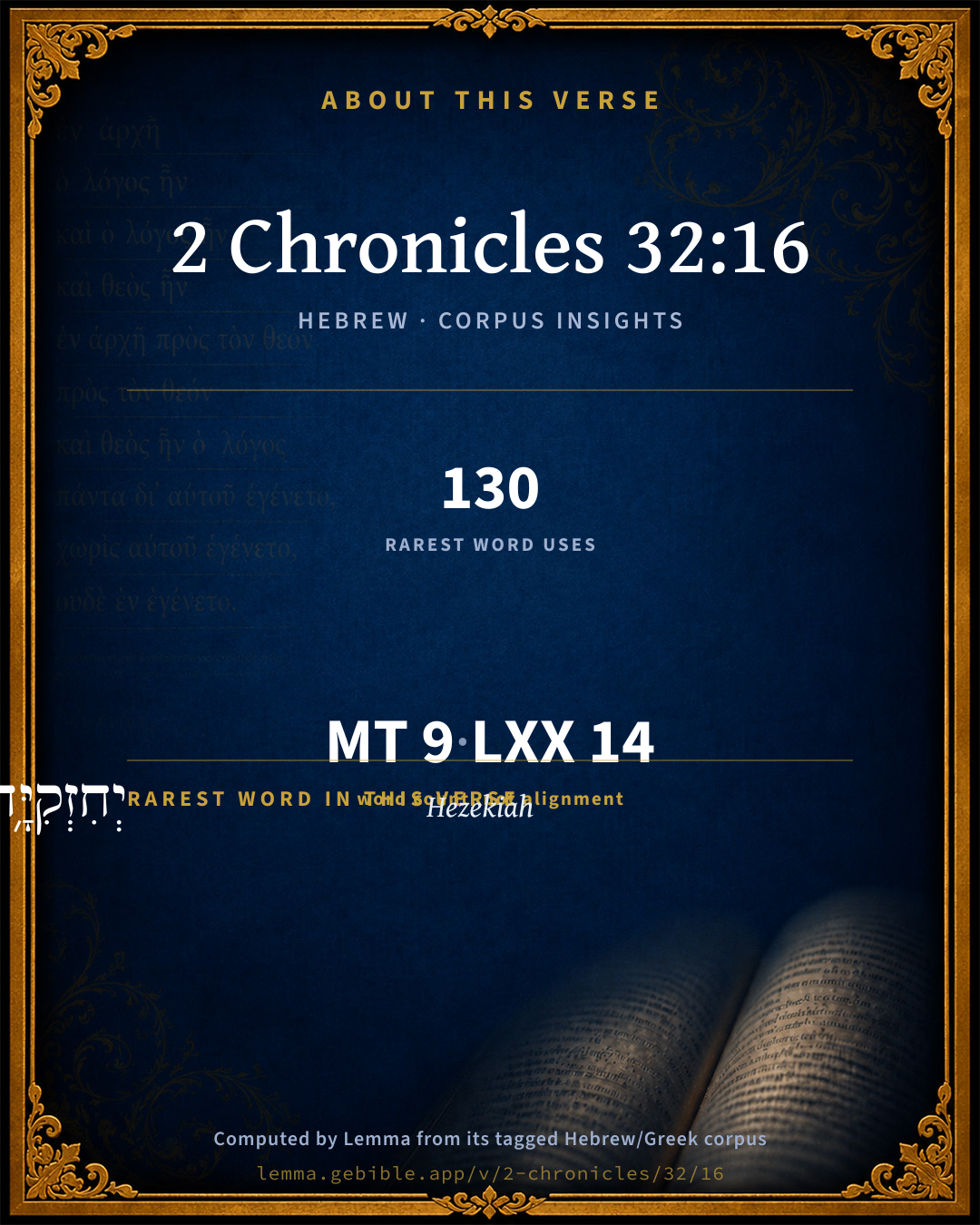
These counts appear in no published source. They are computed here, from the morphology-tagged text and Lemma’s own curated glosses. What Lemma adds →

9
words
7
distinct lemmas
Historical
section

Grammatical profile

  • 1 verb
  • 5 nouns
  • 2 prepositions
  • 1 adverb

Verb forms

  • דִּבְּר֣וּ Piel · Perfect

Repetition

Words recur within this verse — often emphatic in Hebrew:

  • עֲבָדָ֔יו servant H5650 ×2
  • עַל upon H5921 ×2

Hebrew & Septuagint length

In English translation the verse runs 13 words from the Hebrew and 15 from the Septuagint (LXX English) — closely comparable.

A rough comparison of the two English renderings, which tokenize alike — not a word-level alignment.

Word counts can differ between the Hebrew and the Greek without any difference in meaning — e.g. the Hebrew direct-object marker אֵת has no separate Greek word, and Greek often adds the article ὁ.

In the original languages it is 9 Hebrew tokens and 14 Greek tokens — but the two are counted differently (Hebrew bundles its prefixes and suffixes into one token; the Greek is in lemma form), so that isn’t a like-for-like length.

Cross-references

3

Topical passages linked to 2 Chronicles 32:16 in the Treasury of Scripture Knowledge — connected by theme and wording, ordered by reader-vote popularity; previews shown in the World English Bible.

  • Job 15:25–26 Because he has stretched out his hand against God, And behaves himself proudly against the Almighty;
  • Psalms 73:9 They have set their mouth in the heavens. Their tongue walks through the earth.
  • John 15:21 But all these things will they do to you for my name's sake, because they don't know him who sent me.

Cross-references courtesy of OpenBible.info (CC BY 4.0).

Hebrew and Greek witnesses Masoretic Hebrew ↔ Greek Septuagint

The same verse in the two great witnesses to the Old Testament, shown verse-for-verse.

These are two independent witnesses, not word-aligned to each other, and the Septuagint is shown in lemma (dictionary) form.

Hebrew 2 Chronicles 32:16 Masoretic · Westminster Leningrad Codex

וְעוֹד֙ דִּבְּר֣וּ עֲבָדָ֔יו עַל יְהוָ֖ה הָאֱלֹהִ֑ים וְעַ֖ל יְחִזְקִיָּ֥הוּ עַבְדּֽוֹ

His servants spoke yet more against Yahweh God, and against his servant Hezekiah.

World English Bible · Public Domain

Greek LXX 2 Chronicles 32:16 Septuagint · lemma form

καί ἔτι λαλέω ὁ παῖς αὐτός ἐπί κύριος θεός καί ἐπί εζεκιας παῖς αὐτός

And his servants continued to speak against the Lord God, and against his servant Ezekias.

LXX2012 (modern English Septuagint) · Public Domain

Hebrew: Westminster Leningrad Codex (CC BY 4.0). Greek: Septuagint (public domain); English from LXX2012 (modern English Septuagint) (Public Domain). How the Septuagint differs from the Hebrew →

Commentary

Notes on 2 Chronicles 32:16 from classic Christian and Jewish commentators (each source and its license shown beneath its notes). The classic Christian expositions comment on the surrounding passage and are grouped to its opening verse, so a note may address several verses; the Jewish commentaries on the Tanakh (Rashi and others) are per-verse, so they appear only where the commentator wrote on this verse.

Lemma curates 59 commentaries, every one of them public domain or Creative Commons licensed, each selected and text-cleaned for this edition rather than reprinted as found. About our sources →

Trapp's Complete Commentary

John Trapp

2Ch 32:16 And his servants spake yet [more] against the LORD God, and against his servant Hezekiah.

Ver. 16. And his servants spake yet more.] Adding of their own to their master’s mandates which yet needed not.

John Trapp, A Commentary or Exposition upon All the Books of the Old and New Testament (1647–1656) — public domain. Text from a community e-Sword module.

Geneva Bible (1599)

Geneva Bible translators

Herein we see that when the wicked speak evil of the servants of God, they care not to blaspheme God himself: for if they feared God, they would love his servants.

Geneva Bible (1599) marginal notes — public domain. Text via Bolls.life.

Ellicott's Commentary for English Readers

(16) Spake yet more.—See the parallel passages in Kings and Isaiah. The verse shows that the chronicler does not profess to give a full report.

Against the Lord God.—Literally, against Jehovah the (true) God. “Whom hast thou reproached and blasphemed? . . . the Holy One of Israel” (Isa_37:23).

A Bible Commentary for English Readers, edited by Charles John Ellicott (1878–1897) — public domain. Text from a community e-Sword module.

John Gill's Exposition

And they spake against the God of Jerusalem,.... The only living and true God, whom the inhabitants of Jerusalem professed to be their God, and who was worshipped by them in the temple there:

as against the gods of the people of the earth, which were the work of the hands of man; they made no difference between the one and the other, but spoke as freely and as contemptibly of the one as of the other, see Isa 36:19.

John Gill's Exposition of the Whole Bible (1746–1763) — public domain (CC PDM 1.0). Text via the HelloAO Bible API.

The Pulpit Commentary

And his servants spoke yet more. A glimpse of the fact that the compiler of our book very designedly excerpted only what he thought needful from very much more abundant resources.

Vers. 16-23.

The invasion of Sennacherib: 2. The great deliverance.

I SENNACHERIB AND HIS GENERALS. Their renewed efforts to take the city.

1. The letter of Sennacherib to Hezekiah. (Ver. 17.) The tartan with his assistants having failed to either storm Jerusalem or intimidate its inhabitants, returned, or more probably despatched, Rabshakeh to his master for further instructions. Sennacherib was now at Libnah, a few miles nearer Jerusalem than Lachish, which in the interval had capitulated. Learning that the King of Egypt was on the way north to give him battle, he sent back Rabshakeh, accompanied, by special messengers, bearing a letter to Hezekiah to expedite the taking of the city. The letter when received was read by Hezekiah with indignation and alarm. It contained a repetition with emphasis of what had been uttered by Rabshakeh in the hearing of the king"s envoys and of the inhabitants of the city. Of course, the mere reassertion of Rabshakeh"s boastings, though in the form of a letter from Sennacherib himself. did not make them the less false, insolent, or blasphemous.

2. The railings of Sennacheribs generals. As before by Rabshakeh, so a second time by the generals and perhaps also the messengers (ver. 18). To the people on the town wall in their own tongue were addressed words meant to terrify and persuade to capitulation loud, boastful, arrogant, blasphemous reproaches against Jehovah. putting him on a level with idols, the works of men"s hands, and declaring him to be as powerless as these (ver. 19), little dreaming they were so soon and so completely to be undeceived (ver. 21). So men often hug to their bosoms the false ideas they have formed of the Christian"s God, without thinking that in a moment, by being admitted through death"s portal into his presence, they may be proved to have been deceived.

II HEZEKIAH AND HIS PROPHET. Their supplications to the God of heaven (ver. 20).

1. The prayer of Hezekiah. Recorded in 2Ki_19:14-19 and Isa_37:15-19.

(1) Where offered. "In the house of the Lord." Having read the Assyrian"s letter, Hezekiah repaired to the temple and spread it before the Lord; in which act lay a double propriety Jehovah having invited his people to call upon him in the day of trouble, (Psa_1:1-5) and promised to deliver them; (Psa_91:15) and Jehovah being the One most insulted by Sennacherib"s reproaches.

(2) To whom addressed. To Jehovah, the covenant God of Israel, whose presence was with his people, who alone governed the nations, and was supreme Creator of heaven and earth (cf. Jehoshaphat"s prayer. 2Ch_20:6-12)

(3) In what terms couched. Earnest, reverential, direct, and hopeful. Requesting a favourable audience for his intercession, he first called God to see and hear the reproaches of Sennacherib, next acknowledged the truth of Sennacherib"s language concerning the gods of the nations he destroyed, and finally besought God to show that he alone was God, by saving them out of the King of Assyria"s hand.

(4) With what result followed. It was answered by Isaiah, the son of Amoz, who, speaking in God"s name, assured him that "Sennacherib should not come into the city, nor shoot an arrow there, nor come before it with shield, nor cast a bank against it, but should return by the way that he came, and should not come into the city". (2Ki_19:32, 2Ki_19:33; Isa_37:33, Isa_37:34)

2. The prayer of Isaiah. Though not recorded by the writer of 2 Kings that Isaiah prayed along with or in addition to Hezekiah, the fact mentioned that, on Rabshakeh"s first approach, Hezekiah requested Isaiah to lift up his prayer" on their behalf, (2Ki_19:4) renders it probable that on this occasion also he joined the king in crying unto Heaven.

III JEHOVAH AND HIS ANGEL. Their interposition on behalf of Judah and Jerusalem (vers. 21, 22).

1. The destruction of Sennacheribs army.

(1) Where? "In the camp of the King of Assyria;" most probably in that of the tartan lying before Jerusalem (Delitzsch), though it may have been in that of Sennacherib"s army. According to Herodotus (2. 141), the disaster occurred at Pelusium, whither Sennacherib, "King of the Arabians and Assyrians," had marched with a great host on his way to Egypt. If so (Ewald, Cheyne, and others), then Sennacherib must have broken up his camp at Libnah, and moved south to intercept Tirhakah (cf. Driver, "Isaiah: his Life and Times," pp. 81, 82).

(2) When? That night"; (2Ki_19:35) but Whether the night after Hezekiah"s prayer (Rawlinson, Bahr)is uncertain. Hardly, if Pelusium was the scene of the overthrow; possibly, if the Assyrian camp still remained at Libnah (Keil). That the night was that in which Sennacherib, in the following year, sat down to besiege Jerusalem with his own army (Keil, Delitzsch) does not seem likely.

(3) How? By an angel the angel of the Lord (2Ki_19:35; Isa_37:36) Whether the blow was supernatural or natural cannot be determined from the language of Scripture. The destruction of the firstborn of Egypt (Exo_12:29) and the diminution of David"s army (2Sa_24:15, 2Sa_24:16) were both accomplished by the angel of the Lord; yet the former only appear to have been suddenly smitten, while the latter were cut off by pestilence. Herodotus"s notion, that the bow-strings, and shield-straps of Sennacherib"s soldiers were gnawed through during the night by innumerable field-mice, favours the pestilence-theory among the Egyptians the mouse having been the hieroglyph of devastation by pestilence (J. D. Michaelis).

(4) To what extent? To the cutting off of "all the mighty men of valour," with "the leaders and the captains"? (ver. 21); in all, 185, 000. (Isa_37:8)

(5) With what effect? The return of Sennacherib to Assyria with shame of face, because of having failed to effect the object of his expedition. Whether the fleeing Assyrians were pursued by the liberated Judahites (Ewald) is not stated by the Chronicler, and is only a doubtful inference Psa_46:7, 8 76:3,

(6) That the Assyrian monuments have preserved no record ofSennacherib"s humiliation is not surprising. The Egyptian monuments of the nineteenth dynasty contain no memorial of Menephtah"s overthrow in the Red Sea. Nations, like individuals, do not publish their misfortunes least of all perpetuate the remembrance of their defeats.

2. The assassination of Sennacherib himself. The usual end of kings in Assyria (Sargon, and probably Shalmaneser II and Assurnirari), no less than in Israel and Judah. "Within the hollow crown that rounds the mortal temples of a king keeps death his court," etc. ("Richard II," Ac 3. sc. 2).

(1) Where Sennacherib was murdered. "In his own land," in "the house of his god" (ver. 21); i.e. in Nineveh, in the house of Nisroch his god (2Ki_19:37; Isa 36 Isa 37) a divinity not yet identified in the Assyrian pantheon.

(2) When? Not immediately on returning to Nineveh, since, according to the inscriptions, he lived twenty years after the Egyptian and Jewish expedition, and undertook five more campaigns in other parts of his empire.

(3) By whom? "They that came forth of his own bowels and Sharezer his sons" (2Ki_19:37; Isa 36 Isa 38) the former in Assyrian Adar-malik, "Adar is prince," also the name of an Assyrian god; (2Ki_17:31) and the latter in Assyrian Sar-usur, a shortened form of an Assyrian word, of which the first part was probably Assur, Bil, or Nergal, meaning "Assur (Bel or Nergal) protect the king" (Schrader, p. 329). Nergal-sarezer occurs as a proper name in Jeremiah (39:3, 13). This may have been the full designation of Sennacherib"s son (Alexander on " saiah," 2:74; Cheyne, "The Prophecies of Isaiah," 1:225).

IV THE PEOPLES AND THEIR PRESENTS. The effect produced by this deliverance on surrounding nations.

1. Gifts unto Jehovah. Brought not by Judahites alone, but by the inhabitants of nations who had been delivered from the Assyrians" yoke, and were designed as a grateful recognition of Jehovah"s hand in effecting their emancipation. No benefactor more deserving of man"s thanks than; (Psa_139:17, Psa_139:18) no duty more frequently urged upon men than gratitude to the Supreme Giver (Psa_50:14 Psa_100:4 Psa_107:1; Eph_5:20; Php_4:6; Col_1:12; 1Th_5:18) yet no bestower of good receives less thanks than he.

2. Precious things to Hezekiah. As the Philistines and Arabians had brought presents to Jehoshaphat, (2Ch_17:10) so now the inhabitants of heathen countries, among whom may have been the Babylonians though ver. 31; 2Ki_20:12; and Isa_39:1 refernot to this (see below) sent gifts to Hezekiah in recognition of his greatness, as attested by the Divine deliverance wrought on his behalf.

Learn:

1. The heinousness of scoffing at religion.

2. The impotence of human rage against God. (Psa_2:1-5)

3. The superiority of the true God over all divinities worshipped by theheathen. (Psa_115:3, Psa_115:4)

4. The efficacy of prayer. (Jam_5:16)

5. The advantage of social supplication. (Mat_18:19)

6. The command of God over the resources of nature. (Num_11:23)

7. The ability of God to save his people out of any sort of peril. (1Co_10:13)

8. The sad fate of the ungodly. (Psa_75:8, Psa_75:10)

9. The indebtedness of the world to the Church"s God. W.

The Pulpit Commentary (1880–1919), ed. H.D.M. Spence-Jones & Joseph S. Exell — public domain. Text from a community e-Sword module.

unfoldingWord translationNotes

Door43 World Missions Community

out of my hand

Here "hand" represents power or control. AT: "from my power" or "from me" (See: Metonymy)

translationWords

Sennacherib

servant

Hezekiah

mock

Israel

unfoldingWord translationNotes — © Distant Shores Media and the Door43 World Missions Community, licensed CC BY-SA 4.0. Source: git.door43.org/Door43/en_tn.

Lesson kit

Teaching starters — assembled from the data on this page, not authored interpretation. Every prompt links to the verse data it draws on. Edit before teaching.

2 Chronicles, in the Historical, opens this verse with 9 words (7 distinct Hebrew lemmas). Its most distinctive word is Chizqîyâh (“Hezekiah”). A historical commentator’s framing appears above. Read the whole chapter for the surrounding context.

Discussion questions

  1. The word Chizqîyâh carries the sense “Hezekiah.” How does it shape the verse?
  2. Job 15:25–26 shares this passage’s theme. How do the two illuminate each other?
  3. “servant” occurs 2× in this one verse. What is the effect of the repetition?
  4. These translations render this verse differently; the difference is in the English rendering, not the original. What questions does that raise?
  5. The verb «דִּבְּר֣וּ» is Piel Perfect. How does its form color the action?
  6. Reading how Trapp's Complete Commentary and Geneva Bible (1599) read this verse, where do the two commentators agree and where do they part?

Things to notice

Reading settings

Reading text

Shown beneath each verse's original-language words.

Old Testament
Old Testament edition

Read the OT as the Masoretic Hebrew (MT) or the Greek Septuagint (LXX).

English shown for the Greek Septuagint (in the Hebrew ↔ Greek comparison).

Comparing translations? Open the Compare panel on any verse page to stack up to four side by side.