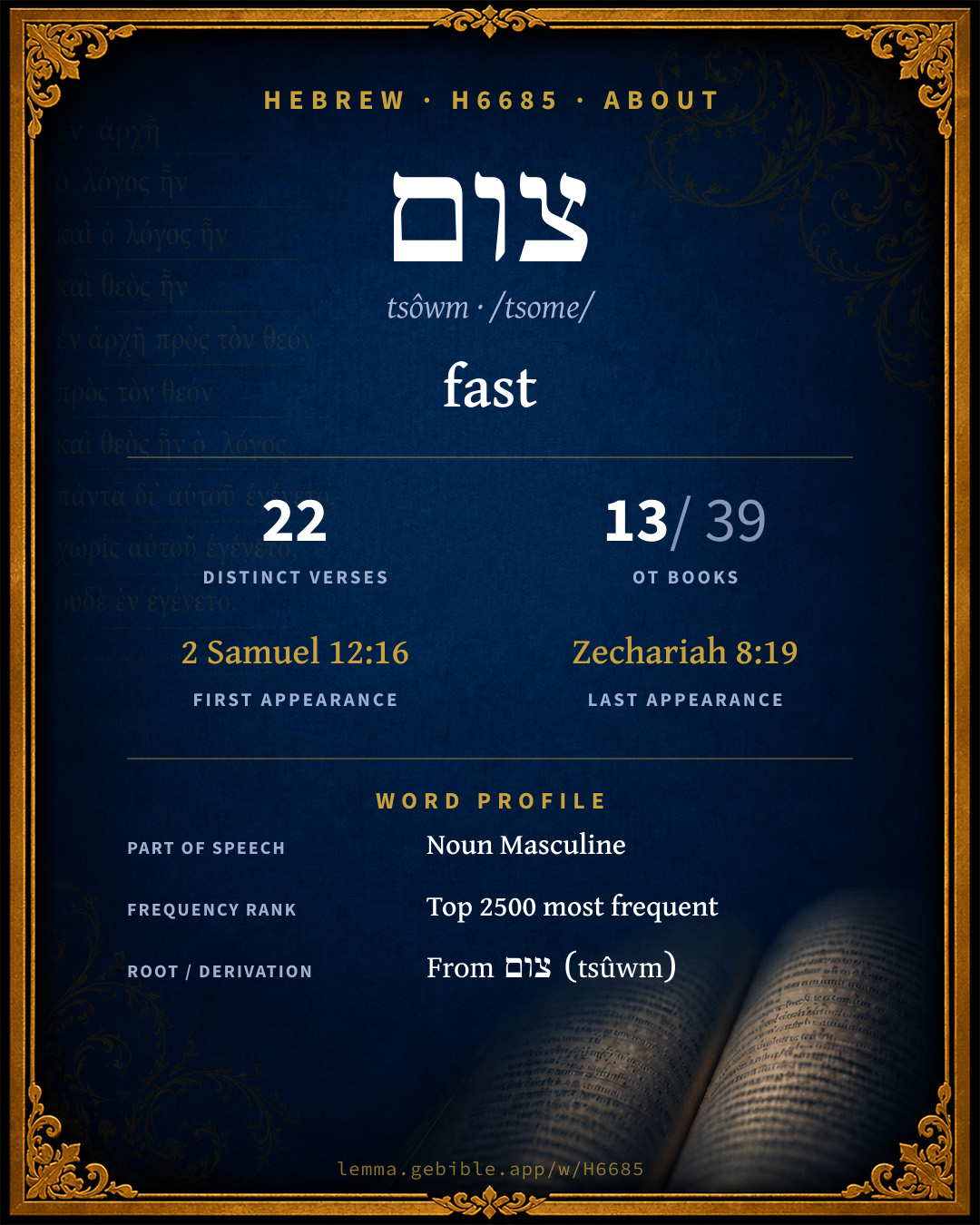
צוֹם
fast
Full lexicon entry — Brown-Driver-Briggs (BDB)
From Brown-Driver-Briggs (BDB)
Where this word appears
See every Absolute-state word in the Hebrew Bible →
Grammar key — what these labels mean
Part of speech
- Noun
- A naming word — a person, place, thing, or idea.
Noun type
- Common
- A common noun — a general class of person, place, or thing (“king,” “city,” “water”), not a specific name.
State
- Absolute
- The independent form of a noun, not bound to a following word.
- Construct
- A noun bound to a following noun in a possessive / “of” relationship (the construct chain).
Gender
- Masculine
- Grammatically masculine.
Number
- Singular
- One.
- Plural
- More than one (in Hebrew, generally three or more).
Grammatical forms
- Noun, Common, Masculine, Singular, Absolute 20 times (77%)
- Noun, Common, Masculine, Singular, Construct 5 times (19%)
- Noun, Common, Masculine, Plural, Absolute 1 time (4%)
Parsed forms decoded from the imported morphology (morphhb / Westminster Leningrad Codex — WLC text public domain, morphhb tagging CC BY 4.0), counted across 26 parsed occurrences — not distinct verses.
Every verse where H6685 appears — 22 distinct verses across 13 books. Click any verse to open its interlinear word-by-word view. Verse text shown in the World English Bible for context — . Each verse’s Hebrew form is shown with its reference; the English is not keyword-highlighted, since the data carries no word-level English alignment. Use “Compare translations” on any verse to read it across multiple English versions. This concordance covers the Hebrew Bible; Septuagint (Greek Old Testament) occurrences are not indexed here.
2 Samuel 1 verse
1 Kings 2 verses
2 Chronicles 1 verse
Ezra 1 verse
Nehemiah 1 verse
Esther 2 verses
- Esther 4:3 וְ/צ֥וֹם conj + n c ms In every province, wherever the king's commandment and his decree came, there was great mourning among the Jews, and fasting, and weeping, and wailing; and many lay in sackcloth and ashes.
- Esther 9:31 הַ/צֹּמ֖וֹת ptcl def.art + n c mp to confirm these days of Purim in their appointed times, according as Mordecai the Jew and Esther the queen had enjoined them, and as they had ordained for themselves and for their seed, in the matter of the fastings and their cry.
Psalms 3 verses
- Psalms 35:13 בַ/צּ֣וֹם prep det + n c ms But as for me, when they were sick, my clothing was sackcloth. I afflicted my soul with fasting. My prayer returned into my own bosom.
- Psalms 69:10 בַ/צּ֣וֹם prep det + n c ms When I wept and I fasted, That was to my reproach.
- Psalms 109:24 מִ/צּ֑וֹם prep + n c ms My knees are weak through fasting. My body is thin and lacks fat.
Isaiah 3 verses
- Isaiah 58:3 צֹֽמְ/כֶם֙ n c ms cs + sfx pers 2mp Why have we fasted, [say they], and you don't see? [why] have we afflicted our soul, and you take no knowledge? Behold, in the day of your fast you find [your own] pleasure, and exact all your labors.
- Isaiah 58:5 צ֣וֹם צ֔וֹם n c ms n c ms Is such the fast that I have chosen? the day for a man to afflict his soul? Is it to bow down his head as a rush, and to spread sackcloth and ashes under him? will you call this a fast, and an acceptable day to Yahweh?
- Isaiah 58:6 צ֣וֹם n c ms Isn't this the fast that I have chosen: to loose the bonds of wickedness, to undo the bands of the yoke, and to let the oppressed go free, and that you break every yoke?
Jeremiah 2 verses
- Jeremiah 36:6 צ֑וֹם n c ms therefore go you, and read in the scroll, which you have written from my mouth, the words of Yahweh in the ears of the people in Yahweh's house on the fast-day; and also you shall read them in the ears of all Judah who come out of their cities.
- Jeremiah 36:9 צ֜וֹם n c ms Now it happened in the fifth year of Jehoiakim the son of Josiah, king of Judah, in the ninth month, that all the people in Jerusalem, and all the people who came from the cities of Judah to Jerusalem, proclaimed a fast before Yahweh.
Daniel 1 verse
Joel 3 verses
- Joel 1:14 צוֹם֙ n c ms Sanctify a fast. Call a solemn assembly. Gather the elders, And all the inhabitants of the land, to the house of Yahweh, your God, And cry to Yahweh.
- Joel 2:12 וּ/בְ/צ֥וֹם conj + prep + n c ms "Yet even now," says Yahweh, "turn to me with all your heart, And with fasting, and with weeping, and with mourning."
- Joel 2:15 צ֖וֹם n c ms Blow the trumpet in Zion! Sanctify a fast. Call a solemn assembly.
Jonah 1 verse
Zechariah 1 verse
About this entry
At a glance — auto-summarized from this page’s data, not written by a person. Every figure links to its source below. This summary describes the numbers; it doesn’t interpret them.
“fast” is the headline sense of the Hebrew noun צום (tsôwm). First canonically at 2 Samuel 12:16, it enters the text early. The Hebrew Bible uses it across 22 verses — uncommon. The sections below give every sense, occurrence, and version rendering.
Gloss history
Strong's 1890 vs modern scholarship
About this word
Strong's H6685 catalogs a Hebrew word from the Hebrew Old Testament.
These counts are not copied from any lexicon or concordance. They are computed here, from the morphology-tagged Hebrew Old Testament. What Lemma adds →
- 22
- distinct verses
- The word appears in 22 distinct verses.
- 13 / 39
- OT books
- The word appears in 13 of 39 Old Testament books.
- #1,251
- by frequency
- Top 2500 most frequent Hebrew words (rank 1,251 of 8,640 Hebrew words by occurrence).
View all 22 occurrences in the concordance →
By section of the Old Testament
By traditional corpus
Conventional, traditional groupings — biblical authorship is debated, so this is a traditional corpus grouping, not an authorship claim. Each share is this word’s portion of its verses in that division of the Hebrew canon. Each figure is a share of the word’s 22 distinct verses.
- Prophets (Nevi'im) 13 verses · 59%
- Writings (Ketuvim) 9 verses · 41%
How translations render this word
Counts come from each version’s own published word-to-Strong’s tagging or interlinear alignment — an approximate guide to how each version renders this word, not a word-level alignment the data otherwise carries. Because each total is that version’s own tagged count, the per-version totals vary from one another and need not match the appearance or distinct-verse counts above. These counts may also differ from a printed concordance because Lemma counts each distinctly tagged rendering and does not collapse phrase taggings into a single head-word total. This is a fixed set of word-tagged versions (KJV, ASV, BSB, ULT) and does not change with the reading translation you choose elsewhere. Each version’s license is shown beside its name below (and on Sources).
- King James Version: Fast 12×, Fasting 7×
- American Standard Version: Fast 12×, Fasting 6×
- Berean Standard Bible: Fast 12×, Fasting 7×
- unfoldingWord Literal Text: Fast 12×, Fasting 7×, Fasts 5×
King James Version Public Domain
Renders H6685 across 25 tagged occurrences — most commonly:
Plus 6 renderings that appear only once — usually multi-word phrases or single function words the recovered tagging swept in, not distinct renderings. Not rendered by a distinct English word in 1 further occurrence.
American Standard Version Public Domain
Renders H6685 across 25 tagged occurrences — most commonly:
Plus 7 renderings that appear only once — usually multi-word phrases or single function words the recovered tagging swept in, not distinct renderings.
Berean Standard Bible Public Domain
Renders H6685 across 23 tagged occurrences — most commonly:
Plus 4 renderings that appear only once — usually multi-word phrases or single function words the recovered tagging swept in, not distinct renderings. Not rendered by a distinct English word in 3 further occurrences.
unfoldingWord Literal Text CC BY-SA 4.0
Renders H6685 across 24 tagged occurrences — most commonly:
Senses in BDB
The 1 sense BDB distinguishes for this word, in lexicon order (not ranked by frequency or importance). The full entry — with sub-senses — is in the Lexicon Entry tab.
- fast, fasting
Word origin
n.m. Is 58:5 fasting, fast;—צ׳ abs. 2 S 12:16 +, cstr. Zc 8:19 (4 times); sf. צֹמְכֶם Is 58:3; pl. צוֹמוֹת Est 9:31;—fast, as acc. cogn. 2 S 12:16; public observance 1 K 21:9, 12; 2 Ch 20:3; Ezr 8:21; Je 36:9; Jon 3:5 (all obj. of קָרָא proclaim), cf. Jo 1:14; 2:15 (both obj. of קַדְּשׁוּ); יוֹם צוֹם Je 36:6, יוֹם צֹמְכֶם Is 58:3, cf. v 5 (‖ יוֹם עַנּוֹת אָדָם נַפְשׁוֹ), v 5, 6; of periodic fasts Zc 8:19(×4) Est 9:31; act or state of fasting, נֶאֶסְפוּ בְצ׳ וּבְשַׂקִּים Ne 9:1 cf. Jo 2:12; Dn 9:3; Est 4:3; עִנֵּיתִי בַצּ׳ נַפְשִׁי ψ 35:13 cf. 69:11 (on וָאֶבְכֶּה v. Che Bae); causing physical weakness 109:24.
— Brown-Driver-Briggs (Oxford 1906, public domain), digitized via Sefaria, supplemented by the OpenScriptures HebrewLexicon (CC BY 4.0). See Sources.
Derived from צום (tsûwm) (H6684) — to fast.
Jastrow Dictionary
A second Hebrew/Aramaic lexicon for comparison, covering Aramaic and post-biblical (Talmudic, Targumic, Midrashic) usage that the biblical-Hebrew BDB does not. Matched by lemma rather than by Strong’s number, so a lemma may carry more than one Jastrow headword (shown separately below), and the entries cover usage well beyond the Bible.
צוּם
- h. צוּם (cmp. צמם) to restrain one’s self; to fast. Targ. II Sam. XII, 16. Targ. Y. Lev. XXIII, 29; a. fr.—Part. צָאֵים, צָיֵים; f. צָיְימָא, צָיְמָא; pl. צָיְימִין, צָיְמִ׳. Targ. II Sam. XII, 23. Targ. Y. II, Lev. l. c.; a. fr.—Y. Ḥall. I, 57ᶜ top צָם תרי יומין fasted two days (observed the Day of Atonement two days). Y. Kil. IX, 32ᵇ bot.—Y. Ḥag. II, 77ᵈ bot. הוות צָיְימָה ומפרסמה she used to fast and make it public; a. fr.
- same. Targ. Y. Lev. l. c.—Y. Ned. VIII, 40ᵈ bot. צ׳ כל ערובת וכ׳ … ר׳ R. J. fasted every New Year’s eve; ib. צ׳ … דצומין observed three hundred voluntary fasts; Y. Meg. I, 70ᵈ top (also צם). Y. Sot. III, 19ᵃ מְצַיְּימָה (ו)אובדת וכ׳ she fasts and loses her virginity; a. fr.
צוֹם
- preced.) fast, fast-day. Treat. Sof’rim XVII, 4 ימי הצ׳ fast-days. R. Hash. 18ᵇ (ref. to Zech. VIII, 19) בזמן שיש … אין שלום צ׳ when there is peace, these days shall be days of joy &c., when there is no peace, they shall be fast-days; a. e.—Pl. צוֹמוֹת, צוֹמִין. Koh. R. to X, 10 יגזרו צ׳ ותעניות let them decree fasts and afflictions. Y. Bets. II, end, 61ᵈ מן הצ׳ ומן התעניות (not התענית) from fasts and &c. Meg. 16ᵇ; a. e. e.g. Zechariah 8:19
צוֹם ²
- , ch. same. Targ. Joel II, 12. Targ. II Esth. III, 8. Targ. Zech. VII, 5 צום תעני a fast of affliction; a. fr.—Y. Ḥall. I, 57ᶜ top; Y. R. Hash. I, 57ᵇ bot. תמן חשין לצ׳ רבה תרין יומין there (in Babylonia) were such as thought the Great Fast (Day of Atonement) should be observed two days (on account of the uncertainty of the calendar). Y. Ab. Zar. I, 39ᵇ bot. דאת מחשב ואת משכח צ׳ רבה וכ׳ for if you make the calculation, you will find that the Day of Atonement would have been on a Sunday (which must not be); a. fr.—Pl. צוֹמִין, צוֹמַיָּא, צוֹמָתָא. Targ. Esth. IX, 31; Targ. II Esth. ib. צומתא (ed. Lag. sing.). Ib. V, 1; a. e.—Y. Ned. VIII, 40ᵈ bot., v. צוּם; a. e.
A Dictionary of the Targumim, the Talmud Babli and Yerushalmi, and the Midrashic Literature (Marcus Jastrow; London, Luzac, 1903) — Public Domain. Digitized via Sefaria. Digitized via Sefaria. Full attribution on Sources.
Forms in the corpus
The 16 distinct written forms H6685 takes in the Hebrew Bible, most frequent first — each parse links to that state’s occurrences in the concordance. Hebrew forms include their vowel points and cantillation, so a single lemma takes many written forms.
Septuagint verse parallels
This word appears in 19 verses that also exist in the Greek Old Testament (Septuagint), out of the 22 Hebrew verses it occurs in. You can read those verses in Greek by switching the Old Testament edition to the Septuagint.
Read these verses in the Septuagint
- 2 Samuel 12:16
- 1 Kings 21:9
- 2 Chronicles 20:3
- Ezra 8:21
- Esther 4:3
- Psalms 35:13
- Isaiah 58:3
- Jeremiah 36:6
- Daniel 9:3
- Joel 1:14
- Jonah 3:5
- Zechariah 8:19
This is a verse-level parallel only — the same verses exist in both the Hebrew and Greek Old Testaments. No word-level Hebrew↔Greek correspondence is claimed: the data carries no such alignment, so no Greek word is shown as this Hebrew word’s translation. Coverage is not total — the Septuagint omits the deuterocanon and renumbers the Psalms, so some Hebrew verses have no direct Greek parallel.