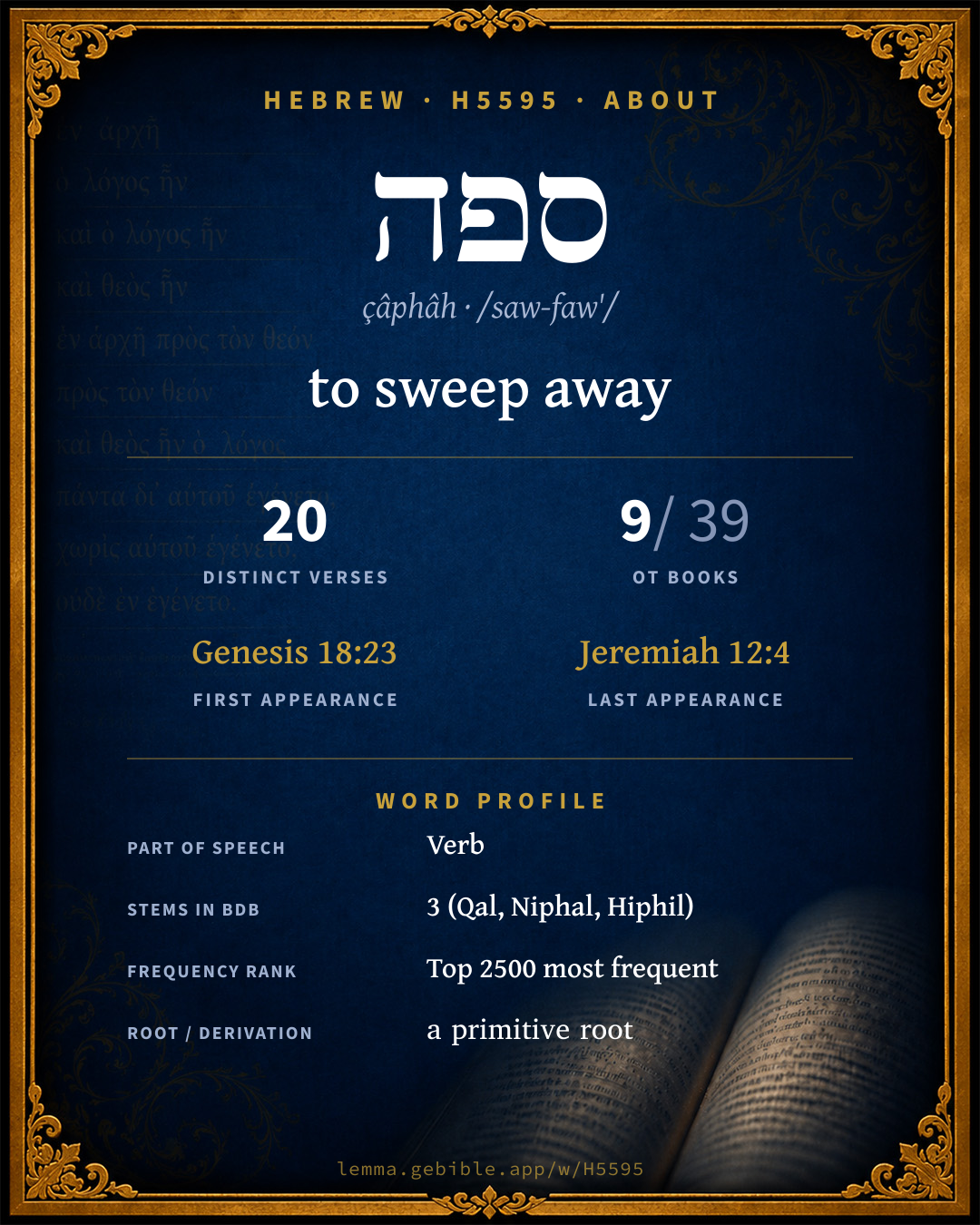
סָפָה
to sweep away
‘to sweep away’ is one of 2 main senses fuller range ↓
Full lexicon entry — Brown-Driver-Briggs (BDB)
From Brown-Driver-Briggs (BDB)
Where this word appears
See every Qal verb in the Hebrew Bible →
Grammar key — what these labels mean
Part of speech
- Verb
- An action or state-of-being word.
Stem
- Niphal
- Usually the simple passive or reflexive of the Qal (“he was written”). Here: ‘be swept away’
- Qal
- The basic, simple active stem — the plain form of the verb (“he wrote”). Here: ‘intrans.’
- Hiphil
- The causative active stem (“he caused / brought about”).
Form
- Imperfect
- An incomplete, ongoing, or future action (“he will / would write”).
- Participle Active
- A verbal adjective expressing ongoing or characteristic action (“writing / one who writes”).
- Infinitive Construct
- A bound verbal noun, frequently with prepositions (“to write / in writing”).
- Imperative
- A direct command (“write!”).
- Perfect
- A completed action or state — Hebrew marks aspect (completeness) more than strict tense (“he wrote”).
State
- Absolute
- The independent form of a noun, not bound to a following word.
Person
- 2nd Person
- The one addressed (“you”).
- 3rd Person
- The one spoken about (“he / she / it / they”).
- 1st Person
- The speaker (“I / we”).
Gender
- Masculine
- Grammatically masculine.
- Common
- Either gender — not distinguished for this form.
- Feminine
- Grammatically feminine.
Number
- Plural
- More than one (in Hebrew, generally three or more).
- Singular
- One.
Grammatical forms 11 distinct
- Verb, Qal, Infinitive Construct 4 times (20%)
- Verb, Niphal, Participle Active, Masculine, Singular, Absolute 3 times (15%)
- Verb, Niphal, Imperfect, 2nd Person, Masculine, Plural 2 times (10%)
- Verb, Niphal, Imperfect, 2nd Person, Masculine, Singular 2 times (10%)
- Verb, Qal, Imperfect, 2nd Person, Masculine, Singular 2 times (10%)
- Verb, Qal, Imperative, 2nd Person, Masculine, Plural 2 times (10%)
- Verb, Niphal, Perfect, 3rd Person, Masculine, Singular 1 time (5%)
- Verb, Niphal, Imperfect, 1st Person, Common, Singular 1 time (5%)
+3 more forms (3 occurrences)
Parsed forms decoded from the imported morphology (morphhb / Westminster Leningrad Codex — WLC text public domain, morphhb tagging CC BY 4.0), counted across 20 parsed occurrences — not distinct verses.
Every verse where H5595 appears — 20 distinct verses across 9 books. Click any verse to open its interlinear word-by-word view. Verse text shown in the World English Bible for context — . Each verse’s Hebrew form is shown with its reference; the English is not keyword-highlighted, since the data carries no word-level English alignment. Use “Compare translations” on any verse to read it across multiple English versions. This concordance covers the Hebrew Bible; Septuagint (Greek Old Testament) occurrences are not indexed here.
Genesis 4 verses
- Genesis 18:23 תִּסְפֶּ֔ה Qal impf 2ms Abraham drew near, and said, "Will you consume the righteous with the wicked?
- Genesis 18:24 תִּסְפֶּה֙ Qal impf 2ms What if there are fifty righteous within the city? Will you consume and not spare the place for the fifty righteous who are therein?
- Genesis 19:15 תִּסָּפֶ֖ה Niphal impf 2ms When the morning arose, then the angels hurried Lot, saying, "Arise, take your wife, and your two daughters who are here, lest you be consumed in the iniquity of the city."
- Genesis 19:17 תִּסָּפֶֽה Niphal impf 2ms It came to pass, when they had taken them out, that he said, "Escape for your life! Don't look behind you, neither stay anywhere in the plain. Escape to the mountain, lest you be consumed!"
Numbers 2 verses
- Numbers 16:26 תִּסָּפ֖וּ Niphal impf 2mp He spoke to the congregation, saying, Depart, I pray you, from the tents of these wicked men, and touch nothing of theirs, lest you be consumed in all their sins.
- Numbers 32:14 לִ/סְפּ֣וֹת prep + Qal inf.cs Behold, you are risen up in your fathers' place, an increase of sinful men, to augment yet the fierce anger of Yahweh toward Israel.
Deuteronomy 2 verses
- Deuteronomy 29:19 סְפ֥וֹת Qal inf.cs and it happen, when he hears the words of this curse, that he bless himself in his heart, saying, I shall have peace, though I walk in the stubbornness of my heart, to destroy the moist with the dry.
- Deuteronomy 32:23 אַסְפֶּ֥ה Hiphil impf 1cs I will heap evils on them; I will spend my arrows on them:
1 Samuel 3 verses
- 1 Samuel 12:25 תִּסָּפֽוּ Niphal impf 2mp But if you shall still do wickedly, you shall be consumed, both you and your king."
- 1 Samuel 26:10 וְ/נִסְפָּֽה conj + Niphal pf 3ms David said, As Yahweh lives, Yahweh will strike him; or his day shall come to die; or he shall go down into battle and perish.
- 1 Samuel 27:1 אֶסָּפֶ֥ה Niphal impf 1cs David said in his heart, I shall now perish one day by the hand of Saul: there is nothing better for me than that I should escape into the land of the Philistines; and Saul will despair of me, to seek me any more in all the borders of Israel: so shall I escape out of his hand.
1 Chronicles 1 verse
Psalms 1 verse
Proverbs 1 verse
Isaiah 4 verses
- Isaiah 7:20 תִּסְפֶּֽה Qal impf 3fs In that day the Lord will shave with a razor that is hired in the parts beyond the River, even with the king of Assyria, the head and the hair of the feet; and it shall also consume the beard.
- Isaiah 13:15 הַ/נִּסְפֶּ֖ה ptcl def.art + Niphal ptcp.act ms Everyone who is found shall be thrust through; and everyone who is taken shall fall by the sword.
- Isaiah 29:1 סְפ֥וּ Qal impv 2mp Ho Ariel, Ariel, the city where David encamped! add you year to year; let the feasts come round:
- Isaiah 30:1 סְפ֥וֹת Qal inf.cs Woe to the rebellious children, says Yahweh, who take counsel, but not of me; and who make a league, but not of my Spirit, that they may add sin to sin,
Jeremiah 2 verses
- Jeremiah 7:21 סְפ֥וּ Qal impv 2mp Thus says Yahweh of Hosts, the God of Israel: Add your burnt offerings to your sacrifices, and eat you flesh.
- Jeremiah 12:4 סָפְתָ֤ה Qal pf 3fs How long shall the land mourn, and the herbs of the whole country wither? for the wickedness of those who dwell therein, the animals are consumed, and the birds; because they said, He shall not see our latter end.
About this entry
At a glance — auto-summarized from this page’s data, not written by a person. Every figure links to its source below. This summary describes the numbers; it doesn’t interpret them.
ספה (çâphâh) is a Hebrew verb most often rendered “to sweep away.” Debuting at Genesis 18:23, it then recurs through the corpus. With 20 verses in 9 books, it is an uncommon word in the Hebrew Bible. As a verb its force shifts by stem, across 3 stems (Qal, Niphal, and more). From the same root come שפה. For the data behind this summary, explore the sense tree and the renderings breakdown below.
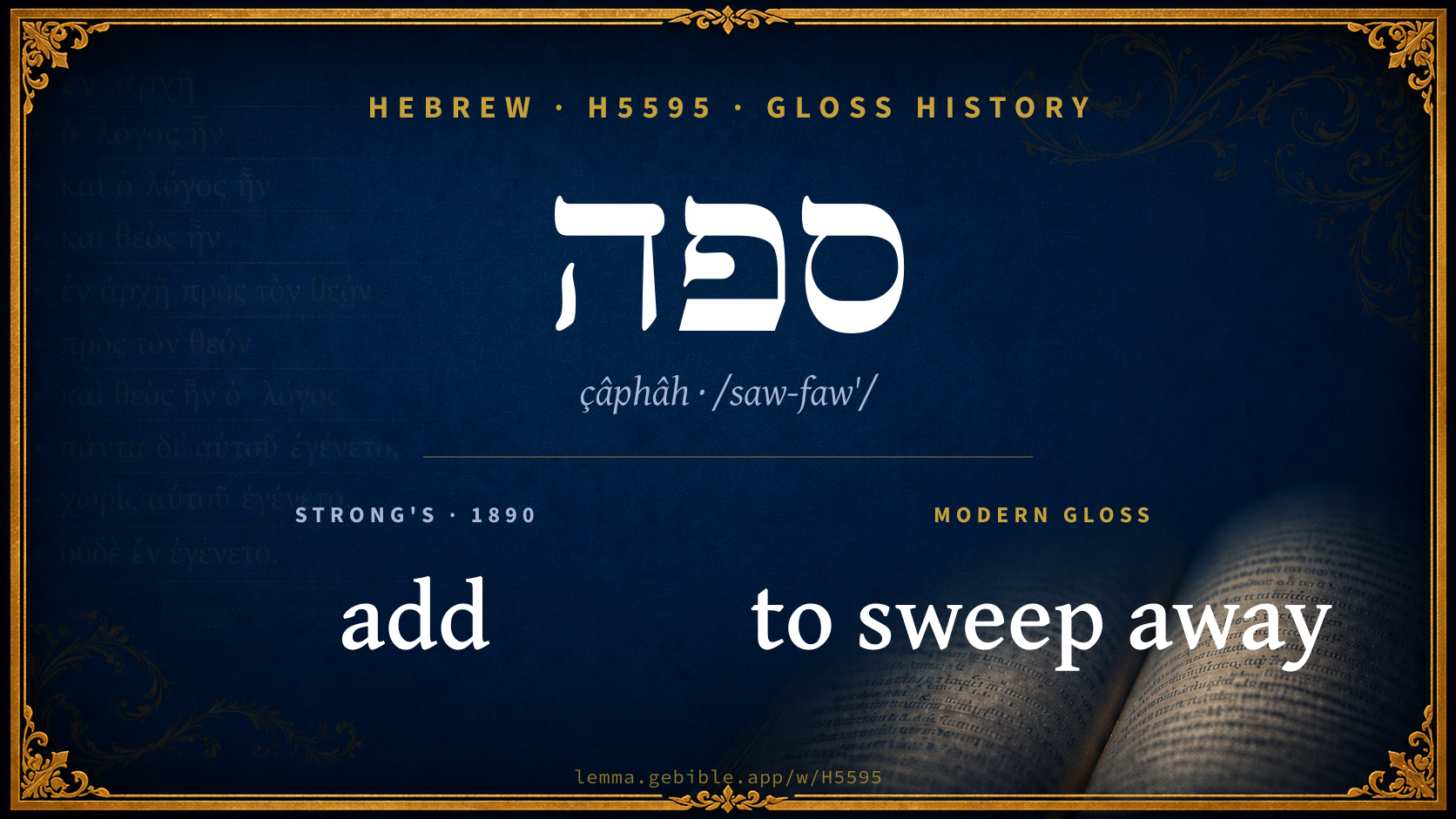
Gloss history
Strong's 1890 vs modern scholarship
About this word
Strong's H5595 catalogs a Hebrew word from the Hebrew Old Testament.
These counts are not copied from any lexicon or concordance. They are computed here, from the morphology-tagged Hebrew Old Testament. What Lemma adds →
- 20
- distinct verses
- The word appears in 20 distinct verses.
- 9 / 39
- OT books
- The word appears in 9 of 39 Old Testament books.
- #1,513
- by frequency
- Top 2500 most frequent Hebrew words (rank 1,513 of 8,640 Hebrew words by occurrence).
View all 20 occurrences in the concordance →
By section of the Old Testament
By traditional corpus
Conventional, traditional groupings — biblical authorship is debated, so this is a traditional corpus grouping, not an authorship claim. Each share is this word’s portion of its verses in that division of the Hebrew canon. Each figure is a share of the word’s 20 distinct verses.
- Prophets (Nevi'im) 9 verses · 45%
- Torah (Pentateuch) 8 verses · 40%
- Writings (Ketuvim) 3 verses · 15%
How translations render this word
Counts come from each version’s own published word-to-Strong’s tagging or interlinear alignment — an approximate guide to how each version renders this word, not a word-level alignment the data otherwise carries. Because each total is that version’s own tagged count, the per-version totals vary from one another and need not match the appearance or distinct-verse counts above. These counts may also differ from a printed concordance because Lemma counts each distinctly tagged rendering and does not collapse phrase taggings into a single head-word total. This is a fixed set of word-tagged versions (KJV, ASV, BSB, ULT) and does not change with the reading translation you choose elsewhere. Each version’s license is shown beside its name below (and on Sources).
- King James Version: Add 2×, Lest thou be consumed 2×, Wilt thou also destroy 2×
- American Standard Version: Add 2×, Destroy 2×, Lest thou be consumed 2×
- Berean Standard Bible: You will be swept away 3×
- unfoldingWord Literal Text: Add 4×, Being swept away 2×, Sweep away 2×
King James Version Public Domain
Renders H5595 across 20 tagged occurrences — most commonly:
Plus 14 renderings that appear only once — usually multi-word phrases or single function words the recovered tagging swept in, not distinct renderings.
American Standard Version Public Domain
Renders H5595 across 20 tagged occurrences — most commonly:
Plus 12 renderings that appear only once — usually multi-word phrases or single function words the recovered tagging swept in, not distinct renderings.
Berean Standard Bible Public Domain
Renders H5595 across 18 tagged occurrences — most commonly:
Plus 15 renderings that appear only once — usually multi-word phrases or single function words the recovered tagging swept in, not distinct renderings.
unfoldingWord Literal Text CC BY-SA 4.0
Renders H5595 across 25 tagged occurrences — most commonly:
Plus 13 renderings that appear only once — usually multi-word phrases or single function words the recovered tagging swept in, not distinct renderings.
Senses in the full BDB
Hebrew verbs can shift meaning by stem (binyan): Qal is the basic action, Niphal is often passive or reflexive, Piel often intensifies or makes it factitive, and Hiphil is typically causative. The senses below are grouped under the stem BDB assigns to each.
What do BDB’s symbols mean?
BDB uses these scholarly abbreviations:
| Symbol | Meaning |
|---|---|
| 𝔊 | the Septuagint (the ancient Greek translation, LXX) |
| 𝔙 | the Vulgate (the Latin translation) |
| 𝔖 | the Syriac version (the Peshitta) |
| 𝔗 | the Targum (the Aramaic translation) |
| ψ | the Psalms |
| √ | root (the underlying root or stem) |
| ‖ | parallel passage (a synonymous or contrasted parallel) |
| † | the dagger: every passage where the word occurs is cited |
The 6 senses and sub-senses the full Brown-Driver-Briggs lexicon distinguishes for this word, in lexicon order (not ranked by frequency), with BDB’s own verbatim wording and sub-sense lettering. Shown in Hebrew script with BDB’s own scholarly abbreviations. The condensed entry is in the Lexicon Entry tab. See also the Forms in the corpus table below.
Qal
- 1. intrans.: Pf. 3 fs. סָֽפְתָה Je 12:4 be snatched away (read poss. סָ֫פָה [סוף]). e.g. Jeremiah 12:4
- 2. trans.: Impf. 3 fs. תִּסְפֶּה Is 7:20 sweep away beard; 2 ms. תִּסְפֶּה Gn 18:23, 24 sweep away indiscriminately (good and bad); Inf. cstr. סְפוֹת Dt 29:18 to snatch away the moist with the dry (proverb. expression, cf. Dr), sf. לִסְפּוֹתָהּ ψ 40:15 to snatch it away.—סְפוֹת Nu 32:14; Is 30:1 v. יסף; וְסָפ֫וּ Am 3:15 v. סוף. e.g. Isaiah 7:20
Niphal
- Pf. 3 ms. וְנִסְפָּה consec. 1 S 26:10; Impf. 2 ms. תִּסָּפֶה Gn 19:15, 17; 1 s. אֶסָּפֶה 1 S 27:1; 2 mpl. תִּסָּפוּ Nu 16:26, תִּסָּפ֑וּ 1 S 12:25; Pt. נִסְפֶּה Is 13:15; Pr 13:23 (1 Ch 21:12 v. infr.);— e.g. 1 Samuel 26:10
- 1. be swept away, destroyed, Gn 19:15 (בַּעֲוֹן הָעִיר by reason of the iniquity of the city), v 17 (both J), Nu 16:26 (JE) 1 S 12:25; 26:10 (in battle), + בְּיַד of agent 1 S 27:1; cf. וְיֵשׁ נִסְפֶּה בְּלֹא מִשְׁפָּט Pr 13:23 and there is that is swept away for lack of justice.—1 Ch 21:12 read נוּסְךָ (as ‖ 2 S 24:13, v. נוּס). e.g. Genesis 19:15
- 2. be caught up, captured, Is 13:15 (‖ נִמְצָא). e.g. Isaiah 13:15
Hiphil
- Impf. 1 s. אַסְפֶּה עָלֵימוֹ רָעוֹת Dt 32:23 I will catch up against them calamities, but read אֹסְפָה I will gather (√ אסף), or אֹסִפָה (Di Dr Buhl Lex 13) I will add, i.e. multiply (√ יסף; v. Ges§ 69 h, note). e.g. Deuteronomy 32:23
Senses from the full Brown-Driver-Briggs lexicon (Brown, Driver, Briggs; Oxford 1906 — public domain), digitized via Sefaria, supplemented by the OpenScriptures HebrewLexicon (CC BY 4.0). Full attribution on Sources.
Word origin
vb. sweep or snatch away, catch up (NH ספי, סָפָא collect (rare), 𝔊 סְפִי (rare), Syriac ܣܦܳܐ collect, pick up; Arabic سَفَا of wind, raise dust and carry it away Lane1377 [v. שָׁפָה]);—
— Brown-Driver-Briggs (Oxford 1906, public domain), digitized via Sefaria, supplemented by the OpenScriptures HebrewLexicon (CC BY 4.0). See Sources.
Origin: a primitive root
Jastrow Dictionary
A second Hebrew/Aramaic lexicon for comparison, covering Aramaic and post-biblical (Talmudic, Targumic, Midrashic) usage that the biblical-Hebrew BDB does not. Matched by lemma rather than by Strong’s number, so a lemma may carry more than one Jastrow headword (shown separately below), and the entries cover usage well beyond the Bible.
סִפָּה
- , pl. סִפּוֹת(b. h.; v. סַף) bowls, moulds of glassware. Tosef. Kel. B. Bath. VII, 7 משינטלו מן הס׳ שלהן as soon as they are taken out of their moulds.
ספי
- 1. to cut, esp. to cut a slice, to give a portion; to have a share in a meal. Pes. 3ᵇ סְפוּ לי מאליה give me a piece of the fat-tail. Midr. Till. to Ps. IV, 7 ed. Bub. מי יתן (לנו) לִסְפּוֹת עמכם וכ׳ (differ. in ed., v. ed. Bub. note) oh, that we could share with you in the good of the hereafter; Yalk. ib. 627 לספור (corr. acc.).
- 2. to consume, destroy. Tanḥ. Vayera 8 (ref. to Gen. XVIII, 23) בשר ודם האף סוֹפֶה אותו וכ׳ as regards a human being, anger consumes him (carries him away), is it so with thee? Wilt thou consume the righteous with the wicked? e.g. Genesis 18:23
- to be destroyed, ruined. Gen. R. s. 49 (ref. to Prov. XIII, 23) ונמצא נ׳ בלא משפט מקומו and thus he was ruined (by the tax-gatherers) not in accordance with the judgment of his place (which had been released from the tax in the meanwhile). e.g. Proverbs 13:23
A Dictionary of the Targumim, the Talmud Babli and Yerushalmi, and the Midrashic Literature (Marcus Jastrow; London, Luzac, 1903) — Public Domain. Digitized via Sefaria. Digitized via Sefaria. Full attribution on Sources.
Forms in the corpus
The 18 distinct written forms H5595 takes in the Hebrew Bible, most frequent first — each parse links to that stem’s occurrences in the concordance. Hebrew forms include their vowel points and cantillation, so a single lemma takes many written forms.
Same root — word family
Other BDB entries built from the same root as H5595, grouped by Strong’s listed origin. These share a root / origin per the lexicon — not necessarily a shared meaning. Each links to that word’s own entry.
Derived from this word
Compare all same-root words → They share a root, not necessarily a meaning.
Septuagint verse parallels
This word appears in 20 verses that also exist in the Greek Old Testament (Septuagint), out of the 20 Hebrew verses it occurs in. You can read those verses in Greek by switching the Old Testament edition to the Septuagint.
Read these verses in the Septuagint
- Genesis 18:23
- Numbers 16:26
- Deuteronomy 29:19
- 1 Samuel 12:25
- 1 Chronicles 21:12
- Psalms 40:14
- Proverbs 13:23
- Isaiah 7:20
- Jeremiah 7:21
This is a verse-level parallel only — the same verses exist in both the Hebrew and Greek Old Testaments. No word-level Hebrew↔Greek correspondence is claimed: the data carries no such alignment, so no Greek word is shown as this Hebrew word’s translation. Coverage is not total — the Septuagint omits the deuterocanon and renumbers the Psalms, so some Hebrew verses have no direct Greek parallel.