
1 Kings 9:2

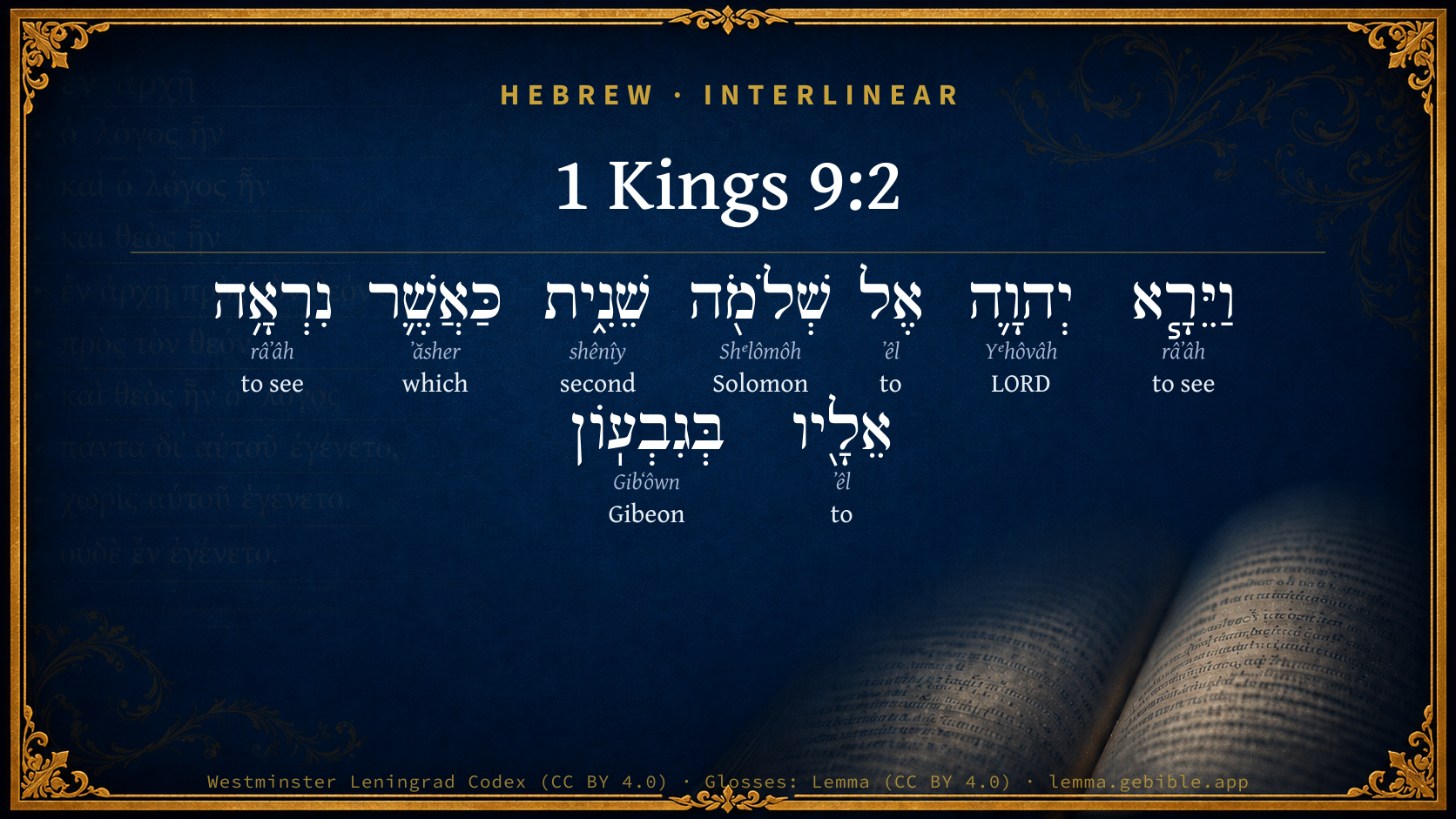
Hebrew (Westminster Leningrad Codex) 1 Kings 9:2 appears in the Hebrew Old Testament. The text above is from the Westminster Leningrad Codex. Each word links to its Strong’s number, a concise gloss, and parsing drawn from the Open Scriptures Hebrew Bible morphology. Click any word for its full Brown-Driver-Briggs (BDB) entry.
Download image
Cite this verse

1 Kings 9:2 (World English Bible). Public Domain. Lemma interlinear Bible study tool, https://lemma.gebible.app/v/1-kings/9/2.

Show BibTeX & RIS
BibTeX
RIS
English Translation
that Yahweh appeared to Solomon the second time, as he had appeared to him at Gibeon.
World English Bible · Public Domain
Download a study sheet

One document with this verse’s original text, its word-by-word gloss line, the meaning frame, cross-references with their text, attributed commentary, and full source and license credits — printable, and it pastes into notes with its structure intact.

This verse Autodidact and up

Study sheet (.html) Plain text (.txt)

A passage Seminary Student

Up to 50 verses in one chapter. A passage sheet keeps up to 6 commentary sources and 12 cross-references per verse, in the order this page ranks them, and says so on the sheet whenever that leaves anything out. Ask for a single verse and you get the Autodidact verse sheet above.

Everything on this page stays free to read, with no account — the sheet is a download of what is already on screen, not access to it.

Want to remove ads? Support Godless Engineer
Compare translations 3

The same verse in 3 English versions, stacked beneath the original-language interlinear above. Click any original word for its lexicon entry.

Each is an independent rendering of the whole verse — the interlinear is not word-aligned to these translations.

Highlighted words mark where these versions differ — a whole-verse word diff, not a word-by-word alignment.

  • World English Bible Public Domain
    that Yahweh appeared to Solomon the second time, as he had appeared to him at Gibeon.
  • King James Version Public Domain
    That the LORD appeared to Solomon the second time, as he had appeared unto him at Gibeon.
  • unfoldingWord Literal Text CC BY-SA 4.0
    that Yahweh appeared to Solomon a second time, just as he had appeared to him at Gibeon.

unfoldingWord Literal Text — © unfoldingWord, licensed CC BY-SA 4.0. Word-aligned USFM3 via Door43 (git.door43.org/unfoldingWord/en_ult).

Versions to compare (up to 4)

3 of 4 selected

Show all 18 translations

Every available English version of this verse, each an independent rendering of the whole verse.

  • World English Bible Public Domain
    that Yahweh appeared to Solomon the second time, as he had appeared to him at Gibeon.
  • Berean Standard Bible Public Domain
    the LORD appeared to him a second time, as He had appeared to him at Gibeon.
  • Majority Standard Bible Public Domain
    the LORD appeared to him a second time, as He had appeared to him at Gibeon.
  • King James Version Public Domain
    That the LORD appeared to Solomon the second time, as he had appeared unto him at Gibeon.
  • American Standard Version (1901) Public Domain
    that Jehovah appeared to Solomon the second time, as he had appeared unto him at Gibeon.
  • Revised Version (1885) Public Domain
    that the LORD appeared to Solomon the second time, as he had appeared unto him at Gibeon.
  • Geneva Bible (1599) Public Domain
    Then the Lord appeared vnto Salomon the second time, as he appeared vnto him at Gibeon.
  • Douay-Rheims (1899) Public Domain
    That the Lord appeared to him the second time, as he had appeared to him in Gabaon.
  • Young's Literal Translation Public Domain
    that Jehovah appeareth unto Solomon a second time, as He appeared unto him in Gibeon,
  • Literal Standard Version CC BY-SA 4.0
    that YHWH appears to Solomon a second time, as He appeared to him in Gibeon,
  • Unlocked Literal Bible CC BY-SA 4.0
    Yahweh appeared to Solomon a second time, as he had appeared to him at Gibeon.
  • unfoldingWord Literal Text CC BY-SA 4.0
    that Yahweh appeared to Solomon a second time, just as he had appeared to him at Gibeon.
  • Darby Bible Public Domain
    that Jehovah appeared to Solomon the second time, as he had appeared to him at Gibeon.
  • World Messianic Bible Public Domain
    The LORD appeared to Solomon the second time, as he had appeared to him at Gibeon.
  • Webster's Bible Public Domain
    That the LORD appeared to Solomon the second time, as he had appeared to him at Gibeon.
  • Free Bible Version CC BY-SA 4.0
    the Lord appeared to him a second time, as he had appeared to him at Gibeon.
  • Bible in Basic English Public Domain
    The Lord came to him again in a vision, as he had done at Gibeon;
  • JPS Tanakh (1917) Public Domain
    that the LORD appeared to Solomon the second time, as He had appeared unto him at Gibeon.

Literal Standard Version (2020), Covenant Press — licensed CC BY-SA 4.0. Text via the HelloAO Bible API (eBible.org). Unlocked Literal Bible (unfoldingWord) — licensed CC BY-SA 4.0. Text via the HelloAO Bible API (eBible.org). unfoldingWord Literal Text — © unfoldingWord, licensed CC BY-SA 4.0. Word-aligned USFM3 via Door43 (git.door43.org/unfoldingWord/en_ult). Free Bible Version, Dr. Jonathan Gallagher — licensed CC BY-SA 4.0. Text via the HelloAO Bible API (eBible.org).

Word by word

More ways to search: Search by grammar → Find every occurrence → Compare this word →

Practice this passage: Drill this verse → Learn its vocabulary →

About this verse

These counts appear in no published source. They are computed here, from the morphology-tagged text and Lemma’s own curated glosses. What Lemma adds →

9
words
7
distinct lemmas
Historical
section

Shared distinctive vocabulary

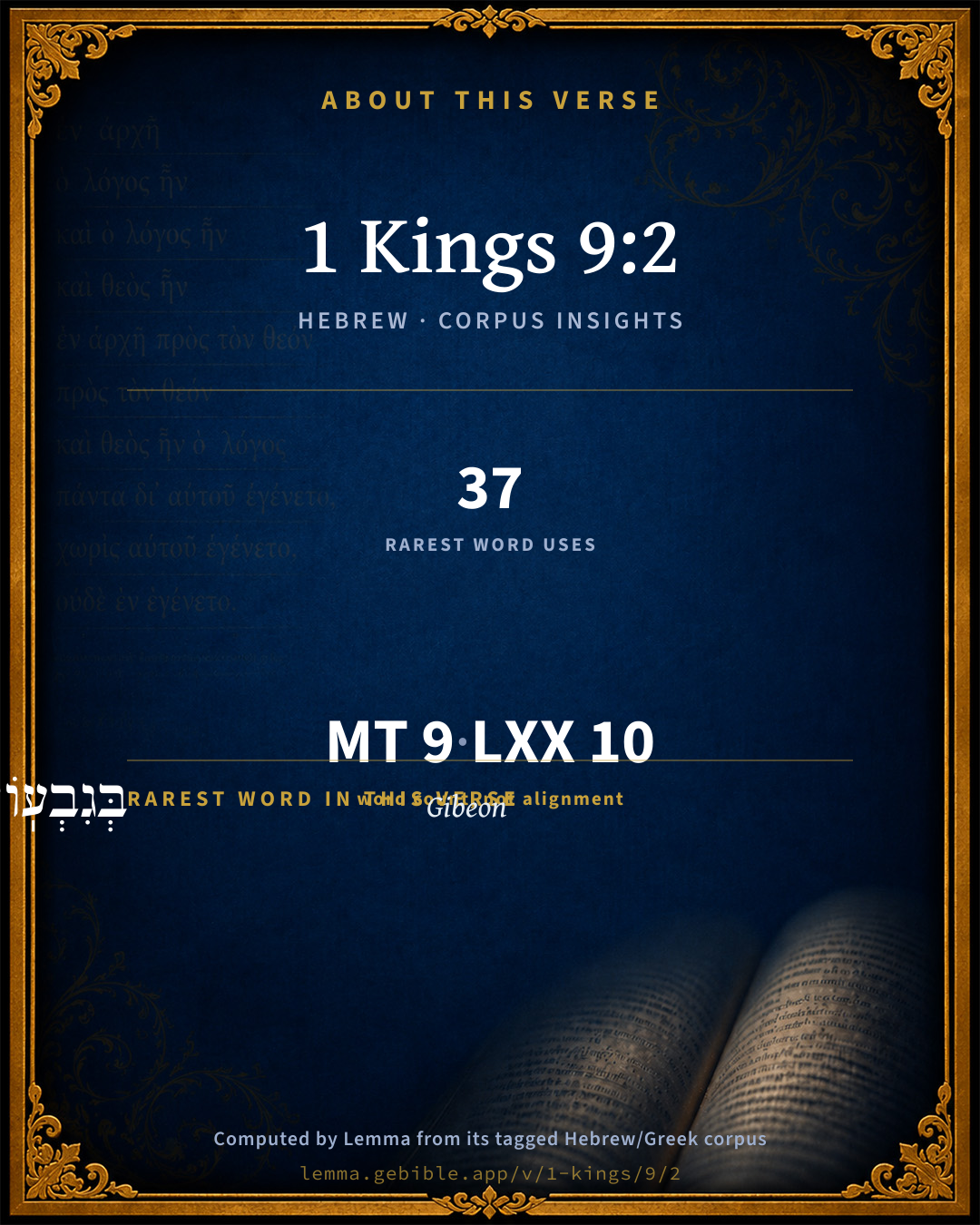
בְּגִבְעֽוֹן Gibeon H1391 occurs in 35 verses of the Hebrew Bible. Also found in:

Grammatical profile

  • 2 verbs
  • 3 nouns
  • 1 adjective
  • 2 prepositions
  • 1 particle

Verb forms

  • וַיֵּרָ֧א Niphal · Sequential Imperfect
  • נִרְאָ֥ה Niphal · Perfect

Repetition

Words recur within this verse — often emphatic in Hebrew:

  • וַיֵּרָ֧א to see H7200 ×2
  • אֶל to H413 ×2

Hebrew & Septuagint length

In English translation the verse runs 16 words from the Hebrew and 14 from the Septuagint (LXX English) — closely comparable.

A rough comparison of the two English renderings, which tokenize alike — not a word-level alignment.

Word counts can differ between the Hebrew and the Greek without any difference in meaning — e.g. the Hebrew direct-object marker אֵת has no separate Greek word, and Greek often adds the article ὁ.

In the original languages it is 9 Hebrew tokens and 10 Greek tokens — but the two are counted differently (Hebrew bundles its prefixes and suffixes into one token; the Greek is in lemma form), so that isn’t a like-for-like length.

Cross-references

4

Topical passages linked to 1 Kings 9:2 in the Treasury of Scripture Knowledge — connected by theme and wording, ordered by reader-vote popularity; previews shown in the World English Bible.

  • 1 Kings 3:5 In Gibeon Yahweh appeared to Solomon in a dream by night; and God said, Ask what I shall give you.
  • 2 Chronicles 7:12 Yahweh appeared to Solomon by night, and said to him, I have heard your prayer, and have chosen this place to myself for a house of sacrifice.
  • 1 Kings 11:9 Yahweh was angry with Solomon, because his heart was turned away from Yahweh, the God of Israel, who had appeared to him twice,
  • 2 Chronicles 1:7–12 In that night did God appear to Solomon, and said to him, Ask what I shall give you.

Cross-references courtesy of OpenBible.info (CC BY 4.0).

Hebrew and Greek witnesses Masoretic Hebrew ↔ Greek Septuagint

The same verse in the two great witnesses to the Old Testament, shown verse-for-verse.

These are two independent witnesses, not word-aligned to each other, and the Septuagint is shown in lemma (dictionary) form.

Hebrew 1 Kings 9:2 Masoretic · Westminster Leningrad Codex

וַיֵּרָ֧א יְהוָ֛ה אֶל שְׁלֹמֹ֖ה שֵׁנִ֑ית כַּאֲשֶׁ֛ר נִרְאָ֥ה אֵלָ֖יו בְּגִבְעֽוֹן

that Yahweh appeared to Solomon the second time, as he had appeared to him at Gibeon.

World English Bible · Public Domain

Greek LXX 1 Kings 9:2 Septuagint · lemma form

καί ὁράω κύριος ὁ σαλωμών δεύτερος καθώς ὁράω ἐν γαβαων

that the Lord appeared to Solomon a second time, as he appeared in Gabaon.

LXX2012 (modern English Septuagint) · Public Domain

Hebrew: Westminster Leningrad Codex (CC BY 4.0). Greek: Septuagint (public domain); English from LXX2012 (modern English Septuagint) (Public Domain). How the Septuagint differs from the Hebrew →

Targum (Aramaic paraphrase)

1

The Targum is the ancient Jewish Aramaic paraphrase of the Hebrew Scriptures — an interpretive translation, not the Hebrew text itself. Onkelos (literal) and Pseudo-Jonathan (expansive) render the Torah, and Jonathan the Prophets. Coverage is partial: where no permissively-licensed English translation exists for a verse, only the Aramaic is shown. This is verse-level text, not a word-by-word alignment to the Hebrew.

  1. Targum Jonathan Prophets (Joshua–Malachi)
    וְאִתְגְלֵי יְיָ לִשְׁלֹמֹה תִּנְיָנוּת כְּמָא דְאִתְגְלֵי לֵיהּ בְּגִבְעוֹן:

    (no public-domain English translation for this verse)

    Targum Jonathan — Aramaic: “Mikraot Gedolot” (public domain). English: “Sefaria Community Translation” (CC0 1.0 (public-domain dedication)); “London "Chaldee Paraphrase," 1871” (public domain). Text via Sefaria.

Commentary

Notes on 1 Kings 9:2 from classic Christian and Jewish commentators (each source and its license shown beneath its notes). The classic Christian expositions comment on the surrounding passage and are grouped to its opening verse, so a note may address several verses; the Jewish commentaries on the Tanakh (Rashi and others) are per-verse, so they appear only where the commentator wrote on this verse.

Lemma curates 59 commentaries, every one of them public domain or Creative Commons licensed, each selected and text-cleaned for this edition rather than reprinted as found. About our sources →

Trapp's Complete Commentary

John Trapp

1Ki 9:2 That the LORD appeared to Solomon the second time, as he had appeared unto him at Gibeon.

Ver. 2. That the Lord appeared to Solomon the second time.] This was a great engagement upon Solomon to cleave close to that God who had appeared unto him twice. {1Ki 11:9} See an analogical appearance to all that love him, {Joh 14:21} and be instructed, lest God’s soul depart from us, {Jer 6:8} for our "evil heart of unbelief in departing from the living God." {Heb 3:12}

John Trapp, A Commentary or Exposition upon All the Books of the Old and New Testament (1647–1656) — public domain. Text from a community e-Sword module.

Matthew Poole's English Annotations

To wit, in a dream or vision; for that which is mentioned 1Ki 6:11, seems to have been imparted unto him by some prophet or messenger sent from God with that errand. The time of this revelation was either,

1. After all Solomon’s buildings, as the words thus rendered plainly imply. And if it seem strange that God should not reveal this purpose and sentence of his concerning the temple till so many years after the finishing of it, it must be considered,

1. That as it is an act of God’s singular grace when he doth thus reveal himself to any person, so it is but meet he should choose his own time for it.

2. That God had presently after the finishing of the temple, at the feast of the dedication of it, sufficiently showed his acceptance and approbation of it by that glorious cloud, 1Ki 8:10,11, and therefore this revelation was not then necessary.

3. That God might choose this as the fittest time for giving Solomon the following admonition, when he perceived that his heart befall to be lifted up in pride for his sumptuous and magnificent buildings, &c., and that he was grown vain, and careless, and secure; and therefore most needed such all awakening oracle. Or,

2. Presently after the building of the temple, as may be thought from the matter of this revelation, which seems best to suit with that time when it was newly built, and when Solomon’s prayer here mentioned was newly made; for seeing the following words contain God’s answer to that prayer, it seems improbable, that the answer should come so many years after it. But then this second verse, and the rest, even to 1Ki 9:11, are to be enclosed with a parenthesis; and the place must be thus rendered, 1Ki 9:2, For (so the Hebrew vau is oft rendered) the Lord appeared, or had appeared, to Solomon, &c.; 1Ki 9:3, And the Lord had said unto him, &c. And this parenthesis may seem to have a foundation in 1Ki 9:10, where the first verse (in substance, though not in the very same words) is repeated, as is usual after long digressions; and then he completes the sentence, 1Ki 9:11, &c., which till then had been suspended. Nor are such long parentheses without example in Scripture. See my Latin Synopsis on Rom 5:12, &c.; Eph 3:1, &c. Rev 22:7.

Matthew Poole's English Annotations on the Holy Bible (1683–1685) — public domain. Text from a community e-Sword/MySword module.

The Biblical Illustrator

Joseph S. Exell

1Ki_9:2-9

The Lord said unto him, I have heard thy prayer.

Essential points in prayer

It was an exceedingly encouraging thing to Solomon that the Lord should appear to him before the beginning of his great work of building the temple. See in the third chapter of this First Book of the Kings, at the fifth verse, In Gibeon the Lord appeared to Solomon in a dream by night: and God said, Ask what I shall give thee. I cannot forget when the Lord appeared unto me in Gibeon at the first. Truly there are things about the lives of Christian men that would not have been possible if God had not appeared to them at the beginning. If he had not strengthened and tutored them, and given them wisdom beyond what they possess in themselves; if he had not inspirited them. It is a priceless blessing to begin with God, and not to lay a stone of the temple of our life-work till the Lord has appeared unto us. I do not know, however, but that it is an equal, perhaps a superior, blessing for the Lord to appear to us after a certain work is done; even as in this case: The Lord appeared to Solomon the second time, as He had appeared unto him at Gibeon. We want renewed appearances, fresh manifestations, new visitations from on high; and I commend to those of you who are getting on in life, that while you thank God for the past, and look back with joy to His visits to you in your early days, you now seek and ask for a second visitation of the Most High. All days in a palace are not days of banqueting, and all days with God are not so clear and glorious as certain special Sabbaths of the soul in which the Lord unveils His glory. Happy are we if we have once beheld His face; but happier still if He again comes to us in fulness of favour. I think that we should be seeking those second appearances: we should be crying to God most pleadingly that He would speak to us a second time.

I. Our proper place in prayer. The Lord said, I have heard thy prayer, and thy supplication, that thou hast made before Me. There is the place to pray--before Me: that is to say, before the Lord. But we should take care that the place is hallowed by our prayer being deliberately and reverently presented before God.

1. This place is not always found. The Pharisee went up to the temple to pray, and yet, evidently, he did not pray before God; so that even in the most holy courts he did not find the place desired.

2. This blessed place before God can be found in public prayer. Solomons prayer before God was offered in the midst of a great multitude.

3. But prayer before God can just as well be offered in private.

4. The prayer is to be directed to God.

5. We should endeavour in prayer to realise the presence of God.

II. Our great desideratum in prayer. It is that which God said that He had given to Solomon. I have heard thy prayer and thy supplication.

1. The first thing the soul desires in prayer is audience with God. If the Lord do not hear us, we have gained nothing. And what an honour it is to have audience with God!

2. But we Want more than that: we want that He should accept. It were a painful thing to be permitted to speak to a great friend, and then for him to stand austere and stern, and say, I have heard what you have to say. Go your way. We ask not this of God.

3. Still, there is a third thing which we want, which God gave to Solomon, and that was an answer.

III. Our assurance of answer to prayer. Can we have an assurance that God has heard and answered prayer? Solomon had it. The Lord said unto him, I have heard thy prayer and thy supplication, that thou hast made before Me. Does the Lord ever say that to us? I think so. Let us consider how He does so.

1. I think that He says it to us very often in our usual faith.

2. But sometimes you require strong confidence. You have to solicit some extraordinary blessing. You get to a place like that to which Jacob came, when common prayer was not sufficient.

3. Sometimes this comes in the form of a comfortable persuasion.

4. The Lord also gives to His people a manifest preparation for the blessing. He prepares them to receive it. Their expectation is raised, so that they begin to look out for the blessing, and make room for it; and when it is so, you may be sure that it is coming.

5. Actual observation also breeds in us a solid confidence that our suit is succeeding. (C. H. Spurgeon.)

Prayer penetrates

Which are the sounds that penetrate furthest? We on terra firma are scarcely in a position to judge. However, a number of scientists have been making a series of experiments to test the relative penetrating quality of sounds, The Government lent them a military balloon, which ascended from the artillery camp at Woolwich, and passed over London. A sharp ear was kept for the sounds of the vast city that penetrated upward. Trains were heard in practically continuous rumble, punctuated by their shrill whistles. Sirens from the river and various factories rose sharp and clear. Most noticeable were the barkings of high-voiced dogs, which could be distinctly heard even at a mile high. The highly-instructive fact was noted, however, that, though the city was crossed just at neon, when from the streets the striking of clocks and bells is always such a noticeable feature, yet the most careful listener aloft could detect no such sounds. These observations go to prove how inferior are the carrying powers of bells as heard from aloft, and to emphasise the fact that noises of an unmusical, discordant nature have much better chance of making themselves heard at a distance than have more harmonious sounds. But the reverse is the case in the spiritual sphere. It is the discords of earth that have no carrying power, and that last but for a day. It is the sweet and harmonious utterance, the secret prayer, the quiet deed, that reaches unto the heavens. (Signal.)

The Biblical Illustrator, edited by Joseph S. Exell (c. 1880s–1900s) — public domain. Text from a community e-Sword module.

Tyndale Open Study Notes

Tyndale Open Resources

9:2 The Lord had previously appeared to Solomon when granting his desire for wisdom (3:3-15). The Chronicler provides additional details of God’s blessings or judgment, depending on the faithfulness of Solomon and Israel (2 Chr 7:11-22).

Tyndale Open Study Notes — © Tyndale Open Resources, licensed CC BY-SA 4.0. Text via the HelloAO Bible API.

Jamieson, Fausset & Brown

Robert Jamieson, A. R. Fausset & David Brown

That--rather, "For."

the Lord appeared--This appearance was, like the former one at Gibeon, most probably made in a supernatural vision, and on the night immediately following the dedication of the temple (Ch2 7:12). The strain of it corresponds to this view, for it consists of direct answers to his solemn inaugural prayer (Kg1 9:3 is in answer to Kg1 8:29; Kg1 9:4-5 is in answer to Kg1 8:25-26; Kg1 9:6-9 to Kg1 8:33-46; see also Deu 29:22-24).

Jamieson, Fausset & Brown — Commentary Critical and Explanatory on the Whole Bible (1871) — public domain (CC PDM 1.0). Text via the HelloAO Bible API.

Adam Clarke's Commentary

Verse 2. The Lord appeared to Solomon] The design of this appearance, which was in a dream, as that was at Gibeon, was to assure Solomon that God had accepted his service, and had taken that house for his dwelling-place, and would continue it, and establish him and his descendants upon the throne of Israel for ever, provided they served him with an upright heart; but, on the contrary, if they forsook him, he would abandon both them and his temple.

Adam Clarke's Commentary on the Bible (1810–1826) — public domain. Text from a community e-Sword/MySword module.

The Cambridge Bible for Schools and Colleges

gen. ed. J. J. S. Perowne

2. the Lord appeared to Solomon the second time] In 2 Chron. we are told that this was ‘by night,’ therefore in a vision. Josephus says ‘a vision appearing to the king in his sleep shewed him that God had hearkened to his prayer.’

at Gibeon] Cf. on 1Ki_3:5 above.

The Cambridge Bible for Schools and Colleges (gen. ed. J. J. S. Perowne; Cambridge University Press, 1878–1918) — public domain. Text from a community e-Sword module.

John Gill's Exposition

That the Lord appeared to Solomon the second time,.... Junius and Tremellius read this verse with the following, to the end of the ninth, in a parenthesis, and render this clause, "for the Lord had appeared", &c. and Piscator translates it, "moreover the Lord appeared", &c. as beginning a distinct narrative from the former; and indeed if the words are to be connected with the preceding, as in our version, this appearance must be thirteen years after the building of the temple, which is not probable; but rather it was the night after the dedication of it, when an answer was returned to Solomon's prayer in the preceding chapter; for that it should be deferred twelve or thirteen years is not reasonable to suppose; and this appearance was the second of the kind and manner:

as he had appeared unto him at Gibeon; in a dream and a vision, and by night, Kg1 3:5, see Ch2 7:12.

John Gill's Exposition of the Whole Bible (1746–1763) — public domain (CC PDM 1.0). Text via the HelloAO Bible API.

Albert Barnes' Notes on the Bible

This appearance is fixed by 1Ki 9:1 to Solomon’s twenty-fourth year, the year in which he completed his palace 1Ki 6:37-38; 1Ki 7:1. The fact seems to be that, though the temple was finished in Solomon’s eleventh year, the dedication did not take place until his twenty-fourth year. The order of the narrative in Kings agrees with this view, since it interposes the account of the building of the palace 1Ki 7:1-12, and of the making of the furniture 1 Kings 7:13-51, between the completion of the building of the temple 1Ki 6:38 and the ceremony of the Dedication 1 Kings 8.

Albert Barnes' Notes on the Bible (1834–1885) — public domain. Text from a community e-Sword/MySword module.

Haydock's Catholic Bible Commentary

Gabaon; that is, "during the night," 2 Paralipomenon vii. 12. God had spoken to Solomon, by a prophet, while he was building the temple; (chap. vi. 11.; Haydock) unless that passage relate to the same time as that which is here recorded more in detail, and took place in the night, after Solomon had poured forth his most solemn prayer. (Calmet) --- Others think that God deferred answering his petition for thirteen years, till Solomon was on the point of falling off from the observance of piety, that so he might be restrained more effectually. (Salien, the year before Christ 1011.) --- Fire from heaven had sufficiently signified that his former request had been granted. (Menochius) --- The context shews that the admonition was not sent till the palace was finished, (ver. 1, and 10.) in the 23rd year of Solomon. (Salien)

George Leo Haydock (1774–1849), Haydock's Catholic Family Bible and Commentary, 1859 edition — public domain. Excludes Psalms (Douay-Rheims chapter numbering differs from Protestant) and Deuterocanonical books (Catholic canon only).

Whedon's Commentary on the Bible

Daniel D. Whedon

2. As he had appeared unto him at Gibeon — Namely, in a dream by night, (1Ki_3:5; 2Ch_7:12,) reminding him of the covenant with David, and conditioning his future happiness on his obedience. These two appearances to Solomon marked two memorable turning points in his career. The one given him in the simplicity of his youth (1Ki_3:7) lifted him into an element of wisdom and favour with both God and man; the other, given in the blaze of his worldly glory, was, alas! soon followed by shameful idolatries. Like Saul, when he was little in his own eyes the Lord made him great, (1Sa_15:17;) but when exalted among men, he lightly observed the Divine counsels.

Daniel D. Whedon (gen. ed.), Commentary on the Old and New Testaments (1874–1909) — public domain. Text from a community e-Sword module.

The Pulpit Commentary

That the Lord appeared to Solomon the second time, (see on 1Ki_6:11, and 1Ki_11:9) Solomon had received a message during the building of the temple as he had appeared unto him at Gibeon i.e., in a dream. (1Ki_3:5)

The Pulpit Commentary (1880–1919), ed. H.D.M. Spence-Jones & Joseph S. Exell — public domain. Text from a community e-Sword module.

Lesson kit

Teaching starters — assembled from the data on this page, not authored interpretation. Every prompt links to the verse data it draws on. Edit before teaching.

1 Kings, in the Historical, opens this verse with 9 words (7 distinct Hebrew lemmas). Its most distinctive word is Gibʻôwn (“Gibeon”). A historical commentator’s framing appears above. Read the whole chapter for the surrounding context.

Discussion questions

  1. What does “Gibeon” (Gibʻôwn) contribute to the verse as a whole?
  2. Joshua 9:3 shares the word «Gibeon» with this verse. How do the two illuminate each other?
  3. “to see” occurs 2× in this one verse. What is the effect of the repetition?
  4. These translations render this verse differently. What is at stake in choosing one wording over another?
  5. The verb «וַיֵּרָ֧א» is Niphal Sequential Imperfect. How does its form color the action?
  6. Reading how Trapp's Complete Commentary and Matthew Poole's English Annotations read this verse, where do the two commentators agree and where do they part?

Things to notice

Reading settings

Reading text

Shown beneath each verse's original-language words.

Old Testament
Old Testament edition

Read the OT as the Masoretic Hebrew (MT) or the Greek Septuagint (LXX).

English shown for the Greek Septuagint (in the Hebrew ↔ Greek comparison).

Comparing translations? Open the Compare panel on any verse page to stack up to four side by side.