
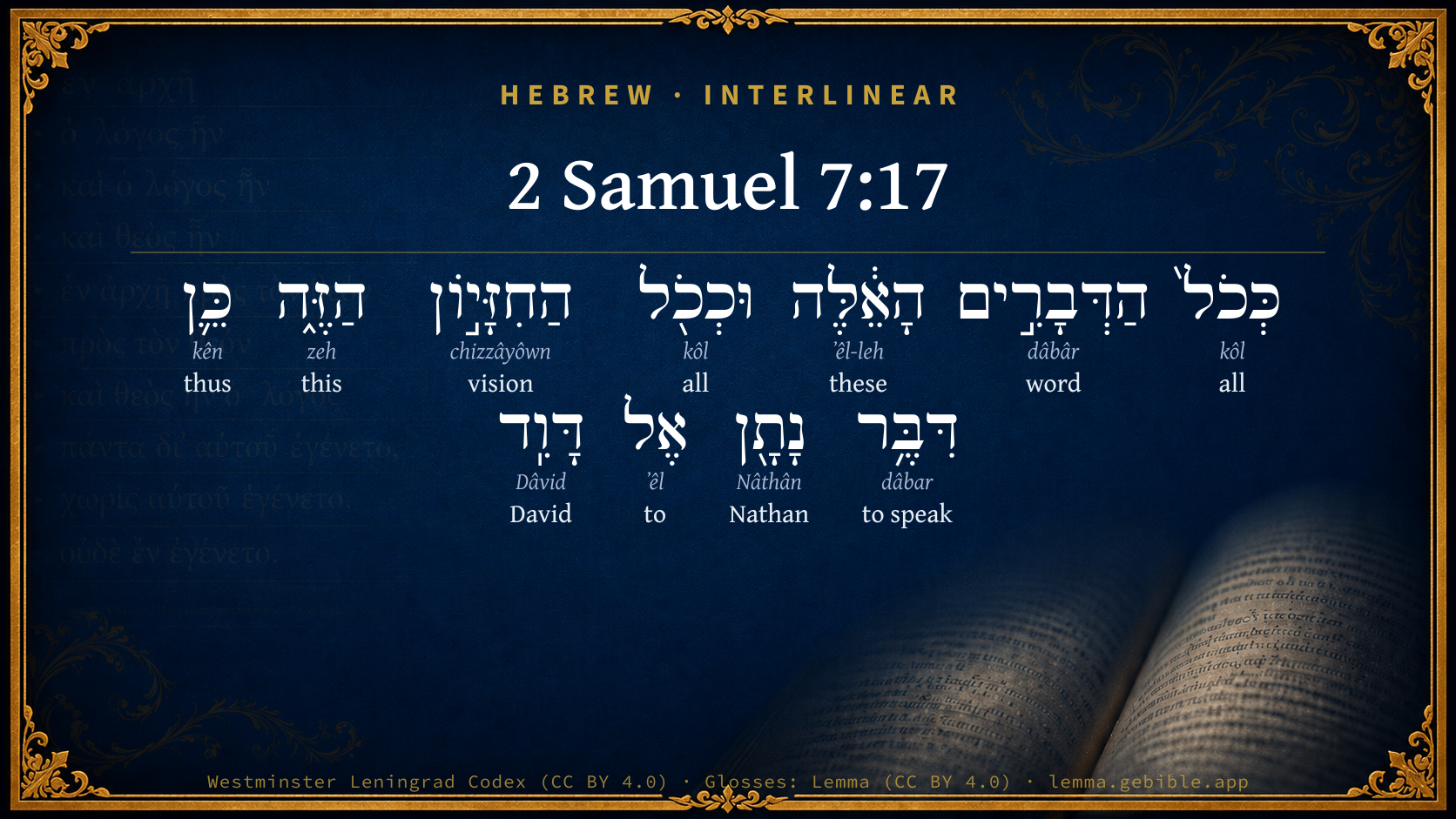
2 Samuel 7:17

Hebrew (Westminster Leningrad Codex) 2 Samuel 7:17 appears in the Hebrew Old Testament. The text above is from the Westminster Leningrad Codex. Each word links to its Strong’s number, a concise gloss, and parsing drawn from the Open Scriptures Hebrew Bible morphology. Click any word for its full Brown-Driver-Briggs (BDB) entry.
Download image
Cite this verse

2 Samuel 7:17 (World English Bible). Public Domain. Lemma interlinear Bible study tool, https://lemma.gebible.app/v/2-samuel/7/17.

Show BibTeX & RIS
BibTeX
RIS
English Translation
According to all these words, and according to all this vision, so did Nathan speak to David.
World English Bible · Public Domain
Highlights
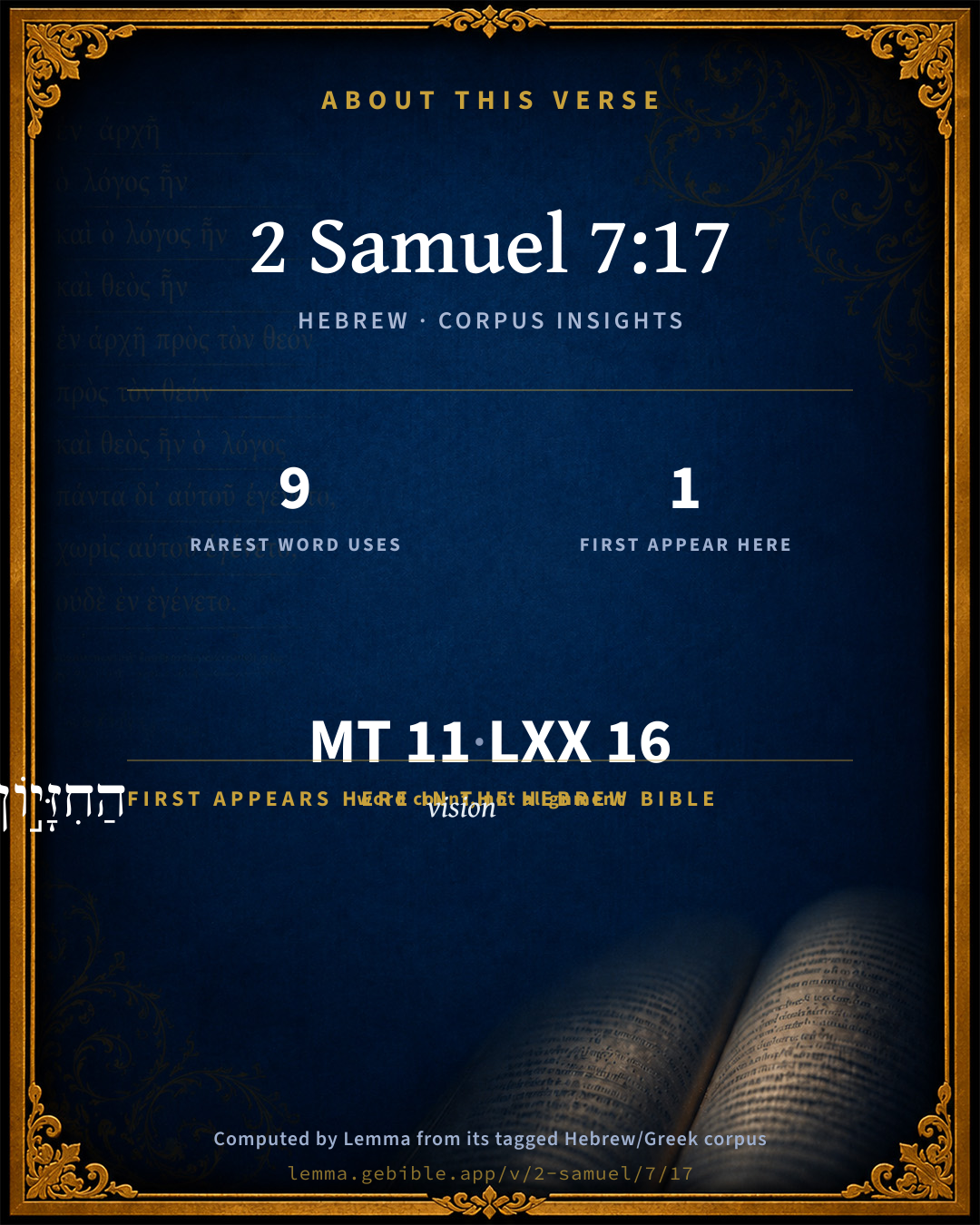
  • 1 first appearance in the Hebrew Bible
Full analysis ↓
Download a study sheet

One document with this verse’s original text, its word-by-word gloss line, the meaning frame, cross-references with their text, attributed commentary, and full source and license credits — printable, and it pastes into notes with its structure intact.

This verse Autodidact and up

Study sheet (.html) Plain text (.txt)

A passage Seminary Student

Up to 50 verses in one chapter. A passage sheet keeps up to 6 commentary sources and 12 cross-references per verse, in the order this page ranks them, and says so on the sheet whenever that leaves anything out. Ask for a single verse and you get the Autodidact verse sheet above.

Everything on this page stays free to read, with no account — the sheet is a download of what is already on screen, not access to it.

Want to remove ads? Support Godless Engineer
Compare translations 3

The same verse in 3 English versions, stacked beneath the original-language interlinear above. Click any original word for its lexicon entry.

Each is an independent rendering of the whole verse — the interlinear is not word-aligned to these translations.

Highlighted words mark where these versions differ — a whole-verse word diff, not a word-by-word alignment.

  • World English Bible Public Domain
    According to all these words, and according to all this vision, so did Nathan speak to David.
  • King James Version Public Domain
    According to all these words, and according to all this vision, so did Nathan speak unto David.
  • unfoldingWord Literal Text CC BY-SA 4.0
    According to all of these words and according to all of this vision, thus Nathan spoke to David.

unfoldingWord Literal Text — © unfoldingWord, licensed CC BY-SA 4.0. Word-aligned USFM3 via Door43 (git.door43.org/unfoldingWord/en_ult).

Versions to compare (up to 4)

3 of 4 selected

Show all 18 translations

Every available English version of this verse, each an independent rendering of the whole verse.

  • World English Bible Public Domain
    According to all these words, and according to all this vision, so did Nathan speak to David.
  • Berean Standard Bible Public Domain
    So Nathan relayed to David all the words of this entire vision.
  • Majority Standard Bible Public Domain
    So Nathan relayed to David all the words of this entire revelation.
  • King James Version Public Domain
    According to all these words, and according to all this vision, so did Nathan speak unto David.
  • American Standard Version (1901) Public Domain
    According to all these words, and according to all this vision, so did Nathan speak unto David.
  • Revised Version (1885) Public Domain
    According to all these words, and according to all this vision, so did Nathan speak unto David.
  • Geneva Bible (1599) Public Domain
    According to all these wordes, and according to all this vision, Nathan spake thus vnto Dauid.
  • Douay-Rheims (1899) Public Domain
    According to all these words and according to all this vision, so did Nathan speak to David.
  • Young's Literal Translation Public Domain
    According to all these words, and according to all this vision, so spake Nathan unto David.
  • Literal Standard Version CC BY-SA 4.0
    According to all these words, and according to all this vision, so spoke Nathan to David.
  • Unlocked Literal Bible CC BY-SA 4.0
    Nathan spoke to David and reported to him all these words, and he told him about the entire vision.
  • unfoldingWord Literal Text CC BY-SA 4.0
    According to all of these words and according to all of this vision, thus Nathan spoke to David.
  • Darby Bible Public Domain
    According to all these words, and according to all this vision, so did Nathan speak to David.
  • World Messianic Bible Public Domain
    Nathan spoke to David all these words, and according to all this vision.
  • Webster's Bible Public Domain
    According to all these words, and according to all this vision, so did Nathan speak to David.
  • Free Bible Version CC BY-SA 4.0
    This is what Nathan explained to David—everything he was told in this divine revelation.
  • Bible in Basic English Public Domain
    So Nathan gave David an account of all these words and this vision.
  • JPS Tanakh (1917) Public Domain
    According to all these words, and according to all this vision, so did Nathan speak unto David.

Literal Standard Version (2020), Covenant Press — licensed CC BY-SA 4.0. Text via the HelloAO Bible API (eBible.org). Unlocked Literal Bible (unfoldingWord) — licensed CC BY-SA 4.0. Text via the HelloAO Bible API (eBible.org). unfoldingWord Literal Text — © unfoldingWord, licensed CC BY-SA 4.0. Word-aligned USFM3 via Door43 (git.door43.org/unfoldingWord/en_ult). Free Bible Version, Dr. Jonathan Gallagher — licensed CC BY-SA 4.0. Text via the HelloAO Bible API (eBible.org).

Word by word

More ways to search: Search by grammar → Find every occurrence → Compare this word →

Practice this passage: Drill this verse → Learn its vocabulary →

הַחִזָּי֣וֹן
chizzâyôwn
H2384
“the · vision”
Particle, Definite Article + Noun, Common, Masculine, Singular, Absolute
Part of Speech
Particle + Noun
Type
Common
Gender
Masculine
Number
Singular
State
Absolute
Full BDB Definition

Origin: from H2372

TWOT: 633e

vision - vision (in the ecstatic state) - valley of vision (perhaps figuratively of Jerusalem or Hinnom) - vision (in the night) - vision, oracle, prophecy (in divine communication)
  1. כְּכֹל֙ kôl H3605 “like/as · all of” Preposition + Noun, Common, Masculine, Singular, Construct
  2. הַדְּבָרִ֣ים dâbâr H1697 “the · words” Particle, Definite Article + Noun, Common, Masculine, Plural, Absolute
  3. הָאֵ֔לֶּה ʼêl-leh H428 “the · these” Particle, Definite Article + Pronoun, Demonstrative, Common, Plural
  4. וּכְכֹ֖ל kôl H3605 “and · like/as · all of” Conjunction + Preposition + Noun, Common, Masculine, Singular, Construct
  5. הַזֶּ֑ה zeh H2088 “the · this” Particle, Definite Article + Pronoun, Demonstrative, Masculine, Singular
  6. כֵּ֛ן kên H3651 “thus” Particle, Demonstrative
  7. דִּבֶּ֥ר dâbar H1696 “to speak” Verb, Piel, Perfect, 3rd Person, Masculine, Singular
  8. נָתָ֖ן Nâthân H5416 “Nathan” Noun, Proper
  9. אֶל ʼêl H413 “to” Preposition
  10. דָּוִֽד Dâvid H1732 “David” Noun, Proper

About this verse

These counts appear in no published source. They are computed here, from the morphology-tagged text and Lemma’s own curated glosses. What Lemma adds →

11
words
10
distinct lemmas
Historical
section

Notable vocabulary

The rarest word here is הַחִזָּי֣וֹן vision H2384 — appearing just 9 times in the whole Hebrew Bible.

First appearance in Scripture

This word makes its first canonical appearance in the Hebrew Bible here:

  • הַחִזָּי֣וֹן vision H2384

Shared distinctive vocabulary

הַחִזָּי֣וֹן vision H2384 occurs in 9 verses of the Hebrew Bible. Also found in:

Grammatical profile

  • 1 verb
  • 6 nouns
  • 2 pronouns
  • 1 preposition
  • 1 particle

Verb forms

  • דִּבֶּ֥ר Piel · Perfect

Repetition

A word recurs within this verse — often emphatic in Hebrew:

  • כְּכֹל֙ all H3605 ×2

Hebrew & Septuagint length

In English translation the verse runs 17 words from the Hebrew and 16 from the Septuagint (LXX English) — closely comparable.

A rough comparison of the two English renderings, which tokenize alike — not a word-level alignment.

Word counts can differ between the Hebrew and the Greek without any difference in meaning — e.g. the Hebrew direct-object marker אֵת has no separate Greek word, and Greek often adds the article ὁ.

In the original languages it is 11 Hebrew tokens and 16 Greek tokens — but the two are counted differently (Hebrew bundles its prefixes and suffixes into one token; the Greek is in lemma form), so that isn’t a like-for-like length.

Cross-references

4

Topical passages linked to 2 Samuel 7:17 in the Treasury of Scripture Knowledge — connected by theme and wording, ordered by reader-vote popularity; previews shown in the World English Bible.

  • 1 Chronicles 17:15 According to all these words, and according to all this vision, so did Nathan speak to David.
  • Acts 20:20 how I didn't shrink from declaring to you anything that was profitable, teaching you publicly and from house to house,
  • Acts 20:27 for I didn't shrink from declaring to you the whole counsel of God.
  • 1 Corinthians 15:3 For I delivered to you first of all that which I also received: that Christ died for our sins according to the Scriptures,

Cross-references courtesy of OpenBible.info (CC BY 4.0).

Hebrew and Greek witnesses Masoretic Hebrew ↔ Greek Septuagint

The same verse in the two great witnesses to the Old Testament, shown verse-for-verse.

These are two independent witnesses, not word-aligned to each other, and the Septuagint is shown in lemma (dictionary) form.

Hebrew 2 Samuel 7:17 Masoretic · Westminster Leningrad Codex

כְּכֹל֙ הַדְּבָרִ֣ים הָאֵ֔לֶּה וּכְכֹ֖ל הַחִזָּי֣וֹן הַזֶּ֑ה כֵּ֛ן דִּבֶּ֥ר נָתָ֖ן אֶל דָּוִֽד

According to all these words, and according to all this vision, so did Nathan speak to David.

World English Bible · Public Domain

Greek LXX 2 Samuel 7:17 Septuagint · lemma form

κατά πᾶς ὁ λόγος οὗτος καί κατά πᾶς ὁ ὅρασις οὗτος οὕτως λαλέω ναθαν πρός δαυίδ

According to all these words, and according to all this vision, so Nathan spoke to David.

LXX2012 (modern English Septuagint) · Public Domain

Hebrew: Westminster Leningrad Codex (CC BY 4.0). Greek: Septuagint (public domain); English from LXX2012 (modern English Septuagint) (Public Domain). How the Septuagint differs from the Hebrew →

Targum (Aramaic paraphrase)

1

The Targum is the ancient Jewish Aramaic paraphrase of the Hebrew Scriptures — an interpretive translation, not the Hebrew text itself. Onkelos (literal) and Pseudo-Jonathan (expansive) render the Torah, and Jonathan the Prophets. Coverage is partial: where no permissively-licensed English translation exists for a verse, only the Aramaic is shown. This is verse-level text, not a word-by-word alignment to the Hebrew.

  1. Targum Jonathan Prophets (Joshua–Malachi)
    כְּכֹל פִּתְגָמַיָא הָאִלֵין וּכְכֹל נְבוּאֲתָא הָדָא כְּדֵין מַלֵיל נָתָן עִם דָוִד:

    (no public-domain English translation for this verse)

    Targum Jonathan — Aramaic: “Mikraot Gedolot” (public domain). English: “Sefaria Community Translation” (CC0 1.0 (public-domain dedication)); “London "Chaldee Paraphrase," 1871” (public domain). Text via Sefaria.

Commentary

Notes on 2 Samuel 7:17 from classic Christian and Jewish commentators (each source and its license shown beneath its notes). The classic Christian expositions comment on the surrounding passage and are grouped to its opening verse, so a note may address several verses; the Jewish commentaries on the Tanakh (Rashi and others) are per-verse, so they appear only where the commentator wrote on this verse.

Lemma curates 59 commentaries, every one of them public domain or Creative Commons licensed, each selected and text-cleaned for this edition rather than reprinted as found. About our sources →

Trapp's Complete Commentary

John Trapp

2Sa 7:17 According to all these words, and according to all this vision, so did Nathan speak unto David.

Ver. 17. So did Nathan speak unto David.] He unsaid what he had said before, {2Sa 7:3} and thought it no such disgrace - since God had now revealed his mind to the contrary - as Jonah did, {Jon 4:1-3} swelling, till he was ready to burst again. See the like piety and modesty in Isa 38:5. Augustine also is famous for his book of "Retractations"; wherein none had imitated him in Ludovicus Vives’s time. Bellarmine hath since written a book of "Recognitions": {a} but therein he maketh some things worse than before.

{a} De Caus. Cor. Art., lib. i.

John Trapp, A Commentary or Exposition upon All the Books of the Old and New Testament (1647–1656) — public domain. Text from a community e-Sword module.

Joseph Benson's Commentary

2Sa 7:17. According to all this vision did Nathan speak unto David — And thereby manifested his integrity, not being ashamed to retract his own words when he was better taught of God. And, as Dionysius observes in the epistle to Novatus, the correction of his fault was more remarkable than the fault itself.

Joseph Benson's Commentary on the Old and New Testaments (1811–1818) — public domain. Text from a community e-Sword module.

The Preacher's Complete Homiletical Commentary

Joseph S. Exell (gen. ed.)

CRITICAL AND EXPOSITORY NOTES—

2Sa_7:17. “Words.” … “Vision.” “The words, as the content of God’s revelation to Nathan, are distinguished from the vision as indication of its form and mode.” (Erdmann.) “The vision (a communication received in a waking condition) is constantly distinguished from a revelation in a dream.” (Keil.)

2Sa_7:18. “Sat,” rather tarried. “Even if the verb be rendered sat, it is not necessary to suppose that David remained sitting.” (Bib. Commentary.) “Yet sitting under such circumstance would be a respectful attitude, and elsewhere we have no proof in Scripture of a customary attitude in prayer.” (Tr. of Lange’s Commentary.)

2Sa_7:19. “Manner of man.” Rather the law of man, i.e., according to Keil, “the law which determines or regulates the conduct of men.” The explanations of this phrase are very varied and numerous. Keil, Grotius, Thenius, De Witte, Hengstenberg, and others, with some differences, understand it to refer to the condescension of Jehovah in treating David as one human creature might treat another, and think the parallel text in Chron., 2Sa_17:17 confirms this view. Many expositors give it a direct Messianic reference, and others thus paraphrase it: “It is not thus that men act towards one another, but Thy ways, O Lord, are above men’s ways.” But the objection to this and to the meaning given above is that the word translated law is in these cases rather taken as manner or custom, which it does not signify. Erdmann says “This must be referred to the Divine determination that the everlasting kingdom here spoken of is to be in connection with his house. This is the Divine torah or prescription which is to hold for a weak insignificant man and his seed, for poor human creatures.” Similarly Von Gerlach: “Such a law Thou establishest for a man and his house, viz., that Thou promisest it everlasting duration.” So also Bunsen: “Of so grand a promise hast Thou, O God, thought a man worthy.”

2Sa_7:21. “For Thy word’s sake.” “This must contain an allusion to the earlier promises of God, or the Messianic prophecies generally, particularly Gen_49:10, and Num_24:17 sqq. For the fact that David recognised the connection between the promise communicated to him by Nathan and Jacob’s prophecy is evident from 1Ch_28:4, where he refers to his election as king as being the consequence of Judah’s election as ruler.” (Keil.)

2Sa_7:23. “Whom God.” Elohim here stands with a plural verb, as often elsewhere when heathen idols are referred to (as Exo_32:4-8), because the thought is here intended to be expressed that there is no other nation which the deity worshipped by it redeemed as Jehovah redeemed Israel. (So Keil, Erdmann, etc.) “For you.” If this reading is correct, David’s sudden turning from addressing God to addressing the nation must be attributed to his deep emotion.

2Sa_7:29. “Let the house,” etc., rather “Will the house,” i.e., God has said it, and it will be so.”

MAIN HOMILETICS OF THE PARAGRAPH.—2Sa_7:17-29

DAVID’S THANKSGIVING AND PRAYER

I. The bestowal of new honours should awaken a new sense of humility. The vessel that carries much sail and looks well above the water, should have much ballast below the water-line. Only some heavy weight in the hold will give the needful steadiness to the ship. So the soul that receives from God many and great gifts, and is honoured by Him in a special manner, needs to be well ballasted, lest, being too highly exalted, it make shipwreck on the rock of pride. But if the man be in right relations to God, a sense of his unworthiness and of the increase of responsibility which each new gift and honour brings, will be to him what the iron and stone in the hold are to the full-rigged ship. With David, humility seems ever to have kept pace with the honour bestowed upon him by God. On the day when he was first brought before Saul as the deliverer of his people from the Philistine giant, his words and bearing show that he possessed that spirit of dependence upon God which is only found in those who have formed a lowly, and therefore a right estimate of themselves. We find no trace of any other spirit in him at any period of his history up to this crowning day of his life, when it was revealed to him that he was to be, not only a great and mighty monarch himself, but the ancestor of one who should rule a far more mighty and enduring empire. The manner in which he receives the revelation shows how well fitted he was to carry with a steady hand the overflowing cup of blessing held out to him.

II. Prayer for the fulfilment of Divine promises is a law of the kingdom of God. The promise that God gave to David concerning the Messiah was certain to be fulfilled; no power in the universe could prevent it. But many things are included in the certainty of its fulfilment, and prayer is one—the prayers of all the faithful who lived before the coming of Christ. The very longing of these souls for some more complete manifestation of God than they possessed was in itself a prophecy of it, and the assurance which they received of the coming blessing did by no means cause them to cease to pray for it, but gave them matter for supplication and a motive to continue in it. David here feels no inconsistency in asking that what God has promised shall come to pass, but links his prayer to the Divine word, and makes the promise the basis of the petition: “And now O Lord God, the word that Thou hast spoken concerning Thy servant, and concerning his house, establish it for ever, and do as Thou hast said.” (2Sa_7:25.) “And now O Lord God, … Thy words be true, and Thou hast promised this goodness unto Thy servant: Therefore now let it please Thee to bless the house of Thy servant. (2Sa_7:28-29.) So Daniel, when he understood that the time was drawing nigh for the return of the captives from Babylon “set his face unto the Lord God to seek by prayer and supplications, with fastings” (Dan_9:3), and besought the Lord “to hearken, and, do and defer not” (2Sa_7:19) to fulfil the promise which He had made by Jeremiah. And this not because Daniel had any misgivings concerning the faithfulness of Jehovah, but because that very faithfulness furnished him with the ground for his appeal. The same connection between Divine promises and human prayers is taught and practised in the dispensation of the New Testament. We know that the kingdom of God will “come,” and His will one day “be done, as in heaven, so on earth,” yet our Lord commands His disciples to pray constantly for this blessed result. Paul declares in Rom_10:1, that his “heart’s desire and prayer to God for Israel is, that they might be saved, and in the next chapter (2Sa_7:26) says that it is the purpose and plan of God when the fulness of the Gentiles be come in, that “all Israel shall be saved.” Promise and petition are indissolubly linked together in the Divine economy, and as Dr. Chalmers remarks, “God’s prophecies tell us what ought to be the subject of our prayers.”

OUTLINES AND SUGGESTIVE COMMENTS

2Sa_7:17. We see the fidelity of the Lord’s prophet, which all His servants in the ministry should imitate, and that he is not ashamed to recall and recant what formerly he had said to David upon better ground and information from the Lord. Which should teach all men humbly to submit to truth, and quit error and not to stand upon their own credit, in maintaining what once they have professed without retractation.—Guild.

Here there presents itself to us a striking testimony of the reality of immediate divine revelations. David and Nathan united, according to their best knowledge and conscience, in a truly pious and holy work, and suddenly they renounce their cherished purpose, whose execution everything appeared to counsel. Why did they give up the noble intention? Not certainly of their own accord, but rather because God the Lord gave forth his voice regarding it, and interposed immediately his veto. And how should the living personal God, who has given to man the power of speech, not himself be able to speak to the children of men? No argument that can stand the test can be urged to the contrary.—Krummacher.

This revelation is an epoch-making one for David’s inner life. It brought an entirely new element into his life, which as the Psalms show, moved him powerfully … David saw its meaning more and more clearly when he compared the promise with the Messianic idea which had been handed down from the fathers, and finally attained to perfect certainty by the further inner disclosures attached to this fundamental promise, with which he was occupied day and night. Psalms 2 and Psalms 110 afford special proof that such spiritual disclosures were really given to him. The Messianic hope, which had experienced no further development since Genesis 49, now acquired much greater fulness and life. It had a substratum for further development, hallowed by God Himself, in the kingdom already in existence, and especially in David’s personality and fortunes.—Hengstenberg.

The narrative shows that the Messianic sense of the prediction was not only understood, but that it filled David’s heart with the warmest emotions of gratitude and delight. We found this remark partly on the elevated strain of David’s thanksgiving … It is abrupt, impassioned, sublime. It is the language of one who has been raised to the same lofty pedestal as Abraham, Isaac, and Jacob, the illustrious fathers of the nation, and made to occupy the same relation to the Seed of the Woman. Both in spirit and in sentiment there is a close correspondence between this thanksgiving and that of the Virgin Mary. Generally, the announcement was understood by the people as a prediction of the Messiah. Henceforth the Hope of Israel was known as the Son of David.—Blaikie.

2Sa_7:25. There are two ways wherein David’s faith works. I. By believing the Divine word. “Thou hast said.” The object and ground of faith is the Divine saying—it is not upon thus saith a man, or thus saith a minister, nay, nor thus saith an angel. Divine faith can stand only upon a Divine testimony. If you have faith, then you have received the word, not as the word of man, but, as it is indeed, the Word of God. II. Faith acts by pleading the accomplishment of the promise. “Do as Thou hast said.” It is the business of faith to put God to His word.

1. To plead upon the mercy that made the promise.

2. Upon the truth that is to make out the promise.

3. Upon the power of the Promiser.

4. Upon the Blood of the Covenant.

5. Upon the love of God to Christ.—Erskine.

2Sa_7:29. Blessed conviction! What matters it that our offspring be successful in business, or rise in the world, or form high connections, or accumulate great fortunes, if there be no grace in their hearts, enlightening, refining, and enlarging their moral faculties; and what matters it though the world pity them, and scorn and hate them, if Christ be in them the hope of glory. Blaikie.

In what sense, I shall be asked, did David expect that his sons’ kingdom would be a Divine and spiritual one? In what sense an earthly and magnificent one? I answer—he looked for no earthly magnificence which was not the manifestation of an inward and spiritual dominion; he feared no earthly magnificence, which was a manifestation of it.—Maurice.

The Preacher's Complete Homiletical Commentary (gen. ed. Joseph S. Exell; Funk & Wagnalls, c. 1892) — public domain (pre-1929). A full-Bible homiletical/sermon-outline anthology covering 65 of 66 books (2 John is absent from the source module). Text from a community e-Sword module.

Ellicott's Commentary for English Readers

(17) This vision.—A word applied to any Divine communication, and not merely to that given in vision strictly so called. (See Isa_1:1.)

A Bible Commentary for English Readers, edited by Charles John Ellicott (1878–1897) — public domain. Text from a community e-Sword module.

The Cambridge Bible for Schools and Colleges

gen. ed. J. J. S. Perowne

17. this vision] The manner in which God’s message was communicated to Nathan was by “a vision,” in which his spiritual sight was quickened to discern the truth. The word for “vision” is derived from the same root as chôzeh, one of the words translated ‘seer’ (see on 1Sa_9:9), and is distinguished as a method of revelation from a ‘dream.’ Cp. Isa_1:1.

On the Messianic interpretation of this prophecy, see Additional Note I. p. 233.

The Cambridge Bible for Schools and Colleges (gen. ed. J. J. S. Perowne; Cambridge University Press, 1878–1918) — public domain. Text from a community e-Sword module.

John Gill's Exposition

According to all these words, and according to all this vision,.... All the words of this prophecy, just as they were delivered to Nathan, were exactly expressed by him; he did not vary from them in the least, but with the greatest faithfulness related them:

so did Nathan speak unto David; though in the part which related to the history of the house of God, it was contrary to the advice which he had given; but he was not ashamed to retract his sense, when he was made acquainted with the mind of God.

John Gill's Exposition of the Whole Bible (1746–1763) — public domain (CC PDM 1.0). Text via the HelloAO Bible API.

Matthew Poole's English Annotations

Although it was contrary to his own opinion, and an evidence of his rashness and folly. This therefore is here mentioned as an evidence of his fidelity and impartiality in relating the whole mind of God herein, and of his modesty in taking shame to himself.

Matthew Poole's English Annotations on the Holy Bible (1683–1685) — public domain. Text from a community e-Sword/MySword module.

The Pulpit Commentary

Vision. This word does not imply that Nathan saw anything with the natural eye, but signifies that sort of prophecy which was vouchsafed to a "seer." Thus the prophecies of Isaiah, of Nahum, and of Obadiah are called "visions." Probably the word is taken from the fixed gaze, with which the seer looked into the far off world with unmoved eyes, yet seeing not with them, but with the spiritual sight within. It would thus be an intellectual process accompanied by a rigidity of the natural organs, caused partly by intensity of feeling, but chiefly by mental preoccupation, which left no faculty at liberty to discharge its ordinary function.

The Pulpit Commentary (1880–1919), ed. H.D.M. Spence-Jones & Joseph S. Exell — public domain. Text from a community e-Sword module.

Keil & Delitzsch

C. F. Keil & F. Delitzsch

"According to all these words ... did Nathan speak unto David," i.e., he related the whole to David, just as God had addressed it to him in the night. The clause in apposition, "according to all this vision," merely introduces a more minute definition of the peculiar form of the revelation. God spoke to Nathan in a vision which he had in the night, i.e., not in a dream, but in a waking condition, and during the night; for חזּיון = חזון is constantly distinguished from חלום, a revelation in a dream.

Keil & Delitzsch — Biblical Commentary on the Old Testament (1861–1891) — public domain (CC PDM 1.0). Text via the HelloAO Bible API. (Old Testament only.)

Lesson kit

Teaching starters — assembled from the data on this page, not authored interpretation. Every prompt links to the verse data it draws on. Edit before teaching.

2 Samuel, in the Historical, opens this verse with 11 words (10 distinct Hebrew lemmas). Its most distinctive word is chizzâyôwn (“vision”). A historical commentator’s framing appears above. Read the whole chapter for the surrounding context.

Discussion questions

  1. The word chizzâyôwn carries the sense “vision.” How does it shape the verse?
  2. The word “vision” first appears here in Scripture. What is being introduced at this debut?
  3. Job 4:13 shares the word «vision» with this verse. How do the two illuminate each other?
  4. “all” occurs 2× in this one verse. What is the effect of the repetition?
  5. The translations on this page render this verse differently — a whole-verse word diff, not a word-by-word alignment. What might account for the different wordings?
  6. The verb «דִּבֶּ֥ר» is Piel Perfect. How does its form color the action?
  7. Reading how Trapp's Complete Commentary and Joseph Benson's Commentary read this verse, where do the two commentators agree and where do they part?

Things to notice

Reading settings

Reading text

Shown beneath each verse's original-language words.

Old Testament
Old Testament edition

Read the OT as the Masoretic Hebrew (MT) or the Greek Septuagint (LXX).

English shown for the Greek Septuagint (in the Hebrew ↔ Greek comparison).

Comparing translations? Open the Compare panel on any verse page to stack up to four side by side.