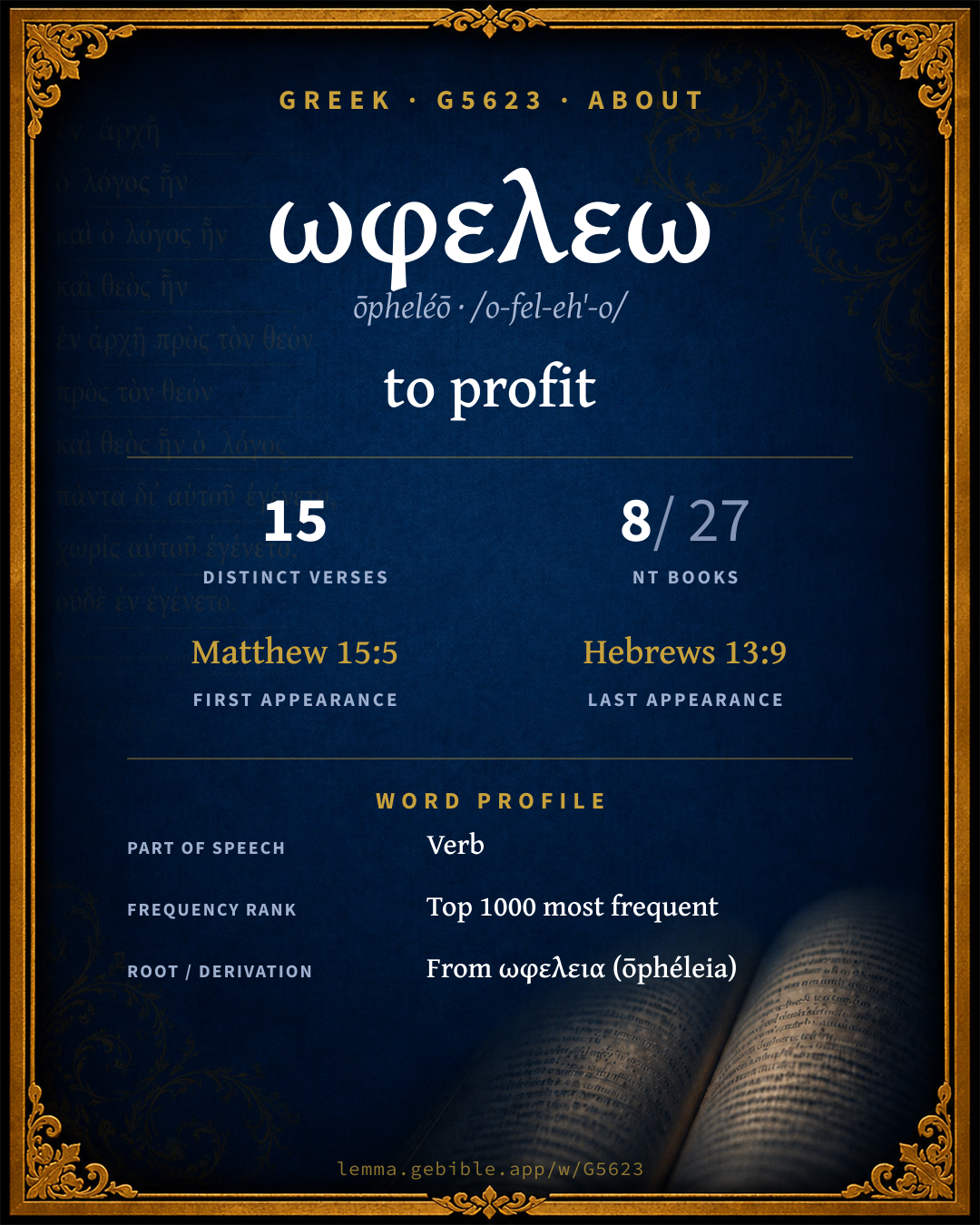
ὠφελέω
to profit
Full lexicon entry — Thayer's Greek Lexicon
From Thayer's Greek Lexicon
Where this word appears
See every Present-tense verb in the Greek New Testament →
Grammar key — what these labels mean
Part of speech
- Verb
- An action or state-of-being word.
Tense
- Present
- Ongoing or general action in present time (imperfective aspect).
- Aorist
- Action viewed as a simple whole, without regard to duration — often past (perfective aspect).
- Future
- Action expected in future time.
Voice
- Active
- The subject performs the action.
- Passive
- The subject receives the action.
Mood
- Indicative
- States a fact or asks a factual question (the mood of reality).
- Subjunctive
- Expresses probability, purpose, or possibility (the mood of contingency).
- Participle
- A verbal adjective (“writing,” “having written”).
Case
- Nominative
- The case of the subject (and the predicate nominative).
Person
- 3rd person
- The one spoken about (“he / she / it / they”).
- 2nd person
- The one addressed (“you”).
- 1st person
- The speaker (“I / we”).
Gender
- Feminine
- Grammatically feminine.
Number
- Singular
- One.
- Plural
- More than one.
Grammatical forms 11 distinct
- Verb, Present, Active, Indicative, 3rd person, Singular 4 times (27%)
- Verb, Aorist, Passive, Subjunctive, 2nd person, Singular 2 times (13%)
- Verb, Aorist, Active, Indicative, 3rd person, Singular 1 time (7%)
- Verb, Aorist, Passive, Indicative, 3rd person, Plural 1 time (7%)
- Verb, Aorist, Passive, Participle, Nominative, Singular, Feminine 1 time (7%)
- Verb, Future, Active, Indicative, 1st person, Singular 1 time (7%)
- Verb, Future, Active, Indicative, 3rd person, Singular 1 time (7%)
- Verb, Future, Passive, Indicative, 3rd person, Singular 1 time (7%)
+3 more forms (3 occurrences)
Parsed forms decoded from the imported morphology (Robinson–Tischendorf, public domain), counted across 15 parsed occurrences — not distinct verses.
Every verse where G5623 appears — 15 distinct verses across 8 books. Click any verse to open its interlinear word-by-word view. Verse text shown in the World English Bible for context — . Each verse’s Greek form is shown with its reference; the English is not keyword-highlighted, since the data carries no word-level English alignment. Use “Compare translations” on any verse to read it across multiple English versions. This concordance covers the Greek New Testament; Septuagint (Greek Old Testament) occurrences of this word are not indexed here.
Matthew 3 verses
- Matthew 15:5 ὠφεληθῇς aor pass subj 2sg But you say, 'Whoever may tell his father or his mother, "Whatever help you might otherwise have gotten from me is a gift devoted to God,"
- Matthew 16:26 ὠφεληθήσεται fut pass ind 3sg For what will it profit a man, if he gains the whole world, and forfeits his life? Or what will a man give in exchange for his life?
- Matthew 27:24 ὠφελεῖ pres act ind 3sg So when Pilate saw that nothing was being gained, but rather that a disturbance was starting, he took water, and washed his hands before the multitude, saying, "I am innocent of the blood of this righteous person. You see to it."
Mark 3 verses
- Mark 5:26 ὠφεληθεῖσα aor pass ptcp nom sg fem and had suffered many things by many physicians, and had spent all that she had, and was no better, but rather grew worse,
- Mark 7:11 ὠφεληθῇς aor pass subj 2sg But you say, 'If a man tells his father or his mother, "Whatever profit you might have received from me is Corban, that is to say, given to God;"'
- Mark 8:36 ὠφελεῖ pres act ind 3sg For what does it profit a man, to gain the whole world, and forfeit his life?
Luke 1 verse
John 2 verses
- John 6:63 ὠφελεῖ pres act ind 3sg It is the spirit who gives life. The flesh profits nothing. The words that I speak to you are spirit, and are life.
- John 12:19 ὠφελεῖτε pres act ind 2pl The Pharisees therefore said among themselves, "See how you accomplish nothing. Behold, the world has gone after him."
Romans 1 verse
1 Corinthians 2 verses
- 1 Corinthians 13:3 ὠφελοῦμαι pres pass ind 1sg If I dole out all my goods to feed the poor, and if I give my body to be burned, but don't have love, it profits me nothing.
- 1 Corinthians 14:6 ὠφελήσω fut act ind 1sg But now, brothers, if I come to you speaking with other languages, what would I profit you, unless I speak to you either by way of revelation, or of knowledge, or of prophesying, or of teaching?
Galatians 1 verse
Hebrews 2 verses
- Hebrews 4:2 ὠφέλησεν aor act ind 3sg For indeed we have had good news preached to us, even as they also did, but the word they heard didn't profit them, because it wasn't mixed with faith by those who heard.
- Hebrews 13:9 ὠφελήθησαν aor pass ind 3pl Don't be carried away by various and strange teachings, for it is good that the heart be established by grace, not by food, through which those who were so occupied were not benefited.
About this entry
At a glance — auto-summarized from this page’s data, not written by a person. Every figure links to its source below. This summary describes the numbers; it doesn’t interpret them.
“to profit” is the headline sense of the Greek verb ωφελεω (ōpheléō). Its earliest occurrence is Matthew 15:5. It turns up in 15 verses across 8 books, an uncommon footprint. See the sense tree, 15-verse concordance, and the renderings breakdown below.
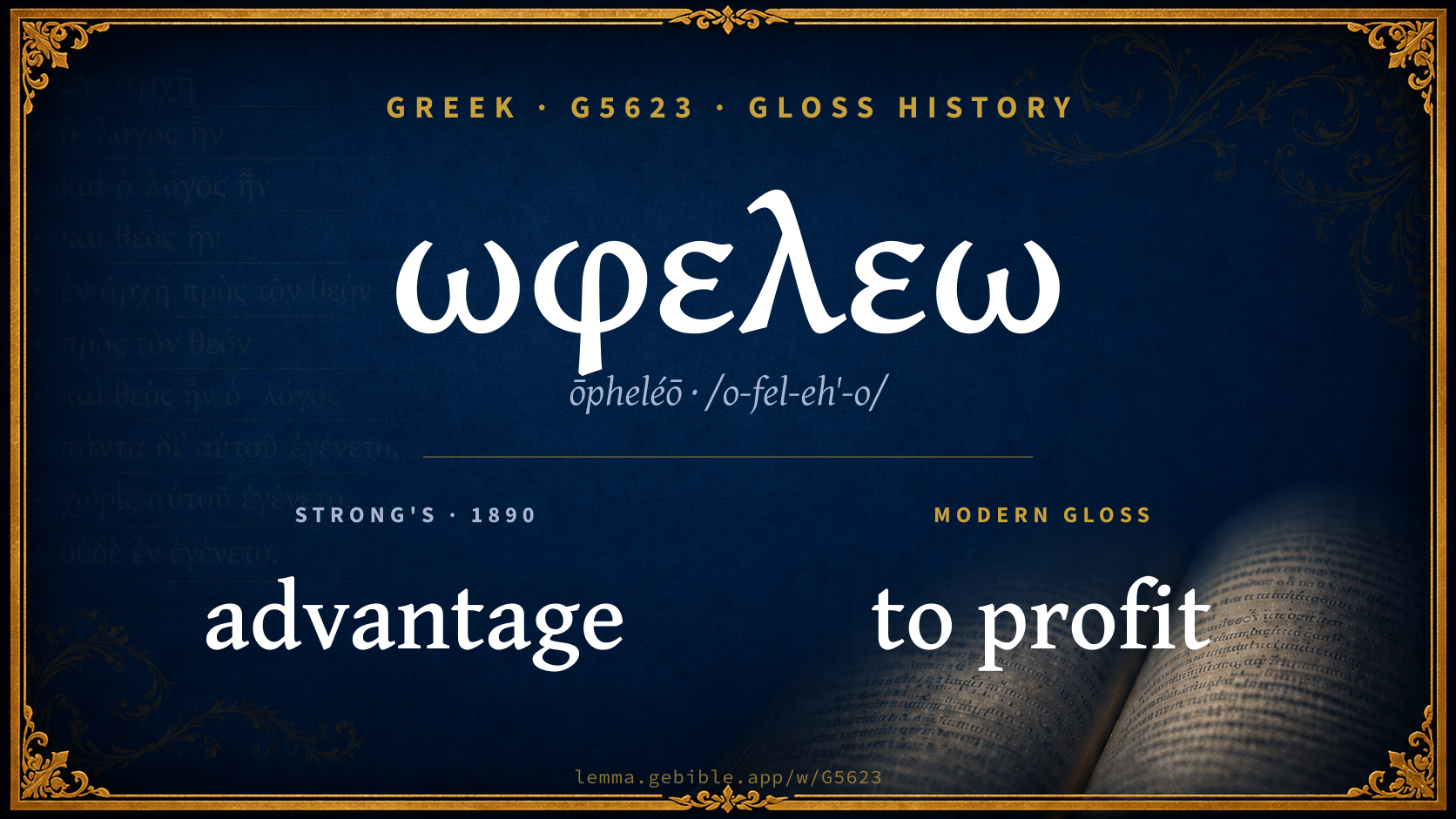
Gloss history
Strong's 1890 vs modern scholarship
About this word
Strong's G5623 catalogs a Greek word from the Greek New Testament.
These counts are not copied from any lexicon or concordance. They are computed here, from the morphology-tagged Greek New Testament. What Lemma adds →
- 15
- distinct verses
- The word appears in 15 distinct verses.
- 8 / 27
- NT books
- The word appears in 8 of 27 New Testament books.
- #768
- by frequency
- Top 1000 most frequent Greek words (rank 768 of 5,347 Greek words by occurrence).
View all 15 occurrences in the concordance →
By section of the New Testament
By traditional corpus
Conventional, traditional groupings — biblical authorship is debated, so this is a traditional corpus grouping, not an authorship claim. Some books belong to more than one corpus (Luke is in both the Gospels and the Lukan corpus, and so on), so these shares overlap and need not total 100%. Each figure is a share of the word’s 15 distinct verses.
- Gospels 9 verses · 60%
- Pauline corpus 4 verses · 27%
- Johannine 2 verses · 13%
- Hebrews 2 verses · 13%
- Lukan (Luke–Acts) 1 verse · 7%
How translations render this word
Counts come from each version’s own published word-to-Strong’s tagging or interlinear alignment — an approximate guide to how each version renders this word, not a word-level alignment the data otherwise carries. Because each total is that version’s own tagged count, the per-version totals vary from one another and need not match the appearance or distinct-verse counts above. These counts may also differ from a printed concordance because Lemma counts each distinctly tagged rendering and does not collapse phrase taggings into a single head-word total. This is a fixed set of word-tagged versions (KJV, ASV, BSB, ULT) and does not change with the reading translation you choose elsewhere. Each version’s license is shown beside its name below (and on Sources).
- King James Version: Profited 2×, Profiteth 2×
- American Standard Version: Profiteth 3×, Profited 2×, Thou mightest have been profited 2×
- Berean Standard Bible: Does it profit 2×, You would have received 2×
- unfoldingWord Literal Text: Benefit 3×, You might have benefited 2×
King James Version Public Domain
Renders G5623 across 19 tagged occurrences — most commonly:
Plus 15 renderings that appear only once — usually multi-word phrases or single function words the recovered tagging swept in, not distinct renderings.
American Standard Version Public Domain
Renders G5623 across 20 tagged occurrences — most commonly:
Plus 13 renderings that appear only once — usually multi-word phrases or single function words the recovered tagging swept in, not distinct renderings.
Berean Standard Bible Public Domain
Renders G5623 across 15 tagged occurrences — most commonly:
Plus 11 renderings that appear only once — usually multi-word phrases or single function words the recovered tagging swept in, not distinct renderings.
unfoldingWord Literal Text CC BY-SA 4.0
Renders G5623 across 19 tagged occurrences — most commonly:
Plus 14 renderings that appear only once — usually multi-word phrases or single function words the recovered tagging swept in, not distinct renderings.
Senses in Thayer's
The 1 sense Thayer's distinguishes for this word, in lexicon order (not ranked by frequency or importance). The full entry — with sub-senses — is in the Lexicon Entry tab.
- to assist, to be useful or advantageous, to profit
Word origin
Derived from ωφελεια (ōphéleia) (G5622) — usefulness.
From the same as G5622 ; to be useful that is to benefit : - advantage better prevail profit.
— Strong’s Exhaustive Concordance (1890), public domain.
Forms in the corpus
The 11 distinct written forms G5623 takes in the Greek New Testament, most frequent first — each parse links to that tense’s occurrences in the concordance.
Septuagint usage
The same Greek word ωφελεω appears 18 times in the Greek Old Testament (Septuagint), across 16 verses in 5 books.
- 18
- LXX occurrences
- Tagged occurrences of this Greek word in the Septuagint.
- 16
- verses
- Distinct Septuagint verses containing this word.
- 5 / 39
- OT books
- The word appears in 5 of the 39 Old Testament books.
Sample Septuagint occurrences
- Psalms 88:23 ὠφελέω
- Proverbs 10:2 ὠφελέω
- Isaiah 30:5 ὠφελέω
- Jeremiah 2:11 ὠφελέω
- Habakkuk 2:18 ὠφελέω
Septuagint occurrences (same lexeme)
Every verse where the same Strong’s number (G5623) appears in the Greek Septuagint. Verse text shown in the World English Bible for context; the Greek form is the matched word — the English is not keyword-highlighted.
- Psalms 88:23 ὠφελέω
- Proverbs 10:2 ὠφελέω Treasures of wickedness profit nothing, But righteousness delivers from death.
- Proverbs 25:13 ὠφελέω As the cold of snow in the time of harvest, So is a faithful messenger to those who send him; For he refreshes the soul of his masters.
- Isaiah 30:5 ὠφελέω They shall all be ashamed because of a people that can't profit them, that are not a help nor profit, but a shame, and also a reproach.
- Isaiah 30:6 ὠφελέω The burden of the animals of the South. Through the land of trouble and anguish, from whence come the lioness and the lion, the viper and fiery flying serpent, they carry their riches on the shoulders of young donkeys, and their treasures on the humps of camels, to a people that shall not profit [them].
- Isaiah 30:7 ὠφελέω For Egypt helps in vain, and to no purpose: therefore have I called her Rahab who sits still.
- Isaiah 44:9 ὠφελέω Those who fashion an engraved image are all of them vanity; and the things that they delight in shall not profit; and their own witnesses don't see, nor know: that they may be disappointed.
- Isaiah 47:12 ὠφελέω Stand now with your enchantments, and with the multitude of your sorceries, in which you have labored from your youth; if so be you shall be able to profit, if so be you may prevail.
- Isaiah 57:12 ὠφελέω I will declare your righteousness; and as for your works, they shall not profit you.
- Jeremiah 2:11 ὠφελέω Has a nation changed [its] gods, which yet are no gods? but my people have changed their glory for that which does not profit.
- Jeremiah 7:4 ὠφελέω Don't you trust in lying words, saying, The temple of Yahweh, the temple of Yahweh, the temple of Yahweh, are these.
- Jeremiah 7:8 ὠφελέω Behold, you trust in lying words, that can't profit.
- Jeremiah 12:13 ὠφελέω They have sown wheat, and have reaped thorns; they have put themselves to pain, and profit nothing: and you shall be ashamed of your fruits, because of the fierce anger of Yahweh.
- Jeremiah 15:10 ὠφελέω Woe is me, my mother, that you have borne me a man of strife and a man of contention to the whole earth! I have not lent, neither have men lent to me; [yet] everyone of them does curse me.
- Jeremiah 23:32 ὠφελέω Behold, I am against those who prophesy lying dreams, says Yahweh, and do tell them, and cause my people to err by their lies, and by their vain boasting: yet I didn't send them, nor commanded them; neither do they profit this people at all, says Yahweh.
- Habakkuk 2:18 ὠφελέω "What value does the engraved image have, that its maker has engraved it; the molten image, even the teacher of lies, that he who fashions its form trusts in it, to make mute idols?
These are occurrences of the same Greek lexeme (G5623) in the Septuagint — not a translation of any one Hebrew word. The store carries no word-level Hebrew↔Greek alignment, so no Hebrew original is asserted here. Counts come from the recovered LXX Strong's tagging — high-frequency vocabulary is well covered, while rare or late forms may be untagged — so they reflect tagged occurrences and may slightly undercount.