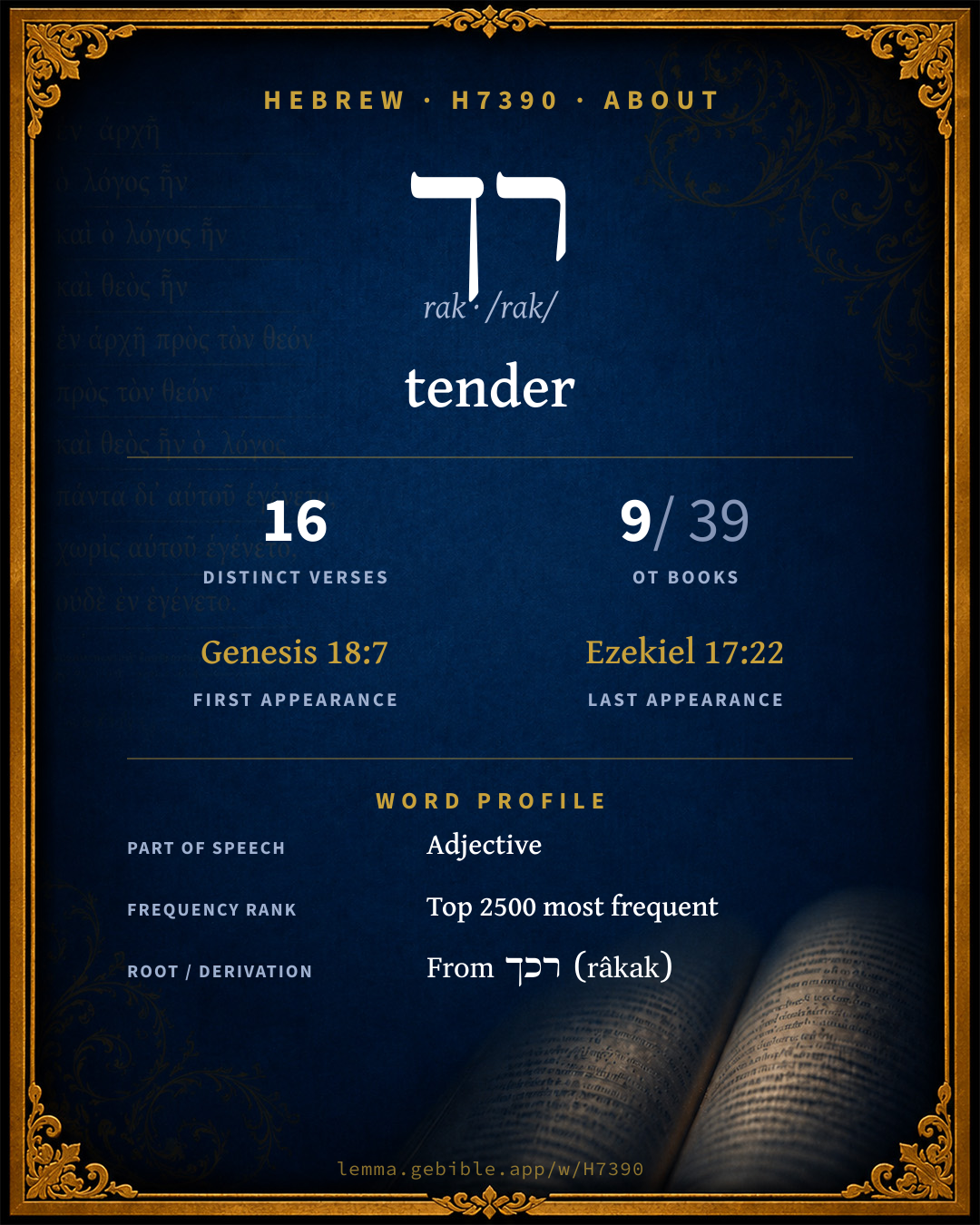
רַךְ
tender
also: soft, delicate, weak fuller range ↓
Full lexicon entry — Brown-Driver-Briggs (BDB)
From Brown-Driver-Briggs (BDB)
Where this word appears
See every Absolute-state word in the Hebrew Bible →
Grammar key — what these labels mean
Part of speech
- Adjective
- A word that describes or qualifies a noun.
State
- Absolute
- The independent form of a noun, not bound to a following word.
- Construct
- A noun bound to a following noun in a possessive / “of” relationship (the construct chain).
Gender
- Masculine
- Grammatically masculine.
- Feminine
- Grammatically feminine.
Number
- Singular
- One.
- Plural
- More than one (in Hebrew, generally three or more).
Grammatical forms
- Adjective, Adjective, Masculine, Singular, Absolute 8 times (50%)
- Adjective, Adjective, Feminine, Singular, Absolute 3 times (19%)
- Adjective, Adjective, Feminine, Plural, Absolute 2 times (13%)
- Adjective, Adjective, Masculine, Singular, Construct 2 times (13%)
- Adjective, Adjective, Masculine, Plural, Absolute 1 time (6%)
Parsed forms decoded from the imported morphology (morphhb / Westminster Leningrad Codex — WLC text public domain, morphhb tagging CC BY 4.0), counted across 16 parsed occurrences — not distinct verses.
Every verse where H7390 appears — 16 distinct verses across 9 books. Click any verse to open its interlinear word-by-word view. Verse text shown in the World English Bible for context — . Each verse’s Hebrew form is shown with its reference; the English is not keyword-highlighted, since the data carries no word-level English alignment. Use “Compare translations” on any verse to read it across multiple English versions. This concordance covers the Hebrew Bible; Septuagint (Greek Old Testament) occurrences are not indexed here.
Genesis 3 verses
- Genesis 18:7 רַ֤ךְ adj Adjective ms Abraham ran to the herd, and fetched a tender and good calf, and gave it to the servant. He hurried to dress it.
- Genesis 29:17 רַכּ֑וֹת adj Adjective fp Leah's eyes were weak, but Rachel was beautiful and well favored.
- Genesis 33:13 רַכִּ֔ים adj Adjective mp Jacob said to him, "My lord knows that the children are tender, and that the flocks and herds with me have their young, and if they overdrive them one day, all the flocks will die.
Deuteronomy 3 verses
- Deuteronomy 20:8 וְ/רַ֣ךְ conj + Adjective Adjective ms cs The officers shall speak further to the people, and they shall say, What man is there who is fearful and faint-hearted? let him go and return to his house, lest his brother's heart melt as his heart.
- Deuteronomy 28:54 הָ/רַ֣ךְ ptcl def.art + Adjective Adjective ms The man who is tender among you, and very delicate, his eye shall be evil toward his brother, and toward the wife of his bosom, and toward the remnant of his children whom he has remaining;
- Deuteronomy 28:56 הָ/רַכָּ֨ה ptcl def.art + Adjective Adjective fs The tender and delicate woman among you, who would not adventure to set the sole of her foot on the ground for delicateness and tenderness, her eye shall be evil toward the husband of her bosom, and toward her son, and toward her daughter,
2 Samuel 1 verse
1 Chronicles 2 verses
- 1 Chronicles 22:5 וָ/רָךְ֒ conj + Adjective Adjective ms David said, Solomon my son is young and tender, and the house that is to be built for Yahweh must be exceedingly magnificent, of fame and of glory throughout all countries: I will therefore make preparation for it. So David prepared abundantly before his death.
- 1 Chronicles 29:1 וָ/רָ֑ךְ conj + Adjective Adjective ms David the king said to all the assembly, Solomon my son, whom alone God has chosen, is yet young and tender, and the work is great; for the palace is not for man, but for Yahweh God.
2 Chronicles 1 verse
Job 1 verse
Proverbs 3 verses
- Proverbs 4:3 רַ֥ךְ adj Adjective ms For I was a son to my father, Tender and an only child in the sight of my mother.
- Proverbs 15:1 רַּ֭ךְ adj Adjective ms A gentle answer turns away wrath, But a harsh word stirs up anger.
- Proverbs 25:15 רַ֝כָּ֗ה adj Adjective fs By patience a ruler is persuaded. A soft tongue breaks the bone.
Isaiah 1 verse
Ezekiel 1 verse
About this entry
At a glance — auto-summarized from this page’s data, not written by a person. Every figure links to its source below. This summary describes the numbers; it doesn’t interpret them.
“tender” is the headline sense of the Hebrew adjective רך (rak). Not a single-sense word: its full sense range also takes in “soft”, “delicate”, and “weak”. The Hebrew Bible uses it across 16 verses — uncommon. First canonically at Genesis 18:7, it enters the text early. It shares a root with רכך, מרך and רך. The sections below give every sense, occurrence, and version rendering.
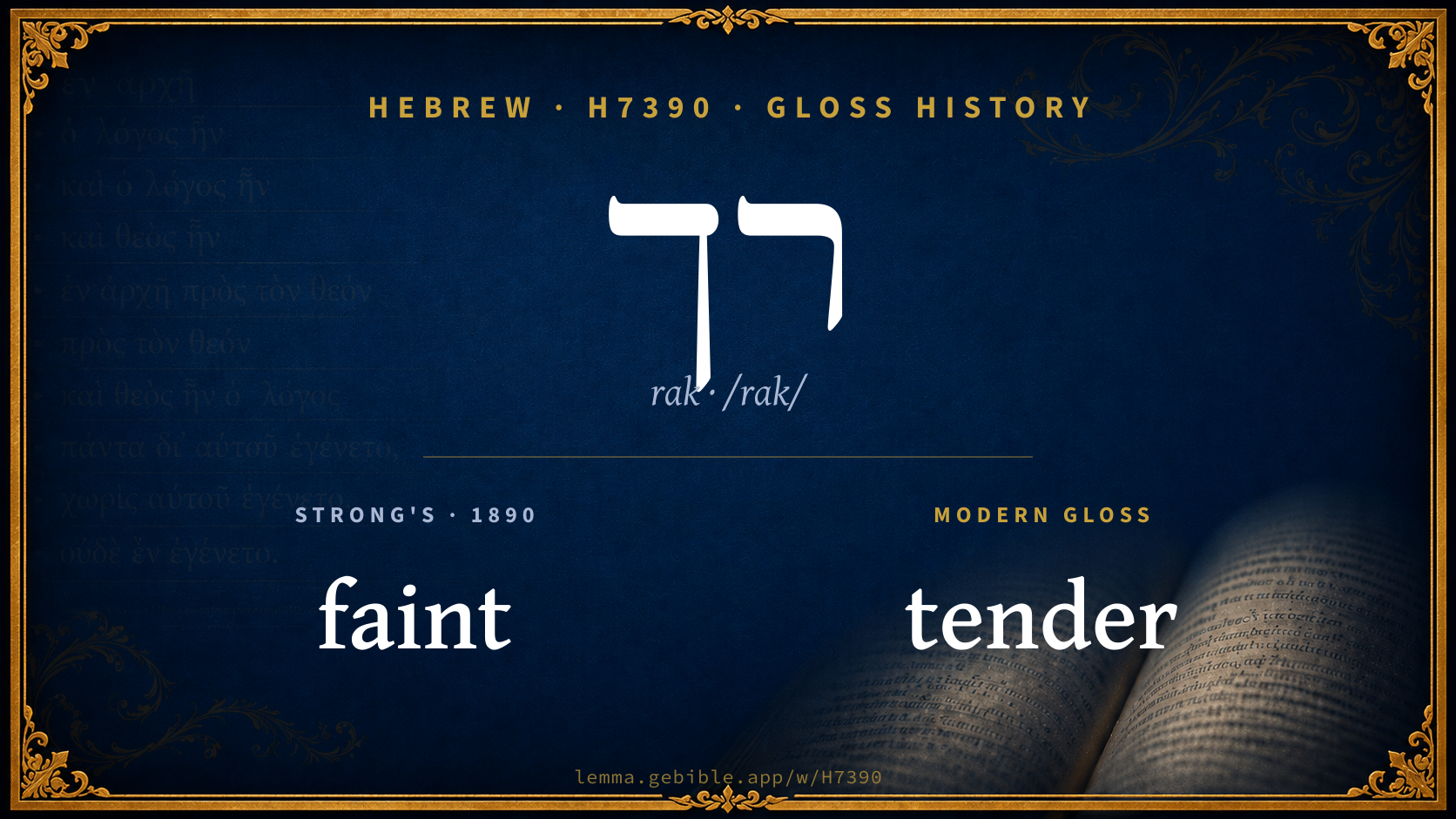
Gloss history
Strong's 1890 vs modern scholarship
About this word
Strong's H7390 catalogs a Hebrew word from the Hebrew Old Testament.
These counts are not copied from any lexicon or concordance. They are computed here, from the morphology-tagged Hebrew Old Testament. What Lemma adds →
- 16
- distinct verses
- The word appears in 16 distinct verses.
- 9 / 39
- OT books
- The word appears in 9 of 39 Old Testament books.
- #1,752
- by frequency
- Top 2500 most frequent Hebrew words (rank 1,752 of 8,640 Hebrew words by occurrence).
View all 16 occurrences in the concordance →
Most concentrated in
- Genesis 3 verses 19%
- Deuteronomy 3 verses 19%
- Proverbs 3 verses 19%
By section of the Old Testament
By traditional corpus
Conventional, traditional groupings — biblical authorship is debated, so this is a traditional corpus grouping, not an authorship claim. Each share is this word’s portion of its verses in that division of the Hebrew canon. Each figure is a share of the word’s 16 distinct verses.
- Writings (Ketuvim) 7 verses · 44%
- Torah (Pentateuch) 6 verses · 38%
- Prophets (Nevi'im) 3 verses · 19%
How translations render this word
Counts come from each version’s own published word-to-Strong’s tagging or interlinear alignment — an approximate guide to how each version renders this word, not a word-level alignment the data otherwise carries. Because each total is that version’s own tagged count, the per-version totals vary from one another and need not match the appearance or distinct-verse counts above. These counts may also differ from a printed concordance because Lemma counts each distinctly tagged rendering and does not collapse phrase taggings into a single head-word total. This is a fixed set of word-tagged versions (KJV, ASV, BSB, ULT) and does not change with the reading translation you choose elsewhere. Each version’s license is shown beside its name below (and on Sources).
- King James Version: Tender 6×, Soft 3×
- American Standard Version: Tender 6×, Soft 2×
- Berean Standard Bible: Gentle 3×, Inexperienced 3×, Tender 3×
- unfoldingWord Literal Text: Tender 9×
King James Version Public Domain
Renders H7390 across 16 tagged occurrences — most commonly:
Plus 7 renderings that appear only once — usually multi-word phrases or single function words the recovered tagging swept in, not distinct renderings.
American Standard Version Public Domain
Renders H7390 across 16 tagged occurrences — most commonly:
Plus 8 renderings that appear only once — usually multi-word phrases or single function words the recovered tagging swept in, not distinct renderings.
Berean Standard Bible Public Domain
Renders H7390 across 16 tagged occurrences — most commonly:
Plus 7 renderings that appear only once — usually multi-word phrases or single function words the recovered tagging swept in, not distinct renderings.
unfoldingWord Literal Text CC BY-SA 4.0
Renders H7390 across 18 tagged occurrences — most commonly:
Plus 9 renderings that appear only once — usually multi-word phrases or single function words the recovered tagging swept in, not distinct renderings.
Senses in the full BDB
What do BDB’s symbols mean?
BDB uses these scholarly abbreviations:
| Symbol | Meaning |
|---|---|
| 𝔊 | the Septuagint (the ancient Greek translation, LXX) |
| 𝔙 | the Vulgate (the Latin translation) |
| 𝔖 | the Syriac version (the Peshitta) |
| 𝔗 | the Targum (the Aramaic translation) |
| ψ | the Psalms |
| √ | root (the underlying root or stem) |
| ‖ | parallel passage (a synonymous or contrasted parallel) |
| † | the dagger: every passage where the word occurs is cited |
The 3 senses and sub-senses the full Brown-Driver-Briggs lexicon distinguishes for this word, in lexicon order (not ranked by frequency), with BDB’s own verbatim wording and sub-sense lettering. Shown in Hebrew script with BDB’s own scholarly abbreviations. The condensed entry is in the Lexicon Entry tab. See also the Forms in the corpus table below.
- 1. tender of flesh Gn 18:7 (J; בֶּן־בָּקָר); tender, delicate, especially in body, of children 33:13 (J), cf. (implying weakness of undeveloped character) 2 S 3:39, נַעַר וָרָ֑ךְ 1 Ch 22:5; 29:1, (וְיָחִיד) רַךְ Pr 4:3 (‘of tender age,’ Toy, q.v.); of man (+ עָנֹג; i.e. delicately nurtured) Dt 28:54, so of woman v 56 (+ עֲנֻגָּה), so, fig. of Bab., Is 47:1 (+ id.); רַךְ as subst. = tender (twig) Ez 17:22 (in fig.); delicate, weak, of eyes Gn 29:17 (E). e.g. Genesis 18:7
- 2. רַךְ (ה)לֵבָב weak of heart, timid, Dt 20:8 (+ יָרֵא), 2 Ch 13:7 (נַעַר). e.g. Deuteronomy 20:8
- 3. soft, of words, abs. רַכּוֹת Jb 40:27 = subst., mild, gentle words (‖ תַּחֲנוּנִים); מַעֲנֶה רַךְ Pr 15:1 (opp. דְּבַר עֶצֶב), לָשׁוֹן רַכָּה 25:15. e.g. Job 40:27
Senses from the full Brown-Driver-Briggs lexicon (Brown, Driver, Briggs; Oxford 1906 — public domain), digitized via Sefaria, supplemented by the OpenScriptures HebrewLexicon (CC BY 4.0). Full attribution on Sources.
Word origin
adj. tender, delicate, soft;—ר׳ abs. Gn 18:7 +, cstr. Dt 20:8; 2 Ch 13:7; fs. רַכָּה Dt 28:56 +; mpl. רַכִּים Gn 33:13; fpl. abs. רַכּוֹת 29:17 Jb 40:27;—
— Brown-Driver-Briggs (Oxford 1906, public domain), digitized via Sefaria, supplemented by the OpenScriptures HebrewLexicon (CC BY 4.0). See Sources.
Derived from רכך (râkak) (H7401) — to be weak.
Jastrow Dictionary
A second Hebrew/Aramaic lexicon for comparison, covering Aramaic and post-biblical (Talmudic, Targumic, Midrashic) usage that the biblical-Hebrew BDB does not. Matched by lemma rather than by Strong’s number, so a lemma may carry more than one Jastrow headword (shown separately below), and the entries cover usage well beyond the Bible.
רַךְ I
- to be soft, v. רְכַךְ.
רַךְ II
- soft, tender. Men. 66ᵇ, a. e. רך (ו)מל, v. כַּרְמֶל. Ex. R. s. 1, a. e. (play on פרך, Ex. I, 13) בפה רך with soft (persuasive) speech. Gen. R. s. 90 (expl. א̇ב̇ר̇ך̇, Gen. XLI, 43) א̇ב̇ … ור̇ך̇ בשנים a father in wisdom, but tender of years. Keth. 46ᵃ (ref. to רכיל, Lev. XIX, 16) שלא יהא רך לזה וקשה לזה that the court should not be soft (lenient) to one and hard to another; Sifra K’dosh. Par. 2, ch. IV שלא תהיה רך דברים וכ׳ that thou be not soft of speech &c.; a. fr.—Pl. רַכִּים, רַכִּין Tosef. Shebi. II, 11; a. fr.—Fem. רַכָּה; pl. רַכּוֹת. Gen. R. s. 70 (ref. to Gen. XXIX, 17) ר׳ מבכיה her eyes had grown tender (sore) from weeping, v. רַכִּיךְ. e.g. Exodus 1:13
A Dictionary of the Targumim, the Talmud Babli and Yerushalmi, and the Midrashic Literature (Marcus Jastrow; London, Luzac, 1903) — Public Domain. Digitized via Sefaria. Digitized via Sefaria. Full attribution on Sources.
Forms in the corpus
The 16 distinct written forms H7390 takes in the Hebrew Bible, most frequent first — each parse links to that state’s occurrences in the concordance. Hebrew forms include their vowel points and cantillation, so a single lemma takes many written forms.
Same root — word family
Other BDB entries built from the same root as H7390, grouped by Strong’s listed origin. These share a root / origin per the lexicon — not necessarily a shared meaning. Each links to that word’s own entry.
Derives from
Shares the same root
Proper names from this root
People and places named from this root — a name, not an additional meaning of the word.
Compare all same-root words → Showing 4 of 5 — not the complete family. 1 of the same-root words is a proper name (a person or place). They share a root, not necessarily a meaning.
Septuagint verse parallels
This word appears in 16 verses that also exist in the Greek Old Testament (Septuagint), out of the 16 Hebrew verses it occurs in. You can read those verses in Greek by switching the Old Testament edition to the Septuagint.
Read these verses in the Septuagint
- Genesis 18:7
- Deuteronomy 20:8
- 2 Samuel 3:39
- 1 Chronicles 22:5
- 2 Chronicles 13:7
- Job 41:3
- Proverbs 4:3
- Isaiah 47:1
- Ezekiel 17:22
This is a verse-level parallel only — the same verses exist in both the Hebrew and Greek Old Testaments. No word-level Hebrew↔Greek correspondence is claimed: the data carries no such alignment, so no Greek word is shown as this Hebrew word’s translation. Coverage is not total — the Septuagint omits the deuterocanon and renumbers the Psalms, so some Hebrew verses have no direct Greek parallel.