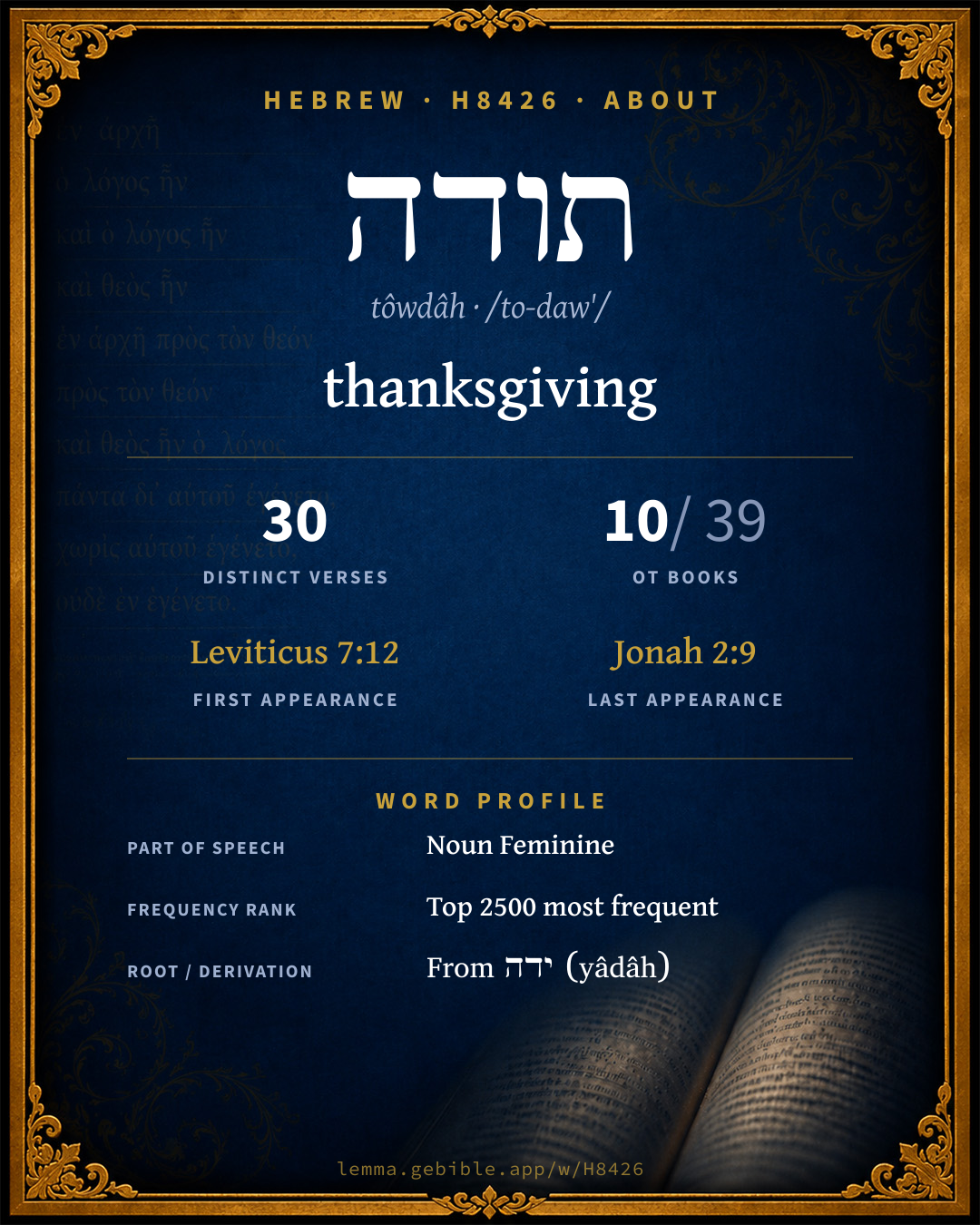
תּוֹדָה
thanksgiving
also: confession, praise fuller range ↓
Full lexicon entry — Brown-Driver-Briggs (BDB)
From Brown-Driver-Briggs (BDB)
Where this word appears
Grammar key — what these labels mean
Part of speech
- Noun
- A naming word — a person, place, thing, or idea.
Noun type
- Common
- A common noun — a general class of person, place, or thing (“king,” “city,” “water”), not a specific name.
State
- Absolute
- The independent form of a noun, not bound to a following word.
- Construct
- A noun bound to a following noun in a possessive / “of” relationship (the construct chain).
Gender
- Feminine
- Grammatically feminine.
Number
- Singular
- One.
- Plural
- More than one (in Hebrew, generally three or more).
Every verse where H8426 appears in the Book of Jeremiah — 3 distinct verses. Click any verse to open its interlinear word-by-word view. Verse text shown in the World English Bible for context — . Each verse’s Hebrew form is shown with its reference; the English is not keyword-highlighted, since the data carries no word-level English alignment. Use “Compare translations” on any verse to read it across multiple English versions. This concordance covers the Hebrew Bible; Septuagint (Greek Old Testament) occurrences are not indexed here.
Jeremiah
- Jeremiah 17:26 תוֹדָ֖ה n c fs They shall come from the cities of Judah, and from the places round about Jerusalem, and from the land of Benjamin, and from the lowland, and from the hill-country, and from the South, bringing burnt offerings, and sacrifices, and meal-offerings, and frankincense, and bringing [sacrifices of] thanksgiving, to the house of Yahweh.
- Jeremiah 30:19 תּוֹדָ֖ה n c fs Out of them shall proceed thanksgiving and the voice of those who make merry: and I will multiply them, and they shall not be few; I will also glorify them, and they shall not be small.
- Jeremiah 33:11 תּוֹדָ֖ה n c fs the voice of joy and the voice of gladness, the voice of the bridegroom and the voice of the bride, the voice of those who say, Give thanks to Yahweh of Hosts, for Yahweh is good, for his loving kindness endures forever; [and of them] who bring [sacrifices of] thanksgiving into the house of Yahweh. For I will cause the captivity of the land to return as at the first, says Yahweh.
About this entry
At a glance — auto-summarized from this page’s data, not written by a person. Every figure links to its source below. This summary describes the numbers; it doesn’t interpret them.
The Hebrew noun תודה centers on the idea of “thanksgiving.” Beyond “thanksgiving” it also covers “confession” and “praise” — see its full sense range. The Hebrew Bible uses it across 30 verses — moderately common. Psalms dominates its distribution — 12 of 30 verses. First canonically at Leviticus 7:12, it enters the text early. For the data behind this summary, explore the sense tree and the renderings breakdown below.
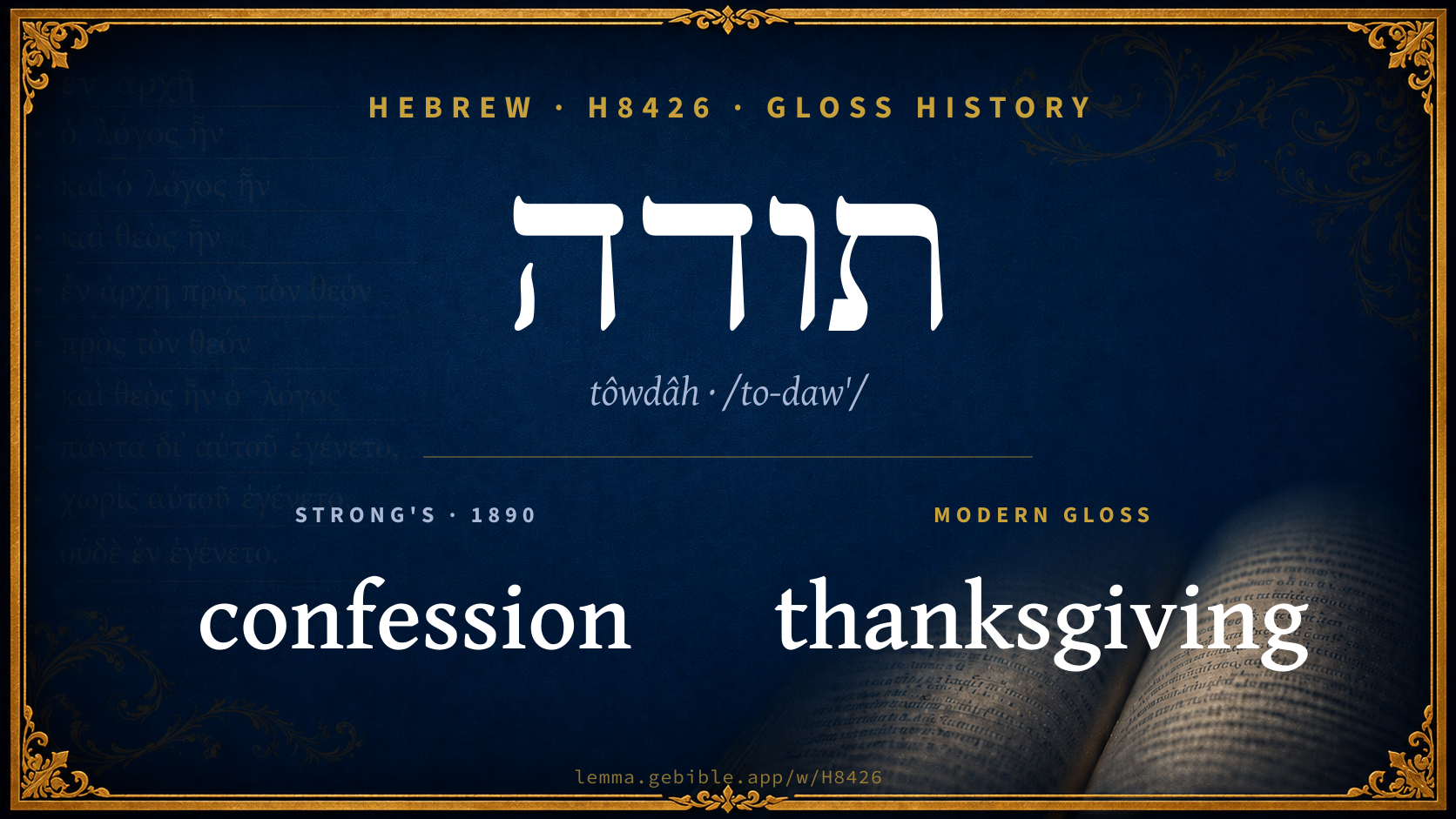
Gloss history
Strong's 1890 vs modern scholarship
About this word
Strong's H8426 catalogs a Hebrew word from the Hebrew Old Testament.
These counts are not copied from any lexicon or concordance. They are computed here, from the morphology-tagged Hebrew Old Testament. What Lemma adds →
- 30
- distinct verses
- The word appears in 30 distinct verses.
- 10 / 39
- OT books
- The word appears in 10 of 39 Old Testament books.
- #1,086
- by frequency
- Top 2500 most frequent Hebrew words (rank 1,086 of 8,640 Hebrew words by occurrence).
View all 30 occurrences in the concordance →
By section of the Old Testament
By traditional corpus
Conventional, traditional groupings — biblical authorship is debated, so this is a traditional corpus grouping, not an authorship claim. Each share is this word’s portion of its verses in that division of the Hebrew canon. Each figure is a share of the word’s 30 distinct verses.
- Writings (Ketuvim) 19 verses · 63%
- Prophets (Nevi'im) 7 verses · 23%
- Torah (Pentateuch) 4 verses · 13%
How translations render this word
Counts come from each version’s own published word-to-Strong’s tagging or interlinear alignment — an approximate guide to how each version renders this word, not a word-level alignment the data otherwise carries. Because each total is that version’s own tagged count, the per-version totals vary from one another and need not match the appearance or distinct-verse counts above. These counts may also differ from a printed concordance because Lemma counts each distinctly tagged rendering and does not collapse phrase taggings into a single head-word total. This is a fixed set of word-tagged versions (KJV, ASV, BSB, ULT) and does not change with the reading translation you choose elsewhere. Each version’s license is shown beside its name below (and on Sources).
- King James Version: Thanksgiving 15×, Praise 3×, Thank offerings 3×
- American Standard Version: Thanksgiving 14×, Sacrifice of thanksgiving 3×, Thank-offerings 3×
- Berean Standard Bible: Thanksgiving 19×, Thank offerings 5×, Thank offering 3×
- unfoldingWord Literal Text: Thanksgiving 13×, Thank offering 3×, Thanksgivings 3×
King James Version Public Domain
Renders H8426 across 32 tagged occurrences — most commonly:
Plus 7 renderings that appear only once — usually multi-word phrases or single function words the recovered tagging swept in, not distinct renderings.
American Standard Version Public Domain
Renders H8426 across 30 tagged occurrences — most commonly:
Plus 6 renderings that appear only once — usually multi-word phrases or single function words the recovered tagging swept in, not distinct renderings.
Berean Standard Bible Public Domain
Renders H8426 across 32 tagged occurrences — most commonly:
Plus 1 rendering that appears only once — usually multi-word phrases or single function words the recovered tagging swept in, not distinct renderings.
unfoldingWord Literal Text CC BY-SA 4.0
Renders H8426 across 32 tagged occurrences — most commonly:
Plus 5 renderings that appear only once — usually multi-word phrases or single function words the recovered tagging swept in, not distinct renderings.
Senses in the full BDB
What do BDB’s symbols mean?
BDB uses these scholarly abbreviations:
| Symbol | Meaning |
|---|---|
| 𝔊 | the Septuagint (the ancient Greek translation, LXX) |
| 𝔙 | the Vulgate (the Latin translation) |
| 𝔖 | the Syriac version (the Peshitta) |
| 𝔗 | the Targum (the Aramaic translation) |
| ψ | the Psalms |
| √ | root (the underlying root or stem) |
| ‖ | parallel passage (a synonymous or contrasted parallel) |
| † | the dagger: every passage where the word occurs is cited |
The 4 senses and sub-senses the full Brown-Driver-Briggs lexicon distinguishes for this word, in lexicon order (not ranked by frequency), with BDB’s own verbatim wording and sub-sense lettering. Shown in Hebrew script with BDB’s own scholarly abbreviations. The condensed entry is in the Lexicon Entry tab. See also the Forms in the corpus table below.
- 1. give praise to י׳ Jos 7:19 (JE; ‖ שִׂים כָּבוֹד לְ׳), Ezr 10:11, in both of praise rendered by acknowledging and abandoning sin; v. Di on Jos, and on Ezr. Öt and especially Ryle; cf. vb. ידה c. לְ; so RVm; > Thes MV SS Be RV al. confession. e.g. Joshua 7:19
- 2. thanksgiving in songs of liturgical worship קול ת׳ ψ 26:7; 42:5; Jon 2:10; ‖ שִׁיר ψ 69:31 Ne 12:27; ‖ זְמִרוֹת ψ 95:2; ‖ קוֹל זִמְרָה Is 51:3; ‖ תְּהִלָּה ψ 100:4; ‖ כִּנּוֹר 147:7. e.g. Psalms 26:7
- 3. thanksgiving choir, procession, line, company Ne 12:31, 38, 40, prob. also Je 30:19 (‖ קוֹל מְשַׂחֲקִים). e.g. Nehemiah 12:31
- 4. thank-offering קטּר ת׳ Am 4:5 (‖ נְדָבוֹת); a division of זֶבַח הַשְּׁלָמִים Lv 7:12a; זבח ת׳ שׁלמיו v 13, 15; זבח (ה)ת׳ v 12b (all P), 22:29 (H); זבחים ותודות 2 Ch 29:31(×2); זבחי שְׁלָמִים ות׳ 33:16; ת׳ זבח זבח(י) ψ 107:22; 116:17; מבאי(ם) ת׳ Je 17:26; 33:11; לתודה ψ 100:1 (title); in ψψ ‖ נדרים: זָבַח ת׳ offer a thank-offering 50:14, 23 (see BrMP 239); שׁלּם ת׳ 56:13. e.g. Amos 4:5
Senses from the full Brown-Driver-Briggs lexicon (Brown, Driver, Briggs; Oxford 1906 — public domain), digitized via Sefaria, supplemented by the OpenScriptures HebrewLexicon (CC BY 4.0). Full attribution on Sources.
Word origin
n.f. thanksgiving, תּ׳ Lv 7:12 + 23 times; cstr. תּוֹדַת Lv 7:13, 15; pl. תּוֹדוֹת ψ 56:13 + 3 times; תּוֹדֹת Ne 12:31, 40;—
— Brown-Driver-Briggs (Oxford 1906, public domain), digitized via Sefaria, supplemented by the OpenScriptures HebrewLexicon (CC BY 4.0). See Sources.
Derived from ידה (yâdâh) (H3034) — to throw.
Jastrow Dictionary
A second Hebrew/Aramaic lexicon for comparison, covering Aramaic and post-biblical (Talmudic, Targumic, Midrashic) usage that the biblical-Hebrew BDB does not. Matched by lemma rather than by Strong’s number, so a lemma may carry more than one Jastrow headword (shown separately below), and the entries cover usage well beyond the Bible.
תּוֹדָה I
- thanksgiving, (sub. קרבן) thank-offering. Ber. 6ᵇ כאילו הקריב ת׳ as if he had offered a thank-offering. Shebu. 15ᵇ שיר של ת׳ וכ׳ the song of thank-giving (in the Temple) was accompanied by citterns &c. Lev. R. s. 9 חטאת … ת׳ אינה באה על חטא the sin-offering is brought for a sin …, but not so the thank-offering. Ib. לעתיד … וקרבן ת׳ וכ׳ in future all sacrifices will cease, but the thank-offering shall never cease. Zeb. V, 6. Men. II, 3. Ib. VII, 1; a. fr.—Pl. תּוֹדוֹת. Ib. 80ᵃ מרבה בת׳ הוא he had the intention of bringing several thank-offerings. Lev. R. l. c.; a. e.
תּוֹדָה II
- Todah (an adaptation of תַּדַּאי, Thaddæus, for the sake of paronomasia), one of the disciples of Jesus. Snh. 43ᵃ (missing in later editions) חמשה … ות׳ Jesus had five disciples; Matthew, … and T. Ib. אתיוה לת׳ אמר ת׳ יהרג וכ׳ they brought up T., and he said, shall T. be put to death? is it not written (Ps. C, 1), a song of T.? Said they to him אין ת׳ יהרג וכ׳ yes, T. shall be slain, for it is written (Ps. L, 23), he who sacrifices T. honoreth me. e.g. Psalms 100:1
A Dictionary of the Targumim, the Talmud Babli and Yerushalmi, and the Midrashic Literature (Marcus Jastrow; London, Luzac, 1903) — Public Domain. Digitized via Sefaria. Digitized via Sefaria. Full attribution on Sources.
Forms in the corpus
The 25 distinct written forms H8426 takes in the Hebrew Bible, most frequent first — each parse links to that state’s occurrences in the concordance. Hebrew forms include their vowel points and cantillation, so a single lemma takes many written forms.
Same root — word family
Other BDB entries built from the same root as H8426, grouped by Strong’s listed origin. These share a root / origin per the lexicon — not necessarily a shared meaning. Each links to that word’s own entry.
Derives from
Shares the same root
Proper names from this root
People and places named from this root — a name, not an additional meaning of the word.
- ידו Yiddôw H3035 Iddo
- ידון Yâdôwn H3036 Jadon
- ידותון Yᵉdûwthûwn H3038 Jeduthun
- ידיה Yᵉdâyâh H3042 Jedaiah
- יהודה Yᵉhûwdâh H3063 Judah
Compare all same-root words → Showing 4 of 9 — not the complete family. 5 of the same-root words are proper names (people or places). They share a root, not necessarily a meaning.
Septuagint verse parallels
This word appears in 22 verses that also exist in the Greek Old Testament (Septuagint), out of the 30 Hebrew verses it occurs in. You can read those verses in Greek by switching the Old Testament edition to the Septuagint.
Read these verses in the Septuagint
- Leviticus 7:12
- Joshua 7:19
- 2 Chronicles 29:31
- Ezra 10:11
- Psalms 26:7
- Isaiah 51:3
- Jeremiah 17:26
- Amos 4:5
- Jonah 2:9
This is a verse-level parallel only — the same verses exist in both the Hebrew and Greek Old Testaments. No word-level Hebrew↔Greek correspondence is claimed: the data carries no such alignment, so no Greek word is shown as this Hebrew word’s translation. Coverage is not total — the Septuagint omits the deuterocanon and renumbers the Psalms, so some Hebrew verses have no direct Greek parallel.