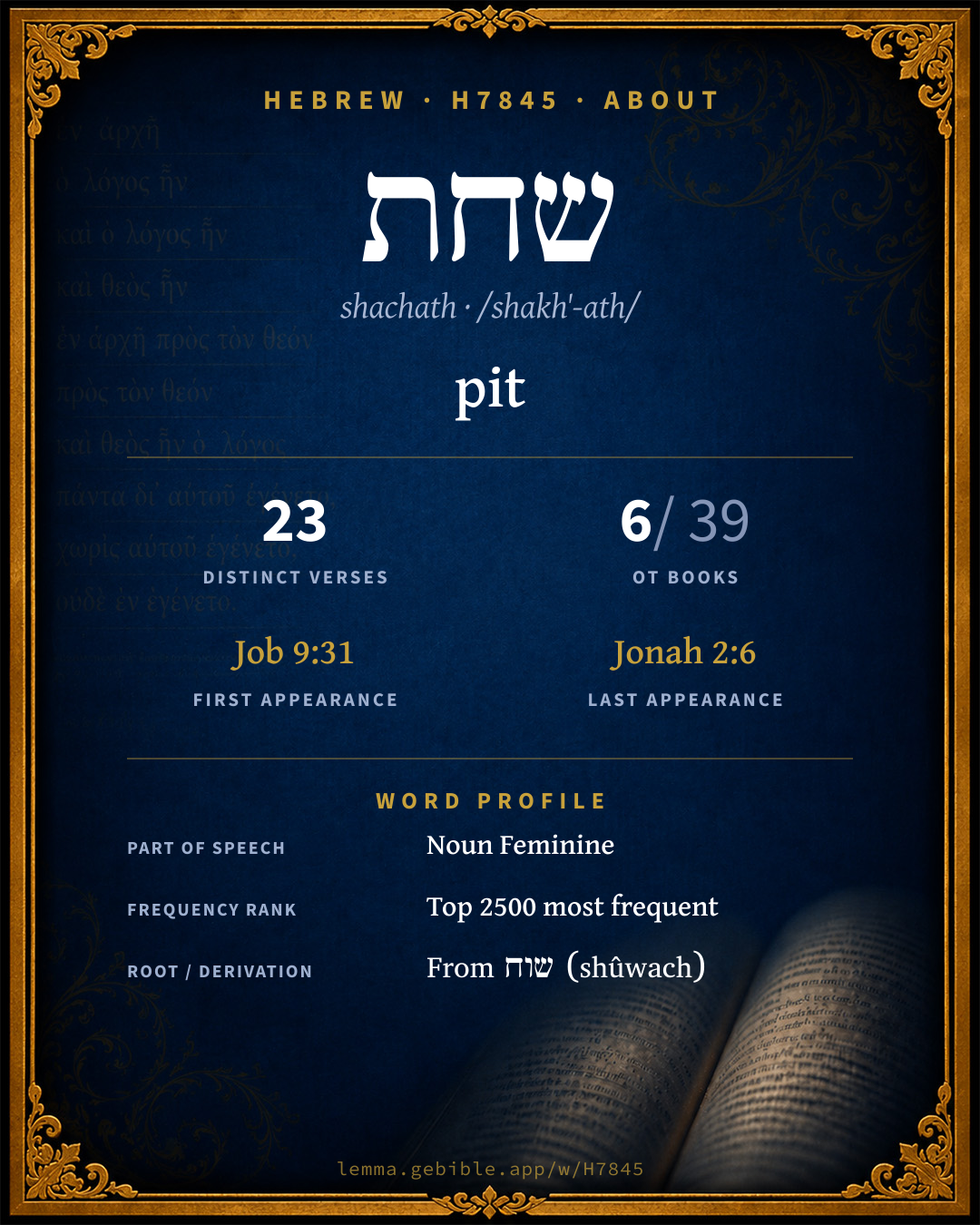
שַׁ֫חַת
pit
also: destruction, grave fuller range ↓
Full lexicon entry — Brown-Driver-Briggs (BDB)
From Brown-Driver-Briggs (BDB)
Where this word appears
Grammar key — what these labels mean
Part of speech
- Noun
- A naming word — a person, place, thing, or idea.
Noun type
- Common
- A common noun — a general class of person, place, or thing (“king,” “city,” “water”), not a specific name.
State
- Absolute
- The independent form of a noun, not bound to a following word.
- Construct
- A noun bound to a following noun in a possessive / “of” relationship (the construct chain).
Gender
- Feminine
- Grammatically feminine.
Number
- Singular
- One.
Every verse where H7845 appears in the Book of Jonah — 1 distinct verse. Click any verse to open its interlinear word-by-word view. Verse text shown in the World English Bible for context — . Each verse’s Hebrew form is shown with its reference; the English is not keyword-highlighted, since the data carries no word-level English alignment. Use “Compare translations” on any verse to read it across multiple English versions. This concordance covers the Hebrew Bible; Septuagint (Greek Old Testament) occurrences are not indexed here.
Jonah
About this entry
At a glance — auto-summarized from this page’s data, not written by a person. Every figure links to its source below. This summary describes the numbers; it doesn’t interpret them.
שחת — transliterated shachath — is a Hebrew noun carrying the sense “pit.” Debuting at Job 9:31, it then recurs through the corpus. Spanning 23 verses in 6 books, it ranks among the uncommon words of the Hebrew Bible. Its uses concentrate in Psalms (39% of all occurrences). It also covers “destruction” and “grave”, alongside “pit” — see its full sense range. See the sense tree, 23-verse concordance, and the renderings breakdown below.
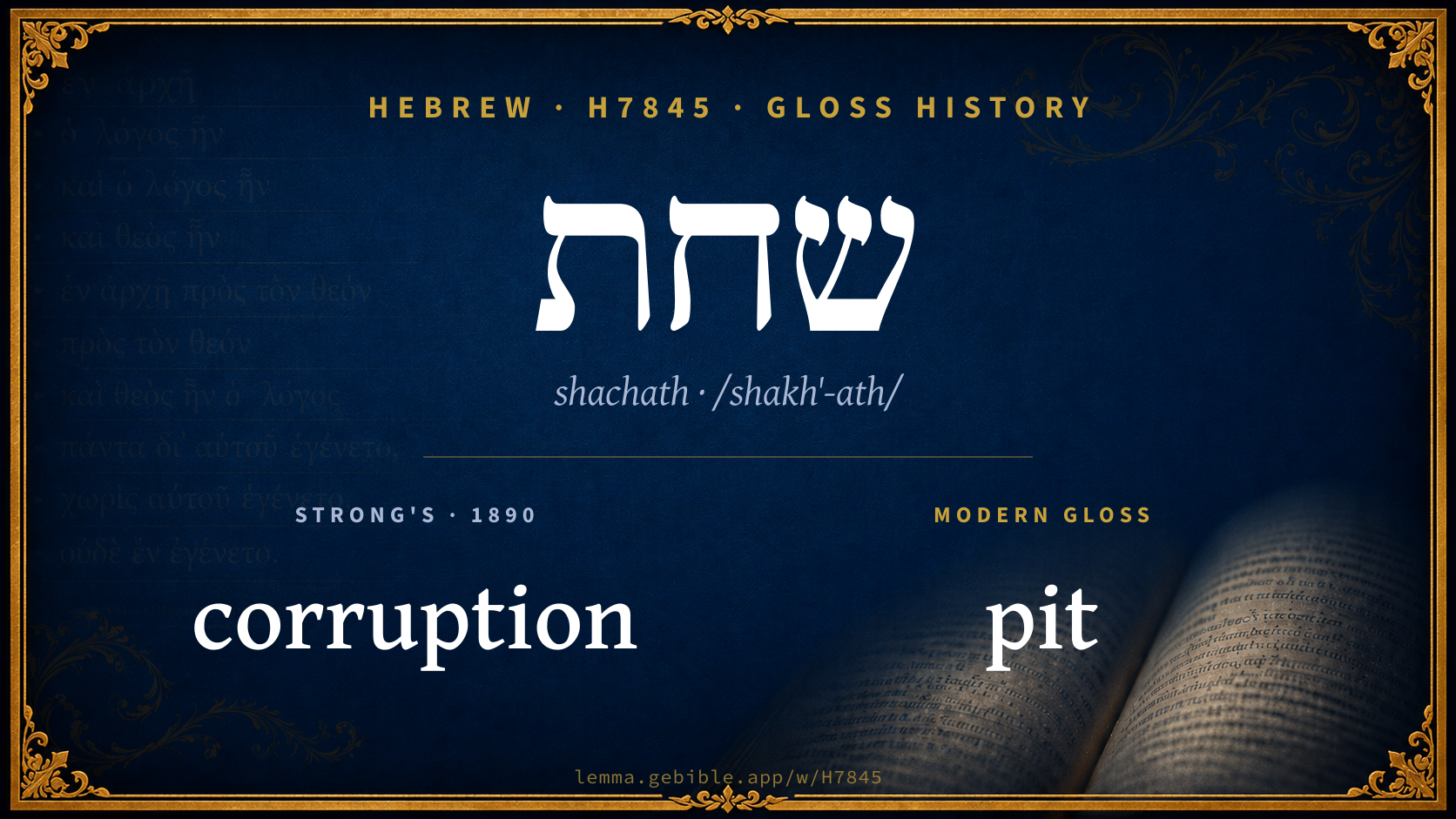
Gloss history
Strong's 1890 vs modern scholarship
About this word
Strong's H7845 catalogs a Hebrew word from the Hebrew Old Testament.
These counts are not copied from any lexicon or concordance. They are computed here, from the morphology-tagged Hebrew Old Testament. What Lemma adds →
- 23
- distinct verses
- The word appears in 23 distinct verses.
- 6 / 39
- OT books
- The word appears in 6 of 39 Old Testament books.
- #1,368
- by frequency
- Top 2500 most frequent Hebrew words (rank 1,368 of 8,640 Hebrew words by occurrence).
View all 23 occurrences in the concordance →
By section of the Old Testament
By traditional corpus
Conventional, traditional groupings — biblical authorship is debated, so this is a traditional corpus grouping, not an authorship claim. Each share is this word’s portion of its verses in that division of the Hebrew canon. Each figure is a share of the word’s 23 distinct verses.
- Writings (Ketuvim) 17 verses · 74%
- Prophets (Nevi'im) 6 verses · 26%
How translations render this word
Counts come from each version’s own published word-to-Strong’s tagging or interlinear alignment — an approximate guide to how each version renders this word, not a word-level alignment the data otherwise carries. Because each total is that version’s own tagged count, the per-version totals vary from one another and need not match the appearance or distinct-verse counts above. These counts may also differ from a printed concordance because Lemma counts each distinctly tagged rendering and does not collapse phrase taggings into a single head-word total. This is a fixed set of word-tagged versions (KJV, ASV, BSB, ULT) and does not change with the reading translation you choose elsewhere. Each version’s license is shown beside its name below (and on Sources).
- King James Version: Pit 12×, Corruption 4×, Destruction 2×
- American Standard Version: Pit 11×, Corruption 3×, Destruction 2×
- Berean Standard Bible: Pit 18×, Decay 2×
- unfoldingWord Literal Text: Pit 17×, Trap 2×
King James Version Public Domain
Renders H7845 across 23 tagged occurrences — most commonly:
Plus 3 renderings that appear only once — usually multi-word phrases or single function words the recovered tagging swept in, not distinct renderings.
American Standard Version Public Domain
Renders H7845 across 23 tagged occurrences — most commonly:
Plus 5 renderings that appear only once — usually multi-word phrases or single function words the recovered tagging swept in, not distinct renderings.
Berean Standard Bible Public Domain
Renders H7845 across 23 tagged occurrences — most commonly:
Plus 3 renderings that appear only once — usually multi-word phrases or single function words the recovered tagging swept in, not distinct renderings.
unfoldingWord Literal Text CC BY-SA 4.0
Renders H7845 across 23 tagged occurrences — most commonly:
Plus 4 renderings that appear only once — usually multi-word phrases or single function words the recovered tagging swept in, not distinct renderings.
Senses in the full BDB
What do BDB’s symbols mean?
BDB uses these scholarly abbreviations:
| Symbol | Meaning |
|---|---|
| 𝔊 | the Septuagint (the ancient Greek translation, LXX) |
| 𝔙 | the Vulgate (the Latin translation) |
| 𝔖 | the Syriac version (the Peshitta) |
| 𝔗 | the Targum (the Aramaic translation) |
| ψ | the Psalms |
| √ | root (the underlying root or stem) |
| ‖ | parallel passage (a synonymous or contrasted parallel) |
| † | the dagger: every passage where the word occurs is cited |
The 2 senses and sub-senses the full Brown-Driver-Briggs lexicon distinguishes for this word, in lexicon order (not ranked by frequency), with BDB’s own verbatim wording and sub-sense lettering. Shown in Hebrew script with BDB’s own scholarly abbreviations. The condensed entry is in the Lexicon Entry tab. See also the Forms in the corpus table below.
- 1. pit, for catching lion (in fig.) Ez 19:4, 8; fig. פעל שׁ׳ ψ 7:16; c. עשׂה 9:16; c. חפר 35:7 (transp. שׁ׳ to v b); c. כרה 94:13 Pr 26:27; + ψ 35:8b 𝔖 We (for שׁוֹאָה); טָבַל בּשׁ׳ Jb 9:31. e.g. Ezekiel 19:4
- 2. pit of She’ôl, ירד שׁ׳ Jb 33:24; ראה (ה)שׁ׳ ψ 16:10 (‖ שְׁאוֹל), 49:10; לשׁ׳, c. הוֹרִיד Ez 28:8, and ψ 55:24 (לִבְאֵר שׁ׳); קָרֵב Jb 33:22; יָמוּת Is 51:14; עָבַר בַּשּׁ׳ Jb 33:28; יָרַד אֶל־שׁ׳ ψ 30:10; מִשּׁ׳, c. חשׁק Is 38:17 (poem), c. חְשׂךְ Jb 33:18 (מִנִּי־); c. העלה Jon 2:7; c. הֵשִׁיב Jb 33:30 (מִנִּי־); c. גאל ψ 103:4; personif. Jb 17:14 (‖ רִמָּה).—שׁ׳ here either = שְׁאוֹל (hollow place, cavern), or שְׁאוֹל (cf., from Ezek. on, בּוֹר 5; also אֲבַדּוֹן, p. 2, and עִמְקֵי שְׁאוֹל Pr 9:18. This distinction of two parts of שְׁאוֹל became important in Jewish and Christian theology). e.g. Job 33:24
Senses from the full Brown-Driver-Briggs lexicon (Brown, Driver, Briggs; Oxford 1906 — public domain), digitized via Sefaria, supplemented by the OpenScriptures HebrewLexicon (CC BY 4.0). Full attribution on Sources.
Word origin
n.f. pit;—abs. שׁ׳ ψ 7:16 +; שָׁ֑חַת 16:10 +; cstr. שַׁ֫חַת Is 38:17 ψ 35:7; sf. שַׁחְתָּם Ez 19:4, 8 (+ שַׁחְתֹּה ψ 35:8b We);—
— Brown-Driver-Briggs (Oxford 1906, public domain), digitized via Sefaria, supplemented by the OpenScriptures HebrewLexicon (CC BY 4.0). See Sources.
Derived from שוח (shûwach) (H7743) — to sink down.
Jastrow Dictionary
A second Hebrew/Aramaic lexicon for comparison, covering Aramaic and post-biblical (Talmudic, Targumic, Midrashic) usage that the biblical-Hebrew BDB does not. Matched by lemma rather than by Strong’s number, so a lemma may carry more than one Jastrow headword (shown separately below), and the entries cover usage well beyond the Bible.
שָׁחַת
- (b. h.) to be low, bent.
- (cmp. חָבַל) to pervert, ruin, do harm. Ex. R. s. 8 ש׳ לנפשו he did harm to himself; a. e.—Ab. d. R. N. ch. I, end וירדו … לשַׁחֲתוֹ ed. Schechter (ed. לשרתו, corr. acc.) and the ministering angels came down to destroy him (Adam). Kidd. 24ᵇ (ref. to Ex. XXI, 26) עד שיתכוין לשַׁחְתָהּ when he intended to destroy it. Naz. 4ᵇ לשַׁחֵת, v. שֵׂעָר; a. e. e.g. Exodus 21:26
- 1. same. same. Ex. R. l. c. ה׳ לנפשו, v. supra. Tanḥ. Tol’d. 6 לילך … להַשְׁחִיתוֹ to go to Nabal to ruin him; a. fr.—Esp. בַּל תַּשְׁחִית (v. בַּל) the law forbidding to ruin anything wantonly (derived from Deut. XX, 19). Sabb. 129ᵃ והא קעבר מר משום בל ת׳ in doing so, do you not disregard the law which forbids wilful destruction? בל ת׳ דגופאי עדיף לי not to do injury to myself is a higher duty to me; ib. 140ᵇ; a. fr. e.g. Deuteronomy 20:19
- 2. to commit a nuisance. Y. Succ. V, 55ᶜ (play on משתחויתם, Ez. VIII, 16) [read:] שהיו משתחוים לחמה ומַשְׁחִיתִים להיכל they prostrated themselves in worship of the sun, and committed nuisance towards the Temple (v. Bab. Succ. 53ᵇ; Yoma 77ᵃ). e.g. Ezekiel 8:16
שְׁחַת
- ; part. pass. שְׁחִית mutilated. Targ. Y. Lev. XXII, 24 (h. text נתוק).
שַׁחַת I
- pit, grave. Pesik. R. s. 10 (ref. to Ps. LXXV, 8) זה שהשפיל לישראל לבאר ש׳ וכ׳ as zeh (Neh. IX, 18) brought Israel down to the lowest pit, so did zeh (Ex. XXX, 13) lift it up &c.; a. e. e.g. Psalms 75:8
שַׁחַת II
- (preced.) low growth, corn in its earliest stage used instead of grass. Peah II, 1 הקוצר לש׳ he who cuts young corn to be used as fodder; Tosef. ib. I, 8. Men. X, 8 (71ᵃ) קוצר לש׳ ומאכיל לבהמה (Bab. ed. מאכל, corr. acc.) one may cut barley as shaḥath and give it to the cattle (before the ʿOmer has been offered); Tosef. ib. X, 32 קוצר לש׳ עד שלא וכ׳ as to cutting barley for fodder: before it has approached maturity by one third, one may begin &c. Men. 71ᵇ כל לש׳ לא וכ׳ whatever is for fodder is not considered as harvesting. Sabb. XXIV, 2. Kidd. 62ᵇ; a. e.
A Dictionary of the Targumim, the Talmud Babli and Yerushalmi, and the Midrashic Literature (Marcus Jastrow; London, Luzac, 1903) — Public Domain. Digitized via Sefaria. Digitized via Sefaria. Full attribution on Sources.
Forms in the corpus
The 18 distinct written forms H7845 takes in the Hebrew Bible, most frequent first — each parse links to that state’s occurrences in the concordance. Hebrew forms include their vowel points and cantillation, so a single lemma takes many written forms.
Same root — word family
Other BDB entries built from the same root as H7845, grouped by Strong’s listed origin. These share a root / origin per the lexicon — not necessarily a shared meaning. Each links to that word’s own entry.
Derives from
Shares the same root
Proper names from this root
People and places named from this root — a name, not an additional meaning of the word.
Compare all same-root words → Showing 4 of 5 — not the complete family. 2 of the same-root words are proper names (people or places). They share a root, not necessarily a meaning.
Septuagint verse parallels
This word appears in 21 verses that also exist in the Greek Old Testament (Septuagint), out of the 23 Hebrew verses it occurs in. You can read those verses in Greek by switching the Old Testament edition to the Septuagint.
Read these verses in the Septuagint
This is a verse-level parallel only — the same verses exist in both the Hebrew and Greek Old Testaments. No word-level Hebrew↔Greek correspondence is claimed: the data carries no such alignment, so no Greek word is shown as this Hebrew word’s translation. Coverage is not total — the Septuagint omits the deuterocanon and renumbers the Psalms, so some Hebrew verses have no direct Greek parallel.